Settling the $Z_c(4600)$ in the charged charmonium-like family
Hua-Xing Chen, and Wei Chen

TL;DR
This paper investigates the recently observed $Z_c(4600)$ and related charged charmonium-like states, proposing they are radial excitations with similar quantum numbers, and suggests exploring more such relationships to understand exotic hadrons.
Contribution
It establishes a potential link between higher and lower charged charmonium-like states as radial excitations, offering a new perspective on their structure.
Findings
Higher states are likely radial excitations of lower states.
All states share the quantum numbers $J^{PC}=1^{+-}$.
Proposes further searches for relationships among exotic hadrons.
Abstract
Very recently LHCb reported the evidence of a new charged charmonium-like structure in the invariant mass spectrum near 4600 MeV. In this work we investigate this structure together with three other charged charmonium-like states, the , , and . Our results suggest that the two higher states can be established as the first radial excitations of the two lower ones, all of which have the quantum numbers . We propose to search for more relationship among exotic hadrons in order to better understand them.
Click any figure to enlarge with its caption.
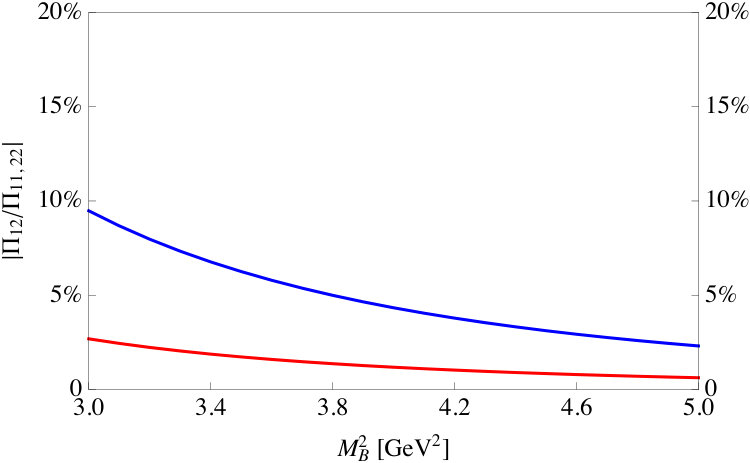 Figure 1
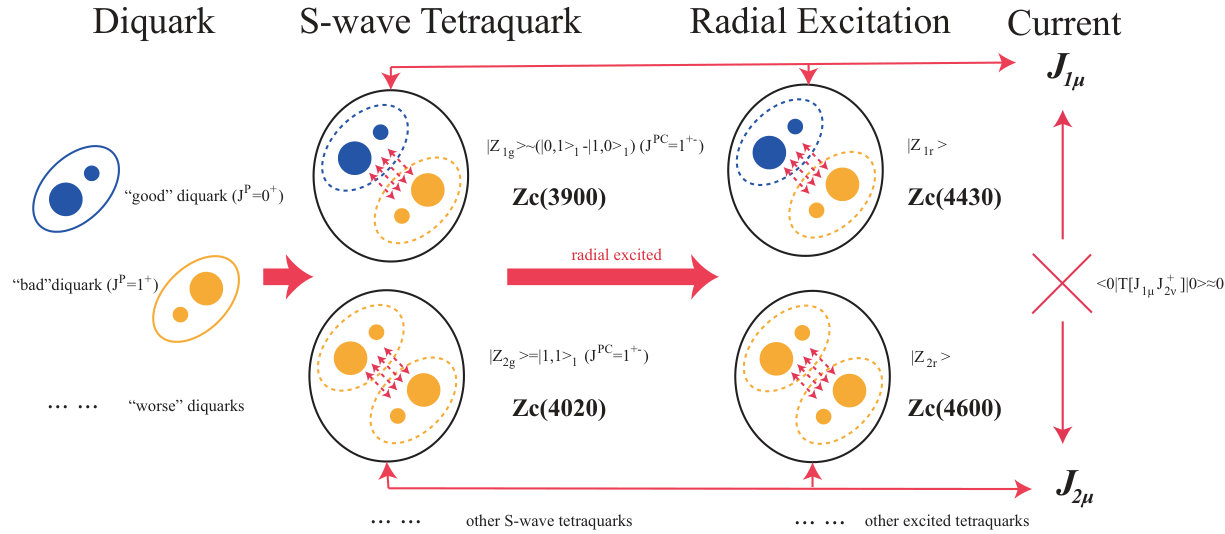 Figure 2
Peer Reviews
No public reviews on file for this paper yet. If you reviewed it on a platform where reviews are public (OpenReview, ICLR, NeurIPS, ICML), you can paste yours below so the community can read it here.
Videos
No videos yet. Explain this paper in a talk, walkthrough, or lecture? Add one.
Settling the in the charged charmonium-like family
Hua-Xing Chen1
Wei Chen2
1School of Physics, Beihang University, Beijing 100191, China
2School of Physics, Sun Yat-Sen University, Guangzhou 510275, China
Abstract
Very recently LHCb reported the evidence of a new charged charmonium-like structure in the invariant mass spectrum near 4600 MeV. In this work we investigate this structure together with three other charged charmonium-like states, the , , and . Our results suggest that the two higher states can be established as the first radial excitations of the two lower ones, all of which have the quantum numbers . We propose to search for more relationship among exotic hadrons in order to better understand them.
tetraquark, diquark, QCD sum rules
pacs:
12.39.Mk, 12.38.Lg, 12.40.Yx
Introduction. Since the discovery of the by the Belle Collaboration in 2003 Choi:2003ue , there have been tens of charmonium-like states observed in various particle experiments pdg , all of which are good multiquark candidates. Their relevant theoretical and experimental studies have significantly improved our understanding on the internal structure of (exotic) hadrons and the non-perturbative property of the strong interaction at the low energy region Chen:2016qju ; Klempt:2007cp ; Lebed:2016hpi ; Esposito:2016noz ; Guo:2017jvc ; Olsen:2017bmm . Some of these states are not isolated, e. g., the can decay radiatively to the Ablikim:2013dyn . These connections can give important hints on their properties. It is thus important to search for possible connections among different states, which shall shed light on our understanding of their underlying properties.
To date, the charged charmonium-like family already has at least five members: the Ablikim:2013mio ; Liu:2013dau , Ablikim:2013wzq ; Ablikim:2013emm , Aaij:2018bla , Chilikin:2014bkk , and Choi:2007wga ; Aaij:2014jqa , etc. Very recently, the evidence of another charged charmonium-like structure was reported by the LHCb Collaboration in the invariant mass spectrum near 4600 MeV, after performing an angular analysis of the decay Aaij:2019ipm . We temporarily denote it as . Actually, the Belle Collaboration has also studied the process in 2014 Chilikin:2014bkk , where they found the evidence for the , that is the effect of destructive interference in the mass spectrum near 4485 MeV, instead of a peaking structure near 4600 MeV. Hence, it is crucial to verify whether there exists the or not experimentally.
Recalling that one possible explanation of the is to interpret it as the first radial excitation of the Maiani:2007wz ; Maiani:2014aja ; Ebert:2008kb ; Nielsen:2014mva ; Wang:2014vha ; Agaev:2017tzv (see reviews Chen:2016qju ; Klempt:2007cp ; Lebed:2016hpi ; Esposito:2016noz ; Guo:2017jvc ; Olsen:2017bmm for more possible explanations), which seems to be reasonable because their mass difference is about 591 MeV, very close to the mass difference between the and . Accordingly, it is natural to consider the as the first radial excitation of some other state, such as the . Moreover, in the diquark model Maiani:2014aja there exist two -wave tetraquark states with , which can be used to explain the and . Therefore, it seems to exist a close relationship among the , , , and .
In this paper we study the together with the , , and . We first use the diquark model proposed in Ref. Maiani:2014aja to perform a phenomenological analysis, and then apply the method of QCD sum rules Shifman:1978bx ; Reinders:1984sr to study their relationship. The results obtained from these two approaches both suggest the following explanations to be possible, as illustrated in Fig. 1: a) the and are the first radial excitations of the and , respectively; b) all of them are composed of -wave charmed diquarks and antidiquarks; c) all of them have the quantum numbers (for neutral charge states). Since we have studied them as a whole, several assumptions/predictions are used/made at the same time, and we propose the experimentalists to: a) verify whether the exists or not, b) determine its quantum numbers as well as those of the , c) search for their partner states with different quark contents. Especially, both theoretical and experimental studies on the relationship of exotic hadrons are intriguing research topics.
Phenomenological analyses within the diquark model. Firstly, let us phenomenologically estimate the masses of the , , , and , assuming that they are composed of one charmed diquark () and one charmed antidiquark (). To do this we use the “type-II” diquark-antidiquark model proposed in Ref. Maiani:2014aja , and we refer to Refs. Maiani:2014aja ; Maiani:2004vq ; Ali:2017wsf ; Maiani:2017kyi for its detailed discussions. In this model, the -wave tetraquarks can be written in the spin basis as , where and are the charmed diquark and antidiquark spins, respectively.
There are two -wave diquarks: the “good” diquark with and the “bad” diquark with (other diquarks are “worse”) Jaffe:2004ph , so can be either 0 or 1. Consequently, there are altogether seven -wave tetraquark states, denotes as :
[TABLE]
Especially, there are two tetraquark states with : and . Note that the notation is used in Ref. Maiani:2014aja , while is used in this paper for convenience. In the “type-II” diquark-antidiquark model, their masses can be evaluated through Maiani:2014aja
[TABLE]
where is the effective charmed diquark mass, and are the quark and antiquark spins. According to this mass formula:
Identifying and , we can use the experimental masses of the and to obtain
[TABLE] 2. 2.
With the above diquark mass, we can use the Cornell potential for charmonia Eichten:1978tg ; Eichten:1979ms ; Ikhdair:2003ry ; Chen:2015dig
[TABLE]
to roughly estimate the radial excitation energy between charmed diquark and antiquark to be about 581 MeV.
Accordingly, the masses of the first radial excitations of the and are about 4467 MeV and 4605 MeV, respectively. These two values are well consistent with the experimental masses of the and , suggesting that the latter two can be interpreted as the first radial excitations of the former two. Again, we refer to Fig. 1 for an illustration of this picture.
Constructions of tetraquark interpolating currents. In the following we shall use the method of QCD sum rules Shifman:1978bx ; Reinders:1984sr to investigate the above interpretations. Similar to the above non-relativistic case, there are two -wave diquark fields:
[TABLE]
where are color indices. We can combine them to construct the tetraquark current corresponding to :
[TABLE]
We need to use the tensor diquark field to construct another tetraquark current with
[TABLE]
In principle, the tensor diquark field can couple to both and channels. However, its positive-parity component () gives the dominant contribution to . Hence, the tetraquark interpolating current with corresponds to .
The tetraquark currents and have been used in Ref. Chen:2010ze to perform QCD sum rule analyses, and the masses extracted are about MeV and MeV, respectively. These two values are slightly larger than the experimental masses of the and . Such results may imply that and can couple to both the ground-state tetraquarks as well as their radial excitations. In the present study we shall consider both the contributions of ground states and their radial excitations.
QCD sum rule analyses at the quark-gluon level. Since the relation between physical states and their relevant interpolating currents is complicated, for example, it is possible that couples to both the and as well as their radial excitations, we need to study and themselves as well as their mixing in order to achieve a more reliable analysis, given that we do not know how to evaluate the mixing between the and theoretically. We refer to Refs. Chen:2018kuu ; Cui:2019roq for detailed discussions.
We investigate both the diagonal and off-diagonal correlation functions ():
[TABLE]
In QCD sum rule studies we express in the form of the dispersion relation with spectral functions :
[TABLE]
which can be further transformed into
[TABLE]
by using the Borel transformation. Here is the Borel mass.
At the quark and gluon level, we can calculate using the method of operator product expansion (OPE). In the present study we have done this up to dimension eight condensates. The diagonal spectral densities and have been calculated and given in Ref. Chen:2010ze , and the off-diagonal spectral density is
[TABLE]
where is a step function and
[TABLE]
To perform numerical analyses, we use the values listed in Ref. Chen:2010ze for the charm quark mass and various condensates (see also Refs. pdg ; Yang:1993bp ; Narison:2002pw ; Gimenez:2005nt ; Jamin:2002ev ; Ioffe:2002be ; Ovchinnikov:1988gk ; Ellis:1996xc ). We show in Fig. 2 as a function of the Borel mass , compared with and . It shows that and only weakly correlate to each other, and thus can not strongly couple to the same physical state.
QCD sum rule analyses at the hadron level. In the present study we assume that couples to both the ground-state tetraquark and its first radial excitation :
[TABLE]
while couples to other states. After inserting Eqs. (12) into the two-point correlation function (Settling the in the charged charmonium-like family), we obtain its expression at the hadron level:
[TABLE]
where denote the contribution from other higher states (the continuum); and are the masses of and , respectively. Again, we perform the Borel transformation to Eq. (13) and obtain
[TABLE]
One important assumption in the QCD sum rule approach is the quark-hadron duality, which ensures the equivalence of the correlation functions obtained at the quark-gluon level and the hadron level. Accordingly, we assume the contribution from the continuum states can be approximated well by the OPE spectral density above a threshold value , and obtain
[TABLE]
where we have used the notation
[TABLE]
To extract and , one can differentiate Eq. (Settling the in the charged charmonium-like family) with respect to up to three times Wang:2014vha :
[TABLE]
The unknown parameters , , , and can be obtained by solving the above three equations together with Eq. (Settling the in the charged charmonium-like family). Focusing on the hadron masses, both and can satisfy the following equation
[TABLE]
where
[TABLE]
After carefully investigating a) the OPE convergence, b) the pole contribution, and c) the mass dependence on the two free parameters and , we obtain reliable QCD sum rule results in the regions GeV GeV2 and GeV GeV2, where the hadron masses are extracted to be
[TABLE]
Here the central values correspond to GeV2 and GeV2, and the uncertainties are due to the Borel mass , the threshold value , and various QCD condensates. These two mass values are consistent with the experimental masses of the and .
Similarly, we assume that couples to another ground-state tetraquark as well as its first radial excitation :
[TABLE]
whose masses are extracted to be
[TABLE]
Here the central values correspond to GeV2 and GeV2. These two mass values are in good agreement with the experimental masses of the and . Our investigations can support the picture illustrated in Fig. 1 that the and can be well interpreted as the first radial excitations of the and , respectively, consistent with the phenomenological analyses within the diquark model Maiani:2014aja .
Summary and Discussions. Very recently, the LHCb Collaboration reported the evidence of a new charged charmonium-like structure in the invariant mass spectrum near 4600 MeV Aaij:2019ipm . In this work we investigate it together with three other charged charmonium-like structures, the , , and . We first estimate their masses within the diquark model proposed in Ref. Maiani:2014aja , and then study them using the method of QCD sum rules. Especially, in sum rule analyses we have used two weakly correlated interpolating currents, and , which independently couple to different tetraquark states. The results from both two approaches suggest the following possible explanations, as illustrated in Fig. 1:
- •
The and are -wave tetraquark states with . The contains one “good” diquark with and one “bad” diquark with , while the contains two “bad” diquarks with .
- •
The and are the first radial excitations of the and , respectively. They also have the quantum numbers .
Note that there are many other possible explanations for the , , and , and we refer interested readers to Refs. Chen:2016qju ; Klempt:2007cp ; Lebed:2016hpi ; Esposito:2016noz ; Guo:2017jvc ; Olsen:2017bmm for more discussions.
In the present study we have studied the , , , and as a whole, and used/made several assumptions/predictions at the same time. To verify these assumptions/predictions, we propose the experimentalists to: a) further study the structure observed in the mass spectrum near 4600 MeV to verify whether there exists a genuine charged charmonium-like state, b) determine its quantum numbers as well as those of the , and c) search for their partner states with the quark contents and , etc. Especially, we propose to establish more connections among exotic hadrons in order to better understand them. Both theoretical and experimental studies on this topic are intriguing, which can further improve our understanding on the internal structure of (exotic) hadrons and the non-perturbative property of the strong interaction at the low energy region.
Acknowledgments
We thank Prof. Luciano Maiani and Prof. Shi-Lin Zhu for useful discussions. This project is supported by the National Natural Science Foundation of China under Grants No. 11722540, the Fundamental Research Funds for the Central Universities, and the Chinese National Youth Thousand Talents Program.
The reference list from the paper itself. Each links out to its DOI / PubMed record.
- 1(1) S. K. Choi et al. [Belle Collaboration], Phys. Rev. Lett. 91 , 262001 (2003) . · doi ↗
- 2(2) M. Tanabashi et al. [Particle Data Group], Phys. Rev. D 98 , 030001 (2018) . · doi ↗
- 3(3) H. X. Chen, W. Chen, X. Liu, and S. L. Zhu, Phys. Rept. 639 , 1 (2016) . · doi ↗
- 4(4) E. Klempt and A. Zaitsev, Phys. Rept. 454 , 1 (2007) . · doi ↗
- 5(5) R. F. Lebed, R. E. Mitchell, and E. S. Swanson, Prog. Part. Nucl. Phys. 93 , 143 (2017) . · doi ↗
- 6(6) A. Esposito, A. Pilloni, and A. D. Polosa, Phys. Rept. 668 , 1 (2016) . · doi ↗
- 7(7) F. K. Guo, C. Hanhart, U. G. Meissner, Q. Wang, Q. Zhao, and B. S. Zou, Rev. Mod. Phys. 90 , 015004 (2018) . · doi ↗
- 8(8) S. L. Olsen, T. Skwarnicki, and D. Zieminska, Rev. Mod. Phys. 90 , 015003 (2018) . · doi ↗