A construction of UD $k$-ary multi-user codes from $(2^m(k-1)+1)$-ary codes for MAAC
SHAN Lu, Wei Hou, Jun Cheng, and Hiroshi Kamabe

TL;DR
This paper presents a recursive construction method for multi-user codes in the MAAC setting, utilizing higher-ary codes to improve overall rate efficiency.
Contribution
It introduces a novel recursive construction of UD $k$-ary multi-user codes from $(2^m(k-1)+1)$-ary codes, enhancing code rate performance.
Findings
Constructed $k$-ary $T$-user UD codes from difference sets.
Recursive method increases code rate compared to conventional codes.
Higher-ary codes lead to improved total rate of the code set.
Abstract
In this paper, we proposed a construction of a UD -ary -user coding scheme for MAAC. We first give a construction of -ary -user UD code from a -ary -user UD code and a -ary -user difference set with its two component sets and {\em a priori}. Based on the -ary -user difference set constructed from a -ary UD code, we recursively construct a UD -ary -user codes with code length of from initial multi-user codes of -ary, -ary, \dots, -ary. Introducing multi-user codes with higer-ary makes the total rate of generated code higher than that of conventional code.
Click any figure to enlarge with its caption.
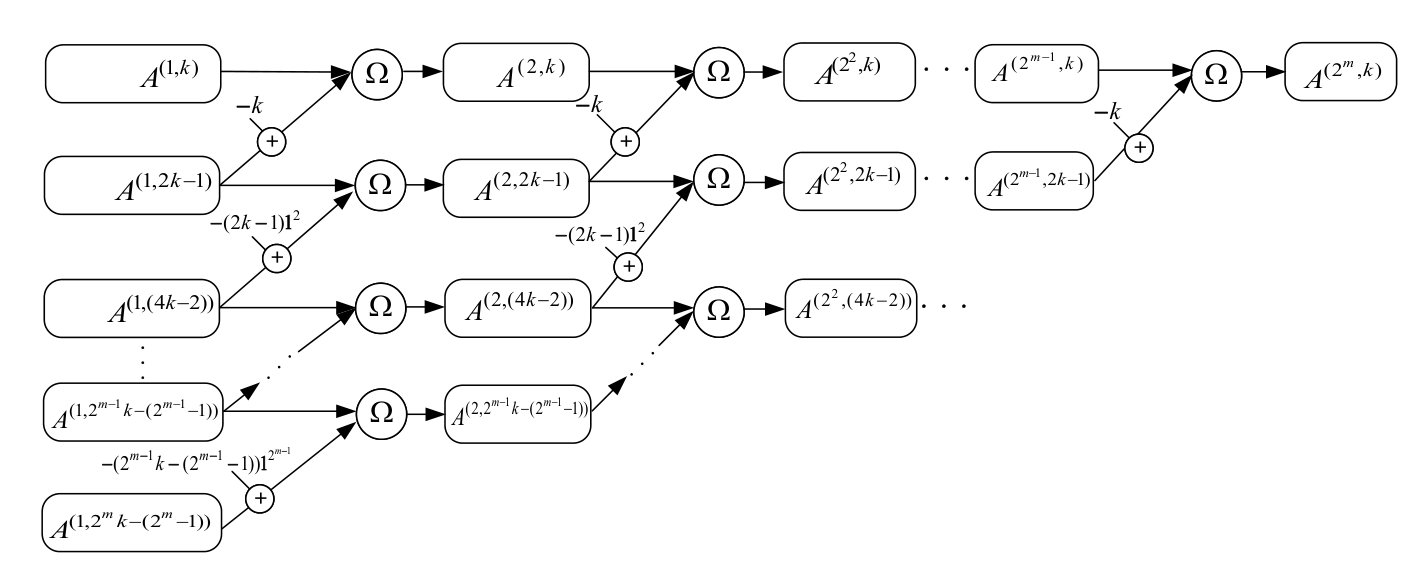 Figure 1
| numbers | : code in Corollary | : the code in [13] | ||
|---|---|---|---|---|
| of | code | total rates | code | total rates |
| users | lengths | (b/c) | lengths | (b/cu) |
| 8 | 4 | 2.000+ | 3 | 1.666+ |
| 14 | 7 | 2.286+ | 5 | 2.000+ |
| 20 | 10 | 2.500+ | 7 | 2.286+ |
| 26 | 13 | 2.692+ | 9 | 2.444+ |
| 32 | 16 | 3.000+ | 11 | 2.545+ |
Peer Reviews
No public reviews on file for this paper yet. If you reviewed it on a platform where reviews are public (OpenReview, ICLR, NeurIPS, ICML), you can paste yours below so the community can read it here.
Videos
No videos yet. Explain this paper in a talk, walkthrough, or lecture? Add one.
Taxonomy
TopicsCooperative Communication and Network Coding · Coding theory and cryptography · Wireless Communication Security Techniques
A construction of UD -ary multi-user codes from -ary codes for MAAC
Shan Lu1, Wei Hou2, Jun Cheng3, and Hiroshi Kamabe1
1Department of Electrical, Electronic, and Computer Engineering, Gifu University, Gifu, 501-1193 Japan
2The State Key Laboratory of ISN, Xidian University, Xi’an, 710071, China
3Department of Intelligent Information Engineering and Sciences, Doshisha University, Kyoto, 610-0321 Japan
Abstract
In this paper, we proposed a construction of a UD -ary -user coding scheme for MAAC. We first give a construction of -ary -user UD code from a -ary -user UD code and a -ary -user difference set with its two component sets and a priori. Based on the -ary -user difference set constructed from a -ary UD code, we recursively construct a UD -ary -user codes with code length of from initial multi-user codes of -ary, -ary, …, -ary. Introducing multi-user codes with higer-ary makes the total rate of generated code higher than that of conventional code.
I Introduction
In a multiple access communication system, independent sources transmit data over a common channel. A central problem in multi-user coding for the multiple-access communications system is to assign constituent codes () to senders so that they can communicate simultaneously with a common receiver through a multiple-access adder channel(MAAC), even in the presence of noise. The collection of constituent codes is the -user -ary code, denoted by .
The -user -ary code is said to be *uniquely decodable * (UD) if all sums consisting of one codeword from each constitute code are distinct. Most extensively investigated UD multiuser codes for the MAAC are binary [1] [2] [3] [4]. Lindström, Martirosyan, and Khachatryan gave the multiuser UD codes, where each constituent code consists of only two codewords, one of them being zero [1] [2]. Chang and Weldon’s construction also focused on the symmetric case of each constituent code with two codewords [3].
By distributing those codewords of [2] or [3] among as few users as possible, affine multiuser codes are proposed[4] [5] to achieve higher total rate for a fixed number of users. Each constituent code Hughes and Cooper’s code [4] consist of codewords and Martirosyan’s code [5] is free of that constraints and achieves the higher total rate for a fixed number of users than those of [2] [3].
Multiuser -ary () UD codes was originally studied by Jevtić [6] and was then generalized to the case of arbitrary code length in [7]. By extension of Hughes and Cooper’s idea [4] to -ary, a mixed-rate multiuser -ary code was given in [10] and achieves the higher total rate for a fixed number of users than that of [6] [7].
On the other hand, error-correcting multi-user codes are also studied for noisy MAAC [3][8][9][11]. They usually construct the error-correcting codes from the UD codes.
In this paper, we proposed a construction of a UD -ary -user coding scheme for MAAC. We first give a construction of -ary -user UD code from a -ary -user UD code and a -ary -user difference set with its two component sets and a priori. Based on the -ary -user difference set constructed from a -ary UD code, we recursively construct a UD -ary -user codes with code length of from initial multi-user codes of -ary, -ary, …, -ary. Introducing multi-user codes with higer-ary makes the total rate of generated code higher than that of conventional code.
II Preliminary
II-A -user -ary MAAC
Let for a given positive integer not less than . Denote the th user’s input, the output of the noiseless MAAC at each time epoch is given by
[TABLE]
where summation is over the real numbers. Clearly, each output symbol of the channel is an integer from set . Symbol and block synchronization are assumed and all of the users are always active.
A noisy MAAC is regarded as a noiseless MAAC cascaded with a discrete memoryless channel [3]. The discrete memoryless channel is -ary-input and -ary-output, and is completely described by transition probabilities for all the possible input-output pairs , .
II-B -user code
Let be a -user -ary code for MAAC composed of constituent codes , . The rate of is , where is the cardinality of . The total rate of is .
The weight of an integer -vector (a row vector with length ) is defined as , where summation is over the real numbers. The distance between two vectors and is defined as , where the minus sign “” denotes componentwise real-number subtraction.
Definition 1
[3]** For any positive integer , a -user -ary code over with code length is -decodable, if for any two distinct -ary -vectors and , ,
[TABLE]
A -user -decodable -ary code with code length is referred to as an -code. A -decodable code is capable of correcting or fewer errors [3], where is the greatest integer less than or equal to . On the other hand, the -decodable code is used for detecting or fewer errors.
An -code is said to be uniquely decodable (UD), and is used for the noiseless MAAC such that the decoder is able to uniquely resolve any possible received word into the transmitted codewords, one from each of the users.
Lemma 1
A -user -ary code is UD, if for any two -ary -vectors and , ,
[TABLE]
implies
[TABLE]
II-C -subset difference set
Let . Denoted by an code with . Given vector \mbox{\boldmathd}_{j}\in(\mathcal{K}^{\pm})^{n}, we obtain two vectors \mbox{\boldmathd}_{j}^{+} and \mbox{\boldmathd}_{j}^{-}\in\mathcal{K}^{n} in the following manner. Let be the th element in \mbox{\boldmathd}_{j}, and , be the th element in \mbox{\boldmathd}^{+}_{j}, \mbox{\boldmathd}_{j}^{-}, respectively. We can always put
[TABLE]
Let
[TABLE]
We obtain and . Note that both of sets are over .
Since \mbox{\boldmathd}_{j}=\mbox{\boldmathd}_{j}^{+}-\mbox{\boldmathd}_{j}^{-}, for convenience we refer to the -code as -subset -decodable difference set over , denoted by . Except for the domain of the set, the definition of -subset difference set is almost same as that in Definition 1. In this paper, we focus on the code over . To avoid confusion, we call as a set over , not a code. The difference set over plays an important role in our coding scheme.
III Uniquely Decodable Multi-User Codes
III-A -User UD Code
First, we give a construction of -user UD code from a -user UD code and a -user difference set.
Let and be nonnegtive integers. Without loss of generality, we assume . Let
[TABLE]
be -code, and
[TABLE]
be -difference set, respectively. When and are given a priori, a -user code
[TABLE]
is made as follows:
[TABLE]
The notations in the above equations are defined as follows:
- 1
{\mbox{\boldmatha}}^{(g)} is the first components of vector , and \mbox{\boldmatha}^{\langle f-g\rangle} is the last components of , i.e., \mbox{\boldmatha}=(\mbox{\boldmatha}^{(g)},\ \mbox{\boldmatha}^{\langle f-g\rangle}).
- 2
\mbox{\boldmathd}^{+[f]} is an -vector whose first components are the vector \mbox{\boldmathd}^{+}, and whose last components are , i.e., \mbox{\boldmathd}^{+[f]}=(\mbox{\boldmathd}^{+},\ {\bm{0}}^{f-g}).
Theorem 1
If the -ary code and the difference set over are UD, then of (8) is a -code.
Proof: Clearly, has code length , and is -ary. The number of users in are .
Let us prove that is UD. Let
[TABLE]
By Lemma 1, we will show that
[TABLE]
implies
[TABLE]
We have that
[TABLE]
with
[TABLE]
Restricting the -vector \mbox{\boldmaths}_{1} of (13) to its first components, we have
[TABLE]
Thus
[TABLE]
By assumption of (9), it holds
[TABLE]
Then we have that
[TABLE]
Since is UD by assumption, Lemma 1 implies
[TABLE]
Thus
[TABLE]
From (13) we have
[TABLE]
for which it similarly follows that
[TABLE]
That is
[TABLE]
The proof of this lemma is completed.
By our notation, the number of users of is represented by , since its code length is . Thus, the relationship between , and is
[TABLE]
The total rate of code is
[TABLE]
where and .
Note that when , set is empty set. In this case, .
III-B UD Code with Code Length
Based on the construction of (8), we give a recursive construction of -ary multiuser code with code length of .
For any positive integers and , let
[TABLE]
where Code is recursively constructed as follows.
For step , the initial codes are defined as
[TABLE]
Successively for steps , using operation defined in (8), we have
[TABLE]
Therefore, from equation (22), we can obtain at step . Fig. 1 shows the recursive construction procedure to get code . From the initial 2-user code , , by steps recursion, the code is obtained.
Theorem 2
Given positive integers and , multi-user code is an -code with the number of users and the total rate as
[TABLE]
Proof: Let be the number of users of code for all . First, we want to show
[TABLE]
All the initial codes of (III-B) have two users, i.e.,
[TABLE]
From (18), we have
[TABLE]
When and , it follows that
[TABLE]
This verifies (25).
Next, let’s show sum rate of (24). For compact notation, let be the sum rate of code . From Theorem 1 and (19), we have
[TABLE]
By recursion, we have
[TABLE]
When and , it follows that
[TABLE]
where
[TABLE]
Finally, we have
[TABLE]
Therefore we verify (24).
Finally, we show code is UD by recursion. The initial 2-user code , , of (III-B) is UD. Assume that , , is UD. Thus set (see (22)) is UD. By Theorem 1, code is UD. This confirms is UD, and completes the proof.
Remark 1
Note that equations of (23) and (24) are the number of users and the total code of -ary UD codes with . When , viewed as a specific case \mathcal{D}=\left[\begin{array}[]{c}2\mathcal{A}\\ I\end{array}\right]. The number of users and total rate become
[TABLE]
They are as same as that of the code of Construction 2 of [4], Hughes and Cooper give a construction of binary() multi-user code.
Remark 2
The construction of (8) have a similar architecture as that the construction of in [13]. The equation of in [13] can be viewed as a specific case of that \mathcal{D}=\left[\begin{array}[]{c}2\mathcal{A}\\ I\end{array}\right].
Example 1
In this example, we give the recursive construction of .
For , the codes are used to be initialized. When , it follows and {\mbox{\boldmatha}}_{0}=(2^{0}). Using equation (III-B), we have the ternary code
[TABLE]
Similarly, we have the -ary code
[TABLE]
and the -ary code
[TABLE]
Successively, at step , we construct code
[TABLE]
with constituent codes
[TABLE]
and
[TABLE]
with constituent codes
[TABLE]
At step , we obtain the code
[TABLE]
with constituent codes
[TABLE]
The total rate of code is
III-C UD Code with Arbitray Length
This section gives a -user UD -ary code with an arbitrary code length based on Theorem 1 and Theorem 2.
To give a -user UD -ary code, some notations are needed. An arbitrary positive integer is represented as the binary form
[TABLE]
where
[TABLE]
Using the binary form of , put
[TABLE]
Then,
[TABLE]
Especially, when ,
[TABLE]
Moreover, let
[TABLE]
We are ready to give a -user UD code . For an arbitrary positive integer , when codes () of (III-B) and (22) are given a priori, a -user UD code is constructed as follows:
For , the code is initially defined by
[TABLE]
where is given in (III-B).
Successively for , a code is constructed from and by recursion
[TABLE]
where is given in (8).
Finally, due to (31), put
[TABLE]
In (40), is defined in (8) with and . Note that .
The number of users and the total rate of are
[TABLE]
The derivations of (42) and (43) are shown in Appendix Acknowledgement.
Theorem 3
The -user code of (41) is UD.
*Proof *: The theorem is proved by induction.
Let us observe of (35). When , is the empty set. When , is UD.
Prove that if is UD, then is UD. According to (40), two cases must be considered:
Case 1: , it holds
[TABLE]
where \mathcal{D}^{(g_{j-1},\pm\tilde{k}_{j-1})}\stackrel{{\scriptstyle{\scriptscriptstyle{\bigtriangleup}}}}{{=}}\mathcal{A}^{(g_{j-1},\tilde{k}_{j-1})}-(\tilde{k}_{j-1}-1)\mbox{\boldmath1}^{g_{j-1}} (see (40)). Since is UD over , is UD over . It follows from Theorem 1 that is UD, since is UD.
Case 2: , it holds . It is obvious that is UD.
Therefore, is UD. This completes the proof of this theorem. The derivations of (42) and (43) are shown in Appendix Acknowledgement.
Remark 3
Table I gives a numerical comparison of code parameters between codes of (41) and [13]. Although both codes have arbitrary code length, we compare their total rates for a fixed number of users. The proposed codes have the higher code rate and shorter code length than those of previous codes [13] for a fixed number of users.
Example 2
In this example, we give the recursive construction of code with code length .
The binary form of is .
For , , the code is initially defined by as shown in Example 1.
For , ,
[TABLE]
with constituent codes as
[TABLE]
For , ,
[TABLE]
with constituent codes as
[TABLE]
The code rate is bits/channel use.
IV Conclusions
We proposed a construction of a UD -ary -user coding scheme for MAAC. We first give a construction of -ary -user UD code from a -ary -user UD code and a -ary -user difference set with its two component sets and a priori. Based on the -ary -user difference set constructed from a -ary UD code, we recursively construct a UD -ary -user codes with code length of from initial multi-user codes of -ary, -ary, …, -ary. Introducing multi-user codes with higer-ary makes the total rate of generated code higher than that of conventional code.
Using the UD -ary code proposed in this paper, applying the construction in [14], error-correcting multi-user codes with higher total rate can also be constructed.
Acknowledgement
This work was supported in part by JSPS KAKENHI Grant Number16K06373, 18K04132 and 18H0113325, in part by MEXT through the Strategic Research Foundation at Private Universities under Grant S1411030, and in part by the Fundamental Research Funds for the Central Universities of China (XJS17111).
[Derivations of in (42) and in (43)]
We first show (42). The number of users in is counted according to the recursive procedure of (40). From (18) and (30), for , it follows
[TABLE]
Moreover, from (44) and (30), we have
[TABLE]
Substituting (25)into (45), we obtain
[TABLE]
which verifies (42).
Second, we verify (43). From (29) and (19), it follows that
[TABLE]
Moreover, from (31) we have
[TABLE]
Since , it follows that
[TABLE]
Then we verify (43).
The reference list from the paper itself. Each links out to its DOI / PubMed record.
- 1[1] B. Lindström, “Determining subsets by unramified experiments,” in A Survey of statistical Design and Linear Models, J. N. Srivastava, ed. North-Holland, New York, 1975.
- 2[2] S. S. Martirosyan and G. G. Khachatryan, “Construction of signature codes and the coin weighing problem,” Probl. Inform. Transm. , vol. 25, pp. 334-335, Oct.-Dec. 1989.
- 3[3] S. C. Chang and E. J. Weldon, Jr, “Coding for T 𝑇 T -user multiple-access channels,” IEEE Trans. Inform. Theory , vol. IT-25, no. 6, pp. 684–691, Nov. 1979.
- 4[4] B. L. Hughes and A. B. Cooper III, “Nearly optimal multiuser codes for the binary adder channel,” IEEE Trans. Inform. Theory , vol. IT-42, no. 2, pp. 387–398, March 1996.
- 5[5] G. K. Khachatrian and S. S. Martirossian, “Code construction for the T 𝑇 T -user noiseless adder channel,” IEEE Trans. Inform. Theory , vol. IT-44, no. 5, pp. 1953-1957, Sept. 1998.
- 6[6] D. Jevtić, “On families of sets of integral vectors whose representatives form sum-distinct sets,” SIAM J. Discrete Math. , vol. 8, no. 4, pp. 652-660, Nov. 1995.
- 7[7] J. Cheng and Y. Watanabe, “ T 𝑇 T -user code with arbitrary code length for multiple-access adder channel,” IEICE Trans. Fundamentals , vol. E 82-A, no. 10, pp. 2011–2016, Oct. 1999.
- 8[8] J. H. Wilson, “Error-correcting codes for a T 𝑇 T -user binary adder channel,” IEEE Trans. Inform. Theory , vol. IT-34, no. 4, pp. 888-890, July 1988.