Non-freeness of groups generated by two parabolic elements with small rational parameters
Sang-hyun Kim, Thomas Koberda

TL;DR
This paper investigates when groups generated by two specific parabolic matrices with rational parameters are non-free, providing computational criteria and density results, supported by computer-assisted proofs and Mathematica code.
Contribution
It introduces a robust computational criterion for non-freeness of these groups and establishes density and sequence results for various rational parameters.
Findings
Groups are non-free for all rational parameters with numerator |s| ≤ 27, except possibly s=24.
For s=24, the set of denominators r making the group non-free has natural density 1.
For fixed s, there exist arbitrarily long sequences of denominators r where the group is non-free.
Abstract
Let , let \[a=\begin{pmatrix} 1&0\\1&1\end{pmatrix},\quad b_q=\begin{pmatrix} 1&q\\0&1\end{pmatrix},\] and let be the group generated by and . In this paper, we study the problem of determining when the group is not free for rational. We give a robust computational criterion which allows us to prove that if for then is non-free, with the possible exception of . In this latter case, we prove that the set of denominators for which is non-free has natural density . For a general numerator , we prove that the lower density of denominators for which is non-free has a lower bound \[ 1- \left(1-\frac{11}{s}\right) \prod_{n=1}^\infty \left(1-\frac{4}{s^{2^n-1}}\right). \] Finally, we show that for a fixed , there are…
Click any figure to enlarge with its caption.
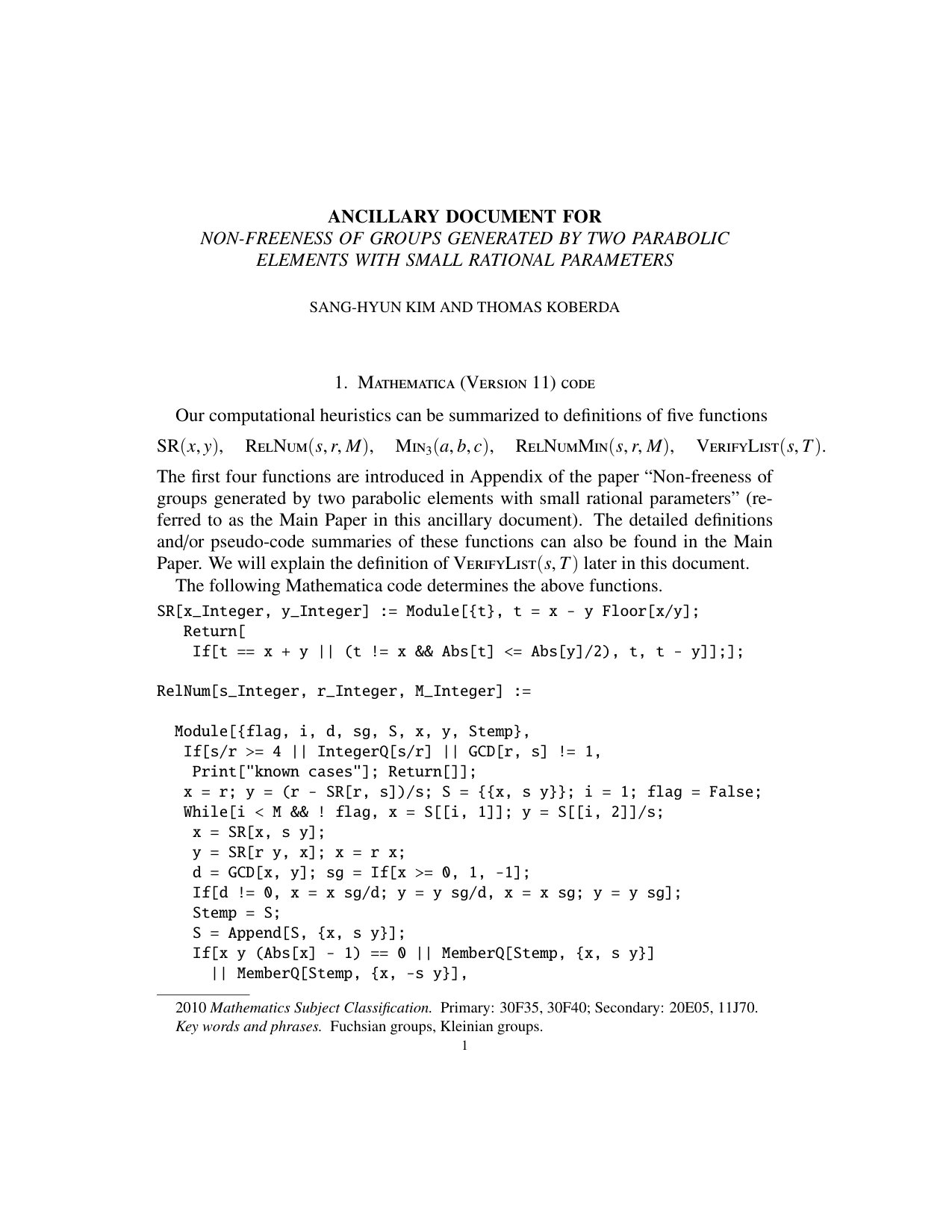 Figure 1
| 0 | 1 | 1,33,-31 | 33 | 4 | 0 | -15,17,-47 | -15 |
|---|---|---|---|---|---|---|---|
| 1 | -1 | 11,53,-21 | -21 | 5 | 1 | -5,27,-37 | 27 |
| 2 | -1 | -7,25,-39 | -39 | 6 | 0 | 9,41,-23 | 9 |
| 3 | -1 | -13,19,-45 | -45 | 7 | 0 | 3,35,-29 | 3 |
Peer Reviews
No public reviews on file for this paper yet. If you reviewed it on a platform where reviews are public (OpenReview, ICLR, NeurIPS, ICML), you can paste yours below so the community can read it here.
Videos
No videos yet. Explain this paper in a talk, walkthrough, or lecture? Add one.
Non-freeness of groups generated by two parabolic elements with small rational parameters
Sang-hyun Kim
School of Mathematics, Korea Institute for Advanced Study (KIAS), Seoul, 02455, Korea
[email protected] http://cayley.kr and
Thomas Koberda
Department of Mathematics, University of Virginia, Charlottesville, VA 22904-4137, USA
[email protected] http://faculty.virginia.edu/Koberda
Abstract.
Let , let
[TABLE]
and let be the group generated by and . In this paper, we study the problem of determining when the group is not free for rational. We give a robust computational criterion which allows us to prove that if for then is non-free, with the possible exception of . In this latter case, we prove that the set of denominators for which is non-free has natural density . For a general numerator , we prove that the lower density of denominators for which is non-free has a lower bound
[TABLE]
Finally, we show that for a fixed , there are arbitrarily long sequences of consecutive denominators such that is non-free. The proofs of some of the results are computer assisted, and Mathematica code has been provided together with suitable documentation.
Key words and phrases:
Fuchsian groups, Kleinian groups, Schottky groups, Möbius groups
2010 Mathematics Subject Classification:
Primary: 30F35, 30F40; Secondary: 20E05, 11J70
1. Introduction
For each , let us write
[TABLE]
and write for the subgroup of generated by and .
The group is not cyclic unless . It is proved by Sanov [20] (for ) and Brenner [4] (for ) that the group is free for all ; more strongly, the group is discrete and free for all in the Riley slice of the complex plane [12].
In this paper, we study the following conjecture:
Main Conjecture**.**
For each nonzero rational number in , the group
[TABLE]
is not free.
Lyndon and Ullman asked this conjecture (as a question) in [17]. This problem has a long history, and the reader is directed to [9] and to Section 1.2 below for the state of the art prior to this writing.
Slightly different normalizations have also been considered in the literature. We may define
[TABLE]
The corresponding question for is attributed to Merzlyakov in the Kourovka Notebook [13, Problem 15.83]. It is noted in [6] that . In some other papers such as [6, 9], the group is considered.
Remark 1.1*.*
Under the hypothesis that is rational and belongs to , the group is discrete only if ; see [16].
1.1. Main results
As mentioned above, is free whenever . It is easy to see that is free if is transcendental. However, being algebraic is not sufficient to guarantee non-freeness. As noted in [7], Galois conjugation yields an isomorphism
[TABLE]
the latter of which is indeed free by the result of Sanov and Brenner.
Definition 1.2**.**
We will say is a relation number if is not a rank–two free group.
A good summary of known results about rational relation numbers can be found in Theorem 7.7 of [9]. Before stating the results of this paper, we introduce some terminology. Let be a free group of rank two. A complex number is called an –step relation number if there exists a nontrivial word of the form
[TABLE]
for some and such that is a lower–triangular matrix in .
It turns out then every relation number is an –step relation number for some , and vice versa (Lemma 2.1). Actually, if is an –step relation number, then there exists a word of syllable length at most such that ; see Remark 2.2.
Let be a subset. The (right) upper density of is given by
[TABLE]
The (right) lower density of is similarly given by
[TABLE]
If these limits coincide, they are called the (right) natural density of . Note we allow to have negative integers.
Remark 1.3*.*
One may also consider a symmetric (lower or upper) density, which is a limit (superior or inferior) of . For the integer sets concerned in this paper, all right densities will coincide with symmetric densities, whence we will simply refer to upper and lower densities when no confusion can arise. Note in particular that if is an –step relation number then so is .
Our main results are towards resolving the Main Conjecture. Precisely, we prove the following:
Theorem 1.4**.**
Let be a positive integer.
- (1)
Suppose and . Then for all but finitely many nonzero integers , the number is a –step relation number. Moreover, for all nonzero integer satisfying , the number is a relation number. 2. (2)
If , then is a –step relation number for all in some natural density–one subset of .
By our previous discussion, the above theorem resolves the Main Conjecture for all if , and for almost all if . It even asserts that for a given and for almost all , there exists a nontrivial word of syllable length at most in that becomes trivial. We note that some parts of the proof are computer assisted, and we have provided code and documentation in the appendices below.
For a general , we have the following result which finds a very large number of relation numbers with a given numerator:
Theorem 1.5**.**
Let be an integer greater than . If we set
[TABLE]
then we have
[TABLE]
It is natural to wonder if . Unfortunately, the sequence grows much too quickly, and generally the infinite product in Theorem 1.5 will converge to real number strictly less than (see Section 6 below). Of course, the choices of such a sequence can be modified, but it is not clear to the authors that the methods given here avail themselves to a suitable choice that witnesses .
Question 1.6**.**
For an integer , is it true that ?
We are able to prove one further result which strongly suggests that the answer to Question 1.6 is yes, without quite establishing it definitively.
Theorem 1.7**.**
(see Corollary 3.9) Let . Then there exists an such that
[TABLE]
is a –step relation number for all integers and .
In particular, for a fixed there are arbitrarily long sequences of consecutive denominators which give rise to relation numbers of the form . However, such sequences may possibly be spaced very sparsely within .
1.2. Notes and references
As noted above, the extent to which Sanov’s result holds or fails for has a long history. Some of the earliest examples of non-integral rational relation numbers of were found by Ree [18]. On the other hand, many conditions for freeness of were found by Chang–Jennings–Ree [6]. Many more examples of relation numbers were found in [5, 10, 11, 17, 2]. Connections to diophantine problems, and especially solutions to Pell’s Equation, were studied in [8, 22, 3]. Discreteness of for a complex parameter has been extensively studied; see [1, 9] and the references therein. For related discreteness questions in , see [15], for instance.
A dynamical interpretation of relation numbers was suggested first by Tan–Tan [22], and these ideas have been developed in [2, 19, 21].
One may compare the results of this paper to the results outlined in Theorem 7.7 of [9]. We are primarily concerned with groups of the form for rational, whereas the results there are given for groups of the form where may be non-rational algebraic. One notes immediately from Theorem 1.4 that we have produced many new examples of rational relation values of , and in view of Theorems 1.5 and 1.7, many new infinite families of relation values which do not fall under the purview of previously known results.
The freeness and non-freeness of the groups has applications to group–based cryptography and theoretical computer science. See for instance [7].
Finally, a remark about normalizations. We consider the groups over the groups , in spite of the break in symmetry, because the groups encompass a larger class of subgroups of and hence give rise to an a priori richer theory.
1.3. General strategy and intuition
Our approach to Conjecture Main Conjecture is essentially from first principles. If is a parameter for which is not free then very elementary manipulations show that has to be a root of a polynomial with rational coefficients. The degrees of these polynomials are related to the simplest nontrivial words in the free group which witness the fact that is not free, where here complexity is measured in terms of the syllable length of words.
For high degree polynomials, criteria for defining natural families of relation numbers are difficult to formulate in a way which is concise and amenable to study, so that we restrict our attention to relatively simple polynomials. From there, we consider the following question: what conditions on force to be a relation number for fixed?
The answers we propose have to do with the divisibility properties of modulo various multiples of . This leads to many technical definitions (cf. –good residue classes in Definition 3.3 below), and the main technical tools (see Lemmata 3.2, 3.5. and 3.6 below). These tools allow us to declare all sufficiently large elements of certain residue classes modulo some multiple of to be relation numbers.
So, to show that is always a relation number for fixed and , we begin showing as many residue classes as possible modulo consist of relation numbers, for some nonzero integer . Then, take the remaining residue classes and consider their residues modulo for some multiple of . Then, the technical tools allow us to conclude that many of these residue classes modulo consist of relation numbers. Through this recursive procedure, more and more values of are shown to give relation numbers, and the hope is that the procedure terminates after finitely many steps.
For and , we can indeed show that the procedure terminates in finitely many steps, proving that all the relevant rational parameters with those numerators are relation numbers. For , we cannot show that the procedure terminates, but we have enough control over the number of residue classes which are eliminated at each stage to conclude that the set of denominators for which is not a relation number has natural density zero. We generalize these ideas to give lower bounds on the natural density of relation number denominators for arbitrary numerators.
2. Notation and terminology
Recall we have separately defined a relation number and an –step relation number in the introduction. The number is the unique [math]–step relation number. The following lemma (due to Lyndon and Ullman) describes the relationship between the Main Conjecture and –step relation numbers.
Lemma 2.1** ([17]).**
A complex number is a relation number if and only if it is an –step relation number for some .
Proof.
The forward direction is obvious from the fact that the identity matrix is lower–triangular. For the converse, let be such that the matrix
[TABLE]
is lower triangular such that the diagonal entries are . It follows that the reduced word becomes the identity in after setting and .∎
Remark 2.2*.*
The syllable length of a nontrivial element is the smallest integer such that
[TABLE]
for some . The above proof shows that if is an –step relation number then there exists a nontrivial word of syllable length at most such that .
From Lemma 2.1, we see that the Main Conjecture has the following diophantine-type formulation.
Conjecture 2.3**.**
Every rational number in is an –step relation number for some .
Let us describe a notation that will be used often throughout this paper. Let , and let be a sequence of nonzero integers. We define complex vectors by setting and
[TABLE]
Note that is an –step relation number if and only if one can find a sequence such that for some .
As we are only interested in whether or not the second coordinate of becoming zero, we may regard as a point in the projective space . In particular, we will identify and for and . We will then use the notation
[TABLE]
The nonzero exponents will often be suppressed as well.
Example 2.4*.*
For or , we have a sequence
[TABLE]
For , we see
[TABLE]
It follows that all integers in the interval are relation numbers.
The Main Conjecture can be reformulated in terms of generalized continued fractions. Suppose we have an orbit as above in ( ‣ 2). Write and . Assuming , we define
[TABLE]
Then we have that
[TABLE]
On the other hand, it is obvious that is a relation number if for some , or if
[TABLE]
for some . In summary, we have the following.
Proposition 2.5**.**
Let . Then is a relation number if and only if there exists a finite sequence of non-zero integers
[TABLE]
such that the sequence
[TABLE]
either terminates with for some , or satisfies for some .
The Main Conjecture asserts that one has a sequence as above whenever is a rational number satisfying .
3. Families of rational relation numbers
In this section, we develop a foundation for producing large collections of rational relation numbers in the sequel.
Let us define
[TABLE]
We also let . Throughout this section, we fix an integer .
3.1. On –step relation numbers
Lemma 3.1**.**
The following hold.
- (1)
For positive integers and , if , then . 2. (2)
For all nonzero integers , we have . 3. (3)
For each , we have that
[TABLE]
Proof.
Part (1) is immediate from . For part (2), we let and compute
[TABLE]
Let us prove part (3). Combining Example 2.4 with part (1) we see that and are –step relation numbers. By substituting , we see from part (2) that
[TABLE]
is a –step relation number. ∎
3.2. On –step relation numbers
The notation means is a divisor of either or . It will be convenient for us to use the notation
[TABLE]
For instance, we have , and .
The following tool is crucial for this paper.
Lemma 3.2**.**
Suppose there exist nonzero integers such that
[TABLE]
Then for all we have .
In particular, it follows that for such an .
Proof of Lemma 3.2.
We will assume that , as the other case follows similarly. For some we have
[TABLE]
Let us write for some , and put . Then
[TABLE]
Since and , we see that .
After setting , we have an orbit of as follows.
[TABLE]
From , it follows that .∎
Definition 3.3**.**
Let be nonzero integers such that , and let
[TABLE]
We say the set
[TABLE]
is an –good residue class if there is an integer satisfying the following two conditions:
- •
;
- •
.
In this case, is called a good representative of .
Example 3.4*.*
- (1)
The residue class is –good. Indeed, if we set and , then
[TABLE]
Moreover, is also –good for . 2. (2)
If is a divisor of , then is –good. In particular, is –good. 3. (3)
More generally, if satisfy the hypothesis of Lemma 3.2, then is –good. In this case, we have that . 4. (4)
Let . If we set and , then we have
[TABLE]
Hence, is –good.
Recall we have fixed in this section. We see that all but at most four integers in an –good residue class belong to , which generalizes Lemma 3.2.
Lemma 3.5**.**
If is –good with a good representative , then we have that
[TABLE]
Proof of Lemma 3.5.
Let and be as in Definition 3.3. Set and . Suppose we have an integer such that
[TABLE]
Put . By the –good hypothesis, some satisfies
[TABLE]
Moreover, . Lemma 3.2 implies that . It follows that
[TABLE]
Let us note one further consequence of Lemma 3.2
Lemma 3.6**.**
Suppose nonzero integers satisfy
[TABLE]
Then we have that is –good and that
[TABLE]
Proof.
As in Lemma 3.5, we let and . From and from the hypothesis, we have . Indeed, we have
[TABLE]
so that since , we have that . It follows that and that is –good. ∎
We note that . We also record the following.
Lemma 3.7**.**
If is an –good residue class, then so is for all .
Proof.
Let with a good representative . Then is also –good; this follows from .∎
Proposition 3.8**.**
Suppose that for each we can find a collection of –many –good residue classes whose union contains . Then we have that
[TABLE]
Proof.
By Lemma 3.5, all positive integers in each –good residue class are in , with at most two exceptions. Hence, we have that
[TABLE]
Theorem 1.7 is an immediate consequence of this corollary.
Corollary 3.9**.**
For each finite set , there is a nonzero integer such that
[TABLE]
Proof.
For each , there exists some such that
[TABLE]
By Lemma 3.6 we have that is –good and that
[TABLE]
Note that for each we have
[TABLE]
So, for we see that
[TABLE]
By setting to be a sufficiently large multiple of , we obtain the desired conclusion. ∎
Corollary 3.10**.**
For an integer in , the following hold.
- (1)
The residue class is –good. 2. (2)
If an integer satisfies , then .
Proof.
(1) By Example 3.4, we may only look at the case that . It suffices to show that divides . We may assume and , for otherwise the proof is trivial. Then it only remains to consider the case .
If , then our assumption implies that . Then we see that
[TABLE]
Suppose . Our assumption implies that or modulo 6. Then or , and we obtain the desired conclusion.
(2) We may assume . Then the above proof implies that is a good representative of . By Lemma 3.5, we have that either
[TABLE]
or
[TABLE]
It is a simple computational verification that for all nonzero integer and for all integer the number is a relation number; see Proposition A.2 in Appendix A. This completes the proof that . ∎
Example 3.11*.*
The above corollary implies that is a –step relation number for all satisfying and .
The following extends Lemma 3.1 (3).
Corollary 3.12**.**
For each nonzero integer , we have the following:
[TABLE]
Proof.
Let be arbitrary. We may assume , for otherwise the proof is trivial from direct computations; see also Proposition A.2. Since is a relation number, so is .
In the case when or , we see from Corollary 3.10 that is a relation number.
Let and . Since , Lemma 3.2 implies that
[TABLE]
4. Fixed numerators
In this section, we establish the Main Conjecture for rational numbers with numerators less than 28 and that are not 24.
Theorem 4.1**.**
Let be nonzero integers such that and . If , then is a relation number.
We prove Theorem 4.1 for the rest of this section by establishing several claims. We adopt the convention that variables are always integer–valued unless specified otherwise.
Lemma 4.2**.**
For each integer , we have that
[TABLE]
Proof.
If then we see that
[TABLE]
For another example, if , then we have
[TABLE]
The other values of can be treated similarly, so we omit the details.∎
Lemma 4.3**.**
Suppose an integer satisfies and .
- (1)
Then there exists a finite collection of –good residue classes
[TABLE]
whose union contains all integers that are relatively prime to ; moreover, we can require that . 2. (2)
In part (1), we can further require that
[TABLE]
The requirement that in Part (1) of Lemma 4.3 serves to illustrate the relatively short search that is required to find the desired –good residue classes. In order to establish that the set of integers that are relatively prime to is contained in some union of –good residue classes, one may need to exhibit a large number of –good residue classes with moduli which are very big compared to , and possibly even unbounded. The lemma shows that for small values of different from , such large moduli are not required.
We note one consequence of Part (2). Suppose is an integer relatively prime to . Then belongs to for some by Part (1). Lemma 3.5 implies that either is a 2–step relation number or
[TABLE]
In this latter case, as long as avoids the obvious obstruction that , we will have that is a relation number. This point will be crucial in the proof of Theorem 4.1 given at the end of this section.
Sketch of the proof of Lemma 4.3.
This lemma is a consequence of Proposition B.1 (1) in Appendix. For illustration, we will give more hands-on explanation here and leave the computational details to Appendix.
Let us set
[TABLE]
For part (1), it suffices to find a finite collection of –good residue classes whose union contains ; for, once such a collection is found then we can additionally include for all divisor of . Here, we are using Lemma 3.6 in the case and . By Lemma 4.2, we may assume and .
In each case, we will find a list of pairs that satisfy the conditions of Definition 3.3; we may say is the “certificate” for the –goodness of . We only illustrate the proof for and .
Case : Note that . Then the following is the desired list of pairs :
[TABLE]
This notation is actually an abbreviation of the list
[TABLE]
Case : We have . We compute as follows.
[TABLE]
Since is –good, so is ; see Lemma 3.7. The following is the desired list of pairs:
[TABLE]
See Proposition B.1 for other cases of and for more details.
For part (2), recall that an –good residue class contains at most three nonzero integers
[TABLE]
that are possibly not in . We collect such possible exceptions and individually verify that each one belongs to as long as . This is also done in the proof of Proposition B.1. ∎
Proof of Theorem 4.1.
We may assume that . We have noted after the proof of Lemma 4.3 that if , then .
Let us now assume . Put and
[TABLE]
Since and , we see from the previous paragraph that is a relation number. ∎
5. The case
In this section, we will deduce Theorem 1.4 (2) by proving the following.
Theorem 5.1**.**
Let . Then there exists a sequence of pairs of integers
[TABLE]
such that for each and for , every integer satisfies at least one of the following:
- (A)
We have ; 2. (B)
We have is an –good residue class for some dividing .
Proof of Theorem 1.4 (2) from Theorem 5.1.
Let , and let . Recall from Lemma 3.5 that all but at most four integers in each –good residue class belong to . Hence, Theorem 5.1 implies that
[TABLE]
By sending , we see that has density zero. ∎
Remark 5.2*.*
A crucial point for the proof of Theorem 1.4 (2) is the choice of as given in Theorem 5.1. Through a long sequence of trials, errors, and searches by brute force, the authors discovered that the number of non-–good residue classes modulo is constant for the choice and . More precisely, the authors use Mathematica to enumerate the number of non-–good residue classes modulo for various choices of and . Then it was finally observed that the choices
[TABLE]
eventually stabilizes the number of non-–good residue classes. Hence, a suitable modulus to consider is
[TABLE]
As we see below, the justification of this observation will require some arithmetic analysis on the list of non-–good residue classes for each modulus .
In the remainder of this section, we prove Theorem 5.1. A key observation is that the (possibly non-–good) residue classes
[TABLE]
can be expressed by some period–eight sequence .
To be more precise, let us define integer sequences and determined by the following conditions.
- •
;
- •
and for each ;
- •
.
Lemma 5.3**.**
For each and for each , we have that
[TABLE]
Proof.
By the nature of the given recursion, the sequences and must be periodic. So, one can verify the lemma by brute force. Actually, those sequences have period eight; see Table 1. ∎
We can now define the desired sequences as follows.
[TABLE]
A major computational step of the proof is the following lemma.
Lemma 5.4**.**
For each , the following hold.
- (1)
* and * 2. (2)
If
[TABLE]
then there exists a divisor of such that
[TABLE]
is –good. 3. (3)
If
[TABLE]
then there exists a divisor of such that
[TABLE]
is –good.
Proof.
(1) Note that
[TABLE]
We see from the definitions of and preceding Lemma 5.3 that
[TABLE]
[TABLE]
for some and . Put , so that . Then
[TABLE]
So, we have that
[TABLE]
Note that
[TABLE]
By setting in Definition 3.3 (or, Example 3.4 (3)), we see that
[TABLE]
is an –good residue class.
(3) The proof is essentially the same, after replacing by . ∎
Proof of Theorem 5.1.
We use induction. The base case is a consequence of Proposition B.1 in Appendix, where a computer–assisted proof is given. Namely, we may set
[TABLE]
Let us now assume the conclusion for some . To obtain a contradiction, we also assume that neither of the alternatives (A) or (B) holds for the index and for some fixed positive integer .
In the case when
[TABLE]
we see from the inductive hypothesis that is –good for some . Since , the alternative (A) holds for the index , we are done with this case.
We will now consider the case that
[TABLE]
Let us first suppose
[TABLE]
Then we have for some . If , then Lemma 5.4 implies that
[TABLE]
and that the alternative (A) for the index is satisfied. If , then the same lemma implies that satisfies the alternative (B) for the index . This completes the proof for the case .
By applying the same argument to the residue classes
[TABLE]
we obtain the desired conclusion for . ∎
6. General density estimates
In this section we establish Theorem 1.5, which we do by an averaging argument. The general strategy is as follows: suppose , with horizontal and vertical sections and respectively. One is interested in estimating the density in of the horizontal sections of from below, but these may be difficult to compute. However, one may have better methods for computing the vertical sections of . So, one truncates to for some suitably chosen large values of and , and one adds up the sizes of the vertical sections of restricted to . Dividing by gives the average size of a vertical section of .
In more specific terms, we fix a numerator and a large multiple of , which serves as the truncation above. One then enumerates residue classes modulo which are not contained in –good residue classes (subject to some further constraints to make calculations more tractable), and the number of these serves as the truncation . The number–theoretic lemmata developed earlier allow us to then estimate the density of non–relation numbers of the form . We now make this approach precise.
Fix . In what follows, we recursively construct an increasing sequence such that the set
[TABLE]
has a small density. Then, we apply Lemma 3.5 to see that
[TABLE]
We begin by setting . By Corollary 3.10, we see that
[TABLE]
for or . In particular,
[TABLE]
Suppose we have constructed . For brevity, let us write
[TABLE]
for some . We may choose in the set such that
[TABLE]
We define
[TABLE]
Let . We begin by establishing the following.
Claim 1**.**
The following hold.
- (1)
For each the residue class is –good. 2. (2)
If and are distinct elements of , then the residue classes and are distinct as well. 3. (3)
For each , the cardinality of is at least four.
Proof of Claim 1.
(1) If , then . Applying Definition 3.3 after replacing by , setting , and writing , we have , whence we may conclude that is –good.
(2) This is becase .
(3) Suppose first that . Then the modular arithmetic equation
[TABLE]
has a unique solution modulo . Similarly, has a unique solution as well. Since , we have that
[TABLE]
If , then or . So, we have
[TABLE]
By applying Claim 1 and averaging over , we can find some such that the number of distinct –good residue classes in the set
[TABLE]
is at least
[TABLE]
To make the recursion deterministic, we pick the smallest such .
We now define and . The set is contained in the set
[TABLE]
In the set above, at least residue classes are –good. It follows that
[TABLE]
Summing up, we have that
[TABLE]
From the inequality , we have that
[TABLE]
Hence, the theorem follows. ∎
As remarked in the introduction, Theorem 1.5 does not quite show that has natural density , but the infinite product does give a significant improvement to the density estimate. As a particular example, we consider the case . We have that
[TABLE]
The infinite product converges very quickly, and multiplying it out up to yields
[TABLE]
Similarly, for we obtain the estimates and , respectively. For , we obtain the estimates and , respectively.
Appendix A Certifying is a relation number
In this appendix, we give a detailed description of the algorithms used in the paper. The Mathematica code implementing such algorithms, as well as the relevant outputs of those code, are available for download as an ancillary file (relnum-v2.pdf) with the arXiv version of this paper [14] and also on the authors’ respective websites.
Conceptually, for each orbit point Algorithm 1 determines the next orbit point , so that either or is minimized (depending on the parity of ) over all possible choices. This algorithm is inspired by [17, 22].
To be more precise, let . Setting , we define a shifted remainder of by as
[TABLE]
Note that
[TABLE]
We also let
[TABLE]
The function given in Algorithm 1 can determine (when it succeeds) that a given number is a relation number under iterations. This algorithm begins with the moves
[TABLE]
Using the variables and , we then define
[TABLE]
The function returns True if the orbits becomes periodic (up to changing the sign of ), or if for some . In this case, we see that is a relation number; see Proposition 2.5. Otherwise, the algorithm returns False, and is inconclusive.
Let us now consider a (typically slower) variation of Algorithm 1. Again, for a given this algorithm tries to find a sequence
[TABLE]
so that is minimized among possible choices.
To be precise, for nonzero integers satisfying and , we write
[TABLE]
where and are nonzero integers minimizing the value
[TABLE]
We consider an arbitrary choice if such a pair is not unique. Then Algorithm 2 attempts to find an orbit coming from the moves
[TABLE]
while minimizing the value of in each step by setting
[TABLE]
So, functions exactly as , except that it uses Algorithm 2.
The following conjecture would imply the Main Conjecture.
Conjecture A.1**.**
For all satisfying , there exists such that or .
Using these algorithms, we prove the following.
Proposition A.2**.**
Let and be positive integers such that .
- (1)
If , then is a relation number. 2. (2)
If and , then is a relation number.
Proof.
By induction, it suffices to consider the case when .
For part (1), we use the Mathematica to compute the value for each and . The result shows that all rational numbers in this range are relation numbers, and that this can be verified under 5000 iterations with Algorithm 1. We also remark that
[TABLE]
are inconclusive under 5000 iterations.
For part (2), we again apply the function for each and . The output says that all rational numbers in this range are relation numbers possibly except for
[TABLE]
For the above two rational numbers, we then apply Algorithm 2. The output of the second algorithm then tells us that these two numbers are indeed relation numbers. For instance, when this second algorithm finds a sequence
[TABLE]
So, we are done. ∎
Appendix B Certifying is a finite union of –good residue classes
Proposition B.1**.**
Let be a positive integer in .
- (1)
If , then there exists a finite collection of –good residue classes
[TABLE]
whose union is , such that
[TABLE]
Moreover, we can require that . 2. (2)
If , then every integer satisfies at least one of the following.
- (A)
we have that ; 2. (B)
we have that is an –good residue class for some dividing .
Proof.
(1) By induction, it suffices to find a finite collection of –good residue classes containing
[TABLE]
such that (** ‣ 1) holds.
If , then we simply choose the collection
[TABLE]
From Lemma 4.2, each residue class in the above collection is –good. Moreover, whenever we have that by Proposition A.2. This completes the proof for .
Let . Let us list a specific sequence as follows.
[TABLE]
In particular, ; see Remark 5.2 regarding the choice of .
Except for the case , this sequence is found by brute force in the range until the set is completely covered by –good residue classes. More precisely, the number satisfies the following claim.
Claim 1**.**
Let and . Then for each satisfying , there exist integers such that the following hold:
- (i)
* and ;* 2. (ii)
; 3. (iii)
; 4. (iv)
.
The claim again can be proved by a brute force search, as illustrated in the ancillary file. This search is successful in the finite range and and .
Once the claim is proved, note that Parts (i) through (iii), along with Lemma 3.5, imply each element in the residue class belongs to with possible exceptions of
[TABLE]
In these exceptional cases, Parts (iv) implies that unless . In particular, Part (1) is proved.
For Part (2), we again run the same algorithm for as in Part (1). We then observe that Parts (i) through (iv) of the above claim holds as long as
[TABLE]
This implies Part (2).∎
Acknowledgements
The authors thank an anonymous referee for helpful comments and corrections. The authors thank V. Shpilrain for pointing out the Main Conjecture to them. The authors also thank T. Tsuboi for suggesting a connection to generalized continued fractions. The first author is supported by Samsung Science and Technology Foundation (SSTF-BA1301-51) and by a KIAS Individual Grant (MG073601) at Korea Institute for Advanced Study. The second author is partially supported by an Alfred P. Sloan Foundation Research Fellowship and NSF Grant DMS-1711488.
The reference list from the paper itself. Each links out to its DOI / PubMed record.
- 1[1] H. Akiyoshi, M. Sakuma, M. Wada, and Y. Yamashita, Punctured torus groups and 2-bridge knot groups. I , Lecture Notes in Mathematics, vol. 1909, Springer, Berlin, 2007. MR 2330319
- 2[2] J. Bamberg, Non-free points for groups generated by a pair of 2 × 2 2 2 2\times 2 matrices , J. London Math. Soc. (2) 62 (2000), no. 3, 795–801. MR 1794285
- 3[3] A. F. Beardon, Pell’s equation and two generator free Möbius groups , Bull. London Math. Soc. 25 (1993), no. 6, 527–532. MR 1245077
- 4[4] J. L. Brenner, Quelques groupes libres de matrices , C. R. Acad. Sci. Paris 241 (1955), 1689–1691. MR 0075952
- 5[5] J. L. Brenner, R. A. Mac Leod, and D. D. Olesky, Non-free groups generated by two 2 × 2 2 2 2\times 2 matrices , Canad. J. Math. 27 (1975), 237–245. MR 0372042
- 6[6] B. Chang, S. A. Jennings, and R. Ree, On certain pairs of matrices which generate free groups , Canad. J. Math. 10 (1958), 279–284. MR 0094388
- 7[7] A. Chorna, K. Geller, and V. Shpilrain, On two-generator subgroups in SL 2 ( ℤ ) subscript SL 2 ℤ \mathrm{SL}_{2}(\mathbb{Z}) , SL 2 ( ℚ ) subscript SL 2 ℚ \mathrm{SL}_{2}(\mathbb{Q}) , and SL 2 ( ℝ ) subscript SL 2 ℝ \mathrm{SL}_{2}(\mathbb{R}) , J. Algebra 478 (2017), 367–381. MR 3621679
- 8[8] S. P. Farbman, Non-free two-generator subgroups of SL 2 ( ℚ ) subscript SL 2 ℚ {\rm SL}_{2}(\mathbb{Q}) , Publ. Mat. 39 (1995), no. 2, 379–391. MR 1370894