Multiverse: Easy Conversion of Runtime Systems into OS Kernels via Automatic Hybridization
Kyle C. Hale, Conor Hetland, and Peter Dinda

TL;DR
Multiverse enables seamless integration of existing runtime systems into hybrid runtime models without porting, by splitting execution between legacy OS and HRT environments, enhancing performance and flexibility.
Contribution
Multiverse introduces a novel system that allows unmodified runtimes to adopt the HRT model without porting effort by splitting execution domains.
Findings
Successfully integrated Racket runtime into HRT model
Achieved performance improvements with minimal porting effort
Demonstrated flexibility across different runtime systems
Abstract
The hybrid runtime (HRT) model offers a path towards high performance and efficiency. By integrating the OS kernel, runtime, and application, an HRT allows the runtime developer to leverage the full feature set of the hardware and specialize OS services to the runtime's needs. However, conforming to the HRT model currently requires a port of the runtime to the kernel level, for example to the Nautilus kernel framework, and this requires knowledge of kernel internals. In response, we developed Multiverse, a system that bridges the gap between a built-from-scratch HRT and a legacy runtime system. Multiverse allows unmodified applications and runtimes to be brought into the HRT model without any porting effort whatsoever by splitting the execution of the application between the domains of a legacy OS and an HRT environment. We describe the design and implementation of Multiverse and…
Click any figure to enlarge with its caption.
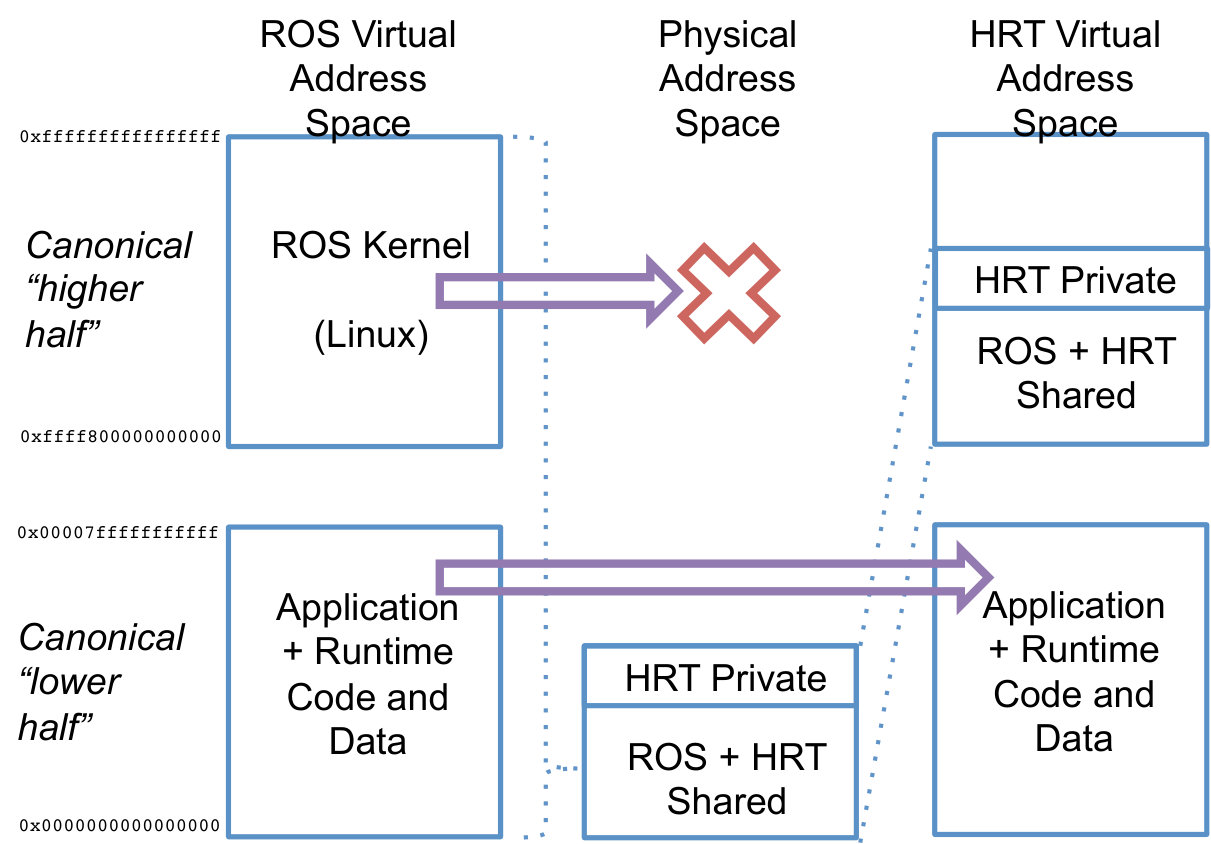 Figure 1
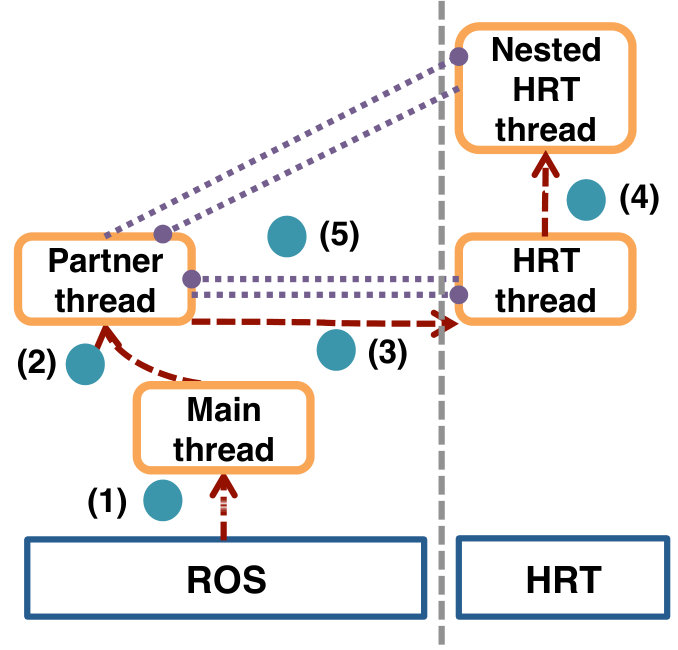 Figure 2
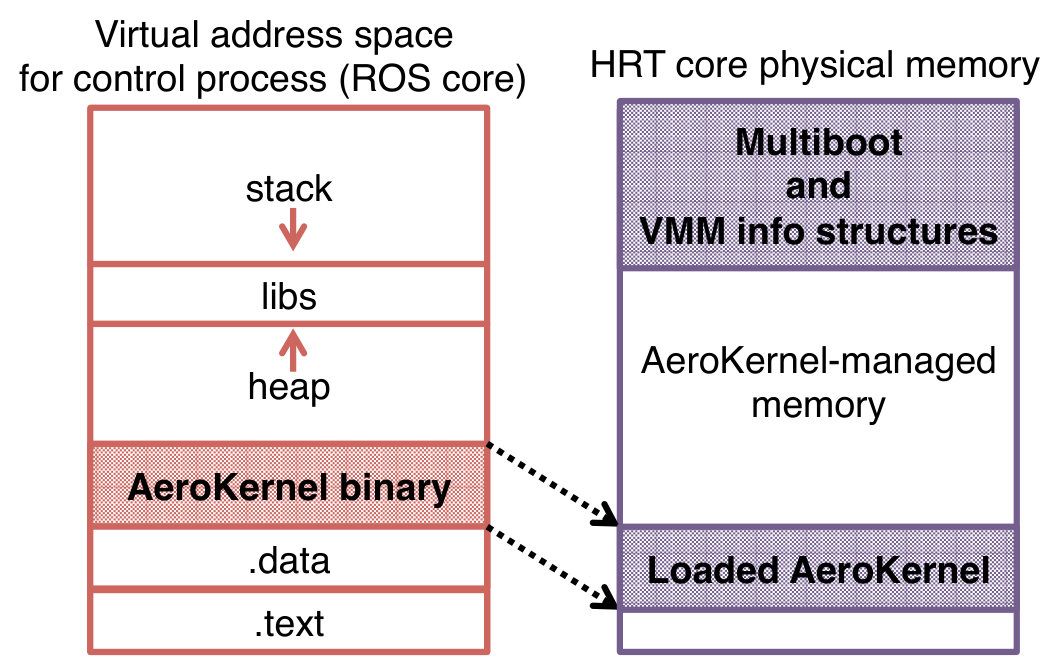 Figure 3
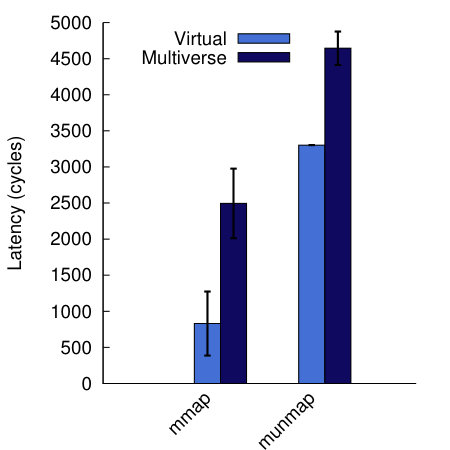 Figure 4
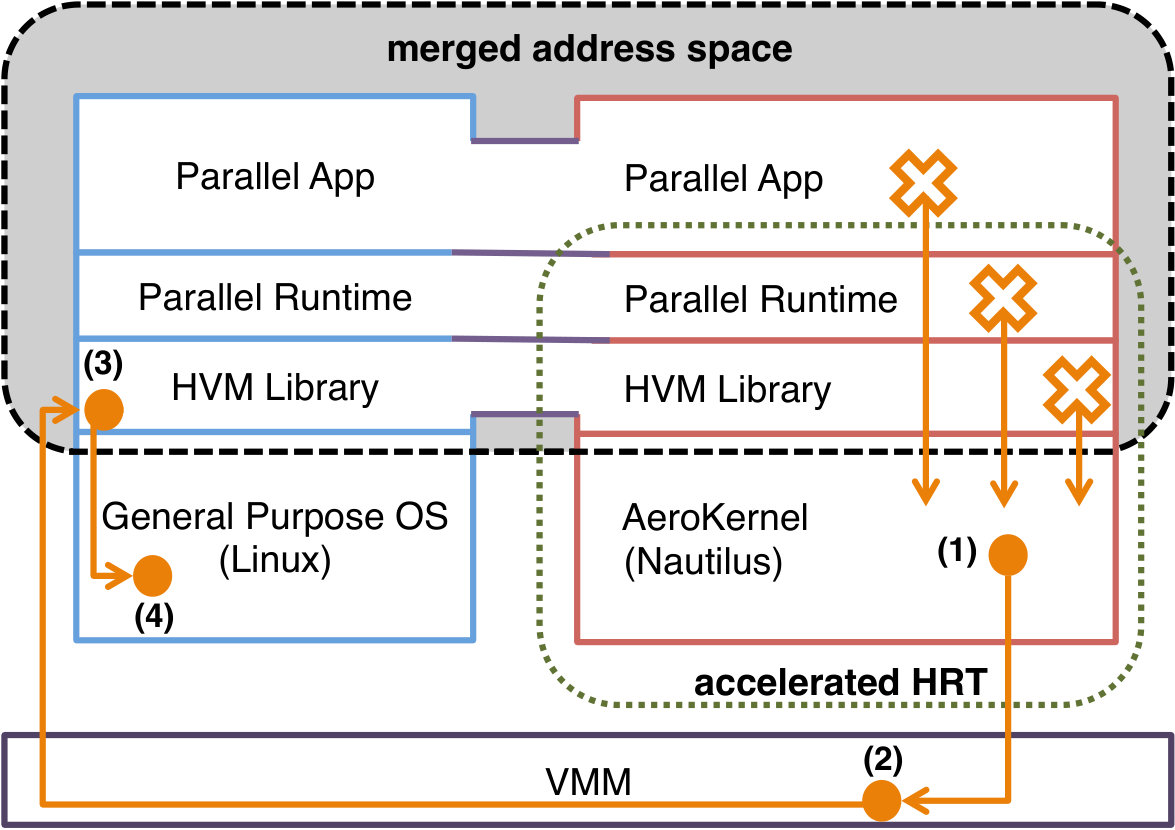 Figure 5
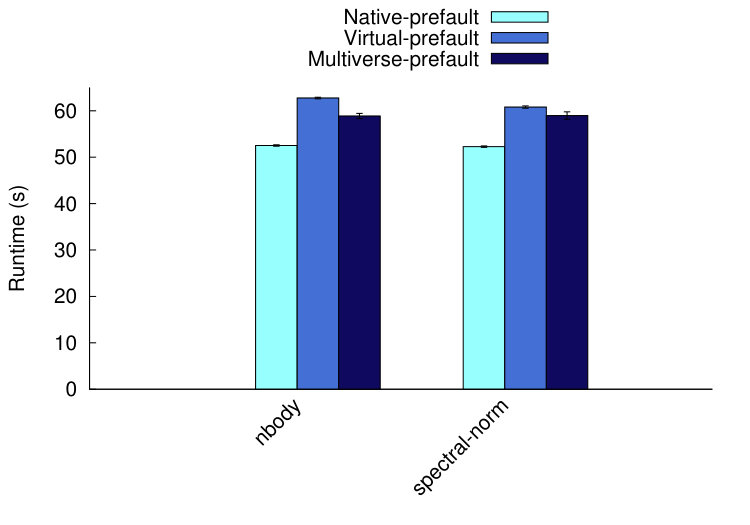 Figure 6
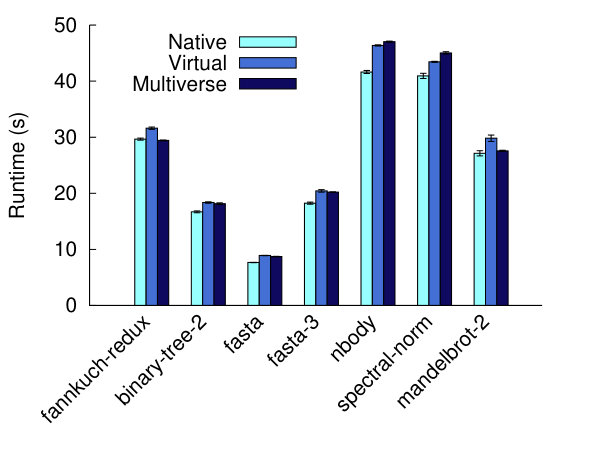 Figure 7
Peer Reviews
No public reviews on file for this paper yet. If you reviewed it on a platform where reviews are public (OpenReview, ICLR, NeurIPS, ICML), you can paste yours below so the community can read it here.
Videos
No videos yet. Explain this paper in a talk, walkthrough, or lecture? Add one.
Multiverse: Easy Conversion of Runtime Systems into OS Kernels
via Automatic Hybridization
Kyle C. Hale
Department of Computer Science
Illinois Institute of Technology
Conor Hetland, Peter Dinda
Department of Electrical Engineering and Computer Science
Northwestern University
[email protected], [email protected]
Abstract
The hybrid runtime (HRT) model offers a path towards high performance and efficiency. By integrating the OS kernel, runtime, and application, an HRT allows the runtime developer to leverage the full feature set of the hardware and specialize OS services to the runtime’s needs. However, conforming to the HRT model currently requires a port of the runtime to the kernel level, for example to the Nautilus kernel framework, and this requires knowledge of kernel internals. In response, we developed Multiverse, a system that bridges the gap between a built-from-scratch HRT and a legacy runtime system. Multiverse allows unmodified applications and runtimes to be brought into the HRT model without any porting effort whatsoever by splitting the execution of the application between the domains of a legacy OS and an HRT environment. We describe the design and implementation of Multiverse and illustrate its capabilities using the massive, widely-used Racket runtime system.
©2017 IEEE. Personal use of this material is permitted. Permission from IEEE must be obtained for all other uses, in any current or future media, including reprinting/republishing this material for advertising or promotional purposes, creating new collective works, for resale or redistribution to servers or lists, or reuse of any copyrighted component of this work in other works. DOI: 10.1109/ICAC.2017.24 (https://dx.doi.org/10.1109/ICAC.2017.24)
I Introduction
Runtime systems can gain significant benefits from executing in a tailored software environment, such as our Hybrid Runtime (HRT) [18]. In an HRT, a light-weight kernel framework (called an AeroKernel), a runtime, and an application coalesce into a single kernel-level entity. The OS is this composite of the application, runtime, and AeroKernel. As such, the runtime and application enjoy a base platform of fully privileged access to the underlying hardware, and can also construct task-appropriate abstractions on top of this base, instead of being limited to abstractions provided by a commodity OS. These capabilities demonstrably enhance performance, scalability, and efficiency, particularly for parallel runtime systems running on current NUMA server hardware and next generation high core-count multicore processors. The capabilities also enable forms of adaptation, both during the design process and during execution, that are simply not available to user-level systems.
An AeroKernel facilitates the creation of HRTs by providing core kernel functionality and optional mechanisms whose interfaces are geared to user-level developers instead of kernel developers. An AeroKernel helps ease the migration of user-level code to kernel-level. The motivation for an AeroKernel draws from the reliable performance of light-weight kernels [22, 21, 16], the philosophy regarding kernel abstractions of Exokernel [12], new techniques and ideas developed in multi-core OS research [23, 13], and the simplicity of other experimental OSes from previous decades [20, 28]. In this paper, we leverage the Nautilus AeroKernel [17], which we describe in more detail in Section II.
Prior to the work and system we describe here, the implementation of an HRT consisted entirely of manual processes. HRT developers needed first to extend an AeroKernel framework such as Nautilus with the functionality the runtime needed. The HRT developers would then port the runtime to this AeroKernel manually. While a manual port can produce the highest performance gains, it requires an intimate familiarity with the runtime system’s functional requirements, which may not be obvious. These requirements must then be implemented in the AeroKernel layer and the AeroKernel and runtime combined. This requires a deep understanding of kernel development. This manual process is also iterative: the developer adds AeroKernel functionality until the runtime works correctly. The end result might be that the AeroKernel interfaces support a small subset of POSIX, or that the runtime developer replaces such functionality with custom interfaces.
While such a development model is tractable ([17] gives three examples), it represents a substantial barrier to entry to creating HRTs, which we seek here to lower. The manual porting method is additive in its nature. We must add functionality until we arrive at a working system. A more expedient method would allow us to start with a working HRT produced by an automatic process, and then incrementally extend it and specialize it to enhance its performance.
The Multiverse system we describe in this paper supports such a method using a technique called automatic hybridization to create a working HRT from an existing, unmodified runtime and application. With Multiverse, runtime developers can take an incremental path towards adapting their systems to run in the HRT model. From the user’s perspective, a hybridized runtime and application behaves the same as the original. It can be run from a Linux command line and interact with the user just like any other executable. But internally, it executes in kernel mode as an HRT.
While in this paper we present one instance of an AeroKernel, Multiverse can work with any AeroKernel (or specialized OS kernel). Such pairings could enable new forms of adaptive computing, both in datacenter and HPC environments. For example, hybridization decisions could be made at runtime to merge an application or runtime system with the most suitable specialized OS kernel in response to, e.g., application characteristics or phases, hardware capabilities, or energy constraints. In this sense, Multiverse would behave as a kind of dynamic linker for applications/runtimes and AeroKernels in that it would support runtime binding of application functionality to specialized kernel services.
By enabling an existing Linux program to run partially in kernel mode as an HRT, Multiverse has the potential to expose additional adaptation mechanisms, enable additional adaptation policies, and allow both to be incrementally added to the program. That is, Multiverse expands the range of autonomic computing possible within the program. For example, the initial program could be extended over time to have direct control over the hardware paging and timer mechanisms when it is running in HRT mode. A specialized policy could then be added to the program to drive these mechanisms, for example to lower TLB miss rates by making use of program-specific information, and to achieve program-specific desirable scheduling behavior, such as real-time behavior.
Although our general focus has been on supporting parallel programs and runtimes, we note that a related concept to HRTs, namely Unikernels [24], has garnered considerable interest in the cloud/datacenter computing space. A similar premise to that given above applies in this space: A Multiverse-like approach expands the range of autonomic computing possible.
Multiverse bridges a specialized HRT with a legacy environment by borrowing functionality from a legacy OS, such as Linux. Functions not provided by the existing AeroKernel are forwarded to another core that is running the legacy OS, which handles them and returns their results. The runtime developer can examine traces of these forwarded events, identify hot spots in the legacy interface, and move their implementations (possibly even changing their interfaces) into the AeroKernel. The porting process with Multiverse is subtractive in that a developer iteratively removes dependencies on the legacy OS. At the same time, the developer can take advantage of the kernel-level environment of the HRT.
To demonstrate the capabilities of Multiverse, we automatically hybridize the Racket runtime system. Racket has a complex, JIT-based runtime system with garbage collection and makes extensive use of the Linux system call interface, memory protection mechanisms, and external libraries. Hybridized Racket executes in kernel mode as an HRT, and yet the user sees precisely the same interface (an interactive REPL environment, for example) as out-of-the-box Racket.
Our contributions in this paper are as follows:
- •
We introduce the concept of automatic hybridization for transforming runtime systems and their applications into HRTs, enabling them to run in kernel mode with full access to hardware features and the ability to adapt the kernel to their needs.
- •
We describe the design of Multiverse, an implementation of automatic hybridization that combines compile-time, link-time, run-time, and virtualization-based techniques.
- •
We demonstrate automatic hybridization with Multiverse by transforming the Racket runtime into an HRT.
- •
We evaluate the performance of Multiverse.
Multiverse will be made publicly available.
II HRT and HVM
Multiverse builds on the previously described Nautilus AeroKernel and Hybrid Virtual Machine [18, 17], which were developed to support the hybrid runtime (HRT) model. We describe the key salient findings and components here.
The core premise of the HRT model is that by moving the runtime (and its application) to the kernel level, we enable the runtime developer to leverage all hardware features (including privileged features), and to specialize kernel features specifically for the runtime’s needs. These capabilities in turn allow for greater performance or efficiency than possible at user-level. The Nautilus AeroKernel facilitates doing exactly this. Nautilus runs on bare metal or under virtualization on x64 machines and the Intel Xeon Phi. It is open source (MIT license) and publicly available.
Three runtimes have been hand-ported to Nautilus, namely Legion [4], the NESL VCODE interpreter [8], and the runtime of a home-grown nested data parallel language. Using the HPCG (High Performance Conjugate Gradient) benchmark [10, 19] developed by Sandia National Labs and ported to Legion by Los Alamos National Labs, speedups over Linux of up to 20% for the Intel Xeon Phi, and up to 40% for a 4-socket, 64-core x64 AMD Opteron 6272 machine were measured. Nautilus provides basic primitives, for example thread creation and events, that outperform Linux by orders of magnitude because they are designed to support runtimes in lieu of general-purpose computing, and because there are no kernel/user boundaries to cross. This combined with hardware and software capabilities available only in kernel mode, for example complete interrupt control and runtime-specific scheduling, leads to these performance gains in applications.
Multiverse also builds on the Hybrid Virtual Machine (HVM), an extension to the open source (BSD license) Palacios VMM [22], and available in its repository. HVM allows for the creation of a VM whose memory, cores, and interrupt logic are segregated so that one VM simultaneously runs two operating systems, the “Regular Operating System” (ROS) (e.g., Linux) and an HRT-based OS (e.g., Nautilus). The ROS runs on a partition of the cores and can only see and touch the ROS cores and the ROS subset of physical memory. In contrast, the HRT, while only allowed to run on its own distinct partition of the cores, has full access to all the memory, cores, and interrupt logic of the entire VM. The HVM design and the Nautilus design are closely coupled, with the result being that HRTs based on Nautilus can execute with negligible virtualization overheads on Palacios. The ROS and HRT can be booted and rebooted independently, the latter with a latency comparable to a fork()/exec() in Linux. That is, a boot of a Nautilus-based HRT is comparable to a Linux process creation.
III Multiverse
We designed the Multiverse system to support automatic hybridization of existing runtimes and applications that run in user-level on Linux platforms.
III-A Perspectives
Multiverse’s goal is to ease the path for developers transforming a runtime into an HRT. We seek to make the system look like a compilation option from the developer’s perspective. That is, to the greatest extent possible, the HRT is a compilation target. Compiling to an HRT results in an executable that is a “fat binary” containing additional code and data that enables kernel-mode execution in an environment that supports it. An HVM-enabled virtual machine on Palacios is the first such environment. The developer can extend this incrementally; Multiverse facilitates a path for runtime and application developers to explore how to specialize their HRT to the full hardware feature set and the extensible kernel environment of the AeroKernel.
From the user’s perspective, the executable behaves as if it were compiled for a user-level Linux environment. The user sees no difference between HRT and user-level execution.
III-B Techniques
The Multiverse system relies on three key techniques: split execution, event channels, and state superpositions.
Split execution
In Multiverse, a runtime and its application begin their execution in the ROS as an ordinary Linux process. Through a well-defined interface discussed in Section III-C, the runtime on the ROS side can spawn an execution context in the HRT. At this point, Multiverse splits its execution into two components, each running in a different context; one executes in the ROS and the other in the HRT; there is now a Linux process and a kernel. The semantics of these execution contexts differ from traditional threads depending on their characteristics. We discuss these differences in Section IV. In the current implementation, the context on the ROS side comprises a Linux thread, the context on the HRT side comprises an AeroKernel thread, and we refer to them collectively as an execution group. While execution groups in our current system consist of threads in different OSes, this need not be true in general. The context on the HRT side executes until it triggers a fault, a system call, or other event. The execution group then converges on this event, with each side participating in a protocol for requesting events and receiving results. This protocol exchange occurs in the context of HVM event channels, which we discuss below.
Figure 1 illustrates the split execution of Multiverse for a ROS/HRT execution group. At this point, the ROS has already made a request to create a new context in the HRT, e.g. through an asynchronous function invocation. When the HRT thread begins executing in the HRT side, exceptional events, such as page faults, system calls, and other exceptions vector to stub handlers in the AeroKernel (1). The AeroKernel redirects these events through an event channel (2) to request handling in the ROS. The VMM then injects these into the originating ROS thread, which can take action on them directly (3). For example, in the case of a page fault that occurs in the ROS portion of the virtual address space, the HVM library replicates the access, which will cause the same exception to occur on the ROS core. The ROS will then handle it as it would normally. For events that need direct handling by the ROS kernel, such as system calls, the HVM library can forward them (4).
Event channels
When the HRT needs functionality that the ROS implements, access to that functionality occurs over event channels, event-based, VMM-controlled communication channels between the two contexts. The VMM only expects that the execution group adheres to a strict protocol for event requests and completion.
Figure 2 shows the measured latency of event channels with the Nautilus AeroKernel performing the role of HRT. Note that these calls are bounded from below by the latency of hypercalls to the VMM.
State superpositions
In order to forego the addition of burdensome complexity to the AeroKernel environment, it helps to leverage functions in the ROS other than those that lie at a system call boundary. This includes functionality implemented in libraries and more opaque functionality like optimized system calls in the vdso and the vsyscall page. To use this functionality, Multiverse can set up the HRT and ROS to share portions of their address space, in this case the user-space portion. Aside from the address space merger itself, Multiverse leverages other state superpositions to support a shared address space, including superpositions of the ROS GDT and thread-local storage state.
In principle, we could superimpose any piece of state visible to the VMM. The ROS or the runtime need not be aware of this state, but the state is nonetheless necessary for facilitating a simple and approachable usage model.
The superposition we leverage most in Multiverse is a merged address space between the ROS and the HRT, depicted in Figure 3. The merged address space allows execution in the HRT without a need for implementing ROS-compatible functionality. When a merged address space takes effect, the HRT can use the same user-mode virtual addresses present in the ROS. For example, the runtime in the ROS might load files and construct a complex pointer-based data structure in memory. It can then invoke a function within its counterpart in the HRT to compute over that data.
III-C Usage models
The Multiverse system is designed to give maximum flexibility to application and runtime developers in order to encourage exploration of the HRT model. While the degree to which a developer leverages Multiverse can vary, for the purposes of this paper we classify the usage model into three categories, discussed below.
Native
In the native model, the application/runtime is ported to operate fully within the HRT/AeroKernel setting. That is, it does not use any functionality not exported by the AeroKernel, such as glibc functionality or system calls like mmap(). This category allows maximum performance, but requires more effort, especially in the compilation process. The ROS side is essentially unnecessary for this usage model, but may be used to simplify the initiation of HRT execution (e.g. requesting an HRT boot). The native model is also native in another sense: it can execute on bare metal without any virtualization support.
Accelerator
In this model, the app/runtime developer leverages both legacy (e.g. Linux) functionality and AeroKernel functionality. This requires less effort, but allows the developer to explore some of the benefits of running their code in an HRT. Linux functionality is enabled by the merged address space discussed previously, but the developer can also leverage AeroKernel functions.
Figure 4 shows a small example of code that will create a new HRT thread and use event channels and state superposition to execute to completion. Runtime initialization is opaque to the user, much like C runtime initialization code. When the program invokes the hrt_invoke_func() call, the Multiverse runtime will make a request to the HVM to run routine() in a new thread on the HRT core. Notice how this new thread can call an AeroKernel function directly, and then use the standard printf() routine to print its result. This printf call relies both on a state superposition (merged address space) for the function call linkage to be valid, and on event channels, which will be used when the C library code invokes a system call (e.g. write()).
Incremental
The application/runtime executes in the HRT context, but does not initially leverage AeroKernel functionality. Benefits are immediately limited to aspects of the HRT environment. However, the developer need only recompile their application to explore this model. In the incremental model, the path to converting a runtime and its application into a kernel is straightforward. Instead of raising an explicit HRT thread creation request, Multiverse creates a new thread in the HRT corresponding to the program’s main() routine. The Incremental model also allows parallelism, as legacy threading functionality automatically maps to the corresponding AeroKernel functionality with semantics matching those used in pthreads. The developer can then incrementally expand their usage of hardware- and AeroKernel-specific features.
While the accelerator and incremental usage models rely on the HVM virtualized environment of Palacios, it is important to note that they could also be built on physical partitioning [26] as well. At its core, HVM provides to Multiverse a resource partitioning, the ability to boot multiple kernels simultaneously on distinct partitions, and the ability for these kernels to share memory and communicate.
III-D Function overrides
One way a developer can enhance a generated HRT is through function overrides. The AeroKernel can implement functionality that conforms to the interface of, for example, a standard library function, but that may be more efficient or better suited to the HRT environment. This technique allows users to get some of the benefits of the accelerator model without any explicit porting effort. However, it is up to the AeroKernel developer to ensure that the interface semantics and any usage of global data make sense when using these function overrides. Function overrides are specified in a simple configuration file that is discussed in Section IV.
Figure 5 shows the same code from Figure 4 using function overrides. Here the AeroKernel developer has overridden the standard pthreads routines so that pthread_create() will create a new HRT thread in the same way that hrt_invoke_func() did in the previous example.
III-E Toolchain
The Multiverse toolchain consists of two main components, the runtime system code and the build setup. The build setup consists of build tools, configuration files, and an AeroKernel binary provided by the AeroKernel developer. To leverage Multiverse, a user integrates their application or runtime with the provided Makefile and rebuilds it. This will result in the compilation of the AeroKernel components necessary for HRT operation and the Multiverse runtime system, including function overrides, exit and signal handlers, and initialization code, into the user program.
IV Implementation
We now discuss the implementation of Multiverse. This includes the components that are automatically compiled and linked into the application’s address space at build time and the parts of Nautilus and the HVM that support event channels and state superpositions. Unless otherwise stated, we assume the Incremental usage model discussed in Section III-C.
IV-A Multiverse runtime initialization
As mentioned in Section III, a new HRT thread must be created from the ROS side (the originating ROS thread). This, however, requires an AeroKernel present on the requested core to create that thread. The runtime component (which includes the user-level HVM library) is in charge of booting an AeroKernel on all required HRT cores during program startup. They can either be booted on demand or at application startup. We use the latter in our current setup.
Our toolchain inserts program initialization hooks before the program’s main() function, which carry out runtime initialization, including:
- •
Registering ROS signal handlers
- •
Hooking process exit for HRT shutdown
- •
AeroKernel function linkage
- •
AeroKernel image installation in the HRT
- •
AeroKernel boot
- •
Merging ROS and HRT address spaces
AeroKernel Boot
Our toolchain embeds an AeroKernel binary into the ROS program’s ELF binary. This is the image to be installed in the HRT. At program startup, the Multiverse runtime component parses this embedded AeroKernel binary and sends a request to the HVM asking that it be installed in physical memory, as shown in Figure 6. Multiverse then requests the AeroKernel be booted on the HRT cores. The boot process brings the AeroKernel up into an event loop that waits for HRT thread creation requests.
The above initialization tasks are opaque to the user.
IV-B Execution model
To implement split execution, we rely on HVM’s ability to forward requests from the ROS core to the HRT, along with event channels and merged address spaces.
The runtime developer can use two mechanisms to create HRT threads, as discussed in Section III-C. Furthermore, two types of threads are possible on the HRT side: top-level threads and nested threads. Top-level threads are explicitly created by the ROS. A top-level HRT thread can create its own child threads as well; we classify these as nested threads. The semantics of the two thread types differ slightly in their operation. Nested threads resemble pure AeroKernel threads, but their execution can proceed in the context of the ROS user address space. Top-level threads require extra semantics in the HRT and in the Multiverse component linked with the ROS application.
Threads
Multiverse pairs each top-level HRT thread with a partner thread that executes in the ROS. This thread has two purposes. First, it allows us to preserve join semantics. Second, it gives us the proper thread context in the ROS to initiate a state superposition for the HRT. Figure 7 depicts the creation of HRT threads and their interaction with the ROS. First, in (1) the main thread is created in the ROS. It sets up the runtime environment for Multiverse. When the runtime system creates a thread, e.g. with pthread_create() or with hrt_invoke_func(), Multiverse creates a corresponding partner thread that executes in the ROS (2). It is the duty of the partner thread to allocate a ROS-side stack for a new HRT thread and then invoke the HVM to request a thread creation in the HRT using that stack (3). When the partner creates the HRT thread, it also conveys information to initiate a state superposition that mirrors the ROS-side GDT and ROS-side architectural state corresponding to thread-local storage (primarily the %fs register). The HRT thread can then create as many nested HRT threads as it desires (4). Both top-level HRT threads and nested HRT threads raise events to the ROS through event channels with the top-level HRT thread’s partner thread acting as the communication end-point (5).
As is typical in threading models, the main thread can wait for HRT threads to finish by using join() semantics, where the joining thread blocks until the child exits. While in theory we could implement the ability to join an HRT thread directly, it would add complexity to both the HRT and the ROS component of Multiverse. Instead, we chose to allow the main thread to join a partner thread directly and provide the guarantee that a partner thread will not exit until its corresponding HRT thread exits on the remote core. When an HRT thread exits, it signals the ROS of the exit event. When Multiverse creates an HRT thread, it keeps track of the Nautilus thread data (sent from the remote core after creation succeeds), which it uses to build a mapping from HRT threads to partner threads. The thread exit signal handler in the ROS flips a bit in the appropriate partner thread’s data structure notifying it of the HRT thread completion. The partner can then initiate its cleanup routines and exit, at which point the main thread will be unblocked from its initial join().
Function overrides
In Section III-C we described how a developer can use function overrides to select AeroKernel functionality over default ROS functionality. The Multiverse runtime component enforces default overrides that interpose on pthread function calls. All function overrides operate using function wrappers. For simple function wrappers, the AeroKernel developer can simply make an addition to a configuration file included in the Multiverse toolchain that specifies the function’s attributes and argument mappings between the legacy function and the AeroKernel variant. This configuration file then allows Multiverse to automatically generate function wrappers at build time.
When an overridden function is invoked, the wrapper runs instead, consults a stored mapping to find the symbol name for the AeroKernel variant, and performs a lookup to find its HRT virtual address. This symbol lookup currently occurs on every function invocation, so incurs a non-trivial overhead. A symbol cache, much like that used in the ELF standard, could easily be added to improve lookup times. When the address of the AeroKernel override is resolved, the wrapper invokes the function directly (since it is already executing in the HRT context where it has appropriate page table mappings for AeroKernel addresses).
IV-C Event channels
The HVM model enables the building of essentially any communication mechanism between two contexts (in our case, the ROS and HRT), and most of these require no specific support in the HVM. As a consequence, we minimally define the basic communication between the ROS, HRT, and the VMM using shared physical memory, hypercalls, and interrupts.
The user-level code in the ROS can use hypercalls to sequentially request HRT reboots, address space mergers (state superpositions), and asynchronous sequential or parallel function calls. The VMM handles reboots internally, and forwards the other two requests to the HRT as special exceptions or interrupts. Because the VMM and HRT may need to share additional information, they share a data page in memory. For a function call request, the page contains a pointer to the function and its arguments at the start and the return code at completion. For an address space merger, the page contains the CR3 of the calling process. The HRT indicates to the VMM when it is finished with the current request via a hypercall.
After an address space merger, the user-level code in the ROS can also use a hypercall to initiate synchronous operation with the HRT. This hypercall indicates to the HRT a virtual address which will be used for future synchronization between the HRT and ROS. They can then use a memory-based protocol to communicate, for example to allow the ROS to invoke functions in the HRT without VMM intervention.
IV-D Merged address spaces
To achieve a merged address space, we leverage the canonical 64-bit address space model of x64 processors, and its wide use within existing kernels, such as Linux. In this model, the virtual address space is split into a “lower half” and a “higher half” with a gap in between, the size of which is implementation dependent. In a typical process model, e.g., Linux, the lower half is used for user addresses and the higher half is used for the kernel.
For an HRT that supports it, the HVM arranges that the physical address space is identity-mapped into the higher half of the HRT address space. That is, within the HRT, the physical address space mapping (including the portion of the physical address space only the HRT can access) occupies the same portion of the virtual address space that the ROS kernel occupies, namely the higher half. Without a merger, the lower half is unmapped and the HRT runs purely out of the higher half. When the ROS side requests a merger, we map the lower half of the ROS’s current process address space into the lower half of the HRT address space.
IV-E Nautilus additions
In order to support Multiverse in the Nautilus AeroKernel, we needed to make several additions to the codebase. Most of these focus on runtime initialization and correct operation of event channels. When the runtime and application are executing in the HRT, page faults in the ROS portion of the virtual address space must be forwarded. We added a check in the page fault handler to look for ROS virtual addresses and forward them appropriately over an event channel.
One issue with our current method of copying a portion of the PML4 on an address space merger is that we must keep the PML4 synchronized. We must account for situations in which the ROS changes top-level page table mappings, even though these changes are rare. We currently handle this by detecting repeat page faults. Nautilus keeps a per-core variable keeping track of recent page faults, and matches duplicates. If a duplicate is found, Nautilus will re-merge the PML4. More clever schemes to detect this condition are possible, but unnecessary since it does not lie on the critical path.
For correct operation, Multiverse requires that we catch all page faults and forward them to the ROS. If we collect a trace of page faults in the application running native and under Multiverse, the traces should look identical. However, because the HRT runs in kernel mode, some paging semantics (specifically with copy-on-write) change. In default operation, an x86 CPU will only raise a page fault when writing a read-only page in user-mode. Writes to pages with the read-only bit while running in ring 0 are allowed to proceed. This issue manifests itself in the form of mysterious memory corruption, e.g. by writing to the zero page. Luckily, there is a bit to enforce write faults in ring 0 in the cr0 control register.
Before we built Multiverse, Nautilus lacked support for system calls, as the HRT operates entirely in kernel mode. However, a legacy application will leverage a wide range of system calls. To support them, we added a small system call stub handler in Nautilus that immediately forwards the system call to the ROS over an event channel.
IV-F Complexity
Multiverse development took roughly 5 person months of effort. Figure 8 shows the amount of code needed to support Multiverse. The entire system is compact and compartmentalized so that users can experiment with other AeroKernels or runtime systems with relative ease. While the codebase is small, much of the time went into careful design of the execution model and working out idiosyncrasies in the hybridization, specifically those dealing with operation in kernel mode.
V Evaluation
We evaluate Multiverse using a hybridized Racket runtime system running a set of benchmarks from The Language Benchmark Game. We ran all experiments on a Dell PowerEdge 415 with 8GB of RAM and an 8 Core 64-bit x86_64 AMD Opteron 4122 clocked at 2.2GHz. Each CPU core has a single hardware thread with four cores per socket. The host machine has stock Fedora Linux 2.6.38.6-26.rc1.fc15.x86_64 installed, and is configured for maximum performance in the BIOS. Benchmark results are reported as averages of 10 runs.
Experiments in a VM were run on a guest setup which consists of a simple BusyBox distribution running an unmodified Linux 2.6.38-rc5+ image with two cores (one core for the HVM and one core for the ROS) and 1 GB of RAM.
Racket [15, 14] is the most widely used Scheme implementation and has been under continuous development for over 20 years. It is an open source codebase that is downloaded over 300 times per day. Recently, support has been added to Racket for parallelism via futures [30] and places [31].
The Racket runtime, which comprises over 800,000 lines of code, is a good candidate to test Multiverse, particularly its most complex usage model, the incremental model, because Racket includes many of the challenging features emblematic of modern dynamic programming languages that make extensive use of the Linux ABI, including system calls, memory mapping, processes, threads, and signals. These features include complex package management via the filesystem, shared library-based support for native code, JIT compilation, tail-call elimination, live variable analysis (using memory protection), and garbage collection.
Our port of Racket to the HRT model takes the form of an instance of the Racket engine embedded into a simple C program. Racket already provides support for embedding an instance of Racket into C, so it was straightforward to produce a Racket port under the Multiverse framework. This port uses a conservative garbage collector, the SenoraGC, which is more portable and less performant than the default, precise garbage collector. The port was compiled with GCC 4.6.3. The C program launches a pthread that in turn starts the engine. Combined with the incremental usage model of Multiverse, the result is that the existing, unmodified Racket engine executes entirely in kernel mode as an HRT.
When compiled and linked for regular Linux, our port provides either a REPL interactive interface through which the user can type Scheme, or a command-line batch interface through which the user can execute a Scheme file (which can include other files). When compiled and linked for HRT use, our port behaves identically.
To evaluate the correctness and performance of our port, we tested it on a series of benchmarks submitted to The Computer Language Benchmarks Game [1]. We tested on seven different benchmarks: a garbage collection benchmark (binary-tree-2), a permutation benchmark (fannkuch), two implementations of a random DNA sequence generator (fasta and fasta-3), a generation of the Mandelbrot set (mandelbrot-2), an n-body simulation (n-body), and a spectral norm algorithm. Figure 9 characterizes these benchmarks from the low-level perspective. Note that while this is an implementation of a high-level language, the actual execution of Racket programs involves many interactions with the operating system. These exercise Multiverse’s system call and fault forwarding mechanisms. The total number of forwarded events is in the last column.
Figure 10 compares the performance of the Racket benchmarks run natively (note here native means on bare metal rather than virtualized) on our hardware, under virtualization, and as an HRT that was created with Multiverse. Error bars are included, but are barely visible because these workloads run in a predictable way. The key takeaway is that Multiverse performance is on par with native and virtualized performance—Multiverse let us move, with little to no effort, the existing, unmodified Racket runtime into kernel mode and run it as an HRT with little to no overhead.
The small overhead of the Multiverse case compared to the virtualized and native cases is due to the frequent interactions, such as those described above, with the Linux ABI. However, in all but two cases, the hybridized benchmarks actually outperform the equivalent versions running without Multiverse. This is due to the nature of the accelerated environment that the HRT provides, which ameliorates the event channel overheads. As we expect, the two benchmarks that perform worse under Multiverse (nbody and spectral-norm) have the most overhead incurred from event channel interactions. The most frequent interactions in both cases are due to page faults.
While Figure 9 tells us the number of interactions that occur, we now consider the overhead of each using microbenchmarks. This estimate will also apply to page faults, since their forwarding mechanism is identical to system calls.
The most frequent system calls used in the Racket runtime (independent of any benchmark) are mmap() and munmap(), and so we focus on these two. Figure 11 shows microbenchmark results (averages over 100 runs) for these two, comparing virtualized execution and Multiverse. Note that neither system calls nor page faults involve the VMM in the virtualized case. For both system calls, the Multiverse event forwarding facility adds roughly 1500 cycles of overhead. If we multiply this number by the number of forwarded events for these benchmarks listed in Figure 9, we expect that Multiverse will add about 112 million cycles (51 ms) of overhead for spectral-norm, and 96 million cycles (43 ms) for nbody. This is roughly in line with Figure 10. Note that the relative overhead cost for these benchmarks is roughly 0.1%. While the cost per system call is almost doubled here, such events are relatively rare.
Note that event forwarding will decrease as a runtime is incrementally extended to take advantage of the HRT model. As an illustration of this, we modified Racket’s garbage collector to prefault in pages any time that it allocates a range of memory for internal use. We accomplished this with a simple change that added the MAP_POPULATE flag to Racket’s internal mmap() invocations. This reduces the number of page faults incurred during the execution of a benchmark, therefore reducing the number of forwarded events. The results are shown in Figure 12. While this change increases the running time for the benchmark overall—indicating that this is not a change that one would introduce in practice—it shows what the relative performance would be with fewer forwarded events. Indeed, with fewer events, the hybridized versions (Multiverse-prefault) of these benchmarks running in a VM now outperform their counterparts (Virtual-prefault).
It is worth reflecting on what exactly has happened here: we have taken a massive (800K line), complex runtime system off-the-shelf, run it through Multiverse without changes, and as a result have a version of the runtime system that correctly runs in kernel mode as an HRT and behaves identically with virtually identical performance. To be clear, all of the Racket runtime except Linux kernel ABI interactions is seamlessly running as a kernel. While this codebase is the endpoint for user-level development, it represents a starting point for HRT development in the incremental model.
VI Related Work
As far as we are aware, Multiverse is the only system that automatically transforms an existing user-level application into a split execution environment that runs within the context of both a general-purpose OS and a specialized OS.
Work on specialized kernels goes back decades, and the design of Nautilus is heavily influenced by much of this early work, including Exokernels [11, 12], SPIN [7], Scout [25], KeyKOS [9], and ADEOS [33]. This line of work has recently been revitalized in the context of Unikernels [24].
The Dune system [6] allows a special kernel module to promote selected processes to ones that can access privileged CPU features on a legacy Linux system. Dune leverages virtualization support to give applications the ability to access, for example, page tables and protection hardware. While Dune gives applications access to previously unavailable hardware, it does so from within the context of a Linux process. Unlike Multiverse, Dune does not give the application the capability to run in an entirely separate OS.
Libra [3] bears similarities to our system in its overall architecture. A Java Virtual Machine (JVM) runs on top of the Libra libOS, which in turn executes under virtualization. A general-purpose OS runs in a controller partition and accepts requests for legacy functionality from the JVM/Libra partition. This system involved a manual port. In contrast, the HVM gives us a more powerful mechanism for sharing between the ROS and HRT as they share a large portion of the address space. This allows us to leverage complex functionality in the ROS like shared libraries and symbol resolution. Furthermore, the Libra system does not provide a way to automatically create these specialized JVMs from their legacy counterparts.
The Blue Gene/L series of supercomputer nodes run with a Lightweight Kernel (LWK) called the Blue Gene/L Run Time Supervisor (BLRTS) [2] that shares an address space with applications and forwards system calls to a specialized I/O node. While the bridging mechanism between the nodes is similar, there is no mechanism for porting a legacy application to BLRTS. Others in the HPC community have proposed similar solutions that bridge a full-weight kernel with an LWK in a hybrid model. Examples of this approach include mOS [32], ARGO [5], and IHK/McKernel [29]. The Pisces Co-Kernel [27] treats performance isolation as its primary goal and can partition hardware between enclaves, or isolated OS/Rs that can involve different specialized OS kernels.
In contrast to the above systems, the HRT model is the only one that allows a runtime to act as a kernel, enjoying full privileged access to the underlying hardware. Furthermore, as far as we are aware, none of these systems provide an automated mechanism for producing an initial port to the specialized OS/R environment.
VII Conclusions
We introduced Multiverse, a system that implements automatic hybridization of runtime systems in order to transform them into hybrid runtimes (HRTs). We illustrated the design and implementation of Multiverse and described how runtime developers can use it for incremental porting of runtimes and applications from a legacy OS to a specialized AeroKernel.
To demonstrate its power, we used Multiverse to automatically hybridize the Racket runtime system, a complex, widely-used, JIT-based runtime. With automatic hybridization, we can take an existing Linux version of a runtime or application and automatically transform it into a package that appears to run just like any other program, but actually executes on remote cores in kernel-mode, in the context of an HRT, and with full access to the underlying hardware. We evaluated the performance overheads of an unoptimized Multiverse hybridization of Racket and showed that performance varies with the usage of legacy functionality. In cases where such use is minimized, the hybridized runtime can outperform the baseline. Runtime developers can use Multiverse to start with a working system and incrementally migrate hot spot functionality to custom components within an AeroKernel.
The reference list from the paper itself. Each links out to its DOI / PubMed record.
- 1[1] The computer language benchmarks game. http://benchmarksgame.alioth.debian.org/.
- 2[2] G. Almási, R. Bellofatto, J. Brunheroto, C. Caşcaval, J. Castaños, L. Ceze, P. Crumley, C. C. Erway, J. Gagliano, D. Lieber, X. Martorell, J. E. Moreira, A. Sanomiya, and K. Strauss. An overview of the blue gene/l system software organization. In Proceedings of the Euro-Par Conference on Parallel and Distributed Computing (Euro Par 2003) , Aug. 2003.
- 3[3] G. Ammons, J. Appavoo, M. Butrico, D. Da Silva, D. Grove, K. Kawachiya, O. Krieger, B. Rosenburg, E. V. Hensbergen, and R. W. Wisniewski. Libra: A library operating system for a jvm in a virtualized execution environment. In Proceedings of the 3 r d superscript 3 𝑟 𝑑 3^{rd} International Conference on Virtual Execution Environments (VEE 2007) , pages 44–54, June 2007.
- 4[4] M. Bauer, S. Treichler, E. Slaughter, and A. Aiken. Legion: Expressing locality and independence with logical regions. In Proceedings of Supercomputing (SC 2012) , Nov. 2012.
- 5[5] P. Beckman. Argo: An exascale operating system. http://www.mcs.anl.gov/project/argo-exascale-operating-system .
- 6[6] A. Belay, A. Bittau, A. Mashtizadeh, D. Terei, D. Mazières, and C. Kozyrakis. Dune: Safe user-level access to privileged CPU features. In Proceedings of the 10 t h superscript 10 𝑡 ℎ 10^{th} USENIX Conference on Operating Systems Design and Implementation (OSDI 2012) , pages 335–348, Oct. 2012.
- 7[7] B. N. Bershad, S. Savage, P. Pardyak, E. G. Sirer, M. E. Fiuczynski, D. Becker, C. Chambers, and S. Eggers. Extensibility, safety and performance in the SPIN operating system. In Proceedings of the 15 t h superscript 15 𝑡 ℎ 15^{th} ACM Symposium on Operating Systems Principles (SOSP 1995) , pages 267–283, Dec. 1995.
- 8[8] G. E. Blelloch, S. Chatterjee, J. Hardwick, J. Sipelstein, and M. Zagha. Implementation of a portable nested data-parallel language. Journal of Parallel and Distributed Computing , 21(1):4–14, Apr. 1994.