Entanglement-Assisted Quantum Data Compression
Zahra Baghali Khanian, Andreas Winter

TL;DR
This paper investigates how entanglement and side information influence quantum data compression, deriving optimal rates and tradeoffs, and revealing that entanglement can significantly reduce the quantum rate below the Schumacher limit.
Contribution
It introduces the optimal asymptotic quantum rate and rate region for entanglement-assisted compression with side information, extending known Schumacher compression scenarios.
Findings
Quantum rate can be halved via entanglement and classical information extraction.
Optimal tradeoff between quantum and entanglement rates established.
Connections to classical information extraction and previous compression settings.
Abstract
Ask how the quantum compression of ensembles of pure states is affected by the availability of entanglement, and in settings where the encoder has access to side information. We find the optimal asymptotic quantum rate and the optimal tradeoff (rate region) of quantum and entanglement rates. It turns out that the amount by which the quantum rate beats the Schumacher limit, the entropy of the source, is precisely half the entropy of classical information that can be extracted from the source and side information states without disturbing them at all ("reversible extraction of classical information"). In the special case that the encoder has no side information, or that she has access to the identity of the states, this problem reduces to the known settings of blind and visible Schumacher compression, respectively, albeit here additionally with entanglement assistance. We comment on…
Click any figure to enlarge with its caption.
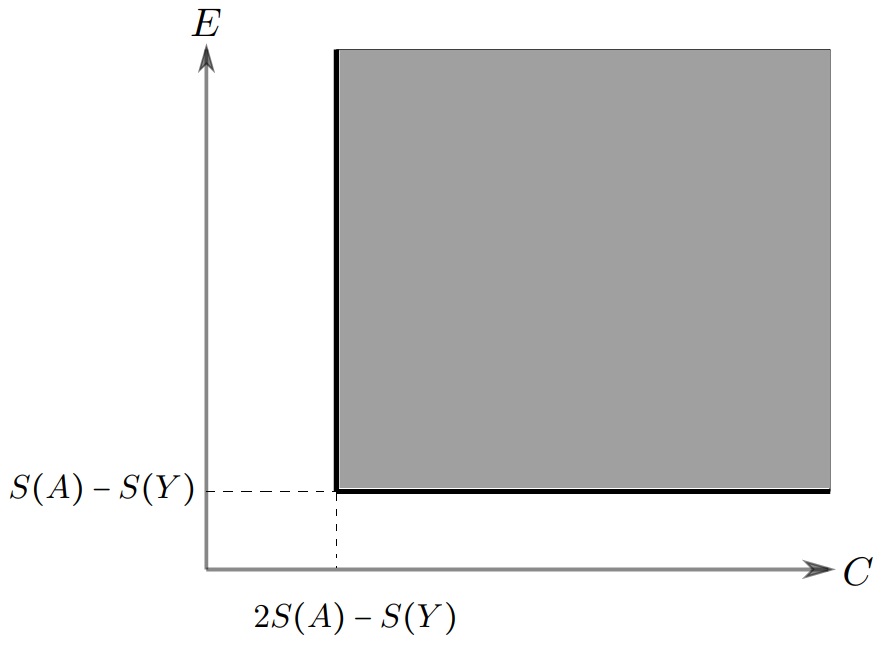 Figure 1
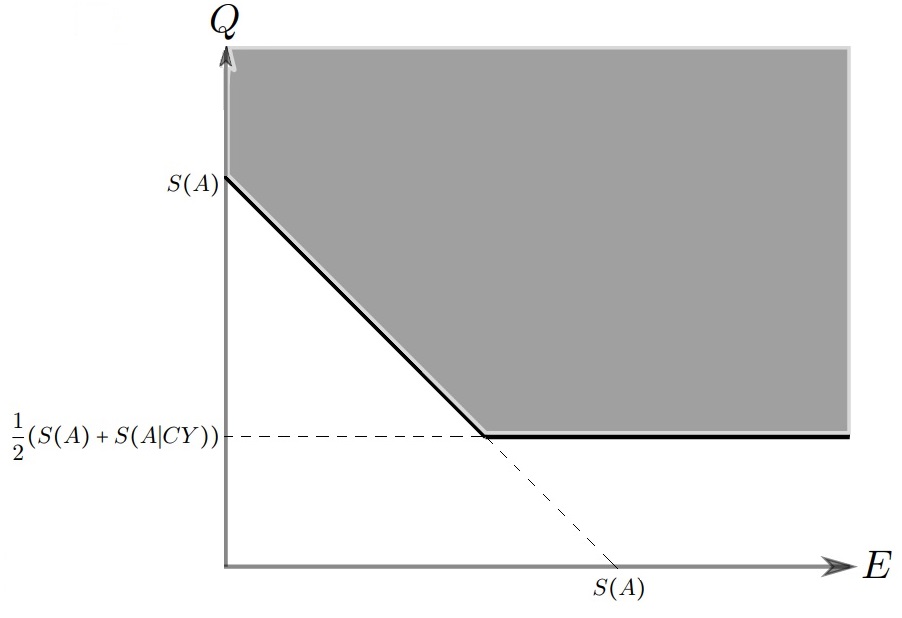 Figure 2
Peer Reviews
No public reviews on file for this paper yet. If you reviewed it on a platform where reviews are public (OpenReview, ICLR, NeurIPS, ICML), you can paste yours below so the community can read it here.
Videos
No videos yet. Explain this paper in a talk, walkthrough, or lecture? Add one.
Entanglement-Assisted Quantum Data Compression
Zahra Baghali Khanian12
1ICFO
Barcelona Institute of Technology
08860 Castelldefels, Spain
Email: [email protected]
2Grup d’Informació Quàntica
Departament de Física
Universitat Autònoma de Barcelona
08193 Bellaterra (Barcelona), Spain
Andreas Winter23
3ICREA
Pg. Lluis Companys, 23
08010 Barcelona, Spain
Email: [email protected]
Abstract
Ask how the quantum compression of ensembles of pure states is affected by the availability of entanglement, and in settings where the encoder has access to side information. We find the optimal asymptotic quantum rate and the optimal tradeoff (rate region) of quantum and entanglement rates. It turns out that the amount by which the quantum rate beats the Schumacher limit, the entropy of the source, is precisely half the entropy of classical information that can be extracted from the source and side information states without disturbing them at all (“reversible extraction of classical information”).
In the special case that the encoder has no side information, or that she has access to the identity of the states, this problem reduces to the known settings of blind and visible Schumacher compression, respectively, albeit here additionally with entanglement assistance. We comment on connections to previously studied and further rate tradeoffs when also classical information is considered.
I Quantum sources with side information
The task of data compression of a quantum source, introduced by Schumacher [1], marks one of the foundations of quantum information theory: not only did it provide an information theoretic interpretation of the von Neumann entropy as the minimum compression rate, it also motivated the very concept of the qubit! (Throughout this paper, denotes by default the binary logarithm.) In the Schumacher modelling, a source is given by an ensemble of pure states , , with a Hilbert space that in this paper we shall assume to be of finite dimension ; denotes the set of states (density operators). Furthermore, ranges over a discrete alphabet, so that we can can describe the source equivalently by the classical-quantum (cq) state .
While the achievability of the rate was shown in [1, 2] (see also [3, Thm. 1.18]), the full (weak) converse was established in [4], a simplified proof being given by M. Horodecki [5]; the strong converse was proved in [6].
In this paper, we consider a more comprehensive model, where on the one hand the sender/encoder of the compressed data (Alice) has access to side information, namely a pure state in addition to the source state , and on the other hand, she and the receiver/decoder of the compressed data (Bob) share pure state entanglement in the form of EPR pairs at a certain rate.
Thus, the source is now an ensemble of product states, which can be described equivalently by the cqq-state
[TABLE]
Yet another equivalent description is via the random variable , distributed according to , i.e. ; this also makes the pure states and random variables.
We will consider the information theoretic limit of many copies of , i.e. :
[TABLE]
using the notation
[TABLE]
Further notation. Conditional entropy and conditional mutual information, and , respectively, are defined in the same way as their classical counterparts:
[TABLE]
The fidelity between two states and is defined as with the trace norm .
II Compression assisted by entanglement
We assume that the encoder, Alice, and the decoder, Bob, have initially a maximally entangled state on registers and (both of dimension ). With probability , the source provides Alice with the state . Then, Alice performs her encoding operation on the systems , and her part of the entanglement, which is a quantum channel, i.e. a completely positive and trace preserving (CPTP) map. (Note that our notation is a slight abuse, which we maintain as it is simpler while it cannot lead to confusions, since channels really are maps between the trace class operators on the involved Hilbert spaces.) The dimension of the compressed system obviously has to be smaller than the original source, i.e. . We call and the quantum and entanglement rates of the compression protocol, respectively. The system is then sent to Bob via a noiseless quantum channel, who performs a decoding operation on the system and his part of entanglement .
According to Stinespring’s theorem [7], all these CPTP maps can be dilated to isometries and , where the new systems and are the environment systems of Alice and Bob, respectively.
We say the encoding-decoding scheme has fidelity , or error , if
[TABLE]
where and . We say that is an (asymptotically) achievable rate pair if for all there exist codes such that the fidelity converges to , and the entanglement and quantum rates converge to and , respectively. The rate region is the set of all achievable rate pairs, as a subset of .
Note that this means that we demand not only that Bob can reconstruct the source states with high fidelity on average, but that Alice retains the side information states as well with high fidelity.
There are two extreme cases of the side information that have been considered in the literature: If is a trivial system, or more generally if the states are all identical, then the aforementioned task is the entanglement-assisted version of blind Schumacher compression. If , or more precisely , then Alice has access to classical random variable , and the task reduces to visible Schumacher compression with entanglement assistance. The blind-visible terminology is originally from [4, 8].
Remark 1
In the case of no entanglement being available, i.e. (), the problem is fully understood: The asymptotic rate from [1, 2] is achievable without touching the side informatiomn, and it is optimal, even in the visible case (which includes all other side informations), by the weak and strong converses of [4, 5] and [6]. ∎
III Optimal quantum rate
To formulate the minimum compression rate under unlimited entanglement assistance, we need the following concept.
Definition 2
An ensemble of pure states is called reducible if its states fall into two or more orthogonal subspaces. Otherwise the ensemble is called irreducible. We apply the same terminology to the source cqq-state .
Notice that a reducible ensemble can be written uniquely as a disjoint union of irreducible ensembles , with a partition and irreducible ensembles , where for and . We define the subspace spanned by the vectors of each irreducible ensemble as . The irreducible ensembles are pairwise orthogonal, i.e. for all . We may thus introduce the random variable taking values in the set with probability distribution ; namely, is a deterministic function of such that .
We define the modified source with side information systems . Because there is an isometry which acts as
[TABLE]
the extended source is equivalent to the original source and side information modulo a local operation of Alice.
We first present the optimal asymptotic compression rate in the following theorem and prove the achievability of it, but we leave the converse proof to the end of this section, as it requires introducing further machinery.
Theorem 3
For the given source , the optimal asymptotic compression rate assisted by unlimited entanglement is .
Furthermore, there is a protocol achieving this communication rate with entanglement consumption at rate .
Proof:
We first show that this rate is achievable. Consider the following purification of ,
[TABLE]
with side information systems . This is obtained from by Alice applying the isometry from Eq. (3).
We apply quantum state redistribution (QSR) [9, 10] as a subprotocol, where the objective is for Alice to send to Bob , using as side information, while serves as reference system; the figure of merit is the fidelity with the original pure state . Denoting the overall encoding-decoding CPTP map , QRS gives us the first inequality of the following chain:
[TABLE]
where the second inequality follows from monotonicity of the fidelity under partial trace. Thus, the protocol satisfies our fidelity criterion (II).
The communication rate we obtain from QSR is . Furthermore, QSR guarantees entanglement consumption at the rate . ∎
To prove optimality (the converse), we first need a few preparations. The following definition is inspired by the “reversible extraction of classical information” in [11].
Definition 4
For a source and , define
[TABLE]
where
[TABLE]
In this definition, the dimension of the environment is w.l.o.g. bounded as ; hence, the optimisation is of a continuous function over a compact domain, so we have a maximum rather than a supremum.
Lemma 5
The function has the following properties:
It is a non-decreasing function of . 2. 2.
It is concave in . 3. 3.
It is continuous for . 4. 4.
For any two states and and for , 5. 5.
For any state , .
Proof:
-
The definition of directly implies that it is a non-decreasing function of .
-
To prove the concavity, let and be the isometries attaining the maximum for and , respectively, which act as follows:
[TABLE]
For , define the isometry by letting, for all ,
[TABLE]
where systems and are qubits. Then, the reduced state on the systems is , where ; therefore, the fidelity is bounded as follows:
[TABLE]
where the second line follows from the concavity of the function , and the last line follows by the definition of the isometries and . Now, define and let . According to Definition 4, we obtain
[TABLE]
where the third line is due to strong subadditivity of the quantum mutual information.
-
The function is non-decreasing and concave for , so it is continuous for . The concavity implies furthermore that is lower semi-continuous at . On the other hand, since the fidelity and mutual information are both continuous functions of CPTP maps, and the domain of the optimization is a compact set, we conclude that is also upper semi-continuous at , so it is continuous at [12, Thms. 10.1, 10.2].
-
In the definition of , let the isometry be the one attaining the maximum which acts on the purified source state with purifying systems and as follows:
[TABLE]
Now, define the isometry acting only on the systems with the output state and the environment as follows:
[TABLE]
Hence, we obtain
[TABLE]
where the first inequality is due to monotonicity of the fidelity under CPTP maps, and the second inequality follows by the definition of . Consider the isometry defined in a similar way, with the output state and the environment . Therefore, we obtain
[TABLE]
where the second line is due to data processing.
- In the definition of let be the isometry attaining the maximum with . Hence, we obtain
[TABLE]
where the first line follows because is a function of . The second and fourth line are due to the chain rule. The third line follows because for the classical system the conditional entropy is non-negative. The penultimate line follows because for any the state on the system is pure. The last line is due to strong sub-additivity of the entropy. Furthermore, for every , the ensemble is irreducible; hence, the conditional mutual information which follows from the detailed discussion on page 2028 of [11]. ∎
*Proof of the converse part of Theorem 3. * We start by observing
[TABLE]
where the second inequality is due to subadditivity of the entropy, and the equality follows because the decoding isometry does not change the entropy. Hence, we get
[TABLE]
where in the first and second line we use the chain rule and subadditivity of entropy. The inequality in the third line follows from the decodability of the system : the fidelity criterion (II) implies that the output state on systems is -close to the original state in trace norm; then apply the Fannes-Audenaert inequality [13, 14] where . The equalities in the fourth and the fifth line are due to the chain rule and the fact that for any the overall state of is pure. In the last line, we use the decodability of the systems , that is the output state on systems is -close to the original states in trace norm, then we apply the Alicki-Fannes inequality [15, 16].
Moreover, we bound as follows:
[TABLE]
where the first equality follows because the encoding isometry does not the change the entropy. Adding Eqs. (III) and (III), we thus obtain
[TABLE]
where the second line is due to data processing. The third line follows from Definition 4. The last line follows from point 4 of Lemma 5. In the limit of and , the rate is bounded by
[TABLE]
where the first line follows from point 3 of Lemma 5 stating that is continuous at . The second line is due to point 5 of Lemma 5.
IV Complete rate region
In this section, we find the complete rate region of achievable rate pairs .
Theorem 6
For the source , all asymptotically achievable entanglement and quantum rate pairs satisfy
[TABLE]
Conversely, all the rate pairs satisfying the above inequalities are achievable.
Proof:
The first inequality comes from Theorem 3. For the second inequality, consider any code with quantum communication rate and entanglement rate . By using an additional communication rate , Alice and Bob can distribute the entanglement first, and then apply the given code, converting it into one without preshared entanglement and communication rate , having exactly the same fidelity. By Remark 1, .
As for the achievability, the corner point is achievable, because QSR which is used as the achievability protocol in Theorem 3 uses ebits of entanglement between Alice and Bob. Furthermore, all the points on the line for are achievable because one ebit can be distributed by sending a qubit. All other rate pairs are achievable by resource wasting. The rate region is depicted in Fig. 1 ∎
V Discussion
First of all, let us look what our result tell us in the cases of blind and visible compression.
Corollary 7
In blind compression (i.e. if is trivial, or more generally the states are all identical), the compression of the source reduces to the entanglement-assisted Schumacher compression for which Theorem 3 gives the optimal asymptotic quantum rate
[TABLE]
This implies that if the source is irreducible, then this rate is equal to the Schumacher limit . In other words, the entanglement does not help the compression. Moreover, due to Theorem 6, a rate of entanglement is consumed in the compression, and in general. ∎
The blind compression of a source is also considered in [11], but there instead of entanglement, a noiseless classical channel was assumed in addition to the quantum channel. It was shown that the optimal quantum rate assisted with free classical communication is equal to , while a rate of classical communication suffices. By sending the classical information using dense coding [18], spending ebit and qubit per cbit, we can recover the quantum and entanglement rates of Corollary 7. This means that our converse implies the optimality of the quantum rate from [11].
Thus we are motivated to look at a modified compression model where the resources used are classical communication and entanglement. Namely, we let Alice and Bob share entanglement at rate and use classical communication at rate , but otherwise the objective is the same as in Section II; define the rate region as the set of all asymptotic achievable classical communication and entanglement rate pairs , such that the decoding fidelity asymptotically converges to .
Theorem 8
For a source , a rate pair is achievable if and only if
[TABLE]
Proof:
We start with the converse. The first inequality follows from Theorem 3, because with unlimited entanglement shared between Alice and Bob, qubits of quantum communication is equivalent to bits of classical communication due to teleportation [17] and dense coding [18]. The second inequality follows from [11], because with free classical communication, the quantum rate is lower bounded by which, due to super dense coding [18], is equivalent to sharing ebits when classical communication is for free.
The achievability of the corner point follows from [11] because the compression protocol uses qubits and bits of classical communication which is equivalent to using ebits of entanglement and bits of classical communication, due to dense coding [18]. Other rate pairs are achievable by resource wasting. The rate region is depicted in Fig. 2. ∎
Corollary 9
In the visible case, our compression problem reduces to the visible version of Schumacher compression with entanglement assistance. In this case, according to Theorem 3 the optimal asymptotic quantum rate is . Moreover, a rate of entanglement is consumed in the compression scheme, and in general. ∎
We remark that the visible compression assisted by unlimited entanglement is also a special case of remote state preparation considered in [19], from which we know that the rate is achievable and optimal.
The visible analogue of [11], of compression using qubit and cbit resources, was treated in [20], where the achievable region was determined as the union of all all pairs such that and , for any random variable forming a Markov chain ——. Compare to the complicated boundary of this region the much simpler one of Corollary 9, which consists of two straight lines.
We close by discussing several open questions for future work: First, the final discussion of different pairs of resources to compress suggests that an interesting target would be the characterisation of the full triple resource tradeoff region for , and together.
Secondly, we recall that our definition of successful decoding included preservation of the side information with high fidelity. What is the optimal compression rate if the side information does not have to be preserved? For an example where this change has a dramatic effect on the optimal communication rate, consider the ensemble consisting of the three two-qubit states , and (where ), with probabilities , and , respectively. Note that is irreducible, hence for , we get an optimal quantum rate of , because . However, by applying a CNOT unitary (with as control and as target), the ensemble is transformed into consisting of the states , and . The state of is not changed, only the side information, which is why we denote it . Hence we can apply Theorem 3 to get a quantum rate , because , .
Thirdly, note that the lower bound in Theorem 6 holds with a strong converse (see the proof and [6]). But does hold as a strong converse rate with unlimited entanglement? Likewise, in the setting of [11] with unlimited classical communication, is a strong converse bound for the quantum rate?
The reference list from the paper itself. Each links out to its DOI / PubMed record.
- 1[1] B. Schumacher, “Quantum coding,” Phys. Rev. A , vol. 51, no. 4, pp. 2738–2747, Apr 1995.
- 2[2] R. Jozsa and B. Schumacher, “A new proof of the quantum noiseless coding theorem,” J. Mod. Optics , vol. 41, no. 12, pp. 2343–2349, 1994.
- 3[3] M. Ohya and D. Petz, Quantum Entropy and Its Use . Springer Verlag, Berlin Heidelberg, 1993 (2nd edition 2004).
- 4[4] H. Barnum, C. A. Fuchs, R. Jozsa, and B. Schumacher, “General fidelity limit for quantum channels,” Phys. Rev. A , vol. 54, no. 6, pp. 4707–4711, Dec 1996.
- 5[5] M. Horodecki, “Limits for compression of quantum information carried by ensembles of mixed states,” Phys. Rev. A , vol. 57, no. 5, pp. 3364–3369, May 1998.
- 6[6] A. Winter, “Coding Theorems of Quantum Information Theory,” Ph.D. dissertation, Universität Bielefeld, Department of Mathematics, Germany, July 1999, ar Xiv:quant-ph/9907077.
- 7[7] W. F. Stinespring, “Positive Functions on C ∗ superscript 𝐶 C^{*} -Algebras,” Proc. Amer. Math. Society , vol. 6, no. 2, pp. 211–216, 1955.
- 8[8] M. Horodecki, “Optimal compression for mixed signal states,” Phys. Rev. A , vol. 61, 052309, Apr 2000.