Pfaffian integrals and invariants of singular varieties
Paolo Aluffi, Mark Goresky

TL;DR
This paper explores how Pfaffian integrals over nonsingular parts of projective varieties relate to invariants like Mather-Chern classes, Euler obstructions, and Milnor numbers, providing simplified proofs and new insights.
Contribution
It offers simplified proofs connecting Pfaffian integrals to key invariants of singular varieties, enhancing understanding of their geometric and topological properties.
Findings
Pfaffian integrals compute Mather-Chern classes and Euler obstructions.
Established links between Pfaffian integrals and Milnor numbers in hypersurfaces.
Provided simplified proofs of classical results in singularity theory.
Abstract
Integrals of the Pfaffian form over the nonsingular part of a projective variety compute information closely related to the Mather-Chern class of the variety and to other invariants such as the local Euler obstruction along strata of its singular locus and, in the hypersurface case, Milnor numbers. We obtain simple proofs of these formulas, recovering along the way several classically known results.
Click any figure to enlarge with its caption.
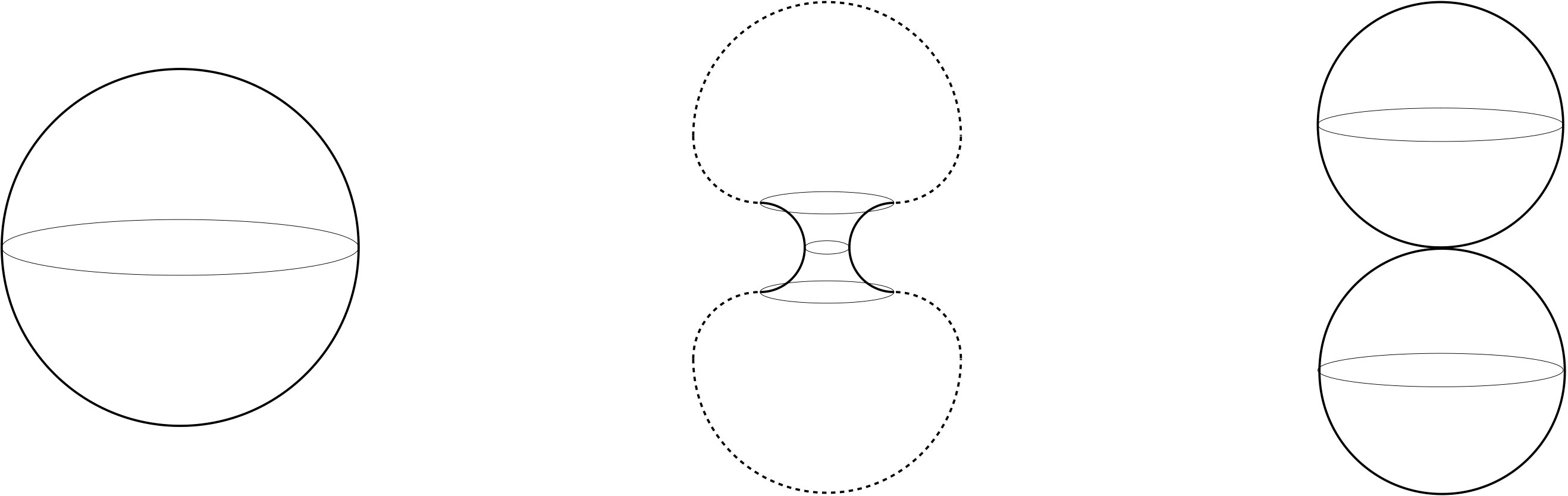 Figure 1
Peer Reviews
No public reviews on file for this paper yet. If you reviewed it on a platform where reviews are public (OpenReview, ICLR, NeurIPS, ICML), you can paste yours below so the community can read it here.
Videos
No videos yet. Explain this paper in a talk, walkthrough, or lecture? Add one.
Pfaffian integrals and invariants of singular varieties
Paolo Aluffi
and
Mark Goresky
Dedicated to Lê Dũng Tráng on the occasion of his 70th birthday
Department of Mathematics, Florida State University, Tallahassee, FL
School of Mathematics, Institute for Advanced Study, Princeton NJ
1. Introduction
1.1.
Chern classes of singular varieties have enjoyed an enormous development over the last forty years with hundreds of published papers and a number of books dedicated to the subject. The simple nature of the Gauss Bonnet theorem has received less attention, after a short announcement in [8]; see also [23], [25], [9]. In [6, 7], Alexandr Buryak studies the more general case of characteristic numbers for singular varieties, showing that any collection of characteristic numbers can be realized by a singular complex projective variety. In this paper we reformulate some of the statements in [8, 7] and give a number of extensions, applications and examples as we now describe.
Let be an dimensional complex projective algebraic variety and let be the nonsingular part. Let denote the smooth differential -forms on . Endow with the Kähler metric that is induced from the Fubini Study metric on the ambient projective space. Associated to this metric there is a unique torsion-free (Levi Civita) connection and its curvature -form with values in the endomorphism bundle of the tangent bundle . Let
[TABLE]
be the Pfaffian -form of the underlying real vector bundle with connection. If is compact and nonsingular, then the Gauss Bonnet theorem states that the integral
[TABLE]
is equal to the Euler characteristic of . In the noncompact case, however, this is far from true. It does not even seem obvious, a priori, that the above integral is finite, or that it is independent of the embedding in projective space.
1.2.
In [17], R. MacPherson defines, for each point , the local Euler obstruction . It is constant as the point varies within any stratum of a Whitney stratification of and has become a well studied local invariant of singular spaces.
1.3 Theorem**.**
Choose a Whitney stratification of so that is the largest stratum. Then the Gauss Bonnet integral is equal to the following sum,
[TABLE]
(where the sum is over singular strata and where ). It is an integer, is independent of the embedding, and is constant within any (Whitney) equisingular ([15]) family.
This result is extended to higher Chern classes in Proposition 2.5 and proven in §3. Our argument relies on the Nash blow-up (the same strategy is also used in [7]). In §4 we give an intrinsic interpretation of the integral, relying on controlled differential forms rather than Nash blow-up. The more general case of characteristic numbers is treated in §5, and extended to degrees of products of Mather Chern classes. We prove that the information carried by the degrees of Mather Chern classes is equivalent to a suitable collection of Pfaffian integrals. In §6 we answer a query of Robert Langlands concerning the behavior of the Gauss Bonnet integral in a flat family. In §7 we briefly mention natural extensions.
1.4.
We are grateful to Robert Langlands for asking these questions and for prompting us to publish these results. We wish to thank Jörg Schürmann for reviewing an earlier version of this note and for informing us of the work of Alexandr Buryak ([6, 7]).
We are pleased to dedicate this paper to Lê Dũng Tráng in recognition of his tremendous influence on singularity theory.
2. Higher Chern classes
2.1.
Suppose, as in the introduction, that is the nonsingular part of a complex projective variety equipped with the Fubini Study metric and associated Levi Civita connection and curvature form . The total Chern form
[TABLE]
is a sum of homogeneous terms of even degree, and the degree part, denoted , is equal to times the -th elementary symmetric function of the eigenvalues of .
2.2.
Let be the Nash blowup of ; it is defined to be the closure of the image of in the Grassmann bundle of dimensional subspaces of the tangent bundle of , under the Gauss map . The tautological -plane bundle on when restricted to is a vector bundle, denoted , that extends the tangent bundle . Let denote its -th Chern class. Recall [17] that the Mather Chern class of is the homology class whose component of dimension is
[TABLE]
where denotes the fundamental (orientation) class of .
2.3.
Each point corresponds to an -dimensional subspace of and so it inherits a Hermitian metric from the Fubini Study metric on . Thus, not only does the tangent bundle of extend to a vector bundle on but also the Kähler metric on extends to a Hermitian metric on the budle . We would like to say that the canonical connection and its curvature 2-form also extends to but unfortunately this variety may still be singular (although it may be possible, with some work, to make sense of these notions in this setting). We avoid these technical difficulties by passing to a resolution of singularities
[TABLE]
of the Nash blowup .
2.4.
The Hermitian metric on pulls back to a Hermitian metric on the vector bundle . Let be the associated connection; it therefore extends the Levi Civita connection on . Let denote its curvature 2-form (with values in ) and let
[TABLE]
be the corresponding total Chern form on with its associated cohomology class Let denote the augmentation.
2.5 Proposition**.**
The homology class
[TABLE]
coincides with the (total) Mather Chern class of . Consequently the Gauss Bonnet integral
[TABLE]
is equal to the degree zero part of the Mather-Chern class.
Proof.
The usual Chern Weil theorem describes the Chern class of as follows:
[TABLE]
Therefore
[TABLE]
which proves equation (2.5.1). For a complex rank vector bundle (such as ) the top Chern form agrees with the Pfaffian (see, for example, [2] p. 186), that is,
[TABLE]
Moreover, the differential form on is smooth. It agrees with on , and has measure zero. So the degree zero part of equation (2.5.1) becomes
[TABLE]
3. Proof of Theorem 1.3
3.1.
As in [17], the Euler obstruction determines an isomorphism from the group of algebraic cycles on to the group of constructible functions on by
[TABLE]
The (MacPherson) total Chern class of a constructible function is defined to be . It follows that the Mather Chern class of is the MacPherson Chern class of the constructible function that is . Proposition 2.5 says that the Gauss Bonnet integral is equal to the degree zero part of this class which is therefore the Euler characteristic of this constructible function , giving equation (1.3.1).
3.2.
The Euler obstruction is constant on strata of a Whitney stratification ([4]) and it is independent of the embedding so the right side of (1.3.1) is independent of the embedding and is constant within any Whitney-equisingular family. (In fact, the Nash blowup is independent of the embedding and can be defined intrinsically on according to [19].) This completes the proof of Theorem 1.3. ∎
4. The map to homology
4.1.
It is possible to give an intrinsic description of the manner in which the differential form gives rise to a homology class in in equation (2.5.1), without referring to the Nash blowup. We give an outline only because the result uses various technicalities involving Whitney stratifications, and it is not essential for the development in this paper.
4.2.
For any Whitney stratification of and for an associated choice of control data ([26, 18]) there is a collection of controlled differential forms ([27, 10]). A controlled differential -form (with real coefficients) is a differential -form on each stratum with the property that, whenever are strata, then where is the projection function of a tubular neighborhood of . The controlled differential forms constitute a complex whose cohomology is naturally isomorphic to the ordinary cohomology .
4.3 Lemma**.**
Fix a Whitney stratification and control data on . Fix with and let be the -th Chern form on . For any controlled differential form ,
[TABLE]
Proof.
Each controlled differential form extends canonically to a smooth differential form in a neighborhood of . It follows that if is a resolution of singularities then pulls back to a smooth differential form on . Using the resolution of the Nash blowup as described in Proposition 2.5 above, we conclude that
[TABLE]
4.4.
Thus, each Chern form determines a homomorphism that vanishes on boundaries, and hence defines a class in the dual space , which is easily seen to agree with the Mather Chern class.
5. Other curvature integrals
5.1.
For any partition , the Mather Chern number is the integer .
5.2 Proposition**.**
Let be a partition of . Then
[TABLE]
that is, the integral of this product of Chern forms equals the corresponding Mather Chern number.
The proof is the same as that of Proposition 2.5.∎
Proposition 5.2 is also proven in [7].
One can also define a product of any collection of Mather Chern classes, as the push-forward
[TABLE]
in .
5.3.
The (algebraic) degree of an integral homology class is the unique integer such that where denotes a codimension linear subspace of .
5.4 Proposition**.**
Let denote the Kähler form on that is induced from the ambient projective space. Then the degree of the Mather Chern class is given by the integral,
[TABLE]
Equation (5.4.1) follows from the fact that the class represented by the Kähler form is the Poincaré dual of the homology class represented by a hyperplane. ∎
5.5.
The numbers may be used to determine the Gauss Bonnet integrals
[TABLE]
over a generic codimension linear section , and vice versa. (Here, is the curvature form on .) Let
[TABLE]
be the Mather Chern (Poincaré) polynomial and let
[TABLE]
be the Pfaffian polynomial. Define an involution on the set of polynomials of fixed degree, by
[TABLE]
5.6 Proposition**.**
The involution interchanges the Mather Chern polynomial with the Pfaffian polynomial:
[TABLE]
The proof follows the same lines as that of Theorem 1.1 in [1]; the key technical step is the good behavior of the Mather Chern class with respect to generic linear sections, which follows for example from Lemma 1.2 in [20].∎
6. Behavior in families
6.1.
We now consider the behavior of the Pfaffian integral along a smoothing family for . Localizing the integral in tubular neighborhoods of components of the singular locus of in a smoothing family leads to expressions for invariants of the singularity in terms of Pfaffian integrals.
As above, denotes a projective variety of dimension , with nonsingular part . We will let be the singular locus of . Suppose that is the central fiber of a flat family over a disk centered at [math]. We let denote the fiber over and we assume that is nonsingular for all ; thus is a smoothing of . We will further assume that is projective. It follows from the first isotopy lemma of R. Thom ([18]) that is topologically locally trivial over .
A metric is induced on the tangent spaces to as above, and to every for in a neighborhood of [math]. We have an induced connection on each , with curvature and Pfaffian .
6.2 Proposition**.**
Denote by the -tubular neighborhood of . Then
[TABLE]
As above, the sum is over the strata contained in , and denotes the (common) value of the local Euler obstruction at points of the stratum . Similarly, denotes the value at of Verdier’s specialization function , see [28, §3]. (We assume that is locally constant along strata.) Explicitly,
[TABLE]
where is the -ball centered at . Note that both and equal away from . Therefore their difference is supported on .
If may be realized as a hypersurface in a flat family with nonsingular fibers, then every fiber , is itself a hypersurface of a nonsingular variety. If has isolated singularities, then Proposition 6.2 admits the following particularly explicit formulation, which recovers a formula of R. Langevin ([14, Theorem 1]):
6.3 Corollary**.**
In the situation considered above, assume that , are hypersurfaces of nonsingular varieties and that . Then
[TABLE]
where denotes the Milnor number at and is a general hyperplane through .
In particular, the left-hand-side is independent of the smoothing.
6.4.
We prove Proposition 6.2 and Corollary 6.3.
Proof of Proposition 6.2..
Consider the complements of the tubular neighborhood. For all positive near [math] the integral
[TABLE]
is a continuous function of near [math], therefore
[TABLE]
by Proposition 2.5. On the other hand, let for any near [math]. (By hypothesis, this number does not depend on .) Then
[TABLE]
by the ordinary Gauss Bonnet formula. Since , this gives
[TABLE]
Arguing as in §3.1,
[TABLE]
By Verdier’s specialization theorem [28, Théorème 5.1], we have, for near [math]:
[TABLE]
Identities (6.4.1) and (6.4.2) complete the proof of Proposition 6.2. ∎
Proof of Corollary 6.3.
For an isolated hypersurface singularity,
[TABLE]
as a consequence of [21, Proposition 5.1]. On the other hand,
[TABLE]
as proven in [22] (also cf. [8, Remarque, p. 240]). The formula in Corollary 6.3 follows then immediately from Proposition 6.2. ∎
6.5.
Assume now that is a hypersurface in a nonsingular projective variety, with a single singular point , and that is a smoothing family as above. If is a general hyperplane through , then is a smoothing family for over (a possibly smaller disk) , satisfying the same hypotheses as . (In fact the set of parameter values such that fails to be transversal to the fiber is algebraic, hence finite. By shrinking if necessary we may assume that it contains no such points.) Iterating, we can find general hyperplanes through such that
[TABLE]
satisfies the same hypotheses for (perhaps at the price of further reducing the radius of the disk ).
Assume this is the case and let . We have fibers and corresponding Pfaffians for . We let be one further general hyperplane; the intersection
[TABLE]
is then zero-dimensional. It consists of an -tuple point at , where is the multiplicity of at , and of a set of reduced points.
6.6 Corollary**.**
Let be a hypersurface in a projective nonsingular variety; assume has an isolated singularity , of multiplicity and Milnor number . Then with notation as above:
[TABLE]
Proof.
We can evaluate each summand by using Corollary 6.3. This shows that the left-hand side equals
[TABLE]
that is (‘telescoping’) , as stated. ∎
An integral formula for the Milnor number was obtained by Phillip Griffiths ([11], [12]; and see [16, p. 207]). It would be interesting to establish a direct relation between the two formulas.
6.7 Example**.**
The simplest example illustrating the situation considered here is probably a family of nonsingular conics degenerating to the union of two lines, in . Topologically, smooth conics and complex projective lines are -spheres; as , the degeneration may be pictured as follows.
where the saddle in the middle depicts the intersection with an -polydisk centered at . In this example, the integral in the left-hand side of (6.6.1) may be evaluated explicitly; as , it converges to
[TABLE]
and hence to as . According to Corollary 6.6,
[TABLE]
i.e., (as it should).
7. Extensions and further questions
7.1.
For simplicity of exposition we assumed that is projective, but Theorem 1.3 applies to subvarieties of any algebraic Kähler manifold.
7.2.
In fact, an analogue of Proposition 2.5 holds (with the same proof) for the Mather Chern class of any coherent sheaf ([24], [13]) realized as a quotient of a locally free sheaf , with respect to any hermitian metric defined on the vector bundle of sections of the dual .
7.3.
Homology classes cannot, in general, be multiplied together. Therefore, multiplicativity properties of Mather Chern classes are subtle. It follows from [3] and [5] that these classes lift canonically to middle intersection homology, giving a well defined homology-valued product of any two such classes. Proposition 5.2 provides an invariant interpretation of any top-degree product of Mather Chern classes and, as observed there, a product of any collection of Mather-Chern classes may be defined by means of a corresponding product in the Nash blow-up. We do not know whether the vector space spanned by these products of Mather Chern classes forms a natural well-defined ring within the homology .
7.4.
Pontrjagin classes of compact complex manifolds also admit Chern-Weil descriptions, and the signature of such a manifold may be expressed as a (rational) linear combination of Chern numbers, hence as a curvature integral. If is a singular variety, the same linear combination of Mather-Chern numbers is defined and by Proposition 5.2 it is given by the same curvature integral over the nonsingular part, . Is this number an integer? What is the relation between this number and the (intersection homological) signature of ?
The reference list from the paper itself. Each links out to its DOI / PubMed record.
- 1[1] P. Aluffi, Euler characteristics of general linear sections and polynomial Chern classes. Rend. Circ. Mat. Palermo (2), 62 (2013), 3–26.
- 2[2] W. Ballman, Lectures on Kähler Manifolds Esi Lectures In Mathematics And Physics 2 (2006) European Mathematical Society.
- 3[3] G. Barthel, J.-P. Brasselet, K.-H. Fieseler, O. Gabber and L. Kaup, Relevement de Cycles Algebriques et Homomorphismes Associes en Homologie d’Intersection, Ann. of Math. (2) 141 (1995), no. 1, 147–179
- 4[4] J. P. Brasselet and M. H. Schwartz, Sur les classes de Chern d’un ensemble analytique complexe, Astérisque 82–83(1981), 93–148.
- 5[5] J. P. Brasselet and A. Weber, A canonical lift of Chern-Mather classes, preprint, http://ar Xiv.org/alg-geom/9712023
- 6[6] A. Y. Buryak. Existence of a singular projective variety with an arbitrary set of characteristic numbers. Math. Res. Lett. , 17(3):395–400, 2010.
- 7[7] A. Y. Buryak, Bott’s residue formula for singular varieties, TWMS J. Pure Appl. Math., 2 (2011), 17–21
- 8[8] A. S. Dubson. Classes caractéristiques des variétés singulières. C. R. Acad. Sci. Paris Sér. A-B , 287(4):A 237–A 240, 1978.