Enhanced magnetic sensitivity with non-gaussian quantum fluctuations
Alexandre Evrard, Vasiliy Makhalov, Thomas Chalopin, Leonid A., Sidorenkov, Jean Dalibard, Raphael Lopes, Sylvain Nascimbene

TL;DR
This paper demonstrates that non-gaussian quantum states of dysprosium atoms can achieve magnetic sensitivity surpassing squeezed states and approaching the Heisenberg limit, using non-linear spin coupling and magnetic sublevel resolution.
Contribution
It introduces a method to create and measure non-gaussian quantum states with enhanced magnetic sensitivity in atomic spins.
Findings
Non-gaussian states outperform squeezed states in magnetic sensitivity.
Sensitivity reaches about half the Heisenberg limit.
Magnetic sublevel resolution is crucial for optimal measurement.
Abstract
The precision of a quantum sensor can overcome its classical counterpart when its constituents are entangled. In gaussian squeezed states, quantum correlations lead to a reduction of the quantum projection noise below the shot noise limit. However, the most sensitive states involve complex non-gaussian quantum fluctuations, making the required measurement protocol challenging. Here we measure the sensitivity of non-classical states of the electronic spin of dysprosium atoms, created using light-induced non-linear spin coupling. Magnetic sublevel resolution enables us to reach the optimal sensitivity of non-gaussian (oversqueezed) states, well above the capability of squeezed states and about half the Heisenberg limit.
Click any figure to enlarge with its caption.
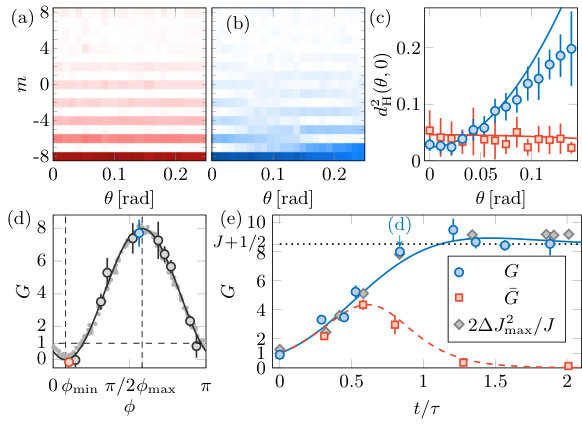 Figure 1
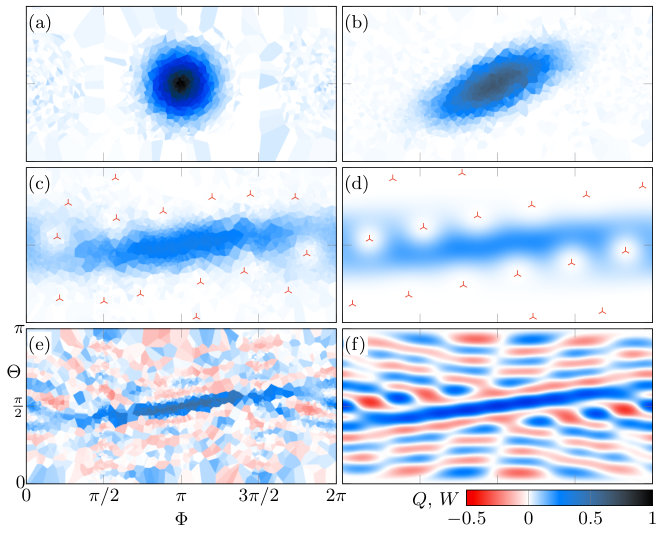 Figure 2
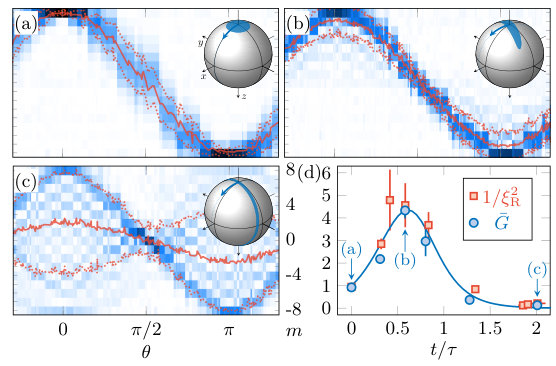 Figure 3
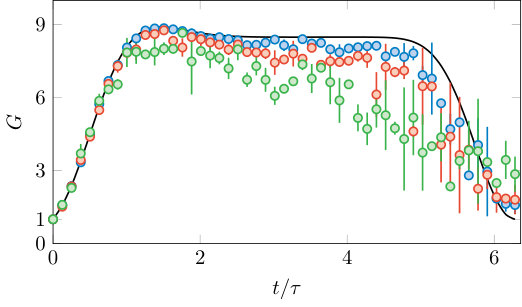 Figure 4
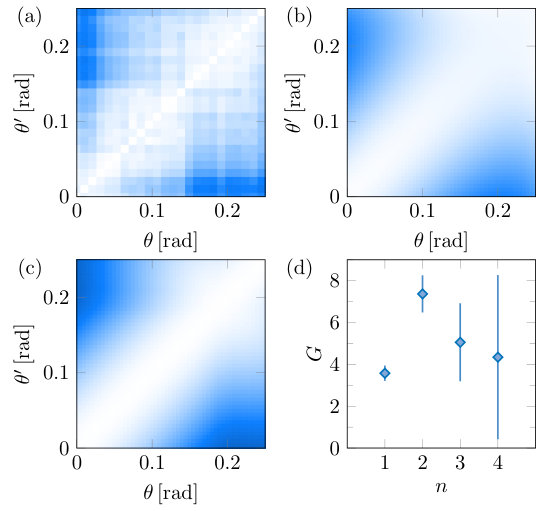 Figure 5
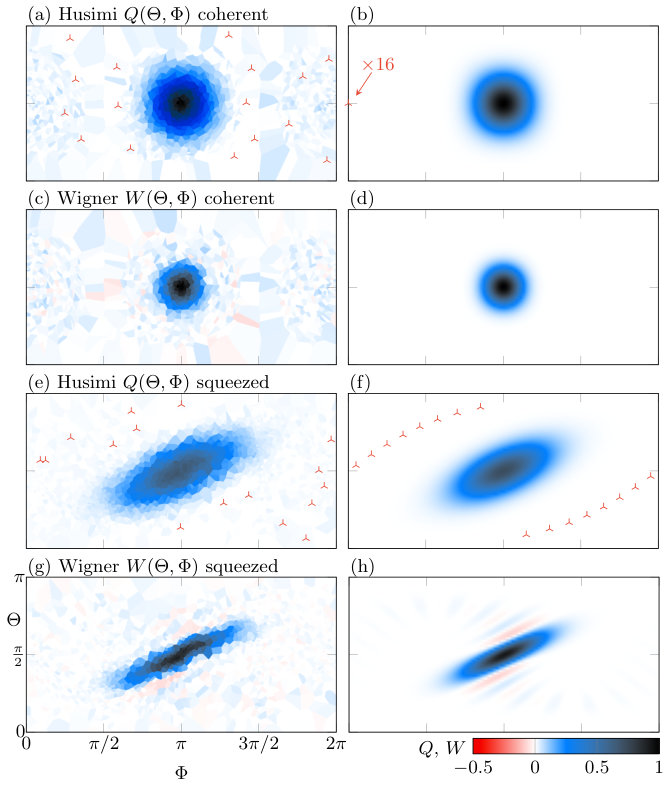 Figure 6
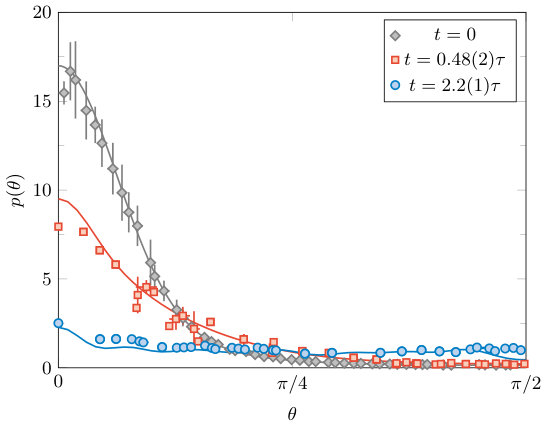 Figure 7
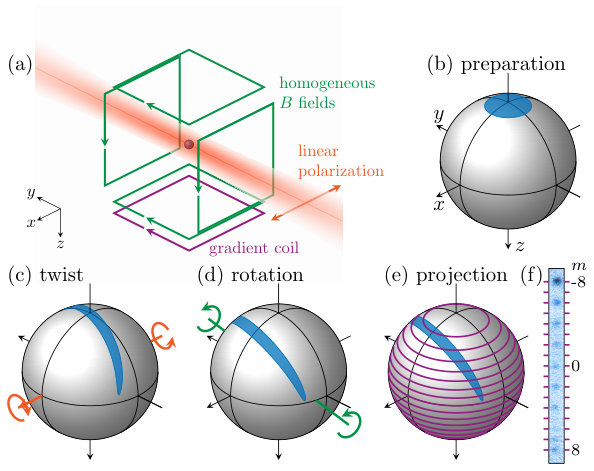 Figure 8
 Figure 9
Peer Reviews
No public reviews on file for this paper yet. If you reviewed it on a platform where reviews are public (OpenReview, ICLR, NeurIPS, ICML), you can paste yours below so the community can read it here.
Videos
No videos yet. Explain this paper in a talk, walkthrough, or lecture? Add one.
Taxonomy
TopicsAtomic and Subatomic Physics Research · Cold Atom Physics and Bose-Einstein Condensates · Quantum Information and Cryptography
Supplemental Material for:
Enhanced magnetic sensitivity with non-gaussian quantum fluctuations
Alexandre Evrard
Vasiliy Makhalov
Thomas Chalopin
Leonid A. Sidorenkov
LNE-SYRTE, Observatoire de Paris, Université PSL, CNRS, Sorbonne Université, 61 Avenue de l’Observatoire, 75014 Paris, France
Jean Dalibard
Raphael Lopes
Sylvain Nascimbene
Laboratoire Kastler Brossel, Collège de France, CNRS, ENS-PSL University, Sorbonne Université, 11 Place Marcelin Berthelot, 75005 Paris, France
I Robustness over non-linear coupling fluctuations
In the main text we discussed the realization of oversqueezed states for interaction times , leading to a metrological gain . The Heisenberg limit can in principle be reached at a time , corresponding to a Schrödinger cat state. We discuss here the robustness of the metrological gain for these two states with respect to fluctuations of the non-linear coupling .
We show in Fig. S.1 the metrological gain , numerically extracted following the experimental procedure discussed in the main text, as a function of , in the absence of noise (black line). We then compute the gain averaged over shot-to-shot fluctuations of with different r.m.s. amplitudes: 5 (blue), 10 (red), and (green). We observe that even in the case of large fluctuations (20 ) the expected metrological gain remains close to its ideal value at , falling solely to 7.8.
For the cat state a different procedure is required, as explained in Ref. Chalopin et al. (2018). In that case, for fluctuations’ amplitudes of = , the metrological gain falls from an ideal value of 16 to a value of approximately 9.
II Experimental protocol
Imaging calibration. Our imaging setup is such that the 17 magnetic sublevels have different cross-sections. To calibrate their effective Clebsh-Gordan coefficients, we prepare a set of spin-polarized samples with constant total atom number and various orientations on the Bloch sphere. We then choose the effective Clebsh-Gordan coefficients to minimize the variations of the calculated total number of atoms over the different state orientations.
Calibration of the diffusion time . We calibrate the diffusion time by applying the non-linear coupling for a set of interaction times and measuring the projection probabilities . We fit the measured probabilities with the variations expected from the one-axis twisting model, the diffusion time being the only free parameter. We checked that the fitted value of is consistent with a direct calculation based on the measured laser intensity and frequency detuning from the atomic resonance.
Magnetic pulses. Arbitrary spin rotations are performed by combining the free spin precession around the quantization field along , of amplitude 60.6(3)\text{,}\mathrm{m}\mathrm{G}, with ‘gate’ pulses of magnetic field along $y$, applied for a duration $\simeq$3\text{\,}\mathrm{\SIUnitSymbolMicro}\mathrm{s}. We mention that during the pulse duration the magnetic field induces a non-negligible Larmor rotation, equal to , that we take into account in the determination of the rotation angles.
Correction of magnetic field fluctuations. We first use an active stabilization of the magnetic field to decrease residual magnetic field fluctuations below (r.m.s. value). The remaining fluctuations are measured using a three-axis magnetic field probe placed about 10 cm away from the atoms. They evolve on a timescale of 10\text{,}\mathrm{m}\mathrm{s}$$, slow compared to the entire spin evolution, and can therefore be treated as a constant. We account for this offset in the data analysis for the calculation of Larmor rotation angles.
III Fit of the Hellinger distance data
The metrological gain is extracted from the measured Hellinger distance in the following way. We fit the experimental data with a polynomial in the two variables and of order , as
[TABLE]
The metrological gain is deduced from the curvature of the fit around , as (see Eq. (4) of the main article). We tested several values of the order . As shown in Fig. S.2d, an order produces significant systematic shifts, while orders leads to an increase of statistical error bars. We thus choose the value for all data analysis presented in the main article. An example of Hellinger distance data, corresponding to the data shown in Fig. 4b of the main article, is displayed in Fig. S.2a, together with its polynomial fit (Fig. S.2b) and the values predicted within the one-axis twisting model for (Fig. S.2c).
IV Husimi and Wigner functions
We provide here both the theoretical and measured Husimi functions along with their fitted zeroes (red stars) and Wigner functions for a coherent state and a squeezed state, corresponding to interaction times and , respectively.
The zeroes are not fitted correctly for the coherent state (see Fig. S.3a), for which we expect all zeros to be located at the north pole (see Fig. S.3b). However, the quantum state corresponding to the fitted Husimi function has a squared overlap of 0.99 with the coherent state . This illustrates the difficulty to determine the position of the zeroes of the Husimi function located in small-amplitude regions due to background noise. The zeroes are better fitted for a squeezed state, as they are located closer to large-amplitude regions of phase space (see Fig. S.3e, S.3f).
We also show the Wigner functions for a coherent and squeezed state in Fig. S.3c, S.3g. For the squeezed state, we measure faint fringes with negative-amplitude regions consistent with theory.
V Purity measurement
The measured spin projection probabilities can be used to directly evaluate the purity of the prepared spin states without having to reconstruct the full density matrix .
According to spin tomography theory, the density matrix of a quantum spin can be reconstructed from integration of the probabilities over the Bloch sphere, as D’Ariano et al. (2003)
[TABLE]
where denotes the unit sphere. The purity can then be written as Filippov and Man’ko (2013)
[TABLE]
where we define . We evaluate the integral (S.5) from a discrete set of independent measurements sampling the sphere . We show in Fig. S.4 the quantity obtained after a first integration over the azimutal angle , i.e.
[TABLE]
such that
[TABLE]
The quantity measured for coherent, squeezed and oversqueezed states matches well the expected values within the one-axis twisting model. Integrating over the variable , we obtain purity values , 1.00(3) and 1.01(4) respectively. Thanks to the symmetry , it is sufficient to compute for . The error bars are determined using a bootstrap sampling method.
The reference list from the paper itself. Each links out to its DOI / PubMed record.
- 1Chalopin et al. (2018) T. Chalopin, C. Bouazza, A. Evrard, V. Makhalov, D. Dreon, J. Dalibard, L. A. Sidorenkov, and S. Nascimbene, Nat. Commun. 9 , 4955 (2018) . · doi ↗
- 2D’Ariano et al. (2003) G. M. D’Ariano, L. Maccone, and M. Paini, J. Opt. B: Quantum Semiclass. Opt. 5 , 77 (2003) . · doi ↗
- 3Filippov and Man’ko (2013) S. N. Filippov and V. I. Man’ko, J Russ Laser Res 34 , 14 (2013) . · doi ↗