Planes in four space and four associated CM points
Menny Aka, Manfred Einsiedler, Andreas Wieser

TL;DR
This paper studies the distribution of certain geometric and lattice objects associated with rational planes in four-dimensional space, proving their equidistribution under specific conditions using advanced ergodic theory results.
Contribution
It introduces a new framework connecting rational planes, Grassmannians, and lattices, and applies recent ergodic theory results to prove their simultaneous equidistribution.
Findings
Proves simultaneous equidistribution of associated objects under splitting conditions
Establishes connections between rational planes and lattice structures in four-space
Utilizes recent results on algebraicity of joinings for the proof
Abstract
To any two-dimensional rational plane in four-dimensional space one can naturally attach a point in the Grassmannian Gr(2,4) and four lattices of rank two. Here, the first two lattices originate from the plane and its orthogonal complement and the second two essentially arise from the accidental local isomorphism between SO(4) and SO(3)xSO(3). As an application of a recent result of Einsiedler and Lindenstrauss on algebraicity of joinings we prove simultaneous equidistribution of all of these objects under two splitting conditions.
Click any figure to enlarge with its caption.
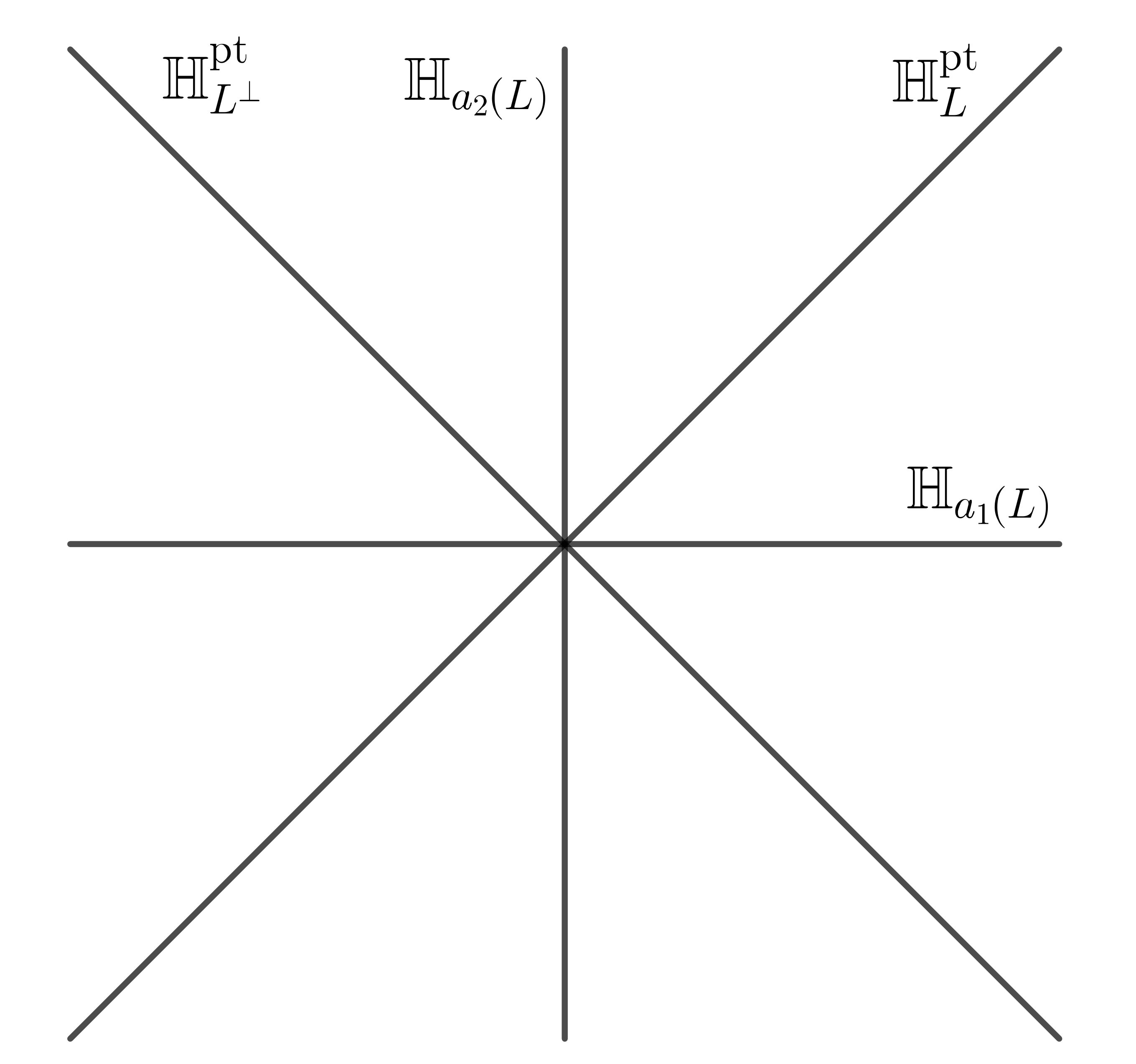 Figure 1
Peer Reviews
No public reviews on file for this paper yet. If you reviewed it on a platform where reviews are public (OpenReview, ICLR, NeurIPS, ICML), you can paste yours below so the community can read it here.
Videos
No videos yet. Explain this paper in a talk, walkthrough, or lecture? Add one.
Taxonomy
TopicsFinite Group Theory Research · Quasicrystal Structures and Properties · graph theory and CDMA systems
Planes in four space and four associated CM points
Menny Aka
,
Manfred Einsiedler
and
Andreas Wieser
Departement Mathematik, ETH Zürich, Rämistrasse 101, 8092 Zürich, Switzerland
Abstract.
To any two-dimensional rational plane in four-dimensional space one can naturally attach a point in the Grassmannian and four shapes of lattices of rank two. Here, the first two lattices originate from the plane and its orthogonal complement and the second two essentially arise from the accidental local isomorphism between and . As an application of a recent result of Einsiedler and Lindenstrauss on algebraicity of joinings we prove simultaneous equidistribution of all of these objects under two splitting conditions.
The authors were supported by the SNF (grants 152819 and 178958).
1. Introduction
For a rational two-dimensional subspace of we define the discriminant of as the square of the covolume of in , i.e.
[TABLE]
For any we let be the finite set of rational planes of discriminant , which is a subset of the real Grassmannian . The set is non-empty if and only if
[TABLE]
(see Corollary 2.7). This statement should be seen as an analogue of Legendre’s theorem for sums of three squares and relates to works of Mordell [Mor32, Mor37] and Ko [Ko37] on representations of binary forms as sums of four squares.
We let denote the hyperbolic plane and call the quotient Y_{0}(1)=\mathchoice{\text{\lower 2.15277pt\hbox{\operatorname{SL}_{2}(\mathbb{Z})}\big{\backslash}\raise 2.15277pt\hbox{\mathbb{H}^{2}}}}{\operatorname{SL}_{2}(\mathbb{Z})\,\backslash\,\mathbb{H}^{2}}{\operatorname{SL}_{2}(\mathbb{Z})\,\backslash\,\mathbb{H}^{2}}{\operatorname{SL}_{2}(\mathbb{Z})\,\backslash\,\mathbb{H}^{2}} the modular surface. Note that
[TABLE]
is a two-to-one quotient of the modular surface obtained by using the orientation reversing reflection through the imaginary axis.
To each we will naturally attach a four-tuple of CM-points on . We conjecture that the set
[TABLE]
is equidistributing to the natural uniform measure on the product space
[TABLE]
when with . In this paper we prove this conjecture under additional congruence conditions. In particular, our result implies the conjecture on average.
Let us now describe the points for in more details. First, consider for any rational plane the two-dimensional lattices
[TABLE]
In order to compare these lattices for different planes, we now choose a rotation moving to and to . The shape (resp. ) is then defined to be the homothety class of the lattice (resp. ) and is as such a well-defined element of (as it is independent of the choice of rotation ). These are the points from above. Indeed, (resp. ) may be thought of as the equivalence class of the integral positive definite binary quadratic form which is the restriction of the form to (resp. ). As such they correspond to CM-points. Due to the geometric construction we will refer to them as the geometric CM points attached to .
The points and come from a natural identification of the Grassmannian with the space
[TABLE]
where if there is with . Note that is a two-to-one quotient of a product of two spheres.
To describe the above identification, it is useful to view as the algebra of real Hamiltonian quaternions
[TABLE]
which is equipped with a conjugation given by and a trace given by for . Furthermore, we identify with the traceless quaternions, i.e. quaternions of the form for . Then,
[TABLE]
is a diffeomorphism where for are given by
[TABLE]
We choose to call the map in (1.1) the Klein map; the name is inspired by the name ’Klein quadric’ for the projective variety obtained from by applying the Plücker embedding. The points as defined here depend on the choice of basis but the equivalence class does not. Furthermore, if is rational and are a -basis of the resulting vectors are integer vectors. As we will explain later, this yields that the subset is (almost) in bijection with a set of points where are vectors of length .
Remark 1.1*.*
The Klein map arises naturally through the accidental local isomorphism between the groups and (and hence also ) as follows. If and is the connected component of the stabilizer subgroup of under the action of on (essentially through the local isomorphism), then the projection of to either of the factors of must be a one-dimensional torus. Any such one-dimensional torus is the stabilizer of a point in the adjoint representation of i.e. the isogeny . The two points we obtain in this way are exactly and (up to multiples as described above) – see Proposition 2.2. It is also worthwhile noting that the above procedure is how the explicit formulas for the Klein map were found.
The identification between and in (1.1) leads to the construction of the following two lattices. For we define . Fixing a copy of in we can rotate these two-dimensional lattices to it to obtain the shapes and , two well-defined points on . Again, these also correspond to CM-points when viewed as the class of the binary form obtained by restriction of the ambient form . We will refer to and as the accidental CM points attached to .
Conjecture 1.2**.**
The normalized counting measure on the finite set
[TABLE]
equidistributes to the uniform probability measure on as with . That is,
[TABLE]
in the weak∗-topology where is the probability measure obtained from an -invariant measure on and an -invariant measure on .
Our main theorem verifies this conjecture under extra congruence conditions:
Theorem 1.3** (Equidistribution for a given discriminant).**
Let be any two distinct odd primes. The normalized counting measure on the finite set equidistributes to the uniform probability measure on as goes to infinity while satisfies the additional condition that is a non-zero square modulo and modulo .
First results in the spirit of this theorem have previously been obtained by Maass [Maa56], [Maa59] and Schmidt [Sch98], who establish the averaged equidistribution of the pairs , where varies over the rational planes of discriminant up to . Recently, Horesh and Karasik [HK20] have obtained equidistribution of the tuples in this averaged setup. All of these results are polynomially effective in . In an upcoming preprint, the authors prove together with Luethi and Michel [AEL*+*21] effective equidistribution of the tuples for using a different method.
Here, we obtain as a corollary of the above theorem the following ineffective strengthening of these results:
Corollary 1.4** (Averaged equidistribution).**
The normalized counting measure on the finite set
[TABLE]
equidistributes to the uniform probability measure on as .
First non-averaged results as in Theorem 1.3 have been established by Linnik [Lin68] and Skubenko [Sku62] (with a congruence condition at one prime) and Duke [Duk88] (building on work of Iwaniec [Iwa87] and without any congruence condition). Duke’s theorem shows equidistribution of integer points on two-dimensional spheres and of CM-points on .
We use these results to obtain the equidistribution on the individual factors of our space. Using a theorem [EL19, Thm. 1.4] of the second named author with Lindenstrauss we then upgrade this information to joint equidistribution. This method of proof has already been used in the work [AES16b] of the first and the second named author with Shapira. Note that the proof of Theorem 1.3 (much like the main result in [AES16b]) can currently not be adapted to provide an error rate as in [Maa56, Maa59, Sch68, Sch98, HK20, AEL*+*21].
Remark 1.5*.*
Our techniques also yield a version of Theorem 1.3 for oriented subspaces, see Theorem 7.1 for the statement. The authors find Theorem 1.3 to be the geometrically more appealing version of these theorems which is why it is presented as the main result, though Theorems 1.3 and 7.1 are (certainly from the dynamical viewpoint) morally equivalent. Given an oriented rational subspace, one can associated to it shapes in the modular curve which are (as opposed to the above points) truly complex multiplication points.
Remark 1.6*.*
Our main motivation for the study of the sets has been geometric. As it turned out, the construction of the CM-points has a rather surprising relation to the group law of the Picard group of an order in . In this way our equidistribution result also has an arithmetic counterpart, see Theorem 8.1. To describe a slightly simpler but analogous result, write for the CM point associated to a proper ideal class of a quadratic order . Then sets of tuples
[TABLE]
where vary over proper ideal classes of are equidistributed in when the discriminant of goes to infinity (given two splitting conditions). There are no clear dependencies between the coordinates of these tuples (in the ambient space ) which is a good reason to suspect this equidistribution statement. The same cannot be said about Theorem 1.3 a priori.
Remark 1.7* (Glue groups).*
We would also like to remark that the proof of our theorem can be used to strengthen our result. In fact, Theorem 1.3 can be formulated to consider only planes , whose glue group is of a fixed isomorphism type (see Theorem 9.1). Here, the glue group of a lattice is an invariant which captures additional information on the lattice including the discriminant (see e.g. McMullen [McM11] or Section 9 for definitions).
Remark 1.8* (Extensions).*
Theorem 1.3 can be generalized to arbitrary quaternion algebras (or rather norm forms on quaternion algebras). In [ACW20], the first and last named authors together with Horace Chaix generalize the above results to arbitrary quadratic forms using the language of Clifford algebras.
Higher-dimensional analogues of the above results have been covered in joint work of first and last author with Andrea Musso [AMW21]. The result there does not involve any accidental shapes, but is stronger in a sense comparable to [AES16a], [Kha19a].
1.1. Outline of the paper
This paper is organized as follows:
- •
In Section 2 we study properties of the Klein map (including the statements made above). This yields important information about the related stabilizer groups which play a crucial role in our dynamical argument.
- •
In Section 3 we discuss in more detail the four CM points attachted to each plane.
- •
In Section 4 we define the joint acting group for the dynamical setup and formulate a dynamical version (Theorem 4.2) of Theorem 1.3.
- •
In Section 5 we use the orbit of the stabilizer in order to generate additional points starting from one point (Propositions 5.1 and 5.2) and apply this to prove Theorem 1.3 assuming Theorem 4.2.
- •
In Section 6 we use the fact that any limit measure coming from Theorem 4.2 is a joining for a higher rank torus action and the algebraicity of such joinings [EL19] to deduce the theorem.
- •
In Sections 8 and 9 we explain further connections to existing work and in particular the above mentioned connection to the Picard group and to glue groups.
- •
In Appendix A we prove the averaged version (Corollary 1.4) of the main theorem. In Appendix B we study the Klein map in the case of the split quaternion algebra .
Acknowledgements: We would like to thank Elon Lindenstrauss, Ilya Khayutin and Philippe Michel for discussions on this paper. We are also very grateful to Curtis McMullen for suggesting a refinement of our theorem with respect to glue groups. Last but not least, we would like to thank the referees for many useful comments, for their very careful reading of this article, and for making us realize that we need to emphasize the naturality of the Klein map more.
2. The Klein map
In the following discussions we let denote a field of characteristic zero.
2.1. Hamiltonian quaternions
As in the introduction, we denote by the variety defined over representing the -algebra of Hamiltonian quaternions. We let be the canonical involution (henceforth also called conjugation), the (reduced) trace, and the (reduced) norm form. For any , and
[TABLE]
writing . As already mentioned we will identify with the four-dimensional affine space and in particular write . A quaternion with zero trace is said to be pure and will often be viewed as a point in three-dimensional space. The variety representing pure quaternions will be denoted by .
We equip with the integral structure arising from the choice of basis : we set
[TABLE]
and define for any prime . Under the above identification we have . Note that is a non-maximal order in ; it is contained with index two in the order of Hurwitz quaternions which is generated by , , , and . Furthermore, we let and similarly for .
Denote by
[TABLE]
the algebraic -group of norm one elements of and observe that the action of on given by preserves the norm. This yields a -isogeny (and in particular a local isomorphism of the groups and ), where the kernel is given by . In what follows, we shall always mean by the special orthogonal group for the sum of squares.
The action of on pure quaternions by conjugation (i.e. by ) gives an isogeny with kernel . Identifiying with the Lie algebra of , this is the adjoint representation. We define to be the composition of this isogeny with the respective coordinate projections .
Remark 2.1*.*
There are various integral structures on which would be naturally in the context of this article. Set for the purposes of this remark
[TABLE]
These finite groups satisfy as well as
[TABLE]
The group is the product of the group of units in the (maximal) order of Hurwitz quaternions with itself. In particular, .
We write for the projective Grassmannian variety of two-dimensional subspaces in four-space. In particular, the set can be identified with the set of two-dimensional -subspaces in (i.e. planes containing zero). Given a subspace and a -algebra we will write .
Under the identification of with the four-dimensional affine space, the action of on induces naturally an action on . The action is not transitive but there is an open and dense orbit, namely the Zariski open set of non-degenerate subspaces . Here, a subspace is non-degenerate if . As is positive definite on , all rational subspaces are contained in .
For any we set to be the Zariski connected component of the stabilizer subgroup of . In particular, for any -algebra
[TABLE]
The restriction of to resp. yields an isogeny as is connected. In particular, is a two-dimensional algebraic torus defined over . Furthermore, for any we define the one-dimensional -torus to be the stabilizer subgroup of . Thus, for any -algebra
[TABLE]
2.2. Definition of the Klein map
We define
[TABLE]
where if there exists with . Also, observe that acts on via where denotes the equivalence class of in . Note that is the set of -points of a quasi-projective variety defined over . In the following we will use the definition of and from Equation (1.4).
Proposition 2.2** (Klein map).**
The map
[TABLE]
*is a well-defined bijection and is equivariant for the actions of . The inverse of is given by111 The fact that (2.1) defines a subspace is not trivial and uses the crucial information that are pure and of the same length. We note that the formula has appeared in a slightly different context in [EMV13] in order to realize the action of the class group on integer points on the -dimensional sphere. *
[TABLE]
for all . Furthermore, we have the following properties:
- •
* for any .*
- •
* for any where denotes the orthogonal complement with respect to .*
Proof.
To see that is well-defined, observe first that for any with basis and for defined as in (1.4) using , we have
[TABLE]
and analogously
[TABLE]
Furthermore, as the maps
[TABLE]
(that are used to define in (1.4)) are bilinear and antisymmetric, it follows that does not depend on the choice of the basis of .
To verify the equivariance property, let and with basis . Then and applying (1.4) for this basis yields
[TABLE]
Similarly, and therefore is equivariant.
To see that the map defined in (2.1) is equal to the inverse of we first show that is equivariant too. Indeed, using the substitution we get
[TABLE]
Let denote an algebraic closure. As acts transitively on and and both and are equivariant, it suffices to verify and at one point. Direct computations show that as well as for and we obtain that is a bijection with inverse for and also for .
The formula for the stabilizers follows from equivariance as for any
[TABLE]
By orthogonality this shows that if and only if there is with and . As is defined to be the connected component of the stabilizer, this shows the desired equality.
For the second property (which could also be verified using equivariance one more time) observe that and thus for . Since the stabilizer of a line within determines the line, we must therefore have and for some . Since and have the same value for , we have . This shows
[TABLE]
so that as . ∎
2.3. Associated integer points
Given any rational plane the points defined using a -basis of the lattice are in fact also integral by (1.4). Furthermore, the bilinearity and antisymmetry in (2.5) show that they are well-defined up to changing signs simultaneously. If not stated otherwise, we will construct for rational planes in this fashion and will refer to these points as the integer points associated to .
Recall that the discriminant of for a rational plane was defined as the square of the covolume of . Alternatively, the discriminant of may be defined as the discriminant of the restriction of the quadratic form to . Recall that the discriminant of a quadratic form with -coefficients is given by the determinant of any matrix representation of the form.
Lemma 2.3** (Equality of discriminants).**
For any we have
[TABLE]
Proof.
Representing in a basis of as
[TABLE]
we obtain . The lemma thus follows from Equation (2.2). ∎
Notice that if is square-free and , the associated integer points are in fact both primitive, since by Lemma 2.3 any integer with would satisfy and similarly for .
For non-square-free we have the following notion, which serves as a replacement of this observation. We say that a pair of vectors is pair-primitive if or for all odd primes and if or .
In fact we will see examples below where the integer points associated to a plane behave differently with respect to the prime , but not too differently as pair-primitivity implies that one of the vector and is not integral.
Lemma 2.4** (Pair primitivity).**
*The integer points associated to a rational plane are pair-primitive. Furthermore, they satisfy . *
Proof.
The antisymmetry of the bilinear maps in (2.5) shows that factors through the Plücker embedding
[TABLE]
Moreover, has an integral structure given by . Furthermore, for any the wedge is primitive if and only if222This can be seen for instance using the Smith normal form; see also [Cas97, Ch. 1, Lemma 2] for a concrete proof. is a basis for where . If this is the case, we may retrieve the wedge from , . In fact, identifying via the standard (integral) basis a direct calculation using bilinearity of and the maps in (2.5) shows that
[TABLE]
where for .
We will now use this to prove the lemma. For the claims concerning the prime notice that as is integral and therefore . (This can also be seen directly from the definition in (1.4).) Furthermore, if then contradicting primitivity of .
If is an odd prime with then and therefore . This contradicts again primitivity of and shows that are pair-primitive. ∎
Before discussing the appropriate converse to Lemma 2.4 (see Proposition 2.6 below), we would like to point out that the integer points associated to a plane need not be primitive in general. The same is true for the restriction of the ambient quadratic form to , which can in fact be non-primitive even for square-free discriminants.
Example 2.5**.**
- (a)
The plane has square-free discriminant and primitive associated integer points and . However, the form is represented by (in the given basis) and thus non-primitive. 2. (b)
The plane of discriminant has associated integer points and , both of which are non-primitive. Furthermore, the quadratic form is represented by the non-primitive form . 3. (c)
The associated integer points of the plane of discriminant are the non-primitive vector and the vector . This shows that Lemma 2.4(a) cannot be improved to include indivisibility of each vector by odd primes. In the given integral basis of the form is represented as .
We will return to these primitivity questions in Section 9.2 where we will reformulate them in terms of glue groups. Such a reformulation is however not necessary for the proof of Theorem 1.3.
To help the reader we will usually point out the stronger statements for square-free discriminants. In this case, the associated integer points are primitive (and not only pair-primitive) and the quadratic forms on the lattices in question are primitive except possibly for the common divisor (cf. Proposition 3.1, Lemma 3.4 and Example 2.5(a) above).
2.4. Integrality properties of the Klein map
Proposition 2.6** (Pair primitivity, converse claim).**
Given pair-primitive with the rational plane has associated integer points if and otherwise.
Moreover, for any the orthogonal complement has associated integer points and discriminant .
Proof.
Write and choose by Proposition 2.2 coprime integers with and . Since is pair-primitive, we must have that is not divisible by any odd prime. Furthermore, is also not divisible by . Otherwise, the equality
[TABLE]
combined with (see Lemma 2.4) shows that contradicting again the pair-primitivity of . Thus, .
Repeating the same argument for the integer (without any congruence condition on modulo ), we see that is not divisible by any odd prime and not divisible by . If then the above argument shows that . If then as .
Now let . Then one applies the first part to the pair to deduce that (which is equal to by Proposition 2.2) indeed has associated integer points . In fact, we have and pair-primitivity by Lemma 2.4.∎
The complete correspondence (established by Lemma 2.4 and Proposition 2.6) between
- •
pairs of integer points up to common sign, which have the same length and are pair-primitive and congruent modulo and
- •
rational planes
allows us to prove a claim from the beginning of the introduction.
Corollary 2.7**.**
For any the set is non-empty if and only if is not congruent to [math], , or (i.e. ).
In particular, if is not divisible by (e.g. if is square-free) and , then the corollary says that is non-empty. The proof will essentially consist in applying the above correspondence (i.e. Lemma 2.4 and Proposition 2.6) and Legendre’s theorem, which states that a number can be written as for primitive if and only if .
Proof.
Lemma 2.4 and Proposition 2.6 together imply that is non-empty if and only if there exists a tuple that is pair-primitive with and .
Assume first that . We claim that in this case the pair-primitive tuple exists if and only if . In fact, if the pair-primitive tuple exists, the vectors represent as a sum of three squares which implies . Conversely, we apply Legendre’s theorem to find a primitive vector and set the second integer equal to .
So suppose now that . Then the set is non-empty if and only if there exists pair-primitive with and . In fact, if then and are integer vectors as and are not congruent mod by pair-primitivity of , see Lemma 2.4. For the converse one can apply Proposition 2.6 to .
We claim that there is such a pair if and only if i.e. . Indeed, if satisfies and then and have only even entries. Similarly, if the vectors have only odd entries. In either case, and are congruent mod . Conversely, if there is a primitive vector with by Legendre’s theorem. By assumption on , must have an even and an odd entry so that switching two coordinates yields a vector with , and pair-primitive.
This proves the corollary in both cases and . ∎
Remark 2.8*.*
If one considers dimensions with and the analogously defined set of rational subspaces of dimension in of discriminant , one can show by elementary means using an induction technique from [Sch68] that is never empty – see [AMW21]. The authors are however not aware of any counting results as in Corollary 2.9 below.
The above can also be used to obtain a count on the number of points in .
Corollary 2.9**.**
For any we have .
Proof.
We denote by the number of integer vectors on the sphere of radius and by the number of primitive integer vectors. Our first goal is to recall that
[TABLE]
It is a consequence of Siegel’s lower bound [Sie36] that is of the size when is square-free. In this case, the class group of the ring of integers in acts freely and transitively on a quotient of by a subgroup of (see [EMV13, Prop. 3.5]).
Assume now that is not necessarily square-free and write where is the largest square-free divisor of . Then one can express (see e.g. [CH07]) the number as
[TABLE]
where runs over the odd prime divisors of and denotes the Legendre symbol. From this, one deduces that .
Finally we recall that the number of divisiors of is . Summing over for all square divisors of we obtain the upper bound in (2.6).
In particular, (2.6) implies that as the integer points associated to a plane are uniquely determined up to a simultaneous sign and are of norm .
If and is any pair of primitive integer points of norm , there exists such that . Thus, concluding the proof in this case.
If and is any pair of primitive integer points of norm there exists such that (since ). Therefore, we have also in this case. ∎
2.5. Pointwise stabilizers
For any plane define the pointwise stabilizer subgroup of as the connected -group stabilizing any point in . In particular, for any -algebra
[TABLE]
The proof of the dynamical version of Theorem 1.3 will use the fact that the subgroup exhibits a “-degree” twist with respect to the subgroups , . Let us illustrate this in an example first (see also Section B).
Example 2.10**.**
Consider the plane and let be an element of where is a -algebra. In particular, fixes or in other words . Furthermore, we have . This shows that
[TABLE]
Similarly, we claim that
[TABLE]
For this, let . Since is contained in (see Proposition 2.2), we have . Furthermore, by assumption or equivalently . However, notice that and therefore as acts by conjugation on the plane .
In general the following holds:
Lemma 2.11** (Pointwise stabilizers).**
Let be a non-degenerate plane and let be any element with . Then
[TABLE]
for any -algebra .
We remark that for any invertible the element has the property333Alternatively, recall that the projective group of invertible quaternions is isomorphic over to via the action by conjugation on (see [Vig80, Thm. 3.3]). Thus there exists with by Witt’s theorem, see e.g. [Cas78, p. 21]. required in the lemma (see Proposition 2.2). Such an element exists as is non-degenerate.
Proof.
Let be such that . Applying Proposition 2.2 we have
[TABLE]
and in particular . By Example 2.10
[TABLE]
so that is the graph of the morphism given by conjugation with . Furthermore, notice that
[TABLE]
Hence, and one may replace by in the above (recall that is abelian) to obtain the first part of the lemma.
The second part follows analogously by noting that and applying Example 2.10 again. ∎
We finish this section by clarifying the meaning of the assumed congruence conditions in Theorem 1.3.
Lemma 2.12**.**
Let be a rational plane. If is an odd prime so that , then is a split torus of rank two.
Proof.
Let be any vector with and note that there is an isomorphism of -algebras mapping to some traceless of determinant . Indeed, the norm form of is isotropic over so that is not a division algebra and hence isomorphic to [Voi20, Prop. 7.6.2]. The stabilizer subgroup is thus isomorphic to
[TABLE]
By assumption and by Hensel’s lemma the characteristic polynomial of has two distinct, non-zero roots in so is diagonalizable over . Thus, is a one-dimensional split torus.
By Lemma 2.3 one can apply the above to and . The claim then follows as by Proposition 2.2. ∎
3. CM-points
3.1. Defining the shapes
We recall that denote the factor maps from to respectively using the first or second factor, see Section 2.1. In the following we identify with row vectors in using the basis and with row vectors in using the basis . In particular, we choose to let act on row vectors via . Observe that this action simply corresponds to the usual action on column vectors.
Let us now fix a plane for some . We choose an integer matrix whose first two rows form a basis of and fix an isometry with . In particular, this also implies by orthogonality, respectively
[TABLE]
by the equivariance of the isomorphism in Proposition 2.2. Then we have
[TABLE]
Here, we used that for any viewed as a row vector the vector corresponds to when viewed as an element of and that where is identified with . The shape of is defined as
[TABLE]
where is the projection onto the upper left block and where as in the introduction
[TABLE]
Note that the definition of the shape is independent of the choices of and .
Similarly, one can choose a matrix whose last two rows form a basis of so that
[TABLE]
Denoting by the projection onto the lower right block the shape of is
[TABLE]
which is again independent of the choice of and .
As in the introduction, the shapes and will be called the geometric CM points attached to . By Proposition 2.6 the plane also has discriminant and so
[TABLE]
By adapting and we may assume that these determinants are positive. We note that in case is not square-free the discriminant of the geometric CM points may be a divisor of instead of itself, we will explain this in detail in Proposition 3.1 below.
Define as in the introduction the orthogonal lattices and . If is square-free, and are primitive and the orthogonal lattices have discriminant (c.f. [AES16b, p. 379]). Otherwise, the discriminant of these lattices are the squared lengths of primitive vectors in resp. . Let be a matrix whose last two rows are a basis of and define analogously for . The above choices together with (3.1) yield
[TABLE]
Denoting by the projection onto the lower right block we obtain the shapes
[TABLE]
which are independent of the choices made. These are the accidental CM points attached to . Note that an analogous construction defines the shape of an orthogonal lattice for any primitive integer point .
3.2. CM points and relationship to shapes
The notions shapes of two-dimensional lattices, binary quadratic forms and CM-points are related as we now explain. Recall that acts on positive definite binary forms via
[TABLE]
preserving the discriminant. In particular, acts on integral binary forms; we will denote by the orbit equivalence classes for the latter action. For any equivalence class associated to a positive definite integral form we obtain a well-defined point (called a CM point)
[TABLE]
which doesn’t depend on the choice of representative and which satisfies for any .
Given a rational plane the (potential) point is typically not well-defined as a point of . Indeed, if is a representation of in a basis, then so is which is in the -orbit (when the action is extended) but not typically in the same -orbit. The two points and are related by and one can check that the class of in the two-to-one quotient
[TABLE]
of is independent of the choice of basis. We view the CM point for a class as an element of whenever there is no ambiguity.
Using the basis of contained in one can represent the quadratic form by
[TABLE]
Similarly, we represent the form by
[TABLE]
Both binary forms and have discriminant as by Proposition 2.6.
Proposition 3.1** (Geometric CM points).**
Let for . Then
[TABLE]
and analogously .
*If is square-free, either is a primitive integral form or is a primitive integral form. *
The situation for non-square-free discriminants will be analyzed later (see Proposition 3.2) using local considerations.
Proof.
Let us first prove the statement in the proposition concerning the CM points , . For this we apply a similar argument as in [AES16b, p. 391-392]. Write for the first two rows of and note that
[TABLE]
for , and where denotes the (standard) bilinear form induced by . Furthermore, set . By definition, we have , and . As is the covolume of (see (3.2)), we further note that
[TABLE]
To compute a representative of in we may also conjugate with to obtain
[TABLE]
For the equality we note that the discriminant of is also by Proposition 2.6 so that the above proof applies.
For the second part of the proposition assume that is square-free. We recall that by definition . This implies that for any odd prime (as otherwise ) and as claimed. ∎
3.3. Local analysis at odd primes
Here, we generalize the second part of Proposition 3.1 addressing primitivity issues of for to non-square-free discriminants .
If is not square-free, the form might be non-primitive and the discriminant444By definition of the discriminant in Section 2.3, the discriminant of a binary quadratic form is given by . of the primitive forms might be much smaller than . In the proposition to follow we will compute the discriminant of the form .
Given a binary integral form and a prime we denote by the largest integer for which is integral. Similarly, given a vector we let for a prime be the largest integer with . We also set to be the primitive integer vector in the half-line .
Proposition 3.2** (Geometric CM points and non-square-free discriminants).**
Let for . Then
[TABLE]
for any odd prime and . Furthermore, the discriminant of the primitive form (or ) satisfies
[TABLE]
The proposition essentially says that the quadratic form inherits the “arithmetic complexity” from the integer points of the plane . More precisely, if one of the vectors and is “very non-primitive” then the same will hold for the form. This fact is also reflected in Lemma 2.11. We also note that the statement at the prime could be sharpened. This however is not needed for the proof of (3.3).
Let be a fixed odd prime (the statement for the prime will be a simple consequence of the congruence condition ). Then the quaternion algebra is split over as the norm form is isotropic [Voi20, Prop. 7.6.2] so that we have and in fact . Under this fixed isomorphism, conjugation on corresponds to the adjunct on , the (reduced) trace to the usual trace on matrices and the (reduced) norm to the determinant. Now note that the Klein map (see Proposition 2.2) was defined using only these operations and can thus be defined for two-dimensional subspaces of as well555In fact, the Klein map makes sense for two-dimensional subspaces of any quaternion algebra. In principle, the arguments of this paper carry over to yield a more general statement about such planes and the induced shapes (for the norm form) – see also Remark 1.8.. We will therefore freely identify the resulting Klein map for with the Klein map for .
Let be the set of two-dimensional subspaces in with666As for subspaces we define the discriminant of any as the discriminant of where . For -integral forms the discriminant is defined up to multiples in . and note that acts on (preserving in fact also -equivalence class of the form for any ). Observe also that the Klein map using an integral basis associates to any a pair of vectors with , which is well-defined up to simultaneous multiples in .
Lemma 3.3**.**
Let . Then there is some such that
[TABLE]
for some with and .
Proof.
Choose a basis of for which . We may assume without loss of generality that which implies by pair-primitivity. (Otherwise, one can replace by which interchanges and .)
In order to obtain a plane of the desired form we use equivariance of the Klein map. Note that the action of on the set of primitive vectors with for some fixed non-zero has at most two orbits which can be represented by
[TABLE]
Here, where a non-square in . In fact, one shows that acts transitively on the above set of vectors, and the matrices and are not conjugate by a matrix in if and only if divides (see also the proof of [EMV13, Prop. 3.7]).
Applying this to and to find such that
[TABLE]
for some . A direct computation using either the Klein map on (3.4) or its inverse on (3.6) shows that is of the form desired in the lemma where we set and . ∎
Proof of Proposition 3.2.
Let be an odd prime and let . Furthermore, let be chosen as in Lemma 3.3 for and set
[TABLE]
Clearly, is -equivalent to . In the orthogonal basis for of Lemma 3.3 the form is represented by . Since , we obtain as claimed.
For the statement at the prime note that for any we have
[TABLE]
as .
To prove Equation (3.3) note that by pair-primitivity
[TABLE]
as claimed (where is used in order to ignore the prime ). ∎
3.4. Accidental CM points
As for the geometric CM points, we use the basis of contained in to represent via the binary form . The form is defined analogously. As mentioned, in [AES16b, p. 391-392] and [AES16a, Lemma 3.3] (in the non-square-free case) a discussion similar to Proposition 3.1 was carried out for the shapes and , which we summarize in the following lemma.
Lemma 3.4** (Accidental CM points).**
Let and set . Then we have .
If , the quadratic form is primitive. If , the quadratic form is integral and primitive. Furthermore, .
4. The dynamical formulation of the theorem
4.1. The joint acting group
In this section we first determine the stabilizer subgroups for the CM points associated to a given rational plane and use these to define the acting group appearing in the dynamical version of Theorem 1.3.
Let and let . For any -algebra and we (trivially) have
[TABLE]
Moreover, for any the matrix preserves by definition and therefore is of the block-form \big{(}\scriptsize\begin{array}[]{c|c}\ast&0\\ \hline\cr\ast&\ast\end{array}\big{)}. Projecting this to the upper left block we obtain a homomorphism given by
[TABLE]
defined over . Notice that the image of lies indeed in as is (by definition) connected. The map for should be thought of as the restriction of the action of to the plane represented in our basis of . Analogously, we have a homomorphism
[TABLE]
when projecting to the lower right block. Observe furthermore that is trivial if and only if and that is trivial if and only if . In Appendix B the above isogenies (and also the isogenies for the accidental CM points defined below) are computed explicitly in a special case.
For the accidental CM points the analogous morphisms are given by
[TABLE]
and are also defined over .
Overall, we define the -group to be the graph of the morphism
[TABLE]
For convenience, we set for any
[TABLE]
4.2. -arithmetic setup
For any locally compact group we denote by a Haar measure on . Furthermore, for a quotient \mathchoice{\text{\lower 2.15277pt\hbox{\Gamma}\big{\backslash}\raise 2.15277pt\hbox{G}}}{\Gamma\,\backslash\,G}{\Gamma\,\backslash\,G}{\Gamma\,\backslash\,G} by a lattice we write m_{\mathchoice{\text{\lower 1.50694pt\hbox{\Gamma}\big{\backslash}\raise 1.50694pt\hbox{G}}}{\Gamma\,\backslash\,G}{\Gamma\,\backslash\,G}{\Gamma\,\backslash\,G}} for the unique -invariant probability measure where acts via .
Given a set of places of we set to be the restricted product of the for and if . Furthermore, we set and . We also write (resp. ) for the ring of adeles (resp. finite adeles).
Let be a semisimple linear algebraic group defined over and let be a compact open subgroup. We say that has class number one (with respect to ) if
[TABLE]
If has strong approximation (as is the case for for any ), it has class number one with respect to any compact open subgroup of . We also remark that the class number one property yields that also has class number one with respect to any compact open .
In this paper we will consider the groups , and products of these. The integral structure on is the standard one inherited from viewing so that , for a prime , and so forth are made sense of. By the above, has class number one with respect to . The integral structure on is inherited from :
[TABLE]
and so on. Note that is maximal for and that is not maximal (cf. Section 2.1).
Lemma 4.1**.**
The group has class number one with respect to .
The lemma does not follow from strong approximation for as is compact. While it is non-essential for the methods of this article (and indeed not true for other quaternion algebras), the class number one property simplifies the notations in the following which is why we prove it here.
Proof.
For any prime let and let be the group of norm one units in the completion of the Hurwitz order . Note that for all odd primes . As the Hurwitz order is a principal ideal domain, has class number one with respect to – see [EMV13, p. 29].
We deduce from this the analogous property for . To this end, it suffices to show that for any there exists with . As for , it suffices to check this property at the prime which is what we do now by direct calculation. Let
[TABLE]
for . By definition of the Hurwitz order either for all or for all . In the former case, and we are done. So suppose that the latter case holds and let
[TABLE]
where for every . Then
[TABLE]
It is not too hard to see that one can choose the signs so that this (automatically integral) trace is divisible by which in turn implies that . ∎
For any semisimple -group the subgroup is a lattice by a theorem of Borel and Harish-Chandra when is embedded diagonally (see for example [PR94, Thm. 5.5]). If has an integral structure as in the above discussion (obtained for instance by embedding into some ) and is a set of places containing the archimedean place, is a lattice when embedded diagonally. Here and in the following we identify with its image under the diagonal embedding.
We will use the -arithmetic extensions
[TABLE]
of the real quotients \mathchoice{\text{\lower 2.15277pt\hbox{\operatorname{SU}{2}(\mathbb{Z})}\big{\backslash}\raise 2.15277pt\hbox{\operatorname{SU}{2}(\mathbb{R})}}}{\operatorname{SU}_{2}(\mathbb{Z})\,\backslash\,\operatorname{SU}_{2}(\mathbb{R})}{\operatorname{SU}_{2}(\mathbb{Z})\,\backslash\,\operatorname{SU}_{2}(\mathbb{R})}{\operatorname{SU}_{2}(\mathbb{Z})\,\backslash\,\operatorname{SU}_{2}(\mathbb{R})} and \mathchoice{\text{\lower 2.15277pt\hbox{\operatorname{SL}{2}(\mathbb{Z})}\big{\backslash}\raise 2.15277pt\hbox{\operatorname{SL}{2}(\mathbb{R})}}}{\operatorname{SL}_{2}(\mathbb{Z})\,\backslash\,\operatorname{SL}_{2}(\mathbb{R})}{\operatorname{SL}_{2}(\mathbb{Z})\,\backslash\,\operatorname{SL}_{2}(\mathbb{R})}{\operatorname{SL}_{2}(\mathbb{Z})\,\backslash\,\operatorname{SL}_{2}(\mathbb{R})}. For simplicity we write for . The class number one property for from Lemma 4.1 implies that we have for any two sets of places containing the archimedean place a map
[TABLE]
equivariant under by taking the quotient with from the right. Similarly, one obtains maps for .
We also define the -group
[TABLE]
which has class number one with respect to by the above. We equip any subgroup with the integral structure inherited from so that for instance . We set
[TABLE]
for any set of places containing the archimedean place.
4.3. Toral packets and the dynamical result
Let be a rational plane. Following the discussion in Section 4.1 we will study orbits in under the -points of the -group . First, let us consider the compact adelic orbit (it is compact as is anisotropic over ). The projection of this orbit to , where and , are two distinct odd primes is an example of a homogeneous toral packet, see [ELMV11, Sec. 4,5] for this terminology.
In order to normalize the behavior on the real quotient we choose for every plane an element such that
[TABLE]
and also consider the pushed packet . Furthermore, let be the pushforward of the normalized Haar measure on the shifted orbit to (under the natural projection to ).
In the following we shall call a sequence of rational planes in admissible (with respect to ) if the following conditions are satisfied:
- •
For every the discriminant satisfies the assumptions in Theorem 1.3 for the fixed primes .
- •
As goes to infinity
[TABLE]
go to infinity. Here, , denote the primitive vectors in the half-lines , as in Proposition 3.2.
We remark that the second condition is automatically satisfied if the discriminants are square-free or more generally if the square-free part of goes to infinity.
The following implies our main theorem (Theorem 1.3).
Theorem 4.2** (Equidistribution of packets).**
Let be an admissible sequence of rational planes. Then as .
5. Proof of the main theorem from the dynamical version
In this section we show that Theorem 4.2 does indeed imply Theorem 1.3. For this we will use adelic orbits of the form for some in order to generate additional points in as in Theorem 1.3 from one such point (see for instance [PR94, Thm. 8.2]).
Let be a rational plane. Recall that the class number
[TABLE]
of the group is finite (c.f. [PR94, Thm. 5.1]) and that has class number one (i.e. ). We may thus write
[TABLE]
for a finite set of representatives. Note that by construction the cardinality of is the class number of in (5.1).
We now construct points in \mathchoice{\text{\lower 2.15277pt\hbox{\operatorname{SU}{2}^{2}(\mathbb{Z})}\big{\backslash}\raise 2.15277pt\hbox{\mathcal{J}{D}}}}{\operatorname{SU}_{2}^{2}(\mathbb{Z})\,\backslash\,\mathcal{J}_{D}}{\operatorname{SU}_{2}^{2}(\mathbb{Z})\,\backslash\,\mathcal{J}_{D}}{\operatorname{SU}_{2}^{2}(\mathbb{Z})\,\backslash\,\mathcal{J}_{D}} using the above stabilizer orbit, where acts naturally on not affecting the other components. We will implicitly identify with the image in under the injective map
[TABLE]
and analogously for binary quadratic forms with rational coefficients. In the following, points will sometimes be written as for the corresponding elements and .
Proposition 5.1** (Generating integer points).**
Let be a rational plane and let with .
- (i)
The plane is rational and has the same discriminant as . Furthermore,
[TABLE] 2. (ii)
The quadratic form is an integral binary form and is equivalent to . The analogous statement also holds for , and .
It follows that for any we obtain a corresponding point in the set and in particular a rational plane .
Proof.
Choose and such that and write as in (4.1) for some .
To see (i) notice first that is rational as
[TABLE]
To compute the discriminant let , be a -basis of . Recall that for any group acting on a module there is a natural corresponding action of on given by for . We observe
[TABLE]
since preserves . As it follows that is integral.
To show primitivity we write for the -adic coordinate of . Then
[TABLE]
for all (for the maximum norm777To define the norm one chooses a -basis of and takes the maximum of -adic absolute values of the coordinates in this basis. on the wedge product). Therefore, is primitive. Hence, the Euclidean norm of is exactly the discriminant of . As the former is the Euclidean norm of which in turn is the discriminant of .
It remains to show the equality for the lengths of the primitive vectors. By the equivariance in Proposition 2.2, we have . As above, it follows from considering every prime that as a multiple of is primitive. Thus, as desired. The argument for is analogous.
For (ii) we begin by showing that is an integral form. To this end, we just note that
[TABLE]
where the form on the left has coefficients in and the form on the right has coefficients in . The analogous argument shows that is integral.
We now wish to show that and are equivalent. Recall that (as is implicit in the definition of resp. ) we have chosen a matrix (resp. ) so that the first two rows form a basis of (resp. ).
Now notice that
[TABLE]
where
[TABLE]
Observe that (acting on row vectors) maps to itself. Indeed, maps to , by (5.3) maps to , and finally maps back to . In other words, is of the block form \big{(}\scriptsize\begin{array}[]{c|c}\ast&0\\ \hline\cr\ast&\ast\end{array}\big{)}. Denoting by the projection onto the upper left block (as in Section 3.1) the above calculation can be summarized as .
We want to show that . To see that is integral, we use the third component of together with (4.1) to obtain
[TABLE]
We note that is a block matrix with [math] in the right top -by- block, which implies that the upper left block
[TABLE]
and hence also are invertible. This implies that as claimed.
This concludes (ii) for . The argument to verify that is equivalent to is completely analogous.
For the remaining copies one can use the equivariance property in Proposition 2.2 to reduce the statement to [AES16b, Prop. 3.2]. ∎
For we have by definition of the generated planes in Proposition 5.1 that for , and and the analogous statement holds for the binary forms. The function
[TABLE]
which maps for and to and the attached CM points is thus well-defined (i.e. independent of the choice of ).
Call a plane exceptional if the finite group strictly contains where denotes the full stabilizer subgroup.
Proposition 5.2** (On the collection of generated points).**
Let for .
- (a)
Every fiber of the map in (5.4) is a union of at most two -orbits. 2. (b)
Amongst the fibers in (5.4) of non-exceptional planes the number of -orbits is equal. 3. (c)
The set of exceptional planes in has size as most . 4. (d)
The volume of the -orbit through is independent of .
We will call the image of (5.4) the packet attached to and denote it by . Clearly, if two points lie on the same -orbit, they give rise to the same point in \mathchoice{\text{\lower 2.15277pt\hbox{\operatorname{SU}{2}^{2}(\mathbb{Z})}\big{\backslash}\raise 2.15277pt\hbox{\mathcal{J}{D}}}}{\operatorname{SU}_{2}^{2}(\mathbb{Z})\,\backslash\,\mathcal{J}_{D}}{\operatorname{SU}_{2}^{2}(\mathbb{Z})\,\backslash\,\mathcal{J}_{D}}{\operatorname{SU}_{2}^{2}(\mathbb{Z})\,\backslash\,\mathcal{J}_{D}}. By Proposition 5.1(ii) it suffices to prove the analogous statement to (a) and (b) for the fibers of the map
[TABLE]
To this end, we will use the following lemma.
Lemma 5.3**.**
Define the group
[TABLE]
Then the fiber of the map (5.5) through any point is equal to . If we denote by the number of -orbits in the fiber , we have
[TABLE]
Proof of Lemma 5.3.
By definition of and the generated planes in Proposition 5.1, the fiber through a point contains . Conversely, if is another point in the fiber through , we write and for elements and replace if necessary so that . Then is an element of and satisfies . Moreover, since is normal
[TABLE]
and so as claimed.
For the second part, write for . Then
[TABLE]
Now note that by definition of and integrality of . Also, we have that . Indeed, for any the element is in and
[TABLE]
In particular, and using normality of in equality holds. We conclude that
[TABLE]
which proves the second part of the lemma. ∎
Proof of Proposition 5.2.
To prove the claim in (a) notice first that by (5.6) it suffices to estimate the index . To do the latter, observe that if satisfies then . Indeed, we can write the point as for and so there is with . Thus, and since we further have so that . This proves that . As the index of in is , and (5.6) implies the claim in (a).
To see (b), note that if the plane generated by is non-exceptional, we have which is contained in the center. In this case, (5.9) implies that equality holds in (5.6). Since the right hand side in (5.6) is independent of the point , this proves (b).
For (c) it suffices to show that for any the number of planes with is of size . We distinguish two cases.
- •
There exists a two-dimensional irreducible subspace for the action of . In this case, must act as a rotation on and hence and where . Suppose without loss of generality that . In this case, its action on pure quaternions by conjugation is non-trivial and hences fixes a unique rational line. Therefore, we have that for any with and in particular for any two such as the norms agree. Using the Klein map the only ’free’ choice is thus in the vector . The set of all such must be thus bounded by the number of vectors with which is .
- •
Any irreducible subspace for the action of has dimension . Thus, the action of on is diagonalizable and has determinant one. As , there must be exactly one two-dimensional subspace such that and . If is a plane with then either or . In the latter case, is a reflection when restricted to and therefore (see (2.5)) and . This shows that and as act by orthogonal transformations and preserve resp. . So this case corresponds to counting the number of representations of by an integral binary form, which is of order (cf. [Cas78, p. 372]).
Thus, the number of such pairs is . This proves (c).
For (d) observe that for any
[TABLE]
where was chosen with and where we used that is abelian in the second equality. ∎
Remark 5.4* (Decomposing into packets).*
Note that given two planes the question whether or not can be generated from as in Proposition 5.1 is equivalent to asking whether or not and exist with . This defines an equivalence relation and hence we can decompose the set \mathchoice{\text{\lower 2.15277pt\hbox{\operatorname{SU}{2}^{2}(\mathbb{Z})}\big{\backslash}\raise 2.15277pt\hbox{\mathcal{J}{D}}}}{\operatorname{SU}_{2}^{2}(\mathbb{Z})\,\backslash\,\mathcal{J}_{D}}{\operatorname{SU}_{2}^{2}(\mathbb{Z})\,\backslash\,\mathcal{J}_{D}}{\operatorname{SU}_{2}^{2}(\mathbb{Z})\,\backslash\,\mathcal{J}_{D}} into disjoint packets.
Let for . We now project the set in (5.2) onto the -arithmetic quotient to obtain the packet of orbits
[TABLE]
invariant under . The union is still disjoint: If , have the same image in there exists and with . In particular, this equation at the infinite place yields so that as desired. Note that the projection (5.4) factors through the projection to .
Proof of Theorem 1.3 assuming Theorem 4.2.
For any plane choose an element with . By Theorem 4.2 we know that along any admissible sequence . In particular, the convergence holds after pushforward to the real quotient and to
[TABLE]
For any and we let be the normalized sum of Dirac measures over the packet \mathcal{P}(L)\subseteq\mathchoice{\text{\lower 2.15277pt\hbox{\operatorname{SU}{2}^{2}(\mathbb{Z})}\big{\backslash}\raise 2.15277pt\hbox{\mathcal{J}{D}}}}{\operatorname{SU}_{2}^{2}(\mathbb{Z})\,\backslash\,\mathcal{J}_{D}}{\operatorname{SU}_{2}^{2}(\mathbb{Z})\,\backslash\,\mathcal{J}_{D}}{\operatorname{SU}_{2}^{2}(\mathbb{Z})\,\backslash\,\mathcal{J}_{D}} attached to – see Proposition 5.2. By part (b)-(d) of that proposition and by Corollary 2.9, the pushforward measure on to and differ for by at most as the weights of these measures on need to be changed by at most on exceptional planes only. So the measures are also equidistributing as .
Since is -invariant, by a similar argument the sets equidistribute in if and only if the sets \mathchoice{\text{\lower 2.15277pt\hbox{\operatorname{SU}{2}^{2}(\mathbb{Z})}\big{\backslash}\raise 2.15277pt\hbox{\mathcal{J}{D}}}}{\operatorname{SU}_{2}^{2}(\mathbb{Z})\,\backslash\,\mathcal{J}_{D}}{\operatorname{SU}_{2}^{2}(\mathbb{Z})\,\backslash\,\mathcal{J}_{D}}{\operatorname{SU}_{2}^{2}(\mathbb{Z})\,\backslash\,\mathcal{J}_{D}} equidistribute in . We claim that the latter is true.
To see this, write the set \mathchoice{\text{\lower 2.15277pt\hbox{\operatorname{SU}{2}^{2}(\mathbb{Z})}\big{\backslash}\raise 2.15277pt\hbox{\mathcal{J}{D}}}}{\operatorname{SU}_{2}^{2}(\mathbb{Z})\,\backslash\,\mathcal{J}_{D}}{\operatorname{SU}_{2}^{2}(\mathbb{Z})\,\backslash\,\mathcal{J}_{D}}{\operatorname{SU}_{2}^{2}(\mathbb{Z})\,\backslash\,\mathcal{J}_{D}} for with
[TABLE]
as a disjoint union of packets – see Remark 5.4. Let be the union of the packets attached to planes with and . Recall from Corollary 2.9 that \mathchoice{\text{\lower 2.15277pt\hbox{\operatorname{SU}{2}^{2}(\mathbb{Z})}\big{\backslash}\raise 2.15277pt\hbox{\mathcal{J}{D}}}}{\operatorname{SU}_{2}^{2}(\mathbb{Z})\,\backslash\,\mathcal{J}_{D}}{\operatorname{SU}_{2}^{2}(\mathbb{Z})\,\backslash\,\mathcal{J}_{D}}{\operatorname{SU}_{2}^{2}(\mathbb{Z})\,\backslash\,\mathcal{J}_{D}} is of size . Also, observe that the number of pairs of primitive integer points where one of the points has quadratic value at most is of size (see the proof of Corollary 2.9). Thus, the sets \mathchoice{\text{\lower 2.15277pt\hbox{\operatorname{SU}{2}^{2}(\mathbb{Z})}\big{\backslash}\raise 2.15277pt\hbox{\mathcal{J}{D}}}}{\operatorname{SU}_{2}^{2}(\mathbb{Z})\,\backslash\,\mathcal{J}_{D}}{\operatorname{SU}_{2}^{2}(\mathbb{Z})\,\backslash\,\mathcal{J}_{D}}{\operatorname{SU}_{2}^{2}(\mathbb{Z})\,\backslash\,\mathcal{J}_{D}} equidistribute if and only if the subsets equidistribute.
However, by Theorem 4.2 and the above discussion any sequence of packets equidistributes since
[TABLE]
(which implies admissibility of the underlying planes ). This implies that the sets equidistribute (as finite unions of equidistributing subsets) and hence concludes the proof of Theorem 1.3. ∎
6. Proof of Theorem 4.2
Let be a sequence of admissible planes so that the sequence of measures converges to a measure . We want to show that is the normalized Haar measure on X_{S}=\mathchoice{\text{\lower 2.15277pt\hbox{\mathbb{G}(\mathbb{Z}^{S})}\big{\backslash}\raise 2.15277pt\hbox{\mathbb{G}(\mathbb{Q}_{S})}}}{\mathbb{G}(\mathbb{Z}^{S})\,\backslash\,\mathbb{G}(\mathbb{Q}_{S})}{\mathbb{G}(\mathbb{Z}^{S})\,\backslash\,\mathbb{G}(\mathbb{Q}_{S})}{\mathbb{G}(\mathbb{Z}^{S})\,\backslash\,\mathbb{G}(\mathbb{Q}_{S})}. Since the limit is then independent of the arbitrarily chosen sequence , this implies Theorem 4.2. To prove that we will use the fact that the pushforward of under all projections to the factors in is the Haar measure on the respective factor and then apply a joinings classification of Lindenstrauss and the second named author [EL19].
Proposition 6.1** (Limit measures are joinings).**
The push-forward of under any projection for is the Haar measure on . In particular, is a probability measure.
This proposition should be seen as a version of Duke’s Theorem [Duk88] or its strengthenings to subcollections (see specifically [HM06]). Indeed, as we project on a factor, we obtain subsets of toral packets for a form of . Since we assume splitting conditions, individual equidistibution may be proven by means of Linnik’s ergodic method [Lin68], since the total volume of the packets we consider is large enough in each factor. In the following we give more details to this reasoning.
In the case , the proposition amounts to showing that projected to equidistributes to the Haar measure. This is a version of Duke’s theorem for the form of – see for example [ELMV11, Thm. 4.6], [HM06] or [Wie19, Thm. 7.1] (as we are assuming splitting conditions). We remark that as we consider the simply connected cover (instead of the adjoint group ), we are considering not the whole Picard group attached to the quadratic order defined by , but rather the set of squares in it [Wie19, Lemma 7.2]. Since the -torsion of the Picard group has size (see e.g. [Cas78, p. 342]), the squares form a subgroup of size which is why one can still apply Linnik’s ergodic method (as is done in [Wie19, Thm. 7.1]).
For (and similarly ) the image under projection to could potentially be ’small’ in comparison to . The following lemma rules this out and hence one may apply the same theorems cited above.
Lemma 6.2** (About the image).**
Let be a field with and let . The maps and are surjective. In particular, the natural map induced by
[TABLE]
is surjective (and similarly for ).
We remark that the isogenies and are not surjective on -points. In fact, the image of the -points is the set of squares and a similar statement holds for the induced map on class groups. We refer to [Wie19, Sec. 7.1.1] for a thorough discussion of this, see also [EMV13, Sec. 4.2]. This lack of surjectivity is inconsequential in the subsequent arguments as the -torsion of the class group is small.
Proof of Lemma 6.2.
It suffices to show that the restriction of to is a -isomorphism. Now note that the kernel of is and thus trivial by Lemma 2.11. As an injective -homomorphism between -tori of rank is a -isomorphism. (We remark that the inverse can be explicitly constructed in the case at hand.) ∎
In the case or we correspondingly see the set of fourth powers. This is due to the orthogonal complement construction – see for instance [EMV13, Sec. 4.2] and the way it is used in [AES16b]. The -torsion of the Picard group is still of size so that [HM06] or [Wie19, Thm. 7.4] cover Proposition 6.1.
Essential to the characterization of the joining is the fact that exhibits invariance under a higher rank diagonalizable action. This is the reason why the additional congruence conditions in Theorem 1.3 are needed (see also Lemma 2.12).
Lemma 6.3**.**
There exist planes and so that is invariant under the two commuting, diagonalizable subgroups
[TABLE]
In other words, is invariant under . Furthermore, contains a subgroup of class-, which acts ergodically with respect to the Haar measure on each factor where .
Here, the homomorphisms can be defined as in Section 4.1.
For the general definition of the term class- we refer to [EL19, Def.1.3]. In our case it suffices to show that the group contains a subgroup generated by some and each with eigenvalues and that the same holds for . We remark that (isomorphic to ) is mapped under each of the maps to a subgroup of rank one (and not two) by the discussion in Section 4.1. The group in the lemma is then simply the graph of on the product .
Proof.
By compactness we may assume that as for all . Denote by (resp. ) the -plane spanned by the first two rows of (resp. the last two rows of ). By continuity (with respect to the basis in ) is the limit of the sequence and the same is true for . By Proposition 2.2 and by continuity of the Klein map we also have and hence .
The admissability assumption on the planes yields that
[TABLE]
modulo is a non-zero square. In particular, the proof of Lemma 2.12 shows that the stabilizer group is a maximal split torus (maximal as the rank is two).
Furthermore, as in Section 3.1 we obtain four binary forms (defined over ) using each of which represents a restriction of to a -submodule of rank two (e.g. the restriction of to uses the basis contained in ). By the above these forms have discriminant in and are hence isotropic by Hensel’s lemma. This shows that is diagonalizable.
The same discussion applies to define (along a further subsequence) and to see that the obtained group is diagonalizable. Since the measure is -invariant, it follows directly that is -invariant. The existence of the subgroup (and hence as in the lemma) follows from the fact that any maximal torus in is conjugate to the diagonal one where one can consider the subgroup generated by and . Indeed, this subgroup acts ergodically on by Mautner’s phenomenon and by the fact that acts ergodically by strong approximation. A similar argument for ergodicity applies in the other coordinates. ∎
Proof of Theorem 4.2.
As mentioned, we now want to apply the joinings classification in [EL19, Thm.1.4]. To this end, recall that and are simply-connected ([PR94, p.64]) so that is also simply-connected. In particular, it follows that is saturated by unipotents in the sense of [EL19] i.e. the subgroup generated by the unipotent elements acts ergodically. Let be a subgroup as in Lemma 6.3. Then almost every ergodic component of is again a joining for the -action on given by (as the Haar measures are ergodic for the -action). Let be one such ergodic component. It is sufficient to show that to prove the theorem.
Moreover, by Corollary 1.5 in [EL19] we may as well show that the projection of to any product of two factors for is the trivial joining. Let be the corresponding -groups. By Theorem 1.4 in [EL19] there exists a linear algebraic group defined over , a finite-index subgroup and some so that is the Haar measure on where . The measure is exactly invariant under the subgroup , which has finite index in . Since contains the projection of to the -th coordinate pair, the subgroup contains the projection of the Zariski-closure of .
Assuming for a moment that then for instance [BT73, Cor. 6.7, p. 534] proceeds to show that does not have any proper, finite-index subgroup (as is simply-connected). In particular, and is the trivial joining.
So suppose that . As is a joining and as or are both simply-connected groups, the projections of to and are isomorphisms. In other words, is the graph of some isomorphism between and defined over and in particular, is the graph of an isomorphism between and . To obtain a contradiction, we distinguish three cases.
Case 1: . By assumption, we have so that any maximal torus in has rank . On the other hand, by Lemma 6.3 the subgroup contains the torus , which is of rank two (see Proposition 2.2 or Lemma 6.3).
Case 2: . In this case there is no isomorphism between and as is compact and is not.
Case 3: . We exhibit elements of of the form for some non-trivial contradicting the assumption.
- •
If we can consider for some non-trivial . This element is of the desired form as for any and as is non-trivial.
- •
If we can consider for some non-trivial so that again . Recall that by Lemma 2.11 (the “-degree” twist) the pointwise stabilizer of acts non-trivially on the orthogonal complement of so that is in fact non-trivial. The cases are analogous (in particular using Lemma 2.11 again).
- •
If we can consider for some non-trivial where .
This concludes the proof. ∎
7. Equidistribution of oriented planes
In this section, we discuss an extension of Theorem 1.3 which takes into account the orientation of the subspaces. In particular, we will associate to any oriented rational subspace four actual CM points avoiding the additional identification in the introduction.
7.1. Homogenization of
Let be the homogeneous variety of pure -wedges for affine four space; we see as a subvariety of the -dimensional affine space via the choice of basis
[TABLE]
One can view as the homogenization of the projective variety and in particular we have a morphism of varieties
[TABLE]
As a map on -points for a field , the morphism sends a pure wedge for linearly independent to the subspace spanned by and .
Furthermore, setting
[TABLE]
for any pure wedge we obtain a morphism of varieties defined over (also called the discriminant)
[TABLE]
We denote by the Zariski open subset where or equivalently .
The level set in is denoted by . The compact manifold is naturally the manifold of oriented two-dimensional subspaces of . Indeed, the fiber of any subspace under the surjective map consists of two points, one for each choice of orientation on . The action of on induced from the action on is transitive with connected stabilizers (as opposed to the action on the Grassmannian). We equip with the unique invariant probability measure.
The integral structure on is inherited from the integral structure on the wedge: We let be the set of pure wedges in and define similarly for any prime . For any integer we set
[TABLE]
and view it as a subset of . As such, it may be projected onto by division with .
Write for the set of primitive wedges in ; any such wedge is of the form where forms a basis of the two-dimensional subspace
[TABLE]
satisfying . By definition, . The map
[TABLE]
is surjective and the fiber of each subspace consists of two points (each corresponding to a choice of orientation). Explicitly, if and is a -basis of , then are the two points in the fiber of .
7.2. Theorem for oriented subspaces
The orthogonal complement construction on the set of primitive wedges may be defined as follows, and descends to the usual orthogonal complement construction on under the map in (7.2). For the vector is the unique vector corresponding to with being a positive multiple of . In words, we choose so that the orientations of and are compatible.
The shape for with is the proper equivalence class of the quadratic form . In particular, we can view as a point in
[TABLE]
As before, the Klein map yields two points (now with no ambuigity) for any – we will briefly discuss this below. The shape of the lattices in the respective orthogonal complements can also be defined as points in (see also the definition of the shape in [AES16b]).
Theorem 7.1**.**
Let be two distinct odd primes. The set of tuples
[TABLE]
is equidistributed in as goes to infinity while satisfying the additional condition that is a non-zero square modulo and modulo .
Except for the necessary discussion of the Klein map the theorem follows from Theorem 4.2 in a fashion similar to Theorem 1.3.
7.3. The Klein map and orientation
We give the analogue of the Klein map (cf. Proposition 2.2) in this setup. Roughly speaking, we need to explain in which sense the Klein map could capture the orientation of a subspace.
So suppose first that and that is an orthonormal basis of . Defining as in (1.4) we already obtain two points in . Note that reversing the order of changes the sign on and . We now explain how the choice of sign in defines the orientation on . Proposition 2.2 easily implies that is invariant under left-multiplication by (which is the same as right-multiplication by ). As , this left-multiplication is a rotation by 90 degrees and the rotation by 90 degrees in the opposite direction is given by multiplication with . Therefore, fixing a non-zero vector two bases with distinct orientation are given by resp. . In the following, we make this discussion more precise and extend it to any base field.
The action of on induces an action of on . Under the morphism , this action descends to the aforementioned action on . We remark that for any the stabilizer -subgroup is equal to where .
We define to be the subvariety of given by the equation and by the Zariski open subset where . We also denote by resp. the points defined in (1.4) for any . These do not depend on any choices (as opposed to the definition for subspaces) and satisfy
[TABLE]
(see Lemma 2.3).
Corollary 7.2** (Affine version of the Klein map).**
The map
[TABLE]
is a well-defined bijection and equivariant for the -actions. Furthermore, it has the property that for any and .
Proof.
These claims are straightforward to deduce from the calculations in the proof of Proposition 2.2 except for the bijectivity which we verify here by constructing an inverse. Let , let be the plane define and let be invertible (as is non-degenerate, such a exists). In particular, satisfies and . We define
[TABLE]
We leave it to the reader to verify that does not depend on the above choice of , that , and that . ∎
In particular, the Klein map induces an equivariant bijection
[TABLE]
which induces an equivariant bijection . In words, the manifold of oriented two-dimensional subspaces of can be identified with .
8. Further comments and relations to class groups
In this section we formulate an arithmetic interpretation of Theorem 1.3 which permits (possible) generalizations thereof. Let us first describe how the class group acts on the projections of the collections appearing in Theorem 1.3 to each factor. Here, is square-free and is the maximal order in .
- •
First, recall that for square-free the class group acts on the set of CM-points (as they are simply ideal classes in ).
- •
Similarly, the quotient of the set of integer points of norm by carries a transitive action888To be more precise, denote by the (maximal) order of Hurwitz quaternions in . For any with consider
which is a left--ideal where . The element of the class group mapping to is then given by the class of (up to finite index issues) – see [EMV13, Prop. 3.5]. of the class group (see [EMV13, Sec. 3]). We will identify the set with the image in \mathchoice{\text{\lower 2.15277pt\hbox{\operatorname{SO}_{3}(\mathbb{Z})}\big{\backslash}\raise 2.15277pt\hbox{\mathbb{S}^{2}}}}{\operatorname{SO}_{3}(\mathbb{Z})\,\backslash\,\mathbb{S}^{2}}{\operatorname{SO}_{3}(\mathbb{Z})\,\backslash\,\mathbb{S}^{2}}{\operatorname{SO}_{3}(\mathbb{Z})\,\backslash\,\mathbb{S}^{2}} after projection. The Klein map then yields an action of on the set (or more precisely a finite-to-one quotient thereof).
All of the above actions of the class group will be denoted by for any element .
8.1. Monomials in ideals and simultaneous equidistribution
Using these actions we may now give an analogous formulation of Theorem 1.3 which may be thought of as an arithmetic (rather than geometric) interpretation of it.
Theorem 8.1** (Arithmetic version).**
Let and be two distinct odd primes. For any square-free which is not of the form999This guarantees that is non-empty. for integers fix basepoints as well as , , , in . Then the subsets
[TABLE]
of (\mathchoice{\text{\lower 2.15277pt\hbox{\operatorname{SO}_{3}(\mathbb{Z})}\big{\backslash}\raise 2.15277pt\hbox{\mathbb{S}^{2}}}}{\operatorname{SO}_{3}(\mathbb{Z})\,\backslash\,\mathbb{S}^{2}}{\operatorname{SO}_{3}(\mathbb{Z})\,\backslash\,\mathbb{S}^{2}}{\operatorname{SO}_{3}(\mathbb{Z})\,\backslash\,\mathbb{S}^{2}})^{2}\times Y_{0}(1)^{4} equidistribute when goes to infinity while is square-free and satisfies .
Note the symmetry in the actions here. Clearly, the acting element in the first (resp. the second) coordinate in is the quotient (resp. the product) of the two acting elements in the coordinates in . Also, the acting element in the third coordinate in is given by the product of the acting elements and in the first resp. second coordinate in . Similarly, the acting element in the fourth coordinate in is the quotient of and .
The authors find it to be a pleasing coincidence that the objects in Theorem 1.3 obtained by geometric constructions (the Klein map and the orthogonal complement) admit a description as in Theorem 8.1. Observe that the relation between the basepoints is determined by these geometric constructions. We will hint at this relation in Appendix B.
8.2. Extensions
The above arithmetic game may be extended. For instance, one can change the -degree picture (see Lemma 2.11) and show that the triples
[TABLE]
for equidistribute where denotes any choice of basepoints. Another interesting case (as first studied by M. Bhargava) concerns the triples
[TABLE]
Here one can prove equidistribution under weakened congruence conditions. This will appear in an upcoming preprint [ELM18] of the second-named author with E. Lindenstrauss and Ph. Michel.
Given one could also ask about the distribution of the set of tuples
[TABLE]
for and any fixed choice of basepoints . The difficulty here lies in the individual equidistribution as there is no sufficient quantitative control on the -torsion of the class group. Assuming individual equidistribution, the joinings classification in [EL19] can be used to show equidistribution of these tuples under sufficient congruence conditions. Such a theorem will appear in [ELM18] in the case of (as there is control on the -torsion).
One may combine this theorem with the problems from the beginning of this subsection (and the like) to obtain an equidistribution statement of the following kind. If is primitive with then the tuples
[TABLE]
for and any fixed choice of basepoints equidistribute as under sufficient congruence conditions. Note that one can apply [EL19, Cor. 1.4] in order to generalize this to any finite number of primitive vectors (weights) as long as no two vectors are equal or opposite to each other101010An elementary argument shows that the sets \left\{\big{(}[{\mathfrak{a}}].\mathbf{z}^{(D)},[{\mathfrak{a}}]^{-1}.\mathbf{z}^{(D)}\big{)}:[{\mathfrak{a}}]\in\operatorname{Cl}(\mathcal{O}_{D})\right\} for a basepoint are not equidistributed in as ..
8.3. Subcollections
Given any subset for every one could enquire about equidistribution of the tuples considered in Theorem 1.3 or Section 8.2 when restricted to . Let us discuss this question only in the context of Theorem 8.1 and in a concrete example here.
Motivated by the mixing conjecture of Michel and Venkatesh fix an ideal class and consider the subset
[TABLE]
Given the collections from Theorem 8.1 for equal basepoints and one obtains along the subset the finite set of tuples of the form
[TABLE]
for . Clearly, equidistribution in the fourth component is impossible as only one point in is considered. Recent work of Khayutin [Kha19b] yields equidistribution under sufficient assumptions on and on the quadratic field .
9. Glue groups
In this section we formulate a further strengthening of Theorem 1.3 in terms of glue groups, whose definition we now recall.
The dual lattice of a lattice is defined as
[TABLE]
where is standard Euclidean inner product. When is integral (i.e. restricted to takes values in ), then contains and the glue group (or discriminant group) of
[TABLE]
is a finite abelian group of order . A glue group comes with a naturally attached binary form
[TABLE]
called the fractional form of the glue group.
We remark that the name “glue” originates from the question whether or not two lattices can be glued together in the sense that there is a unimodular lattice and an embedding of the orthogonal sum such that and . In fact, can be glued in this way if and only if there is an isomorphism that maps the fractional form on to the negative of the fractional form on . For this and for further background on glue groups we refer to [CS99] and [McM11].
Following a question raised by C. McMullen we consider the distribution of rational planes in whose glue group is of a given isomorphism type. Here, two glue groups and are called isomorphic if there is an isomorphism between the abstract groups with for all . For simplicity, we just write this as .
Theorem 9.1** (Equidistribution along prescribed isomorphism types).**
Let be any two distinct odd primes. For any fix a plane and set
[TABLE]
Let be the subset of points, whose underlying planes are in . Then the normalized counting measure on the finite sets equidistributes to the uniform probability measure on when goes to infinity along any sequence for which the planes are admissible with respect to .
Here, admissible sequences of planes were defined in Section 4.3. Given the local interpretation of glue groups from the next subsection and Theorem 4.2 this result is quite directly deduced.
9.1. Local glue groups
The glue group of a lattice can be computed from local quantities. For any prime denote by the completion at and define the -glue group of as the abelian -group
[TABLE]
Notice that also comes equipped with a fractional form
[TABLE]
Then the glue group of can be computed as
[TABLE]
and for any the value is uniquely determined by the values for all primes . We remark that the -glue group is clearly also defined for general -lattices in .
Proof of Theorem 9.1.
By Theorem 4.2 it suffices to show that for any the planes underlying the points generated from the adelic orbit all have the same isomorphism type as . If is any such plane and is a prime, then the construction shows that there is such that . In particular, for all primes and thus . ∎
9.2. Primitivity and glue
In this section we compute the glue group for lattices of the form where . Notice that this is not needed for the proof of Theorem 9.1, but relates our discussion of glue groups to Section 2.3 and Section 3.3. We refrain from discussing the fractional forms here and focus on the abstract groups.
Proposition 9.2** (Primitivity at odd primes).**
For an odd prime let and define the numbers and . Then the -glue group of satisfies
[TABLE]
We remark that the subspaces and can be shown to have isomorphic (local or non-local) glue groups by elementary means [CS99, p. 100] which agrees with the above proposition where is invariant under taking orthogonal complements. In fact, one can prove using that which can be seen to suffice for the proof of Theorem 1.3 (replacing Proposition 3.2).
Proof.
Notice that the action of on the set preserves the isomorphism class of -glue groups (that is, including the fractional form). Recall that by Lemma 3.3 and under the identification there exists some and non-zero such that
[TABLE]
with and . By pair-primitivity we have .
Since this direct sum is orthogonal, the -glue group of is simply the product of the -glue groups of the summands. Now for any primitive vector the -glue group of is \mathchoice{\text{\raise 2.15277pt\hbox{\mathbb{Z}{p}}\big{/}\lower 2.15277pt\hbox{Q(v)\mathbb{Z}{p}}}}{\mathbb{Z}_{p}\,/\,Q(v)\mathbb{Z}_{p}}{\mathbb{Z}_{p}\,/\,Q(v)\mathbb{Z}_{p}}{\mathbb{Z}_{p}\,/\,Q(v)\mathbb{Z}_{p}}\cong\mathchoice{\text{\raise 2.15277pt\hbox{\mathbb{Z}}\big{/}\lower 2.15277pt\hbox{p^{\operatorname{ord}_{p}(Q(v))}}}}{\mathbb{Z}\,/\,p^{\operatorname{ord}_{p}(Q(v))}}{\mathbb{Z}\,/\,p^{\operatorname{ord}_{p}(Q(v))}}{\mathbb{Z}\,/\,p^{\operatorname{ord}_{p}(Q(v))}}\mathbb{Z}. For v=\Big{(}{\scriptsize\begin{matrix}\alpha_{1}&0\\ 0&\alpha_{2}\end{matrix}}\Big{)} this gives
[TABLE]
Similarly, \mathcal{G}\left(\mathbb{Z}_{p}\Big{(}{\scriptsize\begin{matrix}0&1\\ -\frac{D}{\alpha_{1}\alpha_{2}}&0\end{matrix}}\Big{)}\right)\cong\mathchoice{\text{\raise 2.15277pt\hbox{\mathbb{Z}}\big{/}\lower 2.15277pt\hbox{p^{n-k}\mathbb{Z}}}}{\mathbb{Z}\,/\,p^{n-k}\mathbb{Z}}{\mathbb{Z}\,/\,p^{n-k}\mathbb{Z}}{\mathbb{Z}\,/\,p^{n-k}\mathbb{Z}} and the proposition follows. ∎
Contrary to the behaviour at odd primes, the local glue groups at are determined by the discriminant only.
Proposition 9.3** (Primitivity at ).**
Let for and assume that is positive. Then
[TABLE]
Proof.
By Corollary 2.7 (describing the assumption ) we only need to handle the cases . Note that for the statement is clear, as is a finite group of order .
In the cases or we will heavily use the fact that is a division algebra (compare the discussion to follow with [EMV13, Prop. 3.7]). As is divisible by , the vectors and are integral. Choose a non-zero element of maximal norm. Looking at the inverse Klein map (cf. Proposition 2.2), this element satisfies . Moreover,
[TABLE]
which is in fact an orthogonal sum as .
If is any non-zero vector and are such that then . We introduce the short-hand and note that by our choice of we have . Since (as ), the congruence equation has no non-trivial solutions. This implies in particular for any with that . Hence, we have and
[TABLE]
In particular, equals up to a square in which implies that . As , the statement for the glue group can be obtained as in the conclusion of the proof of Proposition 9.2. ∎
As mentioned after Proposition 2.2, one can refine the statement at the prime therein. For instance, one can show for that whenever and that whenever . For this, one can apply the technique in the proof of Proposition 9.3 above. We omit this here.
Appendix A Proof of Corollary 1.4
In this section, we will prove the averaged version (Corollary 1.4) of our main theorem (Theorem 1.3) using the homogeneous counting results of Duke-Rudnick-Sarnak [DRS93] and Eskin-McMullen [EM93].
Consider first the following tentative argument. Let be the set of the first odd primes. The ’probability’ that is zero or a non-square modulo is bounded from above by . Thus, the probability that there are no two distinct primes with and with is at most (essentially by the Chinese remainder theorem). Somewhat similarly, we would now like to know the proportion of the set of planes in for which the discriminant satisfies for at most one . In fact, we claim that this proportion is also . To prove this, we will use the counting results mentioned above to estimate the number of points in that satisfy certain congruence conditions. Notice that from the claim Corollary 1.4 follows quite immediately from Theorem 1.3 (cf. the proof below).
A.1. Definition of the homogeneous space
As in Section 7.1 we denote by the variety of pure -wedges in affine four space. As this section uses mostly the real points and subsets thereof, we write for simplicity. Recall that \mathchoice{\text{\raise 2.15277pt\hbox{\mathbf{W}_{\mathrm{prim}}(\mathbb{Z})}\big{/}\lower 2.15277pt\hbox{\left{\pm 1\right}}}}{\mathbf{W}_{\mathrm{prim}}(\mathbb{Z})\,/\,\left\{\pm 1\right\}}{\mathbf{W}_{\mathrm{prim}}(\mathbb{Z})\,/\,\left\{\pm 1\right\}}{\mathbf{W}_{\mathrm{prim}}(\mathbb{Z})\,/\,\left\{\pm 1\right\}} can be identified with the set of rational planes.
We view
[TABLE]
by choosing the standard basis with for the identification . Let us denote by the coordinates in this basis. Notice that is the zero locus of the quadratic form which is represented in the standard basis by the form .
Let be the Euclidean norm on . We may retrieve the discriminant of a rational plane with integral basis by the formula
[TABLE]
In particular,
[TABLE]
A.1.1. as a homogeneous variety
Note that acts transitively on via (this is simply the natural action on planes). The induced action of on is transitive. Furthermore, the stabilizer of the wedge under the action of is the group
[TABLE]
We may thus identify with the quotient \mathchoice{\text{\raise 2.15277pt\hbox{\operatorname{SL}_{4}(\mathbb{R})}\big{/}\lower 2.15277pt\hbox{H}}}{\operatorname{SL}_{4}(\mathbb{R})\,/\,H}{\operatorname{SL}_{4}(\mathbb{R})\,/\,H}{\operatorname{SL}_{4}(\mathbb{R})\,/\,H}. More generally, we denote by the stabilizer of .
A.1.2. Reducing points on the variety
Let be odd and square-free. We consider the similarly defined finite set
[TABLE]
and let \mathbf{W}_{\mathrm{prim}}(\mathchoice{\text{\raise 2.15277pt\hbox{\mathbb{Z}}\big{/}\lower 2.15277pt\hbox{N\mathbb{Z}}}}{\mathbb{Z}\,/\,N\mathbb{Z}}{\mathbb{Z}\,/\,N\mathbb{Z}}{\mathbb{Z}\,/\,N\mathbb{Z}}) to be the set of primitive vectors \mathbf{a}\in\mathbf{W}\big{(}\mathchoice{\text{\raise 2.15277pt\hbox{\mathbb{Z}}\big{/}\lower 2.15277pt\hbox{N\mathbb{Z}}}}{\mathbb{Z}\,/\,N\mathbb{Z}}{\mathbb{Z}\,/\,N\mathbb{Z}}{\mathbb{Z}\,/\,N\mathbb{Z}}\big{)}. Denote by the set of wedges with . By the Chinese remainder theorem we have
[TABLE]
where taking the discriminant on the left-hand side corresponds to taking the discriminant componentwise on the right-hand side. Clearly, .
A.2. Proof of Corollary 1.4
The proof of Corollary 1.4 uses (apart from Theorem 1.3) the following two ingredients.
Proposition A.1** (Counting under congruence conditions).**
Let be odd and square-free and let \mathbf{a}\in\mathbf{W}_{\mathrm{prim}}(\mathchoice{\text{\raise 2.15277pt\hbox{\mathbb{Z}}\big{/}\lower 2.15277pt\hbox{N\mathbb{Z}}}}{\mathbb{Z}\,/\,N\mathbb{Z}}{\mathbb{Z}\,/\,N\mathbb{Z}}{\mathbb{Z}\,/\,N\mathbb{Z}}) so that . Then we have
[TABLE]
Proposition A.2**.**
Let be odd and square-free. Then the relative number of vectors \mathbf{a}\in\mathbf{W}_{\mathrm{prim}}(\mathchoice{\text{\raise 2.15277pt\hbox{\mathbb{Z}}\big{/}\lower 2.15277pt\hbox{N\mathbb{Z}}}}{\mathbb{Z}\,/\,N\mathbb{Z}}{\mathbb{Z}\,/\,N\mathbb{Z}}{\mathbb{Z}\,/\,N\mathbb{Z}}) with the property that is a non-zero square mod for at most one prime is where is the number of prime divisors of .
We note that the homogeneous counting results [DRS93] and [EM93] are used to prove Proposition A.1. Also, we remark that explicit asymptotics for as are known (see Schmidt [Sch68], [Sch98]), but will not be needed here. We will prove Propositions A.1 and A.2 below, but let us first explain how they can be combined to obtain the corollary of Theorem 1.3.
Proof of Corollary 1.4.
Let and let be the product of the first odd primes. Furthermore, we set to be the subset of points in \mathbf{W}_{\mathrm{prim}}(\mathchoice{\text{\raise 2.15277pt\hbox{\mathbb{Z}}\big{/}\lower 2.15277pt\hbox{N\mathbb{Z}}}}{\mathbb{Z}\,/\,N\mathbb{Z}}{\mathbb{Z}\,/\,N\mathbb{Z}}{\mathbb{Z}\,/\,N\mathbb{Z}}) for which is a non-zero square modulo at most one prime . Denote by the subset of points in the set whose underlying planes satisfy . Then by Proposition A.1 and Proposition A.2
[TABLE]
Therefore, the average of a continuous function over differs from the average over by . Notice that each discriminant appearing in satisfies the splitting conditions of Theorem 1.3 at least at two prime divisiors of . Thus, Theorem 1.3 implies equidistribution of these finite subsets and so
[TABLE]
Since was arbitrary, Corollary 1.4 follows. ∎
A.3. Counting under congruence conditions
Let \mathbf{a}\in\mathbf{W}_{\mathrm{prim}}(\mathchoice{\text{\raise 2.15277pt\hbox{\mathbb{Z}}\big{/}\lower 2.15277pt\hbox{N\mathbb{Z}}}}{\mathbb{Z}\,/\,N\mathbb{Z}}{\mathbb{Z}\,/\,N\mathbb{Z}}{\mathbb{Z}\,/\,N\mathbb{Z}}) be fixed. Furthermore, let be the subgroup of consisting of the elements which preserve the subset .
Lemma A.3** (Index of ).**
Whenever is non-empty, acts transitively on and the index of in is equal to |\mathbf{W}_{\mathrm{prim}}\big{(}\mathchoice{\text{\raise 2.15277pt\hbox{\mathbb{Z}}\big{/}\lower 2.15277pt\hbox{N\mathbb{Z}}}}{\mathbb{Z}\,/\,N\mathbb{Z}}{\mathbb{Z}\,/\,N\mathbb{Z}}{\mathbb{Z}\,/\,N\mathbb{Z}}\big{)}|. Furthermore, is a congruence subgroup.
Proof.
Denote by the reduction mod and let with . Then for any we have where we used the analogous notation for the (surjective) reduction map \operatorname{SL}_{4}(\mathbb{Z})\to\operatorname{SL}_{4}(\mathchoice{\text{\raise 2.15277pt\hbox{\mathbb{Z}}\big{/}\lower 2.15277pt\hbox{N\mathbb{Z}}}}{\mathbb{Z}\,/\,N\mathbb{Z}}{\mathbb{Z}\,/\,N\mathbb{Z}}{\mathbb{Z}\,/\,N\mathbb{Z}}). In particular, if H_{\mathbf{a}}<\operatorname{SL}_{4}(\mathchoice{\text{\raise 2.15277pt\hbox{\mathbb{Z}}\big{/}\lower 2.15277pt\hbox{N\mathbb{Z}}}}{\mathbb{Z}\,/\,N\mathbb{Z}}{\mathbb{Z}\,/\,N\mathbb{Z}}{\mathbb{Z}\,/\,N\mathbb{Z}}) denotes the stabilizer of then is the preimage of under the reduction map. Therefore, the index of in is the index of in \operatorname{SL}_{4}(\mathchoice{\text{\raise 2.15277pt\hbox{\mathbb{Z}}\big{/}\lower 2.15277pt\hbox{N\mathbb{Z}}}}{\mathbb{Z}\,/\,N\mathbb{Z}}{\mathbb{Z}\,/\,N\mathbb{Z}}{\mathbb{Z}\,/\,N\mathbb{Z}}). Notice that \operatorname{SL}_{4}(\mathchoice{\text{\raise 2.15277pt\hbox{\mathbb{Z}}\big{/}\lower 2.15277pt\hbox{N\mathbb{Z}}}}{\mathbb{Z}\,/\,N\mathbb{Z}}{\mathbb{Z}\,/\,N\mathbb{Z}}{\mathbb{Z}\,/\,N\mathbb{Z}}) acts transitively on \mathbf{W}_{\mathrm{prim}}(\mathchoice{\text{\raise 2.15277pt\hbox{\mathbb{Z}}\big{/}\lower 2.15277pt\hbox{N\mathbb{Z}}}}{\mathbb{Z}\,/\,N\mathbb{Z}}{\mathbb{Z}\,/\,N\mathbb{Z}}{\mathbb{Z}\,/\,N\mathbb{Z}}). Indeed, this follows from the Chinese remainder theorem in (A.1) and its analogue for as well as the fact that acts transitively on for any odd prime . Therefore, \mathbf{W}_{\mathrm{prim}}(\mathchoice{\text{\raise 2.15277pt\hbox{\mathbb{Z}}\big{/}\lower 2.15277pt\hbox{N\mathbb{Z}}}}{\mathbb{Z}\,/\,N\mathbb{Z}}{\mathbb{Z}\,/\,N\mathbb{Z}}{\mathbb{Z}\,/\,N\mathbb{Z}})=\mathchoice{\text{\raise 2.15277pt\hbox{\operatorname{SL}{4}(\mathchoice{\text{\raise 2.15277pt\hbox{}\big{/}\lower 2.15277pt\hbox{}}}{\mathbb{Z},/,N\mathbb{Z}}{\mathbb{Z},/,N\mathbb{Z}}{\mathbb{Z},/,N\mathbb{Z}})}\big{/}\lower 2.15277pt\hbox{H{\mathbf{a}}}}}{\operatorname{SL}_{4}(\mathchoice{\text{\raise 2.15277pt\hbox{\mathbb{Z}}\big{/}\lower 2.15277pt\hbox{N\mathbb{Z}}}}{\mathbb{Z}\,/\,N\mathbb{Z}}{\mathbb{Z}\,/\,N\mathbb{Z}}{\mathbb{Z}\,/\,N\mathbb{Z}})\,/\,H_{\mathbf{a}}}{\operatorname{SL}_{4}(\mathchoice{\text{\raise 2.15277pt\hbox{\mathbb{Z}}\big{/}\lower 2.15277pt\hbox{N\mathbb{Z}}}}{\mathbb{Z}\,/\,N\mathbb{Z}}{\mathbb{Z}\,/\,N\mathbb{Z}}{\mathbb{Z}\,/\,N\mathbb{Z}})\,/\,H_{\mathbf{a}}}{\operatorname{SL}_{4}(\mathchoice{\text{\raise 2.15277pt\hbox{\mathbb{Z}}\big{/}\lower 2.15277pt\hbox{N\mathbb{Z}}}}{\mathbb{Z}\,/\,N\mathbb{Z}}{\mathbb{Z}\,/\,N\mathbb{Z}}{\mathbb{Z}\,/\,N\mathbb{Z}})\,/\,H_{\mathbf{a}}} which implies the latter claim in the lemma.
To prove transitivity of the action of , let and choose some with . But then and so . ∎
Proof of Proposition A.1.
As mentioned, we use the technique in [EM93] (see also [DRS93]). We begin by recalling the necessary dynamical statement. Fix some . Note that is a lattice in (since has no non-trivial -characters). Let be a non-trivial measure on invariant under and assume (after rescaling of the Haar measure on ) that for any we have
[TABLE]
Since we may set
[TABLE]
To simplify notation we substitute and write . The balls are well-rounded in the sense of [EM93]. We have the following mixing statement on average for
[TABLE]
Then [EM93, Thm. 1.4] implies
[TABLE]
By the analogous argument using the whole lattice instead of the congruence subgroup we have
[TABLE]
Since and [\operatorname{SL}_{4}(\mathbb{Z}):\Gamma_{\mathbf{a}}]=|\mathbf{W}_{\mathrm{prim}}(\mathchoice{\text{\raise 2.15277pt\hbox{\mathbb{Z}}\big{/}\lower 2.15277pt\hbox{N\mathbb{Z}}}}{\mathbb{Z}\,/\,N\mathbb{Z}}{\mathbb{Z}\,/\,N\mathbb{Z}}{\mathbb{Z}\,/\,N\mathbb{Z}})| this proves that
[TABLE]
as desired. ∎
A.4. Counting representations by the discriminant
To prove Proposition A.2 we will use the following auxiliary lemma which can be found in greater generality in [Kit93, Lemma 1.3.1 and Thm. 1.3.2].
Lemma A.4** (Counting solutions to quadratic equations).**
Let be an odd prime and let . The number of solutions to over satisfies where the implicit constant is independent of and . Also, for all .
Proof.
Since is isotropic, it is equivalent to (by discriminant comparison) and so is equal to the number of solutions to . We let and note that any is represented by exactly two values except for . Also, . For any non-zero the number of solutions to is equal to the number of solutions to which is . Furthermore, the number of solutions to is . We now distinguish two cases.
Case 1: (i.e. is not a square). Then and
[TABLE]
Case 2: . If then
[TABLE]
Otherwise,
[TABLE]
which concludes the proof. ∎
Proof of Proposition A.2.
Let us first assume that is an odd prime and let us begin by counting non-zero (i.e. primitive) points in of discriminant . Choosing the standard basis of the quadratic form is represented by . Furthermore, is the set of solutions to . By adding and subtracting one sees that the system of equations
[TABLE]
is equivalent to the decoupled system
[TABLE]
where , , , , and . If , the number of (non-zero) solutions to the latter system is equal to and so
[TABLE]
If , the number of non-zero solutions is .
Fix with and . We now apply (A.2) to estimate
[TABLE]
By Lemma A.4, converges to as goes to infinity uniformly in and so we have
[TABLE]
for all but finitely many odd primes .
Now let be an arbitrary odd and square-free number and let be its prime decomposition. Let be the number of vectors \mathbf{a}\in\mathbf{W}_{\mathrm{prim}}(\mathchoice{\text{\raise 2.15277pt\hbox{\mathbb{Z}}\big{/}\lower 2.15277pt\hbox{N\mathbb{Z}}}}{\mathbb{Z}\,/\,N\mathbb{Z}}{\mathbb{Z}\,/\,N\mathbb{Z}}{\mathbb{Z}\,/\,N\mathbb{Z}}) for which is a non-zero square only modulo . Then by the application of the Chinese remainder theorem in (A.1) and the estimate (A.3)
[TABLE]
where is the number of exceptions to (A.3). Similarly, if is the number of vectors \mathbf{a}\in\mathbf{W}_{\mathrm{prim}}(\mathchoice{\text{\raise 2.15277pt\hbox{\mathbb{Z}}\big{/}\lower 2.15277pt\hbox{N\mathbb{Z}}}}{\mathbb{Z}\,/\,N\mathbb{Z}}{\mathbb{Z}\,/\,N\mathbb{Z}}{\mathbb{Z}\,/\,N\mathbb{Z}}) for which is not a non-zero square modulo any , we have \frac{M_{0}}{|\mathbf{W}_{\mathrm{prim}}(\mathchoice{\text{\raise 1.50694pt\hbox{\mathbb{Z}}\big{/}\lower 1.50694pt\hbox{N\mathbb{Z}}}}{\mathbb{Z}\,/\,N\mathbb{Z}}{\mathbb{Z}\,/\,N\mathbb{Z}}{\mathbb{Z}\,/\,N\mathbb{Z}})|}\ll(\frac{2}{3})^{m}. This proves the proposition. ∎
Appendix B Class groups and Theorem 8.1
In this section we would like to explain the relationship between Theorem 1.3 and Theorem 8.1 by illustrating it in a special case. This will also give more intuition on the -twist discussed in Lemma 2.11.
B.1. Planes in the split quaternion algebra
We consider the quaternion algebra and the group of norm one units (see also Section 3.3). Here, recall that the conjugation on is given by the adjunct
[TABLE]
The norm is the determinant
[TABLE]
and the trace is the usual trace
[TABLE]
As before, we let act on and act on the traceless matrices . The formula (1.4) as well as Proposition 2.2 on the Klein map can directly be generalized to this setup and so one can identify two-dimensional subspaces with equivalence class of pairs where satisfy .
Note that carries an integral structure given by . The analogue of formula (1.4) does not directly yield integral matrices (the trace is not automatically divisible by ) which is why we multiply the defining expression by .
B.2. The acting tori in a special case
For the purposes of this subsection we would like to consider the plane
[TABLE]
where denotes the matrix which is one at the -th entry and zero otherwise. An integral basis of is then given by . So the integer points associated (see also Section 2.3) are given by
[TABLE]
The analogue of Proposition 2.2 thus yields
[TABLE]
where denotes the subgroup of diagonal matrices. A direct computation provides the pointwise stabilizers
[TABLE]
in analogy to Lemma 2.11. We now fix ourselves an element and examine the way it acts on all relevant subspaces (see Section 4.1).
- •
The action of on the subspace is represented by in the integral basis , as
[TABLE]
Note that the restriction of to represented in the basis , is exactly the binary form so that . In other words, the homomorphism defined in analogy to Section 4.1 is given by
[TABLE]
- •
We proceed similarly for for which we consider the integral basis given by . Then
[TABLE]
Therefore,
[TABLE]
- •
The orthogonal complement inside is given by , for which we again choose the integral basis . Then
[TABLE]
This is because the action of on is the conjugation with (by the analogon of Proposition 2.6) so that one can apply the previous calculation with .
- •
Since one analogously obtains
[TABLE]
The reference list from the paper itself. Each links out to its DOI / PubMed record.
- 1[ACW 20] M. Aka, H. Chaix, and A. Wieser, Planes in four space and associated CM points for general quadratic forms , in preparation.
- 2[AEL + 21] M. Aka, M. Einsiedler, M. Luethi, Ph. Michel, and A. Wieser, Mixing, effective disjointness and applications , In preparation.
- 3[AES 16a] M. Aka, M. Einsiedler, and U. Shapira, Integer points on spheres and their orthogonal grids , J. London Math. Soc. 93 (2016), no. 1, 143–158.
- 4[AES 16b] by same author, Integer points on spheres and their orthogonal lattices , Invent. Math. 206 (2016), no. 2, 379–396.
- 5[AMW 21] M. Aka, A. Musso, and A. Wieser, Equidistribution of rational subspaces and their shapes , ar Xiv:2103.05163 (2021).
- 6[BT 73] A. Borel and J. Tits, Homomorphismes ’abstraits’ de groupes algebriques simples , Ann. Math. 97 (1973), no. 3, 499–571.
- 7[Cas 78] J.W.S. Cassels, Rational quadratic forms , London Mathematical Society Monographs, vol. 13, Academic Press Inc., 1978.
- 8[Cas 97] by same author, An introduction to the geometry of numbers , Classics in Mathematics, Springer, 1997.