Spontaneous baryogenesis in spiral inflation
Gabriela Barenboim, Wan-Il Park

TL;DR
This paper explores how spontaneous baryogenesis can occur during spiral inflation driven by the inflaton, analyzing conditions for generating the observed matter-antimatter asymmetry and potential experimental tests.
Contribution
It introduces a novel mechanism of baryogenesis in spiral inflation and details the parametric conditions for successful asymmetry generation.
Findings
Baryon asymmetry depends on effective coupling parameters.
Asymmetry can be achieved during a short matter-dominated era.
Inflationary expansion rate near current experimental bounds.
Abstract
We examined the possibility of spontaneous baryogenesis driven by the inflaton in the scenario of \textit{spiral inflation}, and found the parametric dependence of the late-time baryon number asymmetry. As a result, it is shown that, depending on the effective coupling of baryon/lepton number violating operators, it is possible to obtain the right amount of asymmetry even in the presence of a matter-domination era as long as such era is relatively short. In a part of the parameter space, the required expansion rate during inflation is close to the current upper-bound, and hence can be probed in the near future experiments.
Click any figure to enlarge with its caption.
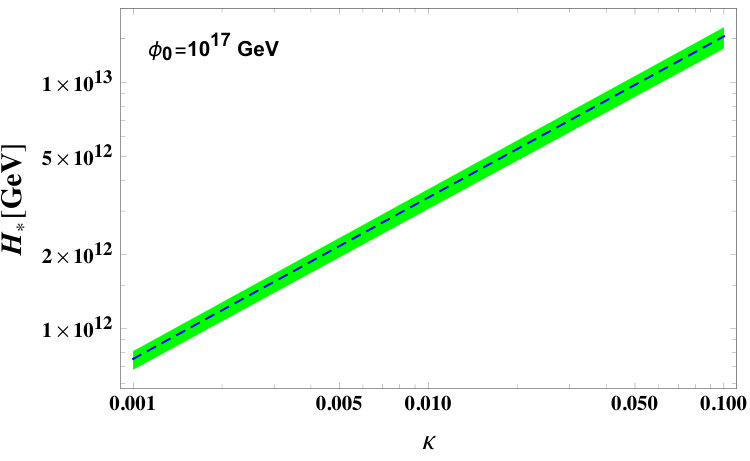 Figure 1
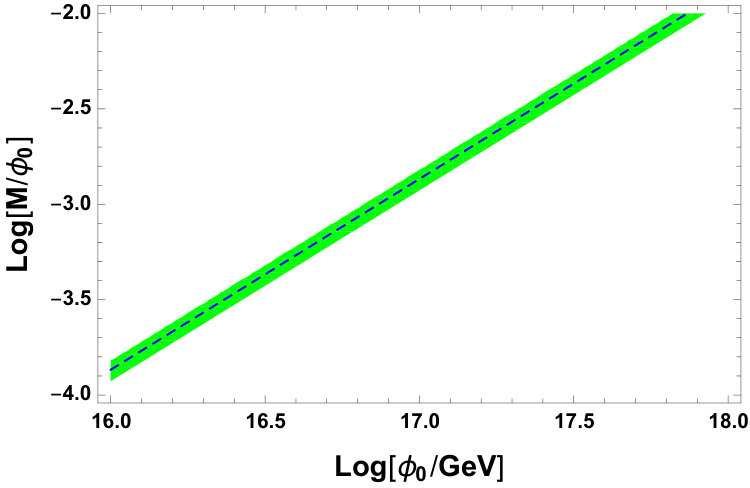 Figure 2
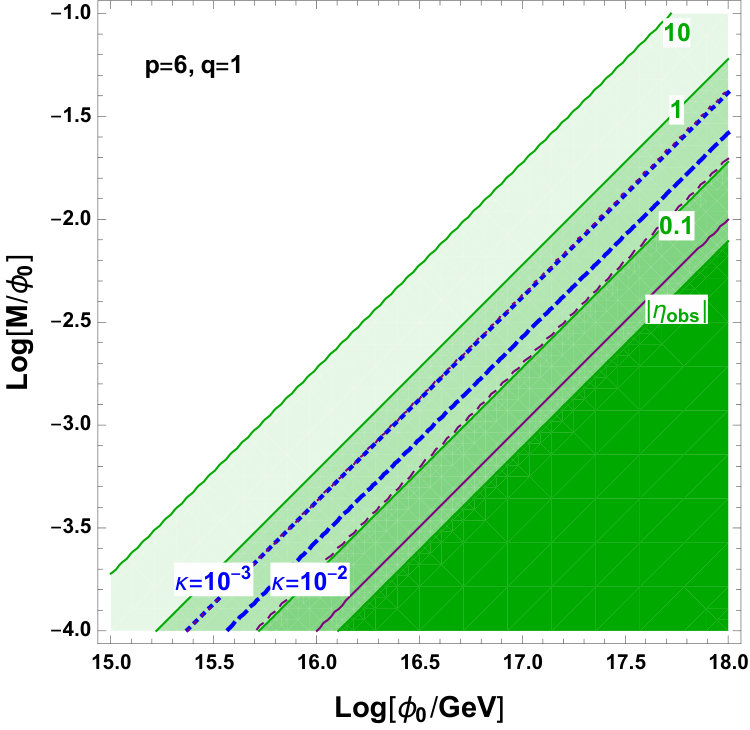 Figure 3
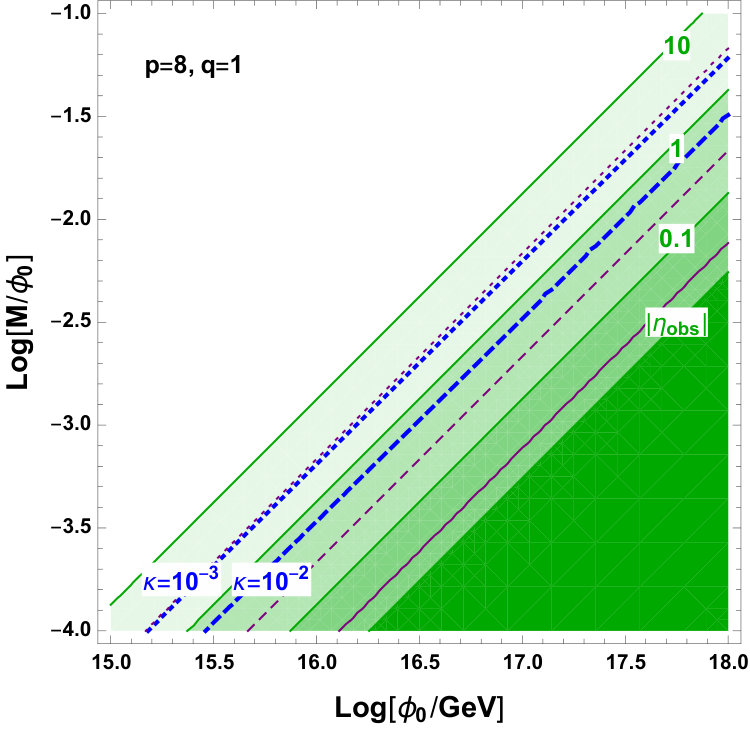 Figure 4
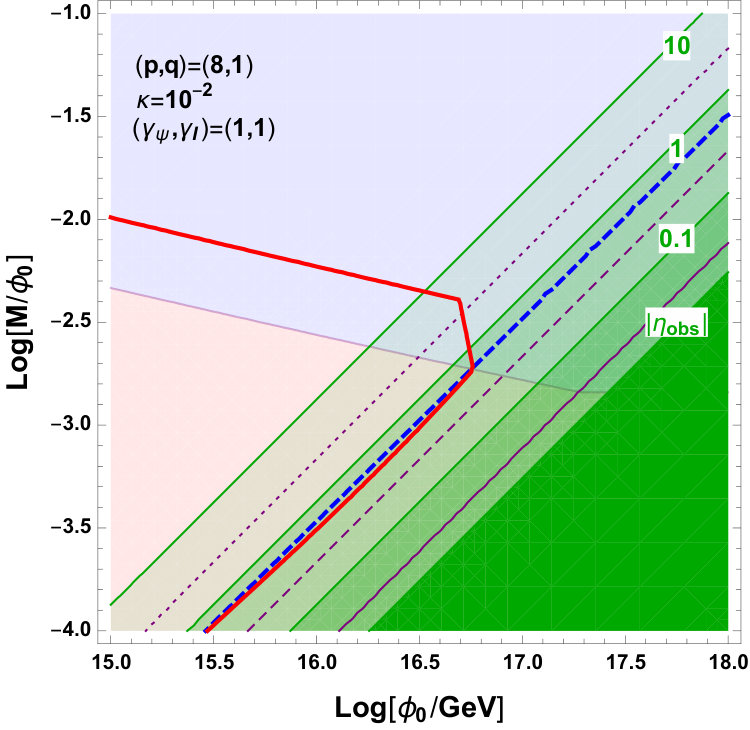 Figure 5
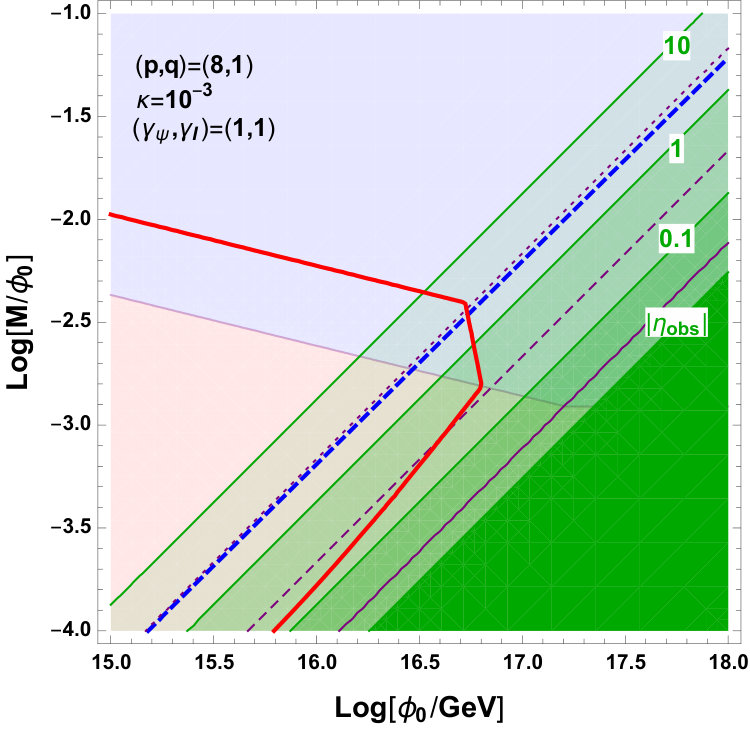 Figure 6
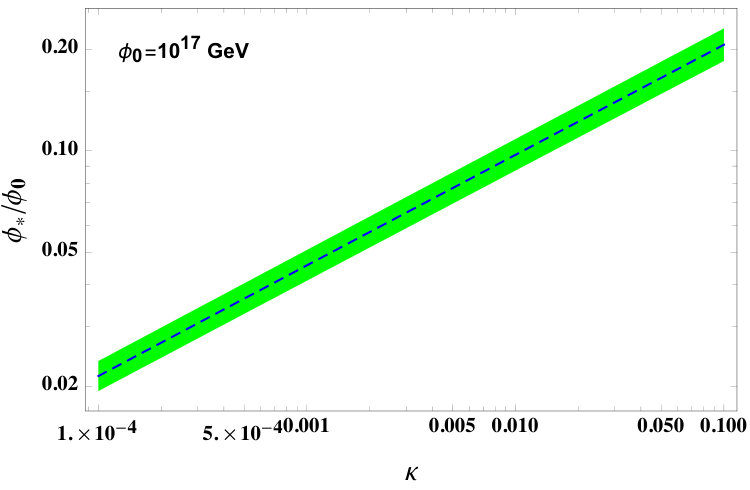 Figure 7
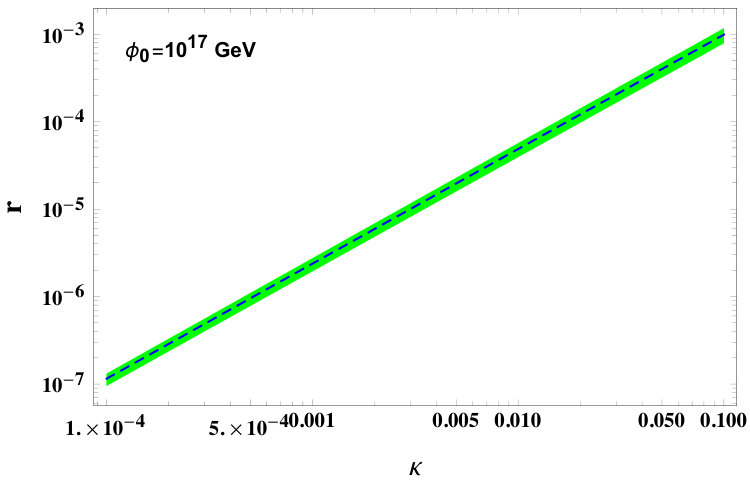 Figure 8
Peer Reviews
No public reviews on file for this paper yet. If you reviewed it on a platform where reviews are public (OpenReview, ICLR, NeurIPS, ICML), you can paste yours below so the community can read it here.
Videos
No videos yet. Explain this paper in a talk, walkthrough, or lecture? Add one.
Spontaneous baryogenesis in spiral inflation
Gabriela Barenboim
and Wan-Il Park
Abstract
We examined the possibility of spontaneous baryogenesis driven by the inflaton in the scenario of spiral inflation, and found the parametric dependence of the late-time baryon number asymmetry. As a result, it is shown that, depending on the effective coupling of baryon/lepton number violating operators, it is possible to obtain the right amount of asymmetry even in the presence of a matter-domination era as long as such era is relatively short. In a part of the parameter space, the required expansion rate during inflation is close to the current upper-bound, and hence can be probed in the near future experiments.
1 Introduction
It is known that our visible world is made of either matter or anti-matter only, depending on how we define them. Observations indicate that the asymmetry between matter and anti-matter in terms of the ratio of baryon-to-entropy density is about [1, 2]. Such an asymmetry could be an initial condition of the universe evolving to our present universe. However, in the presence of inflation [3, 4, 5] which is now believed to be a crucial ingredient of the thermal history of the universe at a very early epoch, typically well before the conventional electroweak phase transition, an initial asymmetry which might have existed is expected to be diluted to a totally negligible level, and hence there should be a process, called baryogenesis, able to generate an asymmetry after inflation.
Typically, when it works through particle-interactions, a baryo/leptogenesis mechanism is required to satisfy the so called Sakharov conditions [6], i.e., (i) baryon()/lepton() number violating process, (ii) - and -violation, and (iii) out-of-equilibrium decay of particles producing baryon/lepton number. However, when the dynamics of a background field is involved, the above conditions can be relaxed. Spontaneous baryogenesis [7, 8] (see also Ref. [9] for cosmological aspects), is a specially interesting case as the asymetry can be generated in equilibrium. The key feature of spontaneous baryogenesis is that, when a baryon/lepton current is coupled to a background evolution of a field, the time-dependence of the field can provide an effective chemical potential associated with baryon/lepton number. As a result, in the presence of - or -violating processes in thermal equilibrium, an asymmetry of - or -number can be generated even in the thermal bath. The main question in this novel scenario is the identity of the background field and its precise nature which should allow - or -violating processes in thermal equilibrium. In principle, the background field can be any scalar field which has a sizable time-evolution at the epoch of baryo/leptogenesis as long as the symmetries of the theory allow a time-dependent coupling of the field to the baryonic/leptonic current.
An additional possibility related to spontaneous baryogenesis is the production of an asymmetry from the decay of the oscillating scalar field associated with spontaneous baryogenesis. Typically, the nature of the deriving field for spontaneous baryogenesis is an angular degree of freedom of a complex field. Hence, when the complex field carries a charge, a motion of the phase field implies an asymmetry of the charge. Even though an oscillation of the angular degree with respect to a true vacuum can not provide an asymmetry with a definite sign, its decay can results in a net baryon/lepton asymmetry with a specific sign, thanks to the expansion of the universe [7] 111See for example Refs. [10, 11, 12] for other possibilities utilizing pseudo-scalar inflaton. A model-dependent question is if the net asymmetry can be large enough to match observations.
On the other hand, Spiral inflation [13, 14] was proposed as a phenomenological scenario of inflation circumventing the flatness and trans-Planckian issues of the inflaton potential. One of the key features of such a scenario is that the inflaton trajectory is spiraling-out and inflation ends by a waterfall-like drop. Such a spiral motion is something similar to an angular motion of a complex field. Hence, a natural question is whether the inflaton in the Spiral inflation scenario can be responsible for generating the right amount of baryon number asymmetry through either spontaneous baryogenesis or the second possibility mentioned in the previous paragraph, i.e. through its decays in an expanding Universe.
In this work, within the framework of spiral inflation, we show that a right amount of baryon number asymmetry can be achieved in a certain parameter space not by spontaneous baryogenesis but by the remnant of the decays of the inflaton. This paper is organized as follows. In section 2, the general form for the potential for spiral inflation is introduced. In section 3, spiral inflation is described, including the post-inflation behavior of the field configuration. In section 4, the genesis of charge asymmetry by means of the inflaton after inflation through either spontaneous baryogenesis or decays of inflaton is considered, searching for the parameter space for a right amount of baryon number asymmetry at the present universe. In section 5, conclusions are drawn.
2 The model
The general form of the potential responsible for spiral infaltion can be written as
[TABLE]
where
[TABLE]
with
[TABLE]
and . We may take and to be non-negative integers, and consider the case of and which might be theoretically plausible. Clearly and can be considered as the modulus and the phase of a complex field given by . This potential is a hilltop potential having a trench spiraling-out from the hilltop.
Starting from the hilltop, the field configuration is expected to follow closely the minimum of the trench as long as the curvature along the orthogonal direction is large enough, satisfying with ‘’ denoting a derivative with respect to . Hence, from
[TABLE]
one finds that along the trajectory
[TABLE]
leading to
[TABLE]
Therefore, for which is expected to be satisfied in the vicinity of the minimum of the trench,
[TABLE]
We denote the trajectory following the minimum of trench and the direction orthogonal to the trajectory as and , respectively. Then, an infinitesimal displacement along can be written as
[TABLE]
with the unit vectors along and given by,
[TABLE]
so that the directional derivatives are found to be respectivcely
[TABLE]
where
[TABLE]
Hence, one finds
[TABLE]
and
[TABLE]
where the elements of the mass-square matrix () are found to be
[TABLE]
Spiral motion ends as the field configuration leaves the trench, falling along the direction at a point satisfying
[TABLE]
There are two solutions of Eq. (2.25), denoted as and , The smaller one is , the end point of the slow-roll inflation. For which is the case we are interested in, unless is quite close to . In this case,
[TABLE]
where and
[TABLE]
which is determined by for a given choice of the other parameters. Note that, as long as , the approximation in Eq. (2.26) is good enough for our purpose.
The other solution, the largest one, , represents the location of the re-trapping of the field in the trench. It satisfies
[TABLE]
where again we assumed , resulting in .
3 Spiral inflation
3.1 Inflation ()
When , inflation consistent with observations (in slow-roll regime) takes place due to the gentle spiral dynamics of the field configuration. For and , if is away enough from , it is expected that leading to . In this case, we expect . Hence
[TABLE]
and
[TABLE]
where was used. Hence, using Eq. (2.9), we find
[TABLE]
Note that in order for to follow closely the minimum of the trench during inflation, the mass scale along should be large enough or at least comparable to the expansion rate, that is, which constrains to satisfy
[TABLE]
where ‘∗’ denotes a quantity associated with a pivot scale of observations. It turns out that this constraint is easily satisfied in the parameter space we are interested in. The slow-roll parameters are given by
[TABLE]
where we used and defined a function which will prove to be convenient later.
At associated with, for example, Planck pivot scale, is expected (see Eq. (2.26)). Hence, as long as , and is nearly fixed by the observed spectral index of the density power-spectrum as in order to match observations. The power spectrum is given by
[TABLE]
leading to
[TABLE]
where [2] is the observed amplitude of the density power spectrum. If Eq. (3.1) is satisfied for most of the region of , the number of -foldings generated is found to be
[TABLE]
For a given comoving scale and the present horizon , observations require such number of -foldings to be
[TABLE]
where we took and is the radiation energy density when reheating is efficient enough to recover a radiation-dominant universe. Specifically, we take to be the energy density of the universe when with being the decay rate of -particles.
For a given set of , if the model-dependent couplings of and to other matter fields are fixed, the model parameters which still remain free are :
[TABLE]
Also, there are three observable constraints:
[TABLE]
Those free parameters and observables are related by four equations, Eq. (2.26), (3.7), (3.10), and Eq. (3.11) equated with Eq. (3.12). Hence, all the free parameters are fixed by the observables as follows. First of all, as shown in Eq. (3.8), which leads to . If , from Eq. (3.7) is fixed, determining as a function of . Plugging Eq. (3.10) into Eqs. (3.11) and (3.12) with being expressed as a function of and as shown in the next subsection, is determined as
[TABLE]
which can be re-used to find , using Eq. (3.10). Note that is treated as a free parameter in this case although it should satisfy Eq. (3.6). Also, depends dominantly on due to the factor in front of in Eq. (3.15). In Fig. 1, we show the allowed parameter spaces. As can be clearly seen in the figure, the dependence of each parameter except is quite weak, so, for simplicity we took as a representative value.
If , from Eq. (3.7) one can regard as a function of and . For a given set of , Eq. (3.10) constrains , and hence becomes a function of those free parameters. Then, from Eqs. (3.11) and (3.12), is constrained for each pair . Therefore, in Eq. (2.26) is not a free parameter but should satisfy the following equation,
[TABLE]
The -dependece of in Eq. (3.16) is from the dependence of on (see Eqs. (3.21) and (3.27)) Since, for a couple of orders of magnitude variation of , the change of is of , we ignore such a dependence for simplicity. Such an assumption is equivalent to setting in Eq. (3.21) when is estimated. Eq. (3.16) can be satisfied by adjusting the ratio as a free parameter replacing . In Fig. 2, the parameter space matching inflationary observables is depicted for with and as an example.
3.2 Post inflation ()
As the inflaton leaves the trench at , the dominant dynamics turns to the oscillation along with respect to as long as the oscillation amplitude satisfies . At this period, governs the dynamics, i.e., the time scale of the oscillation is determined by the mass scale along at ,
[TABLE]
As the motion along becomes sufficiently small, the field configuration can be re-trapped in the trench and the dynamics would be again along the minimum of the canal in the vicinity of the true vacuum. In this case, , and Eqs. (3.1) and (3.2) are applicable again. At , the mass-squared of each orthogonal direction, defined as , is found to be
[TABLE]
where
[TABLE]
In Eq. (3.18) we have not applied Eq. (2.9) for the term with because the field configuration does not follow the trench unless it is trapped again on it. During the oscillation phase which takes place mostly along the direction, the value of this term would vary.
In Eq. (3.20), is a free parameter determined mainly by the set of . It can be either larger or smaller than unity, but lower-bounded as for (see Eq. (3.7)) which is the region we are interested in. Hence, depending on and , in the vicinity of we can have leading to . However, depends on and the slope along changes its sign across . As a result, the angular motion after inflation is commenced only when the oscillation amplitude along is significantly reduced so as to have . In the vicinity of , for the oscillation amplitude of denoted as ,
[TABLE]
Hence,
[TABLE]
Therefore, the onset of the oscillation along is expected to happen as is reduced to , and we find
[TABLE]
which is valid only for . For , we notice that changes its sign as the oscillation amplitude becomes smaller than
[TABLE]
and rapidly approaches to . We take this crossing point as the onset of the oscillation phase of in this case, and the expansion rate around the epoch is found to be
[TABLE]
A comment on the possibility of a second inflationary period caused by re-trapping is in order. From Eqs. (2.28), (3.23) and (3.25), and is expected around the epoch of re-trapping, i.e., the angular motion after inflation would take place before the field configuration is trapped in the trench. Hence, a second stage of inflation would not take place.
Eventually, particles and would decay. We express the decay rate of -particle as 222The precise form of depends on the couplings of each field to matter fields, but we do not specify those model-dependent couplings.
[TABLE]
where is a numerical constant taking allowed decay channels into account. From Eqs. (3.18) and (3.19), and generically we may expect decays earlier than as long as . Also, if , the oscillation of field after inflation would take place in a universe dominated by radiation, otherwise it will happen in a universe dominated by -particles. In terms of our model parameters, the ratio of interest is given by
[TABLE]
If , there is a possibility for -particles to eventually dominate the universe around the epoch of its decay. In order to check this possibility, we compare the energy density of -particles and that of the background radiation as follows. When starts its oscillation, the oscillation amplitude is expected to be
[TABLE]
with . As decays, the universe is dominated by radiation. During this epoch, the energy density of before its decay is given by
[TABLE]
where the energy density of at the onset of its oscillation is
[TABLE]
and with is the expansion rate at the epoch of -particle decay. Hence, becomes comparable to the background radiation density when with
[TABLE]
which gives
[TABLE]
Therefore, particles would be subdominant at the epoch of their decays only if
[TABLE]
Otherewise, an era of -particle domination appears, and entropy release due to the lat-time decay of takes place. This causes a dilution of pre-existing particle densities relative to entropy density. In the sudden decay approximation, the dilution factor is approximately given by
[TABLE]
where and are respectively temperatures when and .
4 Charge asymmetry after inflation
In this section, we consider the possibility of generating a - or -asymmetry from the dynamics or decay of the -field. From now on, we assume that the fields and in the potential Eq. (2.1) are components of a complex field such as which can carry a charge denoted as .
4.1 Spontaneous baryogenesis
A slow motion of after inflation might be considered for spontaneous baryogenesis by introducing a derivative interaction of to baryonic/leptonic current in Lagrangian such as
[TABLE]
where is a dimensionless coupling constant, and is a baryonic/leptonic current. In the current scenario we are considering, a slow evolution of after inflation takes place around the epoch of which is given by either Eq. (3.24) or (3.26). Soon after this epoch, the dynamics of turns into rapid oscillations. If or violating processes which might have been already in equilibrium are decoupled at the very epoch, it might be possible for spontaneous baryogenesis to work. However, if , the universe around the epoch of ’s oscillation would be only partially reheated by the partial decay of particles. This means that the background temperature between the end of inflation and onset of ’s oscillation is expected to be
[TABLE]
where
[TABLE]
That is, and differ only by a factor of a few since . Also, as becomes closer to or even larger than , the epoch between and becomes narrower. Hence, spontaneous baryogenesis is unlikely to occur in our scenario.
4.2 Chage asymmetry from the decay of particles
As another possibility of generating a charge asymmetry, which was already discussed in the original paper of spontaneous baryogenesis (Ref. [7]), we consider the decay of at its oscillation phase, assuming or -violating processes were decoupled already before the onset of ’s oscillations. Here we do not specify or -violating operators, but simply assume the branching fraction of relevant channels to be close to unity.
During the era of -particle domination with the sudden decay approximation of , approximately the solution of ’s EOM can be taken to be 333The error in the estimation of late-time charge asymmetry is less than a factor about 2, and does not affect our argument.
[TABLE]
and the charge density associated with is given by
[TABLE]
where we used and in the vicinity of the true vacuum. Then, the charge asymmetry from the decay of is obtained as 444This is essentially of the same form as one discussed in Ref. [7] modulo the factor .
[TABLE]
where and
[TABLE]
with
[TABLE]
and being the equation of state of the universe. The approximation in the second line of Eq. (4.12) is valid for (i,e,, ), and is Exponential Integral E function with a complex argument. Thus, for one finds
[TABLE]
Meanwhile, if the energy density of -particles is subdominant around the epoch of -particle decay, the entropy density after inflation evolves as
[TABLE]
where is the entropy density around the epoch of -particle decays,
[TABLE]
with being the background temperature at -particle decay, and we set , ignoring their temperature-dependence.
Hence, at late time
[TABLE]
For , using Eqs. (3.7), (3.20) and (3.24), one can re-express Eq. (4.18) as
[TABLE]
For , using Eqs. (3.20) and (3.26), one can re-express Eq. (4.18) as
[TABLE]
If -particle dominates the universe eventually before its decay, Eqs. (4.19) and (4.20) should be divided by the dilution factor given in Eq. (3.35).
If , for as shown in Fig. 1. Hence, in this case, even with close to its upper-bound and , an additional requirement, namely is needed in order to obtain .
On the other hand, if , for a much lower one can find parameter space for a right amount of baryon/lepton number asymmetry as shown in Fig. 3 where we took as a benchmark set. In the figure, the crossing point of dashed blue line and solid red line fixes parameters matching observations of , and simultaneously. For taken in the figure, if , the matching point appears in -particle domination era. A smaller extends -domination era, pushing the border of light blue and pinky regions to left-bottom side of each panel. A smaller results in a smaller baryon asymmetry, pushing the upper and lower part of the red line to bottom and left side, respectively. As a kind of guide line, if , in order to obtain a right amount of asymmetry it is required to have with for a reasonable choice of , such as . A larger requires even larger and much smaller . Such a -dependence of the asymmetry can be understood as follows. For given set of parameters other than , a larger causes a smaller (see Eq. (3.7)). Hence, in order to match observations, i.e., , one should make larger by either increasing or decreasing . This increases (see Eq. (3.18)) and . As a result, a larger asymmetry can be obtained, which is clear from the second line of Eq. (4.14).
5 Conclusions
In this paper, we investigated the possibility of generating an asymmetry of a global charge (e.g., baryon/lepton number) through either the dynamics or the decays of the inflaton in the scenario of spiral inflation.
In spiral inflation, the inflaton can be regarded dominantly as the angular degree of a complex scalar field. Thanks to the presence of a small angle-dependent modulating potential on top of a hilltop-like potential, it gets through a spiraling-out motion from the hilltop. Although inflation ends via a waterfall-like sudden change of field dynamics, angular motion of field configuration reappears after inflation again due to the presence of the angle-dependent modulating potential. When it carries a non-zero global charge, the angular motion of a complex scalar field corresponds to a charge asymmetry (or particle-antiparticle asymmetry) associated with the field. Hence, the angular motion of inflaton after inflation implies an asymmetry associated with inflaton number density. The angular momentum of inflaton in the vicinity of the true vacuum of the potential does not posses a definite sign, but periodically changes its sign. As a result, the asymmetry generated by inflaton changes its sign periodically. However, as discussed in the original paper of spontaneous baryogenesis (Ref. [7]), if the inflaton decays to other particles, transferring its asymmetry (say ‘transfer mechanism’), there can be a well-defined (net) asymmetry in the daughter particles, thanks to the expansion of the universe.
Paying attention to the transfer mechanism, we found that in spiral inflation the decays of the inflaton can produce the right amount of baryon number asymmetry while obtaining inflationary observables consistent with observations. In contrast to the naive expectation that it would be difficult to obtain the right amount of baryon number asymmetry, it is found that even in the presence of matter-domination era a sufficient amount of baryon number asymmetry can be obtained as long as the matter-domination era right after inflation is terminated rather soon. Definitely this is a model-dependent statement, since (as expected) the late-time baryon number asymmetry in our scenario depends on model-dependent decay rate(s) (or branching fraction(s)) of the inflaton to baryonic/leptonic particles through operators (maybe) violating baryon/lepton number.
In a part of the parameter space, the expansion rate during inflation is required to be close to the current upper-bound, and hence it would be easily probed in the near-future experiments, for example CMB-S4 [15], PIXIE [16], and LiteBIRD [17].
Acknowledgments
GB acknowledges support from the MEC and FEDER (EC) Grants SEV-2014-0398, FIS2015-72245-EXP, and FPA2014-54459 and the Generalitat Valenciana under grant PROMETEOII/2017/033. She also acknowledges partial support from the European Union FP7 ITN INVISIBLES MSCA PITN-GA-2011-289442 and InvisiblesPlus (RISE) H2020-MSCA-RISE-2015-690575. WIP was supported by Research Base Construction Fund Support Program funded by Chonbuk National University in 2018, and by Basic Science Research Program through the National Research Foundation of Korea (NRF) funded by the Ministry of Education (No. 2017R1D1A1B06035959).
The reference list from the paper itself. Each links out to its DOI / PubMed record.
- 1[1] M. Tanabashi et al. (Particle Data Group), Phys. Rev. D 98, 030001 (2018)
- 2[2] N. Aghanim et al. [Planck Collaboration], ar Xiv:1807.06209 [astro-ph.CO].
- 3[3] A. H. Guth, Phys. Rev. D 23 , 347 (1981).
- 4[4] K. Sato, Mon. Not. Roy. Astron. Soc. 195 , 467 (1981).
- 5[5] A. A. Starobinsky, Phys. Lett. B 91 , 99 (1980).
- 6[6] A. D. Sakharov, Pisma Zh. Eksp. Teor. Fiz. 5 , 32 (1967) [JETP Lett. 5 , 24 (1967)] [Sov. Phys. Usp. 34 , no. 5, 392 (1991)] [Usp. Fiz. Nauk 161 , no. 5, 61 (1991)].
- 7[7] A. G. Cohen and D. B. Kaplan, Phys. Lett. B 199 , 251 (1987). doi:10.1016/0370-2693(87)91369-4
- 8[8] A. G. Cohen and D. B. Kaplan, Nucl. Phys. B 308 , 913 (1988). doi:10.1016/0550-3213(88)90134-4