Competing Universalities in Kardar-Parisi-Zhang (KPZ) Growth Models
Abbas Ali Saberi, Hor Dashti-N., Joachim Krug

TL;DR
This paper investigates the universal fluctuation behaviors in crossing KPZ interfaces with different initial conditions, revealing a phase transition in fluctuation distributions governed by a control parameter.
Contribution
It introduces a phase diagram for crossing KPZ interfaces and identifies a transition between Tracy-Widom distributions and Gaussian behavior at a critical point p=0.5.
Findings
Distribution converges to GOE TW for p<0.5
Distribution converges to GUE TW for p>0.5
At p=0.5, Gaussian statistics emerge
Abstract
We report on the universality of height fluctuations at the crossing point of two interacting (1+1)-dimensional Kardar-Parisi-Zhang (KPZ) interfaces with curved and flat initial conditions. We introduce a control parameter p as the probability for the initially flat geometry to be chosen and compute the phase diagram as a function of p. We find that the distribution of the fluctuations converges to the Gaussian orthogonal ensemble Tracy-Widom (TW) distribution for p<0.5, and to the Gaussian unitary ensemble TW distribution for p>0.5. For p=0.5 where the two geometries are equally weighted, the behavior is governed by an emergent Gaussian statistics in the universality class of Brownian motion. We propose a phenomenological theory to explain our findings and discuss possible applications in nonequilibrium transport and traffic flow.
Click any figure to enlarge with its caption.
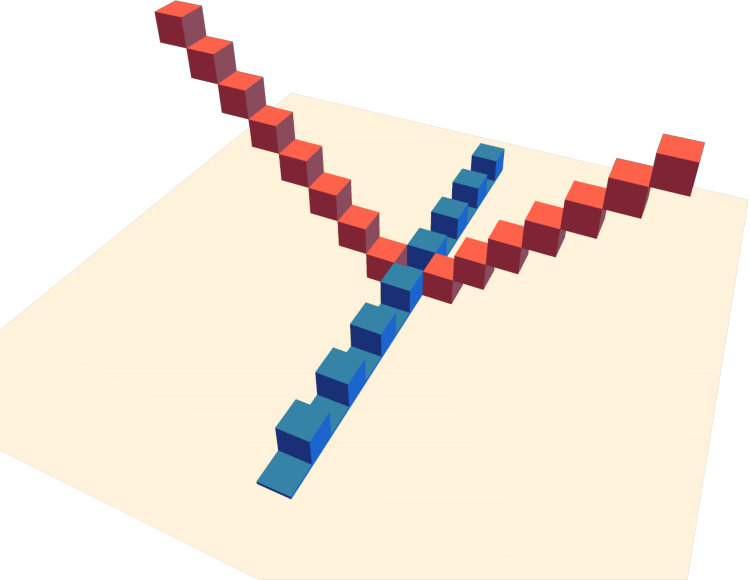 Figure 1
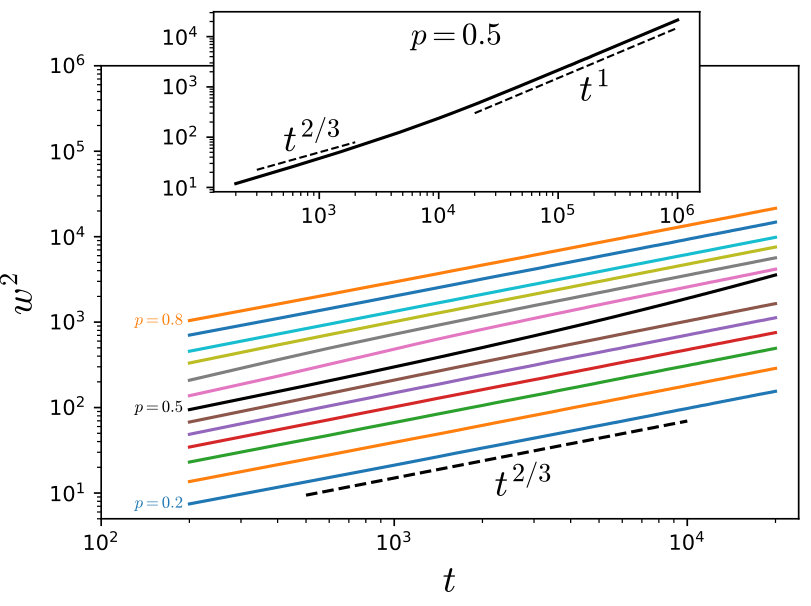 Figure 2
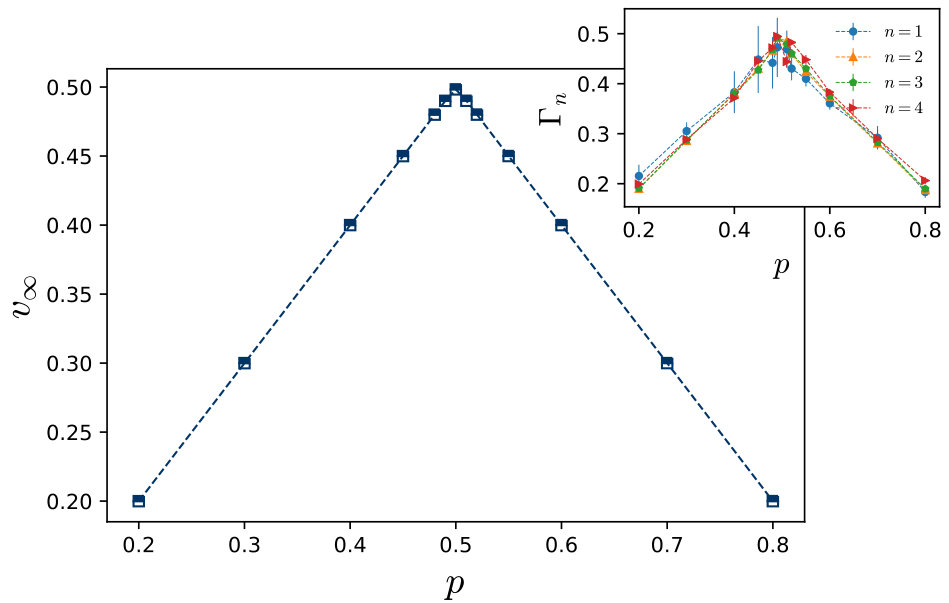 Figure 3
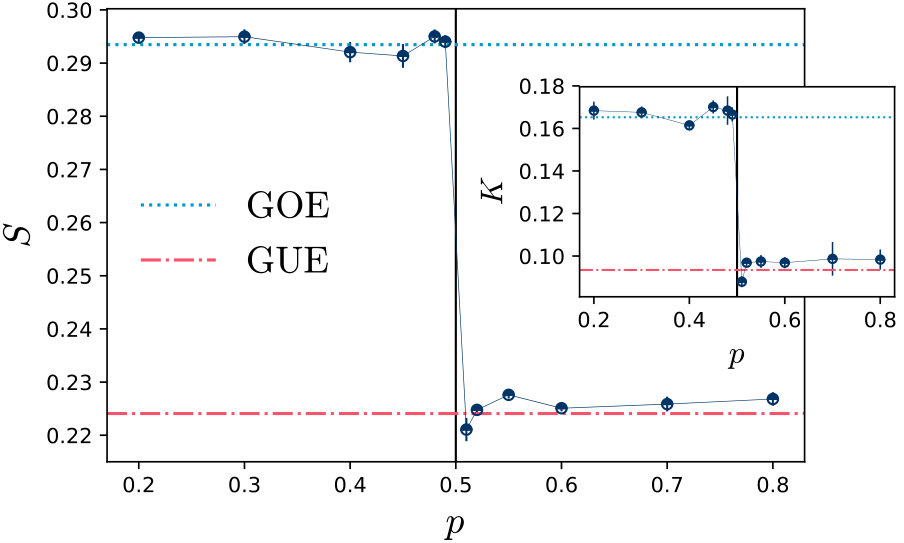 Figure 4
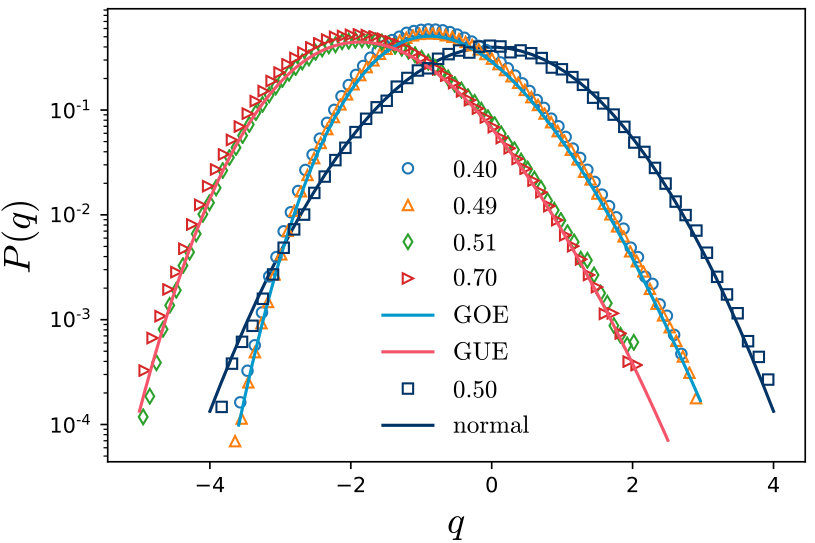 Figure 5
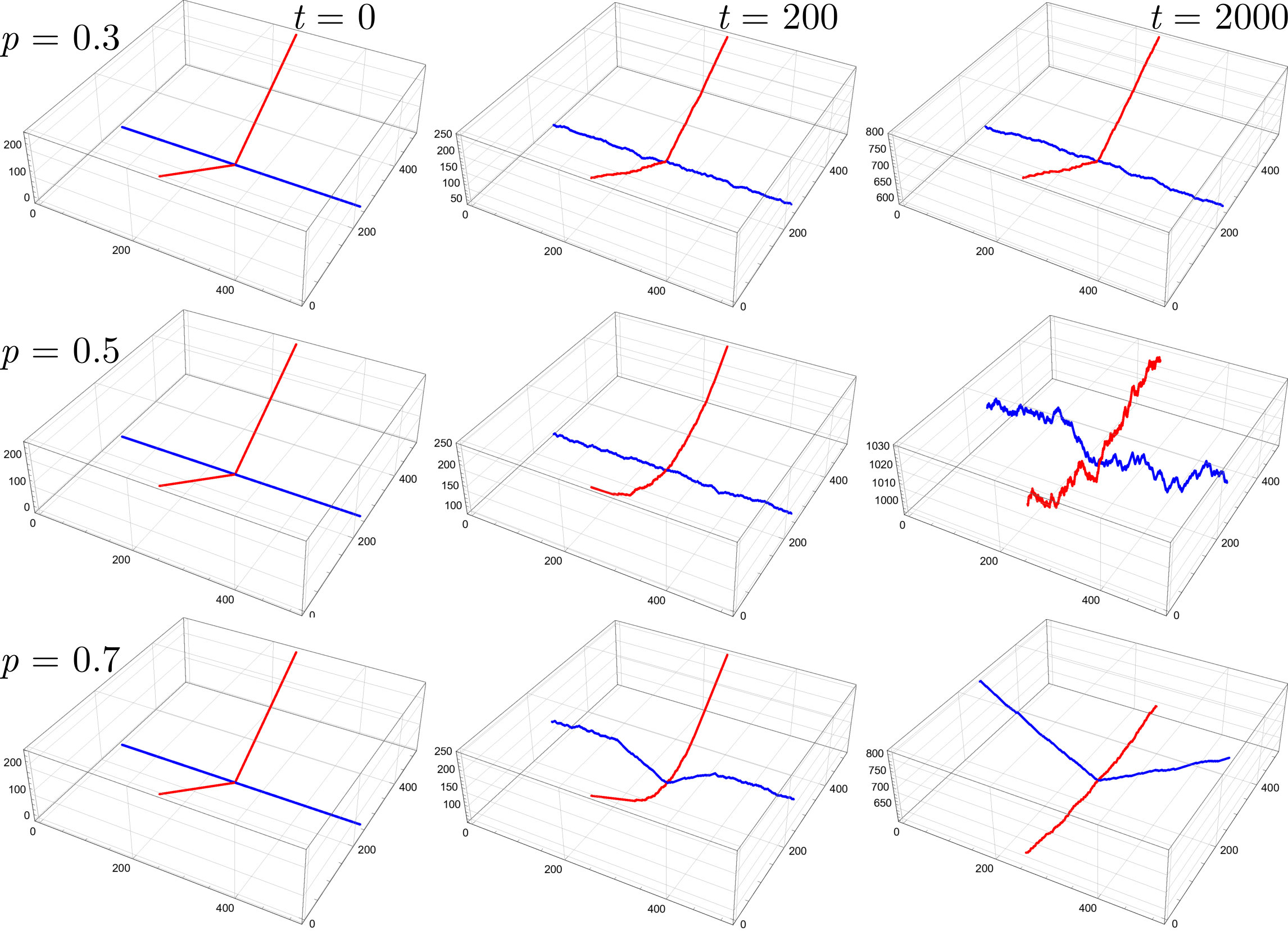 Figure 6
Peer Reviews
No public reviews on file for this paper yet. If you reviewed it on a platform where reviews are public (OpenReview, ICLR, NeurIPS, ICML), you can paste yours below so the community can read it here.
Videos
No videos yet. Explain this paper in a talk, walkthrough, or lecture? Add one.
Competing Universalities in KardarParisiZhang Growth Models
Abbas Ali Saberi
Department of Physics, University of Tehran, P. O. Box 14395-547, Tehran, Iran
School of Particles and Accelerators, Institute for Research in Fundamental Sciences IPM, Tehran, Iran
Institut für Theoretische Physik, Universität zu Köln, Zülpicher Str. 77, 50937 Köln, Germany
Hor Dashti-N
School of Physics, Korea Institute for Advanced Study, Seoul 130-722, South Korea.
Joachim Krug
Institut für Biologische Physik, Universität zu Köln, Zülpicher Str. 77, 50937 Köln, Germany
Abstract
We report on the universality of height fluctuations at the crossing point of two interacting -dimensional Kardar-Parisi-Zhang interfaces with curved and flat initial conditions. We introduce a control parameter as the probability for the initially flat geometry to be chosen and compute the phase diagram as a function of . We find that the distribution of the fluctuations converges to the Gaussian orthogonal ensemble Tracy-Widom (TW) distribution for , and to the Gaussian unitary ensemble TW distribution for . For where the two geometries are equally weighted, the behavior is governed by an emergent Gaussian statistics in the universality class of Brownian motion. We propose a phenomenological theory to explain our findings and discuss possible applications in nonequilibrium transport and traffic flow.
Scale invariant fluctuations play a central role in the emergence of universal properties in complex random systems interconnecting various areas of physics, mathematics and statistical mechanics. Whereas the concept of universality classes is well established in the theory of equilibrium phase transitions Binder (1981), our understanding of systems driven out of equilibrium is much less complete Henkel et al. (2008). The KardarParisiZhang (KPZ) equation Kardar et al. (1986) governing the evolution of the surface height (x,t),
[TABLE]
is a prototypical model for describing nonequilibrium growing interfaces with a wide range of theoretical and experimental applications Krug and Spohn (1991); Barabasi and Stanley (1995); Halpin-Healy and Zhang (1995); Krug (1997). The first term in (1) represents relaxation of the interface caused by a surface tension , the second describes the nonlinear growth locally normal to the surface, and the last term is uncorrelated Gaussian white noise in space and time with zero average and , representing the stochastic nature of the growth process. One recovers the EdwardsWilkinson equation for .
The universality class of randomly growing interfaces is usually characterized by the scaling exponents defined by FamilyVicsek scaling Family and Vicsek (1985) i.e., , in terms of the second moment of the height fluctuations at a measurement scale at time , where const as and as . Thus grows with time like until it saturates to when . The universality class is characterized by the exponents and (the roughness and the growth exponents, respectively), whose exact values for the KPZ equation are known only in 1+1 dimensions (1+1 D) as and .
In a series of pioneering works, it has been shown that the universality in various growth models belonging to the KPZ class holds beyond the second moment Krug et al. (1992); Kriecherbauer and Krug (2010); Takeuchi et al. (2011). Unexpectedly, the height fluctuations of the 1+1 D single-step model (SSM) Meakin et al. (1986) grown from a point seed were found to be governed Johansson (2000) by the Tracy-Widom (TW) distribution of the Gaussian unitary random matrix ensemble (GUE) Mehta (2004). Thereafter, it was reported Prähofer and Spohn (2000); Prähofer and Spohn (2000) that the radial 1+1 D polynuclear growth (PNG) model also follows the TW GUE distribution, and in addition, the Gaussian orthogonal ensemble (GOE) determines the universality of the 1+1 D KPZ growth models on a flat substrate Prähofer and Spohn (2000). Recently, exact solutions of the 1+1 D KPZ equation have confirmed the TW GUE distribution for the height fluctuations on the curved (wedge-like) Sasamoto and Spohn (2010); Amir et al. (2011) and the TW GOE distribution on the flat geometries Calabrese and Le Doussal (2011). The key question of interest in this Letter is how these two GOE and GUE universalities compete when two different 1+1 D KPZ growth models adopting the flat and curved geometries meet each other at a single common point (Fig. 1).
The SSM is a solid on solid growth model in the KPZ class in which at each time step on a 1 D (flat or wedge-like) lattice of size , one site is randomly chosen, and if it is a local minimum the height is increased by . The initial conditions at are and for the flat and wedge geometries, respectively. This definition guarantees that at each step, the height difference between two neighboring sites is . The SSM is the growth model representation Rost (1981) of the totally asymmetric simple exclusion process (TASEP) in 1 D, a paradigmatic model for driven transport of a single conserved quantity Kriecherbauer and Krug (2010).
Here we consider growth on two crossing flat-wedge substrates subject to the same growth rules but with an exception at the origin , where the two geometries meet. The origin is the only site with four nearest neighbors, the heights of which have to exceed the height at 0 by one for growth to take place. This Letter studies the statistics of the fluctuations of the height at the crossing point at time . Here time is defined in terms of the number of deposition trials per lattice site, either successful or not. The initial conditions are set as mentioned above for each geometry so that . Periodic boundary conditions are applied along both geometries. At each time step, one of the two flat or wedge crossing geometries is chosen with probability —the only parameter in our study— and then a site is randomly chosen for the growth process. The flat geometry is chosen with probability and the wedge geometry with probability . In the TASEP representation this corresponds to two single-lane exclusion processes which meet at an intersection. The growth rule at the origin implies that the particles on the two lanes are forced to cross the intersection simultaneously. TASEP-like traffic flow models with intersections have been studied before, but with different crossing rules and without considering the current fluctuations at the intersection Nagatani (1993); Ishibashi and Fukui (1996); Foulaadvand et al. (2004); Foulaadvand and Neek-Amal (2007); Belbasi and Foulaadvand (2008); Embley et al. (2009); Hilhorst and Appert-Rolland (2012); Raguin et al. (2013).
Let us first examine the FamilyVicsek scaling for the second moment of the height fluctuations at the origin i.e., , for different values of . As Fig. 2 demonstrates, all curves for follow the scaling law with the growth exponent predicted for the KPZ equation. A remarkable observation is that for when both geometries are picked with equal probability, the variance of the height at earlier times behaves as in the KPZ class, but later it crosses over to the universality of the Brownian motion (BM) i.e., , with Gaussian statistics (see below).
Until now our analysis has revealed two interesting facts: First, the point with acts as a distinguished fixed point with a characteristic Gaussian statistics in the universality of Brownian motion, and, second, for the statistics of the height fluctuations at the crossing point—despite the existence of four nearest neighbors—is compatible with that of the 1+1 D KPZ equation whose long time statistics converges to the TW GUE/GOE distribution depending on the narrow-wedge/flat initial condition. One might naively expect that for for which the flat geometry is chosen with higher probability, the height fluctuations would converge to the GOE statistics and for where the wedge geometry is more likely to be picked, they should be compatible with the GUE distribution. As we will show in the following, our results unveil exactly the opposite behavior.
The local height of an 1+1 D KPZ interface is asymptotically given by the following relation Takeuchi et al. (2011),
[TABLE]
where is the sign of the nonlinear parameter in the KPZ Eq. (1), and are non-universal parameters and is a stochastic variable with a universal TW distribution depending on the flat/wedge growth geometry. We estimate the parameter by extrapolating versus , as an intercept in a linear regression in the limit, i.e., Krug and Meakin (1990). We carried out extensive simulations to generate height profiles of SSM on the flatwedge geometry of linear size up to time for several values , , , , , , , , , , , , . For each dataset, an ensemble of independent realizations have been generated.
As shown in Fig. 3, we numerically find a simple relation for as a function of the parameter ,
[TABLE]
Contrary to the naive expectation, this implies that the substrate with the smaller growth probability dominates the coupled process. To see why this is so, recall that the asymptotic growth rate of a single 1+1 D SSM interface with periodic boundary conditions is given by , where is the rate of deposition attempts and is the surface slope Krug et al. (1992); Kriecherbauer and Krug (2010). Because the growth rate is maximal at , an SSM interface can lower its growth rate by developing a nonzero slope, but it cannot increase its growth rate beyond Wolf and Tang (1990); Krug (1997). In the present setting for the flat geometry and for the wedge geometry, respectively. To accomodate a common growh rate at the origin, for the flat interface grows at maximal speed whereas the wedge interface maintains a nonzero tilt . For the roles of the two substrates are interchanged and the initially flat interface becomes wedge-shaped (Fig. 4).
We next show that the dominance of the slower geometry extends also to the height fluctuations at the origin. In order to estimate the parameter in Eq. (2) we define , where denotes the th cumulant of the random variable . We write for the value of estimated from the th cumulant. All estimates have to give rise to the same value assuming that the cumulants of are those of the corresponding TW GOE or GUE distributions. To find the possible TW distributions, we use two dimensionless -independent measures, i.e., the skewness and the kurtosis , and compare them with those of the TW distributions. Figure 5 represents the most remarkable finding of our study: For the statistics of the height fluctuations of the crossing point in the wedgeflat geometry is determined by the TW GOE distribution, and, for it is governed by the TW GUE distribution. Therefore we adopt the corresponding cumulants of the TW distributions into the above relations to extract . We find that all follow the same simple relation with as we found for , i.e., —see the inset of Fig. 3. The relation is a known property of the SSM Krug et al. (1992).
Now we can directly check for universality by comparing the height fluctuation distribution with the analytic TW predictions. For this, we define a new variable and plot the rescaled distribution functions for several values of . Figure 6 shows an excellent agreement with the corresponding TW distributions for . The figure also shows the distribution function of height fluctuations for which is in perfect agreement with the Gaussian distribution.
The fact that the fluctuations at the crossing point are determined by the slowly growing interface can be most easily understood in the TASEP representation. The growth rule at the origin implies that a particle on the fast lane has to wait for a particle on the slow lane to appear before it can cross the intersection. Therefore the statistics of the crossing events is determined by the slower lane, and follows TW-GOE (TW-GUE) statistics for (), respectively. Whereas the dynamics on the slow lane is asymptotically unaffected by the intersection, the particles on the fast lane effectively experience a blockage, which leads to the buildup of a density discontinuity across the origin. In the interface representation this implies the formation of a wedge (Fig. 4).
The physics of inhomogeneous growth processes Wolf and Tang (1990) and exclusion processes with a blockage Janowsky and Lebowitz (1994); Basu et al. (2014); Schmidt et al. (2015) is also key to understanding the emergent Gaussian statistics that we observe at . Consider first a single, initially flat SSM interface where deposition attempts occur at unit rate at all sites except a single defect site with deposition rate . This corresponds to a TASEP with a single slow () or fast () bond. Recent work has established that the defect induces a macroscopic inhomogeneity for any , whereas it is asymptotically irrelevant when Basu et al. (2014); Schmidt et al. (2015). We have numerically studied the height fluctuations at the defect site, finding TW-GOE statistics for but Gaussian BM statistics for . The latter behavior can be rationalized within the directed polymer (DP) representation of the process, where the defect site extends to a defect line in space-time which pins the polymer when Halpin-Healy and Zhang (1995); Krug (1997); Basu et al. (2014); Tang and Lyuksyutov (1993). In the pinned phase the energy of the polymer, which translates into the height of the SSM surface, is the sum of uncorrelated contributions accumulated along the one-dimensional defect line, which satisfies a central limit theorem and therefore displays Gaussian statistics.
The crossing geometry at is similar to the SSM with a defect site, in the sense that deposition occurs at the same rate at all sites except for the origin, where it is enhanced by a factor of . By analogy with the 1+1 D SSM, one might anticipate the existence of a critical value , such that the fluctuations display Gaussian BM statistics for and KPZ TW statistics for . However, our simulations of a crossing flat-flat geometry with a variable deposition probability at the crossing point indicate that the critical point, which is at for the single lane problem, is shifted to large , introducing the BM statistics as the dominant process in the long-time limit for any . This may reflect the dynamic nature of the defect: Even when is very large, a TASEP particle attempting to cross the intersection still has to wait for a particle on the second lane to arrive, which happens at unit rate irrespective of . In marked contrast to the 1+1 D SSM, however, we observe BM statistics in the absence of a macroscopically tilted, wedge-like surface profile. To clarify the origin of this behavior, a DP representation of the crossing growth geometry would be needed.
To conclude, we have considered 1+1 D KPZ growth models on a weighted flatcurved geometry and analyzed the statistics of the height fluctuations at the crossing point. We found a rich and unexpectedly non-trivial phase diagram comprising, in addition to the known TW GUE/GOE phases, an emergent Gaussian BM phase at . It is important to note that the dominance of the more slowly growing geometry in the SSM is linked to the fact that the coefficient of the KPZ nonlinearity is negative in this case Krug et al. (1992); Wolf and Tang (1990). When , the argument based on the slope-dependence of the asymptotic growth rate predicts that the faster geometry determines the behavior, which implies that the phase diagram is reflected around the point . We have indeed verified that simulations of the restricted-solid-on-solid (RSOS) model, which also has , lead to the same phase diagram.
At the critical point , the TASEP representation of the model relates to previous work on exclusion processes with intersections Foulaadvand and Neek-Amal (2007); Embley et al. (2009); Raguin et al. (2013), with the seemingly innocuous modification that particles are forced to cross the intersection in a correlated manner. Our results suggest that this makes the transport across the intersections much more efficient, in that macroscopic density discontinuities do not appear, while a signature of the intersection is retained in the form of anomalously large, BM-type current fluctuations. Importantly, the correlated hopping of particles moving along perpendicular directions is a fundamental feature of any particle representation of higher-dimensional growth processes, which is enforced by the integrability condition on the height field Krug and Spohn (1991); Ódor et al. (2009). As such, by introducing a single site with a two-dimensional growth environment into an otherwise one-dimensional setting, the model may provide an inroad for progress towards an understanding of the elusive 2+1 D KPZ problem Halpin-Healy (2012).
Acknowledgment. We thank Andreas Schadschneider for useful discussions. A.A.S. would like to acknowledge support from the Alexander von Humboldt Foundation and partial financial support from the research council of the University of Tehran. J.K. was supported by the German Excellence Initiative through the UoC Forum Classical and Quantum Dynamics of Interacting Particle Systems.
The reference list from the paper itself. Each links out to its DOI / PubMed record.
- 1Binder (1981) K. Binder, Z. Physik B - Condensed Matter 43 , 119 (1981).
- 2Henkel et al. (2008) M. Henkel, H. Hinrichsen, S. Lübeck, and M. Pleimling, Non-equilibrium phase transitions (Springer, Berlin, 2008).
- 3Kardar et al. (1986) M. Kardar, G. Parisi, and Y.-C. Zhang, Phys. Rev. Lett. 56 , 889 (1986).
- 4Krug and Spohn (1991) J. Krug and H. Spohn, in Solids Far From Equilibrium , edited by C. Godrèche (Cambridge University Press, 1991).
- 5Barabasi and Stanley (1995) A.-L. Barabasi and H. Stanley, Fractal concepts in surface growth (Cambridge university press, 1995).
- 6Halpin-Healy and Zhang (1995) T. Halpin-Healy and Y.-C. Zhang, Phys. Rep. 254 , 215 (1995).
- 7Krug (1997) J. Krug, Adv. Phys. 46 , 139 (1997).
- 8Family and Vicsek (1985) F. Family and T. Vicsek, J. Phys. A: Math. Gen. 18 , L 75 (1985).