Vector-like Quark Interpretation of Excess in Higgs Signal Strength
Kingman Cheung, Wai-Yee Keung, Jae Sik Lee, Po-Yan Tseng

TL;DR
This paper proposes a vector-like quark extension to the Standard Model to explain a slight excess in Higgs signal strength and address discrepancies in bottom quark observables, fitting data better than the standard model.
Contribution
It introduces a vector-like quark doublet with specific mixing properties that reduce the bottom Yukawa coupling and improve agreement with Higgs and LEP data.
Findings
Reduced bottom Yukawa coupling improves Higgs signal fit.
Enhanced Z-b coupling addresses LEP bottom asymmetry.
Model aligns better with experimental data than the Standard Model.
Abstract
There is a deviation in the average Higgs-signal strength for all the TeV data up to Summer 2018. We find that a slight reduction of the bottom-Yukawa coupling can fit the data better than the standard model. We suggest an extension with a vector-like quark doublet, of which the right-handed component of mixes nonnegligibly with the standard model quark. We show that the mixing would induce a reduction of the bottom Yukawa coupling. Simultaneously, the coupling of the boson to the right-handed quark increases, which could reduce the forward-backward asymmetry of bottom production at LEP and bring it closer to the experimental value.
Click any figure to enlarge with its caption.
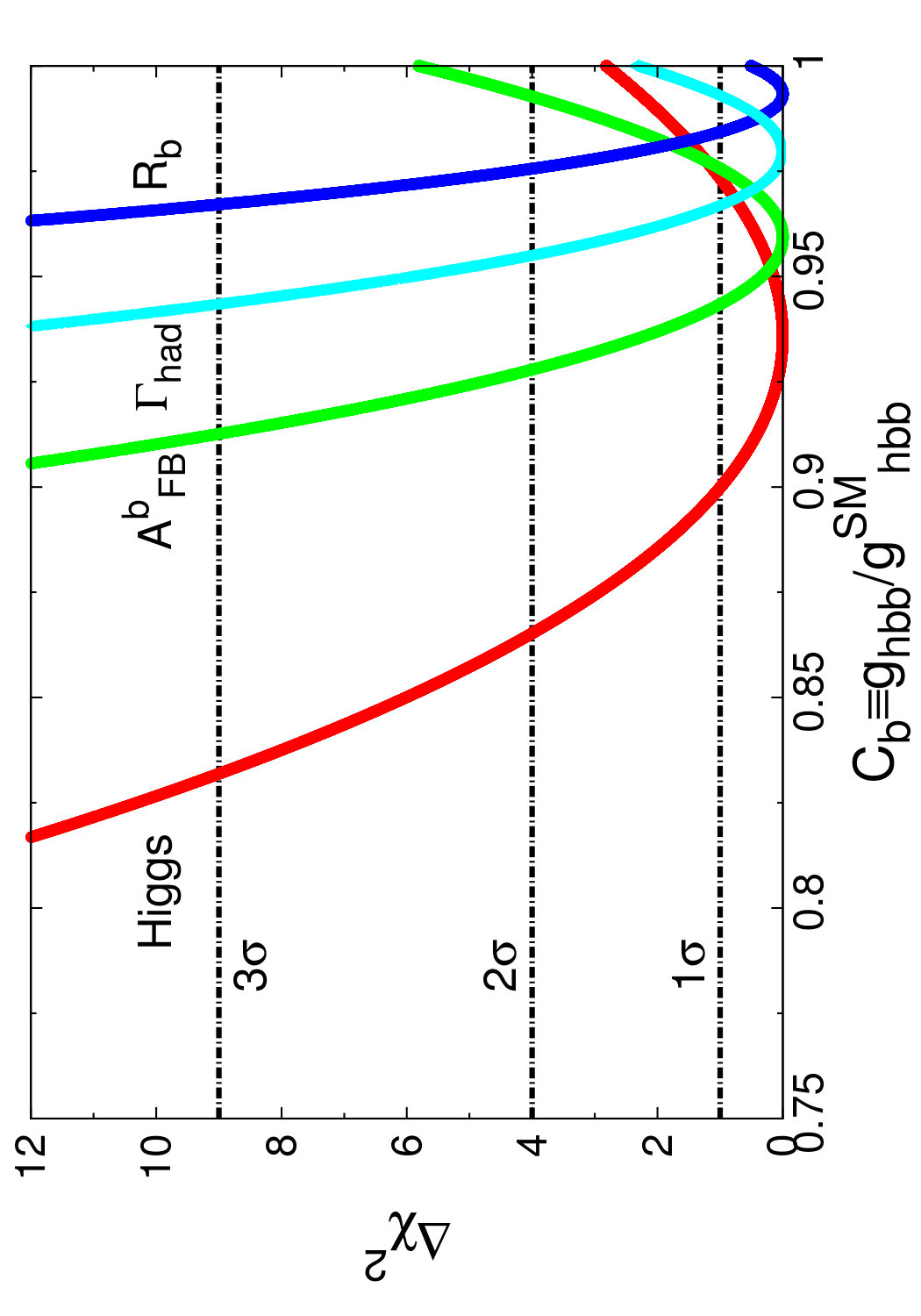 Figure 1
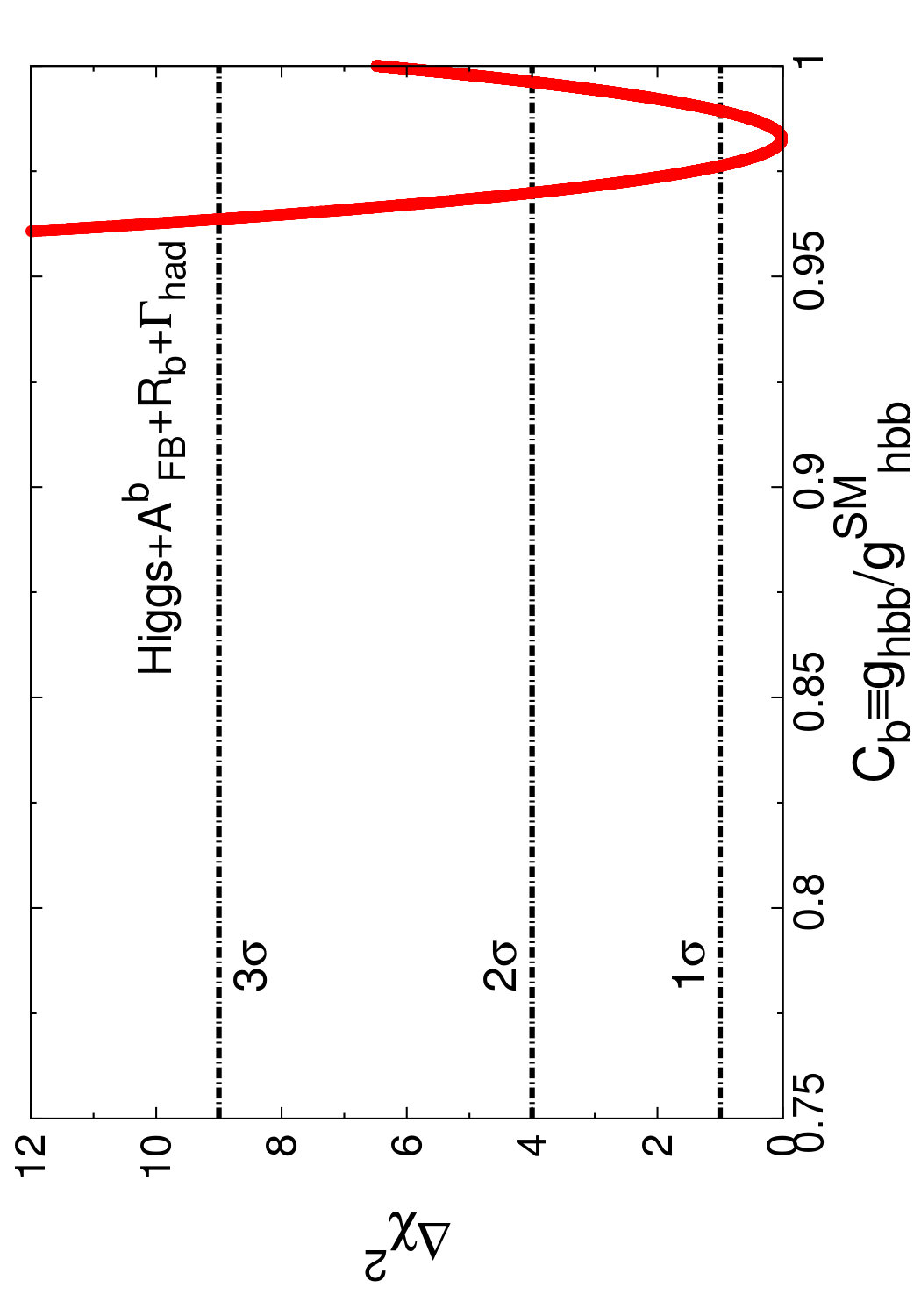 Figure 2
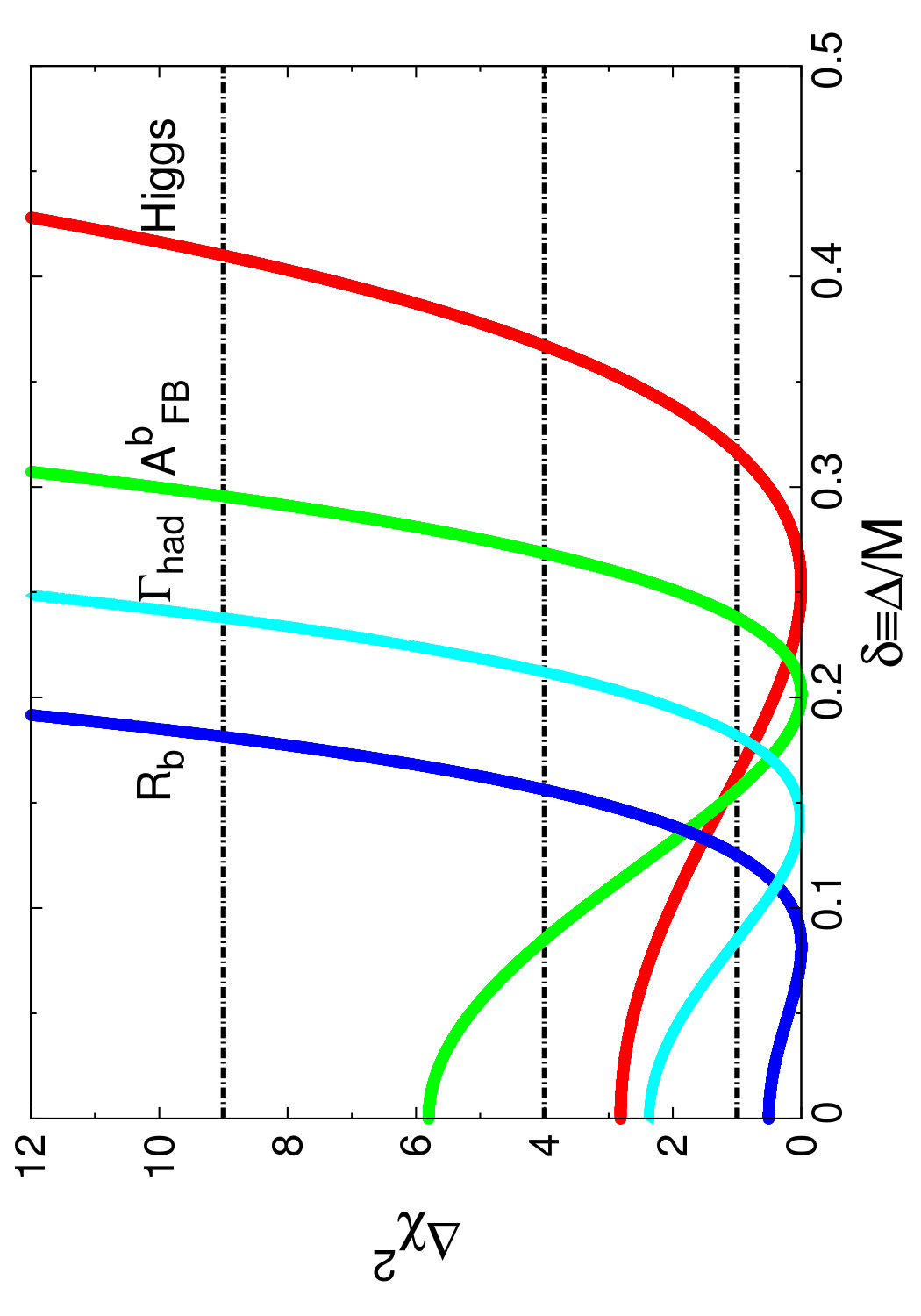 Figure 3
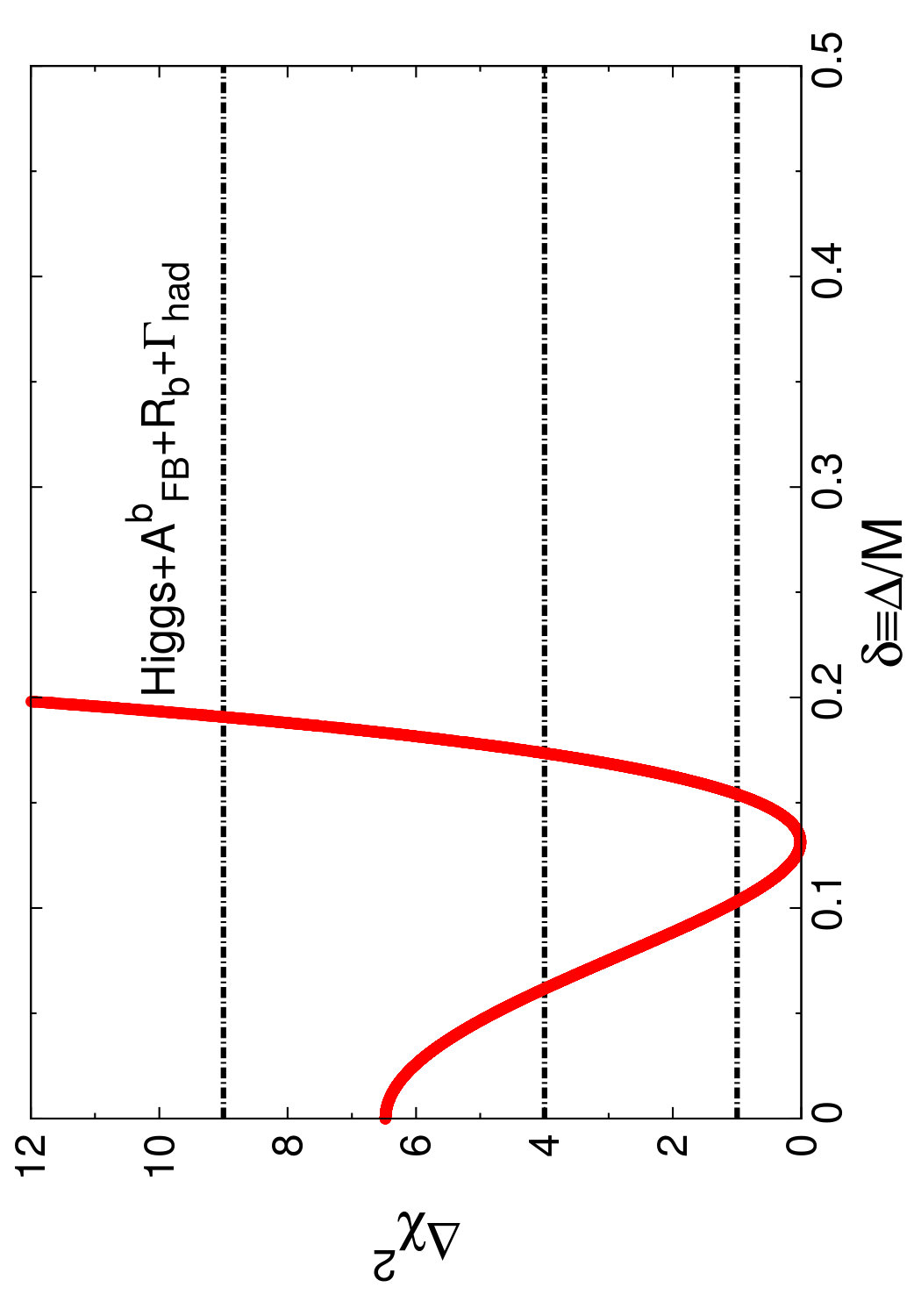 Figure 4
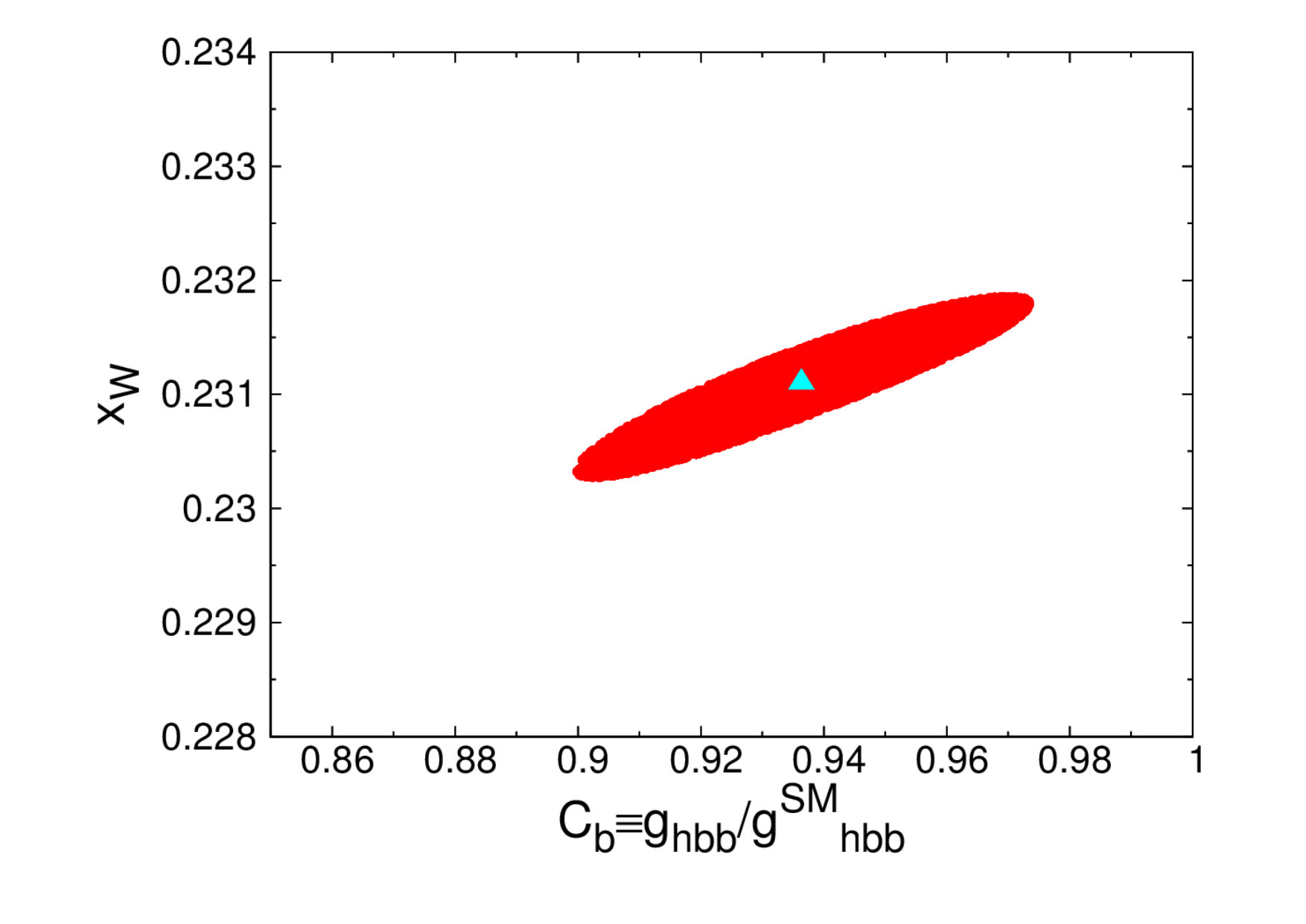 Figure 5
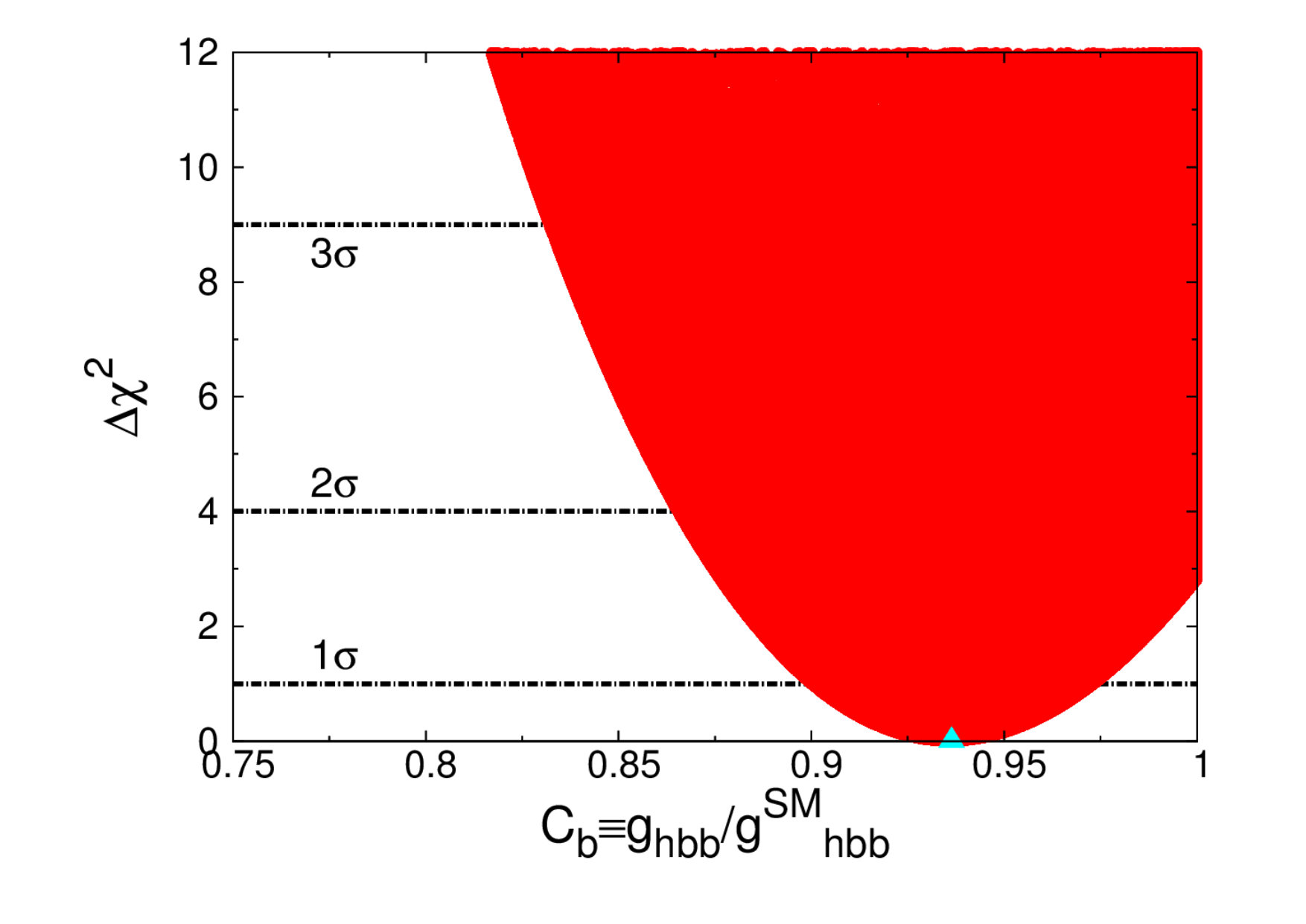 Figure 6
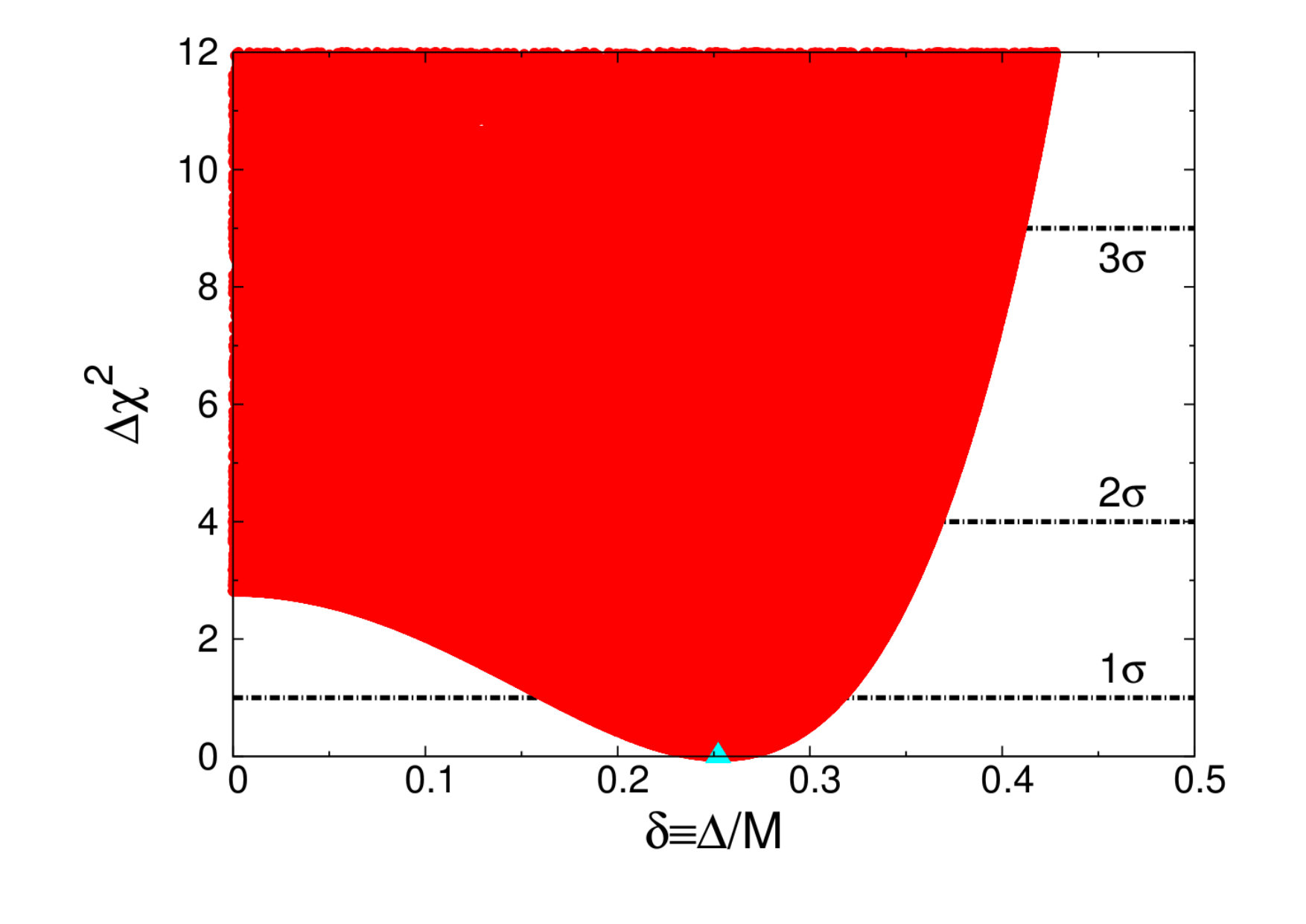 Figure 7
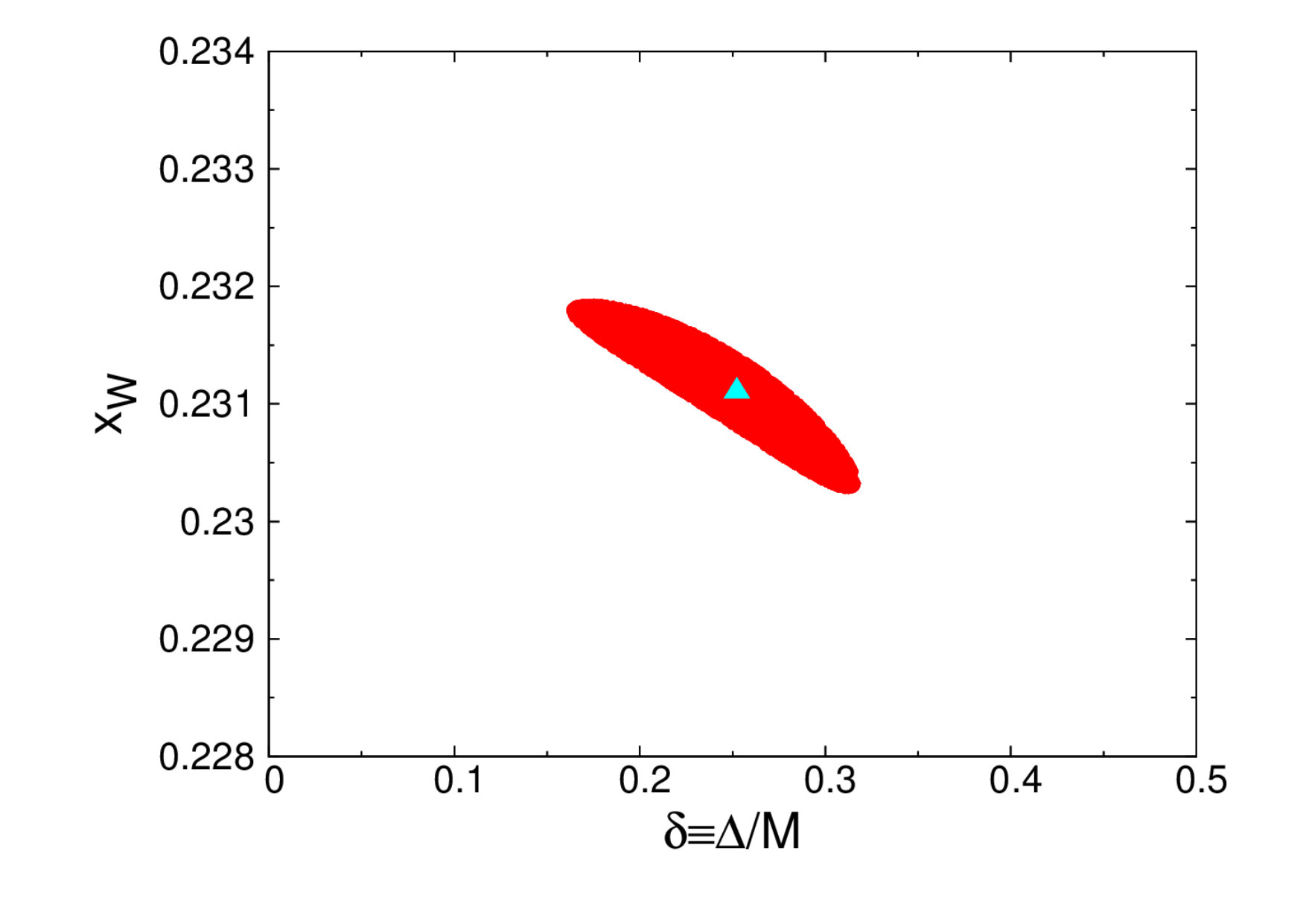 Figure 8
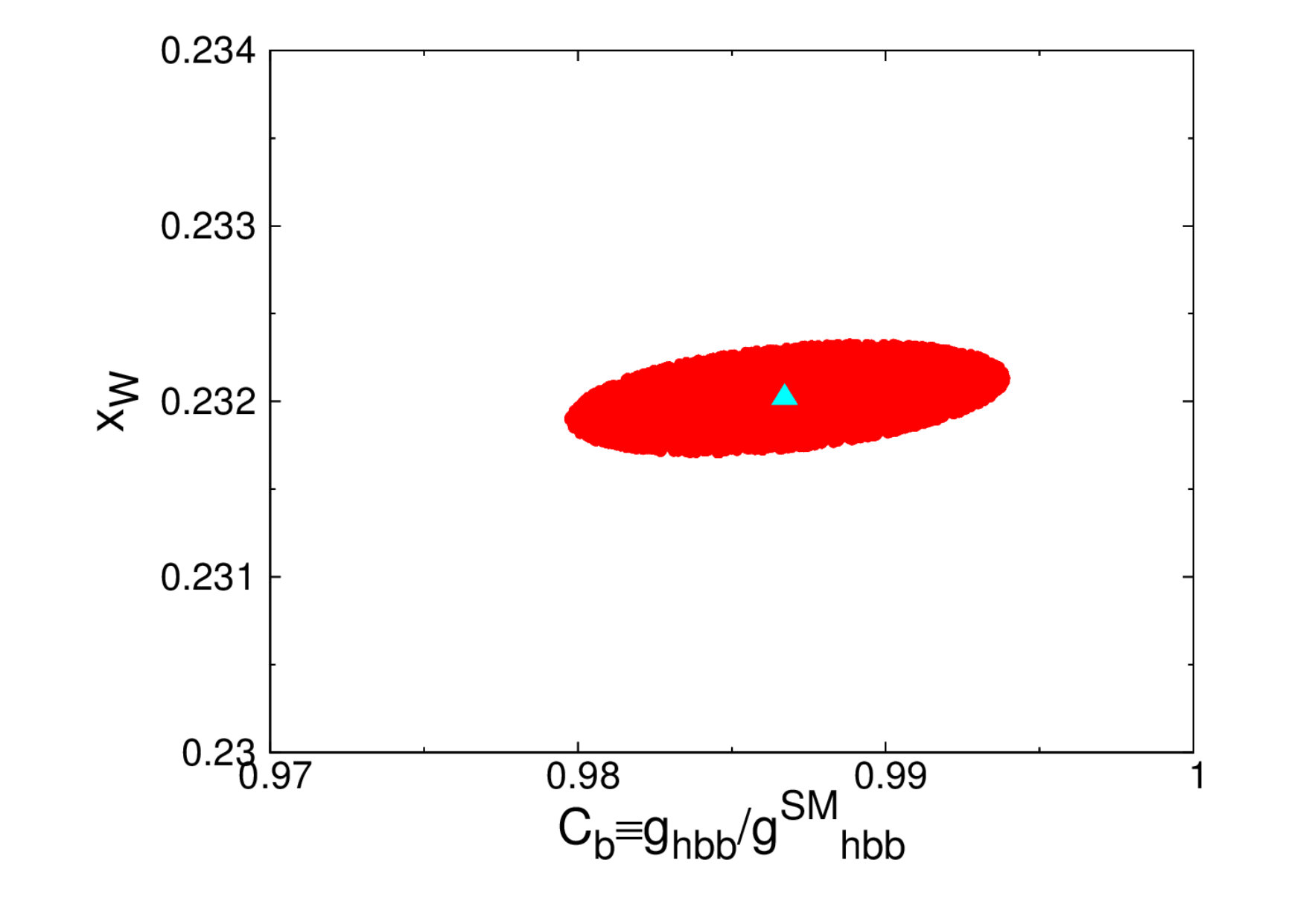 Figure 9
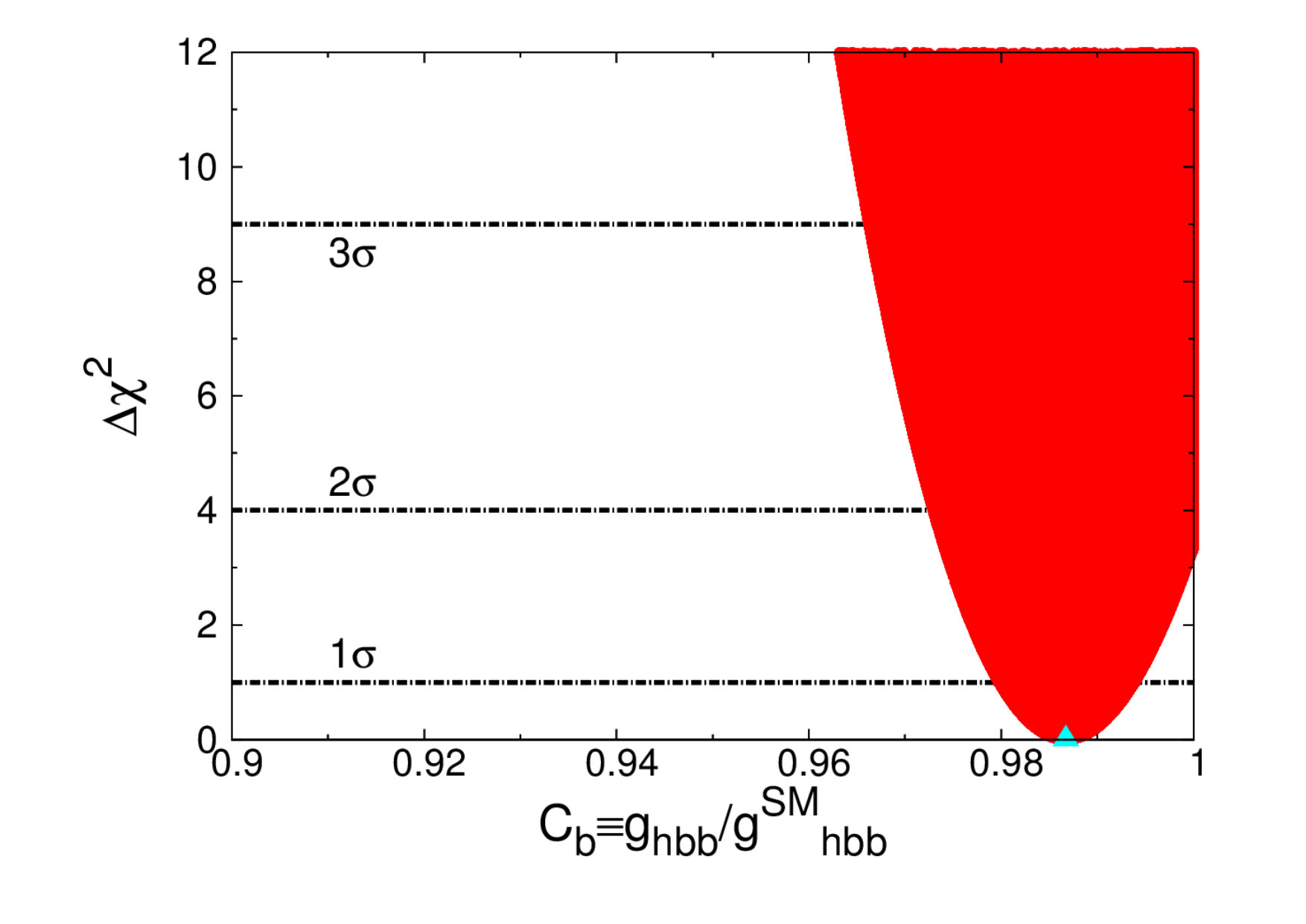 Figure 10
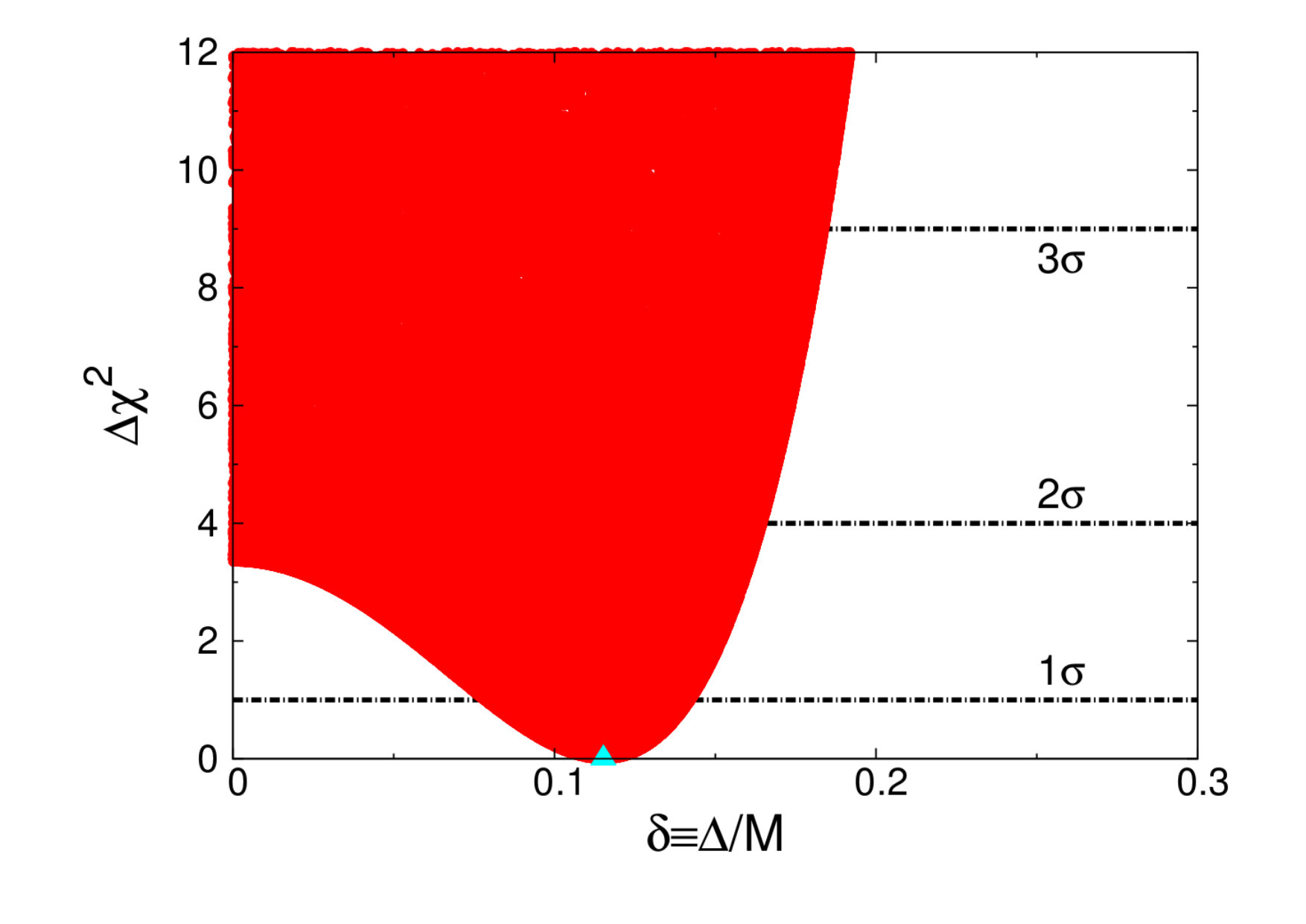 Figure 11
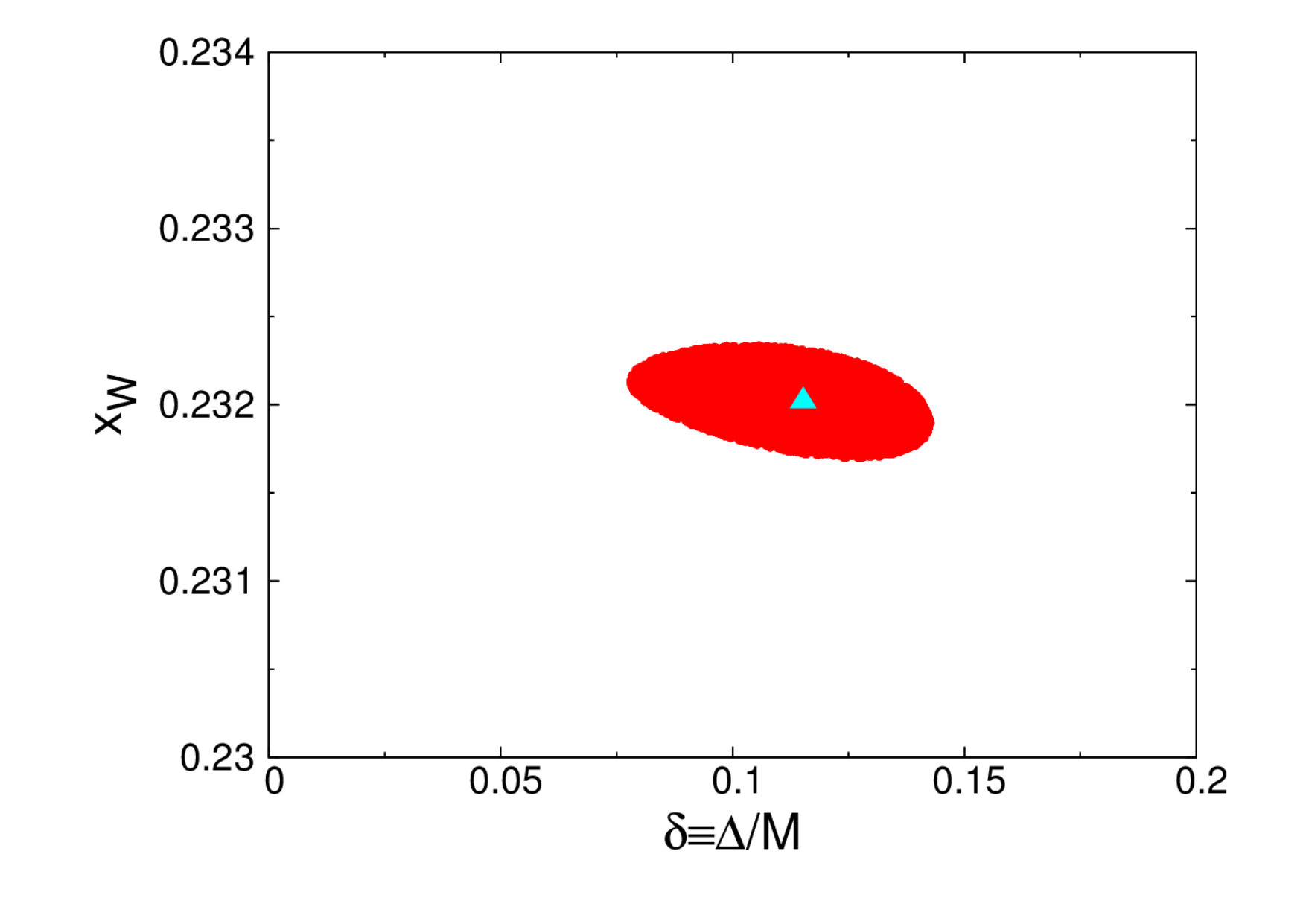 Figure 12
| Cases | SM | i | ii | iii | iv |
|---|---|---|---|---|---|
| data | Higgs | ||||
| 0.23154 | 0.23154 | 0.23154 | 0.23154 | 0.23154 | |
| 1.000 | |||||
| 53.81 | 50.99 | 51.39 | 53.27 | 52.35 | |
| 0.1030 | 0.0968 | 0.0991 | 0.1024 | 0.1012 | |
| 0.21582 | 0.2208 | 0.2189 | 0.21629 | 0.21731 | |
| [GeV] | 1.7411 | 1.7523 | 1.7480 | 1.7421 | 1.7444 |
| 62.21 | 113.9 | 69.78 | 58.32 | 56.13 |
Peer Reviews
No public reviews on file for this paper yet. If you reviewed it on a platform where reviews are public (OpenReview, ICLR, NeurIPS, ICML), you can paste yours below so the community can read it here.
Videos
No videos yet. Explain this paper in a talk, walkthrough, or lecture? Add one.
IUEP-HEP-19-01
Vector-like Quark Interpretation of Excess in Higgs Signal Strength
Kingman Cheung1,2,3,4, Wai-Yee Keung5,1, Jae Sik Lee6,7, and Po-Yan Tseng8,1
1 Physics Division, National Center for Theoretical Sciences, Hsinchu, Taiwan
2 Department of Physics, National Tsing Hua University, Hsinchu 300, Taiwan
3 Division of Quantum Phases and Devices, School of Physics, Konkuk University, Seoul 143-701, Republic of Korea
4 Department of Physics, National Central University, Chungli, Taiwan
5 Department of Physics, University of Illinois at Chicago, Illinois 60607 USA
6 Department of Physics Chonnam National University,
300 Yongbong-dong, Buk-gu, Gwangju, 500-757, Republic of Korea
7 Institute for Universe and Elementary Particles, Chonnam National University,
300 Yongbong-dong, Buk-gu, Gwangju, 500-757, Republic of Korea
8Kavli IPMU (WPI), UTIAS, The University of Tokyo, Kashiwa, Chiba 277-8583, Japan
Abstract
There is a deviation in the average Higgs-signal strength for all the TeV data up to Summer 2018. We find that a slight reduction of the bottom-Yukawa coupling can fit the data better than the standard model. We suggest an extension with a vector-like quark doublet, of which the right-handed component of mixes nonnegligibly with the standard model quark. We show that the mixing would induce a reduction of the bottom Yukawa coupling. Simultaneously, the coupling of the boson to the right-handed quark increases, which could reduce the forward-backward asymmetry of bottom production at LEP and bring it closer to the experimental value.
I Introduction
The standard model (SM) like Higgs boson was discovered in 2012 Aad:2012tfa ; Chatrchyan:2012xdj . After Run I at 7 and 8 TeV, the identity of the Higgs boson was very close to the SM one Cheung:2013kla ; Cheung:2014noa . With more and more measurements of the Higgs-signal strengths for various production and decay channels at a center-of-mass energy of 13 TeV, including the newly established production channel Sirunyan:2018shy ; Aaboud:2018urx , and Sirunyan:2018kst ; Aaboud:2017xsd and Sirunyan:2017khh ; ATLAS:2018lur in 2018, the SM-like Higgs boson is further confirmed. The most updated fits to the Higgs-boson couplings in various scenarios have recently been performed Cheung:2018ave .
Some very interesting results emerge from the new global fits, which were not realized previously. The combined average signal strength of the Higgs boson now stands at a deviation from the SM value, namely . Note that from the earlier combined signal strength at TeV, the ATLAS and CMS obtained Khachatryan:2016vau
[TABLE]
which was about above the SM. The 13 TeV data continues to show such trend, by combining all production and decay channels Cheung:2018ave :
[TABLE]
These two results can be combined naively into a total signal strength
[TABLE]
which shows a above the SM prediction.
If the overall signal strength continues to about 10% above the SM prediction while the uncertainties continues to reduce, it would pose a threat to the SM Higgs boson. One of the most economical fits to the Higgs-signal strength is to vary the total width of the Higgs boson. In Ref. Cheung:2018ave we found that the best-fit value for the is
[TABLE]
which means a reduction of about or 7% to the total width.
Naively, it is hard to imagine that one can add any new channels to reduce the total width. Nevertheless, one possibility is to reduce the partial width into with a reduced bottom-Yukawa coupling, provided that the current uncertainty of coupling is of order 20%. There are a few obvious possibilities that one can consider: (i) a singlet vector-like quark model but the left-handed (LH) component would modify the CKM phenomenology significantly, and thus subject to severe constraints. (ii) A vector-like quark doublet with hypercharge (the same as the SM quark doublet) but it would increase the tension with the experimental bottom forward-backward asymmetry at -pole. In this work, we explore an extensionChang:1996pf of the SM by adding an vector-like quark doublet with a different hypercharge of , of which the upper component mixes with the SM quark while mixes negligibly with . In such a way, the right-handed (RH) component of the bottom quark is reduced and thus the bottom-Yukawa coupling is reduced with respect to the SM value. Therefore, it can effectively explain why the average Higgs-signal strength is enhanced.
Historically, the measurement of forward-backward asymmetry of the bottom quark at the pole remains a deviation from the SM prediction Tanabashi:2018oca . In the present context, due to the mixing between and the effective RH coupling of bottom quark to the boson is enhanced, such that the would decreaseChang:1998uj in accord with the experimental data. Apparently, the addition of the new vector-like quark doublet can simultaneously explain the Higgs-signal strength and the forward-backward asymmetry in the correspondingly right direction. However, there are other precision constraints that we have to consider, namely, the ratio of the partial width to the total hadronic width, as well as the total hadronic width of the boson. We will give details in subsequent sections.
The organization of the paper is as follows. In the next section, we describe the extension of an isospin doublet of vector-like quarks, and modifications to the Higgs and couplings. In Sec. III, we fit the parameter , where measures the mixing and is approximately the mass of heavy vector-like quark, to the data of Higgs-signal strengths and to , with or without and . We discuss some other potential issues with modifications of the bottom-quark couplings and then conclude.
II Formalism
In this work, we consider the vector-like quark doublet with a hypercharge denoted by
[TABLE]
We label electric charges of the new particles by superscripts. Since carries the same electric charge as the SM bottom quark , they can mix. The quark mass matrix of receives additional contributions from the following new coupling with the SM Higgs doublet ,
[TABLE]
where . Note that the vector-like quarks receive their mass from some mechanisms, other than the usual electroweak symmetry breaking. We assume is of order TeV or more. Then the quark-mass matrix and the interactions with the SM Higgs boson become
[TABLE]
The large mass for the vectorial is unrelated to . It is much larger than the off-diagonal mass . The mass parameter accounts for the -quark mass in the SM if we ignore .
II.1 Mass diagonalization and Modifications to Bottom Yukawa
From the above equation, the mass terms for can be written as
[TABLE]
where .
We require the following left and right rotations to diagonalize the non-hermitian mass matrix:
[TABLE]
where the superscript “” denotes the mass eigenstates. For convenience we will drop the “” wherever it is understood to be the mass eigenstates. The presence of the zero entry in the upper-right corner of the quark-mass matrix in Eq. (5) suggests that the right rotation angle is of order , which is much larger than the left rotation angle of order for the favorable scenario . The suppression of is of order .
More precisely, the non-hermitian mass matrix is diagonalized by a bi-unitary rotation as
[TABLE]
which can be turned into
[TABLE]
with . Then the hermitian mass matrix squared can be diagonalized and the corresponding eigenvalues and eigenvectors can be calculated exactly:
[TABLE]
In the limit , they can be simplified to
[TABLE]
The mixing angles can also be simplified as
[TABLE]
and
[TABLE]
In the above, we identify , the mass of the observed -quark mass, and to be the TeV mass of the heavy vector-like quark. Practically, we can take in the analysis and then we find the -- Yukawa coupling depends only on one parameter of . More precisely, the coupling for is given by
[TABLE]
where we use and is given by Eq. (13) in the limit. The result is an overall reduction in the Higgs Yukawa coupling by from the SM value.
There are also couplings for other off-diagonal elements, as given in this equation:
[TABLE]
We can immediately see that the off-diagonal coupling of will dominate over the other one. Phenomenologically, the so-produced will decay into . We shall discuss the collider signature in the Discussion.
In the following we can focus on the effect of RH mixing in numerical analysis.
II.2 Modifications to the couplings
In the weak eigenbasis, according to , the couplings to fermions and , are given by
[TABLE]
[TABLE]
After rotating into mass eigenbasis we have
[TABLE]
[TABLE]
Here the gauge coupling and the electroweak mixing . Note that the coupling to the LH quark is practically the same as the SM coupling for a very small . On the other hand, the RH quark coupling is modified by an amount .
There are a number of observables that would be modified when the RH coupling to the boson is modified:
Total hadronic width. At tree level, the change to the decay width into is given by
[TABLE]
With this modification the total hadronic width is changed to
[TABLE] 2. 2.
. The is the fraction of hadronic width into , and so it is given by
[TABLE]
The value of can increase for a moderate when . 3. 3.
. There is a large tension in the forward-backward asymmetry of quark production at the resonance,
[TABLE]
Those couplings to the boson are basically given by in SM. For the electron it is simply
[TABLE]
while for the quark it is
[TABLE]
Correspondingly, the modified forward-backward asymmetry is given by
[TABLE]
III Fitting to data
Four data sets are considered in our analysis. They are summarized in the following table.
[TABLE]
The 125 GeV Higgs-signal strengths include a combined ATLAS+CMS analysis for the 7+8 TeV datasets Khachatryan:2016vau and all the most updated 13 TeV data summarized in Ref. Cheung:2018ave . The average signal strength is Cheung:2018ave . There are totally 64 data points. The goodness of the SM description for the Higgs data stands at , which gives a -value of . As explained in Introduction, a reduction in the total Higgs decay width can provide a better description of the Higgs data with , corresponding to a -value of 0.851 Cheung:2018ave . In this work, the reduction in the total width is achieved by a slight reduction in the RH bottom Yukawa coupling. On the other hand, the other three datasets were from the LEPI precision measurements tabulated in PDG Tanabashi:2018oca . There has been a deviation in the while is very much consistent with the SM.
In the following, we present our numerical results on fitting to different combinations of the datasets with variation in and a fixed or varying . We first show the fits with each single dataset listed in the previous table. Figure 1 shows the distribution versus fitting to four single experimental datasets with a fixed Tanabashi:2018oca and . (Note that in the mass hierarchy that we have assumed, is practically equal to 1.) The best fit values and uncertainties of for each dataset are listed in Table 1 from Case-i to iv. We can see that the dataset on Higgs-signal strengths and that on prefer a sizable mixing between and , corresponding to the mixing angle equal to and , respectively. The total hadronic width mildly prefers a mixing with mixing angle equal to . However, the is very much consistent with the SM and indicates a very small mixing between and .
Next we come to various combinations of datasets. In Case-v, we perform the fit by combining all four experimental datasets by varying with a fixed . The result is shown in right-panels of Fig.1 and Table 1. The central value of shifts slightly to , which gives mild improvements to all four datasets. Overall, the improves considerably.
In order to see whether such deviations from SM are robust or not, we allow the value of floating together with , and perform two fittings, Fit-I and Fit-II. The Fit-I only includes the Higgs-signal strengths and , because these two datasets would allow a significant deviation from the SM, according to the Cases-i and ii. The best fit point and distribution are shown in Table 1 and Fig.2. In this case, the best fit point gives very good description to the Higgs-signal strengths and , but draws a large deviation in and . For the Fit-II, which includes all four datasets, the best fit values and distributions are shown in Table 1 and Fig. 3, respectively. The best fit point provides the best description for all four datasets - the lowest overall.
So far we observe that the Higgs-signal strengths can be improved substantially by reducing the bottom Yukawa coupling, which is achieved in this work by mixing the RH component of a vector-like quark doublet with the SM right-handed bottom quark. So is the forward-backward asymmetry of the bottom quark at the pole. A mixing of order can achieve the effects. However, such a mixing would deviate and too much. Overall, a mixing of order would improve the whole picture.
IV Discussion
Note that the left-handed quark mixing is extremely small of order . All the decays, including lifetime, branching ratios, - mixing and angular distributions, would not be affected. So are the CKM matrix elements, because all these processes involve the left-handed coupling only.
The parameter in the above analysis. Assuming the mass of the heavy vector-like quark (VLQ) would be of order TeV. This VLQ is phenomenologically very interesting. It can be directly produced via QCD production processes, such as (here is understood to be the mass eigenstate). Assuming the mixing in the left-hand is negligible compared to the right-handed one. the dominant decays of are
[TABLE]
with partial widths given by
[TABLE]
It is understood that the mass of is approximately in the leading order. Note that and in the limit . The partial width of can then be further simplified to
[TABLE]
Therefore, in the limit these two partial widths are the same. We recall the equivalence theorem that in high energy limit the Higgs boson and longitudinal mode of gauge bosons behave the same.
The collider signature of pair production of via the decay into the boson is rather clean
[TABLE]
Such a search for charged lepton pair(s) plus jets has been performed at the 13 TeV LHC Aaboud:2018saj . Here we perform a rough estimate of the the lower mass limit of . The number of events with at least one charged lepton pair is
[TABLE]
where denotes the relevant experimental efficiency collectively. Taking fb*-1*, , , and , and requiring , we obtain
[TABLE]
This upper limit on production cross section can be translated to the lower mass limit of M_{b^{\prime}}\>\raisebox{-2.15277pt}{\stackrel{{\scriptstyle\textstyle>}}{{\sim}}}\>1.4 TeV Aaboud:2018saj .
Further searches of are possible. The signatures would give 1 or 2 charged lepton pairs at the mass plus multiple jets.
Acknowledgment
W.-Y. K. and P.-Y. T. thank the National Center of Theoretical Sciences, Taiwan, R.O.C. for hospitality. The work of K.C. was supported by the National Science Council of Taiwan under Grants Nos. MOST-105-2112-M-007-028-MY3 and MOST-107-2112-M-007-029-MY3. The work of J.S.L. was supported by the National Research Foundation of Korea (NRF) grant No. NRF-2016R1E1A1A01943297. The work of P.-Y.T. was supported by World Premier International Research Center Initiative (WPI), MEXT, Japan.
The reference list from the paper itself. Each links out to its DOI / PubMed record.
- 1(1) ATLAS, G. Aad et al. , Phys. Lett. B 716 , 1 (2012), 1207.7214.
- 2(2) CMS, S. Chatrchyan et al. , Phys. Lett. B 716 , 30 (2012), 1207.7235.
- 3(3) K. Cheung, J. S. Lee, and P.-Y. Tseng, JHEP 05 , 134 (2013), 1302.3794.
- 4(4) K. Cheung, J. S. Lee, and P.-Y. Tseng, Phys. Rev. D 90 , 095009 (2014), 1407.8236.
- 5(5) CMS, A. M. Sirunyan et al. , JHEP 08 , 066 (2018), 1803.05485.
- 6(6) ATLAS, M. Aaboud et al. , Phys. Lett. B 784 , 173 (2018), 1806.00425.
- 7(7) CMS, A. M. Sirunyan et al. , Phys. Rev. Lett. 121 , 121801 (2018), 1808.08242.
- 8(8) ATLAS, M. Aaboud et al. , JHEP 12 , 024 (2017), 1708.03299.