Precursors of the Spin Glass Transition in Three Dimensions
Marco Baity-Jesi, Victor Martin-Mayor

TL;DR
This paper investigates the energy landscape and dynamics of the 3D Heisenberg Spin Glass model in the paramagnetic phase, identifying precursor phenomena to the spin glass transition and drawing parallels with supercooled liquids.
Contribution
It uncovers non-trivial landscape features and dynamical crossovers above the critical temperature, providing insights into the phenomenology of spin glasses in three dimensions.
Findings
Onset of non-trivial landscape behavior at temperature T_o
Power-law growth of relaxation times indicating a dynamical crossover at T_d
Efficient energy minimization using Successive Overrelaxation algorithm
Abstract
We study energy landscape and dynamics of the three-dimensional Heisenberg Spin Glass model in the paramagnetic phase, i.e. for temperature larger than the critical temperature . The landscape is non-trivially related to the equilibrium states even in the high-temperature phase, and reveals an onset of non-trivial behavior at a temperature , which is also seen through the behavior of the thermoremanent magnetization. We also find a power-law growth of the relaxation times far from the spin-glass transition, indicating a dynamical crossover at a temperature , . The arising picture is reminiscent of the phenomenology of supercooled liquids, and poses questions on which mean-field models can describe qualitatively well the phenomenology in three dimensions. On the technical side, local energy minima are…
Click any figure to enlarge with its caption.
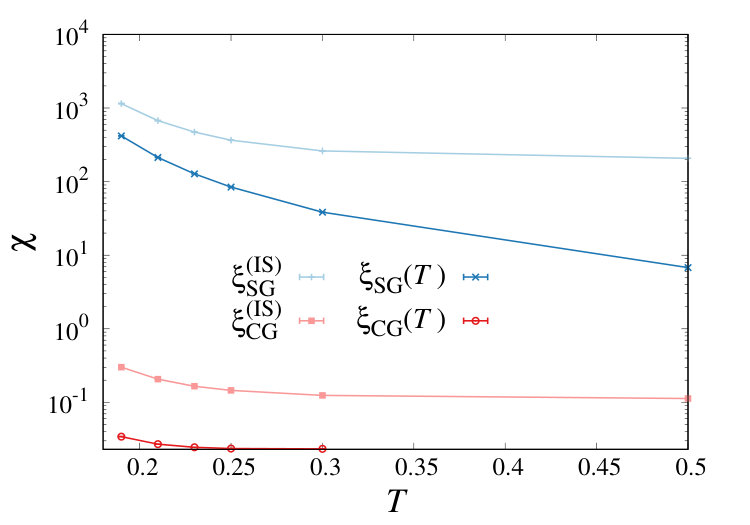 Figure 1
 Figure 2
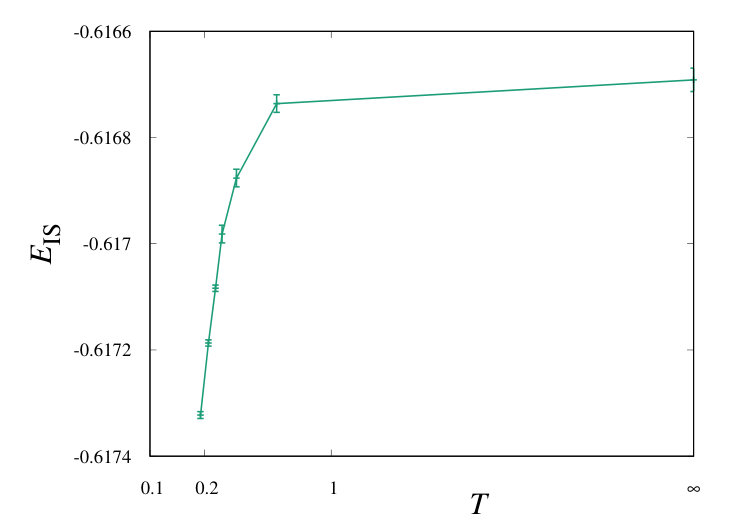 Figure 3
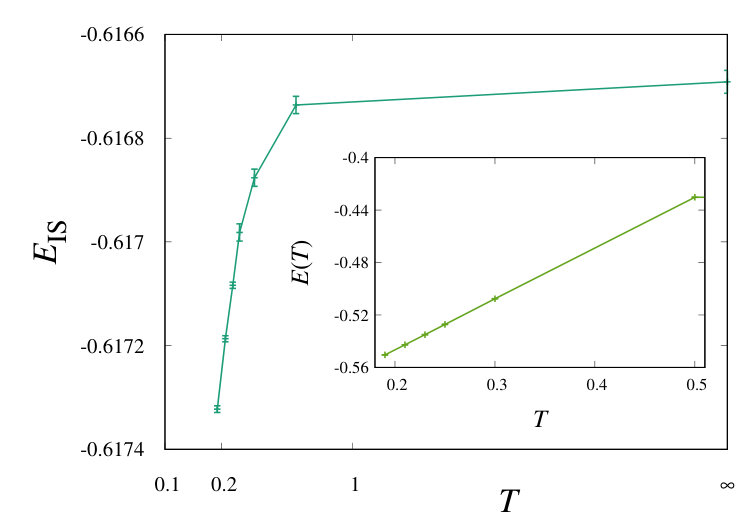 Figure 4
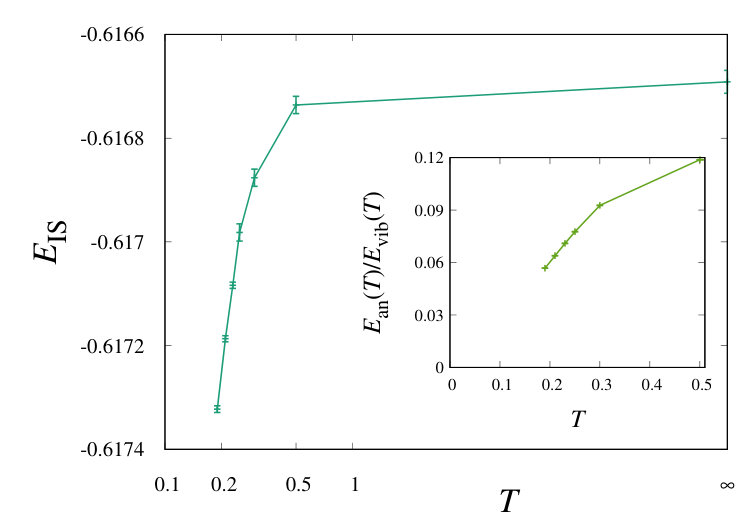 Figure 5
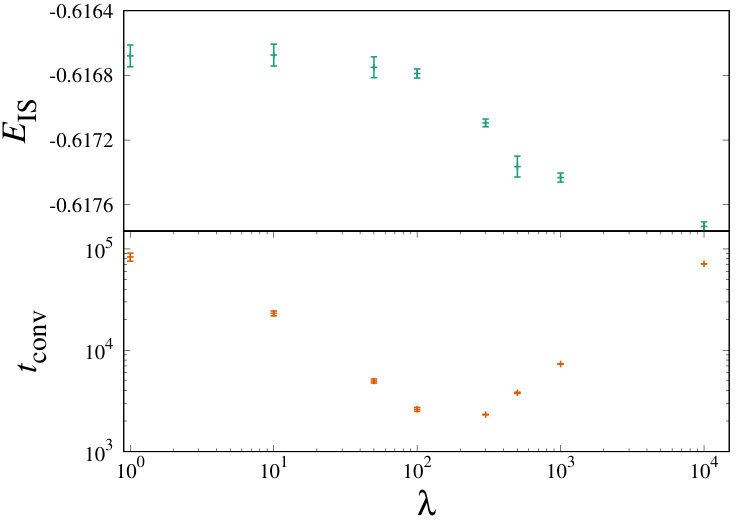 Figure 6
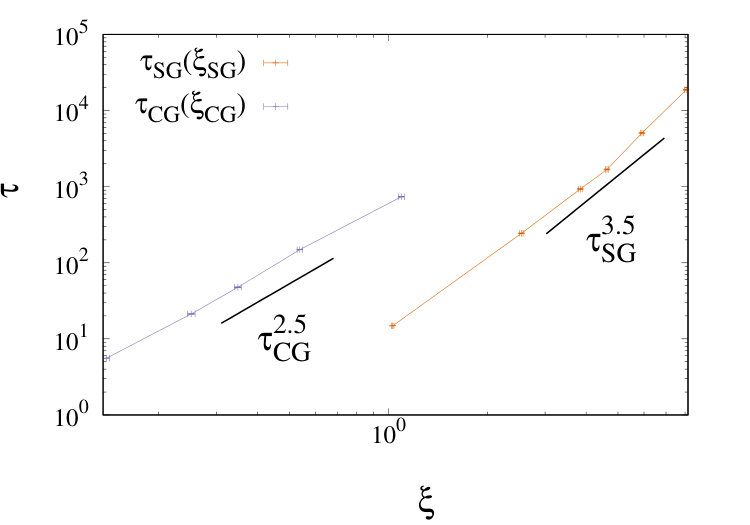 Figure 7
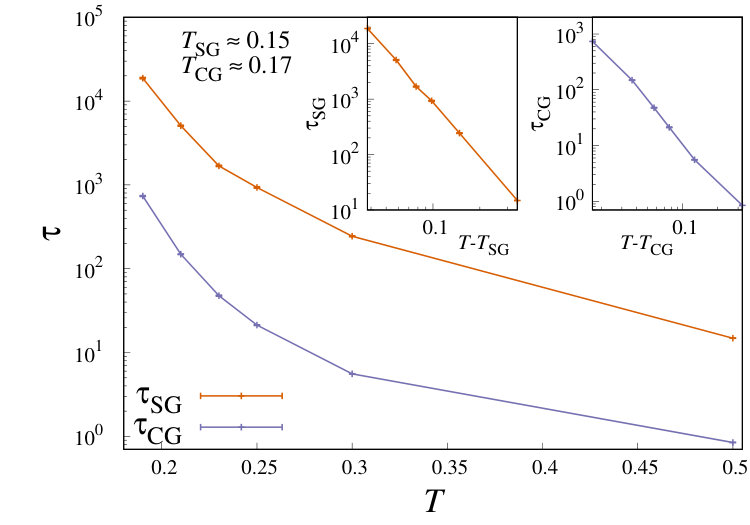 Figure 8
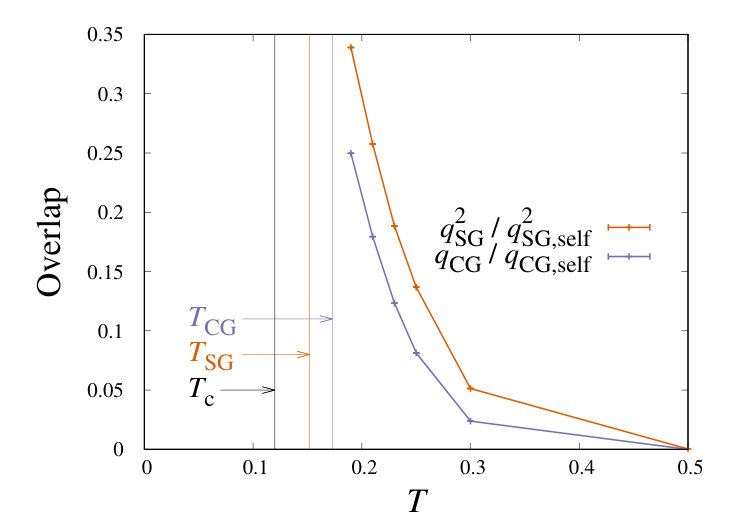 Figure 9
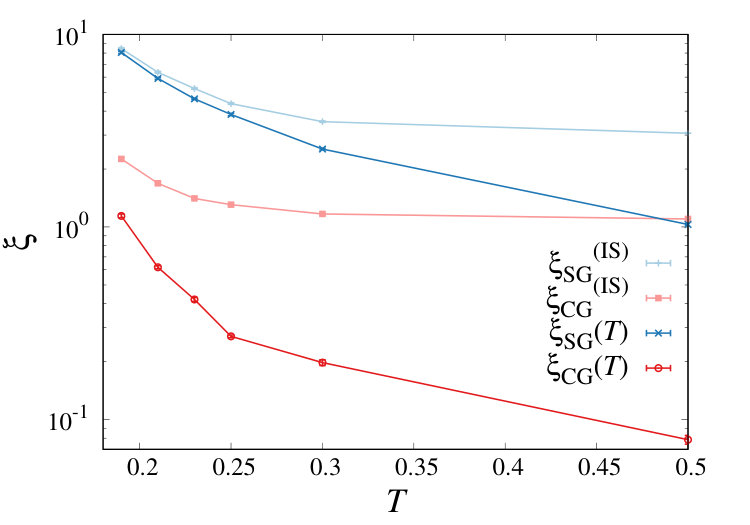 Figure 10
Peer Reviews
No public reviews on file for this paper yet. If you reviewed it on a platform where reviews are public (OpenReview, ICLR, NeurIPS, ICML), you can paste yours below so the community can read it here.
Videos
No videos yet. Explain this paper in a talk, walkthrough, or lecture? Add one.
Precursors of the Spin Glass Transition in Three Dimensions
Marco Baity-Jesi1,†, Víctor Martín-Mayor2
1 Department of Chemistry, Columbia University, New York, NY 10027, USA
2 Departamento de Física Teórica, Universidad Complutense de Madrid, 28040 Madrid, Spain
Abstract
We study energy landscape and dynamics of the three-dimensional Heisenberg Spin Glass model in the paramagnetic phase, i.e. for temperature larger than the critical temperature . The landscape is non-trivially related to the equilibrium states even in the high-temperature phase, and reveals an onset of non-trivial behavior at a temperature , which is also seen through the behavior of the thermoremanent magnetization. We also find a power-law growth of the relaxation times far from the spin-glass transition, indicating a dynamical crossover at a temperature , . The arising picture is reminiscent of the phenomenology of supercooled liquids, and poses questions on which mean-field models can describe qualitatively well the phenomenology in three dimensions. On the technical side, local energy minima are found with the Successive Overrelaxation algorithm, which reveals very efficient for energy minimization in this kind of models.
1 Introduction
Spin glasses are disordered magnetic alloys [1]. It is well established that, in three dimensions, they exhibit a phase transition from a paramagnetic to a spin glass phase at a critical temperature , where the spins freeze in amorphous configurations. Evidence for this phase transition is experimental [2, 3], numerical [4, 5, 6, 7] and (to some extent) also analytical [8].
The nature of the low-temperature phase, the spin glass phase, is not well understood yet. On one side, contrasting interpretations of numerical simulations have been supported [9, 10, 11, 12, 13, 14], and on the other side, first-principles analytical calculations can be performed only in the mean-field limit, corresponding to infinite dimensions [15, 16].
Maybe the simplest scenario for the spin-glass phase is the Droplet Picture, according to which this phase is not very dissimilar to ferromagnetic ordering, with only two pure states related by symmetry [17, 18, 19]. The other dominant theory is the Replica Symmetry Breaking (RSB) scenario, according to which three-dimensional spin glasses behave similarly to their mean-field counterparts [20, 21]. Since different spin-glass models display qualitatively different features, the RSB scenario can apply in different ways.
The main mean-field model taken into account by the RSB scenario is the SK model [22], which is conjectured to behave similarly to the three-dimensional Ising spin glass [23, 24]. Another mean-field model with different phenomenology is the -spin model [25, 26, 27, 28], which is more often used to interpret results for three-dimensional structural glasses rather than spin glasses.111Unless specified otherwise, throughout this work we will refer as -spin model both for the pure [25] and for the mixed [28] -spin models. This is due to striking similarities with the phenomenology of supercooled liquids (SCLs), and to the presence of several non-trivial effects even in the paramagnetic phase [29, 30, 31].
These effects include the presence of a dynamical temperature , associated to a so-called topological transition: at temperature the phase space motion of the system is controlled by saddles of the energy landscape, whereas for the typical configurations are close to local minima of the energy. Since the energy barriers in the -spin model are diverging [32], this implies that the system becomes stuck around the local minima, the relaxation times diverge, and ergodicity is broken. Furthermore, instant energy minimizations (quenches) starting from equilibrium configurations at converge almost surely to local minima (also called inherent structures) at a fixed threshold energy , and only by equilibrating at lower temperatures it is possible to reach lower energies.
A similar phenomenology was encountered in models of supercooled liquids, marking the onset of glassy behavior. On one side, an apparent power-law divergence of the relaxation times in the high-temperature phase is present [33]. On the other side, at high temperatures the energy of the inherent structures (IS) is constant, until it starts decreasing at an onset temperature [34]. In low-dimensional systems these transitions are not sharp, because the energy barriers are not infinite, so they are only found in the form of crossovers.
These effects, that occur in the disordered phase, do not occur in the the SK model, which, in some sense, has a more trivial high-temperature phase. For this reason one usually refers to the -spin model as a mean-field structural glass [31] and to the SK as a mean-field spin glass.
Here, we show that a structural-glass-like (or -spin-like) phenomenology is present also in three-dimensional spin glasses of the Heisenberg type. Specifically, we find that, as it is observed in supercooled liquids, the IS energy has a non-trivial dependence on temperatures, and that the relaxation times have a power-law growth deep in the paramagnetic phase, which can be interpreted as a dynamical crossover. Also, we find that the memory of the initial condition after a quench resembles the -spin rather than the SK model.
We introduce the model and the main observables in Sec. 2. In section 3 we explain how inherent structures can be easily found by using a simple local algorithm. The main results of the paper are given in section 4, followed by a discussion in section 5.
2 Model and Observables
We study the Heisenberg spin glass model on a three-dimensional periodic cubic lattice of linear size . The system has spins 222 We study , finding consistent results, which indicates that our analysis is not hampered by finite-size effects. Therefore, in our analysis, we assume that the system is in the thermodynamic limit.
, with . The Hamiltonian is
[TABLE]
where indicates that the sum is performed over nearest neighbors, and the couplings are randomly chosen from a Gaussian distribution with mean zero and variance one. For averages over the couplings (disorder averages), we use an overline, , whereas for averages over the Gibbs distribution (thermal averages) we use angle brackets, .
This model has a phase transition from a paramagnetic to a glassy phase at [35]. There are two order parameters: the spin-glass overlap and the chiral-glass overlap . Some numerical works indicate two separate transitions temperatures spin and chirality, with the chirality at a higher temperature [36], while others assess no measurable difference between the two [35]. To the scope of this work, the only important datum is that temperatures higher than are in the paramagnetic phase.
In order to have a rotation-invariant definition of the overlap, we use the squared overlap , defined through
[TABLE]
where are the components of the spins, indicate two different configurations with the same realization of the couplings (replicas).
For the chiral overlap, instead, we need to define the chirality along the spatial direction ,
[TABLE]
where (or ) is the neighbor of along the negative (or positive) direction . The chiral overlap between two replicas and in the direction is then defined as
[TABLE]
Correlation functions (and their Fourier transforms, the wave-number dependent susceptibilities ) are measured per planes (applying Eqs. (4) and (6) to couple different sites). The correlation along the direction is
[TABLE]
where is the average overlap (either spin or chiral glass) along the plane perpendicular to . Given the isotropy of the problem, we averaged over the three main directions:
[TABLE]
The chiral correlations can have the chirality direction either parallel or orthogonal to axis of the correlation. We do not remark difference behaviors between the two (see [37]), so we show results averages over all directions. The susceptibilities were calculated by Fourier transforming and , and then averaging.
In order to diminish statistical errors, we follow [38], and truncate the correlation functions when the signal becomes less than three times the error bar (see [37] for details and finite-size effects). From those we calculated the correlation length
[TABLE]
Similarly, we calculate the spin-glass autocorrelation functions
[TABLE]
where is the overlap calculated between configurations of the same replica at times [math] and . Analogously, the chiral glass correlation functions can be written as
[TABLE]
The integrated autocorrelation times are
[TABLE]
3 Inherent Structures
The most intuitive way to perform a direct minimization on a spin model is to successively align every spin to its local field
[TABLE]
This algorithm, called the Gauss-Seidel (GS) algorithm [39], has an extremely slow convergence rate, and is not efficient on our system sizes [40]. 333Though it has been used previously, for example in [41], for finding inherent structures in small Heisenberg spin glasses. Therefore, we resort to a modification of the GS algorithm, called Successive Overrelation (SOR), that consists essentially in adding momentum to the minimization [39].
On the Heisenberg spin glass, the SOR algorithm amounts to updating the spins sequentially, with a linear combination between the local update that mostly decreases the energy (i.e. the GS update)
[TABLE]
and the one that mostly changes the spin position without changing its energy 444This update is the overrelaxation update which is often used for equilibrating Heisenberg spin glasses [42].
[TABLE]
The SOR update, ,
[TABLE]
depends on a parameter , which can be increased to make the minimization less greedy. Indeed, increasing reduces the greediness the algorithm since with one recovers GS, and with SOR is recovered.
Ungreedy versions (i.e. large ) of the algorithm are able to reach lower energies (Fig. 1, top), in agreement with similar algorithms on Ising spin models [43].
In order to achieve optimal performance, must be large enough to be away from the GS limit, but not too large, otherwise the energy does not get minimized at all. It turns out that the best performance is obtained in the interval (Fig. 1,bottom). 555For more tests and applications of SOR to the Heisenberg spin glass see [37].
4 Results
We thermalize configurations deep in the paramagnetic phase, at temperatures = 0.19, 0.21, 0.23, 0.25, 0.3, 0.5, and with a combination of the heatbath and overrelaxation algorithms [42, 44].
Inherent Structure Energy
From each configuration, we minimize the energy with SOR, setting (results with reveal equivalent). As shown in Fig. 2, the IS energy is weakly dependent on temperature, and decreases abruptly at a temperature consistently higher than the spin-glass transition temperature [35], reminescently of what occurs in supercooled liquids [34], where this is interpreted as evidence that the energy landscape plays a pivotal role in the slowing down of glassy systems.
Further, the energy of a low-temperature state, , can be decomposed in three terms: the energy of the inherent structure, ; a vibrational component ; 666The factor 1/3 in in the vibrational energy stems from the normalization we chose in Eq. 1. and an anharmonic energy term, , that is zero in the case that the energy consist purelly of harmonic vibrations around the minimum. From this decomposition, we show in Fig. 2–inset that the anharmonic term is a small fraction of the vibrational energy, for which an energy landscape interpretation of the energy of a state as principally an inherent structure plus harmonic thermal fluctuations is reasonable even in the paramagnetic phase.
Length Scales
As shown in Fig. 3, the qualitative trend of the IS energy is reflected by the IS correlation length, , which starts increasing at . At higher temperature, is approximately constant, and significantly larger than the equilibrium correlation length , that goes to zero as . At lower temperature, the growth of the correlations becomes progressively dominated by the landscape, especially in the spin-glass sector, where the and almost coincide. In the chiral sector there is also a growing correlation length, but, at least at higher temperature, it can not be associated to a growth of the landscape correlations. This is similar to what happens in supercooled liquids, with the crucial difference that in the Heisenberg spin glass we know that at a low-enough temperature the correlations will eventually diverge [35].
Critical scaling would require that the correlation length diverge at the phase transition as , where the critical exponent can be taken from Ref. [35]. The best fit we are able to obtain from gives a divergence of at , which is incompatible with its most accurate measurement, [35]. Equivalently, fixing the critical temperature yields , again incompatible with its value at , so this temperature range the growth of the correlation length is not fully dominated by the phase transition.
Relaxation Times
Starting from the thermalized configurations, with run pure heatbath dynamics to measure the autocorrelation times and (Eqs. (13) and (14). Fig. 4 illustrates that, in the same temperature range where grows mildly, the integrated autocorrelation times grow of about three orders of magnitude. In the spin glass sector, the relaxation time grows from 15ps at to 19000ps at . The chiral relaxation time goes from 1ps to 700ps. 777 One heat-bath sweep in our simulations roughly corresponds to 1ps of physical time [3].
In the insets we show that this growth follows a power law, reminiscent of the mode-coupling crossover in SCLs [33]. The extrapolated transition temperatures in the spin and chiral glass channels are respectively and . We stress that these are not real transitions, but mere crossovers: these power-law growths are expected to be smoothed down when the temperature is low enough for activated dynamics to be relevant. The exponent’s value is for the spin and for the chiral sector. A similar decoupling between spin and chirality was also observed in [45], through AC susceptibility measurements in the same temperature range.888 We know that there can not be a power law divergence at this temperature, and that this growth necessarily a crossover, implying that there is a bias error in addition to the statistical error. As a consequence, for these fits, we use errorbars. The is 4.50/3 (with errors) for the spin glass sector, and 5.98/3 (with errors) for the chiral glass. This growth of is consistently stronger than the one of the correlation lengths. The relationship between the two is shown in Fig. 5. It is not clear what relationship there is between the two observables, because the correlation length’s extrapolation would (wrongly) suggest a divergence at , while the relaxation times’ apparent divergence is at .
Thermoremanent magnetization
Further similarities with a SCL-like behavior (therefore, with the -spin model) are seen in the thermoremanent magnetization, defined as the overlap between the equilibrium configuration and the corresponding inherent structure.
We show in Fig. 6 that it is zero at large , and it becomes larger than zero at temperatures consistently higher than . This reveals a transition (or crossover) from a trivial temperature regime in which memory after a quench is totally lost, to a regime with glassy behavior. The temperature of this onset of glassy behavior is consistent with the one revealed by the inherent structure energy (Fig. 2).
This behavior of the thermoremanent magnetization is qualitatively different both from the SK model (where it is non-zero even at infinite temperature [46]) and from the pure -spin model (where a finite jump is expected at ). It is instead expected in the mixed -spin model [47].
5 Discussion
We analyzed the ISs in the three-dimensional Heisenberg spin glass, with the Successive Overrelaxation algorithm, which reveals efficient even for very large system sizes, and is straightforwardly implemented. Our findings are consistent with an onset temperature of glassy behavior, , where the IS energy starts depending on temperature and the thermoremanent magnetization becomes non-zero. This is accompanied by a gentle growth of the correlation lengths , both chiral and spin glass, which, at least at higher temperatures, appears unrelated to the landscape. While the growth of is mild, the autocorrelation times appear to diverge as a power law to a temperature that is sizably higher than the critical temperature ,999This power-law growth is expected to be leveled down at lower temperatures by activated processes, since we are in the paramagnetic phase. suggesting a mode-coupling transition (which in 3D is a crossover, not a phase transition).
The aforementioned features are qualitatively similar to what occurs in supercooled liquids (SCLs) and in the -spin model [48]. There is a longstanding debate over whether spin glasses and SCLs display the same critical behavior, due to the formal equality between the dynamical equations of the -spin glass and the mode-coupling equations for SCLs [49, 29]. This equivalence is well assessed in mean field, both from the point of view of the statics [31] and the dynamics [50, 51], and is fortified by recent evidence that the dynamical solution of hard spheres [51] can be obtained through a mode-coupling approach [52].
In three dimensions, the random first order transition theory [48] supports an equivalence between spin glasses and SCLs [53], though there are opposing views [54, 55]. Moreover, there is some suggestion that SCLs are in the same universality class of Ising spin glasses in an external magnetic field [56], which breaks time-reversal symmetry of the SG, that is absent in SCLs.
To our knowledge, this is the first study that explores this equivalence on spin glasses with continuous degrees of freedom, which may explain why the features we showed had not yet been found in a three-dimensional spin glass. Our findings strongly suggest that Heisenberg spin glasses behave very similarly to SCLs.101010 Though perturbations to a Heisenberg hamiltonian, such as exchange anisotropy result into an Ising universality class [57].
This is further supported by striking similarities in the energy landscape of these models in three dimensions: both Heisenberg spin glasses [58] and SCLs [59] have an excess of soft localized modes (at frequencies much lower than the boson peak) with the same exponent .
The presence of a dynamical transition in three-dimensional SGs supports also a connection with results obtained within mode-coupling theory [60], which could hold in three dimensions [52] under hypotheses that we are currently verifying [61].
Especially the chiral order parameter shows a behavior reminiscent of SCLs. In fact, it displays a very mild growth of the correlation length in a temperature regime where the relaxation times explode, which is one of the main puzzles in the glass transition problem [48, 55, 53]. An explanation stemming from an equivalence with spin glasses would be that those are preasymptotic effects preceding a phase transition at lower temperature, though the nature of these effects and of the low-temperature phase still would remain unknown.
Our simulations give evidence that the mean-field model describing appropriately the three-dimensional Heisenberg spin glass is not the SK model, nor its extension to vector spins [16, 62], which have infinite steps of replica symmetry breaking. Instead, it is most likely that it be the (mixed [46]) -spin model, with only one step of replica symmetry breaking, that has a phenomenology similar to the Heisenberg spin glass. This observation suggests that the high-dimensional (mean field) limit of low-dimensional spin glasses does not share their universality class. This picture is further sustained by earlier work, showing that the chiral overlap distribution in the Heisenberg spin glasses is 1-RSB [63, 64].
On a last note, we remark that the dynamical crossover we measured is different in the spin and chiral glass sectors [45, 65]. This opens a new scenario for the spin-chirality decoupling debate [66], regarding the putable presence of two critical temperatures in the Heisenberg spin glass: the spin-chirality decoupling could be attributed to a different dynamical crossover in the two critical channels.
6 Acknowledgments
We thank Federico Ricci-Tersenghi for many valuable discussions. We thank Luis Antonio Fernández for suggesting the use of the Successive Overrelaxation algorithm. We also thank Ada Altieri, Silvio Franz and Harukuni Miyazaki for interesting discussions. This work was funded through Grant No. FIS2015-65078-C2-1-P, jointly funded by MINECO (Spain) and FEDER (European Union). M.B.-J. was supported by the Simons Foundation for the collaboration “Cracking the Glass Problem” (No. 454951 to D.R. Reichman).
The reference list from the paper itself. Each links out to its DOI / PubMed record.
- 1[1] M. Mézard, G. Parisi, and M. Virasoro. Spin-Glass Theory and Beyond . World Scientific, Singapore, 1987.
- 2[2] J. de Nobel and F.J. du Chatenier. Specific heats of dilute alloys of manganese in silver and copper at low temperatures and in magnetic fields. Physica , 25(7):969 – 979, 1959.
- 3[3] J. A. Mydosh. Spin Glasses: an Experimental Introduction . Taylor and Francis, London, 1993.
- 4[4] M. Palassini and S. Caracciolo. Universal finite-size scaling functions in the 3D Ising spin glass. Phys. Rev. Lett. , 82:5128–5131, 1999.
- 5[5] H. G. Ballesteros, A. Cruz, L. A. Fernandez, V. Martín-Mayor, J. Pech, J. J. Ruiz-Lorenzo, A. Tarancon, P. Tellez, C. L. Ullod, and C. Ungil. Critical behavior of the three-dimensional Ising spin glass. Phys. Rev. B , 62:14237–14245, 2000.
- 6[6] L. W. Lee and A. P. Young. Single spin and chiral glass transition in vector spin glasses in three dimensions. Phys. Rev. Lett. , 90:227203, Jun 2003.
- 7[7] Stefan Boettcher. Stiffness of the edwards-anderson model in all dimensions. Phys. Rev. Lett. , 95:197205, Nov 2005.
- 8[8] G. Parisi. Field Theory, Disorder and Simulations . World Scientific, 1994.