Novel Block Excitonic Condensate at $n=3.5$ in a Spin-Orbit Coupled $t_{2g}$ Multiorbital Hubbard Model
Nitin Kaushal, Alberto Nocera, Gonzalo Alvarez, Adriana Moreo, and, Elbio Dagotto

TL;DR
This study predicts a novel excitonic condensate at electron density 3.5 in a one-dimensional spin-orbit coupled $t_{2g}$ Hubbard model, revealing new magnetic phases relevant for materials with $d^{3.5}$ valence.
Contribution
It introduces the first evidence of a block excitonic condensate at $n=3.5$ in a $t_{2g}$ Hubbard model with spin-orbit coupling, expanding understanding of magnetic phases in such systems.
Findings
Existence of a block excitonic phase at $n=3.5$ and $q=\pi/2$
Coexistence of excitonic condensate with block magnetic order
Phase diagram showing robustness of the phase at large spin-orbit coupling
Abstract
Theoretical studies recently predicted the condensation of spin-orbit excitons at momentum = in spin-orbit coupled three-orbital Hubbard models at electronic density . In parallel, experiments involving iridates with non-integer valence states for the Ir ions are starting to attract considerable attention. In this publication, using the density matrix renormalization group technique we present evidence for the existence of a novel excitonic condensate at in a one-dimensional Hubbard model with a degenerate sector, when in the presence of spin-orbit coupling. At intermediate Hubbard and spin-orbit couplings, we found an excitonic condensate at the unexpected momentum = involving and bands in the triplet channel, coexisting with an also unexpected block magnetic…
Click any figure to enlarge with its caption.
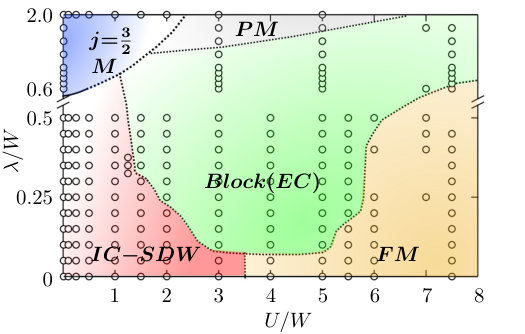 Figure 1
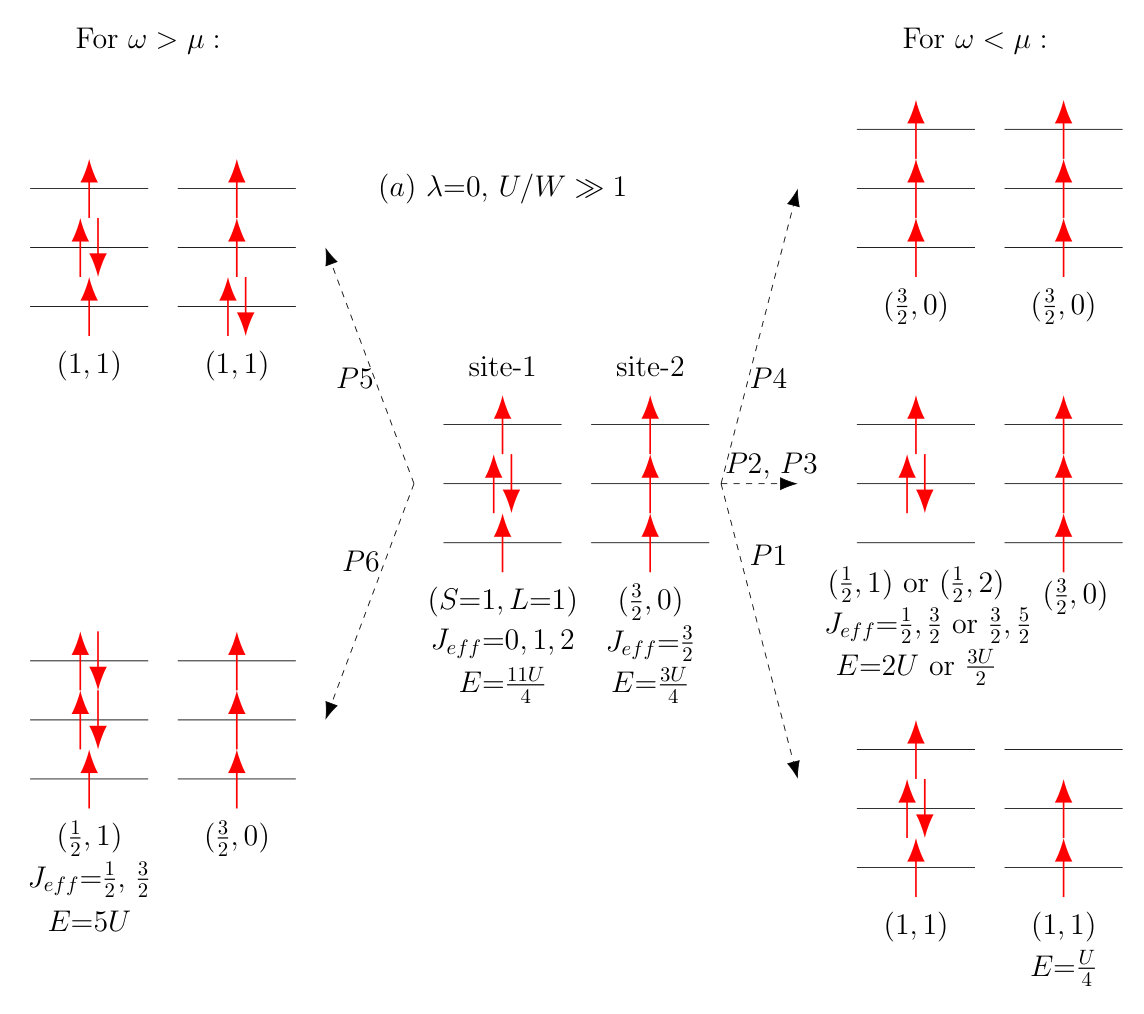 Figure 2
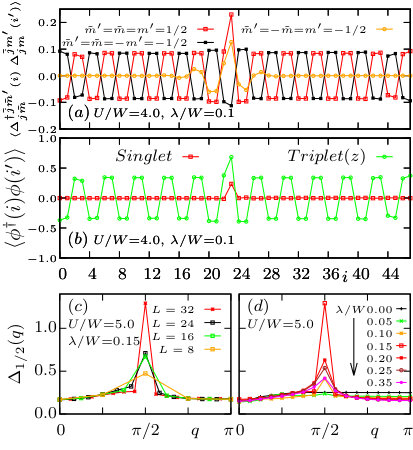 Figure 2
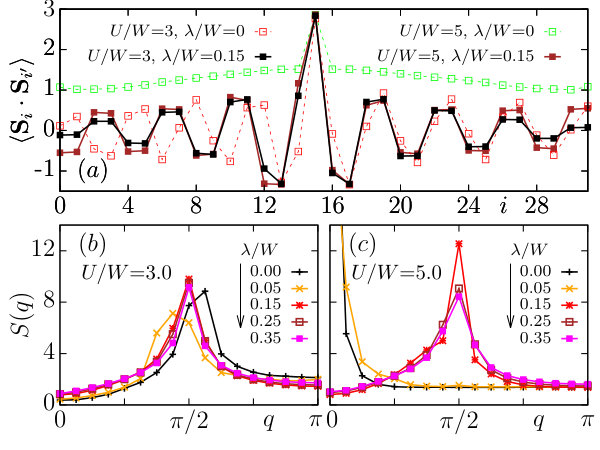 Figure 3
 Figure 4
 Figure 5
 Figure 6
 Figure 7
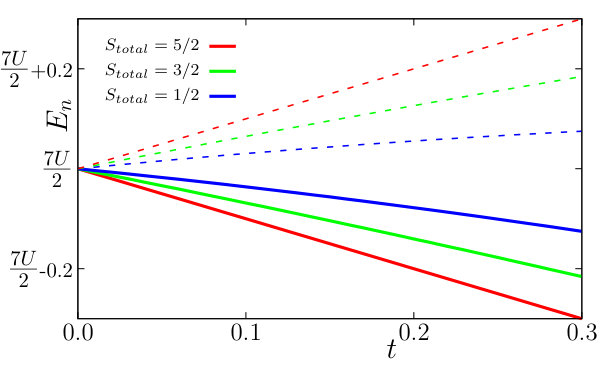 Figure 8
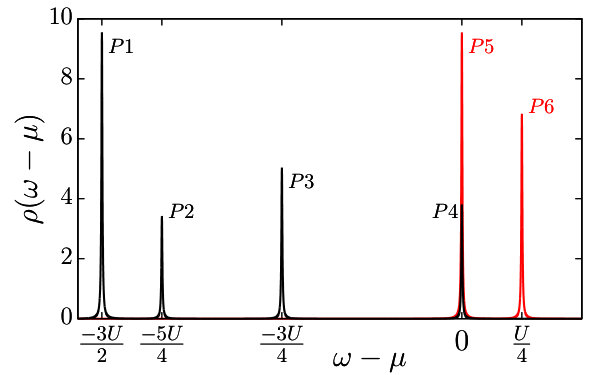 Figure 9
Peer Reviews
No public reviews on file for this paper yet. If you reviewed it on a platform where reviews are public (OpenReview, ICLR, NeurIPS, ICML), you can paste yours below so the community can read it here.
Videos
No videos yet. Explain this paper in a talk, walkthrough, or lecture? Add one.
SUPPLEMENTARY INFORMATION for
**Novel Block Excitonic Condensate at n=3.5 in a
Spin-Orbit Coupled Multiorbital Hubbard Model
** by N. Kaushal, A. Nocera, G. Alvarez, A. Moreo, and E. Dagotto
I Two sites problem in strong coupling ()
In this section, we discuss the 2-sites three-orbital Hubbard model in the strong coupling limit () for i.e a total of 7 electrons. Before discussing further details, below we show the Coulomb interaction term of the Hamiltonian in the rotationally invariant form (we have used ) which we use to calculate the energy of each atom given the occupation, spin moment (), and orbital moment ():
[TABLE]
If we work at , atomic limit, the ground state (GS) of the 2-sites system consists only of and sites which have = and , respectively. Using Eq.(1), the total energy can be calculated to be . The total spin moment of the GS can be and the total orbital moment is 1.
Now to understand the effect of a nonzero kinetic energy, we perform exact diagonalization of the 2-site clusters with finite hopping. As soon as we turn-on the hopping, we noticed the degeneracy in breaks, as shown in Fig. 1(b). Interestingly all manifolds splits in their high-energy anti-bonding (dashed lines) and low-energy bonding (solid lines) states. The GS for finite hopping has a saturated total spin moment i.e. , thus the GS has ferromagnetic ordering. The GS state has a degeneracy fold, where “” and “” arise from -symmetries in the spin sector of the and space. We also noticed that for , for all manifolds, the energies for the bonding(-) and anti-bonding(+) states change linearly with as , where the for , , manifolds are , , and , respectively.
The above discussed bonding and anti-bonding states can be interpreted in terms of momentum and states, respectively, of the incipient bands which fully develops for the larger system and leads to band formation near the chemical potential. The presence of bands near the chemical potential is indeed confirmed by the density-of-state calculations performed on 4 and 16 sites systems using Lanczos and DMRG techniques, as shown in the main paper. We also noticed that the density-of-states of the 2 sites system can explain most of the features present in of 4-site clusters in strong coupling limit. In Fig. 1(c) we show the for the 2-site cluster in the strong coupling limit, and in Fig. 1(a) we show all the “N+1” and “N-1” particle states leading to excitations above and below the chemical potential, respectively. For 4-site clusters we observed that these peaks are present nearly at the same values in terms of , as shown in the main paper.
II Single particle density-of-states
As discussed in the main paper, we calculated the density-of-states using the DMRG correction-vector target method. The electron () and hole () components of are defined as:
[TABLE]
[TABLE]
where is the site index. In the approach above, the sum over all the sites has to be done, which means that for every an “” no. of runs has to be performed for each site with different correction vectors , and similarly for the electron part of . To reduce the cost by times we perform the simulations only with respect to the central site i.e. calculating the following:
[TABLE]
where is a central site. This becomes exact for a system with periodic boundary conditions i.e. , but our DMRG simulations are done for sites with open boundary conditions, for which calculating is still a good approximation.
To reproduce the data shown in this publication, the open source DMRG++ program and input files are available at https://g1257.github.io/dmrgPlusPlus/ .