Unconventional superconductivity in the cage type compound Sc$_5$Rh$_6$Sn$_{18}$
A. Bhattacharyya, D. T. Adroja, N. Kase, A. D. Hillier, A. M. Strydom,, and J. Akimitsu

TL;DR
This study investigates the unconventional superconducting properties of Sc$_5$Rh$_6$Sn$_{18}$, revealing strong-coupling behavior and broken time-reversal symmetry, indicating a novel superconducting state in this cage compound.
Contribution
It provides the first detailed experimental evidence of broken time-reversal symmetry in the superconducting state of Sc$_5$Rh$_6$Sn$_{18}$, a cage-type superconductor, using muon-spin relaxation measurements.
Findings
Superconductivity is type-II with $T_c$ = 4.4 K.
Sc$_5$Rh$_6$Sn$_{18}$ exhibits strong-coupling BCS behavior.
Broken time-reversal symmetry observed below $T_c$.
Abstract
We have examined the superconducting ground state properties of the caged type compound ScRhSn using magnetization, heat capacity, and muon-spin relaxation or rotation (SR) measurements. Magnetization measurements indicate type-II superconductivity with an upper critical field = 7.24 T. The zero-field cooled and field cooled susceptibility measurements unveil an onset of diamagnetic signal below = 4.4 K. The interpretation of the heat capacity results below using the BCS model unveils the value of = 2.65, which gives the dimensionless ratio 2 = 5.3, intimating that ScRhSn is a strong-coupling BCS superconductor. The zero-field SR measurements in the longitudinal geometry exhibit a signature of a spontaneous appearance of the internal magnetic field below the…
Click any figure to enlarge with its caption.
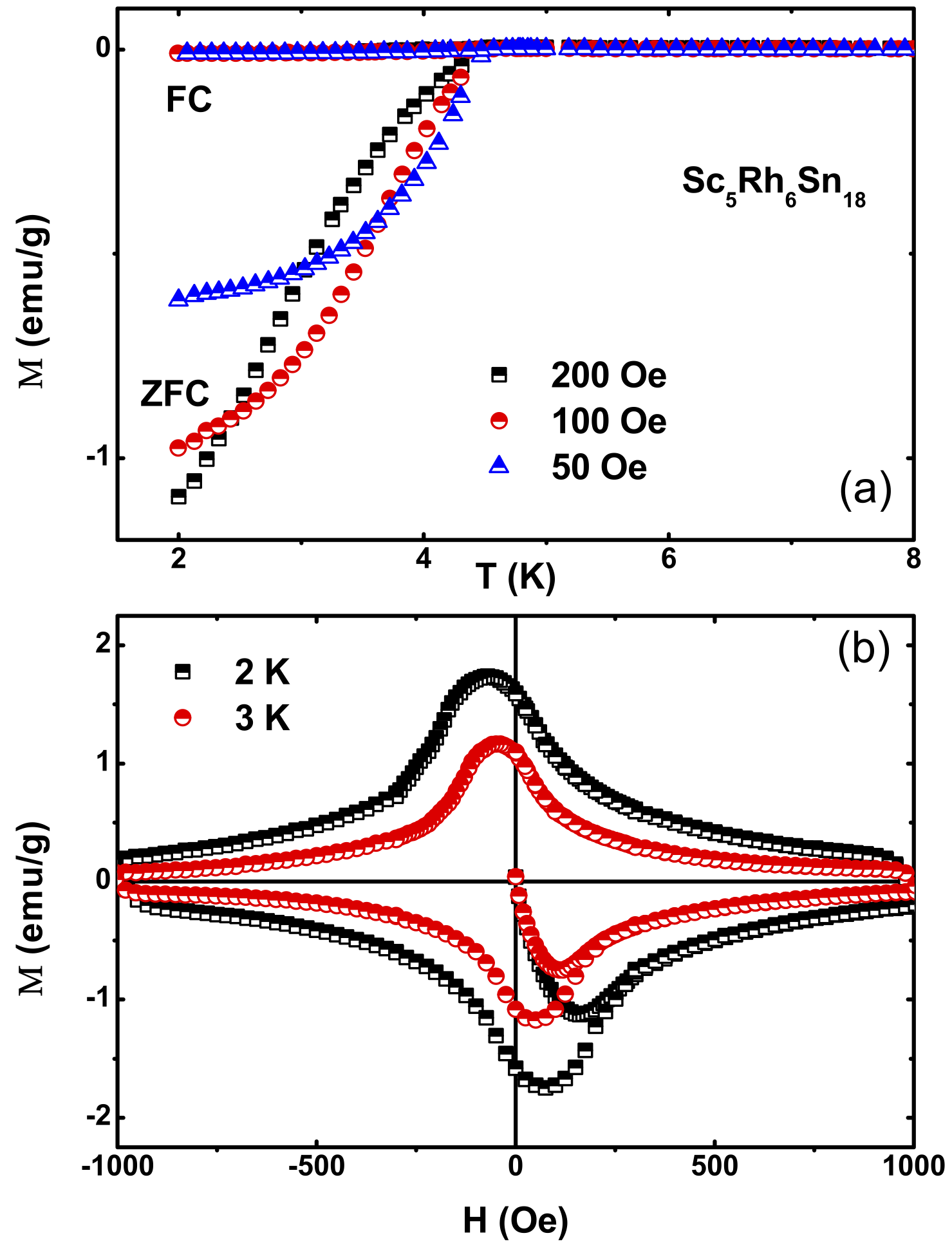 Figure 1
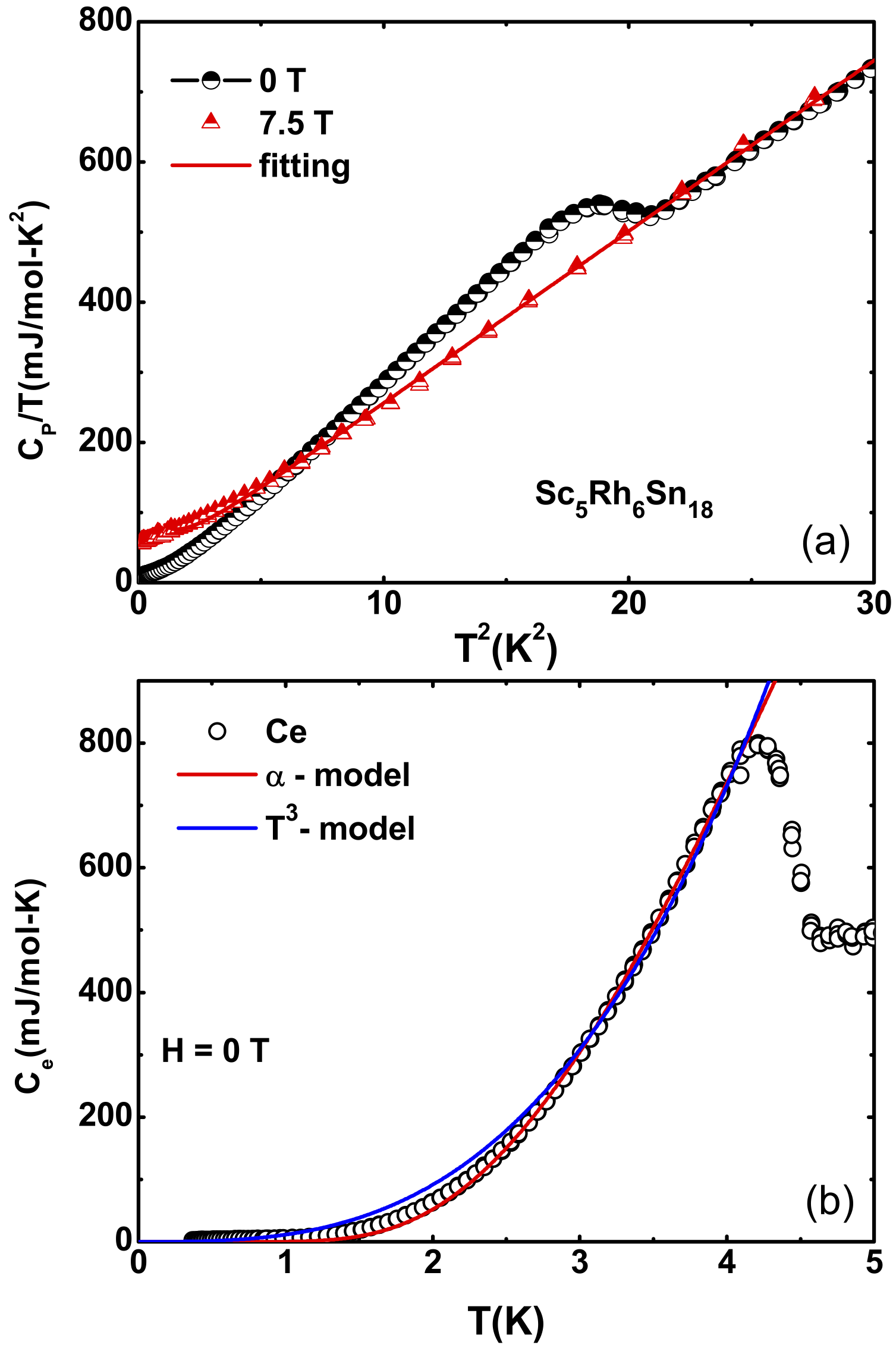 Figure 2
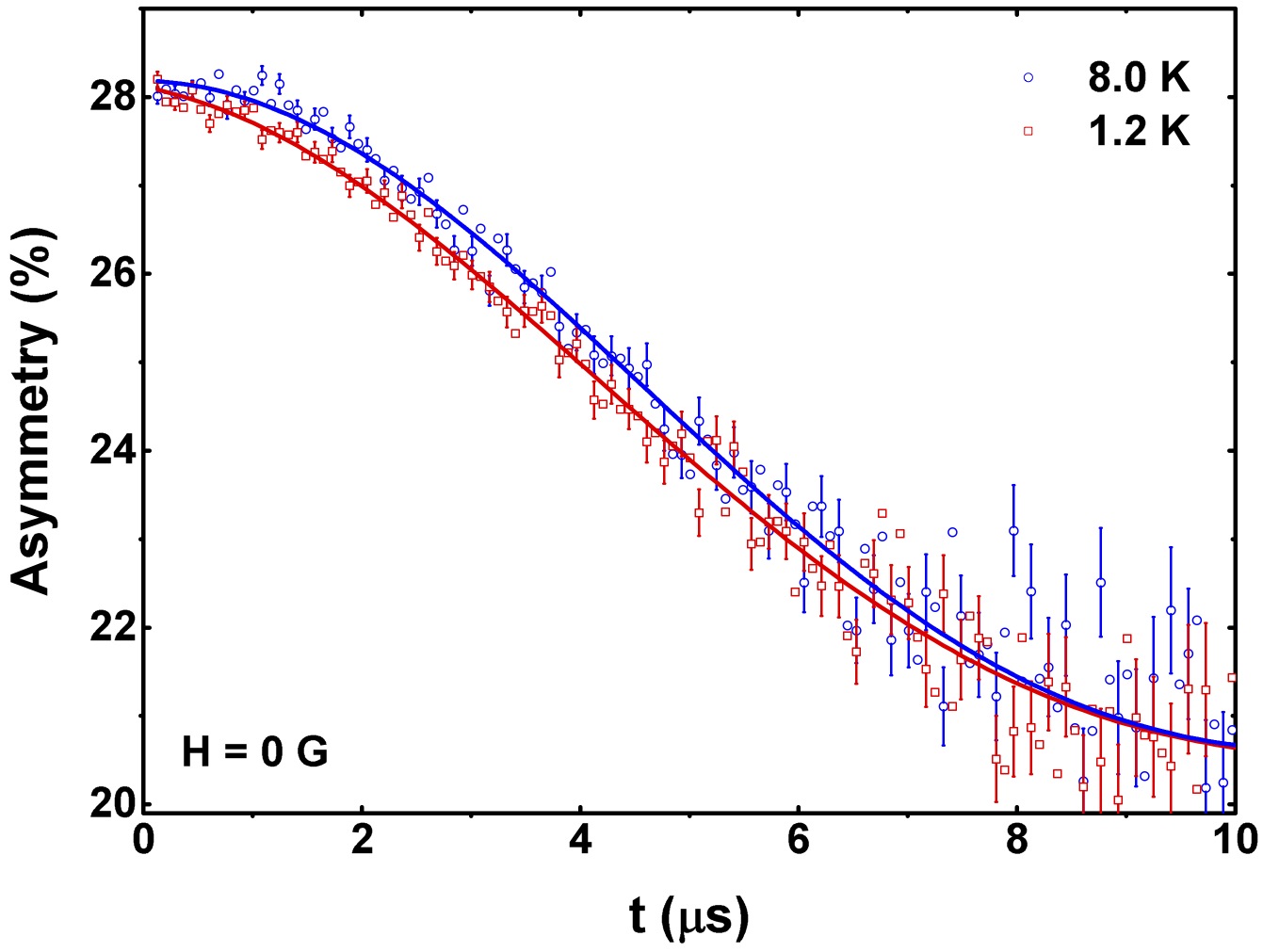 Figure 3
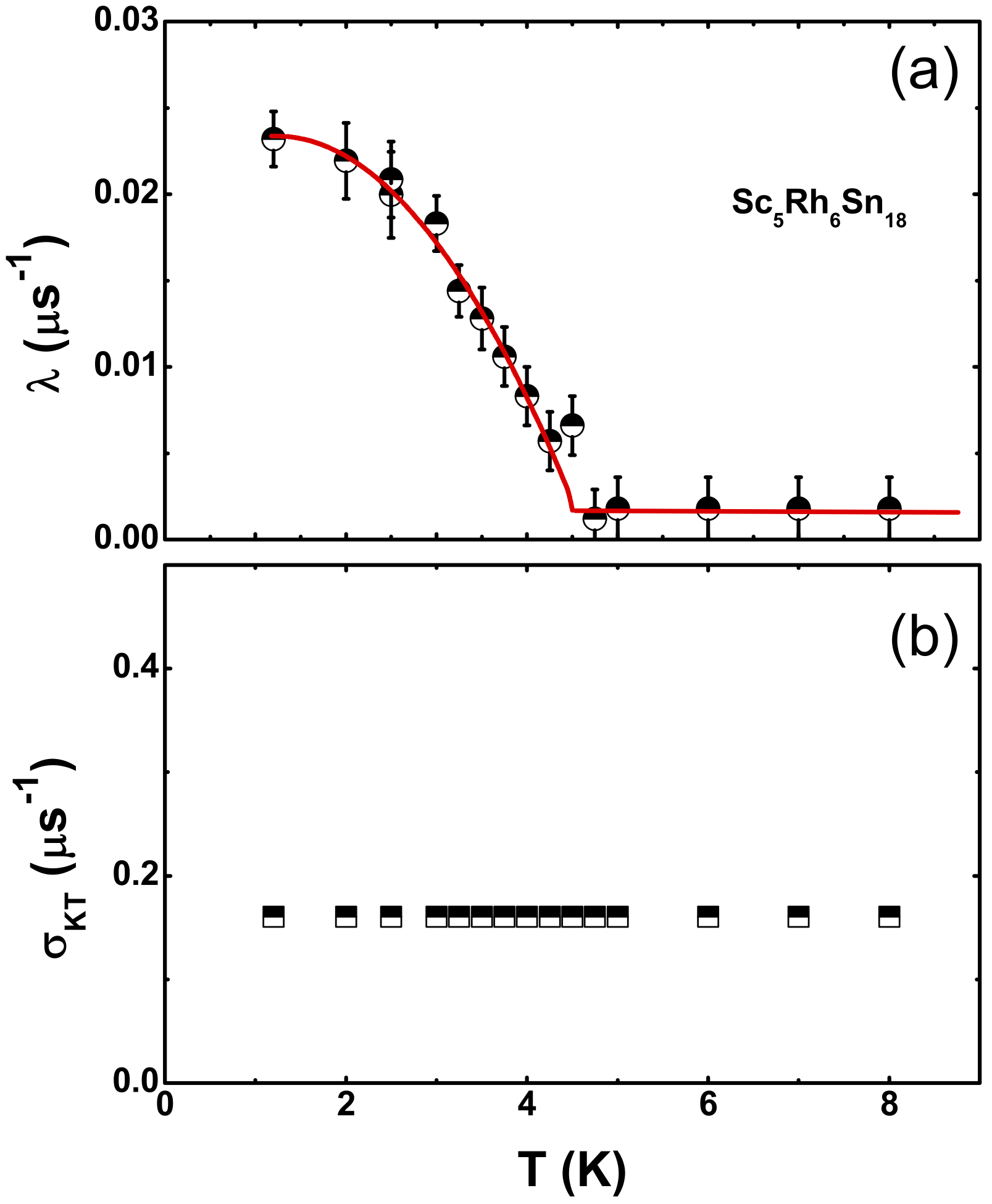 Figure 4
| Compounds | Gap to ratio | Gap | ||||||||
|---|---|---|---|---|---|---|---|---|---|---|
| (T) | (K) | 2 | (G) | function | ||||||
| Sc5Rh6Sn18 | 7.24 | 4.4 | 5.3 | 0.6 | wavea | |||||
| Lu5Rh6Sn18 | 6.45 | 4.0 | 4.28 | 0.5 | wave Bhattacharyya2 | |||||
| Y5Rh6Sn18 | 3.13 | 3.0 | 4.23 | 0.02 | wave Bhattacharyya1 | |||||
| PrOs4Sb12 | 2.2 | 1.8 | 3.7 | 1.2 | s/p-wave MacLaughlin | |||||
| or s-wave Suderow ; AOKI | ||||||||||
| UPt3 | 1.9 | 0.52 | 2.0 | 0.1 | wave UPt3Broholm | |||||
| Sr2RuO4 | 1.5 | 3.5 | 0.5 | wave SrFirmo | ||||||
| 00footnotetext: from heat capacity analysis |
Peer Reviews
No public reviews on file for this paper yet. If you reviewed it on a platform where reviews are public (OpenReview, ICLR, NeurIPS, ICML), you can paste yours below so the community can read it here.
Videos
No videos yet. Explain this paper in a talk, walkthrough, or lecture? Add one.
Unconventional superconductivity in the cage type compound Sc5Rh6Sn18
A. Bhattacharyya
ISIS Facility, Rutherford Appleton Laboratory, Chilton, Didcot Oxon, OX11 0QX, United Kingdom
Highly Correlated Matter Research Group, Physics Department, University of Johannesburg, PO Box 524, Auckland Park 2006, South Africa
Department of Physics, Ramakrishna Mission Vivekananda Educational and Research Institute, Belur Math, Howrah 711202, West Bengal, India
D. T. Adroja
ISIS Facility, Rutherford Appleton Laboratory, Chilton, Didcot Oxon, OX11 0QX, United Kingdom
Highly Correlated Matter Research Group, Physics Department, University of Johannesburg, PO Box 524, Auckland Park 2006, South Africa
N. Kase
Department of Applied Physics, Tokyo University of Science, Tokyo 125-8585, Japan
A. D. Hillier
ISIS Facility, Rutherford Appleton Laboratory, Chilton, Didcot Oxon, OX11 0QX, United Kingdom
A. M. Strydom
Highly Correlated Matter Research Group, Physics Department, University of Johannesburg, PO Box 524, Auckland Park 2006, South Africa
Max Planck Institute for Chemical Physics of Solids, D-01187 Dresden, Germany
J. Akimitsu
Research Institute for Interdisciplinary Science, Okayama University, Okayama, 700-8530 Japan
Abstract
We have examined the superconducting ground state properties of the caged type compound Sc5Rh6Sn18 using magnetization, heat capacity, and muon-spin relaxation or rotation (SR) measurements. Magnetization measurements indicate type-II superconductivity with an upper critical field = 7.24 T. The zero-field cooled and field cooled susceptibility measurements unveil an onset of diamagnetic signal below = 4.4 K. The interpretation of the heat capacity results below using the BCS model unveils the value of = 2.65, which gives the dimensionless ratio 2 = 5.3, intimating that Sc5Rh6Sn18 is a strong-coupling BCS superconductor. The zero-field SR measurements in the longitudinal geometry exhibit a signature of a spontaneous appearance of the internal magnetic field below the superconducting transition temperature, indicating that the superconducting state is characterized by the broken time-reversal symmetry (TRS). We have compared the results of broken TRS in Sc5Rh6Sn18 with that observed in R5Rh6Sn18 (R = Lu and Y).
pacs:
71.20.Be, 75.10.Lp, 75.40.Cx
Unconventional behaviour of superconductors beyond the conventional BCS theory is a major focus area in theoretical and experimental communities in condensed matter physics Bardeen ; Sigrist . BCS superconductors expel magnetic field through the Meissner effect. It is a very rare phenomenon for the superconducting ground state to support an internal magnetic field, which breaks the time reversal symmetry (TRS). TRS broken states were previously suggested for the high-temperature superconductors htcref , but their identification remains experimentally debatable. A symmetry breaking field can modify the superconducting ground state properties and may result in novel unconventional superconductivitySchaibley . TRS breaking is rare and has only been observed directly in a few unconventional superconductors, e.g., Sr2RuO4 gm ; jx , UPt3 gml , (U;Th)Be13 rhh , (Pr;La)(Os;Ru)4Sb12 ya , PrPt4Ge12 am , LaNiC2 ad1 , LaNiGa2 ad2 and Re6Zr rps . The presence of an internal magnetic field places limitations on the pairing symmetry as well as on the possible mechanism responsible for superconductivity.
In recent years, cage type compounds such as filled skutterudites (RT4X12) xs where can be a rare-earth metal, pyrochlore oxides (AOs2O6) zh where is an alkali metal, and Ge- or Si filled clathrates xy have received much attention due to interesting aspects of the crystal structure that impedes heat conductivity in a manner that is considered to be beneficial to the design of novel thermoelectric materials. From a different point of view, a small number of so-called rattling materials among the cage-type structures also belong to the class of strongly correlated electron systems, and these are known for a rich variety of physics such as heavy fermion behavior, metal-insulator transition, multipole ordering, and superconductivity. RT4X12 and RT2X20 exhibit a strong interplay between quadrupole moment and superconductivity kk ; to ; Onimaru . Zero-field muon spin relaxation (ZFSR) is a powerful tool to search for TRS breaking fields or spontaneous internal magnetic fields below . The ZF-SR measurements in PrOs4Sb12 (which was claimed to be the first Pr-based heavy fermion superconductor Bauer ) have revealed an appreciable increase in the internal magnetic field below the onset of superconductivity (K) Koga . The low-lying crystal-field excitations of Pr ions may be playing a vital role in the superconductivity Koga . The caged type material PrV2Al20 is a rare example of a heavy-fermion superconductor based on strong hybridization between conduction electrons and nonmagnetic quadrupolar moments of the cubic ground doublet. PrV2Al20 exhibits superconductivity at mK in the antiferroquadrupole-ordered state under ambient pressure Tsujimoto . In the ordered state, the electronic heat capacity shows a temperature dependence, indicating the gapless mode associated with quadrupole order, octupole order, or both. PrIr2Zn20 and PrRh2Zn20 compounds exhibit non-Fermi liquid behavior in their resistivity and heat capacity and quadrupole ordering at low temperatures Onimaru1 .
Rh6Sn18 ( Sc, Y, Lu) compounds, having the caged type crystal structure also exhibit superconductivity (SC) jpr below = K (Sc), K (Y), and K (Lu). These compounds have a tetragonal structure with the space group and rare-earth element coordination , and where occupies two different crystallographic sites sm . The crystal structure is similar to the skutterudite structure Bauer . Lu5Rh6Sn18 is a conventional BCS type superconductor kase2 . The gap structure of Y5Rh6Sn18 is found to be strongly anisotropic as revealed from the heat capacity measurements; exhibits a variation and , where is the applied magnetic field indicates a -like dependence kase2 . The superconducting properties of Y5Rh6Sn18 thus have a similarity with those of the anisotropic -wave superconductor YNi2B2C except for the difference in kase2 . Zero field, transverse field and longitudinal field muon spin relaxation measurements on Y5Rh6Sn18 have been reported by our group Bhattacharyya . For Lu and Y compounds, the resistivity exhibits an unusual temperature variation. In the Lu compound is nearly constant down to K, and shows an increase on further cooling. For the Y compound continuously increases on cooling below room temperature, with a kink appearing at about K. Coexistence of superconductivity and magnetism was observed in the Tmbased reentrant superconductor Tm5Rh6Sn18 ( = 2.2 K) rojek ; kase3 .
We have recently reported superconducting properties of the caged type compounds (Lu,Y)5Rh6Sn18 using magnetization, heat capacity, and muon-spin relaxation (SR) measurements Bhattacharyya ; Bhattacharyya1 . Zero-field SR measurements reveal the spontaneous appearance of an internal magnetic field below the superconducting transition temperature, which indicates that the superconducting state in these materials is characterized by broken time-reversal symmetry Bhattacharyya1 . It is interesting to note that the electronic heat capacity () of Lu5Rh6Sn18 exhibits exponential behavior as a function of temperature below nk1 ; nk2 . From a series of experiments on Rh6Sn18 (Lu, Sc, Y and Tm), it was concluded that the gap structure is strongly dependent on the atom, whose origin is left to be clarified rojek ; kase3 . In this Rapid Communication, we address these matters by ZFSR measurements for the Sc5Rh6Sn18 system. The results unambiguously reveal the spontaneous appearance of an internal magnetic field in the SC state, providing clear evidence for broken time reversal symmetry and suggesting a common origin in this family of compounds.
The single crystals of Sc5Rh6Sn18 were grown by dissolving the constituent elements in an excess of Sn-flux in the ratio of Sc:Rh:Sn = 1:2:20. The quartz tube was heated up to 1050∘C, maintained at this temperature for about h, and cooled down to C at a rate of C/h, taking days in total. The excess flux was removed from the crystals by spinning the ampoule in a centrifuge jpr . Laue patterns were recorded using a Huber Laue diffractometer and well defined Laue diffraction spots indicate the high quality of the single crystals. The phase purity was inferred from the powder x-ray patterns which were indexed as the Sc5Rh6Sn18 phase with the space group jpr . The magnetization data were collected using a Quantum Design Superconducting Quantum Interference Device. The heat capacity measurements were performed down to 500 mK using a Quantum Design Physical Properties Measurement System equipped with a 3He refrigerator.
We further employed the SR technique to investigate the superconducting ground state. The SR measurements were performed at the MUSR spectrometer at the ISIS Neutron and Muon Facility located at the STFC Rutherford Appleton Laboratory (RAL, United Kingdom). The single crystals (typical size 333 mm3) were mounted on a high purity silver plate (99.995% silver) using diluted GE varnish and then cooled down to K in a standard 4He cryostat with He-exchange gas. It is to be noted that due to the small size and irregular shape the crystals were not aligned in a particular direction, but had random orientations with respect to the incident muon beam. Using an active compensation system the stray magnetic fields at the sample position were canceled to a level of 1 mG. Spin-polarized muons were implanted into the sample and the positrons from the resulting muon decay were collected in the detector positions either forward or backwards of the initial muon spin direction. The asymmetry of the muon decay is calculated by; , where and are the number of counts at the detectors in the forward and backward positions and is a constant determined from calibration measurements made in the normal state with a small G transverse applied magnetic field. The data were analyzed using the software package Wimda FPW .
The bulk nature of superconductivity in Sc5Rh6Sn18 was confirmed by the magnetic susceptibility , as shown in Fig. 1(a). The low-field measurements display a strong diamagnetic signal due to the superconducting transition at K. Fig. 1(b) shows the magnetization at K and at K with a shape that is typical for type-II superconductivity. The electrical resistivity (not shown) exhibits bulk superconductivity at K nk1 ; nk2 .
Fig. 2(a) shows vs. in field values and T. At K a sharp anomaly is observed indicating the superconducting transition which matches well with data. Since the normal-state heat capacity was found to be invariant under external magnetic fields, the normal-state electronic heat capacity coefficient and the lattice heat capacity coefficient were deduced from the data in a field of T where the superconductivity is completely suppressed, using a least-square fit of the data to . The least-squares analysis of the T data provides a Sommerfeld constant = 51.10 mJ/(mol-K2), = 0.13 mJ/(mol-K4), = 0.32 mJ/(mol-K6) and from this value of we have estimated the Debye temperature K nk1 ; nk2 . We have analyzed the electronic heat capacity data (below ) using model and the single-band model that was adapted from the single-band BCS theory to fit the heat capacity data that deviate from the BCS prediction cp1 ; cp2 . The red and blue solid lines in Fig. 2(b) demonstrate a theoretical fit based upon the model and model. In the model it was assumed that the normalized gap amplitude follows the isotropic -wave BCS result with = being an adjustable parameter nk1 ; nk2 . The -model is an excellent fit to the electronic heat capacity data of Sc5Rh6Sn18 below with , which is significantly larger than the value for the weak-coupling BCS value of 1.76. All of these results suggest that Sc5Rh6Sn18 is a strong-coupling superconductor with the value of = 5.3. The Ginzburg-Landau (GL) coherence length and the GL parameter = can be obtained from the upper critical field , the lower critical field , and using the following equations: = /2, = , = . From these, and are estimated to be approximately 34.2 nm and 6.74 nm, respectively. In addition, is calculated to be 51.7. Because is larger than 1/, Sc5Rh6Sn18 is a type II superconductor.
Fig. 3 shows the time evolution of the zero field muon spin relaxation asymmetry in Sc5Rh6Sn18 at temperatures above and below . Below , we observed that the muon spin relaxation became faster with decreasing temperature down to lowest temperature, which indicates the appearance of a spontaneous magnetic field in the superconducting phase. We note that there is no signature of muon spin precession that would accompany a sufficiently large internal magnetic field produced by ordering of electronic moments. The ZFSR spectra for Sc5Rh6Sn18 can be well described by the damped Gaussian Kubo-Toyabe (K-T) function Adroja1 ; Adroja2 ; Adroja3 ; Bhattacharyya3 ,
[TABLE]
where
[TABLE]
is the K-T functional form expected from an isotropic Gaussian distribution of randomly oriented static (or quasi-static) local fields at muon sites. is the electronic relaxation rate, is the initial asymmetry, and is the background arising from the muons stopping on the silver sample holder. and are all found to be temperature independent. First we estimated the value of Kubo-Toyabe depolarization rate by fitting the data at the lowest temperature and then kept this value fixed for fitting other temperature data points as shown in Fig. 4(b) for ZFSR fitting as there is negligible variation with temperature in within the error bars.
Fig. 4(a) shows the temperature dependence of the electronic relaxation rate. It is remarkable that shows a significant increase below an onset temperature of K , but is temperature independent (see Fig. 4 (b)), indicating the appearance of a spontaneous internal field correlated with the superconductivity. This observation provides unambiguous evidence that TRS is broken in the SC state of Sc5Rh6Sn18. Such a change in has only been observed in superconducting URu2Si2 Schemm , Sr2RuO4 gm , LaNiC2 ad1 , (Lu, Y)5Rh6Sn18 Bhattacharyya1 and SrPtAs pkb . This increase in can be explained by the presence of a very small internal field as discussed by Luke et al. * gm , for Sr2RuO4. This suggests that the field distribution is Lorentzian in nature similar to the case of Sr2RuO4. Considering a similar temperature dependence of in Sr2RuO4, LaNiC2, SrPtAs, Lu5Rh6Sn18* and Sc5Rh6Sn18, we attribute this behavior of to TRS breaking below in Sc5Rh6Sn18. It is to be noted that for Y5Rh6Sn18 the onset of a TRS breaking Bhattacharyya1 field appears in below K which is well below K. The increase in the exponential relaxation below in Sc5Rh6Sn18 is s*-1*, which corresponds to a characteristic field strength G, where is the muon gyromagnetic ratio equal to MHz/T. This is about half the value that was observed in the case of Lu5Rh6Sn18, in the B phase of UPt3 and in Sr2RuO4 gml . No theoretical estimates of the characteristic field strength in Sc5Rh6Sn18 are yet available; however, we expect it to be comparable to those in Sr2RuO4 and UPt3 as the fields are expected to arise from a similar mechanism. On the other hand the TRS breaking field appears in in LaNiGa2 laniga2 and in PrOs4Sb12 prossb .
Our theoretical analysis Sigrist ; Mazidian ; Bhattacharyya2 for the isostructural compound Lu5Rh6Sn18 was carried out under the assumption of strong spin orbit coupling and revealed two possible superconducting pairing states. The first one has singlet character and the second one has triplet non-unitarity character. Far below the superconducting temperature , the thermodynamics of the singlet state would be influenced by a line node, which suggest a quadratic temperature dependence of the heat capacity. Furthermore, the triplet state Mazidian would be influenced by point nodes, which happen to be shallow (a result protected by symmetry) and therefore also lead to quadratic temperature variation of the heat capacity. Nevertheless, because of the location of the nodes in the triplet case, fully-gapped behavior may be recovered depending on the topology of the Fermi surface. In addition some limiting cases of the triplet state correspond to regular, i.e. linear point nodes (cubic temperature dependence of the heat capacity) as well as to a more exotic state with a nodal surface (gapless superconductivity, linear temperature variation of the heat capacity). We note that the theoretical analysis presented in the supplemental material Bhattacharyya2 in Ref [48] is valid for any superconductor with point group symmetry in the presence of strong spin-orbit coupling and broken time-reversal symmetry and may therefore be applied for example to Sr2RuO4 Veenstra , as well as to Sc5Rh6Sn18.
In summary, we have investigated the nature of the superconducting ground state in Sc5Rh6Sn18 by using ZF-$$\muSR measurements. Below K, the ZF-$$\muSR measurements revealed the onset of an appreciable internal magnetic field that is correlated exactly with the onset of superconductivity in this compound. The appearance of spontaneous magnetic fields in our ZF-SR results provide unambiguous evidence for TRS breaking in this material and an unconventional pairing mechanism. The evidence of broken TRS in the SC state will help to narrow down the number of possibilities for the symmetry of the SC order parameter. Symmetry analysis suggests either a singlet state with a line node or, alternatively, non-unitary triplet pairing with point nodes, which may be linear or shallow and can become fully gapped depending on the Fermi surface topology. It is hoped that our experimental results presented in this paper will stimulate theoretical interest to understand the unconventional superconductivity in cage type superconductors, as well as to understand the origin of a TRS breaking field in either the electronic/ or the nuclear/ channel.
We would like to thank J. Quintanilla for interesting theoretical discussions. AB would like to acknowledge DST India, for Inspire Faculty Research Grant, FRC of UJ, NRF of South Africa and ISIS-STFC for funding support. DTA and ADH would like to thank CMPC-STFC, grant number CMPC-09108, and also DIST for financial support. DTA thanks to JSPS for invitation fellowship. AMS thanks the SA-NRF (Grant 93549) and UJ Research Committee for financial support.
The reference list from the paper itself. Each links out to its DOI / PubMed record.
- 1(1) J. Bardeen, L. N. Cooper, and J. R. Schrieffer, Phys. Rev. 108 , 1175 (1957).
- 2(2) M. Sigrist and K. Ueda, Rev. Mod. Phys. 63 , 239 (1991).
- 3(3) M. Ho a ̊ ̊ 𝑎 \mathring{a} kansson, T. L o ¨ ¨ 𝑜 \ddot{o} fwander and M. F o ¨ ¨ 𝑜 \ddot{o} gelstrom, Nature Physics 11 , 755?760 (2015).
- 4(4) J. Schaibley, and X. Xu, Nature Physics 10 , 798 (2014).
- 5(5) G. M. Luke, Y. Fudamoto, K. M. Kojima, M. I. Larkin, J. Merrin, B. Nachumi, Y. J. Uemura, Y. Maeno, Z. Q. Mao, Y. Mori et al., Nature (London) 394 , 558 (1998).
- 6(6) J. Xia, Y. Maeno, P. T. Beyersdorf, M. M. Fejer, and A. Kapitulnik, Phys. Rev. Lett. 97 , 167002 (2006).
- 7(7) G. M. Luke, A. Keren, L. P. Le, W. D. Wu, Y. J. Uemura, D. A. Bonn, L. Taillefer, and J. D. Garrett, Phys. Rev. Lett. 71 , 1466 (1993).
- 8(8) R. H. Heffner, J. L. Smith, J. O.Willis, P. Birrer, C. Baines, F. N. Gygax, B. Hitti, E. Lippelt, H. R. Ott, A. Schenck et al., Phys. Rev. Lett. 65 , 2816 (1990).