The PeV-Scale Split Supersymmetry from Higgs Mass and Electroweak Vacuum Stability
Waqas Ahmed, Adeel Mansha, Tianjun Li, Shabbar Raza, Joydeep Roy,, Fang-Zhou Xu

TL;DR
This paper investigates the upper bounds on sfermion masses in PeV-scale split supersymmetry derived from Higgs mass measurements and electroweak vacuum stability, highlighting the role of RGE contributions and collider prospects.
Contribution
It provides new upper bounds on sfermion masses in split SUSY at PeV scales based on Higgs and vacuum stability constraints, considering RGE effects from Higgsinos and gauginos.
Findings
Upper bound on SUSY breaking scale around 10^3 TeV for tanβ=2.
Electroweak vacuum stability constrains sfermion masses to about 10^4 TeV.
PeV-scale split SUSY is consistent with current Higgs and vacuum stability data.
Abstract
The null results of the LHC searches have put strong bounds on new physics scenario such as supersymmetry (SUSY). With the latest values of top quark mass and strong coupling, we study the upper bounds on the sfermion masses in Split-SUSY from the observed Higgs boson mass and electroweak (EW) vacuum stability. To be consistent with the observed Higgs mass, we find that the largest value of supersymmetry breaking scales for and are and respectively, thus putting an upper bound on the sfermion masses around . In addition, the Higgs quartic coupling becomes negative at much lower scale than the Standard Model (SM), and we extract the upper bound of on the sfermion masses from EW vacuum stability. Therefore, we obtain the…
Click any figure to enlarge with its caption.
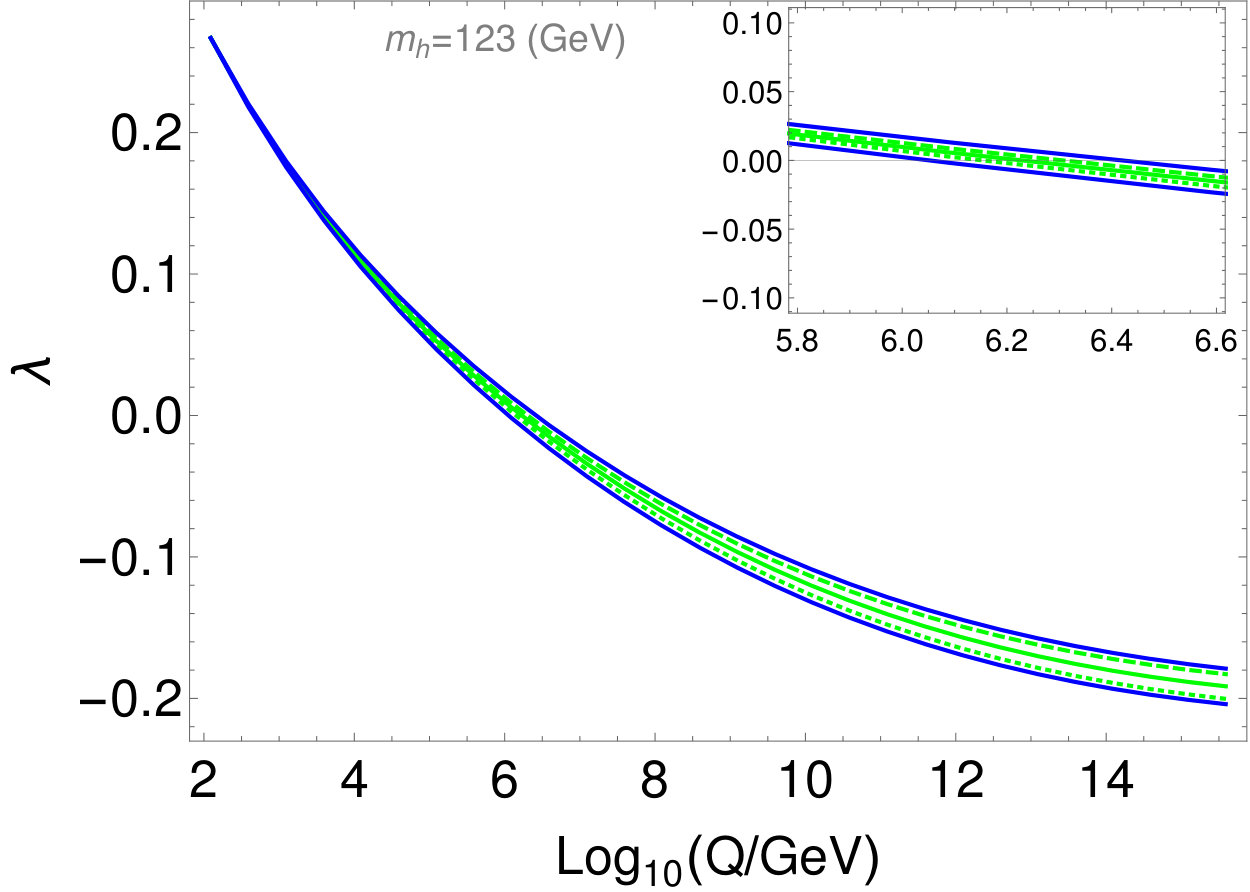 Figure 1
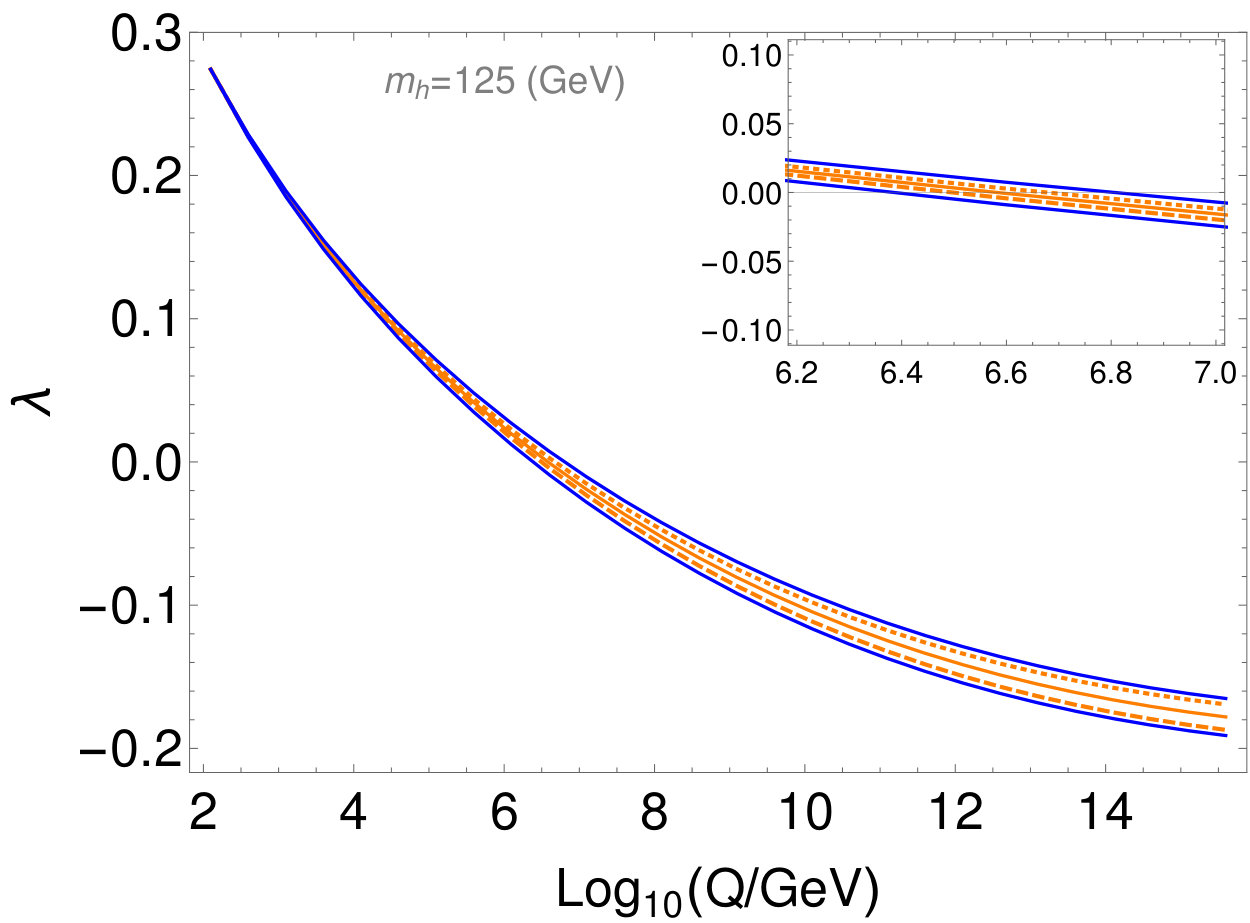 Figure 2
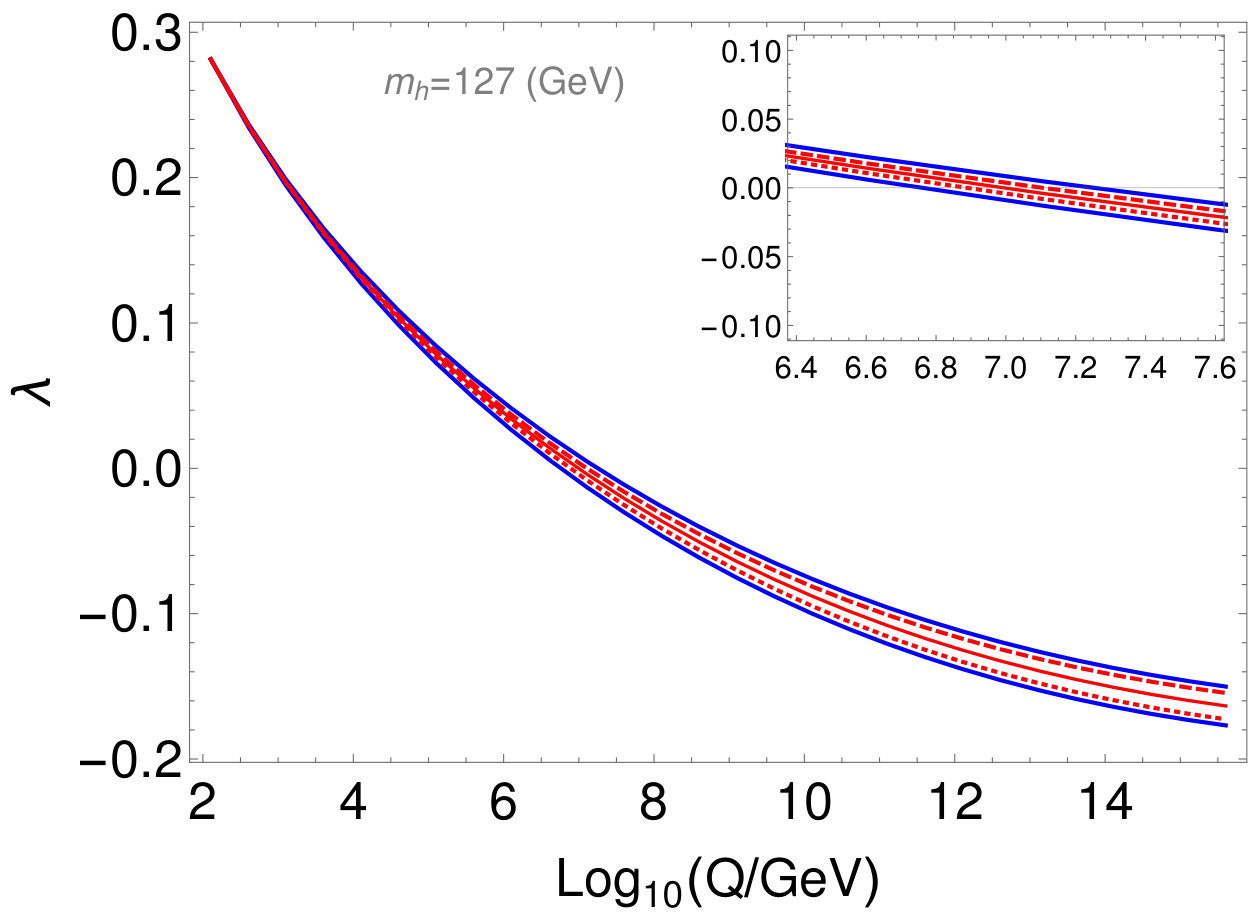 Figure 3
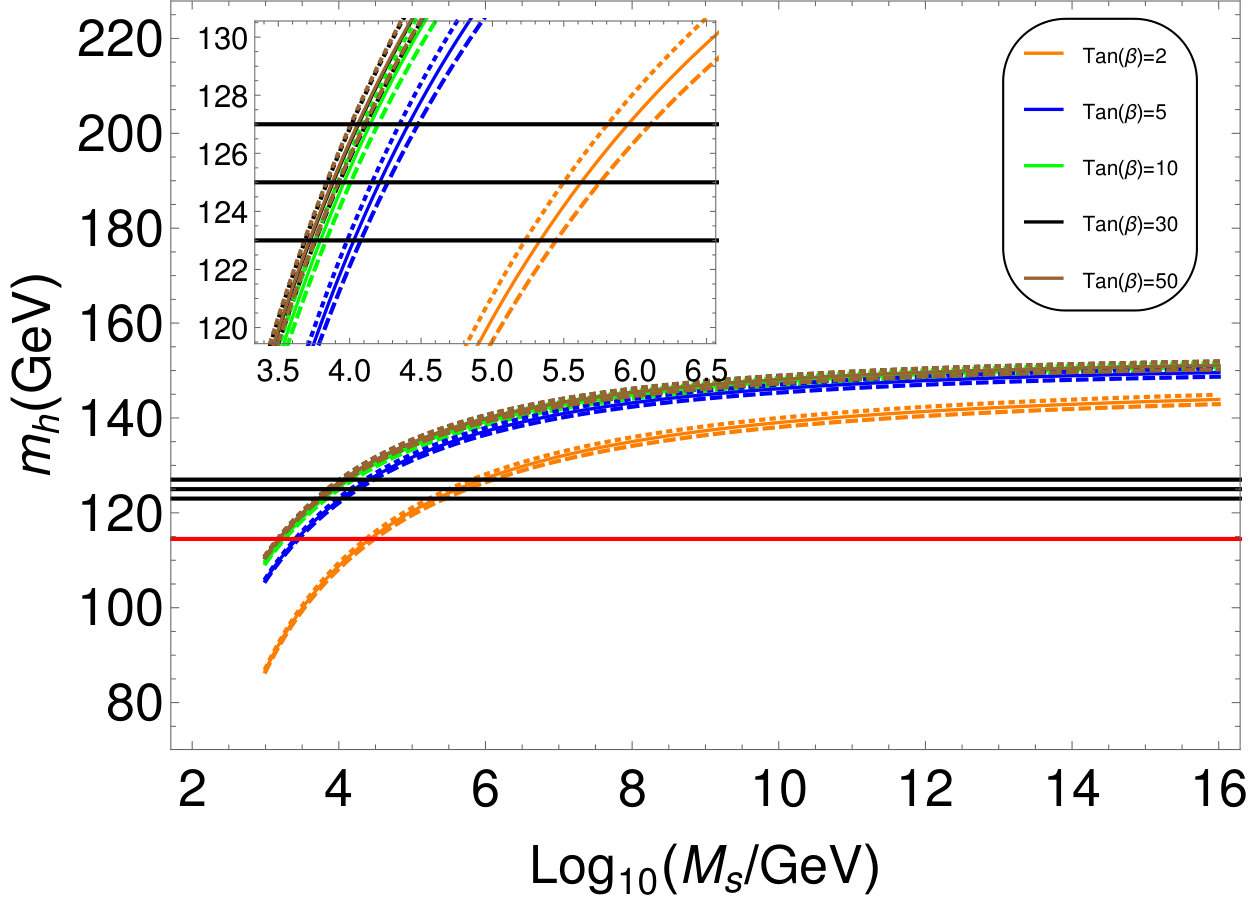 Figure 4
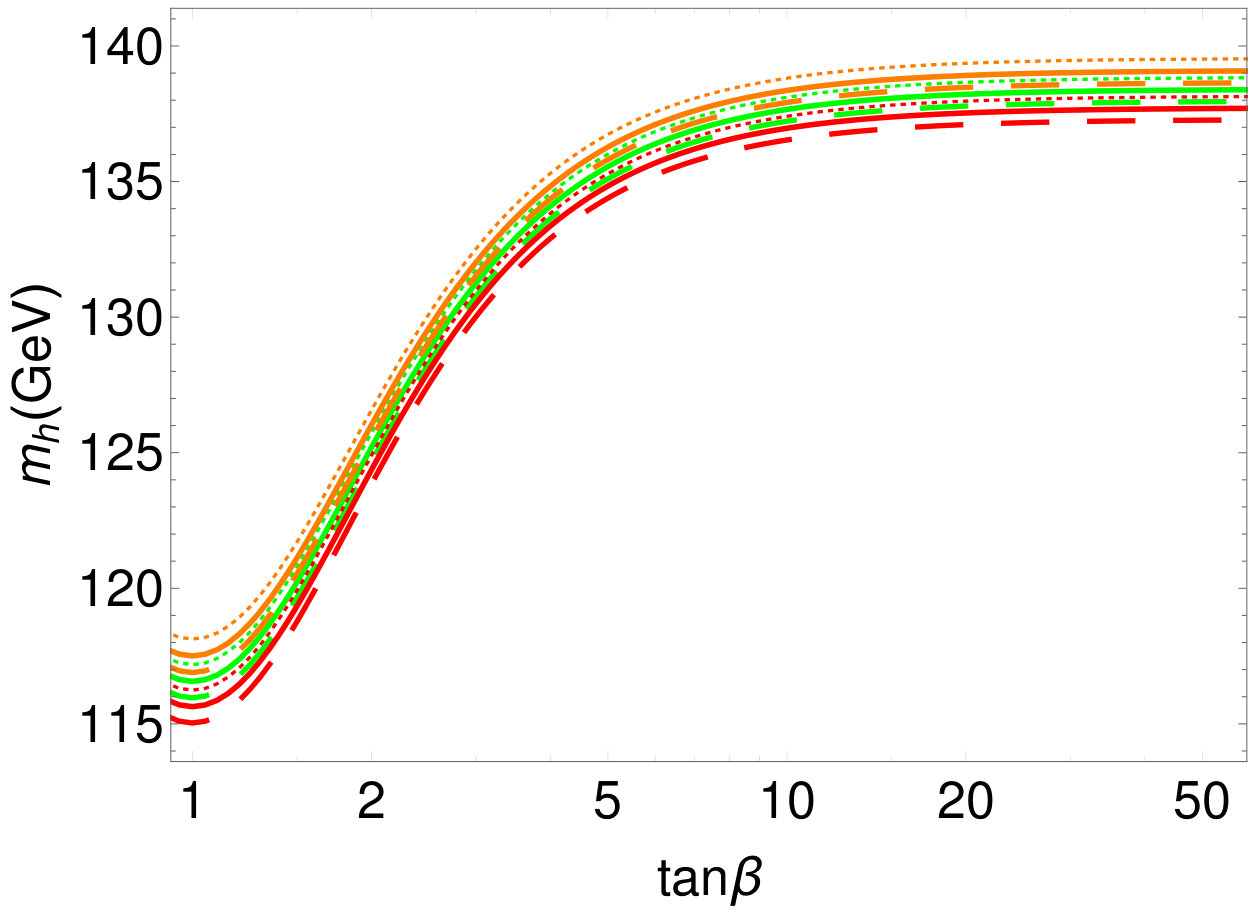 Figure 5
Peer Reviews
No public reviews on file for this paper yet. If you reviewed it on a platform where reviews are public (OpenReview, ICLR, NeurIPS, ICML), you can paste yours below so the community can read it here.
Videos
No videos yet. Explain this paper in a talk, walkthrough, or lecture? Add one.
**The PeV-Scale Split Supersymmetry from Higgs Mass and Electroweak Vacuum Stability **
Waqas Ahmed 111E-mail: [email protected], Adeel Mansha 222E-mail: [email protected], Tianjun Li 333E-mail: [email protected],
Shabbar Raza 444E-mail: [email protected], Joydeep Roy 555E-mail: [email protected], Fang-Zhou Xu 666E-mail: [email protected],
⋆ CAS Key Laboratory of Theoretical Physics,
Institute of Theoretical Physics, Chinese Academy of Sciences,
Beijing 100190, P. R. China
♡School of Physical Sciences, University of Chinese Academy of Sciences,
No. 19A Yuquan Road, Beijing 100049, P. R. China
∗ Department of Physics, Federal Urdu University of Arts, Science and Technology,
Karachi 75300, Pakistan
⋄ Institute of Modern Physics, Tsinghua University, Beijing 100084, China
Abstract
The null results of the LHC searches have put strong bounds on new physics scenario such as supersymmetry (SUSY). With the latest values of top quark mass and strong coupling, we study the upper bounds on the sfermion masses in Split-SUSY from the observed Higgs boson mass and electroweak (EW) vacuum stability. To be consistent with the observed Higgs mass, we find that the largest value of supersymmetry breaking scales for and are and respectively, thus putting an upper bound on the sfermion masses around . In addition, the Higgs quartic coupling becomes negative at much lower scale than the Standard Model (SM), and we extract the upper bound of on the sfermion masses from EW vacuum stability. Therefore, we obtain the PeV-Scale Split-SUSY. The key point is the extra contributions to the Renormalization Group Equation (RGE) running from the couplings among Higgs boson, Higgsinos, and gauginos. We briefly comment on the lifetime of gluinos in our study and compare it with current LHC observations. Additionally, we comment on the prospects of discovery of prompt gluinos in a 100 TeV proton-propton collider.
1 Introduction
The discovery of Higgs boson is the crowning achievement of particle physics [1, 2], which completes the Standard Model (SM). Despite being one of the most successful scientific theory, the SM falls short in explaining some of the important issues. In particular, gauge coupling unification of the strong, weak and electromagnetic interactions of the fundamental particles is not possible. There is no explanation of the gauge hierarchy problem [3]. The SM also does not have a proper dark matter candidate.
The Supersymmetric Standard Model (SSM) is arguably the best bet to resolve all these issues in the SM. Supersymmetry (SUSY) is an elegant scenario to solve the gauge hierarchy problem naturally. The gauge coupling unification is a great triumph of the SSM [4]. The Minimal Supersymmetric Standard Model (MSSM) predicts that the Higgs boson mass () should be smaller than 135 GeV [5]. In addition, with -parity conservation, the lightest supersymmetric particles (LSP) like neutralino etc is predicted to be an excellent dark matter particle [6, 7].
The discovery of the SM-like Higgs boson with mass 125 GeV [1, 2] requires the multi-TeV top squarks with small mixing or TeV-scale top squarks with large mixing [8, 9, 10, 11, 12, 13, 14]. This observation questions the naturalness of the MSSM and specially the exsistance of the low scale ( TeV) SUSY. Note that the TeV-scale SUSY is much more related to the ongoing LHC seraches and near future searches. On the other hand, LHC searches for SUSY or new physics have found no evidence of it [15, 16, 17, 18, 19]. This situation has put the SUSY scenario under tension.
The SUSY electroweak fine-tuning problem is a serious issue, and some promising and successful solutions can be found in the literatures [20, 21, 22, 23, 24, 25, 26, 27, 28, 29, 30, 31, 32]. Particularly, in an interesting scenario, known as Super-Natural SUSY [28, 33], it was shown that no residual electroweak fine-tuning (EWFT) is left in the MSSM if we employ the No-Scale supergravity boundary conditions [34] and Giudice-Masiero (GM) mechanism [35] despite having relatively heavy spectra. One might think that the Super-Natural SUSY have a problem related to the Higgsino mass parameter , which is generated by the GM mechanism and is proportional to the universal gaugino mass . It should be noted that the ratio is of order one but cannot be determined as an exact number. This problem, if it is, can be addressed in the M-theory inspired the Next to MSSM (NMSSM) [36]. Also, see [37], for more recent works related to naturalness within and beyond the MSSM.
In this study we consider Split Supersymmetry (Split-SUSY) scenario proposed and developed in Refs. [38, 39, 40]. In this scenario, the fine-tuning of a light Higgs boson is accepted with ultra heavy sfermion masses, while the gauginos and Higgsinos are still around the TeV scale. Because spectrum has heavy scalars and relatively light fermions for sparticles, it is called Split-SUSY. The fine-tuning of light Higgs is accepted on the same footing as of cosmological constant. By having heavy sfermions, one can suppress additional CP-violation effects, excessive flavor-changing effects, and fast proton decays, etc. Also, one keeps gaugino and Higssino masses around the TeV scale, protected by the (chiral) symmetry. It was shown in [38, 39, 40] that with super-heavy scalars and TeV scale fermions, gauge coupling unification is still preserved. Additionally, the lightest neutralino can still be a dark matter candidate. In this way, one can still keep two very important virtues of SUSY scenario: gauge coupling unification and viable dark matter candidate. It is already known that the SUSY is a broken symmetry and that breakdown may happen at a high energy scale which is beyond the reach of the current LHC or future colliders such as FCC (Future Circular Collider) [41] or SppC (Super proton-proton Collider) [42] searches. In this paper, we first employ the observed Higgs mass as a tool to predict the upper bound on the sfermion masses. In numerical calculations, we vary top quark mass by from its central value, as well as vary from 1 to 60. With the latest values of top quark mass and strong coupling constant , and taking 122, 125, and 127 GeV, we obtain the SUSY breaking scale to be between to GeV, i.e., to . Thus, the upper bound on the sfermion mass is around TeV. Moreover, by keeping 123, 125, and 127 GeV, we calculate the SUSY breaking scale at which the Higgs quartic coupling becomes negative, i.e., from the electroweak (EW) vacuum stability bound. We show that turns out to be between to , i.e., the upper bound on sfermion mass is around TeV from the EW stability bound, which is much lower than the corresponding scale around GeV in the SM [43, 44, 45]. Therefore, we obtain the PeV-Scale Split-SUSY from Higgs boson mass and EW vacuum stability. The main point is the extra contributions to the Renormalization Group Equation (RGE) running from the couplings among Higgs boson, Higgsinos, and gauginos. Since squarks are heavy, gluinos can be long lived depending on . We briefly discuss the lifetime of gluinos in our calculations. It turns out that scenarios with 5 have better chance of being discovered at the near future (33 TeV) or the long run (100 TeV) proton-proton colliders [46, 47].
The remainder of the paper is organized as follows: In Section 2 we give calculations to find SUSY breaking scale. Section 3 contains discussion on the possible LHC SUSY searches for heavy scalars. We summarize our results and conclude in Section 4.
2 The Upper Bound on the Sfermion Masses from Higgs Boson Mass and Stability Bound
The discovery of Higgs boson at the LHC confirmed the SM as the low energy effective theory. But we have not found any new fundamental particle yet. Thus, we have even higher bounds on the new physics scenarios. In this situation, one can try to use Higgs boson mass and stability bound to put upper bounds on new physics (NP). In SM, the tree-level Higgs mass is defined as , where is the SM Higgs self coupling (quartic coupling) which is a free parameter and is the vacuum expectation value. While in the SSMs, is not a free parameter, but it is related to other parameters of the model (we will discuss it more later). At tree level, the Higgs mass is bounded by GeV, but to make it compatible with the LEP lower bound [48] on the Higgs mass, we need to consider radiative correction [49, 50, 51, 52]. For the Higgs boson with mass around 125 GeV, we need the multi-TeV top squarks with small mixing or TeV-scale top squarks with large mixing. In Split-SUSY, we can obtain , which is defined at the SUSY breaking scale where sfermions are decoupled. We then calculate the low energy Higgs quartic coupling via the RGE running, and get the low energy effective field theory [50]. Because enhancing will increase the Higgs boson mass, the upper and lower bounds on can put the corresponding bounds on as well. The tree level Higgs quartic coupling is defined at the SUSY breaking scale [39, 40, 53] as
[TABLE]
where and are and gauge couplings, repectively. The parameter is given as with and are vaccum expectations values of the Higgs doublets and , rexpectively. Above , SUSY is restored and below the SUSY is broken. In order to predict the Higgs mass, below , we use the split-SUSY 2-loop renormalization evolution (RGE) along with 2-loop gauginos and higgsinos contributions and one-loop RGE running for the SM fermion Yukawa couplings (for RGEs, see appendix of [40]).
In our numerical calculations we use the fine structure constant , weak mixing angle at as follows [54]:
[TABLE]
The top quark pole mass and the strong coupling constant are very important parameters in our calculations and we take their values respectively as:
[TABLE]
We also use the one-loop effective Higgs potential with top quark radiative corrections and calculate the Higgs boson mass by minimizing the effective potential given in [56]
[TABLE]
where is the squared Higgs boson mass, is the top quark Yukawa coupling from , and the scale is chosen to be at the Higgs boson mass. For the top quark mass , we use the two-loop corrected value, which is related to the top quark pole mass [56],
[TABLE]
where represents other quark masses. Additionally for we use two-loop RGE running. We display our calculations in Figure 1 which shows the relation between the light mass and for different value of . The horizontal red line represents the LEP bound on the Higgs mass, while horizontal black lines represent 123 GeV, 125 GeV and 127 GeV. We allow variation of 2 GeV from = 125 GeV due to uncertainty in theoretical calculations [57]. Solid curves represent calculations with while dotted (dashed) curves depict calculations with with 0.76 GeV. As we have stated above, the quartic coupling depends on , so the Higgs mass remains constant for large value of . This trend can clearly be seen in Figure 1 that is for larger values of ( 5), all the curves come near to each other. This shows that one can not produce any arbitrary value of the Higgs mass by picking any value for a given . Therefore, for fixed , we have an upper bound on the Higgs mass which becomes GeV.
As discussed above, in split-SUSY, all the sfermions have masses of the same order as of SUSY breaking scale , but gauginos and Higgsions can be light. From the Figure 1 we see that for 123 GeV and 127 GeV the corresponding values for is GeV to GeV respectively for 2. For 50, we have ranges from GeV and GeV. Thus, we show that the lower bound on sfermion masses is 1 TeV and upper bound is about TeV. We note that since GeV for 4, we have more chance to probe Split-SUSY scenario at the future collider [46, 47]. We will discuss it more later in the next section. It is very important to note that how the observed Higgs boson mass restricts the possible values of the SUSY breaking scale and which is really astonishing. We also like to make a comment here. Our lower and upper values of is somewhat different with [39, 40]. We note that this is because of the and we use in our calculations.
Figure 2 shows the relation between the Higgs mass and for different values of and top quark mass with GeV. The orange, green and red curves are for , and respectively. The dashed (dotted) curves are for and the solid ones are for . The solid curves clearly show that when we increase the top quark mass the Higgs mass also increases and vice versa. In addition to it, one can see that when we decrease the by (), the Higgs mass increases which is represented by dotted curves, similarly when we increase the by , the Higgs mass decreases which is shown by dashed curves. In our calculations the predicted Higgs boson mass ranges from to GeV for the variation in from 1 to 60.
It is well-known that if the Higgs mass is below GeV, the radiative corrections from the top quark make the Higgs quartic coupling negative below the Planck scale and as a result the Higgs potential becomes unstable due to quantum tunneling. This is called stability problem. In the Split-SUSY, must be below the scale at which the Higgs quartic coupling becomes negative, so the upper bounds on can be obtained. We consider two-loop quartic couplings RGEs [58]. Figure 3 shows the running of quartic couplings along energy scale . We show our calculations of for 123 GeV, 125 GeV and 127 GeV. The central solid curves in each plot correspond to the central values of and . The dashed (dotted) curves represent and outer upper (lower) curves depict variation of . From the curves we see that the quartic couplings will increase or decrease when we increase or decrease the top quark mass. But we note that when we increase the quartic coupling decreases and vice versa which is opposite to the case of variation in top quark mass. Plots show that quartic coupling cut the x-axis at GeV for 123 GeV and GeV for 127 GeV which give the lower and upper bounds on the energy scale at which vacuum become unstable. The vacuum stability bounds are related to the SUSY breaking scale too. Thus, we have the lower and upper bounds on scalar sparticle masses of about 100 TeV to 1000 TeV, and then we can call it “PeV-Scale Split Supersymmetry”.
3 LHC Searches
In a hadron collider the standard signatures of SUSY consist of multi-jet and multi-lepton final states with missing transverse energy [59, 60]. The underlying physics typically involves pair production of new heavy coloured particles (squarks and gluinos), which cascade-decay into the LSP. In Split-SUSY, since all the squarks are heavy, these cascade decays will essentially not occur. The only available states that may be light are bino(), wino (), Higgsinos and gluinos (). The requirement of viable dark matter particle may force bino, wino and Higgsinos to be around TeV [61, 62, 63]. Also see ref. [64] for the decays of charginos in Split-SUSY.
Gluinos are supposed to be the smoking gun signature for SUSY. The absence of TeV-scale squarks in Split-SUSY effect the production and decays of gluinos as compared to the MSSM. For example, in split-SUSY we can still pair produce gluinos via and annihilations and unlike the MSSM, squark exchange production channel is negligible [65]. So the production rate of gluino is some what smaller in split-SUSY as compared to the MSSM.
In Split-SUSY the available decay channels are , and loop induced channel . Since these decays involved squarks, gluino can be long lived [65, 66, 67]. The latest LHC direct searches have already excluded gluinos lighter than 2 TeV [68, 69, 70]. In addition to it, the LHC searches for long lived massive particles have also put limits on long lived gluinos. In Ref. [71] the ATLAS Collaboration provides the exclusion limits on the production of long-lived gluinos with masses up to 2.37 TeV and lifetimes of nano seconds in a simplified model inspired by Split-SUSY. In another search [72] the CMS Collaboration provides sensitivity to the simplified models inspired by Split-SUSY that involve the production and decay of long-lived gluinos. They consider values of the proper decay length from to mm. Gluino masses up to 1750 and 900 GeV are probed for = 1 mm and for the metastable state, respectively. The sensitivity is moderately dependent on model assumptions for 1 m. The gluino lifetime in terms of and gluino mass is given as [67]
[TABLE]
A part from usual gluino (prompt) signal, long lived gluinos can also produce interesting signals for collider searches. The gluinos with lifetime around seconds will most likely to decay in the detector and can be probed by but with displaced vertices [65]. On the other hand, gluinos with lifetimes between to seconds will decay in the bulk of the detector. Finding such gluinos can be a problem as QCD background may hide them. The gluinos with seconds are expected to decay outside of the detector. In this case they will appear to be effectively stable, and search strategies for heavy stable particles need to be employed [65, 73]. In order to get a rough estimate of the gluino lifetime in our case, we assume = 2.5 TeV. For GeV, seconds which corresponds to prompt gluino. Such a scenario can be realized when gluino decays into light flavour and neutralino () and gluino decays into heavy flavor and neutralino (). It was shown in Refs. [46, 65] that assuming 1 TeV, for the first case (), gluinos lighter than 11 TeV can be discovered, and for the second case (), gluinos lighter 8 TeV can be discovered at a 100 TeV proton-proton collider. On the other hand, for values of and GeV, the lifetime of gluino is and seconds, respectively. We hope that the future analysis at higher energies become more effective, and we will see some hints for such gluinos and eventually the SUSY breaking scale .
4 Conclusions
Taking the latest values of top quark mass and strong coupling, we have studied the upper bounds on the sfermion masses in Split-SUSY from the observed Higgs boson mass and EW vacuum stability. Varying top quark mass by from its central value and calculating the Higgs boson mass for various values of , we first found that for 122, 125, and 127 GeV, the SUSY breaking scale turns out to be between to , thus putting an upper bound on the sfermion masses around . In addition, for 123, 125, and 127 GeV, we showed that the SUSY breaking scale at which the Higgs quartic coupling becomes negative is between to . So we extract the upper bound of on the sfermion masses from EW vacuum stability. Therefore, we obtain the PeV-Scale Split-SUSY. The key point is the extra contributions to the RGE running from the couplings among Higgs boson, Higgsinos, and gauginos. Since squarks are heavy, gluinos can be long lived depending on , and we discussed the lifetime of gluinos. It turns out that the scenarios with 5 have better chance of being discovered at the near future (33 TeV) or the long run (100 TeV) proton-proton colliders.
5 Acknowledgments
This research was supported by the Projects 11475238, 11647601, and 11875062 supported by the National Natural Science Foundation of China, and by the Key Research Program of Frontier Science, CAS.WA was supported by the CAS-TWAS Presidents Fellowship Programme, China.
The reference list from the paper itself. Each links out to its DOI / PubMed record.
- 1[1] G. Aad et al. [ATLAS Collaboration], Phys. Lett. B 716 , 1 (2012) [ar Xiv:1207.7214 [hep-ex]].
- 2[2] S. Chatrchyan et al. [CMS Collaboration], Phys. Lett. B 716 , 30 (2012) [ar Xiv:1207.7235 [hep-ex]].
- 3[3] E. Witten, Nucl. Phys. B 188 , 513 (1981); R. K. Kaul, Phys. Lett. B 109 , 19 (1982).
- 4[4] S. Dimopoulos, S. Raby and F. Wilczek, Phys. Rev. D 24 (1981) 1681; U. Amaldi, W. de Boer and H. Furstenau, Phys. Lett. B 260 , 447 (1991); J. R. Ellis, S. Kelley and D. V. Nanopoulos, Phys. Lett. B 260 (1991) 131; P. Langacker and M. X. Luo, Phys. Rev. D 44 (1991) 817.
- 5[5] H. E. Haber and R. Hempfling, Phys. Rev. Lett. 66 (1991) 1815; J. R. Ellis, G. Ridolfi and F. Zwirner, Phys. Lett. B 257 (1991) 83; Y. Okada, M. Yamaguchi and T. Yanagida, Prog. Theor. Phys. 85 (1991) 1; For a review, see e.g. M. S. Carena and H. E. Haber, Prog. Part. Nucl. Phys. 50 (2003) 63 [hep-ph/0208209].
- 6[6] H. Goldberg, Phys. Rev. Lett. 50 , 1419 (1983); J. Ellis, J. Hagelin, D.V. Nanopoulos, K. Olive, and M. Srednicki, Nucl. Phys. B 238 , 453 (1984).
- 7[7] For reviews, see G. Jungman, M. Kamionkowski and K. Griest Phys. Rept. 267 , 195 (1996) [hep-ph/9506380]; K.A. Olive, “TASI Lectures on Dark matter,” [astro-ph/0301505]; J.L. Feng, “Supersymmetry and cosmology,” [hep-ph/0405215]; M. Drees, “Neutralino dark matter in 2005,” [hep-ph/0509105]. J.L. Feng, Ann. Rev. Astron. Astrophys. 48 , 495 (2010) [ar Xiv:1003.0904 [astro-ph.CO]].
- 8[8] M. Carena, S. Gori, N. R. Shah and C. E. M. Wagner, JHEP 1203 , 014 (2012) [ar Xiv:1112.3336 [hep-ph]].