Gap Localization of TE-Modes by arbitrarily weak defects - multiband case
B.M.Brown, V.Hoang, M.Plum, M.Radosz, I.Wood

TL;DR
This paper analyzes how arbitrarily weak defects in photonic crystal waveguides create localized TE-modes, providing a precise characterization of eigenvalues using Floquet-Bloch theory in complex media.
Contribution
It introduces a novel analysis allowing discontinuities in coefficients and characterizes defect-induced eigenvalues in multiband photonic crystals.
Findings
Eigenvalues created by weak defects are precisely characterized.
Discontinuities in coefficients are incorporated into the model.
The analysis applies to multiband photonic crystal waveguides.
Abstract
This paper considers the propagation of TE-modes in photonic crystal waveguides. The waveguide is created by introducing a linear defect into a periodic background medium. Both the periodic background problem and the perturbed problem are modelled by a divergence type equation. A feature of our analysis is that we allow discontinuities in the coefficients of the operator, which is required to model many photonic crystals. Using the Floquet-Bloch theory in negative order Sobolev spaces, we characterize the precise number of eigenvalues created by the line defect in terms of the band functions of the original periodic background medium for arbitrarily weak defects.
Click any figure to enlarge with its caption.
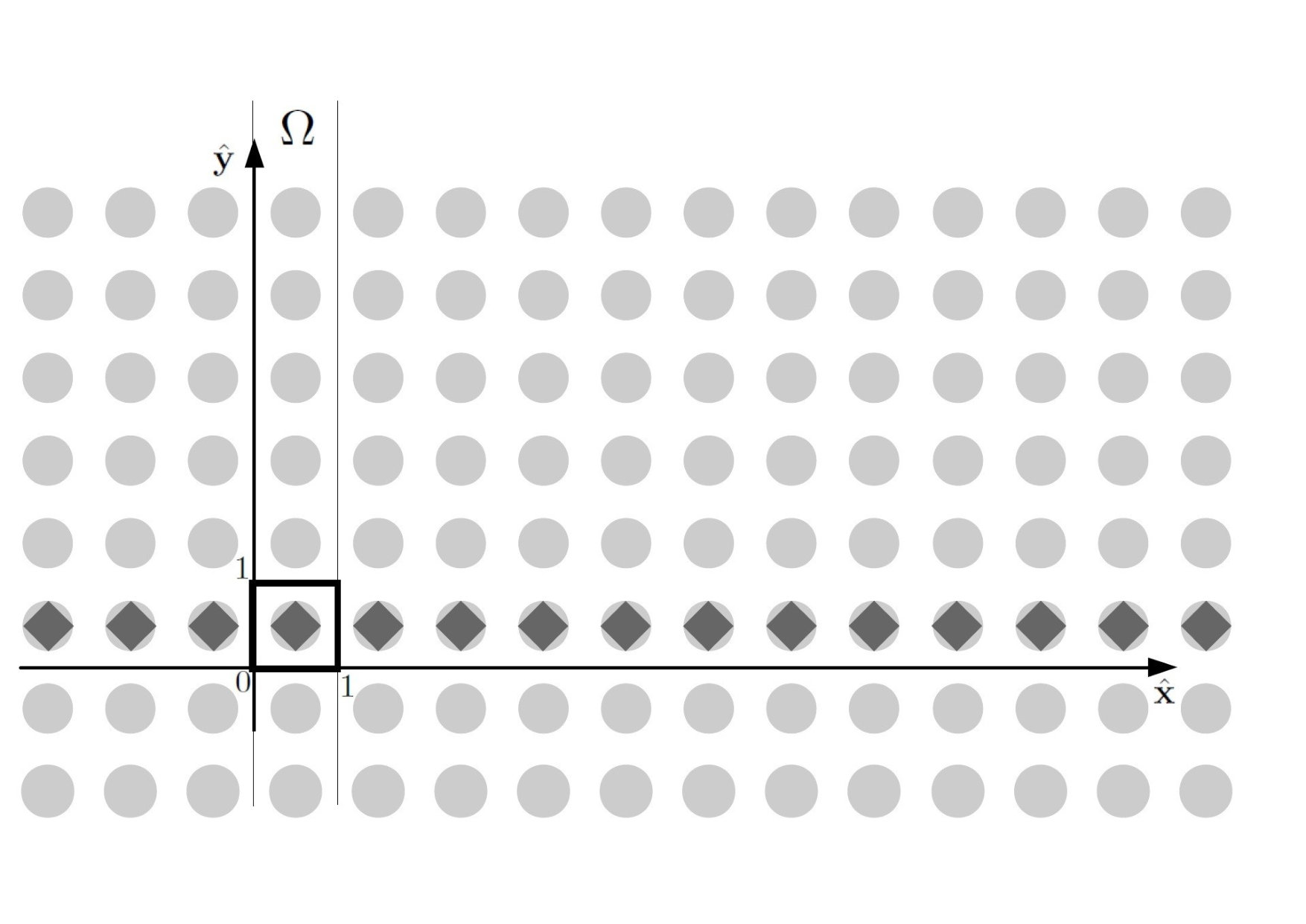 Figure 1
Peer Reviews
No public reviews on file for this paper yet. If you reviewed it on a platform where reviews are public (OpenReview, ICLR, NeurIPS, ICML), you can paste yours below so the community can read it here.
Videos
No videos yet. Explain this paper in a talk, walkthrough, or lecture? Add one.
Taxonomy
TopicsPhotonic Crystals and Applications · Electromagnetic Scattering and Analysis
Gap Localization of TE-Modes by arbitrarily weak defects - multiband case
B.M.Brown
,
V.Hoang
,
M.Plum
,
M.Radosz
and
I.Wood
Abstract.
This paper considers the propagation of TE-modes in photonic crystal waveguides. The waveguide is created by introducing a linear defect into a periodic background medium. Both the periodic background problem and the perturbed problem are modelled by a divergence type equation. A feature of our analysis is that we allow discontinuities in the coefficients of the operator, which is required to model many photonic crystals. Using the Floquet-Bloch theory in negative order Sobolev spaces, we characterize the precise number of eigenvalues created by the line defect in terms of the band functions of the original periodic background medium for arbitrarily weak defects.
1. Introduction
Electromagnetic waves in periodically structured media, such as photonic crystals and metamaterials, are a subject of ongoing interest. Typically, the propagation of waves in such media exhibits band-gaps; see e.g. [11, 14]. These are intervals on the frequency or energy axis where propagation is forbidden. Mathematically, these correspond to gaps in the spectrum of the operator describing a problem with periodic background medium. The existence of these gaps for certain choices of material coefficients was proved in [6, 7, 10] and in [8] for the full Maxwell case.
In a previous paper [2], we studied the propagation of TE-polarized waves in two-dimensional photonic crystals that contain line defects and gave rigorous sufficient conditions which imply spectral localization in band gaps. Our results were restricted to the case where only one band function (see (3.4)) contributes to the edge of the band gap. In this paper, we deal with the general situation where multiple bands contribute to the edge of the gap. We also develop a new approach to characterize the precise number of eigenvalues created by the line defect in terms of the band functions of the original periodic structure.
Our results are applicable to non-smooth coefficients. This is motivated by physical applications, where, to produce the typical band-gap spectrum, the coefficient of the background medium is usually piecewise constant. See, for instance, [6, 7, 8]. In order to overcome the arising difficulties, we use Floquet-Bloch theory in negative function spaces [5]. Additionally, all our results do not depend on the precise geometry of the perturbation, e.g. the shape of the inclusions defined by the region within the periodicity cell where the perturbed material coefficients differ from the unperturbed ones. For a more detailed discussion of relevant background material, we refer to [2] and references therein.
The structure of our paper is as follows: In section 2 we give a brief description of the periodic problem and its perturbation by a line defect and formulate the operator-theoretic background. The following section 3 introduces the Floquet-Bloch theory in negative spaces with the technical proof provided in Appendix A. Section 4 contains some key preparatory Lemmas and estimates. An upper estimate on the number of eigenvalues created in the band gap is given in section 5 while section 6 provides a lower bound and combines all results to our main statement (Theorem 3) on the precise number of eigenvalues.
We note that a variational method similar to the one here is used in [17] to prove generation of spectrum, though not the precise number of eigenvalues, in the band gaps of periodic Schrödinger operators under a slightly weaker sign condition on the perturbation than we require here.
2. The operator theoretic formulation
We consider the propagation of electromagnetic waves in a non-magnetic, inhomogeneous medium described by a varying dielectric function with . Assuming that the magnetic field has the form , where denotes the unit vector in the -direction, we look for time-harmonic solutions to Maxwell’s equations. This leads to the equation
[TABLE]
for the -component of the magnetic field. Note that in the context of polarized waves, we assume that all fields and constitutive functions depend only on .
The periodic background medium is characterised by , where for simplicity we assume that the unit square is a cell of periodicity.
Let and . We now introduce a line defect, which we assume to be aligned along the -axis and preserving the periodicity in the -direction. In addition, the defect is assumed to be localised in the -direction. The new (and perturbed) system is described by a dielectric function , periodic in -direction (see Figure 1), i.e.
[TABLE]
Assumption 1**.**
We make the following general assumptions on the material coefficients, valid throughout the paper:
- (i)
. 2. (ii)
* for some constant and .* 3. (iii)
The perturbation is nonnegative, i.e.
[TABLE] 4. (iv)
There exists a ball such that on .
Since both the perturbed and unperturbed systems are periodic in the -direction, we can apply Bloch’s theorem [16, 13] to reduce both problems to problems on the strip . For fixed quasi-momentum we introduce the space of quasi-periodic -functions on
[TABLE]
For consider the sesquilinear form
[TABLE]
As is bounded and bounded away from zero, we can introduce a new inner product on given by
[TABLE]
which is equivalent to the standard inner product in . When there is no danger of confusion, we denote the associated norm .
Definition 1**.**
Let denote the dual space of . Let be defined by
[TABLE]
where the -notation indicates the dual pairing, i.e. it is the action of the linear functional on the function .
is an isometric isomorphism, and hence the inner product on given by
[TABLE]
induces a norm which coincides with the usual operator sup-norm on .
After this preparation, we now introduce the realisations of the operators in and define the operator by with
[TABLE]
Then is bijective and both and are self-adjoint, see [2, Proposition 4.1]. corresponds to the fully periodic problem (2.1) with .
The useful identity
[TABLE]
follows from the definitions of and .
Let be a spectral gap for and . Then , so
[TABLE]
is well-defined and maps bijectively onto . The operator is the solution operator to the problem
[TABLE]
for a given .
We now examine the perturbed problem. Let the bilinear form and the operator be defined by
[TABLE]
Moreover, we define . Then is a bounded non-negative operator (see [2, Lemma 1 & 2].)
Remark 1**.**
We note that just as in [5, Section 5], the spectra of the -realizations and and the corresponding realizations of the operators in coincide.
Suppose now is a band gap of the unperturbed operator . We will give conditions which ensure that localized modes, i.e. eigenvalues of the perturbed operator , appear in the band gap under arbitrarily weak perturbations and use a Birman-Schwinger-type reformulation to find the eigenvalues of the operator in a spectral gap. For proofs of the results in this section and more details on the reformulation, see [2, Section 5].
Consider the operator
[TABLE]
set and let be the orthogonal projection on . On , we introduce a new inner product given by
[TABLE]
The symmetry and definiteness of this inner product is shown in [2, Appendix A].
The following lemma gives useful estimates for in terms of the size of the perturbation. In particular it shows that for small perturbations, the only dependence of the bound for on the perturbation is through the term .
Lemma 1**.**
The following estimates hold:
- (i)
[TABLE] 2. (ii)
[TABLE] 3. (iii)
Moreover, if , then
[TABLE]
Proof.
See [2, Lemma 5.2]. ∎
Next for define
[TABLE]
Lemma 2**.**
The equation with has a non-trivial solution iff is an eigenvalue of , where .
Proof.
See [2, Lemma 5.3]. ∎
To be able to use the variational characterisation of eigenvalues we need the following properties of the operator .
Proposition 1**.**
* is a compact, symmetric operator on .*
Proof.
See [2, Proposition 5.7]. ∎
3. Floquet-Bloch theory in
For our results we will make use of Floquet-Bloch theory in . We introduce the notation and state the results needed here. A fuller account with proofs of some properties of the Floquet-Bloch theory in can be found in [5]. The Brillouin zone in our setting is the interval . This corresponds to our periodic cell in -direction which is the interval .
Definition 2**.**
For all in the Brioullin zone , we introduce an extension operator with
[TABLE]
for all , .
The partial Floquet transform
[TABLE]
is defined on functions with compact support by
[TABLE]
and extended to by continuity.
is an isometric isomorphism and
[TABLE]
(see [13]).
Definition 3**.**
Let denote the set of restrictions of functions to endowed with the -inner product. For all let
[TABLE]
Note that being an element of requires a weak form of semi-periodic boundary conditions on the boundary of . We denote by the mapping
[TABLE]
and extend it to a mapping between the dual spaces by
[TABLE]
Let
[TABLE]
where, as usual, means for almost all and the norm is induced by the inner product
[TABLE]
* can be viewed as the space of all functions with . By and we denote the canonical isometric isomorphisms (defined analogously to (2.5)).*
Remark 2**.**
* can also be defined as the direct integral of the , which are then regarded as fibers over (see e.g. [18]).*
Analogously to (2.6), we get
[TABLE]
Let be given by . For we have , and
[TABLE]
where is defined as in (2.4) with the range of integration replaced by (see [5, Theorem 3.7]). The form induces the inner product on the space as well as on giving
[TABLE]
Moreover, is an isometric isomorphism (see [5, Theorem 3.8]), whence also its adjoint is. In particular, is a Hilbert space. The map
[TABLE]
is an isometric isomorphism and (see [5, Lemma 3.9]). For , let be the domain of the operator defined in by
[TABLE]
This means that (cf. (2.5))
[TABLE]
Note that is dense in since is dense in and thus, by duality is dense in . Analogously to the case of , the operator is self-adjoint. is compact since it is bounded from to , which is compactly embedded in .
It is possible to transform the spectral problem for the operators which have -dependent domains to a spectral problem for an operator family where the -dependence is transferred to the differential expression (see, e.g. [4], for the transformation in a similar situation). This family is analytic of type (A) in the sense of Kato and using [12, Theorem VII.3.9 and Remark VII.3.10], we can obtain sequences of real-valued functions and eigenfunctions , normalized in . The functions and are all real-analytic functions in the variable on and are such that
[TABLE]
We note that the eigenvalues are not necessarily ordered by magnitude. We call the functions the band functions and the Bloch functions.
Throughout, we will need to make the following non-degeneracy assumption on the band functions:
Assumption 2**.**
The band functions are not constant as functions of .
For notational convenience, we also introduce
[TABLE]
The set forms an orthonormal set in , which is also complete as the set of eigenfunctions of the self-adjoint realisation of the operators in . As a general rule, we will always extend the to the whole of in a -quasiperiodic manner, i.e.
[TABLE]
In what follows, for we denote by the element of , defined by
[TABLE]
Lemma 3**.**
For almost all and
[TABLE]
Proof.
Let . Then
[TABLE]
which proves the identity. ∎
Having introduced the required notation, we are now able to state the results on expansions of functions in terms of the Bloch waves needed for this paper. The proofs can be found in Appendix A.
Proposition 2**.**
- (1)
. 2. (2)
For and ,
[TABLE]
holds. 3. (3)
For and the equality
[TABLE]
holds, where the series converges in . 4. (4)
For and ,
[TABLE] 5. (5)
For ,
[TABLE]
We refer to Figure 2 for an overview of the spaces and mappings discussed here.
4. Preparatory results
Our strategy consists in following , the -th lowest negative eigenvalue (if it exists) of the operator , introduced in (2.10), as varies. The following standard variational characterisations (see, for example, [9]) hold:
[TABLE]
Lemma 4**.**
For in the spectral gap , the mapping is continuous and increasing.
The proof is virtually identical to that of Lemma 6.1 in [4]. We remind the reader that is the lowest point of a spectral band and lies at the top edge of a gap. The solutions of the equation will play an important role in our analysis. We first introduce the following sets:
[TABLE]
We will next see that the set is finite. In the following we denote the elements of by and set and .
Lemma 5**.**
The set is a non-empty finite set. Moreover, as , uniformly in
Proof.
We first note the coincidence of the spectra of the and realisations (see [5, Section 5]), so it is enough to consider the -realisation of the operator. The result then follows from [4, Proposition 3.2 and its proof]. ∎
Corollary 1**.**
There is an such that for all and for all we have , while for all and for all , holds.
Proof.
The assertion follows from continuity of the band functions, existence of the spectral gap and Lemma 5. ∎
Lemma 6**.**
The set is isolated in the sense that there is such that for all , for all .
Proof.
The proof is the same as that of [3, Lemma 3.7], noting that analyticity and non-constancy of the band function in the one-dimensional variable are sufficient to avoid Assumption 3.3 in [3] in the proof. ∎
Noting that is compactly supported in , for , let be the element of defined by
[TABLE]
Moreover, letting denote the functions in with compact support, we define for , the element of by
[TABLE]
Define
[TABLE]
where the action is interpreted as in (4.2).
Remark 3**.**
Observe that the action of on any can be written as
[TABLE]
Since has compact support, the action of can be extended to any -function . Hence we shall define
[TABLE]
Then recalling (4.2) we get
[TABLE]
Lemma 7**.**
The codimension of satisfies .
Proof.
For ,
[TABLE]
Let be compactly supported in the -direction with on . Then
[TABLE]
Hence, and we need to show that
[TABLE]
Assume in . As is symmetric and non-negative in , this is equivalent to . Now, is equivalent to . Let . Then , so
[TABLE]
and thus . Hence (in the sense that for any we have ). Moreover, . Therefore, for any ,
[TABLE]
So , and hence . By unique continuation, see [1], and as the are linearly independent, we get for all . ∎
5. Upper bound on the number of eigenvalues
The main result in this section will require the following additional non-degeneracy assumption on the band functions .
Assumption 3**.**
There are and such that for all and satisfying ,
[TABLE]
holds.
Remark 4**.**
The assumption is true if the zero of is only of order . Non-degeneracy assumptions of a similiar form are common in the mathematical and physical literature (see e.g. [15] and references therein) and are believed to be “generically” true. In other words, it is believed that degeneracy of the band function can be removed by a small perturbation of the coefficients of the differential operator.
The next lemma provides a uniform bound on contributions to the Rayleigh quotient away from points in .
Lemma 8**.**
Let . If is uniformly bounded for in a set , then
[TABLE]
Proof.
Note that the order of integration over and summation over can be exchanged by the monotone convergence theorem. We have
[TABLE]
where the equality follows from Proposition 2 (5) and the final inequality from Lemma 1. ∎
Before stating the first main result we introduce an auxilliary function , which will play a crucial role in the estimates of the Rayleigh quotient, and prove some identities and estimates involving .
For such that () and let
[TABLE]
Lemma 9**.**
The function from (5.1) can be represented as follows:
[TABLE]
where the action is considered as an -pairing. Moreover,
[TABLE]
Proof.
We have
[TABLE]
which proves (5.2).
From (3.5) and Lemma 3 it follows that
[TABLE]
so (5.3) holds.
We next prove (5.4). In order to make use of the explicit form of the Floquet transform on compactly supported functions, we let be a cut-off function with and with for and for . Applying the Floquet transform in to the function we get
[TABLE]
We now argue that in the limit , we can move to the other side of the inner product. Observe that
[TABLE]
Clearly, the first term allows moving to the right and it remains to show that
[TABLE]
Therefore, it suffices to show that
[TABLE]
and we will see that both limits vanish. Now,
[TABLE]
as
[TABLE]
The other term can be estimated in a similar manner.
Using (3.5), Lemma 3 and (3.7),
[TABLE]
which implies that
[TABLE]
where the last equality follows from compactness of the support of . Equation (5.4) now follows from (5.3). To obtain (5.5), we use Remark 3. ∎
Lemma 10**.**
Let be the space defined in (4.4). For the function satisfies the estimate
[TABLE]
Proof.
We use (5.3). First note the following:
[TABLE]
In particular, using (4.5), for we obtain
[TABLE]
As the depend analytically on ,
[TABLE]
and we get for that
[TABLE]
completing the proof. ∎
Lemma 11**.**
There exists such that for all , where is any function compactly supported in the -direction with on .
Proof.
[TABLE]
Now let and set . Then
[TABLE]
where is an -matrix with entries
[TABLE]
Then where . By the proof of Lemma 7, the set is linearly independent, so is a positive definite Hermitian matrix and also its square is.
Now,
[TABLE]
Thus,
[TABLE]
∎
We now state the main result of this section.
Theorem 1**.**
Let Assumptions 1, 2 and 3 hold. Then there exists such that if , then the operator has at most eigenvalues in the spectral gap of the operator .
Proof.
We start by noting an equality for the Rayleigh quotient. Let . Then by using Proposition 2 (4),
[TABLE]
for .
By continuity of the band function we have, for each , either for all or for all . In the first case, while in the second case, we have the reverse inequality. Therefore, with as in Corollary 1,
[TABLE]
We first consider the second sum. By Lemma 6 and Lemma 8, it can be bounded below by
[TABLE]
Now, we turn our attention to the first sum. We remind the reader that the set consists of the elements with . We split the domain of integration into balls of radius around the points and the complement of the union of these balls in , where is chosen as in Assumption 3. Then
[TABLE]
where . On we again use that is uniformly bounded (with respect to and ), since the continuous function is positive and therefore positively bounded away from [math] on the compact set . Using Lemma 8 again, the sum of the last integrals can be bounded below by (5.10).
It remains to estimate the sum of the integrals over . Exchanging the order of the sums which can only add negative terms (if for several ) and then shifting the integration variable yields
[TABLE]
where in the last step we have used Assumption 3 and Equation (5.3). Now, for , by Lemma 10,
[TABLE]
Combining all our results, we get that for
[TABLE]
for some , independent of . Therefore, if the Rayleigh quotient is larger than on the space with . By the variational characterisation of the eigenvalues in (4.1) we have for all . Therefore, using Lemma 2, we see that no more than eigenvalues of the operator are created in the gap. ∎
6. Lower bound on the number of eigenvalues
Lemma 12**.**
Let . For all ,
[TABLE]
holds.
Proof.
As in the proof of Theorem 1, we have that (5) holds for . This leads to the estimate
[TABLE]
where the last inequality follows from Proposition 2 (5). ∎
Corollary 2**.**
Let and suppose that sufficiently small. Then
[TABLE]
Proof.
This follows from Lemma 12 together with Lemma 1. ∎
Remark 5**.**
This shows that for a fixed in the spectral gap, the size of the perturbation has to reach a threshold before it is possible for to lie in the spectrum.
Theorem 2**.**
Let Assumptions 1 and 2 hold. For any such that is sufficiently small, at least eigenvalues are created in the spectral gap.
Proof.
By Corollary 2, if is sufficiently small, we can find such that
[TABLE]
We next give an upper bound on the Rayleigh quotient using equality (5.8) and decomposing the sum over into three parts: one over , one over with , and one over . (Note that for all ). By Lemma 8 the first sum is bounded from above by as long as stays away from . The second sum is bounded from above by [math]. Therefore,
[TABLE]
Now we split up the integration over into a part over the intervals and a remainder, as before in the proof of Theorem 1. We get
[TABLE]
and using Lemma 8 to estimate the integral over , we continue the estimate as follows:
[TABLE]
In the last but one inequality we use the fact that any can be at most in sets ; in the last line, due to analyticity, we have for that for some . For any function
[TABLE]
with coefficients , we have from Lemma 11 and continuity of that is bounded below on . Thus the Rayleigh quotient satisfies the following estimate:
[TABLE]
To show that the Rayleigh quotient tends to as , it is therefore sufficient for
[TABLE]
to diverge in the limit as . We have
[TABLE]
Therefore,
[TABLE]
As , the variational characterisation of the eigenvalues (4.1) implies as , and combined with Lemma 4 and (6.1) this means that at least eigenvalues are created in the gap. ∎
Theorem 1 and Theorem 2 together yield the following result.
Theorem 3**.**
Let Assumptions 1, 2 and 3 hold, i.e.
- (i)
. 2. (ii)
* for some constant and .* 3. (iii)
The perturbation is nonnegative, i.e.
[TABLE] 4. (iv)
There exists a ball such that on . 5. (v)
The band functions are not constant as functions of . 6. (vi)
There are and such that for all and satisfying ,
[TABLE]
Moreover, let be sufficiently small. Then the number of eigenvalues of the operator in the gap equals , the finite number of solution pairs of the equation .
7. Funding
This work was supported by the British Engineering and Physical Sciences Research Council [EP/I038217/1 to B.M.B. and I.W.], the National Science Foundation [DMS 1412023, DMS-1614797, DMS-1810687 to V.H.] and the Deutsche Forschungsgemeinschaft [CRC 1173 to M.P.].
Appendix A Proof of Proposition 2
From [5, Theorem 4.3 & Theorem 4.7], we have , as required for Proposition 2 (1).
For Proposition 2 (2), let be defined by . Then in the proof of [5, Theorem 4.3] it is shown that , where . Thus both sides of (3.7) equal and the statement is true.
To prove Proposition 2 (3) let and use the decomposition (see [13, 5])
[TABLE]
where the series converges in . Thus for ,
[TABLE]
and using Proposition 2 (2) and that we get
[TABLE]
Now, with , using (3.2) and that and commute we have
[TABLE]
Inserting this in (A.1) gives Proposition 2 (3). We next show Proposition 2 (4). Noting that for we have
[TABLE]
and using (3.5), by Proposition 2 (3), we have
[TABLE]
Next let
[TABLE]
Then using the formula (3.1) for the inverse Floquet transform and the isometry property of we get
[TABLE]
Therefore, by Proposition 2 (2) using that , and by (3.2) we get
[TABLE]
We now wish to interchange the order of taking the limit and integrating. To do this note that
[TABLE]
and set
[TABLE]
Since the set is an orthonormal basis in and , the series converges in . In particular, we have that for every
[TABLE]
Moreover, by Bessel’s inequality
[TABLE]
and as a function of the right hand side lies in By Fubini’s theorem, we have
[TABLE]
and by dominated convergence the LHS of (A.3) tends to [math] and so the RHS of (A.3) also does. This implies that
[TABLE]
Therefore, using the Cauchy-Schwarz inequality we have that
[TABLE]
as and so we can exchange the order of summation over and integration over in (A.2). This gives
[TABLE]
Finally, we consider Proposition 2 (5). For , we have
[TABLE]
where we have used Proposition 2 (3) for .
Next, let
[TABLE]
By a similar argument to the proof of Proposition 2 (4), we can swap the order of summation and integration and then using the formula (3.1) for the inverse Floquet transform and the isometry property of we get
[TABLE]
Therefore, using Proposition 2 (2)
[TABLE]
This completes the proof.
The reference list from the paper itself. Each links out to its DOI / PubMed record.
- 1[1] G. Alessandrini. Strong unique continuation for general elliptic equations in 2d. Journal of Mathematical Analysis and Applications , 386(2):669 – 676, 2012.
- 2[2] B. M. Brown, V. Hoang, M. Plum, M. Radosz, and I. Wood. Gap localization of te-modes by arbitrarily weak defects. Journal of the London Mathematical Society , 95(3):942–962, 2017.
- 3[3] B. M. Brown, V. Hoang, M. Plum, and I. Wood. Spectrum created by line defects in periodic structures. Mathematische Nachrichten , 287(17-18):1972–1985, 2014.
- 4[4] B. M. Brown, V. Hoang, M. Plum, and I. Wood. On the spectrum of waveguides in planar photonic bandgap structures. Proc. Roy. Soc. London A. , 471, 2015.
- 5[5] B. M. Brown, V. Hoang, M. Plum, and I. G. Wood. Floquet-bloch theory for elliptic problems with discontinuous coefficients. In Jan Janas, Pavel Kurasov, Ari Laptev, Sergei Naboko, and Günter Stolz, editors, Spectral Theory and Analysis , pages 1–20, Basel, 2011. Springer Basel.
- 6[6] D. Dobson and S. Cox. Maximizing band gaps in two-dimensional photonic crystals. SIAM Journal on Applied Mathematics , 59(6):2108–2120, 1999.
- 7[7] A. Figotin and P. Kuchment. Band-gap structure of spectra of periodic dielectric and acoustic media. ii. two-dimensional photonic crystals. SIAM Journal on Applied Mathematics , 56(6):1561–1620, 1996.
- 8[8] N. Filonov. Gaps in the spectrum of the maxwell operator with periodic coefficients. Communications in Mathematical Physics , 240(1/2):161 – 170, 2003.