Broadband topological slow light through higher momentum-space winding
Jonathan Guglielmon, Mikael C. Rechtsman

TL;DR
This paper proposes a novel edge termination in photonic topological insulators that enables slow light with broadband operation by causing the edge state to wind multiple times around the Brillouin zone, overcoming traditional bandwidth limitations.
Contribution
It introduces a new method to achieve broadband slow light in topological photonic waveguides through higher momentum-space winding of edge states.
Findings
Edge states can wind multiple times around the Brillouin zone.
The approach enables slow and broadband light propagation.
Theoretical demonstration of the winding effect on edge states.
Abstract
Slow-light waveguides can strongly enhance light-matter interaction, but suffer from narrow bandwidth, increased backscattering, and Anderson localization. Edge states in photonic topological insulators resist backscattering and localization, but typically cross the bandgap over a single Brillouin zone, meaning that slow group velocity implies narrow-band operation. Here we show theoretically that this can be circumvented via an edge termination that causes the edge state to wind many times around the Brillouin zone, making it both slow and broadband.
Click any figure to enlarge with its caption.
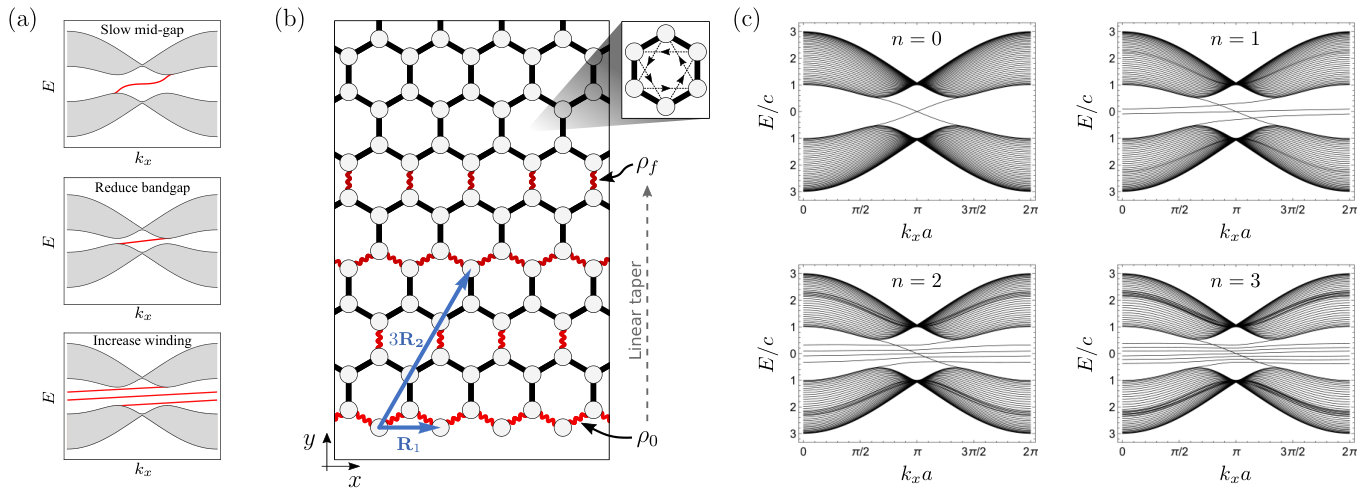 Figure 1
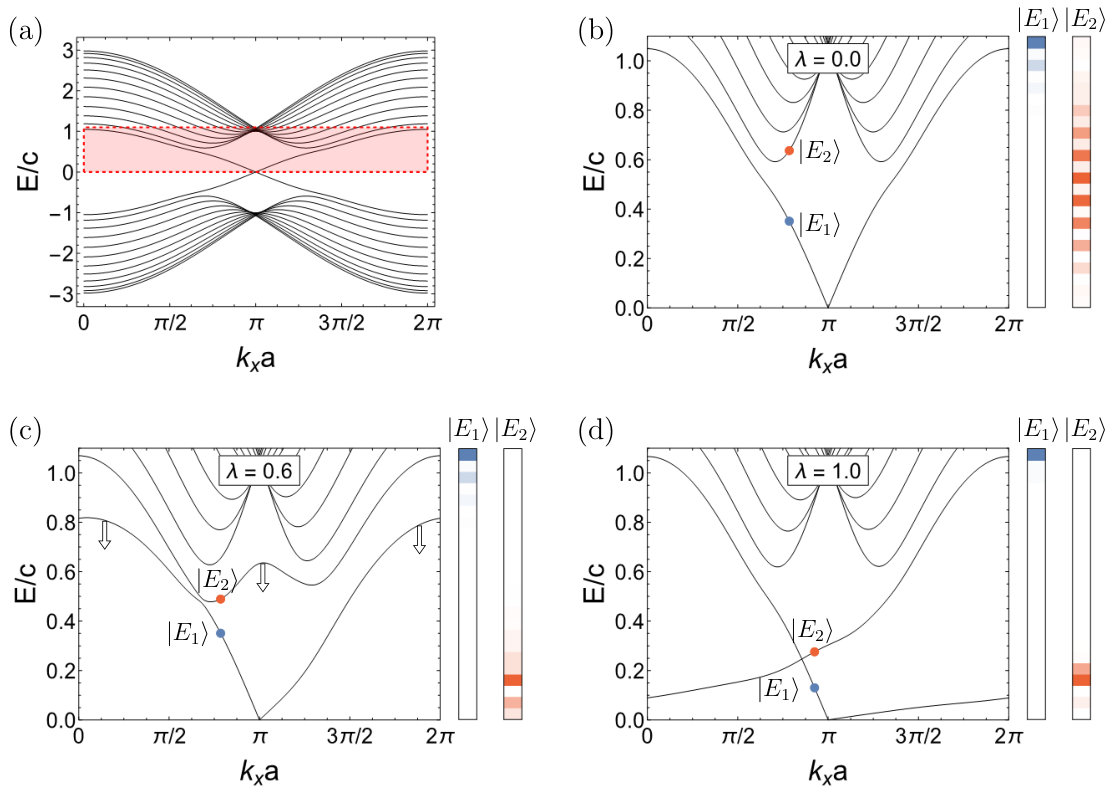 Figure 2
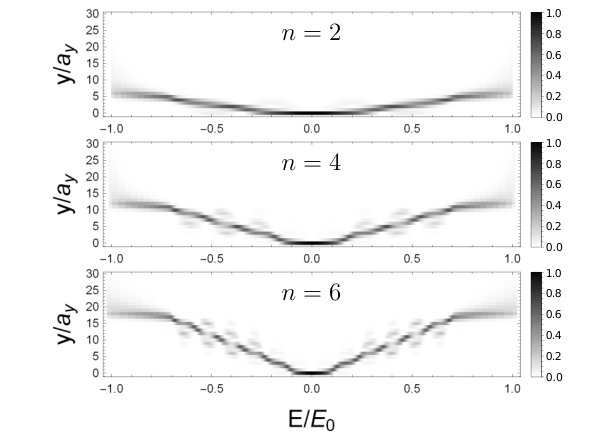 Figure 3
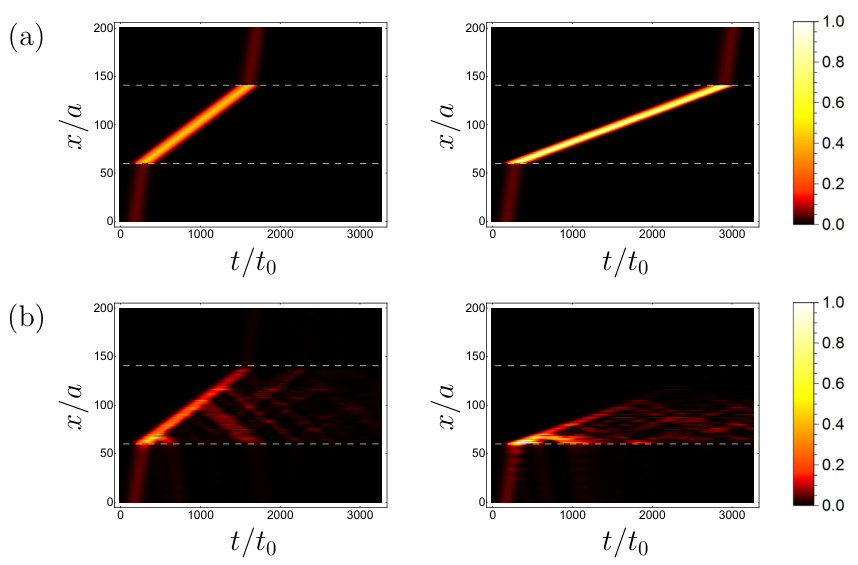 Figure 4
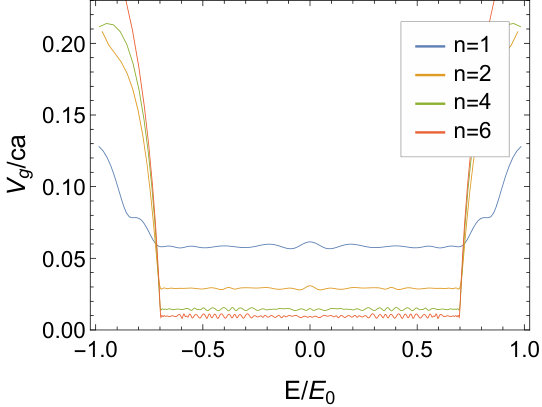 Figure 5
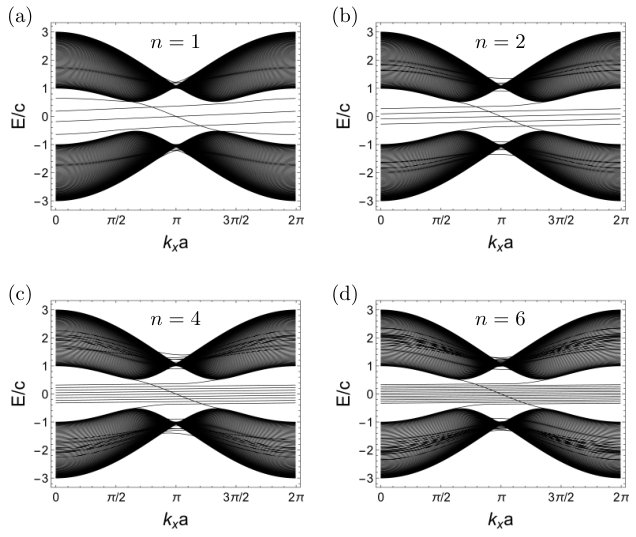 Figure 1
Peer Reviews
No public reviews on file for this paper yet. If you reviewed it on a platform where reviews are public (OpenReview, ICLR, NeurIPS, ICML), you can paste yours below so the community can read it here.
Videos
No videos yet. Explain this paper in a talk, walkthrough, or lecture? Add one.
Broadband topological slow light through higher momentum-space winding
Jonathan Guglielmon1 and Mikael C. Rechtsman1
1Department of Physics, The Pennsylvania State University, University Park, PA 16802, USA
Abstract
Slow-light waveguides can strongly enhance light-matter interaction, but suffer from narrow bandwidth, increased backscattering, and Anderson localization. Edge states in photonic topological insulators resist backscattering and localization, but typically cross the bandgap over a single Brillouin zone, meaning that slow group velocity implies narrow-band operation. Here we show theoretically that this can be circumvented via an edge termination that causes the edge state to wind many times around the Brillouin zone, making it both slow and broadband.
When propagating through a medium, a pulse of light can travel with a group velocity that is much slower than its vacuum value Hau et al. (1999); Ku et al. (2004); Vlasov et al. (2005). This phenomenon of slow light has been extensively studied due to its potential for applications ranging from optical buffers to enhanced light-matter interactions (and thus nonlinearity) Hau et al. (1999); Xu et al. (2000); Soljačić et al. (2002); Povinelli et al. (2005); McMillan et al. (2006); Krauss (2008); Baba (2008); Khurgin and Tucker (2008). A well-known problem encountered in slow-light systems arises from fabrication imperfections: as one decreases the group velocity of the light, it becomes increasingly sensitive to disorder, leading to significant backscattering, loss, and localization Melati et al. (2014). In recent years, significant research effort has been dedicated to studying and realizing photonic topological insulators Haldane and Raghu (2008); Wang et al. (2009); Hafezi et al. (2011); Umucalılar and Carusotto (2011); Fang et al. (2012); Rechtsman et al. (2013); Hafezi et al. (2013); Khanikaev et al. (2013); Peano et al. (2016); Fang et al. (2017); Ozawa et al. (2018). These systems possess chiral edge states that resist backscattering and localization in the presence of disorder. They, therefore, constitute natural candidates for generating robust slow light. Additionally, in contrast to typical slow-light systems, which require special designs to avoid reflections from the slow-light interface Schulz et al. (2010), chiral edge states will automatically exhibit complete transmission between topological fast-light and topological slow-light regions, independent of the slow-light group index and the details of the interface.
In many applications, the usefulness of a slow-light system depends crucially on its bandwidth which, ideally, should be large so that the light can be slowed over a large range of frequencies Baba (2008). In topological systems, a typical edge termination—such as a zig-zag edge of a honeycomb lattice—produces an edge mode that crosses the bulk bandgap over a single Brillouin zone. As a result, reducing the group velocity of the edge mode requires either slowing the mode only in the vicinity of a given energy (e.g., mid-gap) Yang et al. (2013) or reducing the bandgap (see Fig. 1 (a)). In both cases, the reduced group velocity comes at the expense of bandwidth. Additionally, in the latter case, the reduced bandgap means that the existence of the edge mode will be more sensitive to disorder since disorder strong enough to close the bandgap can induce a topological phase transition.
In this letter, we demonstrate that, by engineering the edge termination, a topological edge mode can be made to wind many times around the Brillouin zone as it crosses the bandgap, thereby generating a slow edge mode over a large range of frequencies. The number of times the edge mode winds is determined by the depth of the modification of the edge termination measured into the bulk. In the direction parallel to the edge, the termination does not expand the size of unit cell and, therefore, generates multiple windings in a manner distinct from simple band folding. Since the mode is slowed without reducing the bulk bandgap, its existence remains protected against strong disorder. The ability to slow the mode without reducing its bandwidth is enabled by the fundamentally 2D nature of the system, as different frequencies reside at different depths in the structure. As a result, the minimal group velocity attainable at a fixed bandwidth is determined by the system size in the direction orthogonal to the direction of propagation. In contrast to typical topological slow-light systems, where the 2D footprint of the bulk may be viewed as a drawback, our proposed structure makes use of this region to enable wideband operation.
Designing the edge termination requires specifying a set of parameters that can be tuned along the edge. The implementation of the photonic topological insulator—for example, whether it is realized using magneto-optics Haldane and Raghu (2008); Wang et al. (2009), modulated resonators Fang et al. (2012); Minkov and Savona (2016), or optomechanics Fang et al. (2017)—will determine this set of tunable degrees of freedom. The central observation of this letter, however, is not restricted to a specific implementation but rather is generally applicable to systems containing chiral edge states. We, therefore, avoid assuming a specific photonic implementation and instead conceptually demonstrate the features of our proposal in the Haldane model Haldane (1988).
We begin with the Haldane model defined on a honeycomb lattice with real first-neighbor couplings and complex second-neighbor couplings. We set the inversion symmetry breaking mass to and the phases for the second-neighbor couplings to , with positive phases assigned to counter-clockwise hopping (see Fig. 1). We denote the magnitudes of the first-neighbor and second-neighbor couplings by and , respectively. For definiteness, we take . We denote the lattice constant by and the lattice vectors by and . The non-zero value for places the system in a topologically non-trivial phase with Chern number so that opening the boundaries of the system produces a topological edge mode that crosses the bulk bandgap as the momentum parallel to the edge is swept across the Brillouin zone. We will consider a horizontal strip geometry that is periodic in the -direction and finite in the -direction, terminated on zig-zag edges. We choose coordinates such that the lowest site resides at . We then modify the Hamiltonian in the vicinity of the edge by tailoring the couplings to control the behavior of the edge mode. For simplicity, we will leave the upper edge of the structure unchanged and only introduce modifications to the lower edge.
On the lower edge, we pattern the nearest-neighbor couplings in the way illustrated by Fig. 1(b). In particular, we reduce a subset of the couplings—those indicated in the figure by wavy red lines—by a factor that depends on the height, , of the link center for the neighbor pair (i.e., ). The pattern alternately rescales horizontal and vertical couplings, while interspersing regions in which the couplings are left unchanged. The pattern maintains full periodicity. Up to the values of the rescaling factors, the pattern repeats after translation by . After repetitions along , the pattern terminates into the bulk of the standard Haldane model (i.e., with all nearest-neighbor couplings set to ). The resulting edge termination, therefore, extends to a depth of into the bulk. As we will see shortly, the value of determines the number of times the edge mode winds around the Brillouin zone.
We choose the rescaling function, , so that couplings residing close to the edge are reduced more than couplings residing deeper in the bulk. We take the rescaling factor to begin at a value on the edge and increase linearly to a final value before terminating into the bulk. Defining and as the -coordinates of the link centers for the first and last rescaled nearest-neighbor couplings, respectively, we take . Nearest-neighbor couplings residing beyond are not rescaled and are set to their bulk value .
Similarly, we rescale next-neighbor couplings by a factor which begins at the edge at , ends in the bulk at , and is linearly tapered in between. In contrast to the nearest-neighbor couplings, every next-neighbor coupling near the edge is rescaled (i.e., no couplings are skipped, as they are for the nearest-neighbor pattern). The first rescaled next-neighbor coupling resides at and the final rescaled next-neighbor coupling resides at (i.e., the depth reached after translations along ). Hence, the rescaling function for the next-neighbor couplings is given by . Next-neighbor couplings with are set to their bulk value . Tuning the parameters and allows us to control the dispersion of the edge mode. In the remainder of this letter, we will set and . These values were chosen to produce a simple edge dispersion exhibiting clear additional windings around the Brillouin zone.
With the rescaling functions set as described above, the number of repetitions, , determines the number of times the edge mode winds around the Brillouin zone as it crosses the bandgap. A standard zig-zag edge is reproduced by taking . Sending to causes the edge mode to wind two additional times (i.e., ) around the Brillouin zone as it crosses the bandgap. The resulting band structures for are shown in Fig. 1(c).
For the edge termination (a standard zig-zag edge), the edge modes associated with the upper and lower edges together form a continuously connected pair of bands. To understand how this pair of bands can develop additional windings, we study how the edge mode transforms under a smooth interpolation between the and terminations. We define and to be the Bloch Hamiltonians for the and cases, respectively, and define a one-parameter family of Hamiltonians that smoothly interpolates between and as is varied over the interval . In Fig. 2, we show a magnified view of the resulting transformation. As is increased, a bulk mode is pulled into the gap and approaches the edge mode localized on the top edge (Fig. 2(c)). Typically, these modes would exhibit an avoided crossing due to their spatial overlap. However, as the bulk mode is pulled into the bandgap, it becomes localized on the bottom edge, so that the overlap becomes exponentially suppressed in the system size, allowing it to cross the top-localized edge mode (Fig. 2(d)). A similar process simultaneously occurs for a bulk band residing below the bandgap. As a result, the edge mode acquires two additional windings around the Brillouin zone.
As the number of windings increases, the edge mode utilizes degrees of freedom that reside at increasing depths in the bulk. To study how the edge mode eigenstate profile varies as its energy is swept across the bandgap, we first optimize the coupling pattern to minimize variations in the group velocity (see Supplemental Material sup ) so that the bottom-localized edge mode crosses each energy in the bandgap exactly once and each energy is associated with a unique eigenstate (i.e., the optimization removes any non-monotonicity present in the edge bands and gives them nearly linear dispersion). Figure 3 shows how the edge mode eigenstate profile changes as the energy, , is swept across the gap. The intensity profile is shown over a single strip-geometry unit cell. For simplicity, the intensities associated with the two sublattices have been (additively) coarse-grained into a single intensity profile. At mid-gap, , the edge mode resides at the very edge of the structure. Away from mid-gap, it moves deeper into the bulk, with increasing depths occupied by the mode as the number of windings is increased. Note, however, that even as the mode moves into the bulk, it maintains a small cross-sectional mode profile. This feature is important for achieving enhanced light-matter interactions in a slow-light system.
In typical slow-light systems, a reduction in the group velocity is accompanied by an increased sensitivity to fabrication imperfections so that light is more easily scattered and localized by disorder. Topological edge states, however, are known to resist localization and backscattering. To demonstrate how this feature applies to a topological slow-light device, we perform time-domain simulations in which we launch a narrow-band pulse into a disordered slow-light region. We perform these simulations both for a topological structure and for a topologically trivial 1D array. For the topological structure, we use the optimized edge terminations so that, in the absence of disorder, the edge band has nearly linear dispersion. For the trivial structure, we control the group velocity by varying the nearest-neighbor coupling.
Defining and as the fast-light and slow-light group velocities, respectively, we independently perform the simulations for and (corresponding to the optimized and edge terminations) using onsite disorder with a strength of of the bandgap of the topological structure. We describe these simulations in the Supplemental Material sup . The results are shown in Fig. 4. The topological structure exhibits a clear improvement, resisting the significant localization and backscattering that increase in severity for the trivial system as the group velocity is reduced. More generally, for a wideband pulse, the topological system will display a similar improvement, but the pulse shape will undergo distortion due to disorder-induced dispersion.
In conclusion, we have shown that, by increasing an edge state’s momentum-space winding, it can be slowed without sacrificing bandwidth. For the resulting structures, the magnitude of the group velocity is decoupled from the size of the bandgap and from the periodicity along the propagation direction. The structures, therefore, circumvent the recently suggested limitation Minkov and Fan (2018) that the strength of the topological protection derived from the size of the bandgap is tied to the maximal group index.
For our proposed structure, the wideband nature of the edge state may be viewed as a natural consequence of slowing the mode in the presence of non-trivial topology: due to the non-zero Chern number, the edge state is required to fully traverse the bandgap so that, in response to a reduction of the group velocity of all of the in-gap states, new states are extracted from the bulk and appended to the edge band to enable it to cross the bandgap. The way that this is achieved is closely related to the system’s dimensionality: the degrees of freedom required to support a 1D wideband slow mode are extracted from the 2D reservoir of bulk states.
From the perspective of experimental implementation, the edge termination must be designed using the degrees of freedom that can be tuned in the underlying photonic topological insulator. This will require further studies aimed at adapting our proposal to specific photonic systems. In photonic crystals that break time-reversal symmetry through magneto-optics Haldane and Raghu (2008); Wang et al. (2009), one could, for instance, engineer an edge termination by varying the applied magnetic field in the vicinity of the edge or by further patterning the positions and radii of the edge sites. In proposals that utilize temporally modulated coupled resonators Fang et al. (2012); Minkov and Savona (2016) or driven optomechanical cavities Fang et al. (2017), both the coupling amplitudes and the pattern of relative modulation phases could be structured near the edge. Our work motivates further studies of how these degrees of freedom can be engineered along the edges of a system to control the properties of topological edge states and, in particular, to generate robust slow light.
Acknowledgements.
M.C.R. acknowledges the National Science Foundation under award number ECCS-1509546, the Charles E. Kaufman Foundation, a supporting organization of the Pittsburgh Foundation, and the Office of Naval Research under YIP program, grant number N00014-18-1-2595.
The reference list from the paper itself. Each links out to its DOI / PubMed record.
- 1Hau et al. (1999) L. V. Hau, S. E. Harris, Z. Dutton, and C. H. Behroozi, Nature 397 , 594 (1999).
- 2Ku et al. (2004) P. C. Ku, F. Sedgwick, C. J. Chang-Hasnain, P. Palinginis, T. Li, H. Wang, S. W. Chang, and S. L. Chuang, Opt. Lett. 29 , 2291 (2004).
- 3Vlasov et al. (2005) Y. A. Vlasov, M. O’Boyle, H. F. Hamann, and S. J. Mc Nab, Nature 438 , 65 (2005).
- 4Xu et al. (2000) Y. Xu, R. K. Lee, and A. Yariv, J. Opt. Soc. Am. B 17 , 387 (2000).
- 5Soljačić et al. (2002) M. Soljačić, S. G. Johnson, S. Fan, M. Ibanescu, E. Ippen, and J. D. Joannopoulos, J. Opt. Soc. Am. B 19 , 2052 (2002).
- 6Povinelli et al. (2005) M. L. Povinelli, S. G. Johnson, and J. D. Joannopoulos, Opt. Express 13 , 7145 (2005).
- 7Mc Millan et al. (2006) J. F. Mc Millan, X. Yang, N. C. Panoiu, R. M. Osgood, and C. W. Wong, Opt. Lett. 31 , 1235 (2006).
- 8Krauss (2008) T. F. Krauss, Nature Photonics 2 , 448 (2008) . · doi ↗