Disorder-induced exceptional points and nodal lines in Dirac superconductors
Alexander A. Zyuzin, Pascal Simon

TL;DR
This paper investigates how disorder affects quasiparticle spectra in Dirac superconductors, revealing the emergence of non-Hermitian features like Fermi arcs and exceptional lines, which depend on system dimensionality.
Contribution
It introduces the concept of disorder-induced non-Hermitian phenomena in Dirac superconductors, showing the formation of Fermi arcs and exceptional lines in different dimensions.
Findings
Disorder transforms nodes into Fermi arcs or areas bounded by exceptional points or lines.
In 2D, a Fermi arc bounded by exceptional points can be realized.
In 3D, supercurrents and disorder create Fermi surfaces bounded by exceptional lines.
Abstract
We consider the effect of disorder on the spectrum of quasiparticles in the point-node and nodal-line superconductors. Due to the anisotropic dispersion of quasiparticles disorder scattering may render the Hamiltonian describing these excitations non-Hermitian. Depending on the dimensionality of the system, we show that the nodes in the spectrum are replaced by Fermi arcs or Fermi areas bounded by exceptional points or exceptional lines, respectively. These features are illustrated by first considering a model of a proximity-induced superconductor in an anisotropic two-dimensional (2D) Dirac semimetal, where a Fermi arc in the gap bounded by exceptional points can be realized. We next show that the interplay between disorder and supercurrents can give rise to a 2D Fermi surface bounded by exceptional lines in three-dimensional (3D) nodal superconductors.
Click any figure to enlarge with its caption.
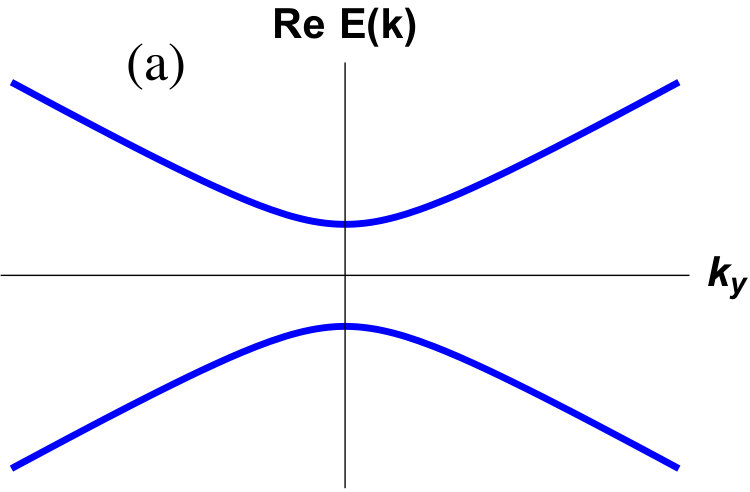 Figure 1
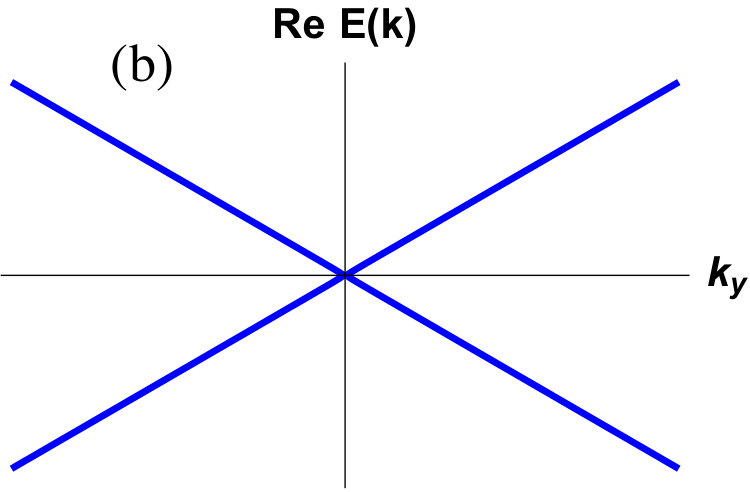 Figure 1
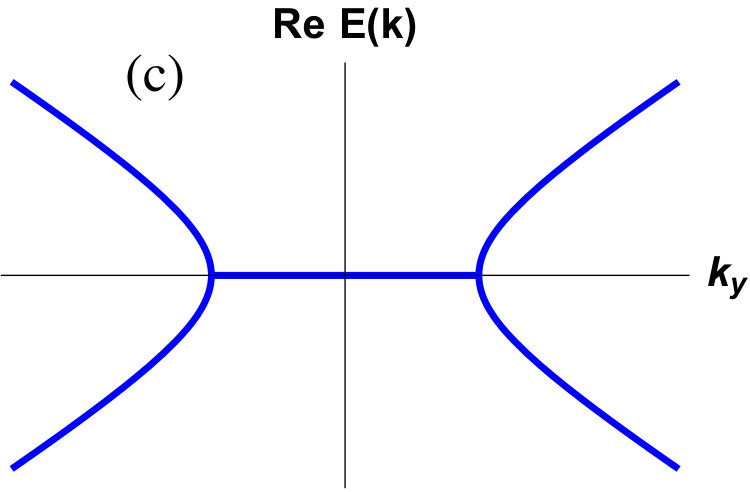 Figure 1
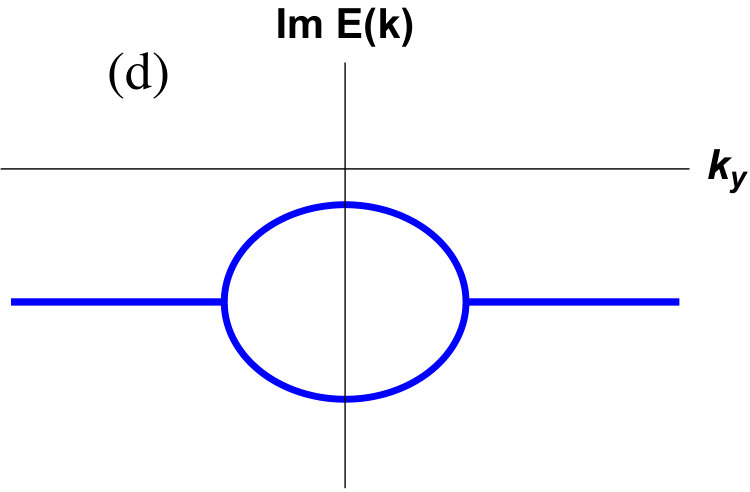 Figure 1
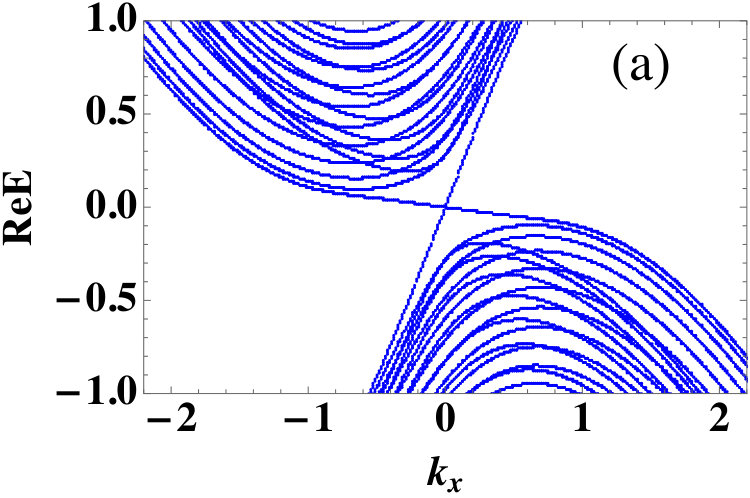 Figure 2
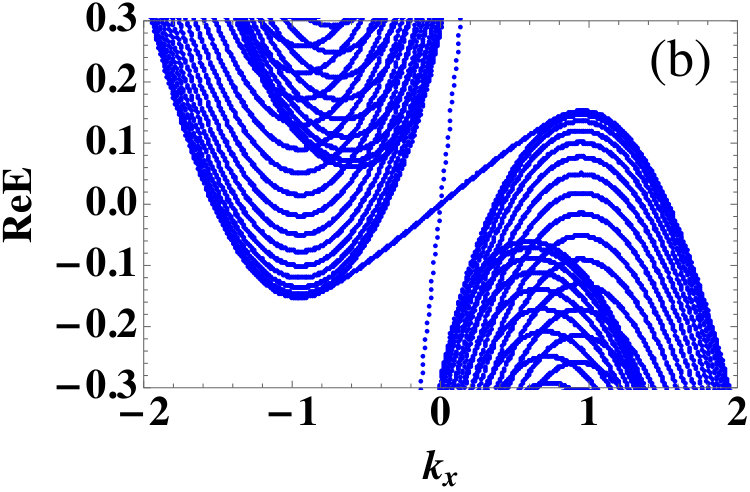 Figure 2
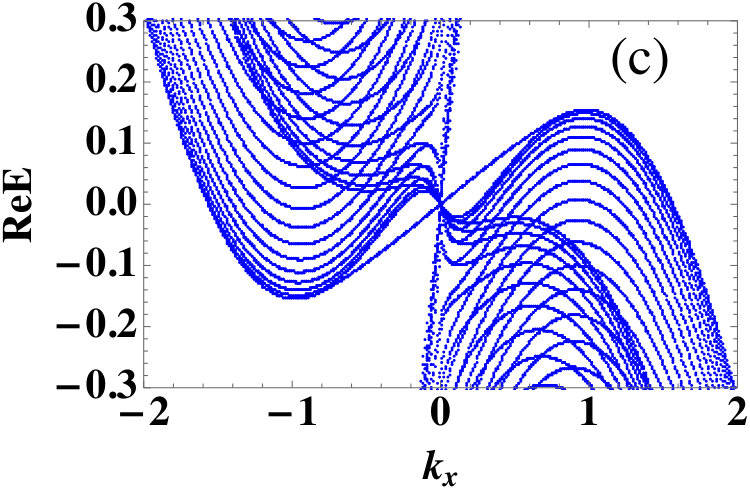 Figure 2
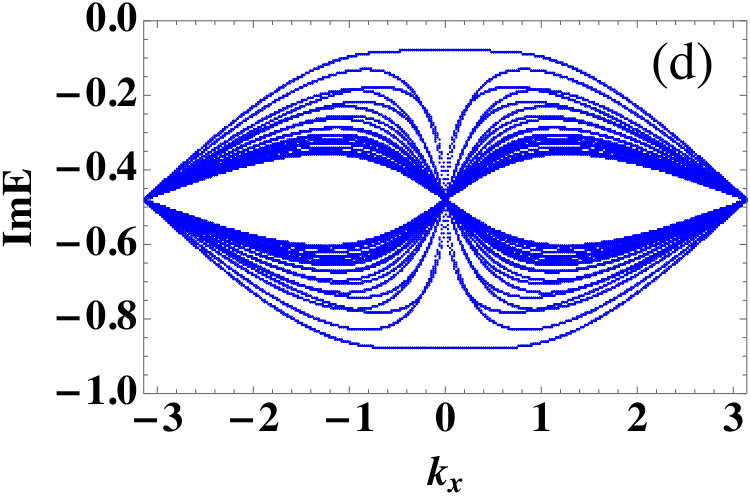 Figure 2
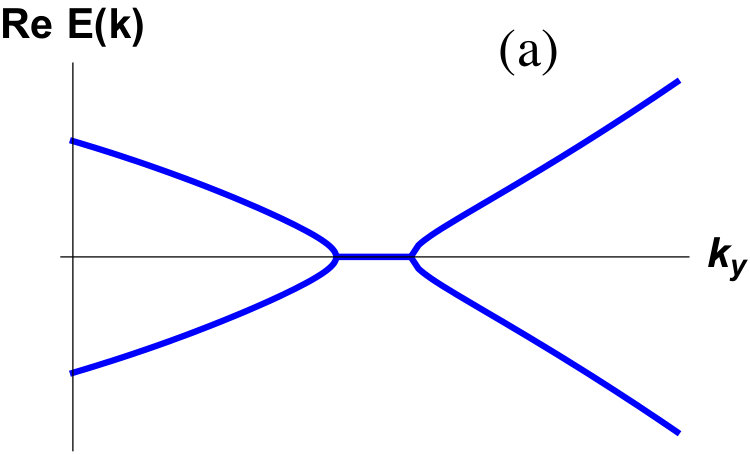 Figure 3
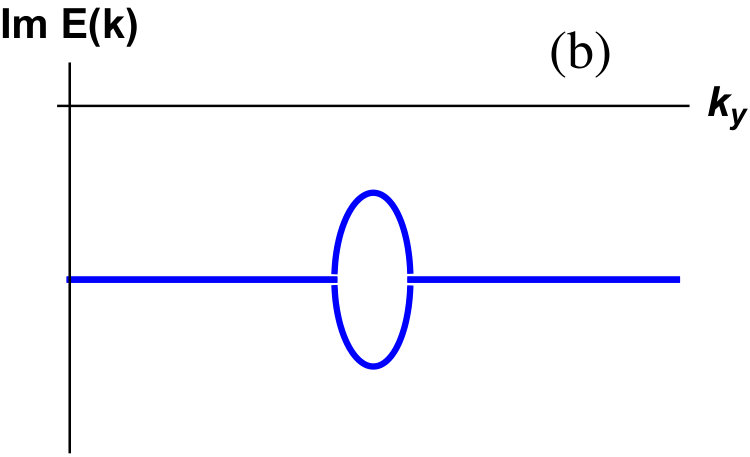 Figure 3
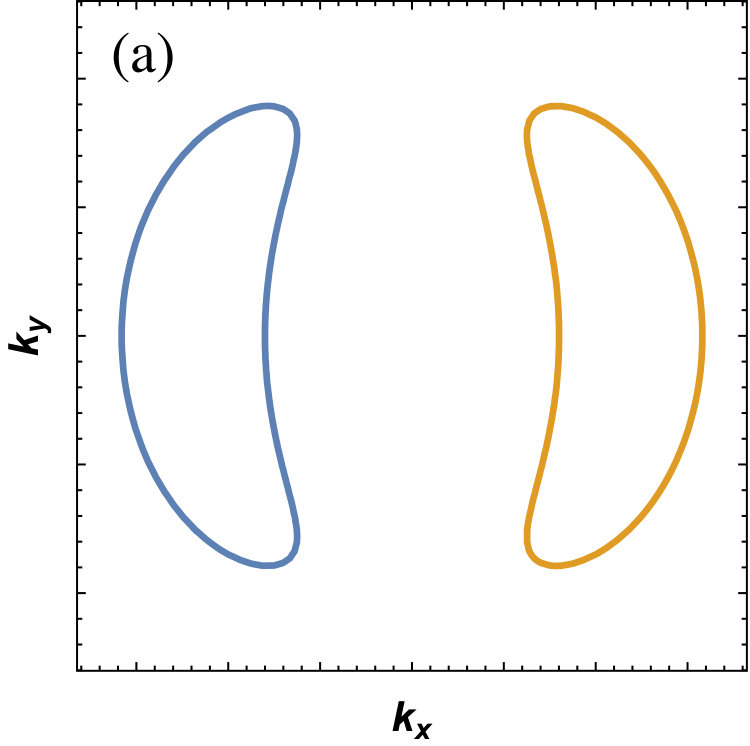 Figure 11
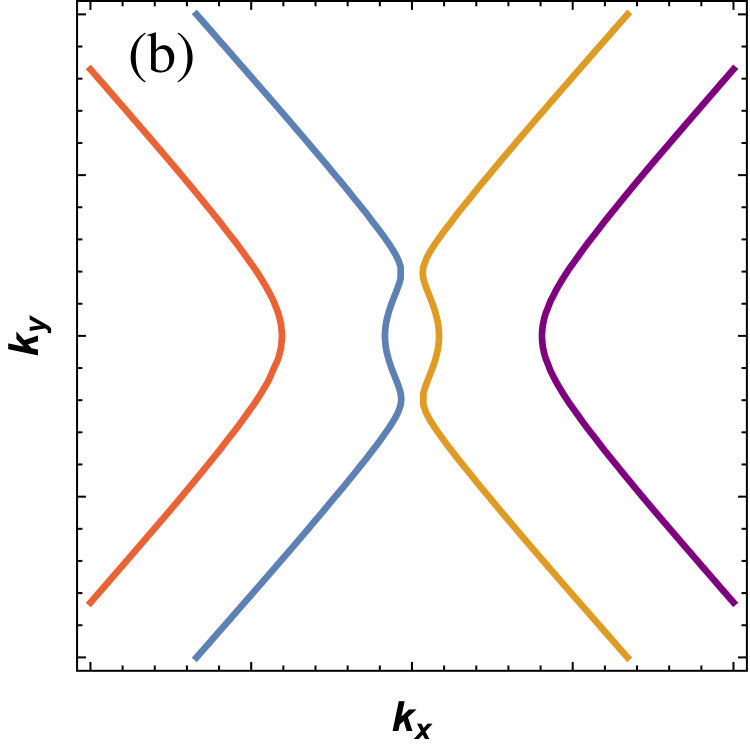 Figure 12
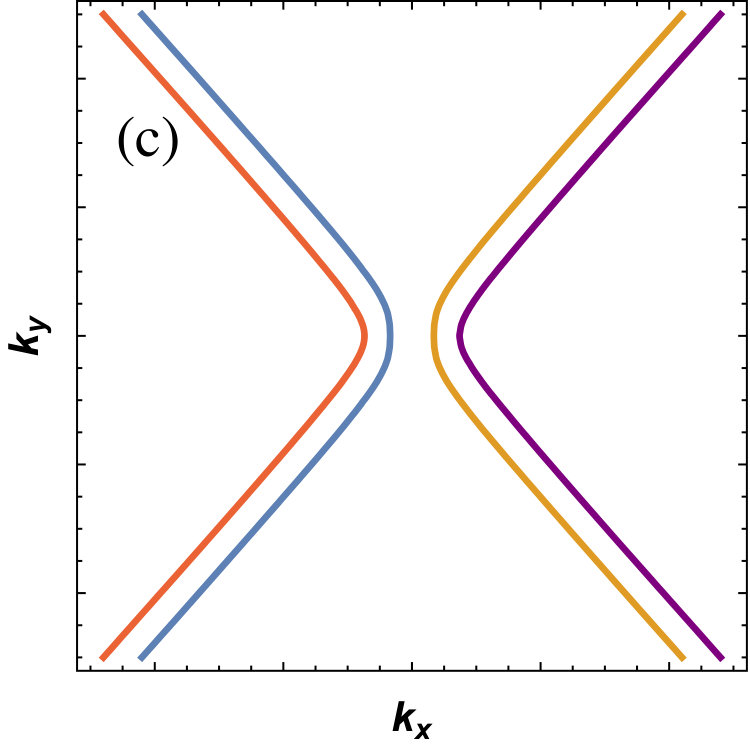 Figure 13
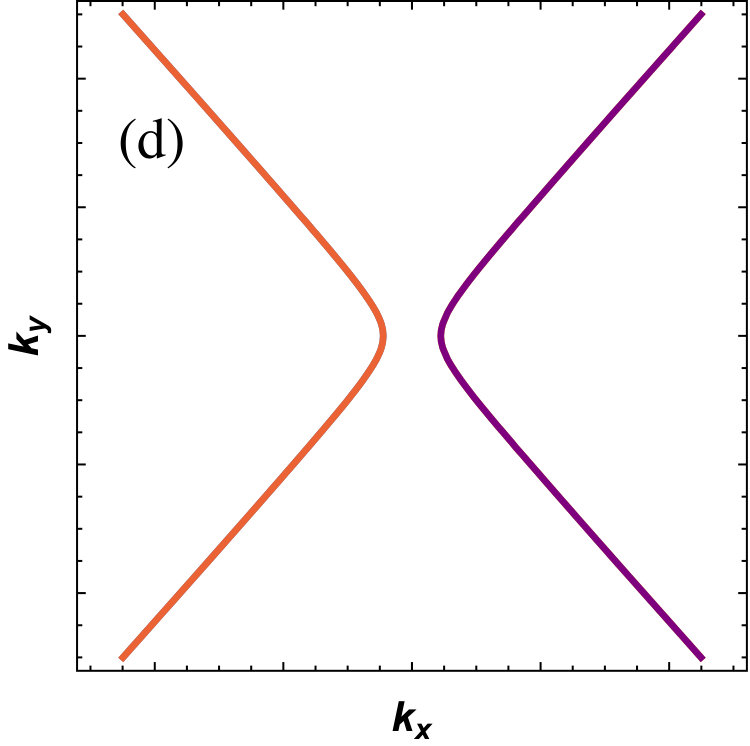 Figure 14
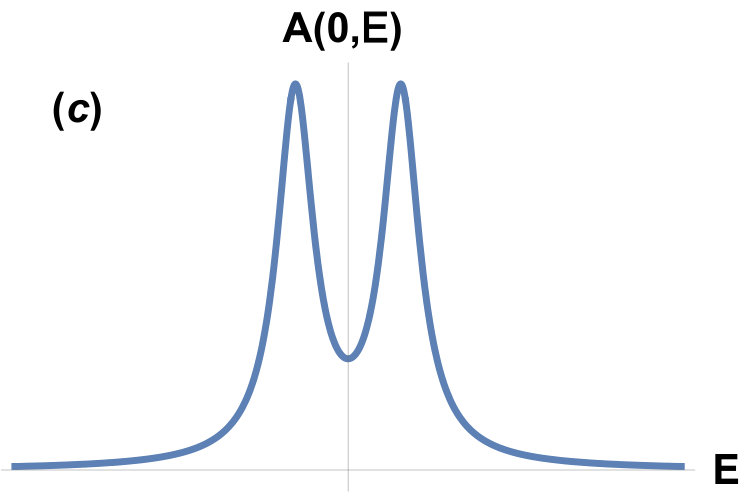 Figure 15
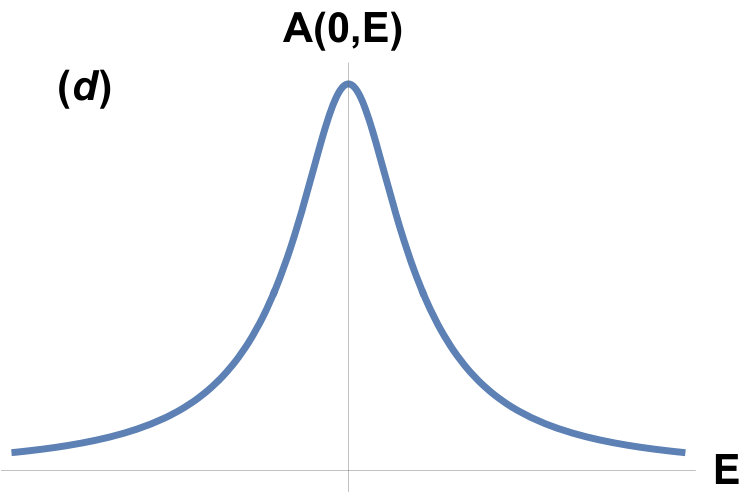 Figure 16
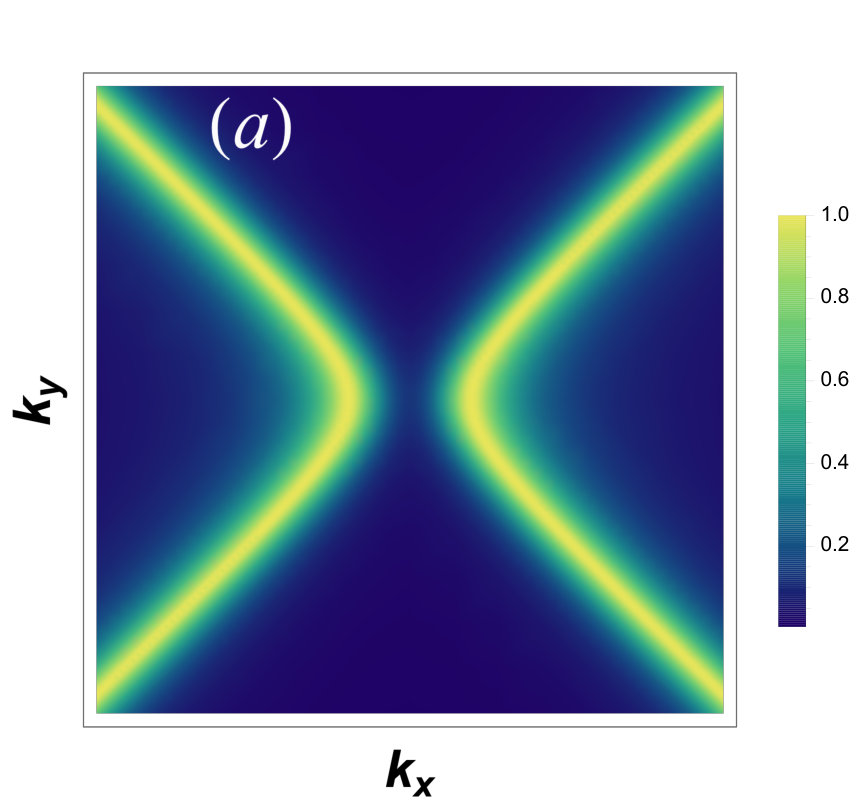 Figure 17
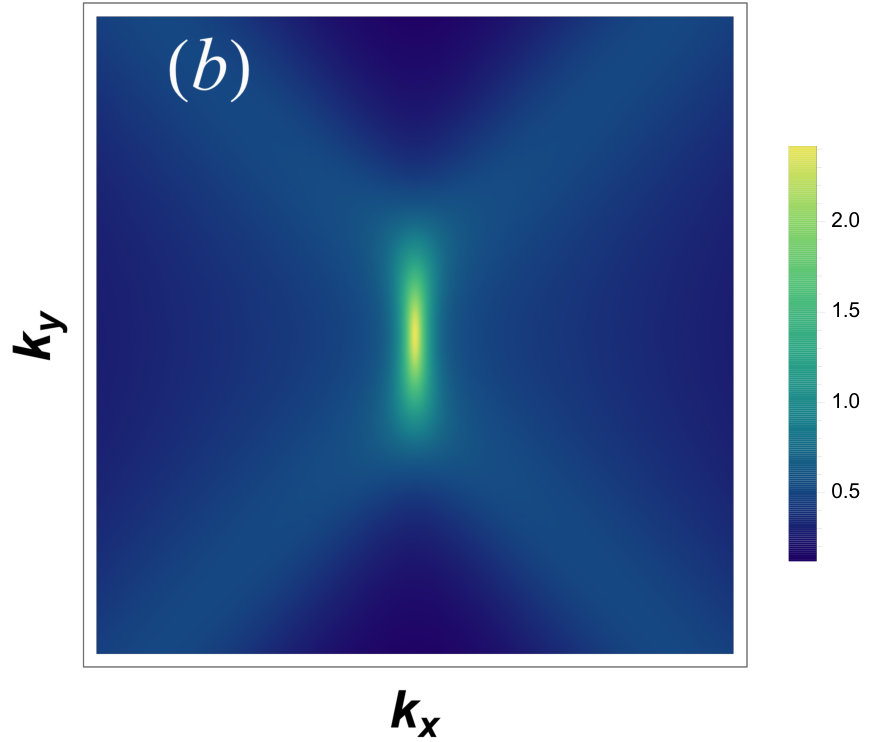 Figure 18
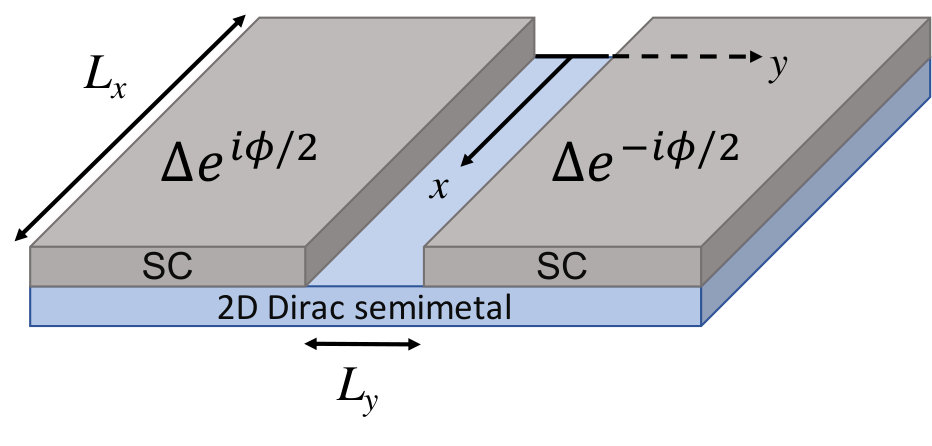 Figure 19
Peer Reviews
No public reviews on file for this paper yet. If you reviewed it on a platform where reviews are public (OpenReview, ICLR, NeurIPS, ICML), you can paste yours below so the community can read it here.
Videos
No videos yet. Explain this paper in a talk, walkthrough, or lecture? Add one.
Disorder-induced exceptional points and nodal lines in Dirac superconductors
Alexander A. Zyuzin
Department of Applied Physics, Aalto University, P. O. Box 15100, FI-00076 AALTO, Finland
Ioffe Physical–Technical Institute, 194021 St. Petersburg, Russia
Pascal Simon
Laboratoire de Physique des Solides, CNRS, Univ. Paris-Sud, University Paris-Saclay, 91405 Orsay Cedex, France
Abstract
We consider the effect of disorder on the spectrum of quasiparticles in the point-node and nodal-line superconductors. Due to the anisotropic dispersion of quasiparticles disorder scattering may render the Hamiltonian describing these excitations non-Hermitian. Depending on the dimensionality of the system, we show that the nodes in the spectrum are replaced by Fermi arcs or Fermi areas bounded by exceptional points or exceptional lines, respectively. These features are illustrated by first considering a model of a proximity-induced superconductor in an anisotropic two-dimensional (2D) Dirac semimetal, where a Fermi arc in the gap bounded by exceptional points can be realized. We next show that the interplay between disorder and supercurrents can give rise to a 2D Fermi surface bounded by exceptional lines in three-dimensional (3D) nodal superconductors.
I Introduction
The physics of non-Hermitian systems and of exceptional points typically arises in open quantum systems with energy gain and loss. Their complex spectra can present exceptional points Kato (1966) which occur when the line-widths of two neighboring resonance frequencies coalesce under some fine-tuning of the system parameters Bender and Boettcher (1998); Berry (2004); Heiss (2004). Such physics has been realized experimentally in various open quantum systems where gain and loss can be introduced in a controllable manner, for example in circuits of resonators Stehmann et al. (2004); Luo et al. , in photonic systems Longhi (2010); Regensburger et al. (2012); Malzard et al. (2015); Leykam et al. (2017a); Lin et al. (2011); Feng et al. (2012); Peng et al. (2014), or in cold atomic gas Xu et al. (2017). Signatures of exceptional points and loops were recently observed in optical waveguides Zhen et al. (2015); Zhou et al. (2018); Cerjan et al. .
In contrast, non-Hermiticity can also naturally emerge in a disordered and/or interacting closed system if we are interested in single-particle excitations. In the presence of disorder, a single-particle excitation of a given momentum acquires a finite life time. One can thus associate a non-Hermitian Hamiltonian in order to describe these single-particle excitations Mudry et al. (1998); Kozii and Fu ; Zyuzin and Zyuzin (2018); Papaj et al. ; Yoshida et al. (2018); Moors et al. (2019).
Because topology has completely reshaped our understanding of electronic band structure in solids, there has been in the past years a growing interest in analyzing the topological properties of non-Hermitian Hamiltonians Esaki et al. (2011); Liang and Huang (2013); Lee (2016); Leykam et al. (2017b); Xu et al. (2017); Kozii and Fu ; Shen et al. (2018); Papaj et al. ; Gong et al. (2018); Yao and Wang (2018); Herviou et al. ; Zhou and Lee ; Yoshida et al. (2019). The topologically-nontrivial electronic bands are often characterized by the presence of Dirac touching points or line nodes. A natural question is how these band structures are modified for non-Hermitian Hamiltonians. In the simplest non-Hermitian extension of a 2D Dirac semimetal, the quasiparticle conduction and valence bands are connected by a bulk Fermi arc that ends at two topological exceptional points instead of a touching Dirac point Kozii and Fu . At these singularities, the non-Hermitian Hamiltonian becomes defective.
This extends to a 3D point node semimetal where the two bands, by adding a non-Hermitian term to the Hamiltonian, can stick on a surface bounded by a one-dimensional (1D) loop of exceptional points Xu et al. (2017); Zyuzin and Zyuzin (2018); Cerjan et al. (2018). In 3D nodal-line semimetals, the nodal lines can be split into two exceptional lines, connected by a Fermi ribbon Zyuzin and Zyuzin (2018); Carlström and Bergholtz (2018); Yang and Hu (2019); Wang et al. (2019); Moors et al. (2019); Okugawa and Yokoyama (2019); Budich et al. (2019); Zhou et al. (2019). In these cases, the real part of the spectrum with momenta lying within the 1D arc (the 2D area) bounded by the exceptional points (or loops) is zero. More generally, it has been shown that -dimensional non-Hermitian systems can support up to -dimensional exceptional surfaces thanks to parity-time or parity-particle-hole symmetries Budich et al. (2019); Okugawa and Yokoyama (2019).
Recently, the interplay of topology and non-Hermiticity was extended on one-dimensional superconductors with a particular emphasis on the difference between Andreev and Majorana bound sates Pikulin and Nazarov (2012, 2013); San-Jose et al. (2016); Kawabata et al. (2018); Avila et al. . Here, we focus on the band dispersion of the quasiparticles excitations in 2D and 3D nodal superconductors in the presence of weak disorder. As for the semimetallic case, we find that the complex self-energy correction to the Green function of quasiparticles due to disorder gives rise to non-Hermitian Bogoliubov-de Gennes (BdG) Hamiltonians describing quasiparticle bands with exceptional points and lines.
To be more specific, we first consider the proximity induced superconductivity in a 2D Dirac semimetal with a tilted Dirac cone. We find a phase transition as a function of the Dirac cone anisotropy, between the gapped state and the state where the superconducting gap closes in momentum space at the Fermi arc bounded by two exceptional points. We then analyze the effect of weak disorder on 3D nodal-ring and point-node superconductors in the presence of the supercurrent flow. We find that the nodal structure in the spectrum of quasiparticles extends into the flat-band regions bounded by the exceptional lines.
Our paper is structured as follows. Section II contains a short reminder of disorder averaging within the Born approximation. In Sec. III, we consider the effects of disorder on 2D Dirac semimetals in proximity of a superconductor. In Sec IV, we deal with the effects of disorder scattering in 3D nodal superconductors. Finally, in Sec. V we summarize and discuss our results.
II Disorder scattering
Let us first recall the effect of the electron elastic scattering on the random scalar potential disorder on the spectrum of nodal superconductors. One of the prominent effects of the disorder on the unusual superconductivity is to smear the nodes in the superconducting gap in momentum space, which can be described by the imaginary part of the self-energy correction to the disorder averaged Green function, Refs. Gor’kov and Kalugin (1985); Mineev and Samokhin (1999). We consider the short-range impurity scattering potential of the form , where the sum is over the all impurities coordinates . The energy and the decay-time of the quasiparticles are defined by the real and imaginary parts of the poles of the disorder-averaged Green function in the superconducting state, respectively.
To find these poles, we will be utilizing the self-consistent equation for the quasiparticle’s retarded self-energy (a matrix written in Nambu representation to include spin and particle-hole degrees of freedom), which within Born approximation is given by
[TABLE]
where defines the strength of the scattering potential, in which is the impurity concentration, is the BCS Hamiltonian of the system in the Nambu representation (the explicit expressions for the Hamiltonian of 2D Dirac semimetals in proximity of a superconductor and of 3D nodal superconductors will be specified further in the text), are the Pauli matrices in the Nambu space, and is the dimensionality of the sample.
In this case of the impurity potential the self-energy is momentum independent. A different potential shape would only render the integration over momentum in Eq. 1 more complicated, but not change the following results of the paper qualitatively. We also neglect the interference of waves scattered on different impurities.
The poles of the disorder averaged Green function can be found from the equation
[TABLE]
Generally, the self-energy might render to be a non-Hermitian matrix with complex eigenvalues and eventually exceptional points in the frequency-momentum space. This implies that the solutions of Eq. (2), which correspond to quasiparticle excitations of momentum , acquire now a finite energy width. In the disordered case, the nodal touching points in the spectrum of quasiparticles may transform into exceptional points, at which the non-Hermitian matrix is defective and hence the spectrum has a singularity. Let us now discuss the conditions needed for the realization of exceptional points in the spectrum of nodal superconductors for several representative cases.
III Interplay between disorder and proximity-induced superconductivity in a 2D Dirac semimetal
We start with a model of a s-wave superconductor placed in contact with a 2D Dirac semimetal with linear dispersion around the band-touching points Fu and Kane (2008); Beenakker (2008). The proximity effect can lead to a gap in the density of states. The linearized Hamiltonian around the single Dirac point (we will neglect disorder scattering between the Dirac valleys) in the presence of the proximity induced superconducting gap is given by
[TABLE]
where are the Pauli matrices acting in the spin space, is the chemical potential, is a dimensionless parameter related to the inclination of the Dirac cone ( means no tilt), is the Fermi velocity in absence of tilt, and is the proximity induced superconducting gap which is considered to be a positive real constant here. We set throughout our calculations.
The spectrum of quasiparticles is given by
[TABLE]
where . The solution of as a function of model parameters is shown in Fig. 1. At , the spectrum is gapped provided and hosts nodal lines in the opposite case, Goerbig et al. (2008). The nodal lines are determined by the equation
[TABLE]
It is worth noting that the linearized Hamiltonian, for which the nodal lines are hyperbolas, is applicable only for momenta below some tilt dependent cutoff determining the width of the electron and hole pockets. When the chemical potential is placed in the conduction band (here, it is enough to consider ), the transition between the gapped and nodal lines state takes place at much smaller values of the tilt parameter ; see Fig. 1(a). We will focus below on the case of low doping , shown in Fig. 1(d), where the exceptional nodal lines can be realized.
III.1 Normal case
Before dealing with the superconducting case, let us first recall results about the normal case Kozii and Fu ; Papaj et al. ; Zhao et al. (2018). At , the Dirac point is smeared due to weak scalar disorder Shon and Ando (1998). To proceed, we consider two limiting cases of weak and strong inclinations of the Dirac cone. We search for the self-energy correction to the disorder averaged Green function of the quasiparticles in the presence of the proximity induced superconducting gap by substituting the expression for the Hamiltonian Eq. (3) into the Eq. (1).
We recover, as it was shown in Refs. Papaj et al. ; Zhao et al. (2018), that in the presence of a finite but small tilt such that , the self-energy in the normal case at zero frequency acquires a nontrivial matrix structure (note that the self-energy in particle-hole space is described by a matrix), where
[TABLE]
Here, is the energy cut-off corresponding to the separation between the Dirac point and the closest bulk band (see Appendix A.1 for more details). The quasiparticles spectrum is found by solving Eq. (2) which now becomes complex valued, . Hence, the dispersion of quasiparticles contains a line segment at bounded by two exceptional points. Such a segment in the quasiparticles spectrum is characterized by a vanishing real part, the so-called bulk Fermi arc Kozii and Fu . This means that the decay rate of a quasiparticle has a strong spatial anisotropy.
In the limit of strong tilt , introducing a cutoff for the width of the electron-hole pockets in momentum space, we obtain in the limit ,
[TABLE]
where the scattering rate, in which the density of states is determined by . Importantly, the self-energy contains a frequency independent imaginary contribution, which also results in an unusual bulk Fermi arc in the spectrum of quasiparticles Kozii and Fu .
It is worth noting that the linearized model introduced in Eq. (3) can not be applied in the limit due to unavoidable higher-order corrections in momentum, which are not taken into account here.
III.2 Superconducting case
We now consider the superconducting case where the superconducting gap is induced by proximity and analyze how the spectrum of 2D quasiparticles might be affected by disorder scattering.
Weak tilt. – In the superconducting case the spectrum is gapped at . At a weak tilt , in the limit where the first-order Born approximation should apply, we obtain (details are presented in Appendix A.2)
[TABLE]
We can notice in this expression that the increase of disorder decreases the proximity induced superconducting gap and increases the anisotropy of the dispersion.
In the strong disorder limit, , we can self-consistently obtain the Fermi arc in the spectrum bounded by the exceptional points due to the imaginary part of the self-energy
[TABLE]
which renders the disorder averaged Green function of quasiparticles non-Hermitian (the derivation of this result is detailed in Appendix A.2). This means, in particular, that disorder drives the system through a Lifshitz transition between a gapped state and a state where the superconducting gap closes at the bulk Fermi arc.
Strong tilt. – Such a phase transition can also take place in the strong tilt case, as we show below. Indeed, in the limit and considering that and , one recovers Eq. (7),
[TABLE]
The self-energy contains a frequency independent imaginary contribution that results in an unusual complex quasiparticles spectrum:
[TABLE]
We find that at the spectrum of the quasiparticles is gapped [see Fig. 2(a)], while in the opposite limit the spectrum acquires a bulk Fermi arc bounded by two exceptional points at as represented in Fig. 2. This constitutes an example of a disorder-induced topological transition in the quasiparticles spectrum in a superconducting Dirac Hamiltonian. The real and imaginary parts of the spectrum have square root singularity at the exceptional points. This result is analogous to the spectral properties at the Fermi arc in 2D Dirac semimetals Kozii and Fu .
Surface Andreev modes. – It is also instructive to examine Andreev modes localized at the line interface between two regions of 2D Dirac semimetal, which are proximitized to two uniform superconductors with phase difference , as schematically shown in Fig. 3. Let us focus on the limit of strong tilt where the phase transition between the gapped and the Fermi arc states can be obtained from Eq. (10). Following Refs. Fu and Kane (2008), we adopt a step function model, assuming the width of the Josephson junction to be much smaller than ; namely we set .
Consider the interface along the line , at which the proximity induced superconducting gap is given by for and for , where gap is the same in both proximitized regions. Note that two bulk superconductors are coupled through the 2D Dirac semimetal and there is no direct coupling between them. At there are two chiral modes, which propagate with the momentum along in the same direction, with the wave-function localized at the interface Fu and Kane (2008). The spectrum of these bound modes is similar to the spectrum of bulk modes given by Eq. (10), namely
[TABLE]
In the special case, at , the two chiral modes are gapless and propagate in the same direction with dispersions . The edge states have a momentum independent imaginary part. Due to the strong tilt, the edge states coexist with the pockets of bulk states, but can however be separated in energy at . The evolution of the spectrum as a function of the tilt is shown in Fig. 3. We note that there are no localized modes at the interface between two superconductors for . This result is consistent with Refs. Tchoumakov et al. (2017); Zyuzin and Zyuzin (2018).
Experimental signatures. – Besides the specific dependence of the Andreev modes predicted for the 2D Josephson junction depicted in Fig. 3, let us address the question of how the proposed phase transition at which exceptional points emerge can be directly probed experimentally. Angle-resolved photoemission spectroscopy seems the most natural technique to probe the spectral function at the surface of a compound. In a system with a given disorder realization, for a light beam of a width typically larger than characteristic length scale of the material (here the mean free path), the measured spectral function will be disorder averaged because different parts of the surface are probed. Therefore, the spectral function probed experimentally, is defined as the disorder averaged retarded Green function of quasiparticles. We plot the spectral function at zero frequency in Figs. 4(a) and 4(b), where one directly observes the transition to a state hosting bulk Fermi arc as the proximity induced gap is varied. It is also instructive to comment on the frequency dependence of in the limit of zero wave-vector which is related to the average density of states which can be probed by scanning tunneling microscopy (STM). As shown in Figs. 4(c) and 4(d) the spectral function has a single peak in the case of the state with the bulk Fermi arc. At strong proximity effect, , the height of two peaks located at is given by . In the limit of weak proximity effect, , the height of the peak at zero frequency is instead given by .
IV 3D nodal superconductors under weak disorder
Let us now consider several representative realizations of 3D topological superconductors with nodal lines or nodal points in their quasiparticles spectrum. Notice that our discussion equally applies to the superfluid 3He Volovik (2003); Silaev and Volovik (2014).
IV.1 Nodal-line superconductors
The BCS Hamiltonian of a characteristic nodal line superconductor (our results can be mapped to a polar phase of superfluid 3He) in the presence of the supercurrent flow with velocity is given by Volovik (2003)
[TABLE]
where is the unit vector in the direction of momentum, is the Fermi momentum, is the effective mass, and is the gap in the spectrum (the gap is suppressed with the increase of supercurrent). The spectrum of quasiparticles at has a nodal ring defined by the equation in the plane . We first consider a case of the supercurrent flowing along the -axis. In this situation the Fermi surface appears above the Lifshitz transition occurring at .
The self-energy due to scattering on the scalar disorder can be found self-consistently. Consider first the situation where the tilt is along the -axis, namely we set for concreteness . The retarded self-energy taken at zero frequency within the first order in powers of is given by
[TABLE]
where and is the scattering rate (details of this result are shown in Appendix B). The first term in Eq. (13) is well known Gor’kov and Kalugin (1985); Mineev and Samokhin (1999) and implies that an infinitesimally weak scattering smears the nodal ring in three dimensions.
We show that this smearing becomes anisotropic due to the tilt, which gives rise to the off-diagonal terms in the self-energy matrix in Eq. (13), with the sign being defined by , i.e., by the direction of the supercurrent. Indeed, taking into account the self-energy in Eq. (13), we can write the spectrum of quasiparticles in the plane in the following form:
[TABLE]
The nodal ring in the disordered superconductor extends into a ring of finite width (called a Fermi ribbon) with the inner and outer radiuses defined by where the matrix of the disorder averaged Green function is defective. This result is analogous to the theoretically predicted exceptional rings in the nodal-line semimetals Zyuzin and Zyuzin (2018); Carlström and Bergholtz (2018); Yang and Hu (2019); Wang et al. (2019); Moors et al. (2019); Okugawa and Yokoyama (2019); Budich et al. (2019). The spectral properties of the Fermi ribbon is similar to that of the Fermi arc discussed in the previous section. The dispersion is shown in Fig. 5. The nodal-loop superconductor has so-called ”drum-head” states localized at any surfaces not laying parallel to the -axis, Burkov et al. (2011). Due to the smearing of the nodal-line the spectral region of these edge states vanishes.
Let us also contrast these results with the situation in which the supercurrent is applied within the plane. The supercurrent tilts the nodal ring and gives rise to Fermi surface pockets connected by two pseudo-Weyl points, which are located at , Volovik (2018). Here the density of states is finite even at infinitesimally small and is given by , in which is the density of states at the Fermi level for one spin projection in the normal state of the system. At , the self-energy at zero frequency is linear in , while in the limit it reaches the value . We did not find any exceptional points in this case because .
IV.2 Point-node superconductors
Let us finally comment on the effect of the interplay between the supercurrent and disorder scattering in a 3D Weyl superconductor with nodal points in their quasiparticles spectrum. The BCS Hamiltonian describing a Weyl superconductor (or equivalently the A-phase of 3He) is given by
[TABLE]
At , the spectrum of quasiparticles has two Weyl nodes at . The surface of the superconductor might host Andreev-Majorana localized chiral modes. The dispersion of surface modes has the form of the Fermi arc, which connects the projections of the bulk Weyl points to the surface; for a review see Ref. Silaev and Volovik (2014).
Consider qualitatively the situation where the supercurrent flows parallel to the -axis, . At , similarly to 3D Dirac-Weyl semimetals, weak disorder satisfying does not lead to a finite imaginary part of the self energy at zero frequency and hence does not form any exceptional lines.
V Discussion and Conclusions
In this paper we have studied the effect of weak scalar disorder on the band structure of nodal superconductors. We have argued that the nodes in the anisotropic superconducting gap in the presence of weak disorder may be replaced by Fermi arcs or 2D Fermi areas bounded by exceptional points or exceptional lines, respectively. At these exceptional points or lines the quasiparticles Green function becomes defective. Here we have analyzed the smearing of the nodes in the superconducting gap in the presence of scalar disorder within the self-consistent Born approximation. Going beyond this approximation and taking into account a more general form for the disorder Aleiner and Efetov (2006) shall be addressed in the future.
We believe that the proposed non-Hermitian superconducting phase might be probed in several materials, such as the quasi-2D organic conductor salt Katayama et al. (2006); Goerbig et al. (2008) and (001) surface states of the crystalline insulator Tanaka, Y. and Ren, Zhi and Sato, T. and Nakayama, K. and Souma, S. and Takahashi, T. and Segawa, K. and Ando, Y. (2012), which host 2D massless Dirac fermions with anisotropic dispersion. The proximity induced superconducting gap in these structures might be established experimentally. Nodal phases with the zeros in the energy spectrum are known to exist in superfluid 3He-A (for a review see Silaev and Volovik (2014)). Signatures of nontrivial topological nodal superconductivity were observed in CuxBi2Se3, in non-centrosymmetric heavy fermion systems, and in cuprate-based superconductors Sato and Ando (2017).
Finally, it would be interesting to extend our work on the interplay between proximity induced superconductivity and disorder in systems with triple Dirac points Bradlyn et al. (2016). Therein, higher-order non-Hermitian degeneracies with cubic-root singularities at the nontrivial exceptional curves are expected Lin et al. (2016).
Acknowledgements We thank G. Volovik for important comments. A.A.Z. acknowledges the hospitality of the Université Paris-Sud and Pirinem School of Theoretical Physics as well as the support by the Academy of Finland.
Appendix A Calculation of the self-energy in two dimensions.
A.1 Normal case
Let us calculate the disorder induced self-energy correction for the case of a two-dimensional semimetal. The Hamiltonian describing such a system reads
[TABLE]
The self-consistent equation for the retarded self-energy within the first Born approximation is given by
[TABLE]
We search for the solution of this equation in the form
[TABLE]
where , , and are complex functions of the energy such that and are real and satisfy because we are dealing with a retarded self-energy. Since the tilt is along the direction, the contribution in the self-energy vanishes to guarantee its momentum independence. This point can also be checked explicitly. Hence
[TABLE]
From hereon we consider to make progress with the algebra. The poles in 19 can be found from the equation
[TABLE]
When , we note that provided
[TABLE]
the integration over momentum yields
[TABLE]
where is the energy cut-off and . It can be now seen that the term is small and will be neglected in what follows.
The integration over in Eq. (37) after some simplifications results in two equations for and :
[TABLE]
Noting that , we obtain for
[TABLE]
which gives , where
[TABLE]
This is the expression given in Eq. (6) of the main text.
When it is enough to consider the self-energy within the first Born approximation similarly as it was shown for the nodal-line semimetal in Zyuzin and Zyuzin (2018). Integrating first over ,
[TABLE]
where is the momentum cutoff on the -axis describing the width of the electron and hole pockets, which might depend on the tilt parameter . This is the expression given in Eq. (7) of the main text.
A.2 Superconducting case
The BdG Hamiltonian describing the low-energy states in the system in the presence of the proximity-induced superconducting gap reads
[TABLE]
where can be considered to be real and positive without loss of generality. In order to obtain an analytical solution for , we again proceed by considering two limiting cases of weak and strong tilts, and .
When and , we can use the first-order Born approximation. For convenience we transform to Matsubara frequencies . The self-energy then reads
[TABLE]
where
[TABLE]
Provided (in the opposite case the integral is zero) after the integration over one obtains
[TABLE]
where is the energy cutoff. The integration over gives
[TABLE]
Notice that there is no contribution proportional to . After the transformation and , one obtains the expression in Eq. (8) of the main text.
When and , following the same reasoning as in Appendix A.1, we now search for the self-energy in the form
[TABLE]
where . The integrand in the self-consistent equation for the self-energy now reads
[TABLE]
and can be linearized in powers of . Performing the same derivations as were done in Appendix A.1, we obtain an additional equation in addition to Eq. (A.1) in order to determine at :
[TABLE]
Together with Eq. (A.1), this gives
[TABLE]
Therefore, and
[TABLE]
In the limit of a strong tilt, when , we have a finite density of states at the Dirac point and we can use the first-order Born approximation to calculate the self-energy,
[TABLE]
where the integral over is taken in the region to qualitatively account for the width of the electron-hole pockets at . It is instructive to rewrite Eq. (36) as
[TABLE]
where
[TABLE]
in which and , and note that
[TABLE]
We can integrate in Eq. (37) over separately in two regions, and , taking into account that does not depend on . For the integration over gives:
[TABLE]
This term is purely imaginary since we neglect small corrections . At we obtain
[TABLE]
We arrive at the expression for the self-energy,
[TABLE]
Finally, we note that and write
[TABLE]
which is given in Eq. (III.2) of the main text.
Appendix B Calculation of the self-energy in three dimensions.
Let us consider a nodal-line superconductor in the presence of a supercurrent flow with velocity parallel to the -axis. The BdG Hamiltonian is given by
[TABLE]
where and is the unit vector in the direction of . We focus on the limit . The nodal-ring is defined by . The equation for the self-energy is given by
[TABLE]
We neglect the contributions to with matrix, assuming . Integration over ,
[TABLE]
where is the density of states in the normal-metal state, we obtain
[TABLE]
where is the mean free time. Using the condition , we obtain two equations for and :
[TABLE]
which together give
[TABLE]
Hence one recovers the expression in Eq. (13) of the main text
[TABLE]
The reference list from the paper itself. Each links out to its DOI / PubMed record.
- 1Kato (1966) T. Kato, Perturbation Theory of Linear Operators (Springer, New York, 1966).
- 2Bender and Boettcher (1998) C. M. Bender and S. Boettcher, “Real Spectra in Non-Hermitian Hamiltonians Having 𝒫 𝒯 𝒫 𝒯 \mathcal{P}\mathcal{T} Symmetry,” Phys. Rev. Lett. 80 , 5243–5246 (1998) . · doi ↗
- 3Berry (2004) M. Berry, “Physics of Nonhermitian Degeneracies,” Czech. J. Phys. 54 , 1039 (2004) . · doi ↗
- 4Heiss (2004) W. D. Heiss, “Exceptional points of non-Hermitian operators,” J. Phys. A: Math. Gen. 37 , 2455 (2004) .
- 5Stehmann et al. (2004) T. Stehmann, W. D. Heiss, and F. G. Scholtz, “Observation of exceptional points in electronic circuits,” J. Phys. A: Math. Gen. 37 , 7813 (2004) . · doi ↗
- 6(6) K. Luo, J. Feng, Y. X. Zhao, and R. Yu, “Nodal Manifolds Bounded by Exceptional Points on Non-Hermitian Honeycomb Lattices and Electrical-Circuit Realizations,” Ar Xiv:1810.09231.
- 7Longhi (2010) S. Longhi, “Optical Realization of Relativistic Non-Hermitian Quantum Mechanics,” Phys. Rev. Lett. 105 , 013903 (2010) . · doi ↗
- 8Regensburger et al. (2012) A. Regensburger, C. Bersch, M-A. Miri, G. Onishchukov, D. N. Christodoulides, and U. Peschel, “Parity - time synthetic photonic lattices,” Nature (London) 488 , 167 (2012) . · doi ↗