Order, Chaos and (Quasi-) Dynamical Symmetries across 1st-order Quantum Phase Transitions in Nuclei
Michal Macek, Pavel Cejnar, Pavel Str\'ansk\'y, Jan Dobe\v{s} and, Amiram Leviatan

TL;DR
This paper investigates the coexistence of regular and chaotic dynamics across first-order quantum phase transitions in nuclei, revealing distinct behaviors in spherical and deformed phases using the IBM Hamiltonian.
Contribution
It demonstrates the contrasting regularity and chaos in nuclear phases and identifies quasi-SU(3) rotational bands in the deformed phase at high energies.
Findings
Deformed phase exhibits complete regularity.
Spherical phase shows highly chaotic dynamics.
Quasi-SU(3) rotational bands are observed at high excitation energies.
Abstract
First order quantum phase transition (QPT) between spherical and axially deformed nuclei shows coexisting, but well-separated regions of regular and chaotic dynamics. We employ a Hamiltonian of the Arima-Iachello Interacting Boson Model (IBM) with an arbitrarily high potential barrier separating the phases. Classical and quantum analyses reveal markedly distinct behavior of the two phases: Deformed phase is completely regular, while the spherical phase shows highly chaotic dynamics, similar to the H\'enon-Heiles system. Rotational bands with quasi-SU(3) characteristics built upon the regular vibrational spectrum of beta- and gamma-vibrations are observed in the deformed phase up to very high excitation energies.
Click any figure to enlarge with its caption.
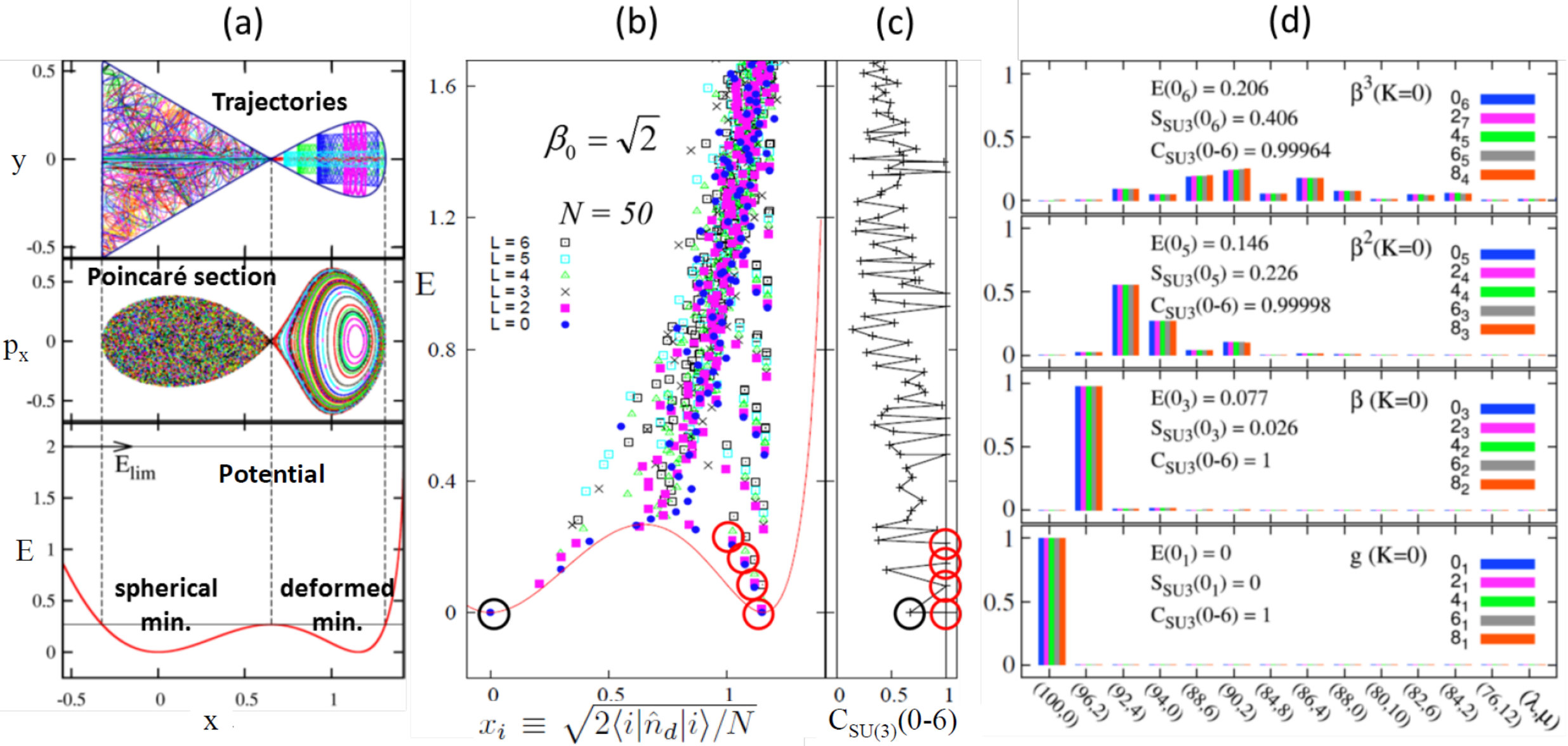 Figure 1
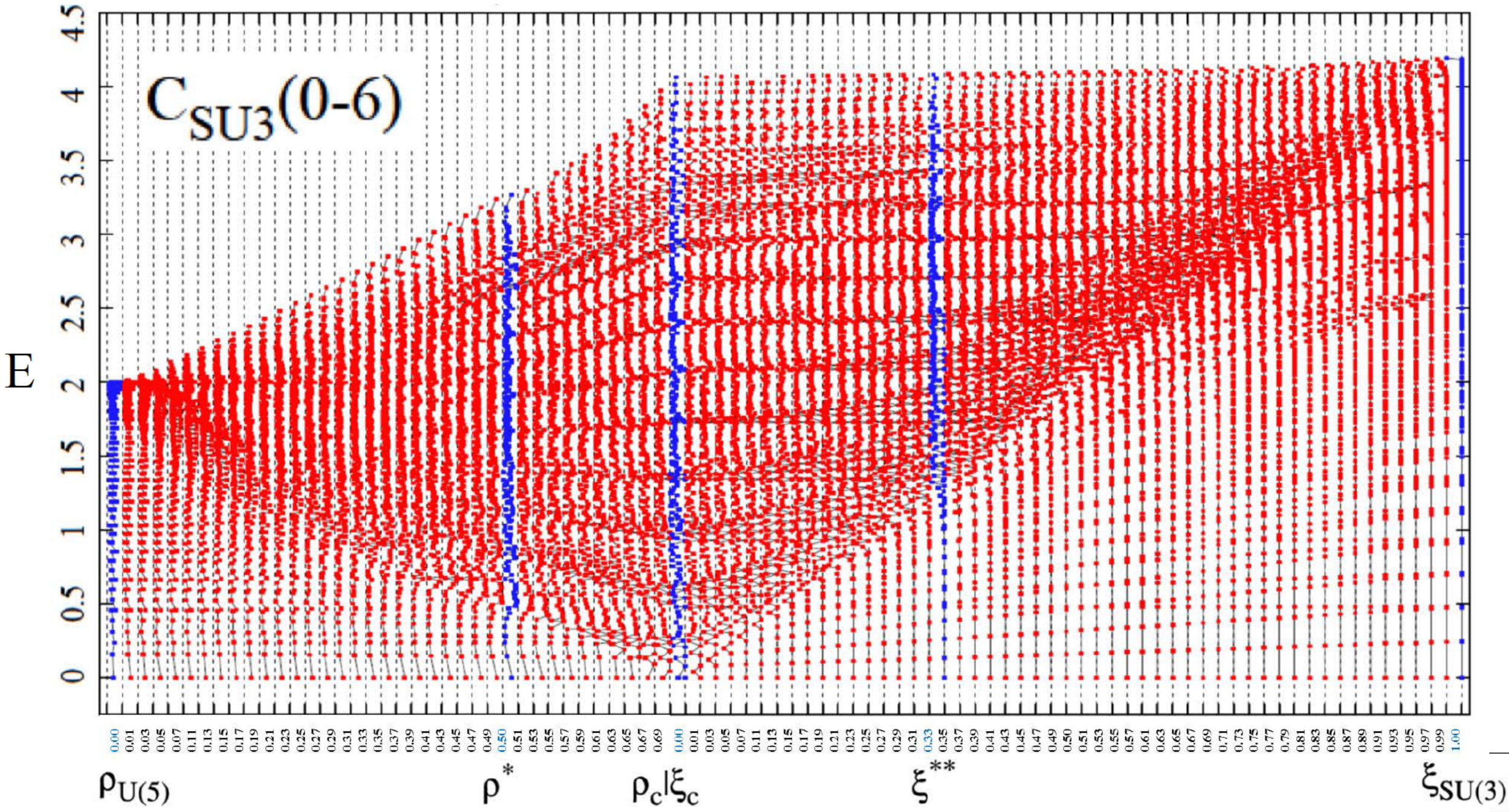 Figure 1
Peer Reviews
No public reviews on file for this paper yet. If you reviewed it on a platform where reviews are public (OpenReview, ICLR, NeurIPS, ICML), you can paste yours below so the community can read it here.
Videos
No videos yet. Explain this paper in a talk, walkthrough, or lecture? Add one.
aff1]The Czech Academy of Sciences, Institute of Scientific Instruments, Brno, Czech Republic aff2]Institute of Particle and Nuclear Physics, Charles University, Prague, Czech Republic aff3]The Czech Academy of Sciences, Nuclear Physics Institute, Řež, Czech Republic aff4]Racah Institute of Physics, The Hebrew University, Jerusalem 91904, Israel \corresp[cor1]Corresponding author: [email protected]
Order, Chaos and (Quasi-) Dynamical Symmetries across 1st-order Quantum Phase Transitions in Nuclei
M. Macek
P. Cejnar
P. Stránský
J. Dobeš
A. Leviatan
[
[
[
[
Abstract
First order quantum phase transition (QPT) between spherical and axially deformed nuclei shows coexisting, but well-separated regions of regular and chaotic dynamics. We employ a Hamiltonian of the Arima-Iachello Interacting Boson Model (IBM) with an arbitrarily high potential barrier separating the phases. Classical and quantum analyses reveal markedly distinct behavior of the two phases: Deformed phase is completely regular, while the spherical phase shows highly chaotic dynamics, similar to the Hénon-Heiles system. Rotational bands with quasi-SU(3) characteristics built upon the regular vibrational spectrum of beta- and gamma-vibrations are observed in the deformed phase up to very high excitation energies.
Professor Iachello (whom we all know as Franco) has much enjoyed and has been virtuous in identifying aesthetic patterns, symmetries, in complicated phenomena of Nature. We know him as striving for elegant and unified understanding by formulating as simple models as possible (but not simpler). Perhaps curiously, Franco’s models provide chances to study also the “exact opposite”: mechanisms of symmetry breaking, (phase) transitions between different symmetries and even onset of chaos. Again curiously, Franco has been greatly supportive of people pursuing to study this fascinating “exact opposite” and has been one of the pioneers in it himself.
The Interacting Boson Model (IBM) [1] combines three basic dynamical symmetries (DS) of nuclear collective motion: the U(5) DS of the spherical vibrator, the SU(3) DS of the axially-deformed rotor, and the SO(6) DS of the axially unstable rotor. In a generic case, the model allows mixing all three of these incompatible symmetries, providing possibilities to study highly non-trivial dynamics, yet with some symmetry-related “handles” to understand it (at least partially). In this short contribution, we would like to point out some of the features identified over the years when approaching the “exact opposite” of symmetry. We will show that at the first order quantum phase transition (QPT) between the U(5) and SU(3) dynamical symmetries [2], a coexistence of completely regular and completely disordered dynamics is present in a single system, and even more strikingly in the same energy ranges: coexisting, yet clearly separated. Further, we will show that the regularity is not connected to an exact DS, but a quasi-dynamical symmetry (QDS), involving coherent linear combinations of irreducible representations of a DS [3]. In particular, this happens also throughout the phase coexistence region between the spinodal and anti-spinodal points [4]: The regular dynamics corresponds to the quasi SU(3) symmetry in the deformed phase, while the chaos—in its onset following the Hénon-Heiles scenario [5]—corresponds to the spherical phase [6].
An IBM Hamiltonian best suited to capture 1st order QPT behavior is the following pair:
[TABLE]
where is the -boson number operator, and the monopole and quadrupole pairing operators are and and . The coefficients are control parameters, while the overall scale is set here to . is relevant for the spherical side of the QPT, while for the deformed side. The two Hamiltonians (1) coincide at the critical point . Primary virtue of this apparently complicated formulation is that the last parameter, , allows to directly adjust (i) the height of the phase-separating potential barrier at the critical point of the QPT, and (ii) the position (i.e. amount of deformation) of the deformed potential minimum [6]. Besides, this Hamiltonian possesses a peculiar symmetry property—the partial dynamical symmetry (PDS) [7]: has U(5) DS for and U(5) PDS for any other , while has SU(3) DS for and and SU(3) PDS for and any values of ; details in [6].
Figure 1 snapshots the classical (panel a) and quantum (panels b-d) dynamics generated by , i.e. directly at the critical point of the QPT, for ; the latter allowing for the partial SU(3) DS. The classical dynamics is generated by Hamiltonians obtained as expectation values of (1) in Glauber coherent states [8, 9, 6]. Two degenerate (spherical and deformed) minima of the classical potential at the critical point are seen in panel (a,bottom). The dynamics related to both of them at energy corresponding to top of the phase-separating barrier (a saddle point of ) is shown in the two panels above it: Trajectories evolving around the deformed minimum are regular, forming a set of (deformed) circles in the corresponding Poincaré section, while the trajectories around the spherical minimum are chaotic and fill the Poincaré section ergodically (Apart from periodic orbits, which form a measure zero set in the phase space.). Panel (b) shows an indicator of quantum chaos—a Peres lattice [10] related to the quantity , which allows to associate the individual eigenstates with the classical potential . The lattices for eigenstates with angular momentum form regular patterns above the deformed minimum and (approximately) overlie each other, which reflects the presence of rotational bands with angular momentum projection on the symmetry axis here. Panel (c) reveals correlations between the eigenstates decomposed in the SU(3) DS basis by plotting a coefficient , see [11], as a function of energy of the “bandheads” (cf. panel b): The rotational bands identify by , while states not linked to any rotational structure have (e.g. the spherical ground state at ). Panels (d) shows examples of some band members: in line with the correlation coefficient , their distributions in the SU(3) basis are highly coherent, but apart from the ground band (which displays a SU(3) PDS), they do not fit within a single SU(3) irrep, expressing the SU(3) QDS [3].
In Fig. 2, we extensively display the evolution of SU(3) quasi dynamical symmetry across the 1st order QPT. The correlation coefficient shown in Fig. 1 (c) at the critical point is shown here in 86 points between the U(5) DS () and the SU(3) DS () limits. A major region where SU(3) QDS dominates the spectrum is seen on the deformed side of the QPT at energies roughly below . Interestingly, and consistent with the discussion above, there are extensive regions with SU(3) QDS elsewhere: Notice the multiple “triangular features” with SU(3) QDS values of seen especially in the phase coexistence region (between and ) up to high energies above . The “triangular features” are connected with finite- precursors of excited state quantum phase transition [12]. The fact that SU(3) QDS is so prolific and found even at very high excitation energy (c.f. the Alhassid-Whelan arc of regularity [8, 9]) may suggest that the related adiabatic separation of rotations and vibrations is due to an underlying regular motion of vibrational dynamics [13].
The authors thank Franco Iachello for lasting inspiration, support and friendship.
The reference list from the paper itself. Each links out to its DOI / PubMed record.
- 1[1] F. Iachello and A. Arima, The interacting boson model (Cambridge University Press, Cambridge, 1987).
- 2[2] O. Scholten, F. Iachello and A. Arima, Ann. Phys. (NY) 115 , 325 (1978).
- 3[3] D. J. Rowe, Phys. Rev. Lett. 93 , 122502 (2004).
- 4[4] A. Leviatan and M. Macek Phys. Lett. B 714 , 110-114 (2012).
- 5[5] M. Hénon and C. Heiles, Astron. J. 69 , 73 (1964).
- 6[6] M. Macek and A. Leviatan, Ann. Phys. 351 , 302 (2014).
- 7[7] A. Leviatan, Prog. Part. Nucl. Phys. 66 , 93 (2011).
- 8[8] Y. Alhassid and N. Whelan, Phys. Rev. Lett. 67 , 816 (1991).