Quantum simulation scheme of two-dimensional xy-model Hamiltonian with controllable coupling
Mun Dae Kim

TL;DR
This paper proposes a quantum simulation scheme for the 2D xy-model Hamiltonian using coupled cavity resonators with controllable coupling via an ancilla transmon qubit, enabling in situ tuning of interaction strength.
Contribution
It introduces a novel method to realize a 2D xy-model Hamiltonian with adjustable coupling in a cavity array using an ancilla transmon qubit.
Findings
Controllable xy-coupling strength achieved via ancilla transmon.
Resonator hopping leads to a tight-binding Hamiltonian.
Scheme enables in situ tuning of quantum interactions.
Abstract
We study a scheme of quantum simulator for two-dimensional xy-model Hamiltonian. Previously the quantum simulator for a coupled cavity array spin model has been explored, but the coupling strength is fixed by the system parameters. In the present scheme several cavity resonators can be coupled with each other simultaneously via an ancilla qubit. In the two-dimensional Kagome lattice of the resonators the hopping of resonator photonic modes gives rise to the tight-binding Hamiltonian which in turn can be transformed to the quantum xy-model Hamiltonian. We employ the transmon as an ancilla qubit to achieve in situ controllable xy-coupling strength.
Click any figure to enlarge with its caption.
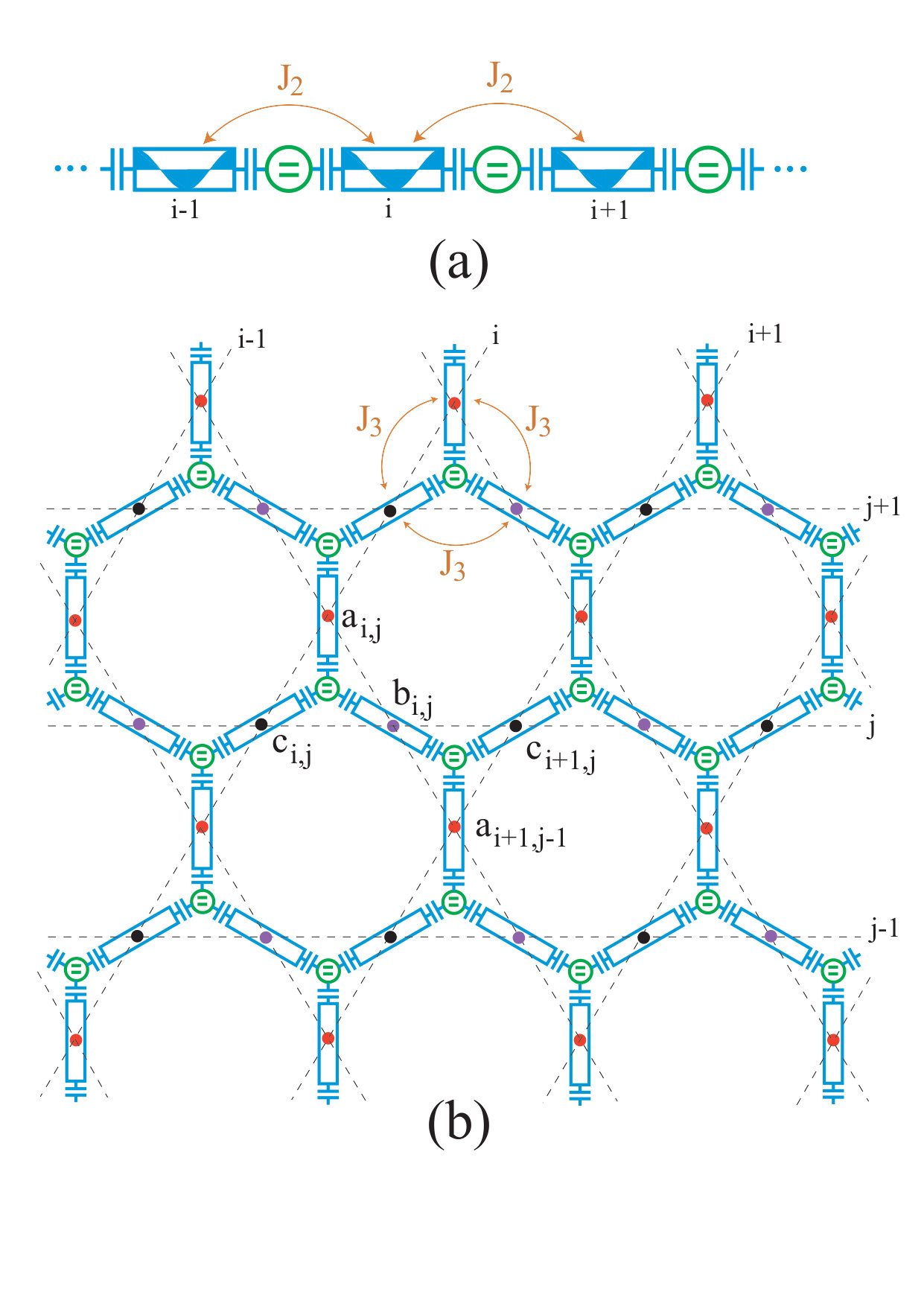 Figure 1
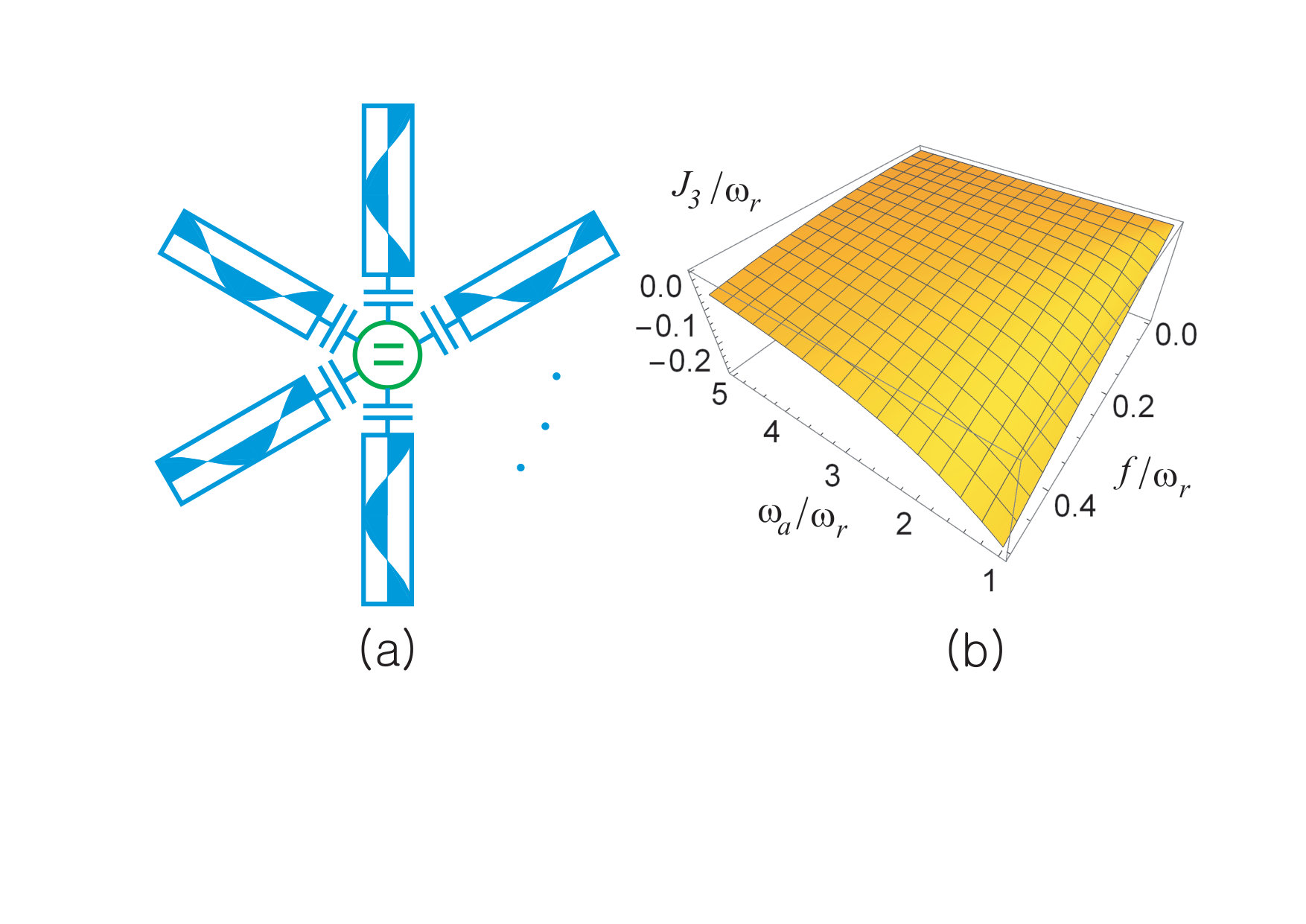 Figure 2
Peer Reviews
No public reviews on file for this paper yet. If you reviewed it on a platform where reviews are public (OpenReview, ICLR, NeurIPS, ICML), you can paste yours below so the community can read it here.
Videos
No videos yet. Explain this paper in a talk, walkthrough, or lecture? Add one.
∎
11institutetext: 22institutetext: Korea Institute for Advanced Study, Seoul 02455, Korea
22email: [email protected]
Quantum simulation scheme of two-dimensional xy-model Hamiltonian with controllable coupling
Mun Dae Kim
(Received: date / Accepted: date)
Abstract
We study a scheme of quantum simulator for two-dimensional xy-model Hamiltonian. Previously the quantum simulator for a coupled cavity array spin model has been explored, but the coupling strength is fixed by the system parameters. In the present scheme several cavity resonators can be coupled with each other simultaneously via an ancilla qubit. In the two-dimensional Kagome lattice of the resonators the hopping of resonator photonic modes gives rise to the tight-binding Hamiltonian which in turn can be transformed to the quantum xy-model Hamiltonian. We employ the transmon as an ancilla qubit to achieve in situ controllable xy-coupling strength.
1 Introduction
In spite of the remarkable advancements of coherent quantum operation the realization of fully controlled quantum computing is severely challenging in quantum information processing technology. On the other hand, significant attention has been paid to quantum spin models as a promising candidate for quantum simulation of many-body effects Georg ; Cirac ; Buluta . Quantum many-body simulation may provide a variety of possibilities to study the properites of many-body systems, realize a new phase of quantum matter, and eventually lead to the scalable quantum computing, which is hard for classical approaches.
Large-scale quantum simulators consisting of many qubits integrated have been experimentally demonstrated to study the quantum phenomena such as many-body dynamics and quantum phase transition. Quantum simulators have been studied in the so-called coupled cavity array (CCA) model, where a two-level atom in the cavity interacts with its own cavity and the hopping of a photon bewteen cavities gives rise to the cavity-cavity coupling. The CCA model has been applied to study the Jaynes-Cummings Hubbard model (JCHM) HartmanNP ; Xue ; Greentree ; Schmidt ; Koch ; Fan and the Bose-Hubbard model Greentree ; Koch to exhibit the phase transition between Mott insulator and superfluid. However, in the CCA model the cavity-cavity hopping amplitude is set by the system parameters and thus not tunable. In recent studies for one-dimensional quantum simulators using trapped cold atoms Nature51 and trapped ion systems Nature53 the coupling strength was tunable.
Previously the superconducting resonators in two-dimensional lattice have been coupled through an interface capacitance, where the resonator-resonator coupling strength is not controllable as the capacitance is fixed NPreview ; AP . For superconducting resonator cavities in circuit-quantum electrodynamics (QED) systems, qubit is located outside of the cavity MDK ; QIP . Hence a qubit can interact with many resonator cavities surrounding the qubit. By using a qubit as a mediator of coupling between many resonators one can obtain a tunable resonator-resonator coupling which is quite different from the coupling by direct photon hopping in the CCA model.
In this study we consider a lattice model of superconducting resonator cavities coupled by ancilla qubits for simulating the quantum xy-model Hamiltonian. The simulation for quantum xy-model has been studied in one-dimensional Hartmann ; Angelakis and two-dimensional Koch JCHM in the CCA model architecture. In the present model the intervening ancilla qubit which couples cavities has controllable qubit frequency. After discarding the ancilla qubit degrees of freedom by performing a coordinate transformation we show that the photon states in the resonators are described by the tight-binding Hamiltonian which, in turn, can be rewritten as the quantum xy-type interaction Hamiltonian. Consequently, the xy-coupling constant depends on the hopping amplitude of the tight-binding Hamiltonian and thus on the ancilla qubit frequency. We consider two-dimensional Kagome lattice model as well as one-dimensional chain model for the quantum simulation of xy-model Hamiltonian and show that the xy-coupling strength is in situ controllable.
2 Hamiltonian of coupled -resonators
In circuit-QED architectures qubits can be coupled with the transmission resonator at the boundaries of the resonator Blais ; Steffen ; Inomata so that we may couple several resonators to a qubit as depicted in Fig. 1 (a). In principle, any kind of qubits are available, but in this study we employ the transmon as the ancilla qubit coupling the resonators with the advantage of controllability. The Hamiltonian of the system with resonators and an ancilla qubit in Fig. 1(a) is given by
[TABLE]
where and with the frequency are the creation and annihilation operators for microwave photon in -th resonator, respectively, and the Pauli matrix with the frequency represents the ancilla qubit state, and is the coupling amplitude between the photon mode in the -th resonator and the ancilla qubit. This Hamiltonian conserves the excitation number
[TABLE]
where are the eigenvalue of the operator for ancilla qubit and is the excitation number of oscillating mode in -th resonator. Here, we consider the subspace that and thus , that is, the state of resonator is the superposition of zero and one-photon states which was generated in experiments previously Houck ; Hofheinz08 ; Hofheinz09 .
In order to obtain the Hamiltonian describing the interaction between photon modes we introduce the transformation
[TABLE]
where
[TABLE]
Here we, for simplicity, assume identical resonators and thus set and . We then expand with by using the relation to obtain
[TABLE]
Here is a matrix in the basis of and .
The degree of freedoms of ancilla qubit and resonator photon modes in the Hamiltonian of Eq. (1) can be decoupled by imposing the condition
[TABLE]
which can be achieved by adjusting the detuning Blais . The resulting transformed Hamiltonian of Eq. (3) becomes
[TABLE]
where is the energy for the state that and for all , and is the energy for the state that and only the -th resonator has one photon, and . For identical resonators, and are explicitly evaluated as
[TABLE]
and the resonator-resonator coupling is given by
[TABLE]
where is for .
In the subspace satisfying the Hamiltonian in Eq. (16) can be represented as
[TABLE]
Consequently, and can be rewritten as and so that we can have the relations, and . In this tight-binding Hamiltonian the ancilla qubit operator is decoupled from the resonator photon mode , and afterward we will ignore the ancilla term.
The tight-binding Hamiltonian can be easily transformed to the xy-spin model by introducing a pseudo spin operator such that and as follows:
[TABLE]
Here, the hopping parameter acts as a xy coupling constant between pseudo spins.
3 xy-model with tunable coupling
Figure 2(a) shows one-dimensional lattice model by extending the structure in Fig. 1(a) for two resonators and an ancilla qubit (). The transformation of Hamltonian in Eq. (3) can be evaluated by using the transformation matrix with
[TABLE]
For identical resonators such that , and thus , the transformation matrix can be calculated as
[TABLE]
with the basis , the photon number in 1st (2nd) resonator and the ancilla qubit spin .
The transformed Hamiltonian can be represented as the tight-binding Hamiltonian of Eq. (20),
[TABLE]
with the hopping parameter , discarding the decoupled ancilla term. This tight-binding Hamiltonian describes photon hopping in the chain model of Fig. 2(a), which can be subsequently transformed to the one-dimensional xy-model Hamiltonian similar to Eq. (21) as
[TABLE]
Further, for we can construct a two-dimensional lattice model as shown in Fig. 2(b). Here the ancilla qubits form the hexagonal lattice, but the resonators the dual lattice, i.e., the Kagoma lattice. The Kagome lattice has been widely studied in the relation of, for example, the frustrated spin model Mielke and the interacting boson model You ; Petrescu . The Kagome lattice in Fig. 2(b) consists of three triangular sublattices denoted as and . Here, two triangles consisting of, for example, and in Fig. 2(b), make up the unit cell and thus the xy-model Hamiltonian in the Kagome lattice can be written as
[TABLE]
Photons hop between resonators with amplitude which depends on the sign of detuning in Eq. (19). If , the hopping amplitude is negative, , indicating that the hopping process reduces the total system energy and the photons hop between cavities, while for and the hopping process has energy cost and thus the photon state is localized in the resonator at the ground state. Since typically the transmon qubit frequency 10GHz KochPRA ; Wallraff and the resonator microwave photon frequency in circuit-QED scheme is 5-10GHz Blais , we will consider the parameter range of .
For three resonators coupled to an ancilla qubit () in Fig. 1(a) the hopping amplitude becomes . Figure 1(b) shows as a function of the ancilla qubit frequency and the ancilla-resonator coupling strength . For the resonant case, , the hopping ampltude has the maximum value, , and diminishes as the detuning grows, which means that can be controllable between . Here the typical value of the coupling between transmon ancilla and resonator 100MHz Zeytin ; Keller ; Bosman .
If we can adjust the parameters, and , the coupling constant becomes tunable. The resonator frequency and the resonator-photon coupling are usually set in the experiment, but we can tune the ancilla qubit frequency during the experiment for some qubit scheme. For the transmon qubit the qubit frequency is represented as with the Josephson coupling energy and the charging energy KochPRA . Since the Josepson coupling energy is controllable by varying the magnetic flux threading a dc-SQUID loop KochPRA , we can adjust the frequency of the transmon qubit, . In the Hamiltonian for the two-dimensional xy-model in Kagome lattice in Eq. (3) , corresponding to the coupling constant between pseudo spins , becomes tunable. Hence, in this way we can achieve a quantum simulator for the two-dimensional xy-model in Kagome lattice with in situ tunable coupling.
We can measure the resonator states by attaching measurement ports to the resonators, resulting in a complex lattice design. Instead, as in a recent study Kollar measurement ports can be attached at the boundary of the lattice, but the analysis of the simulation results becomes complicated. In this study we assume identical resonators with equal ancilla qubit-resonator coupling and further consider a restricted subspace with in the Hilbert space as shown in Eq. (2). If the couplings have some fluctuations from the uniform value , the transformed Hamiltonian will deviate from the exact xy-model Hamiltonian. Furthermore, multiple photons or higher harmonic modes in the resonators may be generated, giving rise to errors in the processes. The effect of these non-idealities should be considered in a future study.
4 conclusion
We proposed a scheme for simulating quantum xy-model Hamiltonian in two-dimensional Kagome lattice of resonator cavities with tunable coupling. By using an intervening ancilla qubit several cavities are coupled with each other. We found that the cavity lattice formed by extending this structure can be transformed to the tight-binding lattice of photons after discarding the ancilla qubit degree of freedom. In the subspace of zero and one photon mode in the cavities this Hamiltonian can be described as the quantum xy-model Hamiltonian. We introduced the ancilla transmon qubit whose energy levels can be controlled by varying a threading magnetic flux. The coupling strength can be in situ tuned by adjusting the frequency of ancilla qubit intervening cavities.
Acknowledgements.
This work was supported by the Basic Science Research Program through the National Research Foundation of Korea (NRF) funded by the Ministry of Education, Science and Technology (2011-0023467).
The reference list from the paper itself. Each links out to its DOI / PubMed record.
- 1(1) I. M. Georgescu, S. Ashhab and F. Nori: Quantum simulation. Rev. Mod. Phys. 86 , 153 (2014)
- 2(2) J. I. Cirac and P. Zoller: Goals and opportunities in quantum simulation. Nature Phys. 8 , 264 (2012)
- 3(3) I. Buluta and F. Nori: Quantum simulators. Science 326 , 108 (2009).
- 4(4) M. J. Hartmann, F. G. S. L. Brand a ~ ~ 𝑎 \tilde{a} o, and M. B. Plenio: Strongly interacting polaritons in coupled arrays of cavities. Nature Phys. 2 , 849 (2006).
- 5(5) P. Xue, Z. Ficek, and B. C. Sanders: Probing multipartite entanglement in a coupled Jaynes-Cummings system. Phys. Rev. A 86 , 043826 (2012)
- 6(6) A. D. Greentree, C. Tahan, J. H. Cole, and L. C. L. Hollenberg: Quantum phase transitions of light. Natute Phys. 2 , 856 (2006).
- 7(7) S. Schmidt and G. Blatter: Strong Coupling Theory for the Jaynes-Cummings-Hubbard Model. Phys. Rev. Lett. 103 , 086403 (2009)
- 8(8) J. Koch and K. Le Hur: Superfluid–Mott-insulator transition of light in the Jaynes-Cummings lattice. Phys. Rev. A 80 , 023811 (2009).