Scalable global entangling gates on arbitrary ion qubits
Yao Lu, Shuaining Zhang, Kuan Zhang, Wentao Chen, Yangchao Shen,, Jialiang Zhang, Jing-Ning Zhang, and Kihwan Kim

TL;DR
This paper presents a scalable method to implement global entangling gates on multiple ion qubits, enabling efficient quantum circuit construction and demonstrating high-fidelity multi-qubit entanglement in trapped-ion systems.
Contribution
It introduces a novel scheme for global entangling gates on ion qubits using multiple motional modes and fully-independent control, with experimental validation.
Findings
Successfully prepared GHZ states with over 93.4% fidelity
Demonstrated genuine multi-partite entanglement up to four qubits
Achieved scalable global entangling gates in a trapped-ion system
Abstract
A quantum algorithm can be decomposed into a sequence consisting of single qubit and 2-qubit entangling gates. To optimize the decomposition and achieve more efficient construction of the quantum circuit, we can replace multiple 2-qubit gates with a single global entangling gate. Here, we propose and implement a scalable scheme to realize the global entangling gates on multiple ion qubits by coupling to multiple motional modes through external fields. Such global gates require simultaneously decoupling of multiple motional modes and balancing of the coupling strengths for all the qubit-pairs at the gate time. To satisfy the complicated requirements, we develop a trapped-ion system with fully-independent control capability on each ion, and experimentally realize the global entangling gates. As examples, we utilize them to prepare the Greenberger-Horne-Zeilinger (GHZ) states in a…
Click any figure to enlarge with its caption.
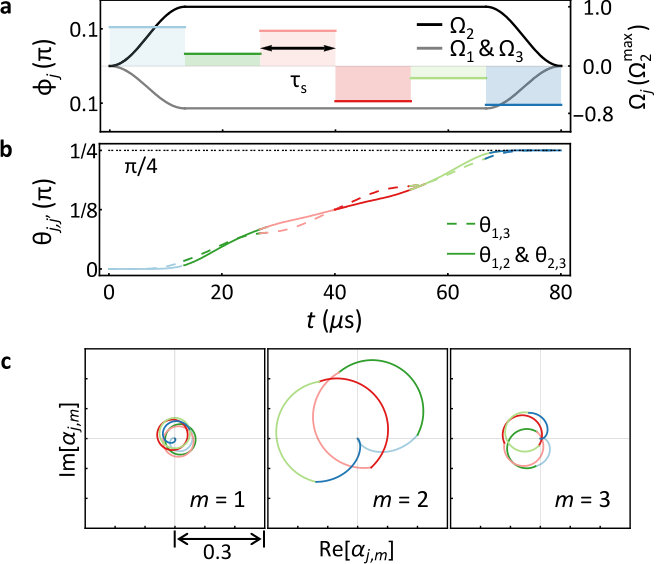 Figure 3
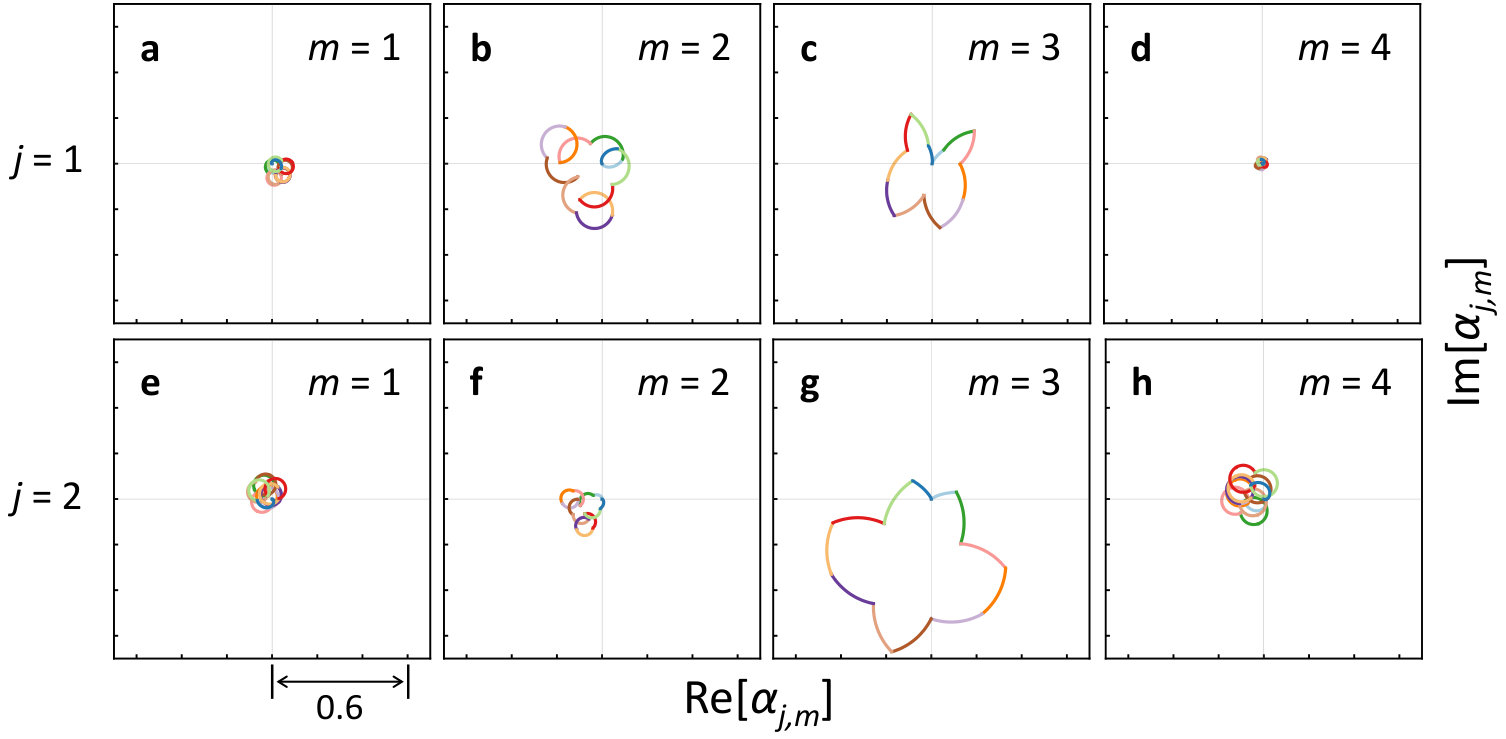 Figure 4
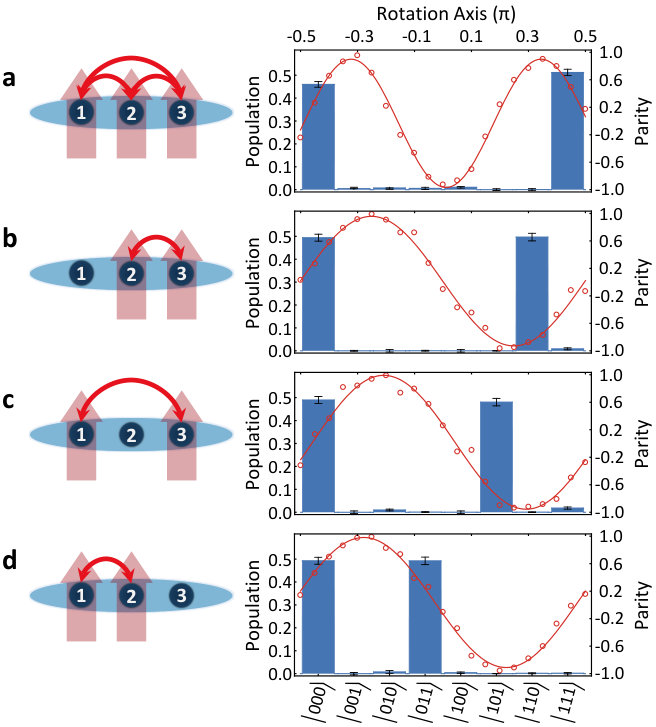 Figure 3
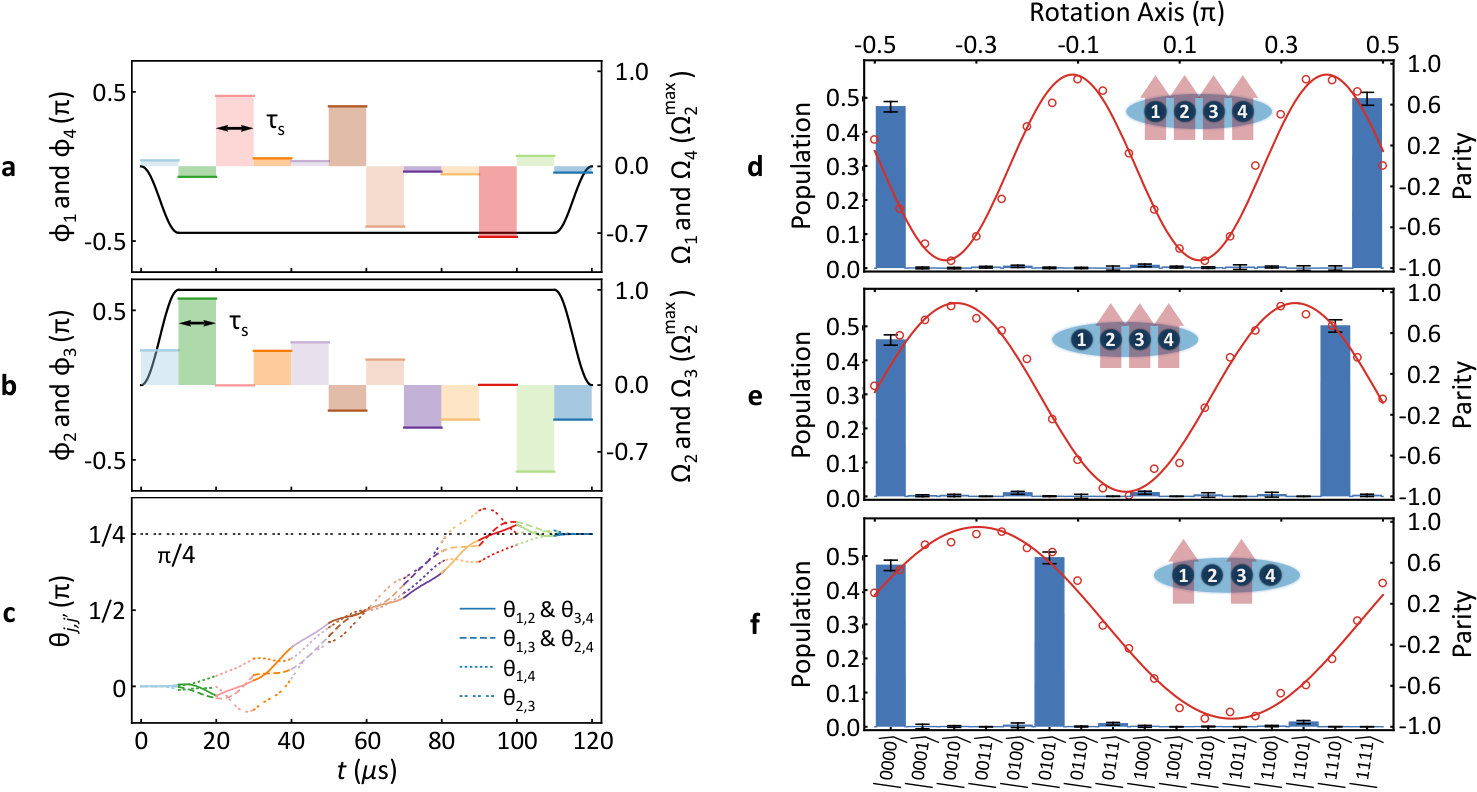 Figure 4
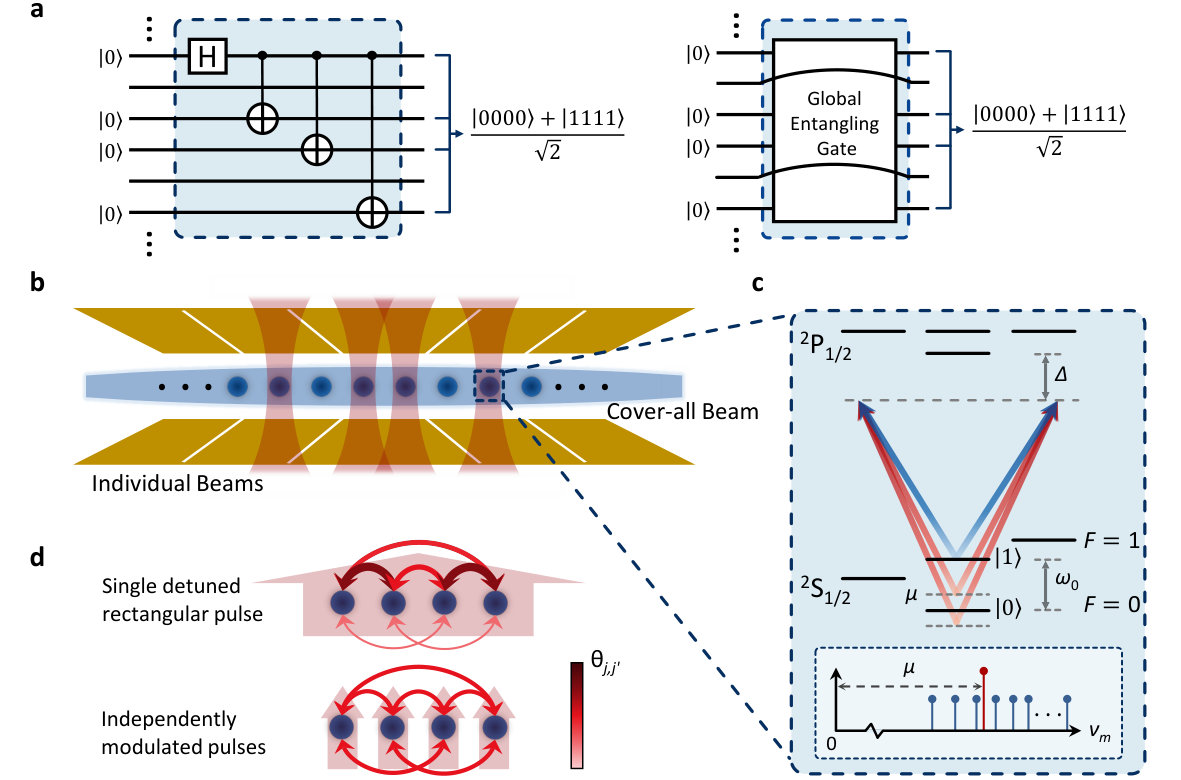 Figure 5
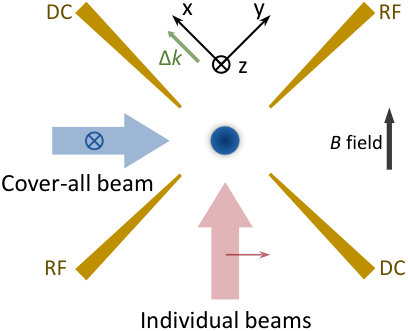 Figure 6
| qubit | 1 | 2 | 3 | |
|---|---|---|---|---|
| (MHz) | ||||
| 1 | 0.104 | 0.104 | 0.104 | |
| 2 | 0.033 | 0.033 | 0.033 | |
| 3 | 0.095 | 0.095 | 0.095 | |
| 4 | -0.095 | -0.095 | -0.095 | |
| 5 | -0.033 | -0.033 | -0.033 | |
| 6 | -0.104 | -0.104 | -0.104 | |
| qubit | 1 | 2 | 3 | 4 | |
|---|---|---|---|---|---|
| (MHz) | |||||
| 1 | 0.041 | 0.231 | 0.231 | 0.041 | |
| 2 | -0.070 | 0.579 | 0.579 | -0.070 | |
| 3 | 0.472 | -0.001 | -0.001 | 0.472 | |
| 4 | 0.054 | 0.230 | 0.230 | 0.054 | |
| 5 | 0.035 | 0.285 | 0.285 | 0.035 | |
| 6 | 0.402 | -0.170 | -0.170 | 0.402 | |
| 7 | -0.402 | 0.170 | 0.170 | -0.402 | |
| 8 | -0.035 | -0.285 | -0.285 | -0.035 | |
| 9 | -0.054 | -0.230 | -0.230 | -0.054 | |
| 10 | -0.472 | 0.001 | 0.001 | -0.472 | |
| 11 | 0.070 | -0.579 | -0.579 | 0.070 | |
| 12 | -0.041 | -0.231 | -0.231 | -0.041 | |
Peer Reviews
No public reviews on file for this paper yet. If you reviewed it on a platform where reviews are public (OpenReview, ICLR, NeurIPS, ICML), you can paste yours below so the community can read it here.
Videos
No videos yet. Explain this paper in a talk, walkthrough, or lecture? Add one.
Scalable global entangling gates on arbitrary ion qubits
Yao Lu
Center for Quantum Information, Institute for Interdisciplinary Information Sciences, Tsinghua University, Beijing, China
Shuaining Zhang
Center for Quantum Information, Institute for Interdisciplinary Information Sciences, Tsinghua University, Beijing, China
Kuan Zhang
Center for Quantum Information, Institute for Interdisciplinary Information Sciences, Tsinghua University, Beijing, China
Wentao Chen
Center for Quantum Information, Institute for Interdisciplinary Information Sciences, Tsinghua University, Beijing, China
Yangchao Shen
Center for Quantum Information, Institute for Interdisciplinary Information Sciences, Tsinghua University, Beijing, China
Jialiang Zhang
Center for Quantum Information, Institute for Interdisciplinary Information Sciences, Tsinghua University, Beijing, China
Jing-Ning Zhang
Center for Quantum Information, Institute for Interdisciplinary Information Sciences, Tsinghua University, Beijing, China
Kihwan Kim
Center for Quantum Information, Institute for Interdisciplinary Information Sciences, Tsinghua University, Beijing, China
Abstract
A quantum algorithm can be decomposed into a sequence consisting of single qubit and 2-qubit entangling gates. To optimize the decomposition and achieve more efficient construction of the quantum circuit, we can replace multiple 2-qubit gates with a single global entangling gate. Here, we propose and implement a scalable scheme to realize the global entangling gates on multiple ion qubits by coupling to multiple motional modes through external fields. Such global gates require simultaneously decoupling of multiple motional modes and balancing of the coupling strengths for all the qubit-pairs at the gate time. To satisfy the complicated requirements, we develop a trapped-ion system with fully-independent control capability on each ion, and experimentally realize the global entangling gates. As examples, we utilize them to prepare the Greenberger-Horne-Zeilinger (GHZ) states in a single entangling operation, and successfully show the genuine multi-partite entanglements up to four qubits with the state fidelities over .
Quantum computers open up new possibilities of efficiently solving certain classically intractable problems, ranging from large number factorization shor1997polynomial-time to simulations of quantum many-body systems Feynman1982Simulating ; lloyd1996universal ; Blatt2012Quantum . Universal quantum computation tasks, e.g. quantum phase estimation Nielsen2010Quantum , Shor’s algorithm shor1997polynomial-time ; Monz2016Realization and quantum variational eigensolver peruzzo2014a ; shen2017quantum , can be decomposed by single qubit and 2-qubit entangling gates in the quantum circuit model Nielsen2010Quantum . However, such decompositions are not necessarily efficient Ivanov2015Efficient ; martinez2016compiling ; Maslov2018Use . Recent theoretical works have pointed out that, with the help of global -qubit entangling gates (), it is possible to have the polynomial or even exponential speed up in constructing various many-body interactions Casanova2012Quantum ; yung2015from ; garciaalvarez2017digital ; Hempel2018Quantum and build more efficient quantum circuits for innumerous quantum algorithms Ivanov2015Efficient ; martinez2016compiling ; Maslov2018Use . For example, the pairwise entangling operations in the preparation of the -qubit GHZ state can be replaced by a single global entangling gate, shown in Fig. 1 (a).
The global entangling gates demand fully-connected couplings among all the qubits, which naturally emerge in trapped-ion systems Kim2009Entanglement ; korenblit2012quantum ; linke2017experimental . The ion qubits are entangled by coupling to the collective motional modes through external fields molmer1999multiparticle ; sorensen1999quantum ; solano1999deterministic , leading to the all-to-all network. Previously, the global entangling gates have been realized by only coupling to the axial center-of-mass (COM) mode lanyon2011universal ; barreiro2011an ; Monz201114 . However, the single mode approach is hard to scale up because the isolation of the mode is challenging as the number of ions increases in a single crystal Monz201114 ; Zhu2006Arbitrary ; zhu2006trapped . Recently, a scalable scheme, by driving multiple motional modes simultaneously, have been proposed to achieve 2-qubit gates with modulated external fields Zhu2006Arbitrary ; zhu2006trapped ; Steane2014Pulsed ; Green2014Phase ; Leung2018Robust and already been demonstrated in the experiments Choi2014Optimal ; Leung2018Robust ; milne2018phase . However, no one has explored the possibility of applying this multi-mode scheme to the global -qubit case yet, either theoretically or experimentally.
Beyond the 2-qubit gate, for the first time, we develop and demonstrate the global multi-qubit entangling gates by simultaneously driving multiple motional modes with modulated external fields in a fully-controllable trapped-ion system. Compared with the 2-qubit situation, we not only need to decouple the qubits from all the motional modes simultaneously at the gate time, but also have to satisfy more constraints coming from the coupling strengths of all qubit pairs. We derive the theoretical expressions of all the constraints and find out it is possible to construct the global entangling gate with the modulated fields. In order to fulfill all the theoretical requirements, we establish the trapped-ion system with the capability of independent control of the parameters of the external fields on each qubit, as shown in Fig. 1 (b). As a proof of principle demonstration, we realize the global entangling gates up to four ions, which we use to create the GHZ states. Moreover, we show the global entangling gate works on an arbitrary subset of the entire ion-chain, by simply turning off the external fields on the ions out of the subset.
In the experiment, we implement the global entangling gate in a single linear chain of ions. A single qubit is encoded in the hyperfine levels belonging to the ground manifold , denoted as and with the energy gap fisk1997accurate , as shown in Fig. 1 (c). The qubits are initialized to the state by the optical pumping and measured by the state-dependent fluorescence detection Olmschenk2007Manipulation . The fluorescence is collected by an electron-multiplying charge-coupled device (EMCCD) to realize the site-resolved measurement. Additional information about the experimental setup is shown in the Methods section.
After ground state cooling of the motional modes, the coherent manipulations of the qubits are performed by Raman beams produced by a pico-second mode-locked laser hayes2010entanglement . One of the Raman beams is broadened to cover all the ions, while the other is divided into several paths which are tightly focused on each ion. The cover-all beam and the individual beams perpendicularly cross at the ion-chain and drive transverse modes mainly along x-direction. With the help of the multi-channel acousto-optic modulator (AOM) controlled by the multi-channel arbitrary waveform generator (AWG), we realize independent control of the individual beams on each ion, as illustrated in Fig. 1 (b), which is similar to Ref. Debnath2016Demonstration .
To perform the global entangling gates with the form of
[TABLE]
we apply the modulated bichromatic Raman beams with the beat-note frequencies to the whole ion-chain, where is the detuning from the carrier transition and its value is around the frequencies of the motional modes. The above bichromatic beams lead to the qubit state-dependent forces on each qubit site haljan2005spin-dependent ; Lee2005Phase and the time evolution operator at the gate time can be written as Zhu2006Arbitrary
[TABLE]
Here is the coupling strength between the -th and the -th qubit in the form of
[TABLE]
where is the scaled Lamb-Dicke parameter James1998Quantum , () is the annihilation (creation) operator of the th motional mode, is the corresponding mode frequency, and are the amplitude and the phase of the time-dependent carrier Rabi frequency on -th ion. And , where represents the displacement of the -th motional mode of the -th ion in the phase space, written as
[TABLE]
Due to the interference of the multiple motional modes, it is not nature to have uniform coupling strengths on all the qubit pairs with single detuned rectangular pulse in a conventional manner, as shown in Fig. 1 (d). Instead, we can employ individual control of time-dependent parameters , , to satisfy the below constraints
[TABLE]
for any motional modes and qubit pairs . We note that, once we find the solution of the global -qubit entangling gate, the entangling gate on any subset qubits can be straightforwardly applied by simply setting for the qubit outside the subset.
Considering a system with qubits and collective motional modes, there are constraints from the requirements of the closed motional trajectories and from the conditions of the coupling strength. Therefore we have to satisfy a total number of constraints. In principle, we can fulfill the constraints by modulating the intensities and the phases of the individual laser beams continuously or discretely. In the experimental implementation, we choose discrete phase modulation because we have high precision controllability on the phase degree of freedom. We divide the total gate operation into segments with equal duration and change the phase on each ion in each segment, which provides independent variables. Because of the nonlinearity of the constraints, it is challenging to find analytical solutions of the constraints equation (5) and equation (6). Therefore, we construct an optimization problem to find numerical solutions. We minimize the objective function of hayes2012coherent ; Leung2018Robust ; webb2018resilient ; shapira2018robust subject to the constraints of equation (6). Note that we also employ the amplitude shaping at the beginning and the end of the operation to minimize fast oscillating terms due to the off-resonate coupling to the carrier transition Roos2008Ion . The details of the constraints under discrete phase modulation and the optimization problem construction are provided in the Methods section.
To experimentally test the performance of the global -qubit entangling gate, we use it to generate the -qubit GHZ state and then measure the state fidelity. Starting from the product state , the GHZ state can be prepared by applying the global entangling gate, while additional single qubit -rotations by are needed if is odd. After the state preparation, we obtain the state fidelity by measuring the population of the entangled state and the contrast of the parity oscillation sackett2000experimental . We also use the fidelity of the GHZ state to test the important feature of the global entangling gate, which is that we can realize entangling gates on any subset of qubits that are addressed by individual laser beams without changing any modulation pattern.
As the first demonstration, we use three ions with the frequencies of the collective motional modes in the x-direction . We choose the detuning to be , between the last two modes. The total gate time is fixed to be and divided into six segments. The details of the phase modulation pattern and the amplitude shaping with relative ratio are shown in Fig. 2 (a). With these parameters, the constraints of equation (5) and equation (6) are fulfilled, shown in Fig. 2 (b-c). We use this global 3-qubit entangling gate to prepare the 3-qubit GHZ state with the state fidelity of , as shown in Fig. 3 (a).
Moreover, by turning off the individual beam on a qubit, we can remove the couplings between the qubit and the others, as shown in Fig. 3. In the 3-qubit system, the global entangling gates on the subsets become the pairwise gates on the arbitrary qubit-pair, which are used to generate the 2-qubit GHZ states with the fidelities over in the experiment, as shown in Fig. 3 (b-c).
For the demonstration of the scalability, we move to a 4-qubit system with the motional frequencies . The larger system means more constraints and more segments are required. To realize the global 4-qubit entangling gate, we choose the detuning to be and fix the total gate time to be , which is evenly divided into twelve segments. The pulse scheme is shown in the Fig. 4 (a-b). The number of the constraints in equation (6) increases quadratically with the number of the qubits and reaches to six in the 4-qubit case, as shown in Fig. 4 (c).
By applying the global 4-qubit entangling gate to all the qubits, we successfully generate the 4-qubit GHZ state with the state fidelity of , as shown in Fig. 4 (d). Similarly we can prepare the 3-qubit GHZ state or the 2-qubit GHZ state by only addressing arbitrary three or two qubits, respectively. Experimentally we choose the qubits of to prepare the 3-qubit GHZ state and the qubit-pair of to prepare the 2-qubit GHZ state, with the state fidelities of and , respectively, as shown in Fig. 4 (e-f).
All of the results are calibrated to remove the detection errors by using the method described in Ref. Duan2012Correcting . The state fidelities of all the prepared GHZ states are mainly limited by the fluctuations of the tightly focused individual beams and the optical paths jittering of the Raman beams (). Other infidelity sources in the experiment include the drifting of the motional frequencies () and the crosstalk of the individual beams to the nearby ions ().
We present the experimental realization of the global entangling gate, which can make quantum circuit efficient, in a scalable approach on the trapped-ion platform. Moreover, we theoretically optimize the pulse schemes for the five and six qubits and we find the required number of segments and the gate duration increase linearly with the number of qubits. So far we have not found the limitation to scale up the global entangling gate to a further number of qubits. However, the optimization of the pulse schemes with large number of qubits belongs to NP-hard problems, but could be assisted by classical machine learning technique. Furthermore, we can extend the global entangling gate to a general form with arbitrary coupling strengths of , which would provide further simplification of quantum circuits for large-scale quantum computation and simulation Maslov2018Use . During the preparation of the paper, we have been aware of the related work about the parallel pairwise entangling gate figgatt2018parallel .
Acknowledgements
This work was supported by the National Key Research and Development Program of China under Grants No. 2016YFA0301900 (No. 2016YFA0301901) and the National Natural Science Foundation of China 11574002, and 11504197.
Author information
These authors contributed equally: Yao Lu, Shuaining Zhang and Kuan Zhang.
I Methods
I.1 Expressions of Constraints under Discrete Phase Modulation
Here, we give the detailed expressions of the constraints under the discrete phase modulation. Review the constraints shown in main text,
[TABLE]
where is the residual displacement of the -th qubit and -th motional mode at the gate time, and is the coupling strength between the -th and the -th qubits. In the experiment we fix the total gate time to be and divide it into segments with the segment duration of . The phases are modulated discretely with the form of
[TABLE]
where is the phase of the Rabi frequency on the -th qubit in the -th segment. And the time dependent amplitude of Rabi frequency can be written as
[TABLE]
where is the maximal value of the amplitude applied on the -th qubit and is the pulse-shaping function to slowly turn on (off) amplitude at the first (last) segment with the form of profile
[TABLE]
By inserting the pulse scheme of equation (9) and equation (11) into equation (7), we can rewrite the residual displacements as
[TABLE]
where is the scaled residual displacement of and
[TABLE]
Similarly, for the coupling strength of equation (8) we can also rewrite it as
[TABLE]
where is the rescaled coupling strength of and
[TABLE]
[TABLE]
It is convenient to rearrange equation (13) and equation (19) into the matrix-form of
[TABLE]
Here , , and are the column vectors of , , and respectively, while and are the matrix-form of and respectively.
Based on the above calculations, we summarize the constraints as below,
[TABLE]
for all .
I.2 Pulse Scheme Optimization
According to the equation (22) to equation (26), although we have already written all the constraints in the matrix-form, it is challenging to directly solve the equations of the constraints due to nonlinearity of equation (25) and equation (26). Instead we construct an optimization problem by minimizing the objective function,
[TABLE]
which is equivalent to , subject to the constraints of equation (25) and equation (26). The construction is still non-trivial because we want to efficiently obtain the suitable pulse scheme. The main difficulty in performing optimization is to fulfill the non-linear constraints and moreover, the number of non-linear constraints grows quadratically with the number of qubits. To simplify the optimization problem, we utilize the symmetries of the Lamb-Dicke parameters, which always have the relations of , then set the and to be same for the ions and . Taking the four-ion case as an example, the constraints of the coupling strengths are reduced from
[TABLE]
to
[TABLE]
because and always establish. If we rewrite equation (29) with the scaled coupling strength and utilize the relations of and , we further simplify the non-linear constraints to
[TABLE]
Finally we construct the optimization problem of minimizing the objective function of subject to the constraints of equation (I.2) and equation (26). After obtaining the modulated phase patterns we solve the equation (25) to get the theoretical values of the maximal amplitudes of the Rabi frequencies . Moreover, we manually introduce an additional symmetry to the modulated patterns by presetting the modulated phases to be or before the optimizing procedure.
I.3 Experimental Setup
In the experiment the single ion-chain is held in a blade trap, with the geometry shown in Fig. 5. The Raman beams are produced by a pico-second pulse laser with the center wavelength of and the repetition rate of . The ions fluorescence during the detection process is collected by the objective lens from the top re-entrant viewport then imaged to the EMCCD.
I.4 Experimental Parameters
Here we present the details of the experimental pulse schemes for the global 3-qubit and 4-qubit entangling gates. The maximal amplitudes of the Rabi frequencies are given based on the theoretical Lamb-Dicke parameters,
[TABLE]
where is the element of the normal mode transformation matrix for the ion and the motional mode , is the center wavelength of the Raman laser, is the reduced Planck constant and is the mass of the ion. The specific values of the modulated phases and amplitudes of Rabi frequencies obtained through the optimization are shown in Table 1 and Table 2. In the experimental realization the required amplitudes of the Rabi frequencies are larger than the theoretical calculation due to the overestimation of the Lamb-Dicke parameters.
In the main text we have already shown the trajectories of the motional modes in the phase space for the 3-qubit situation. Here, we supplement the motion trajectories of for the 4-qubit situation, as shown in Fig. 6.
The reference list from the paper itself. Each links out to its DOI / PubMed record.
- 1(1) Peter W Shor. Polynomial-time algorithms for prime factorization and discrete logarithms on a quantum computer. SIAM J. Comput. , 26(5):1484–1509, 1997.
- 2(2) Richard P Feynman. Simulating physics with computers. Int. J. Theor. Phys. , 21(6-7):467–488, 1982.
- 3(3) Seth Lloyd. Universal quantum simulators. Science , 273(5278):1073–1078, 1996.
- 4(4) Rainer Blatt and Christian F Roos. Quantum simulations with trapped ions. Nat. Phys. , 8(4):277–284, 2012.
- 5(5) Michael A Nielsen and Isaac L Chuang. Quantum computation and quantum information: 10th anniversary edition . Cambridge University Press, 2010.
- 6(6) Thomas Monz, Daniel Nigg, Esteban A Martinez, Matthias F Brandl, Philipp Schindler, Richard Rines, Shannon X Wang, Isaac L Chuang, and Rainer Blatt. Realization of a scalable shor algorithm. Science , 351(6277):1068–1070, 2016.
- 7(7) Alberto Peruzzo, Jarrod Mcclean, Peter Shadbolt, Man-Hong Yung, Xiao-Qi Zhou, Peter J Love, Alán Aspuru-Guzik, and Jeremy L O’brien. A variational eigenvalue solver on a photonic quantum processor. Nat. Commun. , 5(4213):4213–4213, 2014.
- 8(8) Yangchao Shen, Xiang Zhang, Shuaining Zhang, Jing-Ning Zhang, Man-Hong Yung, and Kihwan Kim. Quantum implementation of the unitary coupled cluster for simulating molecular electronic structure. Phys. Rev. A , 95(2), 2017.