Pressure-Induced Rotational Symmetry Breaking in URu$_2$Si$_2$
J. Choi, O. Ivashko, N. Dennler, D. Aoki, K. von Arx, S. Gerber, O., Gutowski, M. H. Fischer, J. Strempfer, M. v. Zimmermann, and J. Chang

TL;DR
This study reveals a pressure-induced rotational symmetry breaking in URu$_2$Si$_2$, indicating an orthorhombic phase and electronic nematic order that emerge above a critical pressure, challenging existing theories of its hidden order and antiferromagnetic phases.
Contribution
It provides the first high-resolution x-ray diffraction evidence of pressure-induced nematic order in URu$_2$Si$_2$, adding a new symmetry breaking element to the understanding of its phases.
Findings
No symmetry breaking below critical pressure $p_c$
Emergence of orthorhombic phase above $p_c$
Identification of electronic nematic order unrelated to hidden order
Abstract
Phase transitions and symmetry are intimately linked. Melting of ice, for example, restores translation invariance. The mysterious hidden order (HO) phase of URuSi has, despite relentless research efforts, kept its symmetry breaking element intangible. Here we present a high-resolution x-ray diffraction study of the URuSi crystal structure as a function of hydrostatic pressure. Below a critical pressure threshold kbar, no tetragonal lattice symmetry breaking is observed even below the HO transition K. For , however, a pressure-induced rotational symmetry breaking is identified with an onset temperatures K. The emergence of an orthorhombic phase is found and discussed in terms of an electronic nematic order that appears unrelated to the HO, but with possible relevance for the pressure-induced antiferromagnetic (AF)…
Click any figure to enlarge with its caption.
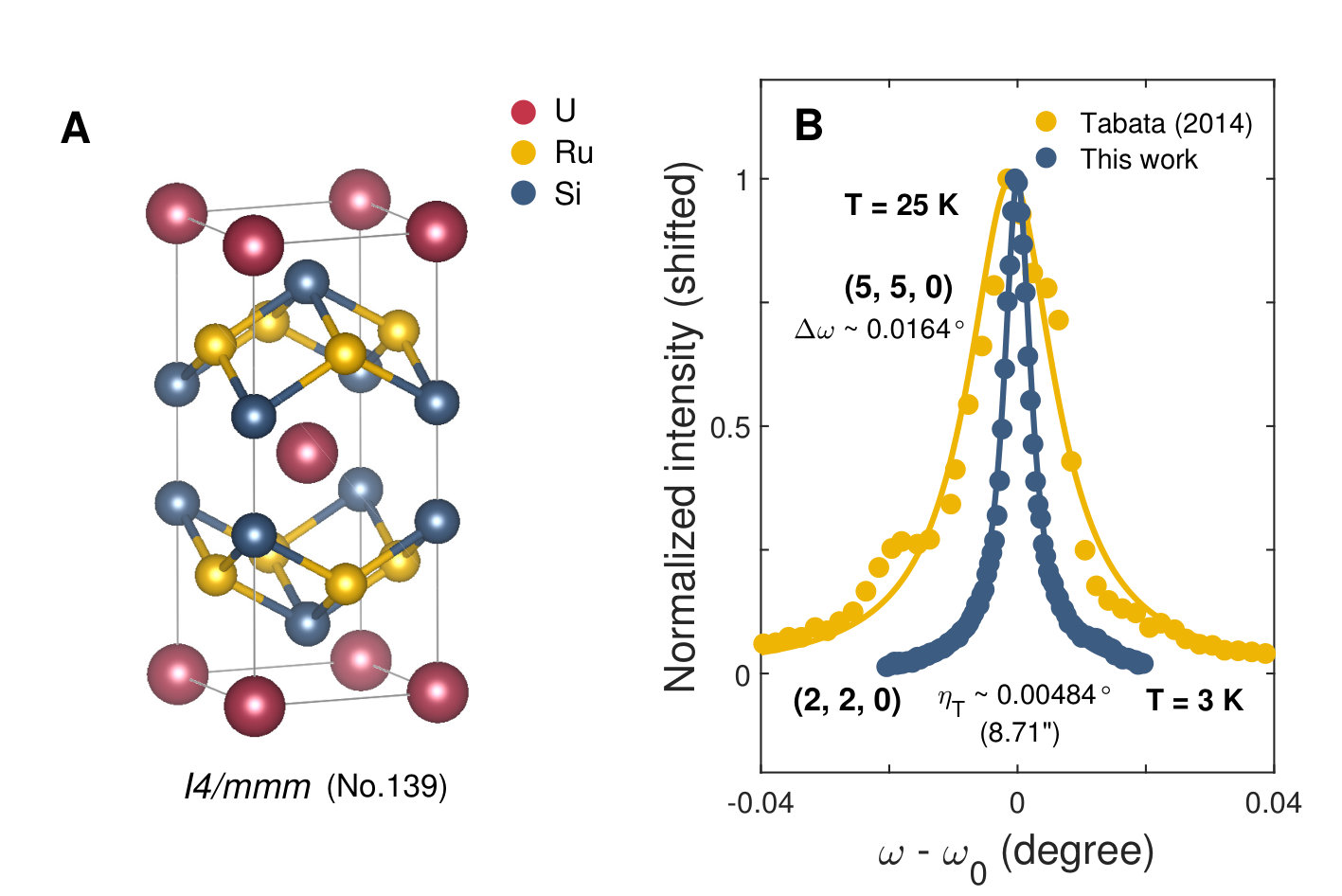 Figure 1
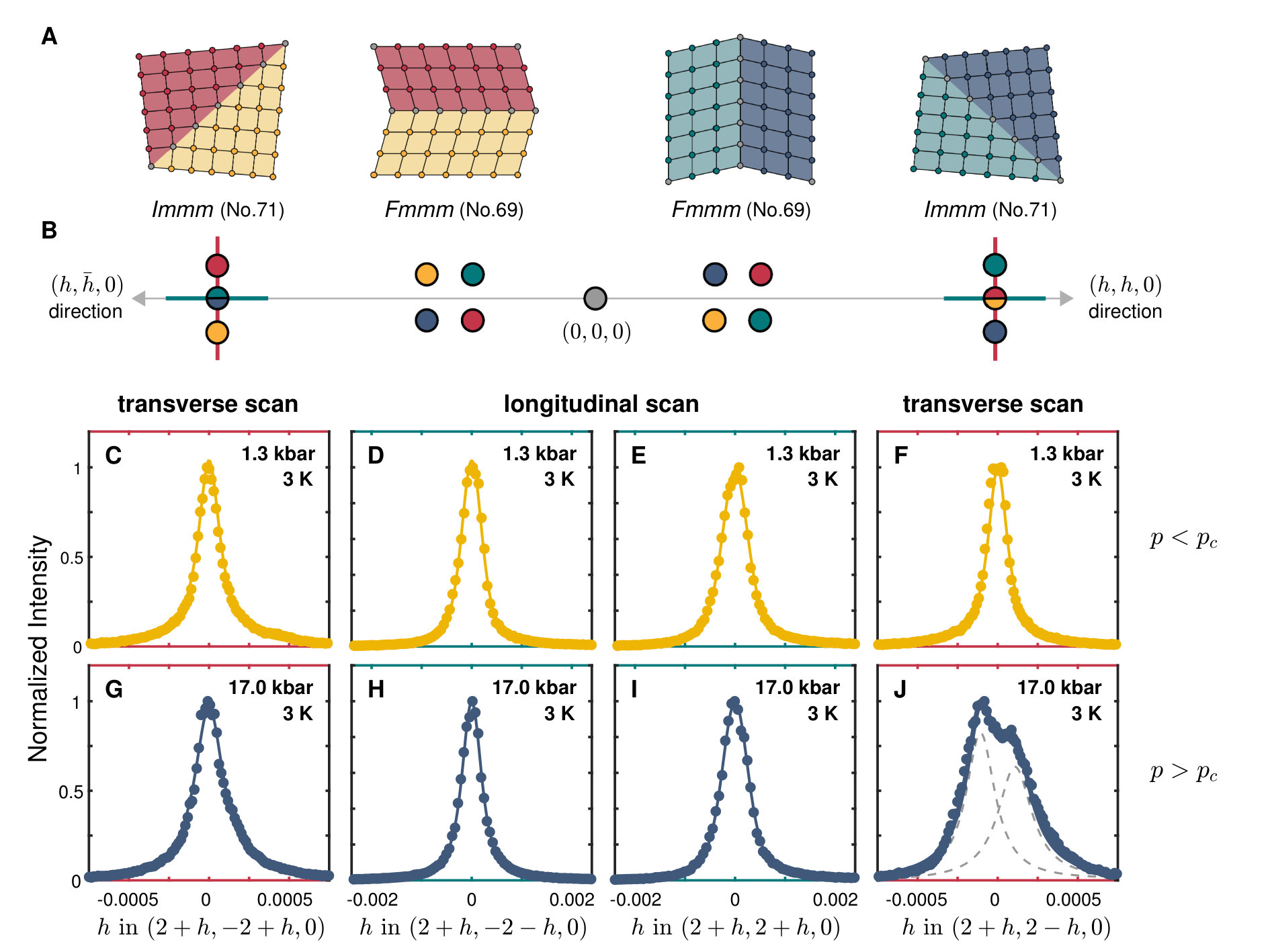 Figure 2
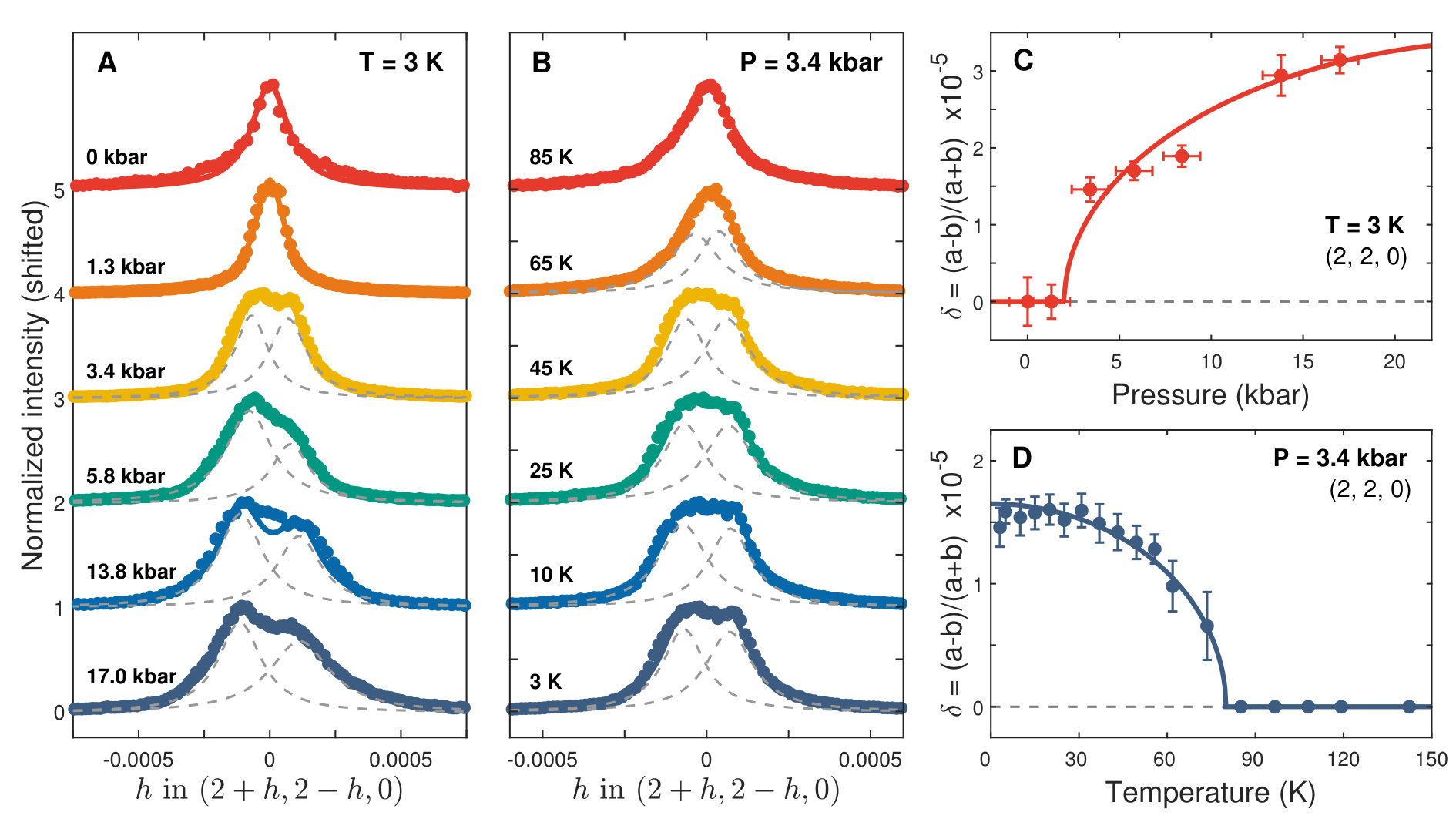 Figure 3
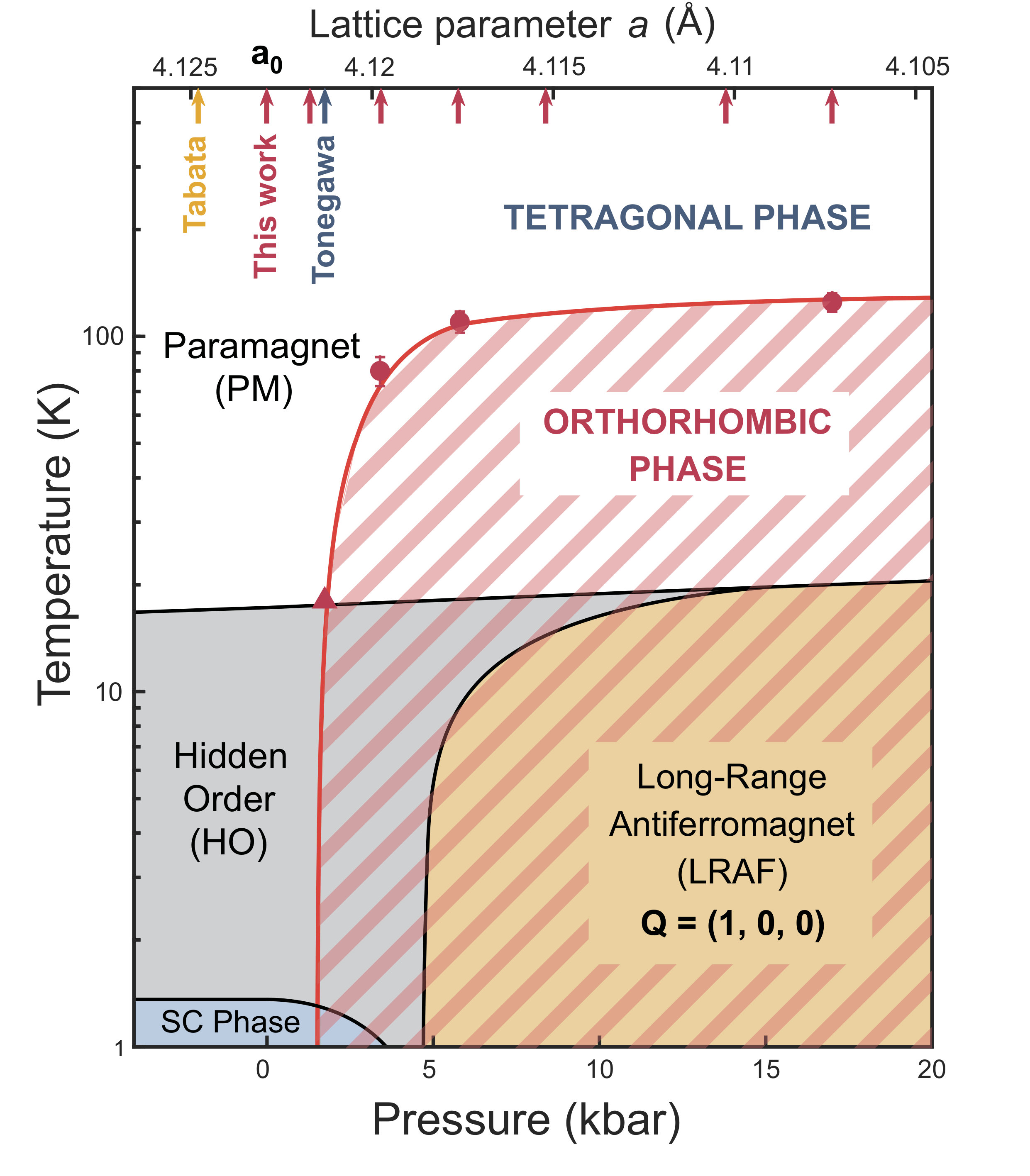 Figure 4
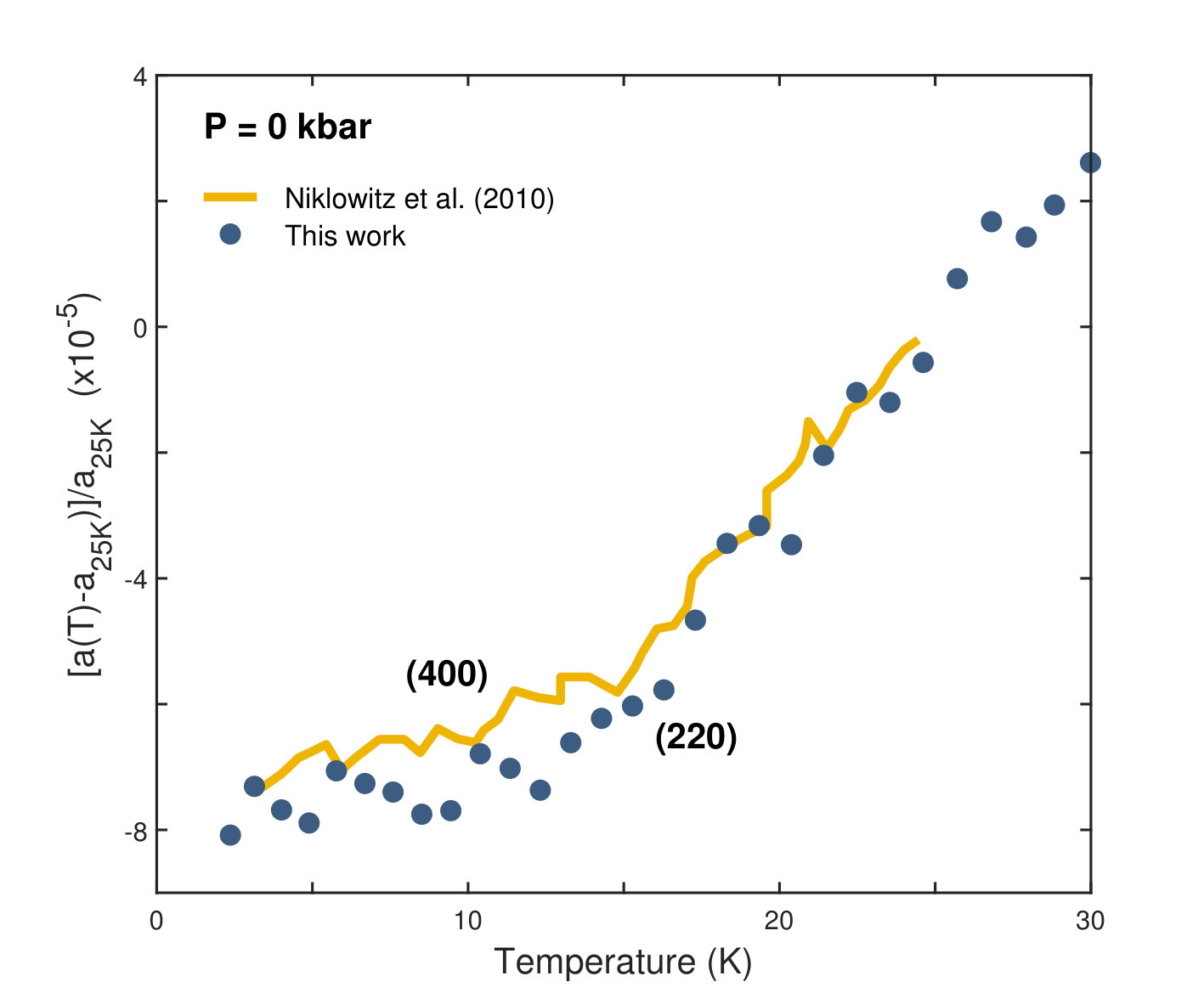 Figure 5
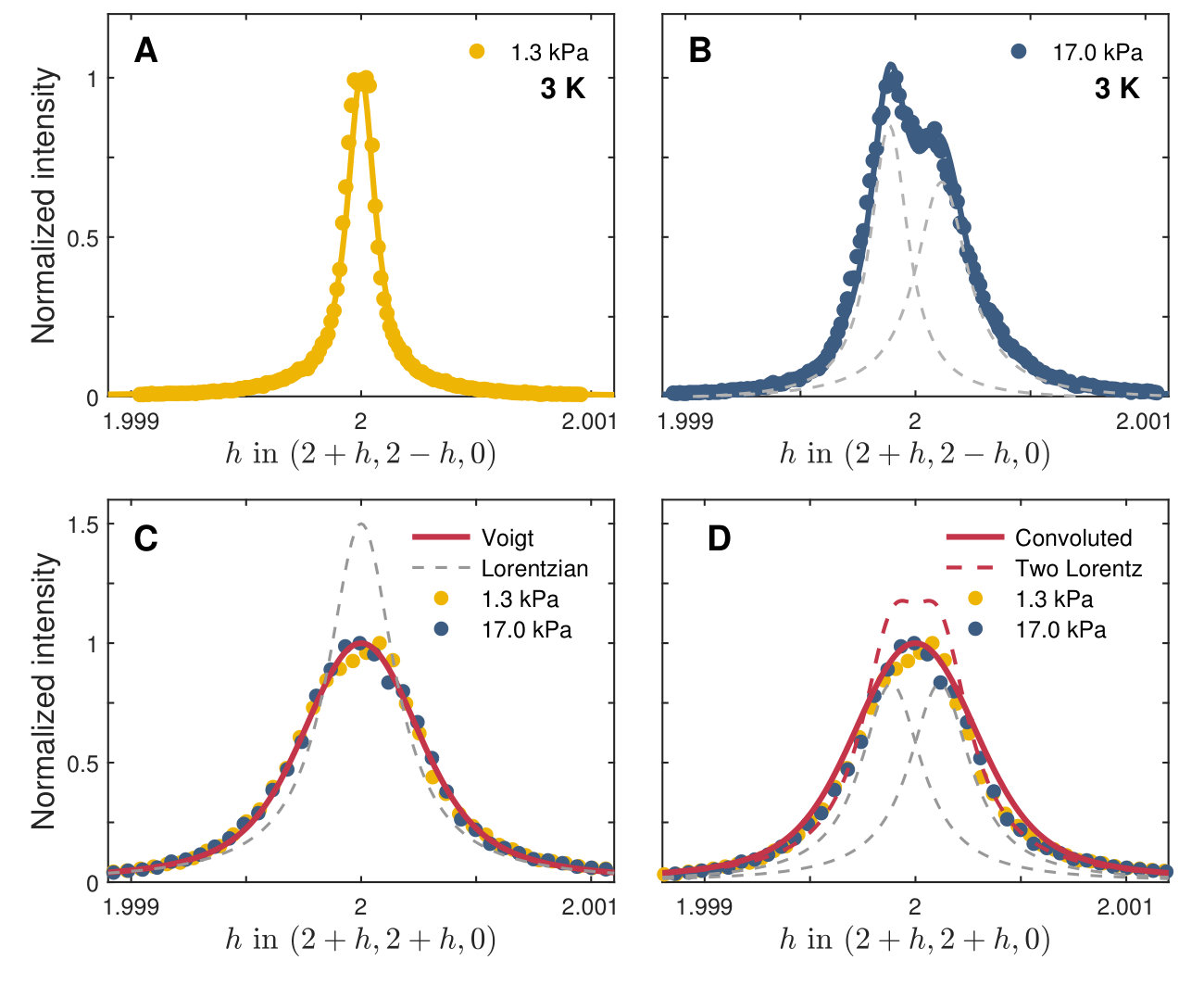 Figure 6
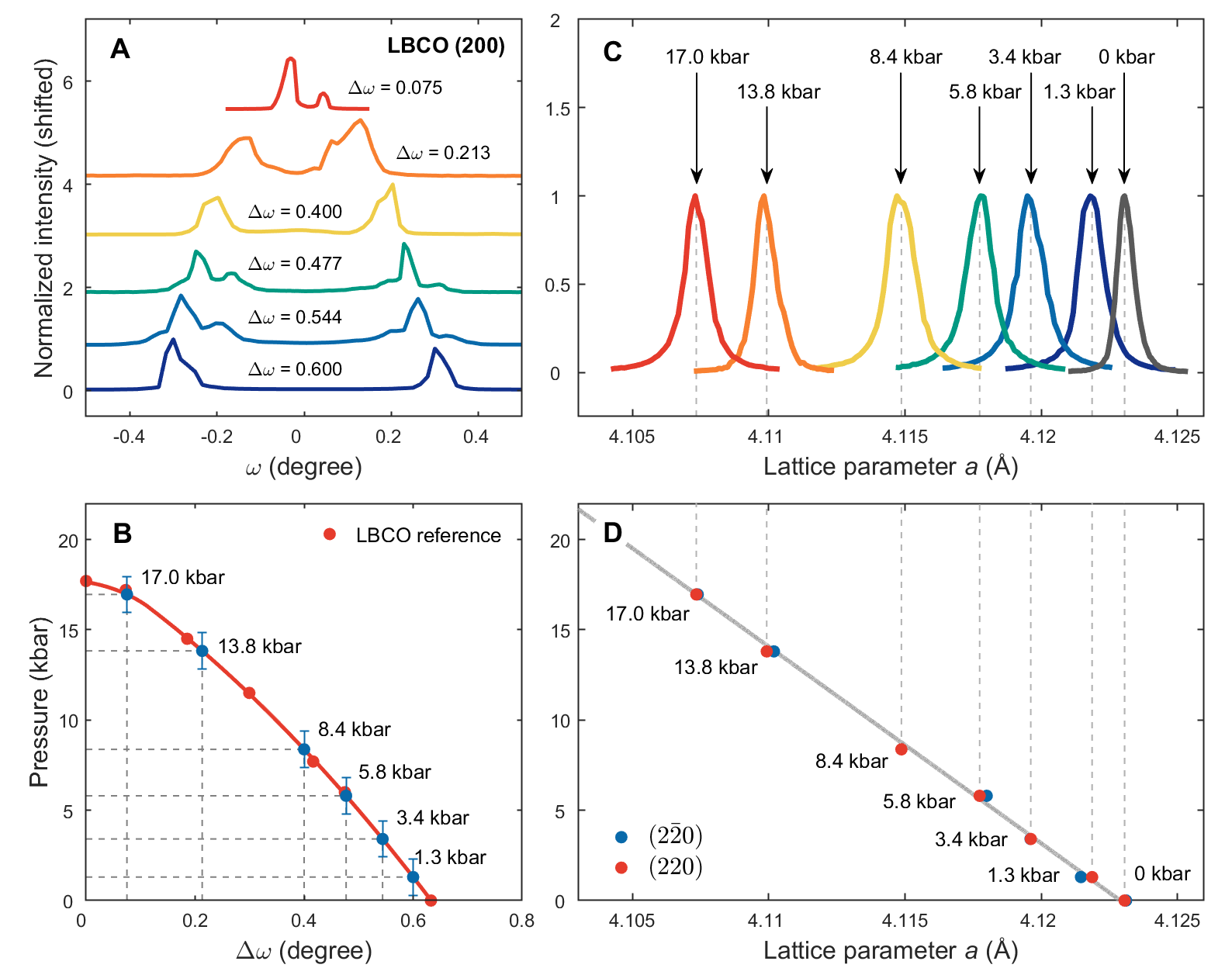 Figure 7
Peer Reviews
No public reviews on file for this paper yet. If you reviewed it on a platform where reviews are public (OpenReview, ICLR, NeurIPS, ICML), you can paste yours below so the community can read it here.
Videos
No videos yet. Explain this paper in a talk, walkthrough, or lecture? Add one.
Taxonomy
TopicsRare-earth and actinide compounds · Nuclear Materials and Properties · Hydrogen Storage and Materials
Pressure-Induced Rotational Symmetry Breaking in URu2Si2
J. Choi
Physik-Institut, Universität Zürich, Winterthurerstrasse 190, CH-8057 Zürich, Switzerland
O. Ivashko
Physik-Institut, Universität Zürich, Winterthurerstrasse 190, CH-8057 Zürich, Switzerland
N. Dennler
Physik-Institut, Universität Zürich, Winterthurerstrasse 190, CH-8057 Zürich, Switzerland
D. Aoki
Université Grenoble Alpes, CEA, INAC-PHELIQS, 38000 Grenoble, France
Institute for Materials Research, Tohoku University, Oarai, Ibaraki 311-1313, Japan
K. von Arx
Physik-Institut, Universität Zürich, Winterthurerstrasse 190, CH-8057 Zürich, Switzerland
S. Gerber
Laboratory for Micro and Nanotechnology, Paul Scherrer Institut, CH-5232 Villigen PSI, Switzerland
O. Gutowski
Deutsches Elektronen-Synchrotron DESY, 22603 Hamburg, Germany.
M. H. Fischer
Physik-Institut, Universität Zürich, Winterthurerstrasse 190, CH-8057 Zürich, Switzerland
Institute for Theoretical Physics, ETH Zürich, 8093 Zürich, Switzerland
J. Strempfer
Deutsches Elektronen-Synchrotron DESY, 22603 Hamburg, Germany.
M. v. Zimmermann
Deutsches Elektronen-Synchrotron DESY, 22603 Hamburg, Germany.
J. Chang
Physik-Institut, Universität Zürich, Winterthurerstrasse 190, CH-8057 Zürich, Switzerland
Abstract
Phase transitions and symmetry are intimately linked. Melting of ice, for example, restores translation invariance. The mysterious hidden order (HO) phase of URu2Si2 has, despite relentless research efforts, kept its symmetry breaking element intangible. Here we present a high-resolution x-ray diffraction study of the URu2Si2 crystal structure as a function of hydrostatic pressure. Below a critical pressure threshold kbar, no tetragonal lattice symmetry breaking is observed even below the HO transition K. For , however, a pressure-induced rotational symmetry breaking is identified with an onset temperatures K. The emergence of an orthorhombic phase is found and discussed in terms of an electronic nematic order that appears unrelated to the HO, but with possible relevance for the pressure-induced antiferromagnetic (AF) phase. Existing theories describe the HO and AF phases through an adiabatic continuity of a complex order parameter. Since none of these theories predicts a pressure-induced nematic order, our finding adds an additional symmetry breaking element to this long-standing problem.
pacs:
74.72.-h, 71.45.Lr, 74.25.Dw
Magnetism, superconductivity and the hidden order (HO) phase in URu2Si2 have been the subject of intense research Mydosh and Oppeneer (2011); Ikeda et al. (2012); Haule and Kotliar (2009); Gallagher et al. (2016); Wiebe et al. (2007); Santander-Syro et al. (2009); Chandra et al. (2013); Ressouche et al. (2012); Riggs et al. (2015). In particular, the symmetry breaking element associated with the hidden order lacks unequivocal evidence Wang et al. (2017); Kung et al. (2015); Tonegawa S. et al. (2014); Okazaki et al. (2011). One influential set of theories describes the hidden order phase and magnetism through an adiabatic continuity of a single complex order parameter Ikeda et al. (2012); Haule and Kotliar (2009); Chandra et al. (2013). Experimental explorations of the hydrostatic pressure and magnetic field phase diagrams are therefore paramount to solve this conundrum. Hydrostatic and chemical pressure tuning has established how the hidden order can be switched into a long-range antiferromagnetic (LRAF) phase Hassinger et al. (2008); Das et al. (2015); Butch et al. (2010). In fact, a modest pressure (reducing the lattice parameter by a few per mille) is sufficient to switch between the HO and LRAF ground states. Similarly, application of a high magnetic field (35 T) along the axis quenches the HO into a spin-density-wave (SDW) phase Correa et al. (2012); Knafo et al. (2016); Jo et al. (2007). The putative adiabatic continuity between hidden order and magnetism implies that the entire pressure and magnetic field phase diagrams should be scrutinized. In fact, even though hydrostatic pressure compresses the unit cell volume Niklowitz et al. (2010), the effect on the crystal lattice symmetry has not been elucidated. As the lattice and electronic degrees of freedom are coupled, it is of great interest to determine the crystal structure Kambe et al. (2018) across the URu2Si2 phase diagram.
Here, we present a hard x-ray diffraction study of the URu2Si2 crystal structure as a function of hydrostatic pressure. A single crystal with pristine mosaicity was selected. At ambient pressure, the crystal structure remains tetragonal across the hidden order transition and down to the lowest measured temperatures (3 K). Above a critical pressure, kbar, an orthorhombic phase is identified. The orthorhombic onset temperature K is, after an initial dramatic rise, only weakly pressure dependent. It is discussed whether the associated electronic nematic order parameter is a trigger (or consequence) of the orthorhombic transition. The weakness of the orthorhombic order parameter in comparison to the onset temperature suggests that the rotational symmetry breaking is electronically driven and that the lattice follows as a secondary effect. From the topology of the established phase diagram, the hidden and nematic orders appear uncorrelated. Nematicity may, however, be a precondition for magnetism. In fact, none of the adiabatic continuity models predicts a pressure-induced nematic order. As such, our findings provide a different symmetry breaking element to the problem.
A high-quality single crystal ( mm3) was selected for hard x-ray diffraction experiments under hydrostatic pressure. This URu2Si2 crystal is from a batch that has previously been used for scattering Ressouche et al. (2012); Walker et al. (2011) and quantum oscillation Hassinger et al. (2010); Aoki et al. (2012) experiments. The residual-resistivity-ratio (RRR) value of these crystals is typically in the range 100-500 Hassinger et al. (2010); Aoki et al. (2012). Our studies were carried out at the P07 triple-axis diffractometer at PETRA III (DESY-Hamburg) using 100-keV x rays in transmission scattering geometry. A 18-kbar piston pressure cell v. Zimmermann et al. (2008); Hücker et al. (2010); Ivashko et al. (2017) with standard Daphne oil as the pressure medium and a La1.875Ba0.125CuO4 Hücker et al. (2010) crystal for pressure calibration (see Supplementral Fig. 1 Sup ) was used. The pressure cell was cooled by a helium cryostat with a crystal orientation allowing access to the scattering plane. In this fashion, the and piston axes are parallel and hence there is no geometric inequivalence between the - and -axis directions. Weak in-plane uniaxial pressure can therefore be excluded entirely. Scattering vectors are specified in tetragonal reciprocal notation with ambient-pressure (3-K) lattice parameters and Å. We checked that the temperature dependence of the in-plane lattice parameter is consistent with previous neutron scattering experiments Niklowitz et al. (2010) (see Supplemental Fig. 2 Sup ).
To investigate crystal structure [Fig. 1(A)], high-quality single crystallinity (quantified by mosaicity) and excellent instrumental resolution are required. Figure 1(B) displays a transverse scan through the Bragg reflection of our URu2Si2 crystal. A Voigt fit reveals a negligible Gaussian contribution and a Lorentzian half width at half maximum (HWHM) (1.510*-4* Å*-1*) defining the resolution along that direction. This resolution is finer than previous studies Tabata et al. (2014); Tonegawa S. et al. (2014) (Fig. 1). Along the longitudinal direction through , our setup has comparable Gaussian 10*-4* Å*-1* and 10*-4* Å*-1* contributions. The high-temperature crystal structure of URu2Si2 belongs to the I4/mmm space group Nandi et al. (2010); Tonegawa S. et al. (2014). This tetragonal structure has 15 nonisomorphic subgroups for which two (Fmmm and Immm) are orthorhombic Tonegawa S. et al. (2014). The possible domains of these two orthorhombic structures are shown in Fig. 2(A). Corresponding Bragg peak splittings are schematically illustrated in Fig. 2(B) along the and reciprocal directions. The relative Bragg peak intensities depend on the exact domain population. Provided sufficient experimental resolution, longitudinal () and transverse () scans through and Bragg peaks are adequate to distinguish between the Fmmm and Immm structures, as shown in Fig. 2. The Fmmm structure splits the Bragg peak in both the transverse and longitudinal direction whereas only a transverse splitting is expected for Immm.
The absence of longitudinal and transverse and Bragg peak splittings for kbar suggests that the system remains tetragonal even inside the hidden order phase [Fig. 2(C)-2(F)]. By contrast, for a transverse splitting of the Bragg peak is observed [Fig. 2(J)]. The fact that remains sharp indicates a highly polarised domain population. At kbar, the transverse splitting amounts to . Our resolution is therefore good enough to resolve a longitudinal Fmmm splitting (if it existed). As the and 17 kbar longitudinal Bragg peaks are essentially identical [Figs. 2(E), 2(I) and Supplemental Fig. 3 Supp], the high-pressure orthorhombic structure is of Immm-type. The onset of orthorhombicity is revealed by transverse scans through versus temperature and pressure [Figs. 3(A) and 3(B)]. The orthorhombic order parameter is defined as where and are in-plane lattice parameters extracted by fitting the Bragg peak splitting McIntyre et al. (1988). A double Lorentzian fit with the widths set by the resolution was used. The orthorhombic order parameter as a function of pressure and temperature is shown in Figs. 3(C) and 3(D), respectively. The pressure-dependent onset temperature of orthorhombicity, defined by , is compared to the phase space of the hidden order and antiferromagnetic state in Fig. 4.
Next, we comment on the fact that ambient-pressure orthorhombicity has previously been reported in ultrapure () URu2Si2 Tonegawa S. et al. (2014). To this end, it is useful to consider the in-plane lattice parameter in detail. The pressure phase diagram ( kbar) of URu2Si2 corresponds to a 20 per mille tuning of the in-plane lattice parameter. Literature-quoted low-temperature ambient-pressure in-plane lattice parameters vary by 5 per mille Palstra et al. (1985); Tonegawa S. et al. (2014); Tabata et al. (2014) – almost 20% of the pressure phase diagram. If the ambient-pressure in-plane lattice constant is not precisely determined, this translates into a large error bar in the pressure phase diagram. Quoting exact lattice parameters is therefore important when discussing orthorhombicity and magnetism. The ambient-pressure orthorhombicity reported by Tonegawa et al. Tonegawa S. et al. (2014) is, for example, found in a crystal with a lattice parameter corresponding to a finite hydrostatic pressure within our reference frame. As such, there is no discrepancy between the reports in that regard. Two central differences are, however, that Tonegawa et al. Tonegawa S. et al. (2014) reported (i) a Fmmm orthorhombic structure that (ii) coincides with the HO onset temperature. Our high-pressure diffraction results are consistent with an Immm orthorhombic structure. though, near the pressure onset of orthorhombicity our resolution is not sufficient to distinguish between Immm and Fmmm. We can therefore not exclude an additional Fmmm phase near . For the orthorhombic onset temperature no correlation with the hidden order phase is found even near . We notice that ultrasound experiments in low magnetic fields report a dominant softening of the mode Yanagisawa et al. (2013, 2018) – consistent with a transition to the Immm space group. Furthermore, the temperature onset of the softening at 120 K is consistent with the appearance of the Immm structure in our diffraction experiment ( K). Although an additional Fmmm structure may occur near the low-temperature tetragonal-to-orthorhombic transition, we conclude that the Immm structure is dominating the pressure phase diagram (Fig. 4).
An interesting question is whether the orthorhombicity is elastic or electronic driven. It is worth noticing that in contrast to URu2Si2, many quasi-two-dimensional systems are pushed toward higher symmetry upon application of hydrostatic pressure. For example, it is typically the case for transition metal oxides with a high-temperature I4/mmm structure Hücker et al. (2010). This trend is also found in isostructural SrFe2As2 Wu et al. (2014) and dichalcogenides such as TaS2 Sipos et al. (2008). The fact that symmetry in URu2Si2 is lowered with hydrostatic pressure suggests the underlying physics is different. Another remarkable difference is that the orthorhombic order parameter of URu2Si2 is at least an order of magnitude smaller than what is found, for example, in pnictide systems Nandi et al. (2010); Kothapalli et al. (2016). Yet, the onset temperatures are comparable. This is suggestive of an electronic nematic ordering parameter being the primary and the lattice orthorhombicity a secondary consequence. Notice that to detect this nematic order parameter directly, for example, with resistivity requires single domain crystals with a sufficiently short in-plane lattice parameter.
Finally, the softening of the ultrasound mode, consistent with an Immm structure, has already been discussed in terms of hybridization between the uranium orbitals and the conduction electrons Yanagisawa et al. (2013, 2018). Stronger hybridization favors a more pronounced softening. Hydrostatic pressure reduces the unit cell volume that in turn enhances all hybridizations including those of uranium and conduction electrons. This provides an electronic (”Band-Jahn-Teller”) mechanism Yanagisawa et al. (2013, 2018) for the lattice symmetry breaking.
The topology of the phase diagram (Fig. 4) suggests no obvious connection between the nematic and hidden order parameters. Since both nematicity and long-range antiferromagnetic (LRAF) Amitsuka et al. (2007) order are pressure induced, a coupling between two is not inconceivable. We note that the pressure onset of LRAF has not been experimentally calibrated to the in-plane lattice parameter scale. It is therefore not impossible that nematicity and LRAF have identical onset pressure. The high-pressure onset temperature of LRAF order seems to coincide with that of the HO parameter. This has led to a class of theories describing the HO and LRAF within a single complex order parameter connected through an adiabatic continuity Chandra et al. (2013); Ikeda et al. (2012); Haule and Kotliar (2009); Ressouche et al. (2012). In fact, a plethora of order parameters has been suggested, where some multipolar orders can break down to on the lattice level Ikeda et al. (2012); Thalmeier and Takimoto (2011), some break to but only in the spin channel Chandra et al. (2013), and then there is the suggestion of an arrested Kondo effect Haule and Kotliar (2009), or chiral density wave Kung et al. (2015) that does not break rotational symmetry. However, for all these cases, rotation symmetry is at best broken in the HO phase, but never in the LRAF phase. Our experimental findings are therefore adding an entirely different electronic symmetry breaking element to the problem. Future work will clarify whether nematicity is part of a complex order or whether it is triggering the adiabatic switching between antiferromagnetism and the hidden order.
The authors are grateful to P.W.J. Moll, S. Benhabib, M. Janoschek, R. Flint, and H. Nojiri for inspiring discussions. J.C., O.I., and J.C. thank the Swiss National Science Foundation for support through the Grant No, BSSGI0155873. D. A. acknowledges support from the MEXT of Japan Grant-in-Aid for Scientific Research (through Grants No. JP15H05882, No. JP15H05884, No. JP15K21732, No. JP15H05745, and No. JP16H04006) and the European Research Council (through ERC-starting grant - NewHeavyFermion).
I Supplemental Material
The reference list from the paper itself. Each links out to its DOI / PubMed record.
- 1Mydosh and Oppeneer (2011) J. A. Mydosh and P. M. Oppeneer, Rev. Mod. Phys. 83 , 1301 (2011) . · doi ↗
- 2Ikeda et al. (2012) H. Ikeda, M.-T. Suzuki, R. Arita, T. Takimoto, T. Shibauchi, and Y. Matsuda, Nat. Phys. 8 , 528 (2012) . · doi ↗
- 3Haule and Kotliar (2009) K. Haule and G. Kotliar, Nat. Phys. 5 , 796 (2009) . · doi ↗
- 4Gallagher et al. (2016) A. Gallagher, K. W. Chen, C. M. Moir, S. K. Cary, F. Kametani, N. Kikugawa, D. Graf, T. E. Albrecht-Schmitt, S. C. Riggs, A. Shekhter, and R. E. Baumbach, Nat. Commun. 7 , 10712 (2016) . · doi ↗
- 5Wiebe et al. (2007) C. R. Wiebe, J. A. Janik, G. J. Mac Dougall, G. M. Luke, J. D. Garrett, H. D. Zhou, Y. J. Jo, L. Balicas, Y. Qiu, J. R. D. Copley, Z. Yamani, and W. J. L. Buyers, Nat. Phys. 3 , 96 (2007) . · doi ↗
- 6Santander-Syro et al. (2009) A. F. Santander-Syro, M. Klein, F. L. Boariu, A. Nuber, P. Lejay, and F. Reinert, Nat. Phys. 5 , 637 (2009) . · doi ↗
- 7Chandra et al. (2013) P. Chandra, P. Coleman, and R. Flint, Nature 493 , 621 (2013) . · doi ↗
- 8Ressouche et al. (2012) E. Ressouche, R. Ballou, F. Bourdarot, D. Aoki, V. Simonet, M. T. Fernandez-Diaz, A. Stunault, and J. Flouquet, Phys. Rev. Lett. 109 , 067202 (2012) . · doi ↗