Atom-only descriptions of the driven-dissipative Dicke model
Fran\c{c}ois Damanet, Andrew J. Daley, Jonathan Keeling

TL;DR
This paper derives a Redfield master equation to accurately describe the dissipative dynamics of atoms in the driven-dissipative Dicke model, surpassing standard approximations and correctly predicting phase transitions and damping.
Contribution
It introduces a Redfield master equation that goes beyond common approximations for the driven-dissipative Dicke model, enabling accurate analysis of atomic dynamics.
Findings
Standard secular approximation fails to predict the Dicke transition.
Large detuning approximation is inadequate for damping rates.
Full Redfield theory accurately predicts phase transition and damping.
Abstract
We investigate how to describe the dissipative spin dynamics of the driven-dissipative Dicke model, describing two-level atoms coupled to a cavity mode, after adiabatic elimination of the cavity mode. To this end, we derive a Redfield master equation which goes beyond the standard secular approximation and large detuning limits. We show that the secular (or rotating wave) approximation and the large detuning approximation both lead to inadequate master equations, that fail to predict the Dicke transition or the damping rates of the atomic dynamics. In contrast, the full Redfield theory correctly predicts the phase transition and the effective atomic damping rates. Our work provides a reliable framework to study the full quantum dynamics of atoms in a multimode cavity, where a quantum description of the full model becomes intractable.
Click any figure to enlarge with its caption.
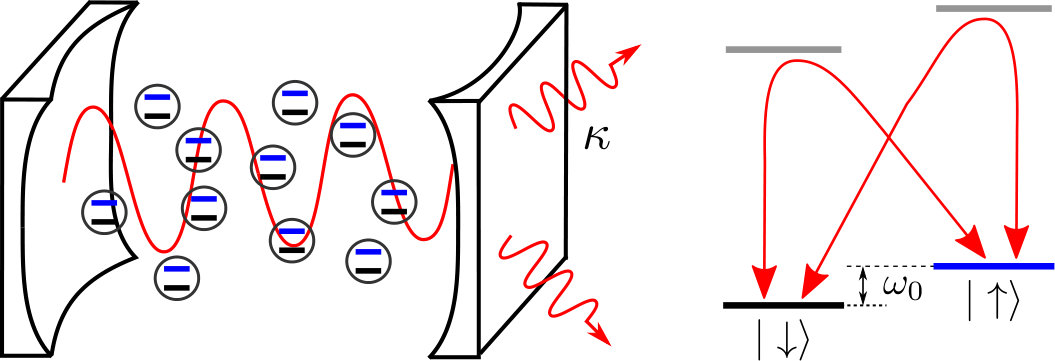 Figure 1
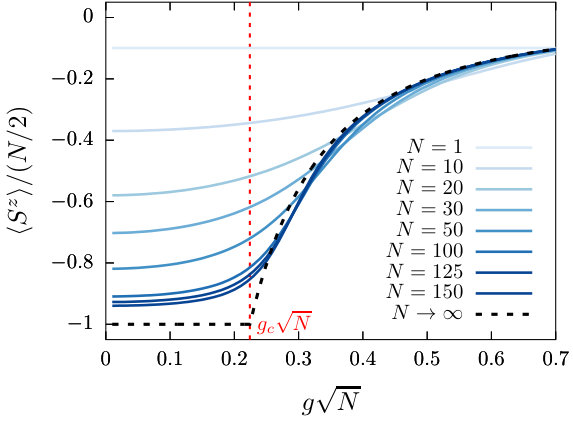 Figure 2
Peer Reviews
No public reviews on file for this paper yet. If you reviewed it on a platform where reviews are public (OpenReview, ICLR, NeurIPS, ICML), you can paste yours below so the community can read it here.
Videos
No videos yet. Explain this paper in a talk, walkthrough, or lecture? Add one.
Atom-only descriptions of the driven-dissipative Dicke model
François Damanet
Department of Physics and SUPA, University of Strathclyde, Glasgow G4 0NG, United Kingdom.
Andrew J. Daley
Department of Physics and SUPA, University of Strathclyde, Glasgow G4 0NG, United Kingdom.
Jonathan Keeling
SUPA, School of Physics and Astronomy, University of St Andrews, St Andrews, KY16 9SS, United Kingdom.
Abstract
We investigate how to describe the dissipative spin dynamics of the driven-dissipative Dicke model, describing two-level atoms coupled to a cavity mode, after adiabatic elimination of the cavity mode. To this end, we derive a Redfield master equation which goes beyond the standard secular approximation and large detuning limits. We show that the secular (or rotating wave) approximation and the large detuning approximation both lead to inadequate master equations, that fail to predict the Dicke transition or the damping rates of the atomic dynamics. In contrast, the full Redfield theory correctly predicts the phase transition and the effective atomic damping rates. Our work provides a reliable framework to study the full quantum dynamics of atoms in a multimode cavity, where a quantum description of the full model becomes intractable.
††preprint: APS/123-QED
I Introduction
Placing ultracold atoms in a high finesse optical cavity provides an ideal platform to study quantum many body physics out of equilibrium. As a many body open quantum system, it also provides a severe test for theoretical modelling, as the problem size scales as the square of the Hilbert space dimension, and the Hilbert space dimension grows exponentially with the number of atoms and cavity modes involved. For this reason, much theoretical work has been restricted to modelling single-mode cavities Dimer et al. (2007); Baumann et al. (2010); Kirton et al. (2018), and cases where all atoms behave identically, so that mean-field descriptions can be applied, or permutation symmetry can be exploited. However, to fully explore many body physics one must move beyond mean-field descriptions, and consider multimode optical cavities Gopalakrishnan et al. (2009, 2010, 2011, 2012); Kollár et al. (2015, 2017); Torggler et al. (2017); Vaidya et al. (2018); Torggler et al. (2018); Guo et al. (2018a, b). Modelling such systems beyond a semiclassical approximation is a major challenge. However, a separation of energy scales naturally exists, with fast cavity degrees of freedom coupled to slower atomic motion. This suggests adiabatic elimination could be used to significantly shrink the Hilbert space. In this paper we show this is indeed possible, but to capture the resulting dissipative dynamics of atoms requires Redfield theory.
Ultracold atoms in optical cavities provide a versatile platform to study a wide variety of questions about engineering and controlling many-body non-equilibrium systems. In particular, one can produce controllable coherent atom-cavity interactions by using a Raman driving scheme, where atoms in the cavity scatter light between an external pump laser and the cavity modes Dimer et al. (2007). This controllable interaction can be combined with multimode optical cavities, which support degenerate or near-degenerate families of transverse modes. This allows tuning the spatial structure of the interactions. Indeed, experiments have realized this using a tunable-length cavity Kollár et al. (2015), which can be used both in the non-degenerate Kollár et al. (2017) and nearly degenerate confocal Vaidya et al. (2018); Guo et al. (2018a, b) regime. This has enabled the creation of tunable-range Vaidya et al. (2018) sign-changing Guo et al. (2018a, b) interactions between atoms. A wide variety of applications of such multimode cavity experiments have been considered. These include realization of quantum liquid crystalline states Gopalakrishnan et al. (2009, 2010), simulating dynamical gauge fields and the Meissner effect Ballantine et al. (2017), realization of spin-glass phases Gopalakrishnan et al. (2011), and creating of associative memories Gopalakrishnan et al. (2012). Related to this last concept there have also been a number of proposals of information processing using such systems, including proposing alternate routes to realize Hopfield associative memory Torggler et al. (2017), and to solve specific NP hard problems such as the -queens problem Torggler et al. (2018). Other quantum generalizations of the Hopfield associative memory Rotondo et al. (2018) have also been studied.
Much of the work listed above on multimode cavities has made use of semiclassical equations, describing the amplitude of the cavity modes and the classical spin state of the atoms. Modelling the full quantum dynamics of the multimode system is a significant challenge, as the multimode structures require keeping track of the quantum state of each atom and each mode of light. Moreover, since the system is driven and dissipative, a full quantum description generally requires a density matrix approach, or an equivalent stochastic approach. Since the dynamics of the cavity modes are generally faster than those of the atoms, it would be highly advantageous to eliminate the cavity modes and consider a master equation for the atomic dynamics only.
To explore the properties of different approximations in deriving an atom-only description, we consider a model for which the correct behavior is well known, namely the open Dicke model Dimer et al. (2007). This model describes two-level atoms coupled to a single cavity mode; it has been extensively studied because this model has a ground state transition to a superradiant111Note the use of the term “superradiant” in this paper refers to a ground-state or steady-state of the open system in which there is a macroscopic photon field. This is distinct from the transient superradiance first discussed by Dicke (1954) and reviewed by Gross and Haroche (1982). It is also distinct from the steady state superradiant laser Meiser et al. (2009); Bohnet et al. (2012). See Kirton et al. (2018) for further discussion. state Hepp and Lieb (1973a); Wang and Hioe (1973); Hepp and Lieb (1973b). While the existence of this ground-state phase transition has historically been questioned Rzażewski et al. (1975), more recent works Vukics and Domokos (2012); Vukics et al. (2014, 2015); Grießer et al. (2016); De Bernardis et al. (2018); De Bernardis et al. (2018) suggest such a transitions is indeed possible, but with subtleties regarding gauge choice. No such issues however occur when considering the driven-dissipative realization of the Dicke model Kirton et al. (2018), and indeed the phase transition has been seen experimentally Baumann et al. (2010). As a single-mode problem, the behavior of this model is well understood both through mean-field approaches Dimer et al. (2007); Keeling et al. (2010); Bhaseen et al. (2012), as well as through exact approaches based on permutation symmetry Xu et al. (2013); Kirton and Keeling (2018); Shammah et al. (2018).
To derive an atom-only master equation, we consider both the cavity mode and the extra-cavity light as forming a structured bath, with a frequency-dependent density of states. Despite this structure, it is nonetheless possible to produce a time-local (i.e., Markovian) equation of motion for the system density matrix, as long as the effective damping rate due to coupling to the bath is smaller than the energy scale over which the bath density of states varies. This holds in the limit of weak enough matter-light coupling, where the Born-Markov approximation holds Breuer and Petruccione (2002). A time-local description means memory effects are neglected, allowing for an efficient computation of the atomic dynamics, while capturing the leading order effects of the cavity loss.
Directly integrating out the bath, and using the Born-Markov equation leads to an equation known as the Redfield master equation Redfield (1957); Bloch (1957). Such an equation is not necessarily of Lindblad form Lindblad (1976), and so does not always preserve the positivity of the reduced density matrix for all time Davies (1974); Duemcke et al. (1979); Whitney (2008), yielding in some situations negative and/or diverging populations. The equation is of Lindblad form if the system-bath coupling terms all sample the bath at the same frequency, or if the bath has no structure. However in most cases (including the problem we consider), this is not true. In order to overcome this potential positivity violation, it is a common practice to use in addition the secular approximation, introduced by Wangsness and Bloch (1953). This approximation amounts to neglecting the non-resonant transitions induced by the system-bath dynamics, i.e. it removes the coupling between populations and coherences related to states of different energies.
In many cases in quantum optics, this approximation holds very well — the energy (or frequency) differences are very large compared with the dynamical frequency scales for evolution of the system, and so the neglected terms have very high frequencies in the interaction picture. Indeed, in the quantum optics literature the rotating wave approximation is used, neglecting all counter-rotating terms in the system-bath coupling, and this has an effect identical to the secular approximation. The master equation can then be put into the standard form Gorini et al. (1976) which, following Lindblad Lindblad (1976), guarantees the positivity of the density matrix for all times. However, neglecting the couplings between populations and coherences can have a dramatic effect and completely remove important physical processes. Indeed it is known that, compared to exactly solvable problems, secular master equations can lead to wrong results where nonsecular Redfield theory gives qualitatively correct behavior Jeske et al. (2015); Cammack et al. (2018); Eastham et al. (2016); Dodin et al. (2018). In this paper, we show that the secular approximation is also inadequate to describe the dissipative dynamics of the Dicke model in the thermodynamic limit.
In this paper we present a variety of atom-only descriptions for the open Dicke model, in the form of effective master equations. These different forms correspond to making or not making the secular approximation, or making an approximation based on the small ratio of atomic energy vs cavity linewidth (i.e., the large bandwidth limit). We will see that these various approximations significantly modify the attractors of the dynamics, and that only the full Redfield theory correctly captures the known behavior of the driven Dicke model. Moreover, we will show how semiclassical equations derived from the full model capture dissipative processes which are lost if one first writes semiclassical equations of the Dicke model, and then adiabatically eliminates photons. By comparison to known results we demonstrate that we can derive a master equation for the atom-only system which captures all the required dissipative dynamics. This provides a firm foundation for future work to model the atom-only dynamics in multimode cavities, making use of advanced numerical methods Daley et al. (2004); Verstraete et al. (2004); Zwolak and Vidal (2004); Finazzi et al. (2015); Jin et al. (2016).
The remainder of the article is arranged as follows. In Sec. II we introduce the open Dicke model, and review the well known behavior of this model, both in terms of its steady states, and the dissipative approach to those states in the limit where atomic energies are much smaller than the cavity linewidth. Section III then presents the atom-only equations of motion, and discusses the form that these take with and without various approximations. The results of each of these different approximations are given in Sec. IV, giving the exact solution in some cases, and numerical and analytic approximations for the full (unsecularized) model. Finally, in Sec.V we summarize our results, and discuss some potential future applications enabled by this work.
II Model and Background
II.1 Raman-driven realization of Dicke model
We consider the Dicke model Hepp and Lieb (1973a); Wang and Hioe (1973); Hepp and Lieb (1973b), describing identical two-level atoms collectively coupled to a single-mode lossy cavity Kirton et al. (2018). As described in Ref. Dimer et al. (2007), such a model can be realized as an effective low energy description of atoms with Raman driving. That is, transitions between two low lying atomic states are driven by scattering a pump photon into a cavity mode, or vice versa (see Fig. 1).
In this context, working in the rotating frame of the pump, one realizes the Dicke Hamiltonian, combined with optical losses from the cavity mode Dimer et al. (2007); Bhaseen et al. (2012). The problem is thus described by the master equation:
[TABLE]
where describes photon losses with a rate and where the Dicke Hamiltonian is given by:
[TABLE]
The first term describes the level splitting of the two low-lying atomic states, where () are collective spin operators written in terms of the standard single-spin Pauli operators (). The second term describes the cost of scattering photons into the cavity, where is the annihilation operator of a cavity photon, and the detuning of the cavity mode from the pump frequency. The final term results from the Raman process, leading to an effective interaction between the atoms and the cavity field, where in terms of the bare coupling , the Rabi frequency of the transverse pump and the atomic detuning . These definitions are chosen to match the Hamiltonian in Ref. Bhaseen et al. (2012), for ease of comparison to the semiclassical results presented there.
II.2 Review of dynamics of the dissipative Dicke model
For completeness, in this section we briefly summarize the well-known properties of the model described by Eq. (1) and Eq. (2). In the thermodynamic limit (i.e., large ), the behavior of the model is well-described by the semiclassical equations of motion Bhaseen et al. (2012):
[TABLE]
Following these equations, one may see this model shows a phase transition between two classes of steady state attractor: normal states, where , and an ordered state where these expectations are non-zero. This ordered state spontaneously breaks the symmetry of the model under the transformation . By analogy to the ground state phase transition in the Dicke model Hepp and Lieb (1973a); Wang and Hioe (1973); Hepp and Lieb (1973b), this ordered state is known as a superradiant state. For the open system Dimer et al. (2007); Bhaseen et al. (2012) the transition occurs when where .
The dynamics in both states is dissipative, i.e., there is damped relaxation towards the given steady state. As discussed in detail in Bhaseen et al. (2012), this can be characterized by considering the semiclassical equations of motion, and then linearizing around a given steady state. In general this procedure leads to a quartic equation for the eigenvalues, but this equation can be solved in the limit where . In the normal state, the eigenvalues of this linearized analysis take the form
[TABLE]
(see Eq. (18) of Ref. Bhaseen et al. (2012)). Thus, for , the normal state is absolutely stable, but with a decay rate that can be much smaller than the bare cavity loss rate, particularly in the experimentally relevant regime . When the system becomes superradiant, one must linearize around the new superradiant solution. This (using Eqs. (19) and (20) of Ref. Bhaseen et al. (2012)) gives instead the eigenvalues:
[TABLE]
which corresponds to damped oscillations around the steady state.
The results above come from an analysis of the linearized semiclassical equations of the full model i.e., both atomic and photon degrees of freedom, as given in Eq. (3). If one performs adiabatic elimination of the photon mode on these semiclassical equations, i.e. using one may note that the other equations depend only on the combination . Inserting this into the other two equations yields purely conservative dynamics of the collective spin expectation . Indeed, as noted in Keeling et al. (2010), this semiclassical spin dynamics corresponds to that from a Lipkin-Meshkov-Glick Lipkin et al. (1965); Meshkov et al. (1965); Glick et al. (1965) Hamiltonian
[TABLE]
This Hamiltonian does reproduce the existence of a phase transition at the correct , but since the dynamics is purely conservative, this atom-only semiclassical theory cannot describe the correct damped decay toward the steady state attractors. In the following we will see that a correct atom-only semiclassical theory can however be derived by eliminating cavity photons first, and then taking a semiclassical limit.
III Atom-only Redfield master equation
III.1 Derivation of the Redfield equation
In this section, we treat the matter-light coupling as a weak system-reservoir coupling and derive a Redfield master equation for the atom-only dynamics. That is, we derive a description purely in terms of atomic operators, which nonetheless captures the effects of the dissipative cavity mode.
In order to formally derive the atom-only equations, it is useful to note that the starting model described in Eq. (1) can also be written as a purely Hamiltonian problem. That is, one could alternatively describe the same system by enlarging the Hilbert space to describe coupling between the cavity mode and a flat bath of extra-cavity radiation modes, , where the bath spectral density satisfies . In such a description, adiabatic elimination of the cavity modes means regarding both the cavity and extra-cavity modes as forming the bath. By diagonalizing these coupled harmonic oscillators, one finds the density of states for this effective bath, and can use this to write the open-system description of the atom-only problem.
Using such an approach, we perform the standard derivation of the Redfield equation, first dividing and then working in the interaction picture with respect to . In this interaction picture, the interaction Hamiltonian takes the form:
[TABLE]
where , and with . The master equation then becomes:
[TABLE]
To evaluate this, we need to find the correlation function of the cavity photons, thus one needs the time dependence of . This can be found either from the Green’s function resulting from diagonalizing the cavity and extra-cavity modes, or alternatively by using Heisenberg-Langevin equations Breuer and Petruccione (2002) for the cavity modes. Using the assumed flat spectral density of the extra-cavity modes finds the cavity photon correlation function:
[TABLE]
Performing the integrals over time after extending the limit of integration to infinity, we can then write the Redfield equation for the density matrix. It is convenient to introduce the quantities:
[TABLE]
in terms of which, the Redfield equation in the Schrödinger picture takes the form:
[TABLE]
In writing Eq. (11), we have not made the secular approximation. To make this additional approximation we would neglect those terms which are time-dependent in the interaction picture. In the above equation, it is the terms with two operators or two operators which oscillate at a frequency respectively. In the following, we will compare a number of different approximations with and without secularization. To enable this we will introduce a prefactor in front of those terms which are time dependent in the interaction picture, so that corresponds to the secular approximation and to making no approximation.
III.2 Master equation in operator form
The master equation given in Eq. (11) can be written in a more compact and convenient form:
[TABLE]
Here the two-component vector has components . To write the Hamiltonian and Lindblad–Kossakowski matrices it is convenient to first define and through . We then find:
[TABLE]
where refers to real and imaginary parts of these quantities.
The quantities and can be thought of as corresponding to the mean and difference of the quantities arising from the co- and counter-rotating terms in the matter-light coupling. In the following, we will compare this full master equation with the results making a number of commonly used approximations. Specifically, we will consider the limit , which is relevant when (i.e. the large detuning limit), and the limit corresponding to secularization. We next briefly summarize the simplifications that occur to the effective master equation in these various limiting cases:
III.2.1 Secularized master equation
In the case , the Hamiltonian and Lindblad–Kossakowski matrix both become diagonal. As expected from secularization, this latter has positive entries guaranteeing complete positivity. We find the effective Hamiltonian takes the form of a Lipkin–Meshkov–Glick Lipkin et al. (1965); Meshkov et al. (1965); Glick et al. (1965) model with symmetry
[TABLE]
accompanied by simple spin raising and lowering rates:
[TABLE]
Because the effective Hamiltonian has symmetry, it conserves the number of excited spins. This conservation is an expected consequence of secularization, as the interaction picture with respect to will give time dependence to any term that is not diagonal in the basis. As we will show below, this means the steady state density matrix is diagonal in the basis, and we find particularly simple steady states arising from the competition of the spin raising and lowering processes.
If we combine this secular limit with the large detuning limit where may be neglected, the equation simplifies further, giving equal rates for spin raising and lowering processes.
III.2.2 Large detuning limit
If we consider the limit where may be neglected, but avoiding secularization (so ), we also find a simple form of the master equation. In this case:
[TABLE]
In this case, despite the lack of secularization, we still find a completely positive master equation Duemcke et al. (1979). This is not surprising, as dropping corresponds to neglecting the energy differences , so that all operators sample the bath at the same frequency. As also discussed further below, this equation also has a simple steady state — since the jump operator is Hermitian, the steady state is a fully mixed density matrix.
III.2.3 Full model
While the two limiting cases mentioned above lead to completely positive master equations, this is not true for the full model. We may see this directly by considering the eigenvalues of the Lindblad–Kossakowski matrix . Specifically, the eigenvalues of this matrix are which indeed involves a negative eigenvalue for any non-zero . However, as we will show below, despite this non-positivity, this full master equation is capable of describing the known behavior of the open Dicke model. This is in contrast to both the limiting cases which cannot reproduce the known behavior at the superradiance transition.
III.3 Master equation in the Dicke basis
Since the master equation is written only in terms of collective spin operators, it is convenient to write the master equation in the Dicke basis spanned by the Dicke states with and which satisfy:
[TABLE]
where In this Dicke basis, the density matrix can be decomposed as
[TABLE]
with matrix elements given by . Noting that we use only and suppress the subscript from hereon. The master equation (11) for these matrix elements reads
[TABLE]
III.4 Atom-only semiclassical dynamics
In the following sections, to understand the behavior in the thermodynamic limit, it is useful to write semiclassical equations of motion, found by writing equations for and then replacing . It is generally easier to extract the equation of motion directly from Eq. (11), but introducing the factors of . Considering a general operator we find:
[TABLE]
We need only consider equations for and , since follows by complex conjugation. We thus find:
[TABLE]
and
[TABLE]
Further simplification of these equations depends on whether or .
IV Spin dynamics of atom-only model
Having introduced the general model in the previous section, in this section, we analyse the dissipative spin dynamics of this model and each of its limiting cases. In several of these cases, we can exactly solve the model in closed form.
IV.1 Secularized master equation
For the secularized case, , the populations are decoupled from the coherences , as can be seen from Eq.(22). Physically, this corresponds to the fact that the Hamiltonian is diagonal in the basis, and the dissipative terms only create or destroy excitations. The equations for the populations (i.e. diagonal elements, ) read:
[TABLE]
One may solve this explicitly for the steady state using a detailed balance condition, where gain and loss terms must be equilibrated Scully and Zubairy (1997). The only consistent way of doing this consists in equating the 1st and 4th terms. This implies the 2nd and 3rd must then also match, and moreover, one may see that the 2nd and 3rd terms relate to the 1st and 4th by replacing . Thus, the only required condition is . This condition is identical to that for a thermal equilibrium magnet of moment in a Zeeman magnetic field , for which , but with the replacement . We can thus use the standard results of such a model and obtain , where and is the Brillouin function Fazekas (1999):
[TABLE]
In the limit the existence of the factor of in the argument of the Brillouin function means there is a sharp dependence of the result on the ratio . Namely, depending on whether or vice versa. Intermediate values of only occur when , a vanishing region at large .
We thus see that in this approach, we never describe a superradiant state, but instead have a state purely determined by the ratio of spin flip rates. This is consistent with our observation from the effective Hamiltonian: the Hamiltonian conserved number of excitations, so could not modify the effects of gain or loss. It is notable that if one considered the effective Hamiltonian on its own, the ground state of this Lipkin-Meshkov-Glick model does have a ground-state phase transition when is negative. That is, for , there is a transition to a state with a finite component of spin in the plane. The effects of dissipation however destroy this transition, and leave only a transition between states aligned along and axes.
One may also verify that in this limit, the semiclassical equations (24) and (25) support this result. The equations for becomes
[TABLE]
which we may rewrite by symmetrizing expressions in the second term as:
[TABLE]
This can be seen to describe overdamped oscillations of . Regardless of , we always find the steady state obeys . The equation for similarly becomes
[TABLE]
In the large limit, the second term can be neglected, and we find the only steady state is , corresponding to the sharp switch noted above.
If we combine the secular limit with the large detuning limit, where , we immediately find all probabilities must be equal and so normalization implies , i.e. a fully mixed state. Thus, in this case independent of all parameters.
IV.2 Large detuning unsecularized master equation
In the large detuning limit (but without secularization), the decoupling of populations and coherences no longer occurs, i.e. the terms in Eq. (22) with couple to other terms with . However, the form of the Master equation in Eq. (19) suggests the solution nonetheless remains straightforward. Namely, since the jump operator in the master equation is Hermitian, a general result Breuer and Petruccione (2002) states that for Hermitian jump operators, is a steady state222The proof follows from the fact that the identity always commutes with the Hamiltonian, , and the identity can make the Lindblad form vanish, i.e. if .. In such a state we find all expectations of vanish, and there is no transition as a function of parameters, as obtained in Imai and Yamanaka (2019).
IV.3 Full model
If we consider the full model with and , no simple solution exists. Nevertheless, the total number of connected density matrix elements containing the populations is \big{\lceil}(n+1)^{2}/2\big{\rceil} (since Eq. (22) connects matrix elements according to a chequerboard pattern), i.e. grows only quadratically with the number of spins, which makes it possible to solve the equations numerically for moderate . In the large limit, we may also use the semiclassical equations of motion to obtain an analytic expression of the expectation value of the collective spin. In this thermodynamic limit, we find, in contrast to the previous two cases, that there is a superradiant transition.
In the case the semiclassical equations simplify considerably, since we may in general write:
[TABLE]
In this case it is clearest to write equations for explicitly, rather than for . If we symmetrize all products of operators before taking expectations (i.e. writing ), we then find the following equations:
[TABLE]
We may note that not all these terms are extensive in the thermodynamic limit, where we assume is finite so . Specifically, those terms involving multiplying a single spin operator (the terms arising from commutators) scale as and so vanish in the limit . In contrast, those terms multiplying two spin operators scale as and so remain finite in this limit. Neglecting such terms is therefore consistent with considering the semiclassical (i.e. mean-field) limit, where fluctuations are suppressed by . Since real experiments involve finite numbers of atoms and finite cavity volumes, the practical distinction is that some of the terms in this equation are -fold smaller, and for a typical , that difference is significant. Neglecting these smaller terms then gives a simplified equation of motion:
[TABLE]
In the limit where , but where it remains finite, we may approximate that the two combinations of appearing here are:
[TABLE]
It is notable that this procedure (eliminating photon modes from the quantum theory, and then deriving the semiclassical equations) does not match the result derived in Keeling et al. (2010) and reviewed at the end of Sec. II.2. Namely, if one first makes a semiclassical approximation for the full model, and then eliminates the photon mode, the resulting equations do not match Eq. (35); such equations are missing the term proportional to which describes damping. Thus, the approach described here of eliminating photons first and making a semiclassical approximation second appears to restore the missing damping. We discuss the consequences of this in the remainder of this section.
IV.3.1 Steady state.
To first check the semiclassical theory, we consider the steady state and its comparison to exact solution of the full atom-only model. The steady state of Eq. (35) is satisfied by along with . This indeed describes two distinct states, a normal state with , or a superradiant state that becomes possible once , allowing a solution with . Using the above result for we indeed see this expression matches the location of the superradiance transition in the full Dicke model. Using this definition of threshold we see that above threshold the solution is
[TABLE]
Figure 2 shows the semiclassical solution for in comparison to results of the exact numerics for finite size calculations. We see that these match well in the large limit, and that in that limit, a sharp cusp develops in the exact solution. We focus on , as the finite size calculation never shows symmetry breaking, however, as discussed elsewhere Kirton and Keeling (2017), signatures of the transition nonetheless survive.
IV.3.2 Linear stability analysis.
To understand the role of the damping term appearing in the equations of motion, we consider linear stability of the normal and superradiant states.
Normal state.
For the normal state, , we can easily see that fluctuations of decouple from those of , Denoting fluctuations of by , we find these obey the coupled equations:
[TABLE]
The eigenvalues of this matrix are:
[TABLE]
We can use this to recover the behavior below and at threshold. When is small, the square root is real, corresponding to oscillating modes, with damping caused by . Instability of the normal state occurs when an eigenvalue crosses zero. This requires . Inserting the expression for we see this again matches the expected threshold, for superradiance of the Dicke model. Using this definition of we find that away from this transition, we can write the eigenvalues as
[TABLE]
which matches precisely the linear stability analysis of the full model as presented in Sec. II.2. For , the eigenvalues have a small negative real part (given by the first term) and an imaginary part (given by the square root). Hence, the solution is stable. For , one of the eigenvalues becomes positive. The solution is thus unstable.
Superradiant state.
One may similarly perform a linear stability analysis around the ordered states. In this case we consider e.g. , where is the steady state value. A similar replacement holds for , while as we may note that . This then gives:
[TABLE]
The second equation can be simplified by noting that the steady state condition implies that . After this, one finds the equations for no longer depend on , allowing one to directly read out the eigenvalues:
[TABLE]
We may note that since , the first term in square root can be neglected. Inserting the expressions for the steady state values (37) we then find:
[TABLE]
This once again matches the linear stability analysis of the full model reviewed in Sec. II.2.
V Conclusion
In summary, we have shown that it is possible to produce an atom-only description of the dissipative Dicke model which correctly describes the dissipation rates and the steady states of the system. To recover such a theory it is necessary to use an unsecularized Redfield master equation, accounting for the variation of effective bath density of states at system frequencies . Such a theory is not of Lindblad form. Attempts to put it in Lindblad form, either by neglecting the small detuning or by secularization lead to a master equation that is qualitatively incorrect, i.e. it fails to produce the phase transition expected. As a result, constructing a time-local equation of motion that captures the dissipative physics of the open Dicke model in an atom-only description appears to require such a non-Lindblad form. Although non-Lindblad master equations may lead to positivity violation, this violation of positivity is restricted to specific initial conditions, and does not typically occur for the steady state of the system. Indeed, in other contexts Eastham et al. (2016) it can be shown that violation of positivity of the density matrix only occurs as a transient behavior at early time starting from certain initial states; this transient non-positivity does not cause problems for the later time evolution.
The ability to describe the dissipative dynamics with an atom-only theory is a crucial step to understand the quantum dynamics in more complicated situations. Specifically, for multimode cavities Gopalakrishnan et al. (2009, 2010, 2011, 2012); Kollár et al. (2015, 2017); Torggler et al. (2017); Vaidya et al. (2018); Torggler et al. (2018); Guo et al. (2018a, b), it enables one to adiabatically eliminate the bosonic cavity modes (which massively increases the size of the Hilbert space), and provides a description of the key slow dynamics with only atomic variables. Such a description can then form a basis for numerical methods, such as matrix-product-density-operator Daley et al. (2004); Verstraete et al. (2004); Zwolak and Vidal (2004), corner-space-renormalization Finazzi et al. (2015), or cluster expansions Jin et al. (2016), to be applied, allowing a full quantum description of the problem. Moreover, as described above, the above quantum theory has a semiclassical limit that correctly captures the effects of dissipation. In addition, the methods described here may be particularly useful when considering fermionic atoms in optical cavities Keeling et al. (2014); Piazza and Strack (2014); Chen et al. (2014) and the possibility of cavity mediated superconductivity Colella et al. (2018), as fermions do not admit the same semiclassical approaches as used for bosonic atoms. Future work will make use of the methods above applied to multimode problems to explore the evolution of entanglement and quantum correlations in this complex open quantum system.
All data underpinning this publication are openly available from the University of Strathclyde KnowledgeBase dat .
Acknowledgements.
J. K. acknowledges useful discussions with Monika Schleier-Smith and Benjamin Lev, and in particular acknowledges Monika Schleier-Smith for asking the question that prompted this work. F. D. and A. D. acknowledge support from the EPSRC Programme Grant DesOEQ (EP/P009565/1), and by the EOARD via AFOSR grant number FA9550-18-1-0064. J. K. acknowledges support from SU2P.
The reference list from the paper itself. Each links out to its DOI / PubMed record.
- 1Dimer et al. (2007) F Dimer, B Estienne, A. S Parkins, and H. J Carmichael, “Proposed realization of the Dicke-model quantum phase transition in an optical cavity QED system,” Phys. Rev. A 75 , 013804 (2007) . · doi ↗
- 2Baumann et al. (2010) Kristian Baumann, Christine Guerlin, Ferdinand Brennecke, and Tilman Esslinger, “Dicke quantum phase transition with a superfluid gas in an optical cavity,” Nature 464 , 1301–1306 (2010) . · doi ↗
- 3Kirton et al. (2018) Peter Kirton, Mor M. Roses, Jonathan Keeling, and Emanuele G. Dalla Torre, “Introduction to the Dicke Model: From Equilibrium to Nonequilibrium, and Vice Versa,” Adv. Quantum Technol. 2 , 1800043 (2018) . · doi ↗
- 4Gopalakrishnan et al. (2009) Sarang Gopalakrishnan, Benjamin L. Lev, and Paul M. Goldbart, “Emergent Crystallinity and Frustration with Bose–Einstein Condensates in Multimode Cavities,” Nat. Phys. 5 , 845 (2009) . · doi ↗
- 5Gopalakrishnan et al. (2010) Sarang Gopalakrishnan, B.L. Lev, and P.M. Goldbart, “Atom-light crystallization of Bose-Einstein condensates in multimode cavities: Nonequilibrium classical and quantum phase transitions, emergent lattices, supersolidity, and frustration,” Phys. Rev. A 82 , 043612 (2010) . · doi ↗
- 6Gopalakrishnan et al. (2011) Sarang Gopalakrishnan, Benjamin L. Lev, and Paul M. Goldbart, “Frustration and Glassiness in Spin Models with Cavity-Mediated Interactions,” Phys. Rev. Lett. 107 , 277201 (2011) . · doi ↗
- 7Gopalakrishnan et al. (2012) Sarang Gopalakrishnan, Benjamin L Lev, and Paul M Goldbart, “Exploring models of associative memory via cavity quantum electrodynamics,” Philos. Mag. 92 , 353–361 (2012) . · doi ↗
- 8Kollár et al. (2015) Alicia J Kollár, Alexander T Papageorge, Kristian Baumann, Michael A Armen, and Benjamin L Lev, “An adjustable-length cavity and Bose–Einstein condensate apparatus for multimode cavity QED,” New J. Phys. 17 , 043012 (2015) . · doi ↗