New scattering features of quaternionic point interaction in non-Hermitian quantum mechanics
Mohammad Hasan, Bhabani Prasad Mandal

TL;DR
This paper investigates unique spectral singularities in quaternionic non-Hermitian quantum mechanics, revealing new phenomena such as spectral singularities arising from lossy point interactions, unlike in standard non-quaternionic cases.
Contribution
It provides the first analytical study of spectral singularities in quaternionic potentials, highlighting features absent in traditional complex non-Hermitian quantum mechanics.
Findings
Spectral singularities can occur in lossy quaternionic point interactions.
New types of spectral singularities are identified in quaternionic potentials.
Distinct differences from complex non-Hermitian cases are demonstrated.
Abstract
The spectral singularity have been extensively studied over the last one and half decade for different non-Hermitian potentials in non-Hermitian quantum mechanics. The nature of spectral singularities have not been studied for the case of quaternionic potential. In the present work we perform an analytical study for the scattering from a quaternionic point interaction represented by delta function. New features of spectral singularities are observed which are different than the case of complex (non-quaternionic) point interaction. Most notable difference is the occurrence of spectral singularity from lossy point interaction which is forbidden in the case of standard non-Hermitian quantum mechanics.
Click any figure to enlarge with its caption.
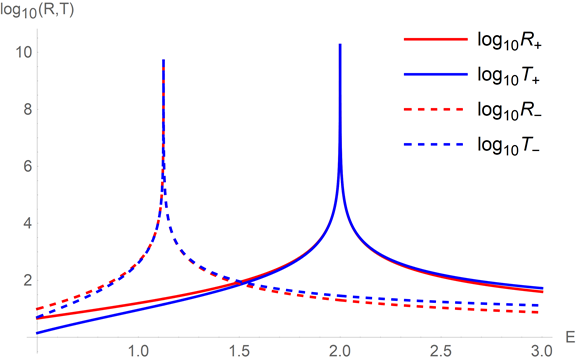 Figure 1
Peer Reviews
No public reviews on file for this paper yet. If you reviewed it on a platform where reviews are public (OpenReview, ICLR, NeurIPS, ICML), you can paste yours below so the community can read it here.
Videos
No videos yet. Explain this paper in a talk, walkthrough, or lecture? Add one.
**New scattering features of quaternionic point interaction in non-Hermitian quantum mechanics **
Mohammad Hasan 111e-mail address: [email protected], [email protected] and Bhabani Prasad Mandal 222e-mail address: [email protected], [email protected]
1*ISRO Head Quarters , Bangalore-560231, INDIA
1,2Department of Physics, Banaras Hindu University, Varanasi-221005, INDIA.
Abstract
The spectral singularity have been extensively studied over the last one and half decade for different non-Hermitian potentials in non-Hermitian quantum mechanics. The nature of spectral singularities have not been studied for the case of quaternionic potential. In the present work we perform an analytical study for the scattering from a quaternionic point interaction represented by delta function. New features of spectral singularities are observed which are different than the case of complex (non-quaternionic) point interaction. Most notable difference is the occurrence of spectral singularity from lossy point interaction which is forbidden in the case of standard non-Hermitian quantum mechanics.
1 Introduction
The early work of Birkhoff and Neumann [1, 2] led to the possibility of formulating the quantum mechanics over quaternions. Since then it remains an open question whether quantum mechanical dynamics require a generalization of complex numbers over quaternion numbers or over other hyper-complex numbers. Does nature prefers complex numbers over quaternions is an experimental problem to be probed. However to enable this an accurate prediction based on theoretical grounds are required to understand the experimental domain where a departure in predicted outcome of Hermitian quantum mechanics (HQM) and quaternionic quantum mechanics (QQM) is expected in experimental results. Various authors have made their contributions towards this.
The generalization of HQM to QQM doesn’t imply additional degree of freedom in the theory. QQM is fundamentally different than HQM but does not modify the postulate of quantum mechanics. One of the disagreement between HQM and QQM is the commutativity of phases. Quaternions rotation does not commute, thus the phases in QQM shows non-commutativity. In 1979, Asher Peres proposed several experiments (Bragg scattering, neutron diffraction and meson regenerations) [3] for testing the presence of quaternionic effects by observing non-commutativity of phases. The non-commutativity of phases at the wave function level was shown by Davies et al. [4]. In 1984 , Kaiser et al. performed the first experiment using neutron interferometry to search for quaternions in quantum mechanics [5]. In this experiment a phase change was looked in the transmitting beams of neutron by reversing the order of two metal targets. No such phase difference was found. It was later shown that the quaternionic effects decay exponentially for massive particles [6] and thus the neutron interferometry experiments did not probe the quaternionic effects. Adler pointed towards the CP-Nonconservation interaction at mass scale of about 20 TeV as a result of underlying quaternionic effects in particle interaction [7]. Due to technological limitations no further test were performed until 2016. Procopio et al. [8] performed single photon test by using a Sagnac interferometer. The two very different optical media used were liquid-crystal and fishnet metamaterial with negative refractive index (at 780 nm). The phase shift between the two modes of the Sagnac interferometer yield a bound of indicating that phase commutes with high accuracy. See [9, 10] for critical comments on the experiment.
For the case when quaternion Hamiltonian is anti-Hermitian, the probability is conserved and unitarity condition is satisfied in the scattering problems. This makes the QQM as the theory of anti-Hermitian operators [6]. The scattering problems of anti-Hermitian scalar potential in QQM have been studied for relativistic and non-relativistic cases both. Due to the mathematical complexity involved with quaternionic algebra, these problems have been limited for simple potential configurations such as delta [11, 12], double delta [13], rectangular [14, 15] and step potential [16, 17]. To the best of our knowledge the scattering properties from a non-anti-Hermitian quaternionic quantum potential has not been studied so far.
The motivation for the present work arise due to the recent works by S. Giardino [18, 19] and the tight (small) experimental bound on the non-commutativity of phases in QQM [8]. Ref [18] posed the question on the necessity of anti-Hermitian assumption in QQM. Ref [19] propose a non-anti-Hermitian QQM as quaternionic generalization of previously known (non-quaternionic) non-Hermitian quantum mechanics (NHQM). The non-Hermitian systems with real energy eigenvalues has become the topic of frontier research over the last two decades. It is because that one can have a consistent quantum theory by restoring the Hermiticity and upholding the unitary time evolution for such a system in a modified Hilbert space [20]-[22]. The non-Hermitian Hamiltonian (NHQM) shows several new features which are absent in the case of Hermitian Hamiltonian. These are exceptional points (EPs) [23]-[25], spectral singularity (SS) [26]-[29], invisibility [28]-[32], reciprocity [28]-[33], coherent perfect absorption (CPA) [34]-[42], critical coupling (CC) [43]-[47] and CPA-laser [48]. In optical domain, some of the features have been verified experimentally [49]-[52]. The experimental realization of the predictions of non-Hermitian theory have further boosted huge interest in the study of non-Hermitian system in experimental as well as in theoretical domains. Recently CPA and SS were also studied in the context of non-Hermitian fractional quantum mechanics [53].
The experimental result of [8] strongly indicate the need for the exploration of more sensitive deviation of quaternionic effects. One such domain to search for sensitive deviation is the study of spectral singularity in the scattering problem of non-anti-Hermitian QQM. Spectral singularities are characterize by the simultaneous divergence of reflection and transmission amplitude from a non-Hermitian potential (see [54] for detail discussion and references therein). These are also called as zero width resonance and found to be extremely sensitive to the dimension of interacting region [55]. As stated above it is proposed that [19] non-anti-Hermitian QQM can be possibly formulated as a generalization of NHQM, it is most desirable to study the scattering features in the domain of non-anti-Hermitian QQM and study for the possible deviation in the scattering features between non-anti-Hermitian QQM and NHQM. To provide analytical understanding (and thus avoiding transcendental equations), we chose point interaction represented by quaternionic (single) delta potential for our study of spectral singularity in non-anti-Hermitian QQM. The objective of the present work is not to propose an experiment to test the quaternionic effects rather the analytical understanding of the deviation of scattering features (SS here) between non-anti-Hermitian QQM and NHQM. We found the new features of SS occurrence in non-anti-Hermitian QQM which are forbidden in the case of standard NHQM.
We organize the paper as follows: In section 2 we briefly introduce the reader with quaternionic quantum mechanics. Section 3 present our detail analytical calculation for the investigation of spectral singularity from quaternionic delta potential. In this section we also discuss new features of SS and the limiting cases. The results are discussed in section 4. Throughout the test we use ‘non-Hermitian QQM’ to distinguish it from ‘anti-Hermitian QQM’.
2 Quaternionic quantum mechanics
The non-relativistic quaternionic quantum mechanics is governed by quaternionic form of Schrodinger equation. The quaternionic Schrodinger equation is
[TABLE]
where is non-Hermitian scalar potential and is expressed in terms of quaternion. is given by
[TABLE]
Here and are three imaginary units with the properties . Also . The property makes quaternion numbers non commutative.
When potential i.e. independent of time we have the time independent quaternionic Schrodinger equation. This is given by
[TABLE]
where now and . The imaginary units have the same properties as defined above. It is evident that in the limit , , we recover the standard Schroedinger equation.
3 Scattering features from non-Hermitian delta potential in quaternionic quantum mechanics
The scattering coefficient from an anti-Hermitian quaternionic Dirac delta potential in one dimension
[TABLE]
has been computed in [11]. The reflection and transmission coefficients are given by
[TABLE]
and
[TABLE]
where
[TABLE]
, and for . When then the quaternionic delta potential given by eq. 4 is non-anti-Hermitian delta potential. For simplicity we consider . Thus our non-anti-Hermitian delta potential is
[TABLE]
with and . From eq. 5 and 6 we see that for spectral singularity we must have . Substituting , in eq. 7 we obtain
[TABLE]
Here
[TABLE]
[TABLE]
[TABLE]
[TABLE]
[TABLE]
Therefore to find the spectral singularity we have to solve the following quartic equation
[TABLE]
for . As we have to find the positive energy at which spectral singularity occurs we have to solve the above equation for roots such that . To find the nature of the root we first investigate the determinant of eq. 15. The determinant of quartic eq. 15 is well known and is given by
[TABLE]
Substituting the values of in the expression of determinant we have for the current problem
[TABLE]
where
[TABLE]
[TABLE]
From the properties of quartic function it is known that if then two roots are distinctly real. For the case , then either all the four roots are real or none is. In this case the nature of the roots depend upon the sign of
[TABLE]
and
[TABLE]
If and , then all the roots are real. From eq. 18 we see that . Thus the sign of the determinant is decided by the sign of . Substituting the values of in eq. 20 and 21 we have
[TABLE]
and
[TABLE]
From eq. 22 we observe . Thus if or there is no real number which satisfies eq. 15. Now we investigate the possibility of . For this we must have i.e.
[TABLE]
with and . For the inequality 24 is satisfied for the range of given by
[TABLE]
which is equivalent to
[TABLE]
This shows that there doesn’t exist for which inequality 24 can be satisfied. This essentially indicates that for a chosen pair , such that , the quaternionic delta potential doesn’t show spectral singularity. However it must be noted that the above arguments is not entirely accurate in ruling out the existence of SS in quaternionic delta potential. The logics and calculated results presented above shows that for a ‘free’ set of chosen numbers , one may not get SS in quaternionic delta potential. To investigate further we write
[TABLE]
where
For SS to occur , must vanish simultaneously. Thus must satisfy
[TABLE]
and,
[TABLE]
Eq. 28 is independent of while eq. 29 is dependent on . This shows that for to satisfy above two equations, can not be a ‘free’ parameter and must depend on . Solutions of eqs. 28 and 29 gives allowed value of as
[TABLE]
The quaternionic delta potential depict SS at energy.
[TABLE]
where is given from eq. 30. In the above we have used . It is to be noted that for a given pair , not all values of obtained from eq. 30 will support SS. As , this implies that . The other restriction is . The expressions for is given below which can be obtained by substituting in eq. 29.
[TABLE]
With the restrictions mentioned above, we investigate the parameter space of for which the quaternionic delta system support SS. Imposing the condition and , we see that for , the allowed values of are . For the range of is to support SS. For condition and to satisfy simultaneously the only parameter space are where . The most interesting outcome is to note that SS exists even when complex part (as ). This is forbidden in standard non-Hermitian quantum mechanics. Further for a given one can have a lossy point interaction as . Thus a suitably chosen lossy quaternionic delta potential can exhibit SS. In general a lossy quaternionic delta potential with always shows SS at energy given from eq. 31 : at provided is given from eq. 30. The graphical representation of SS for is shown in Fig 1 for the case when quaternionic part are given from with the condition . In both cases ( and ), SS occur at energy calculated from eq. 31 which verifies our calculations. It is also observed that SS can also exists even when real part of quaternionic delta potential is greater than zero which is forbidden in case of non-quaternionic complex delta potential [56].
It can be verified that for , we have and thus the quaternionic delta potential reduces to a pure complex delta potential . As discussed above , (i.e. ) will have SS provided . This means that imaginary part of is positive. Further using eq. 31 it can be shown that SS occur at energy which is the well known result of standard NHQM [56]. This verifies our calculation in appropriate limit. For the other solution (), implies and correspondingly . In this limiting case is largely independent of and thus independent on . Thus a quaternion delta potential having only and components (along with real component) doesn’t support SS ( in this case). Further a finite quaternion delta potential such that and support SS at a near-zero energy given by . This is different than the results of standard NHQM in which case a near-zero energy SS also means vanishing strength of imaginary delta potential [56].
4 Conclusions and Discussions
In this work we have analytically studied the occurrence of spectral singularity (SS) from a point interaction represented by quaternionic delta potential. It is shown that the quaternionic delta potential support SS for specific values of the parameters of the potential. Unlike the case of standard NHQM, the quaternion delta potential can support SS even when where represent the real part. It is also observed that SS occur when where represent the coefficient of imaginary number . This case is not supported in standard NHQM for the occurrence of SS as it represent a lossy interaction. It is shown further that our results of non-Hermitian QQM correctly reduces to the limiting case of standard NHQM. A delta interaction with large quaternionic strength can support SS at vanishingly small energy in non-Hermtian QQM. This is again different than the delta interaction of standard NHQM in which occurrence of SS at vanishingly small energy demands vanishing small strength of delta interaction as well [56]. We hope that understanding the deviations of non-Hermitian QQM to that of standard NHQM will pave way for new methodologies to search for quaternionic effects in quantum mechanics.
Acknowledgements:
MH acknowledges support from Director, SSPO/ ISRO to carry out this research work. BPM acknowledges the support from CAS, Department of Physics, BHU.
The reference list from the paper itself. Each links out to its DOI / PubMed record.
- 1[1] G. Birkhoff and J.V. Neumann, Ann. Math. , 37 , 823 (1836).
- 2[2] J. V. Neumann , Mathematical Foundations of Quantum Mechanics , Princeton University Press, Princeton (1955).
- 3[3] A. Peres, Phys. Rev. Lett. , 42 , 683, (1979).
- 4[4] A. J. Davies, B.H.J. Mc Kellar, Phys. Rev. A , 46 , 3671 (1992).
- 5[5] H. Kaiser et. al, Phys. Rev. A . 29 , 2276 (1984).
- 6[6] S.L. Adler, S. Quaternionic Quantum Mechanics and Quantum Fields , Oxford University Press (1995).
- 7[7] S.L. Adler, Phys. Rev. Lett. 57 , 167, (1986).
- 8[8] L. M. Procopio et. al, Nature Comm. , 8 : 15044, doi:10.1038/ncomms 15044 ,(2017).