The periodic table of the elements with $4n^{2}$ $n=2,3,\dots$ periods
Gregory Beylkin

TL;DR
This paper proposes a modified periodic table with $4n^{2}$ periods, redefining periods by halogens and integrating rare-earth elements without separation, supported by ionization energy comparisons.
Contribution
It introduces a novel periodic table arrangement with $4n^{2}$ periods, redefining period boundaries and maintaining rare-earth elements within the main table.
Findings
Periods are defined by halogens instead of noble gases.
Ionization energy graphs support the new period structure.
Rare-earth elements are kept within the main table without separation.
Abstract
A modification of the standard periodic table of the elements reveals periods, where . The new arrangement places hydrogen with halogens and keeps the rare-earth elements in the table proper (without separating them as they are in the standard table). Effectively, periods in the modified table are defined by the halogens rather than by the noble gases. The graph of ionization energy of the elements is presented for comparison of periods in the standard and the modified tables.
Click any figure to enlarge with its caption.
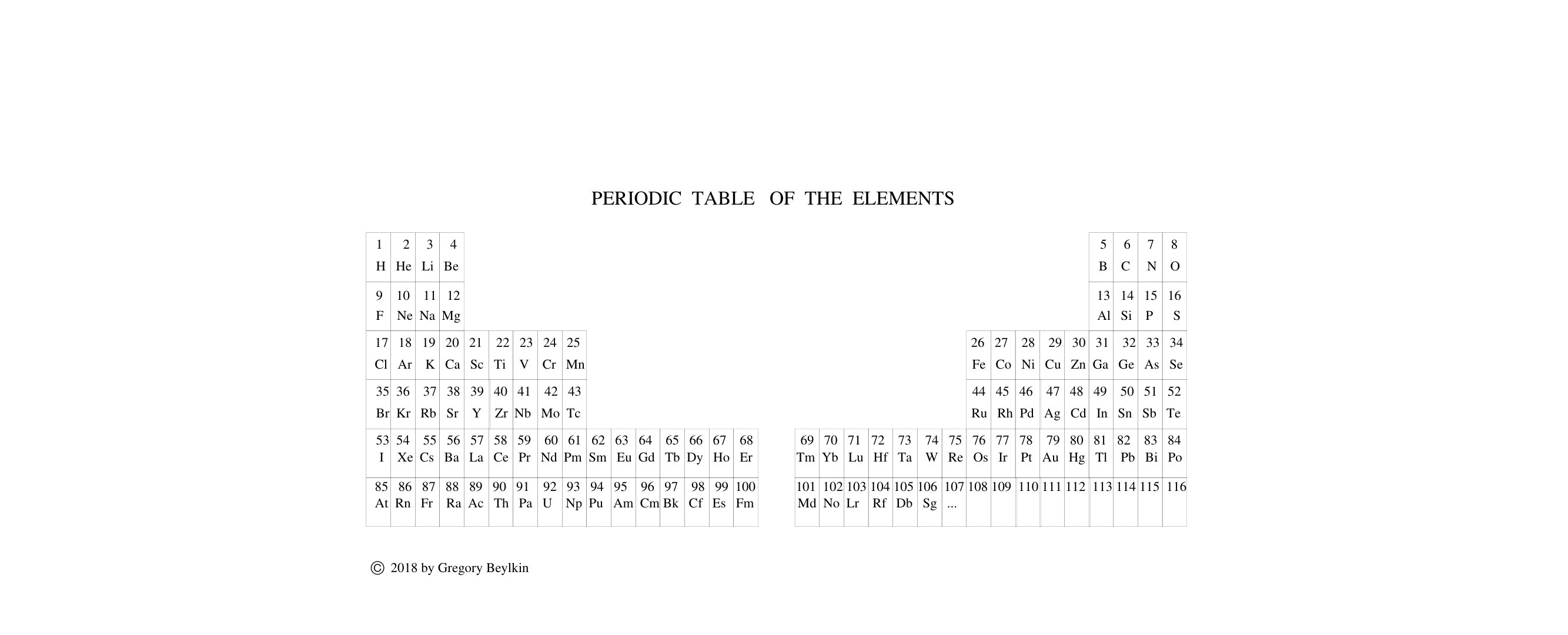 Figure 1
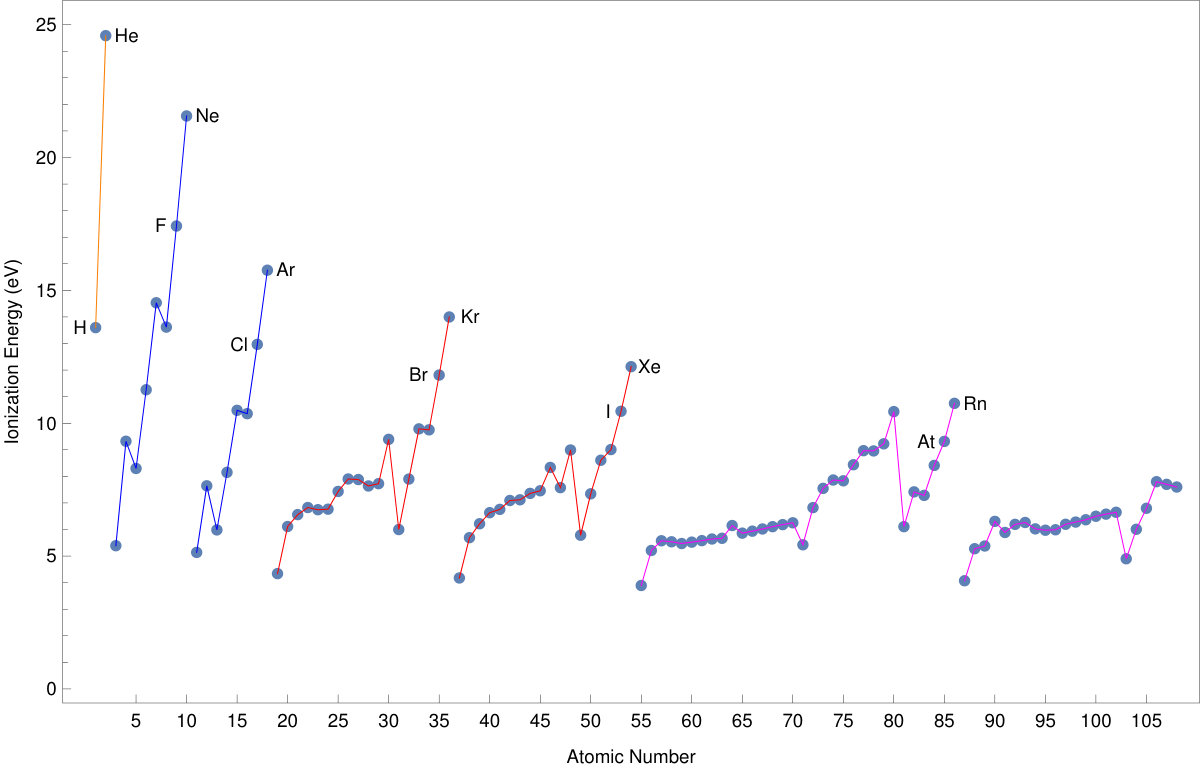 Figure 2
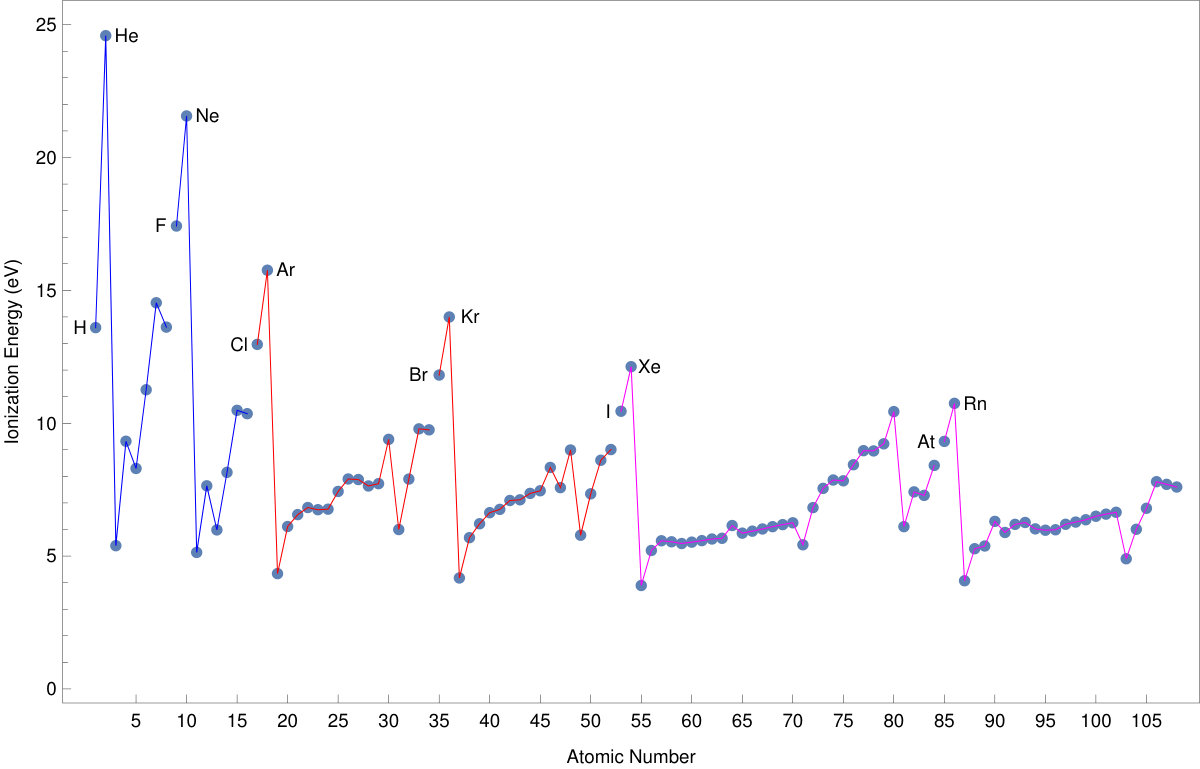 Figure 3
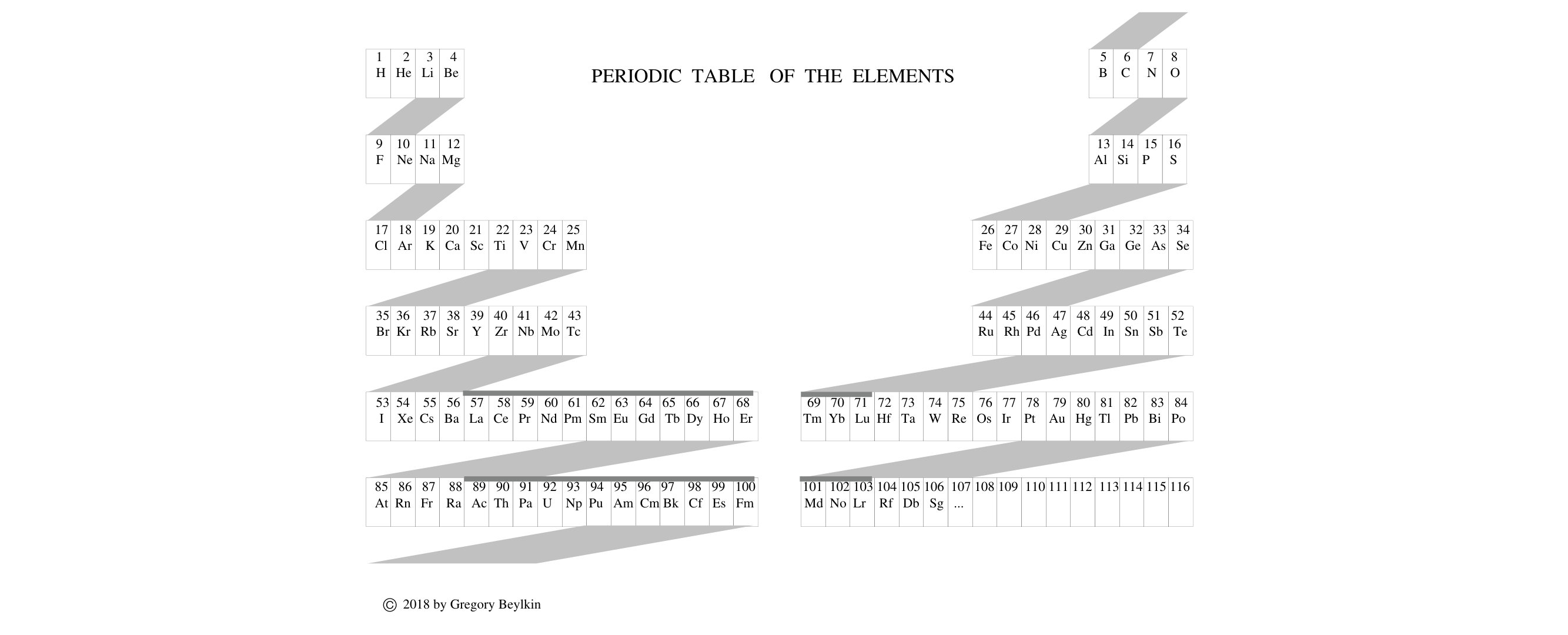 Figure 4
Peer Reviews
No public reviews on file for this paper yet. If you reviewed it on a platform where reviews are public (OpenReview, ICLR, NeurIPS, ICML), you can paste yours below so the community can read it here.
Videos
No videos yet. Explain this paper in a talk, walkthrough, or lecture? Add one.
Taxonomy
TopicsHistory and advancements in chemistry · Chemical Thermodynamics and Molecular Structure · Advanced Chemical Physics Studies
the periodic table of the elements with periods
G. Beylkin
Department of Applied Mathematics
University of Colorado at Boulder
526 UCB
Boulder, CO 80309-0526
Abstract.
A modification of the standard periodic table of the elements reveals periods, where . The new arrangement places hydrogen with halogens and keeps the rare-earth elements in the table proper (without separating them as they are in the standard table). Effectively, periods in the modified table are defined by the halogens rather than by the noble gases. The graph of ionization energy of the elements is presented for comparison of periods in the standard and the modified tables.
1. Introduction
Since the periodic table of the elements was first published by Mendeleev in 1869, there were many attempts to find the “most natural” representation of the periodic law. These attempts to structure the periodic table were numerous in the beginning of 20th century and are well documented in [3]. The periodic law has been qualitatively explained with the advent of Quantum Mechanics (QM) and, for many years now, the periodic table remains virtually unchanged. The standard table may be found in any Chemistry textbook (for many variants of the standard layout see e.g. [1]). The qualitative QM explanation of the periodic table uses the Schrödinger’s equation with the central potential and the Pauli’s exclusion principle stating that two or more identical fermions cannot occupy the same quantum state. Since the eigenvalues of the Schrödinger’s equation have multiplicity , , combined with the Pauli’s exclusion principle, it leads to periods of length in the periodic table (see a more detailed discussion later). In other words, in the standard periodic table a period finishes with the filling of an electron shell and, therefore, the standard table of the elements consists of periods of increasing lengths between noble gases. Indeed, the first period of the periodic table has two elements, followed by two periods of elements, two periods of elements, a period of elements and an incomplete period.
On the other hand, the eigenvalues of the relativistic Dirac’s equation with the central potential have multiplicity , ,. If we were to add two spin states of the nuclei, then the multiplicity becomes . We note that the law for the length of periods was suggested early on by Rydberg (see comments in [3]). However, if we attempt to build the periodic system starting with (so that the first period has length ), then the resulting table is inconsistent.
In this note we show that by starting with , the periods of length yield a simpler and a more symmetric form of the periodic table. Consequently, we introduce a new form of the periodic table of the elements which, due to the new definition of the period, has symmetry and consistency superior to that of the standard table. In the new form of the table a period finishes one element before a halogen and thus has a different meaning than in the standard table. The periods in the new table are of length (or twice ), where .
In the new table there is no need to separate the lanthanide and actinide elements from the main table and hydrogen has its proper place among halogens. The new table consists of six periods. It has two periods of elements (, ), two periods of elements, (, ), and two periods of elements (, ). Remarkably, the new periodic table does not significantly change the composition of the groups of elements. Only four groups of the new periodic table partially differ in their arrangement from that of the standard table. We discuss this difference below.
As additional evidence that the new arrangement of the elements adequately incorporates properties of the elements, we present the ionization curve which we split into segments according to the periods of the new table and compare it with the corresponding segmentation of the ionization curve according to the standard table.
2. Construction of the new periodic table
Let us take a continuous strip of paper and, on one side of the strip, write all the elements in the order of their atomic numbers. We then form a spiral with the strip such that the two most chemically distinct groups, the group of halogens (in which we include hydrogen) and the group of noble gases, are properly aligned. By flattening the strip on a plane and folding it in the middle, we obtain the new periodic table depicted in Figure 1.1. The gray sloping strips indicate the back side of the strip when folded into a spiral. These gray strips are present in Figure 1.1 to illustrate the way this table was initially obtained and are removed in Figure 1.2. A quick examination confirms a highly symmetric form of the new table.
Remark*.*
The first element of the periodic table, hydrogen, can be considered to be either an alkali metal or a halogen. In the standard table hydrogen is an alkali metal and the periods finish one element before the next alkali metal (i.e., noble gases are the last elements of a period). Our construction treats hydrogen as a halogen and, therefore, periods finish one element before the next halogen. This is the new definition of the period which allows us to arrive at the construction in Figure 1.1.
Comparison of groups in the new and the standard periodic tables
An examination of groups of the elements in the new periodic table in Figure 1.2 shows that all the groups are exactly the same as in the standard table with the exception of a partial rearrangement of four groups. These groups in the new table are: , , and . The corresponding groups in the standard table are: , , and .
We note, however, that these rearrangements are among the elements which have many similar properties and, therefore, their grouping is acceptable in more than one way. Moreover, in some older tables these four groups were organized as in the new table in Figure 1.2. The reason for later regrouping of the rare-earth elements was the difficulty of accommodating all of them in the main table. The solution offered to that problem was to remove the lanthanide and the actinide elements from the main table. This caused a rearrangement of the groups in question leading to the current form of the standard table.
In the new table in Figure 1.2 the lanthanide and the actinide elements are a part of the main table and there is nothing special in their classification. Besides the rare-earth element problem resolved in this simple way, hydrogen (which is at the other end of the periodic table) has its proper place among halogens.
To conclude, the new periodic system does not cause any problems with classification of the elements into groups. Instead, it adds a great amount of simplification since all the elements are now in the table proper.
3. **A pseudo-periodicity of the ionization curve and its relation
to the new periodic system**
The fact that the ionization curve has pseudo-periodic properties was always given as a supporting fact for the periodic recurrence of the properties of the elements. Subdivision of the ionization curve into the segments according with the new definition of a period reveals similarity between all of the segments. This is illustrated in Figure 3.1 where we have highlighted the subdivision of the curve according to the periods in the new table and, for comparison, show the subdivision according to the periods in the standard table.
4. On mathematical models for hydrogen and atomic structure.
The models for hydrogen and the atomic structure of the elements are both based on the mathematical model of a charged particle in the central field. Specifically, the eigenvalues of the Schrödinger’s equation with the central potential together with the added requirement for the wave function to be antisymmetric, produce eigenvalues with multiplicity , where is the principal quantum number. Since the elements are multi-electron systems for which we currently cannot solve the multiparticle Schrödinger’s equation directly, simpler models have been devised to evaluate electron configuration of atoms. For example, the Hartree-Fock (H-F) equations are arrived at starting from the multiparticle Schrödinger’s equation by assuming a separable approximation and enforcing antisymmetry by using the Slater determinant as the wave function. The resulting effective potential (which is now evaluated in the process of solving H-F equations) is no longer spherically symmetric and eigenvalues split if compared with the corresponding model of a charged particle in the central field. Consequently, the electron structure can then be described by introducing a shell model which qualitatively explains the standard periodic system of the elements leading to periods of length .
The experimental evidence shows that hydrogen spectrum can be split (the so-called fine and superfine structures), so that the actual multiplicity of eigenvalues in a model of two charged particles should be . Such multiplicity of the spectrum can be arrived at by considering the spin of proton and using the exclusion principle for the wave function to account for the spins of both, electron and proton. This bring us to the relativistic Dirac’s equation for a charged particle with spin which can be solved exactly yielding energy levels for a fixed principal quantum number , where the number of levels does not depend on the charge of the particle [2]. However, there is no equation describing the complete interaction between electron and proton. The superfine structure is obtained as a perturbation to the energy levels that follow from the Dirac’s equation. Furthermore, turning to multi-electron atoms, there is no accepted “multiparticle Dirac equation” at this time and relativistic effects are estimated as corrections to the solutions of non-relativistic equations.
The new form of the periodic system in Figure 1.2 is interesting in that it explicitly reveals periods of length which consist of two sub-periods of the length . If we apply the Pauli’s exclusion principle to both electrons and nucleons of the elements and, therefore, require the full wave function to be antisymmetric with respect to exchanges of (separately) electrons and nucleons, then it is reasonable to expect the periodicity. While the standard table also has these periods, they are “hidden” by having the first period with just two elements, hydrogen and helium. Note that hydrogen does not have a definite place in the standard table since one can think of it having only one electron or, alternatively, missing one electron to form a closed shell. In the new table it found its place with halogens. At the same time, the rare earth elements are not separated from the main table.
Currently there is no firm quantitative basis for selecting the new periodic table over the standard one, although it is easy to argue that the new form of the periodic table has a simpler structure than the standard table. Hopefully, this well structured arrangement will challenge and stimulate the development of methods for quantitative description of the elements and, in particular, further development of relativistic multiparticle models of atomic structure.
The reference list from the paper itself. Each links out to its DOI / PubMed record.
- 1[1] https://www.meta-synthesis.com/index.html.
- 2[2] P. A. M. Dirac , The principles of quantum mechanics , no. 27, Oxford University Press, 1981.
- 3[3] J. W. Spronsen , The Periodic System of Chemical Elements: A History of the First Hundred Years , Elsevier, 1969.