Quantum teleportation using highly coherent emission from telecom C-band quantum dots
M. Anderson, T. M\"uller, J. Huwer, J. Skiba-Szymanska, A.B. Krysa,, R.M. Stevenson, J. Heffernan, D.A. Ritchie, and A.J. Shields

TL;DR
This paper demonstrates that telecom C-band quantum dots can produce highly coherent photons suitable for quantum teleportation and quantum networks, with coherence times exceeding 1 ns and high teleportation fidelity.
Contribution
It introduces highly coherent InAs/InP quantum dots emitting in the telecom C-band, enabling quantum teleportation with high fidelity and advancing quantum communication technologies.
Findings
Photon coherence times >1 ns under non-resonant excitation
Teleportation fidelity of 88.3% in six bases
High interference visibility limited by multiphoton emission
Abstract
A practical way to link separate nodes in quantum networks is to send photons over the standard telecom fibre network. This requires sub-Poissonian photon sources in the telecom wavelength band around 1550 nm, where the photon coherence time has to be sufficient to enable the many interference-based technologies at the heart of quantum networks. Here, we show that droplet epitaxy InAs/InP quantum dots emitting in the telecom C-band can provide photons with coherence times exceeding 1 ns even under non-resonant excitation, more than a factor two longer than values reported for shorter wavelength quantum dots under similar conditions. We demonstrate that these coherence times enable near-optimal interference with a C-band laser qubit, with visibilities only limited by the quantum dot multiphoton emission. Using entangled photons, we further show teleportation of such qubits in six…
Click any figure to enlarge with its caption.
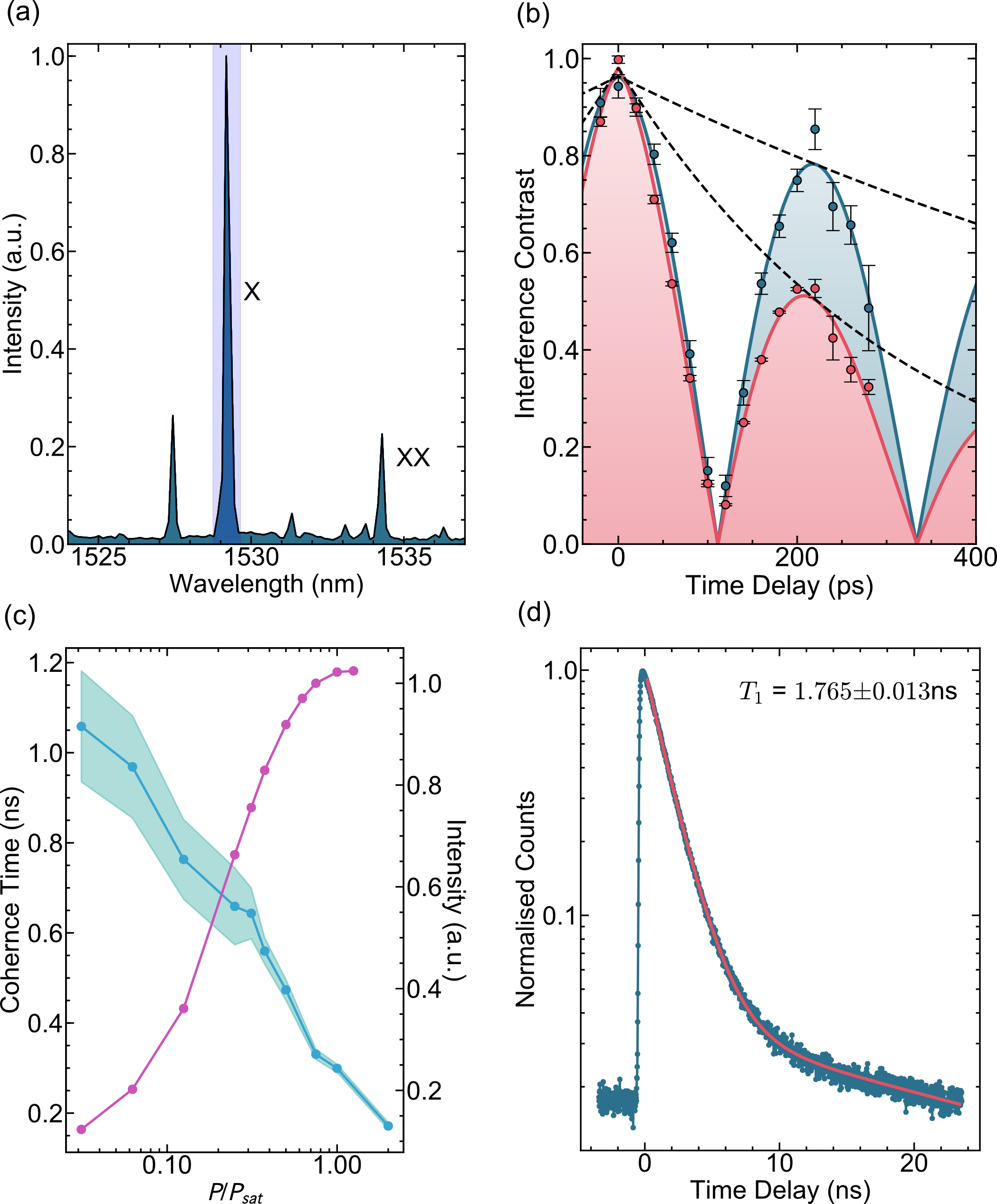 Figure 1
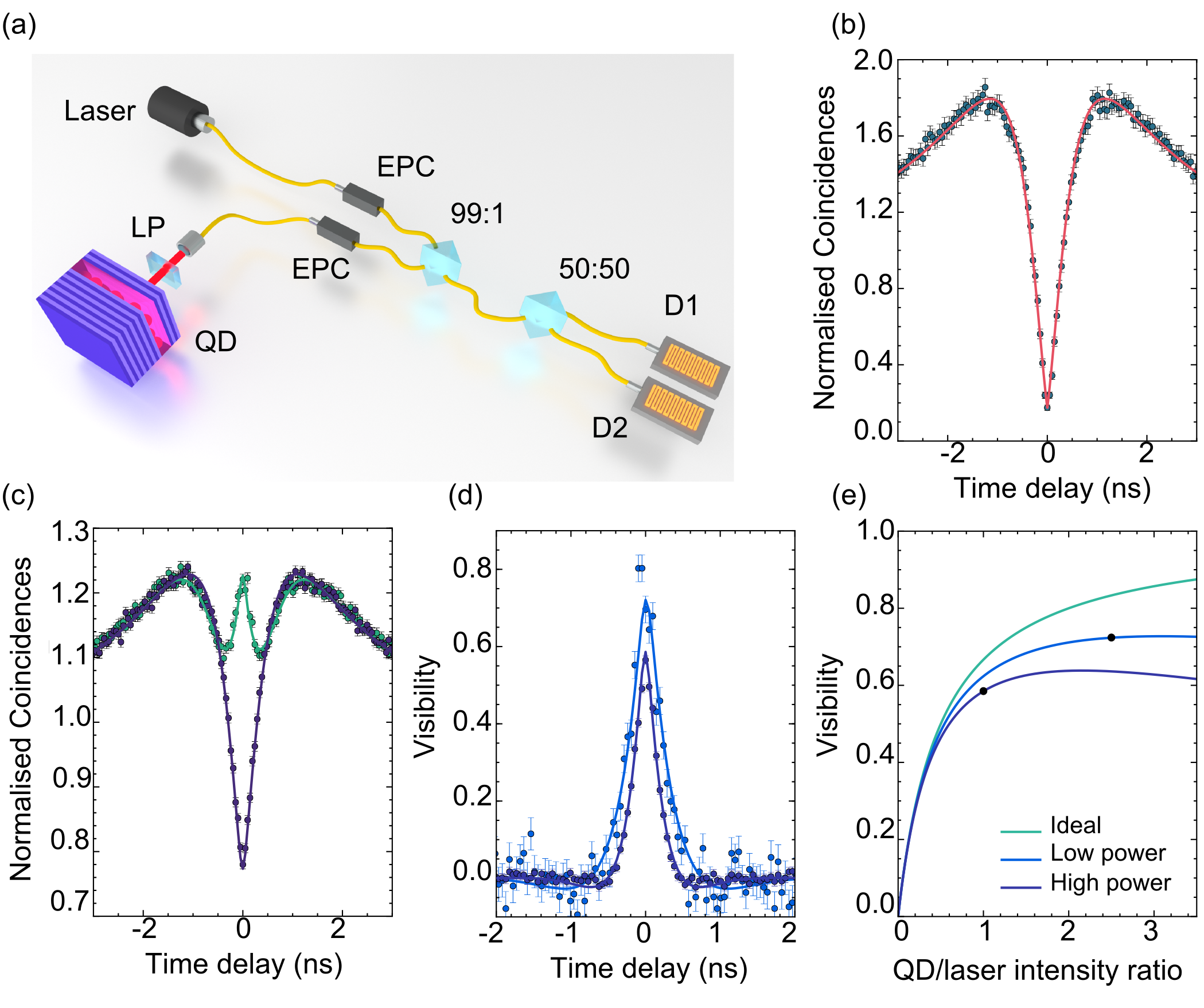 Figure 2
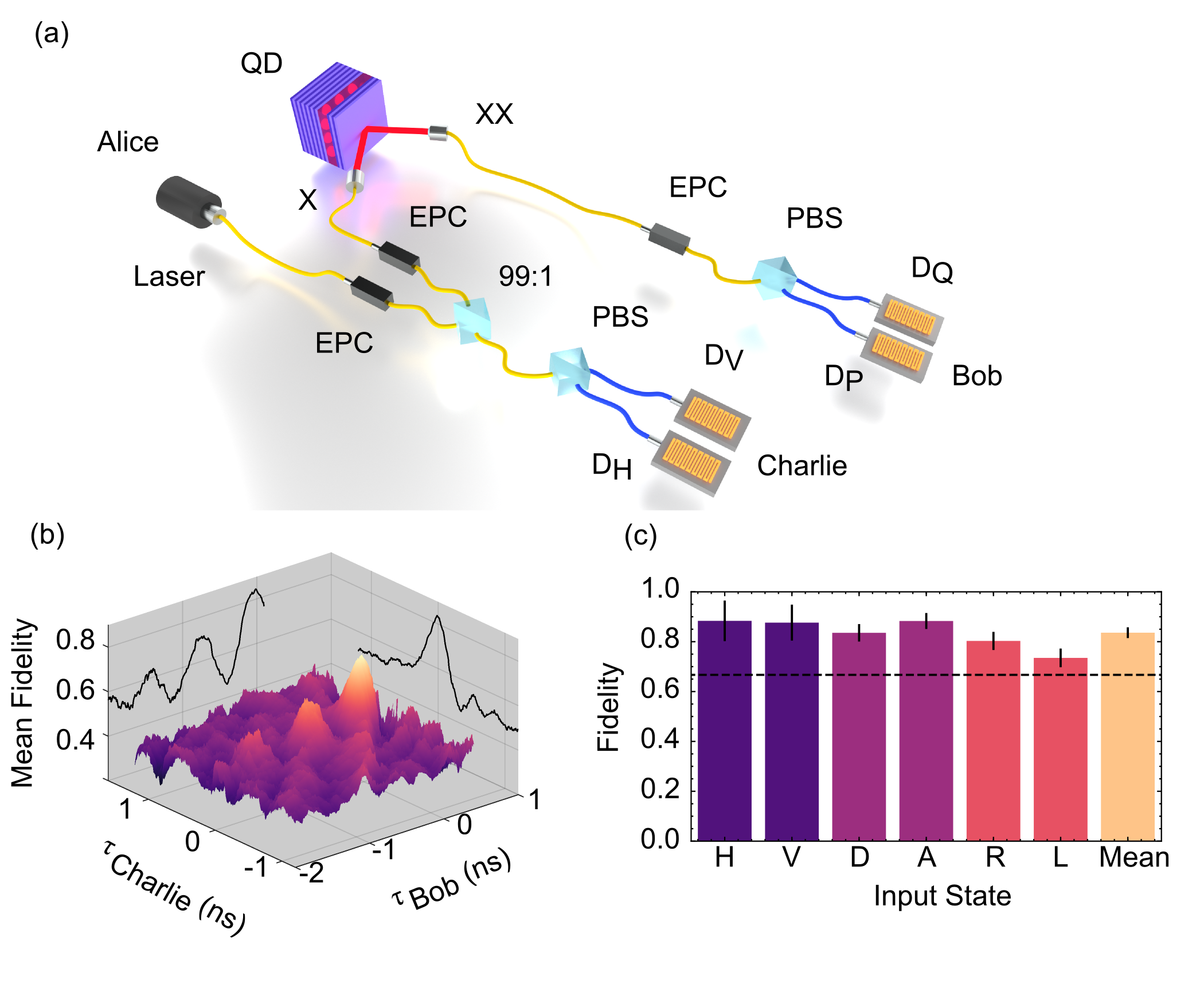 Figure 3
Peer Reviews
No public reviews on file for this paper yet. If you reviewed it on a platform where reviews are public (OpenReview, ICLR, NeurIPS, ICML), you can paste yours below so the community can read it here.
Videos
No videos yet. Explain this paper in a talk, walkthrough, or lecture? Add one.
Quantum teleportation using highly coherent emission
from telecom C-band quantum dots
M. Anderson1,2
T. Müller1
J. Huwer1
J. Skiba-Szymanska1
A.B. Krysa3
R.M. Stevenson1
J. Heffernan4
D.A. Ritchie2
A.J. Shields1
1 Toshiba Research Europe Limited, 208 Science Park, Milton Road, Cambridge, CB4 0GZ, UK
2 Cavendish Laboratory, University of Cambridge, JJ Thomson Avenue, Cambridge, CB3 0HE, UK
3 EPSRC National Epitaxy Facility, University of Sheffield, Sheffield, S1 3JD, UK
4 Departement of Electronic and Electrical Engineering, University of Sheffield, Sheffield, S1 3JD, UK
Abstract
A practical way to link separate nodes in quantum networks is to send photons over the standard telecom fibre network. This requires sub-Poissonian photon sources in the telecom wavelength band around 1550 nm, where the photon coherence time has to be sufficient to enable the many interference-based technologies at the heart of quantum networks. Here, we show that droplet epitaxy InAs/InP quantum dots emitting in the telecom C-band can provide photons with coherence times exceeding 1 ns even under non-resonant excitation, more than a factor two longer than values reported for shorter wavelength quantum dots under similar conditions. We demonstrate that these coherence times enable near-optimal interference with a C-band laser qubit, with visibilities only limited by the quantum dot multiphoton emission. Using entangled photons, we further show teleportation of such qubits in six different bases with average fidelity reaching 88.34%. Beyond direct applications in long-distance quantum communication, the high degree of coherence in these quantum dots is promising for future spin based telecom quantum network applications.
Photonics, Quantum Information, Semiconductor Physics
I Introduction
Quantum network technologies Kimble (2008), ranging from quantum teleportation Fattal et al. (2004) and its applications in quantum communication Briegel et al. (1998); Nilsson et al. (2013); Huwer et al. (2017), to heralded entanglement Bernien et al. (2013) and quantum computing Knill et al. (2001), rely on interference of indistinguishable photons, and demand sources of highly coherent photons with sub-Poissonian statistics. To establish larger scale quantum networks over the standard telecom fibre network, the photons should further have a wavelength in the minimum loss telecom C-band around 1550 nm.
Solid-state quantum systems, most prominently semiconductor quantum dots (QDs) and defects in diamond, are well established candidates for emerging quantum technologies. Significant work in this field has developed the basic building blocks of a quantum network, such as near-ideal photon sources Somaschi et al. (2016), deterministic entanglement between distant spins Humphreys et al. (2018), and teleportation of qubits Nilsson et al. (2013). However, these systems have in common that their wavelength in the visible and near infrared up to about 900 nm prevents wider integration using the standard optical fibre infrastructure due to the strong attenuation ( 1dB/km) at those wavelengths. Recent efforts have pushed QD emission to the telecom O-band at 1310 nm Huwer et al. (2017) (0.3 dB/km), and the C-band (0.15 dB/km), where single and entangled photon pair sources were reported Kim, D. et al. (2005); Olbrich et al. (2017); Müller et al. (2018). However, the coherent emission necessary for all interference-based quantum network applications has not yet been reported from any solid-state single photon emitter in that band.
Alternatively, technologies based on wavelength conversion of single photon sources or non-linear optical processes have successfully been used to reach the telecom C-band and demonstrate two-photon interference Weber et al. (2018) as well as teleportation over several kilometers Sun et al. (2016); Valivarthi et al. (2016), respectively. But these approaches are limited in efficiency due to the losses during the conversion process, or the Poissonian statistics underlying attenuated laser pulses that therefore require an additional layer of complexity to guarantee optimal operation.
Here, we demonstrate coherent emission from InAs/InP QDs emitting in the standard telecom window, through measurement of single and two-photon interference. We show further the power and utility that this photonic platform offers in quantum information by teleporting a telecom C-band polarization encoded qubit.
II Singe-photon interference
The experiments we report here use metalorganic vapor-phase epitaxy grown droplet InAs QDs on an InP substrate. To increase photon extraction efficiency, the QDs are embedded in a planar cavity between p-doped repeated layers of distributed Bragg reflectors on the top and n-doped layers at the bottom. The sample is similar to that used in our recent work Müller et al. (2018). The device is operated at 8.5 K in a temperature controlled Helium vapor cryostat. Emission from a single QD is collected using a standard confocal microscope (NA=0.68) coupled to a single-mode fibre. We excite the QD using a non-resonant continuous-wave laser diode at 785 nm. A photoluminescence spectrum taken at the pump power where the neutral exciton () intensity saturates () is shown in Fig. 1(a). We observe several isolated emission lines, and identify the and biexciton () transitions by polarization spectroscopy and intensity correlations.
The coherence time of single photons can be measured with high temporal resolution through first-order field-correlation measurements using Fourier Transform Spectroscopy Zwiller et al. (2004). For this we use a single-mode optical fibre-based Michelson interferometer, where an optical delay line allows us to vary the delay between the arms coarsely and a fibre stretcher to measure interference fringes. When one arm of the interferometer is varied using the fibre stretcher, we measure single-photon interference as oscillations in the output intensity. Along with the delay line and fibre stretcher, Faraday mirrors are used at the end of both arms to compensate for polarization rotations and fluctuations in the fibres. The interference fringe visibility is defined as
[TABLE]
where and correspond to the cases of constructive and destructive interference, respectively. Interference fringes are then fitted to extract this visibility at different coarse delays.
Two example visibility measurements performed on the quantum dot transition at excitation powers of 0.75 and 0.03 are given in Fig. 1(b), where the latter is chosen as the lowest power with a sufficient signal-to-noise ratio for the measurement. For both powers, the decay of the visibility displays a characteristic beating pattern in the fringe contrast resulting from the fine-structure splitting (FSS) of the . However, the envelope of the oscillations decays more slowly for lower driving powers. The Fourier transform of a double Lorentzian was used to fit our data, and has the form
[TABLE]
where is the fringe contrast at zero delay, is the coherence time, and is the central energy difference. The fringe contrast accounts for experimental imperfections, but remains close to unity for all measurements presented here. From the fit we extract a FSS of eV and a coherence time ps at 0.75, where the uncertainty is given by the standard error extracted from a least-squares fitting routine. At the lower pump power, the coherence time remarkably increases to ps, a factor of two longer than the highest previously reported values for quantum dot emission at any wavelength under this type of excitation scheme Flagg et al. (2010); Patel et al. (2010), as well as exceeding those measured using resonant p-shell excitation Gold et al. (2014), resonant two-photon excitation Müller et al. (2014) and approaching those measured using strict resonant s-shell excitation Moody et al. (2016).
The power dependence of is shown in Fig. 1(c), where coherence times are longer and dephasing is reduced for lower pump powers due to a more stable charge environment in the vicinity of the QD under these conditions Berthelot et al. (2006). Increasing the excitation power leads to brighter emission from the quantum dot (Fig. 1(c)) at the cost of increased charge fluctuations and spectral diffusion. We note however that even at maximum brightness at , the measured coherence time ( ps) is still sufficient for applications such as a quantum relay Huwer et al. (2017). The fact that our QD maintains a high level of temporal coherence even under saturated pumping conditions where the intensity is the brightest for the is surprising, especially with the given excitation scheme where one would typically expect to observe a relatively high level of dephasing. We hypothesise that the reduced dephasing in our QDs is due to the two main differences to previous QD systems: the droplet epitaxy growth mode leads to a reduced wetting layer and fewer abundant charges compared to the more established Stransky-Krastanov growth Skiba-Szymanska et al. (2017), while the lower electron mobility and diffusion coefficient of the InP matrix compared to the traditional GaAs might further contribute to a more stable charge environment.
A Fourier transform-limited photon exhibits a coherence time , where is the radiative lifetime of the transition. In this limit, the emitter is fundamentally free from external dephasing processes. A measurement of the exciton radiative lifetime, shown in Fig. 1(d), determines ns and thus . Notably, this is comparable to values obtained in shorter wavelength systems under non-resonant as well as quasi-resonant p-shell excitation Gold et al. (2014), which is less disruptive than the non-resonant excitation scheme used here. Only under strict resonant s-shell excitation has this value been shown to approach the Fourier limit Moody et al. (2016). The radiative lifetime in our case could further be reduced by enhancing the cavity coupling of the quantum dot through the Purcell effect Gérard et al. (1998), bringing the emission even closer to the transform limit Bennett et al. (2016).
III Two-photon interference with a laser
The most fundamental quantum network technology enabled by the long coherence times is the interference of two photons. To demonstrate this, we interfere a quantum dot with a telecom-wavelength laser qubit. This is the first step in the quantum teleportation protocol presented in Section IV, and we pick a quantum dot for this experiment that will be suitable teleportation as well. In addition to the long temporal coherence time, we therefore require a dot with low FSS, leading to high entanglement fidelity, and also high brightness to collect the necessary correlation statistics. We typically find coherence times exceeding 150 ps in 80 of dots in our sample, even when driving at to extract maximum count rates. Thus, we focus on choosing at dot with sufficient FSS. For the dot used in the remainder of the paper, we measured a FSS of eV, a maximum entanglement fidelity of % and saturation count rates typically around 300k counts/s for .
A schematic of the two-photon interference (TPI) measurement is shown in Fig. 2(a). Photons which are identical in all degrees of freedom will coalesce and leave through one port of a beamsplitter Hong et al. (1987), after which correlation measurements are performed. If the laser and dot photons are distinguishable (due to their orthogonal polarization), we expect a dip at zero delay due to the single photon nature of the photon from the dot. If however the input photons are indistinguishable (in the co-polarised case), we expect to see bunching at zero delay due to two-photon interference superimposed on the dip. This can be described by a modified version of the two-photon correlation function for dissimilar photon sources presented by Bennett et al. Bennett et al. (2009), taking into account our experimental setup and background contributions. The form of the correlation function is then
[TABLE]
where is the dot intensity, is the laser intensity, is the background contribution, is the detuning between QD and laser photon, and gives the polarization difference between the two photons ( and for co- and cross-polarised photons, respectively). This model is convolved with a Gaussian response function with ps FWHM to account for the measured detector response. The interference visibility can be calculated from the contrast of the co- and cross-polarised correlation measurements as , where and are the correlation functions for the co- and cross-polarised cases, respectively.
We start by measuring the quantum dot autocorrelation for the dot chosen for this experiment, to confirm the single photon nature of the emission. The autocorrelation of the QD at saturation power is shown in Fig. 2(b) and is described for this power by a 4-level model Kitson et al. (1998) as
[TABLE]
where and denote the coupling rates from the additional levels and , and are the timescales of the respective decay processes. Note that for lower powers, and the behavior reduces to a standard 3-level model. A full background corrected function is then defined as
[TABLE]
where is the contribution of the uncorrelated background intensity. Equation 5 is used to fit the autocorrelation data in Fig. 2(b) and extract the background contribution for the system. From the fit we extract the multi-photon emission probability at , and a similar measurement at gives (data not shown).
We perform TPI for realistic teleportation conditions, where the QD is excited at and , as well as for more ideal conditions, where the driving power is reduced to , and . Here, we excite the QD using a below-band non-resonant laser at 1309nm, where we see an increase in the neutral transition intensity, to increase the statistics. This does not affect the measured coherence times. As an example, the resulting correlation measurements for the higher power parameters are shown in Fig. 2(c). The calculated visibility for both sets of parameters can be seen in Fig. 2(d), where the peak values of and are extracted from the fit (solid lines). Again, these results surpass some of those seen in similar experiments at shorter wavelength under quasi-resonant excitation Thoma et al. (2016), and is expected to increase only when moving to pulsed excitation with a pulse separation shorter than the timescale of the spectral diffusion. From the fits we can also further determine ps at and ps at . The coherence time at is in agreement with the value measured using the MI for this dot ( ps, data not shown), and is also comparable to the value shown by the dot presented in Fig. 1 at this power.
In practice, both the multi-photon probability of the QD and the QD/laser intensity ratio limit the maximum achievable visibility, as can be seen from Equation 3. In our case, for both power settings, the visibility is above 85% of the ideal value where , and is well described when taking the finite multi-photon emission at the respective powers into account, as shown in Fig. 2(e).
IV Quantum teleportation
One direct application of this type of interference is the teleportation of a qubit, a fundamental operation in quantum information technologies. The larger the temporal coherence of the interfering photons, the more photons are teleported with high fidelity.
The quantum teleportation protocol relies on the distribution of an entangled pair of photons between an intermediate station, Charlie, and Bob. A Bell state measurement is then performed on the input qubit and one of the entangled photons (Charlie). This measurement projects the wavefunction of Bob’s photon into the state of the input, up to a unitary transform Jacobs et al. (2002). In this experiment, we use the entanglement generated by the biexciton radiative cascade, which results in the two-photon entangled state
[TABLE]
where and denote the horizontal and vertical polarization eigenbasis of the QD. The telportation protocol is illustrated in the sketch of our experimental implementation in Fig. 3(a). While similar setups have been successfully used to teleport photons at shorter wavelengthsNilsson et al. (2013); Huwer et al. (2017), no sources have so far been available to conduct this experiment in the technologically important wavelength region around 1550 nm. Here, the X photon is overlapped with the input laser qubit (Alice) at the 99:1 beamsplitter, with the intensity of the laser set to match the intensity of the QD to optimise both TPI performance and 3-photon coincidence count rates. We then perform a Bell-state measurement using a polarising beamsplitter (PBS) and detectors and calibrated to the QD eigenbasis (Charlie). The XX photon is finally analysed at a PBS by aligning the detectors and to the expected output state basis (Bob). Experimentally, third-order correlations are measured at Charlie () and Bob () both triggered from . A successful Bell-state measurement heralds the telportation (). The teleportation fidelity is then calculated as where is the third-order correlation function for Bob’s photon detected in polarization (), corresponding to the expected (unexpected) output polarization. By sending horizontal (), vertical (), diagonal , antidiagonal , right-hand circular and left-hand circular weak coherent laser input qubits, corresponding to the six symmetrically distributed polarization states on the Poincaré sphere, we can measure correlations at Bob to determine the mean fidelity of our teleporter.
For the dot presented in Fig. 2, driven at , the resulting mean fidelity coincidence map for the post-selection window corresponding to the most statistically significant teleportation is displayed in Fig. 3(b), where a fidelity of for an equivalent window size of 203 ps is achieved. This fidelity exceeds the classical threshold of 2/3 by 7.8 standard deviations, and is also 5.1 standard deviations above the limit imposed for secure implementations of 6-state secret key sharing protocols Chau (2002).
We use temporal post-selection to filter out the successfully teleported photons. Our teleporter is limited along by the interference visibility of the laser and QD photon, with a timescale given by the coherence time and the detector resolution. Along , the evolution of the quantum state due to the FSS, together with the detector resolution, limits the maximum window size. When varying the window size, smaller windows lead to higher fidelities at the cost of teleporting fewer photons within that window. For larger window sizes, more photons are teleported, but the signal starts to be washed out and the teleportation fidelity decreases. Varying the temporal post-selection window size, we find the mean fidelity increases to a maximum of for an equivalent post-selection window size of 103 ps, which is 5.4 standard deviations above the classical threshold. This is the first reported value of quantum teleportation using a quantum dot emitting in this wavelength band. The point of highest fidelity in Fig. 3(b) is centered on corresponding to the three-photon coincidence where the input polarization state is mapped to the output photon at Bob. Along the axis we see oscillations in the fidelity resulting from the time-evolving nature of the two-photon entangled source. Indeed, the beat frequency is given exactly by the FSS of the QD. A cut-through the axis shows the high-fidelity teleportation heralding peak with width set by the X coherence time. It is clear in Fig. 3(b) a small amount of residual detuning of the laser from the QD is present, accounting for difference in the peak width from Fig. 2(d) in the TPI measurement. This is most likely as a result the 5.7 eV splitting combined with the eV accuracy of the overlapping routine. Individual basis fidelities are displayed in Fig. 3(c), where each one is above both the classical and 6-state protocol thresholds. Furthermore, we note that due to the coherence time we are able to teleport superposition basis states with fidelity nearing the maximum given by the polar states, where TPI is not a requirement Nilsson et al. (2013) and the teleportation fidelity is limited only by the entanglement fidelity. As such, our teleporter offers a robust and universal platform where teleportation of any arbitrary input state can be realised with high fidelity.
V Conclusion
We have demonstrated the coherent emission from a telecom C-band quantum light source based on semiconductor QDs by measuring a single-photon coherence time exceeding 1 ns at low excitation powers. This compares well with state-of-the-art systems even when we use non-optimal, but highly practical, non-resonant excitation schemes. We have found that the source remains highly coherent even under power-broadened excitation and thus enables us to perform TPI measurements using a weak coherent source with near perfect visibility, when taking into account the limitations imposed by the multi-photon emission probability of the QD. We further showed how these experiments can be combined to form basic building blocks of a quantum network, by measuring proof-of-principle quantum teleportation of telecom C-band qubits.
The teleportation shown here with emission wavelength in the telecom C-band straightforwardly enables extension of the reach of existing QKD systems, using simple non-resonant driving and relying only on standard industry growth and fabrication techniques in a material compatible with on-chip integrated detection. The low degree of spectral wandering and stable transition energy revealed by the long coherence times will further facilitate resonant excitation schemes, where we expect the true limits of coherence in emitted photons and the underlying spin states to be revealed. This will make our system available for a whole range of applications pioneered using short wavelength solid-state systems, at a wavelength that can be directly integrated with long-distance quantum networks.
VI Acknowledgments
The authors acknowledge partial financial support from the Engineering and Physical Sciences Research Council and the UK’s innovation agency, Innovate UK. M. A. gratefully acknowledges support from the Industrial CASE award funded by the EPSRC and Toshiba Research Europe Limited.
The reference list from the paper itself. Each links out to its DOI / PubMed record.
- 1Kimble (2008) H. J. Kimble, Nature 453 , 1023 (2008) . · doi ↗
- 2Fattal et al. (2004) D. Fattal, E. Diamanti, K. Inoue, and Y. Yamamoto, Phys. Rev. Lett 92 , 037904 (2004) . · doi ↗
- 3Briegel et al. (1998) H.-J. Briegel, W. Dür, J. I. Cirac, and P. Zoller, Phys. Rev. Lett. 81 , 5932 (1998) . · doi ↗
- 4Nilsson et al. (2013) J. Nilsson, R. M. Stevenson, K. H. A. Chan, J. Skiba-Szymanska, M. Lucamarini, M. B. Ward, A. J. Bennett, C. L. Salter, I. Farrer, D. A. Ritchie, and A. J. Shields, Nat. Photonics 7 , 311 (2013) . · doi ↗
- 5Huwer et al. (2017) J. Huwer, R. M. Stevenson, J. Skiba-Szymanska, M. B. Ward, A. J. Shields, M. Felle, I. Farrer, D. A. Ritchie, and R. V. Penty, Phys. Rev. Appl. 8 , 024007 (2017) . · doi ↗
- 6Bernien et al. (2013) H. Bernien, B. Hensen, W. Pfaff, G. Koolstra, M. S. Blok, L. Robledo, T. H. Taminiau, M. Markham, D. J. Twitchen, L. Childress, and R. Hanson, Nature 497 , 86 (2013) . · doi ↗
- 7Knill et al. (2001) E. Knill, R. Laflamme, and G. J. Milburn, Nature 409 , 46 (2001) . · doi ↗
- 8Somaschi et al. (2016) N. Somaschi, V. Giesz, L. D. Santis, J. C. Loredo, M. P. Almeida, G. Hornecker, S. L. Portalupi, T. Grange, C. Antón, J. Demory, C. Gómez, I. Sagnes, N. D. Lanzillotti-Kimura, A. Lemaítre, A. Auffeves, A. G. White, L. Lanco, and P. Senellart, Nat. Photonics 10 , 340 (2016) . · doi ↗