Constraint to chiral invariant masses of nucleons from GW170817 in an extended parity doublet model
Takahiro Yamazaki, Masayasu Harada

TL;DR
This paper constrains the chiral invariant masses of nucleons using nuclear matter properties and gravitational wave data from GW170817, finding masses larger than about 600 MeV and predicting high-density symmetry energy parameters.
Contribution
It introduces an extended parity doublet model with four light nucleons and constrains their chiral invariant masses using nuclear matter saturation and neutron star merger observations.
Findings
Chiral invariant masses are constrained to be above 600 MeV.
Tidal deformability from GW170817 further restricts nucleon masses.
Predictions made for symmetry energy and slope parameters at high densities.
Abstract
We construct nuclear matter based on an extended parity doublet model including four light nucleons , , , and . We exclude some values of the chiral invariant masses by requiring the saturation properties of normal nuclear matter; saturation density, binding energy, incompressibility, and symmetry energy. We find further constraint to the chiral invariant masses from the tidal deformability determined by the observation of the gravitational waves from neutron star merger GW170817. Our result shows that the chiral invariant masses are larger than about MeV. We also give some predictions on the symmetry energy and the slope parameters in the high density region, which will be measured in future experiments.
Click any figure to enlarge with its caption.
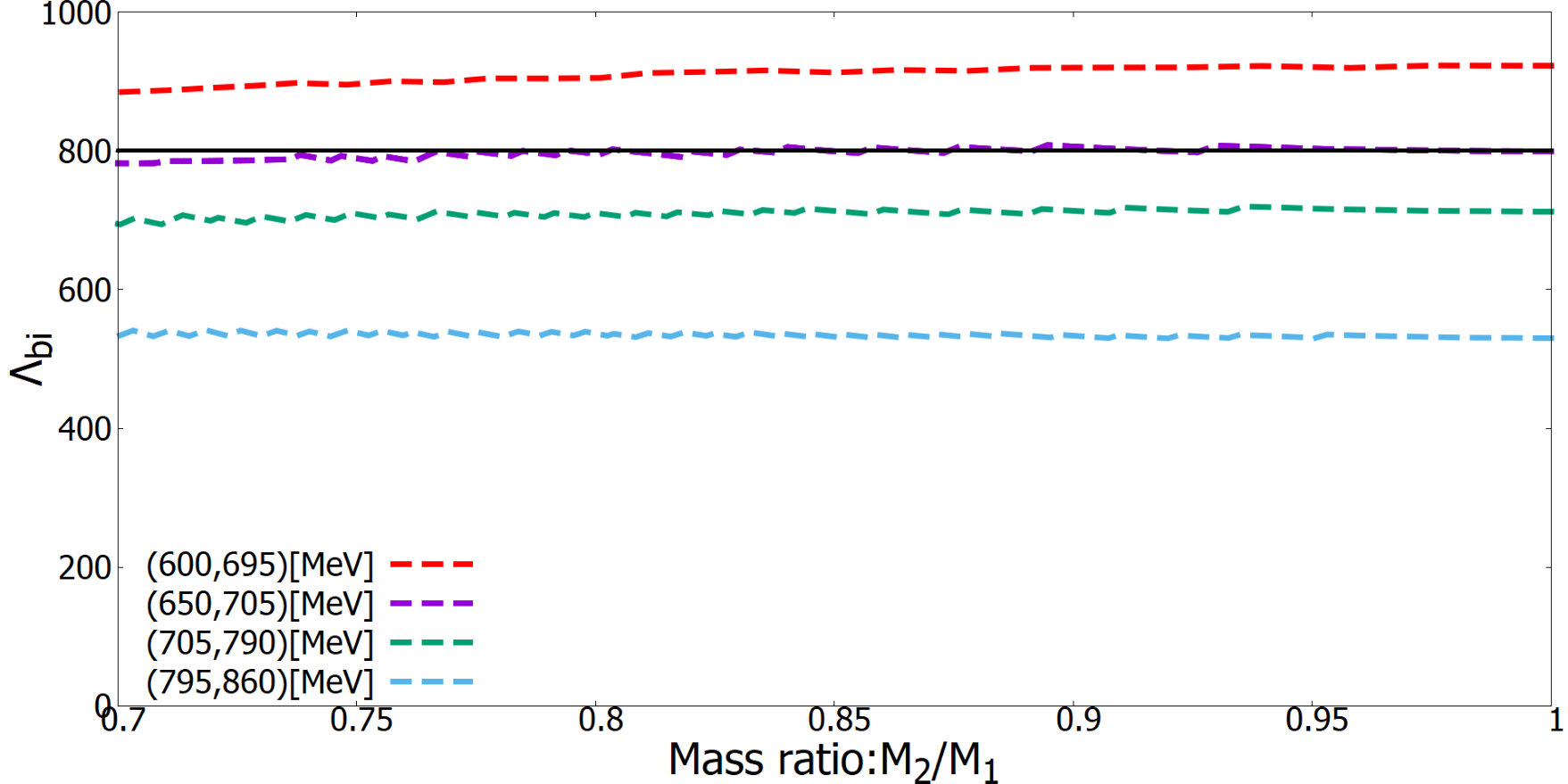 Figure 1
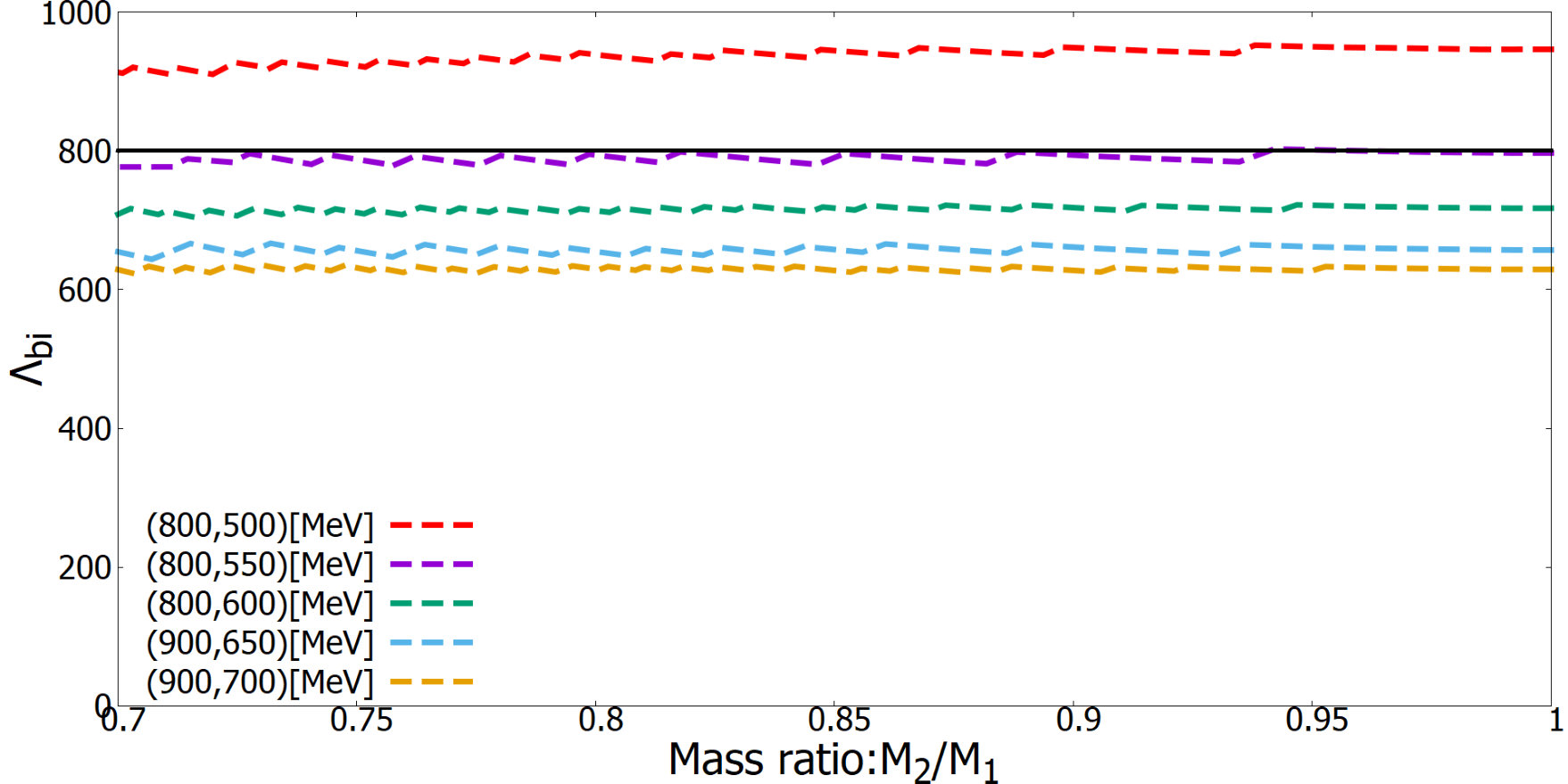 Figure 2
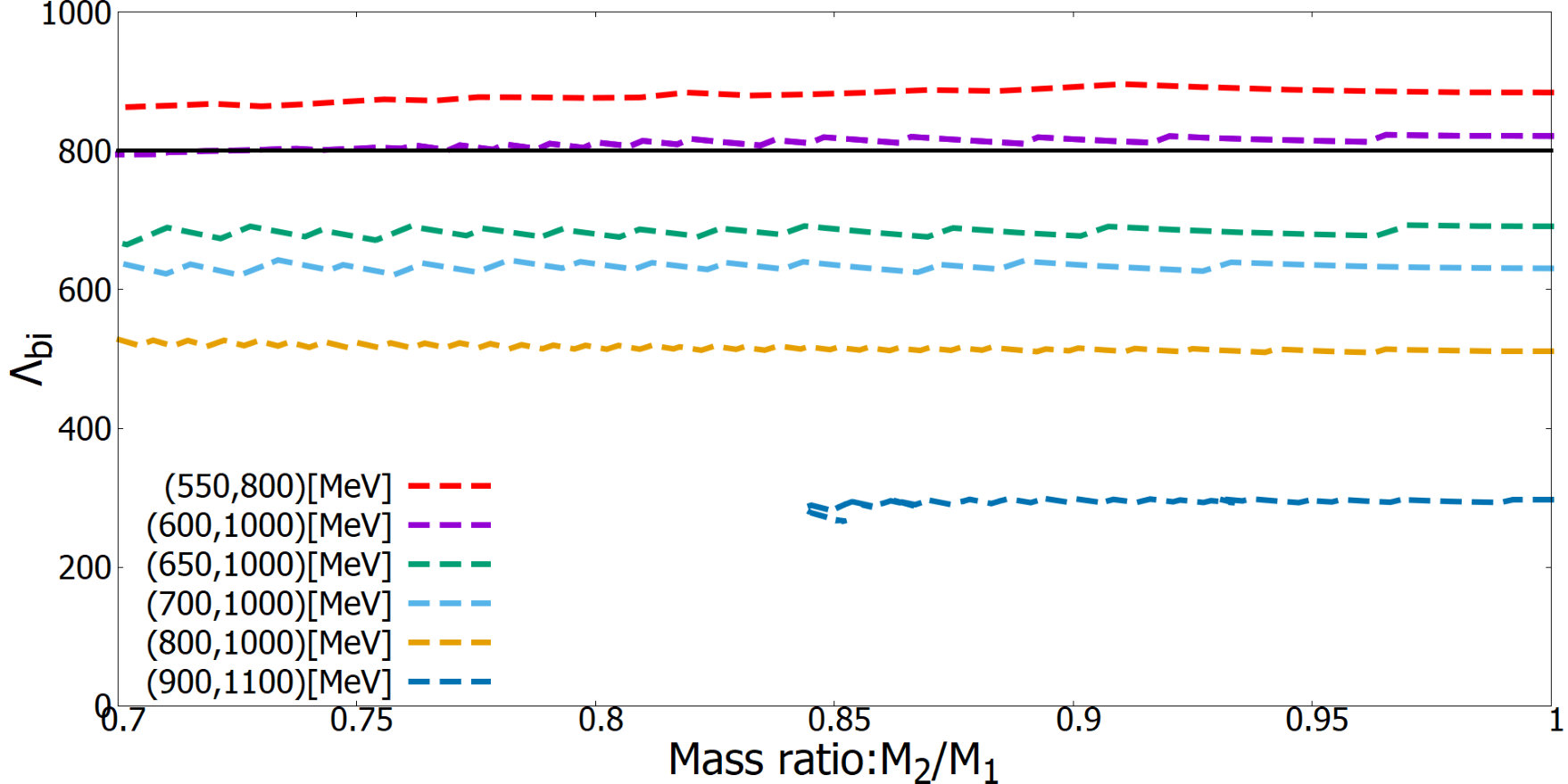 Figure 3
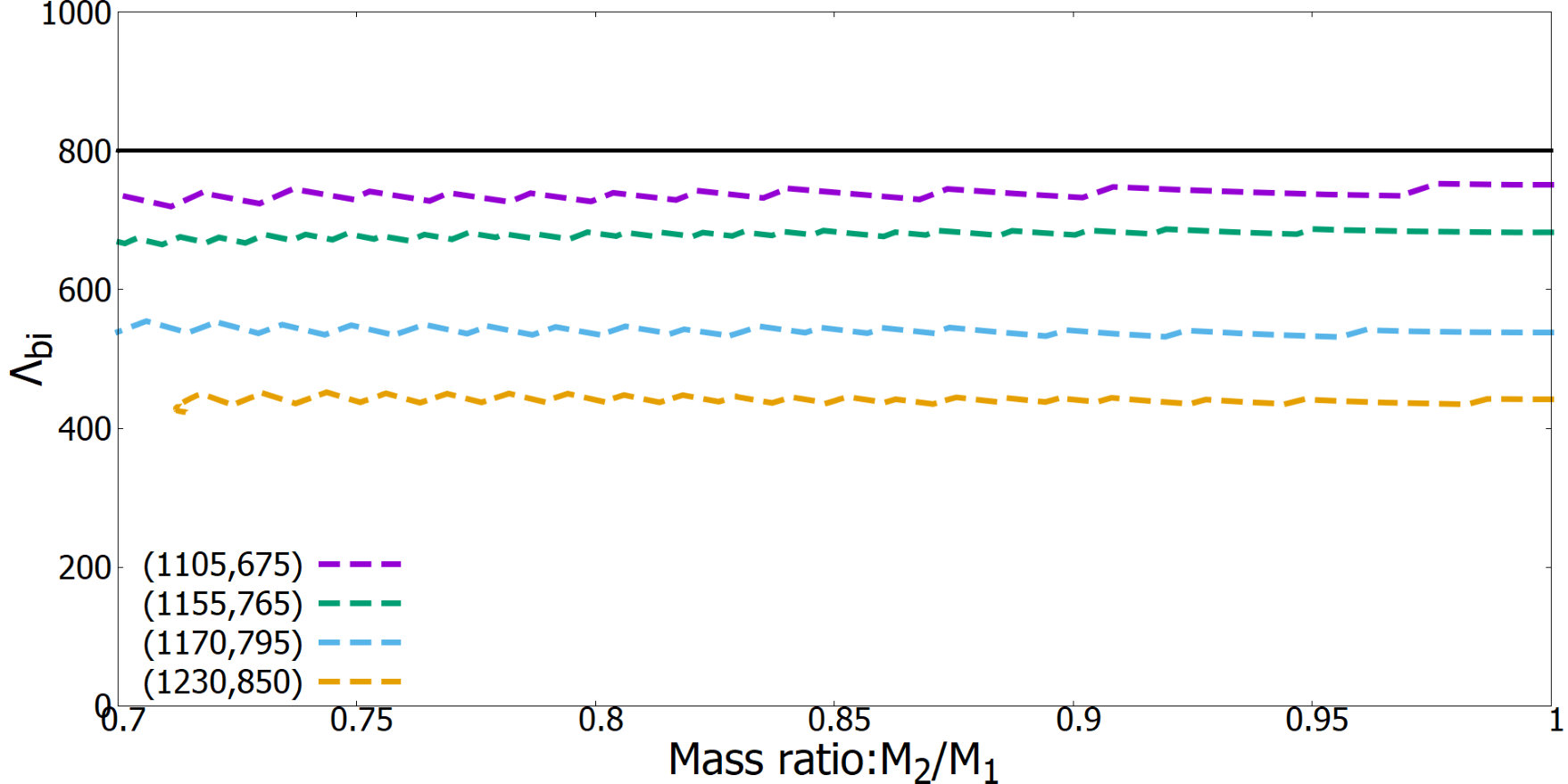 Figure 4
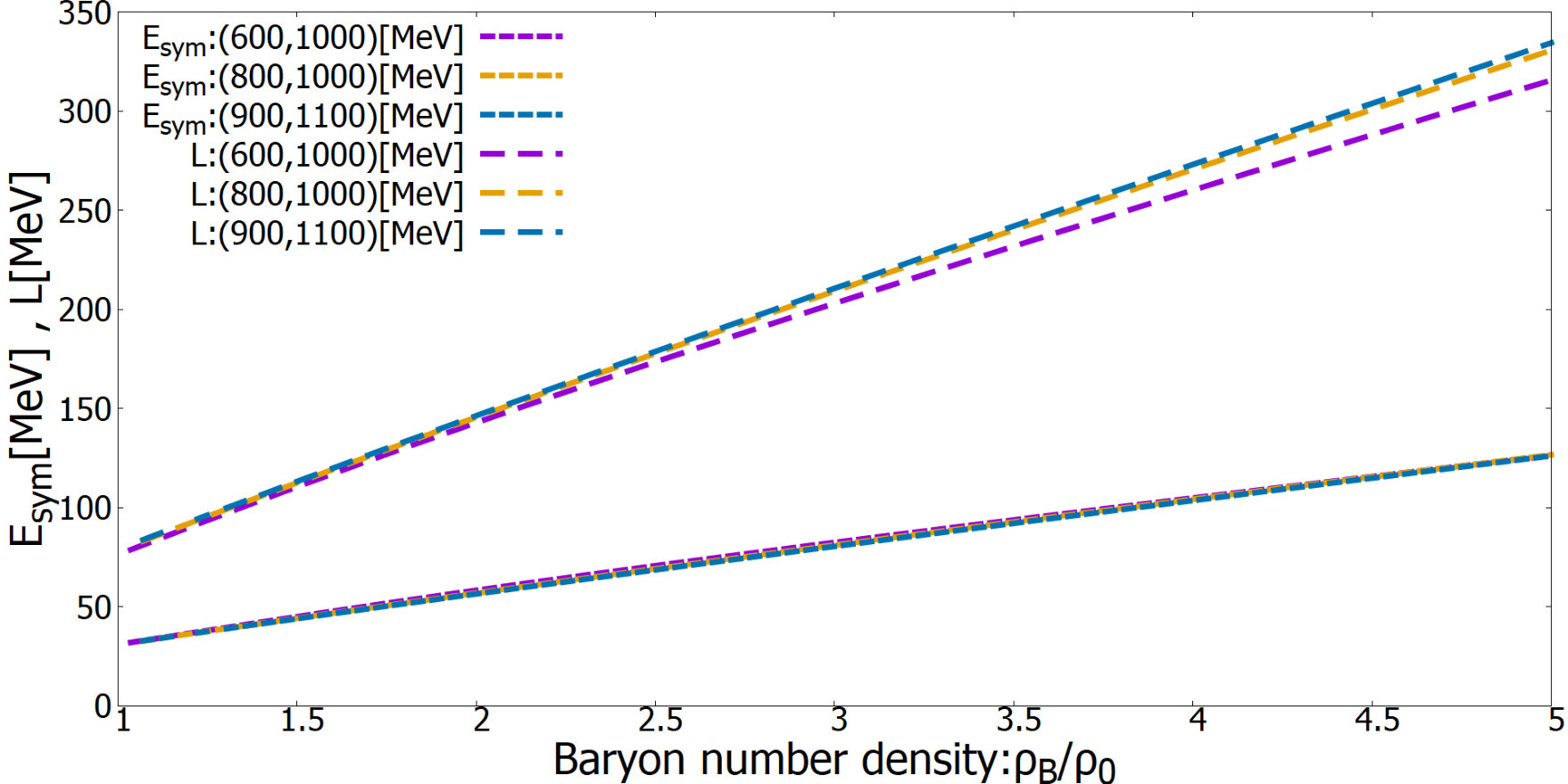 Figure 5
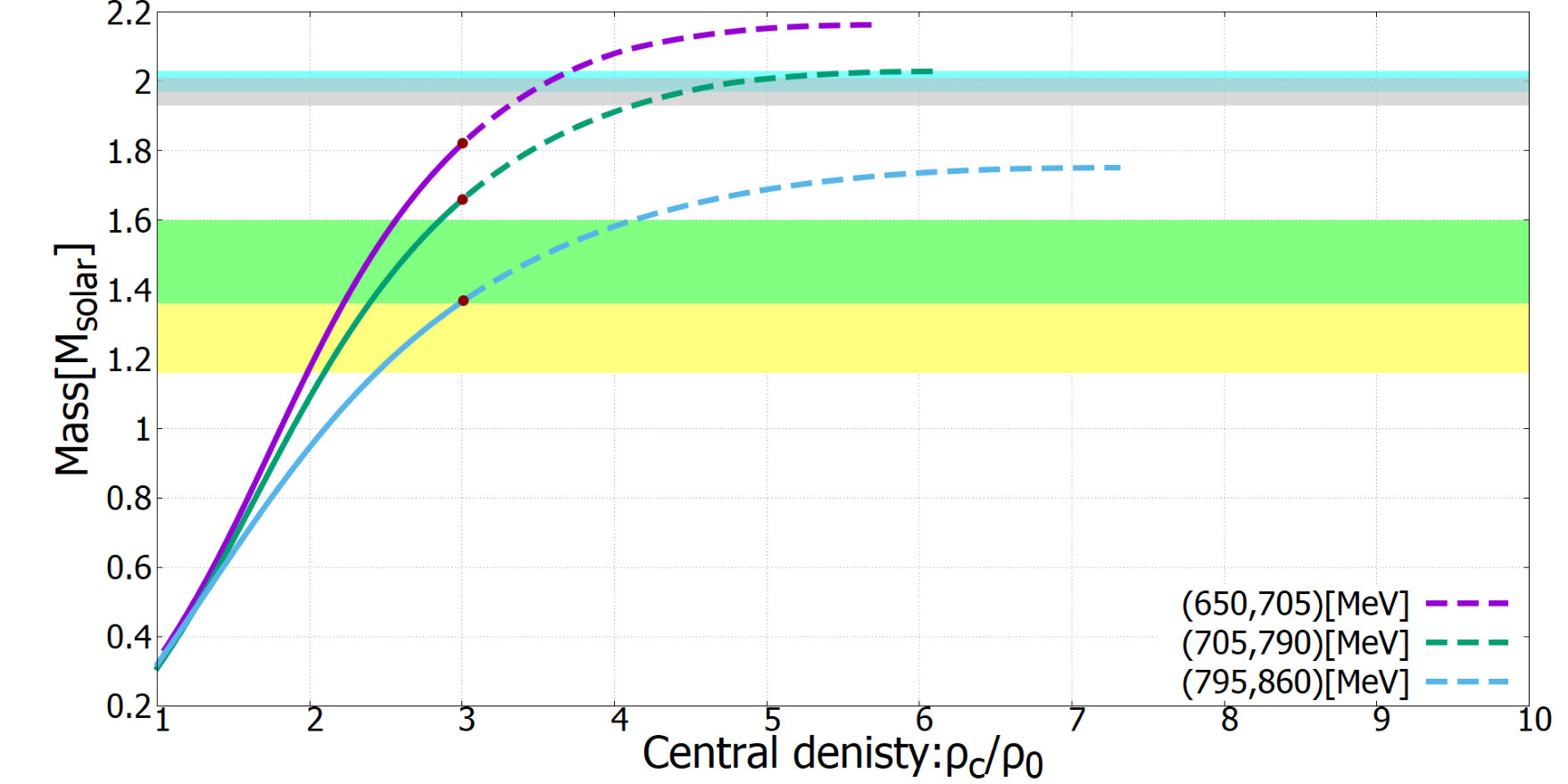 Figure 6
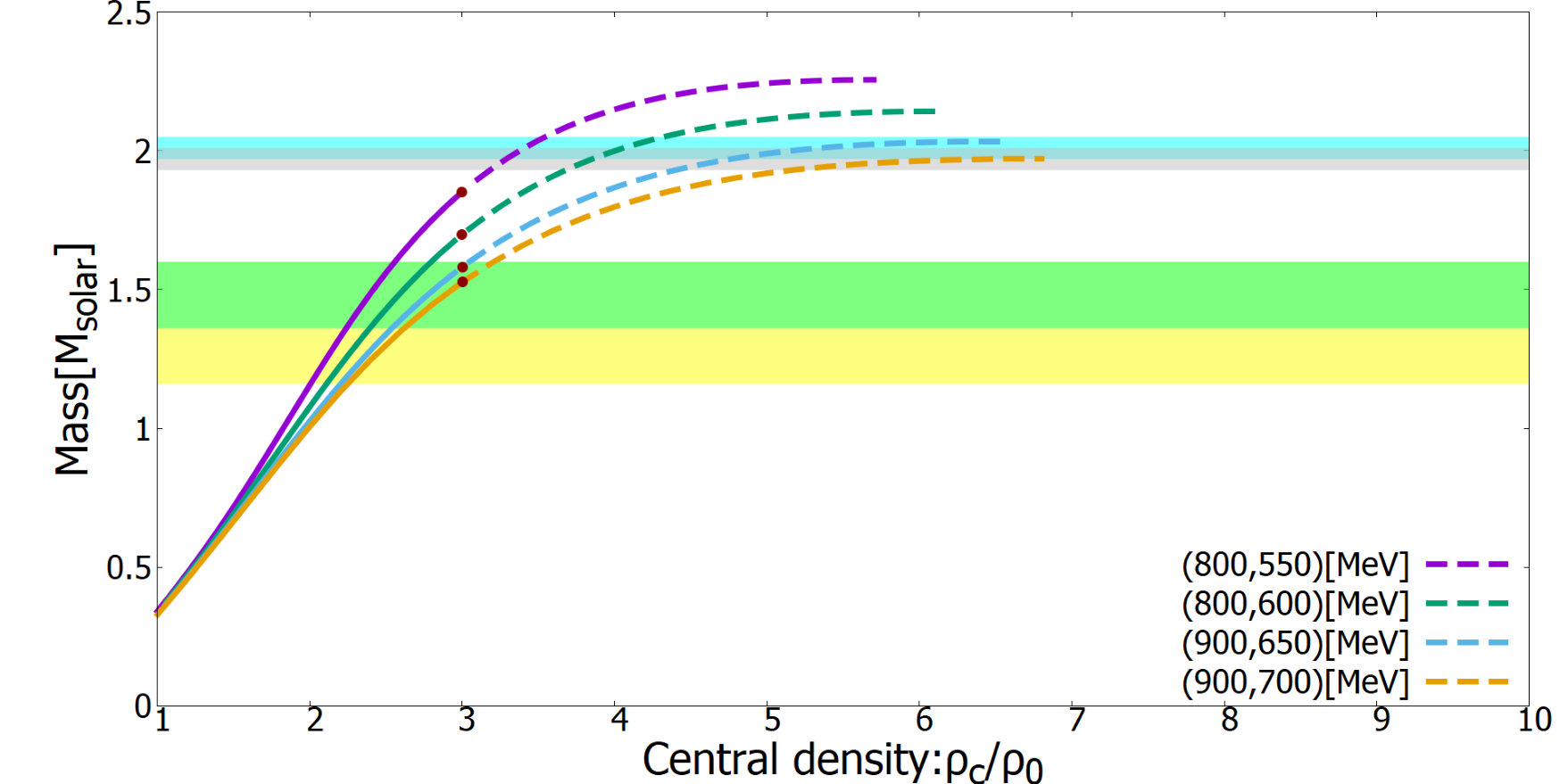 Figure 7
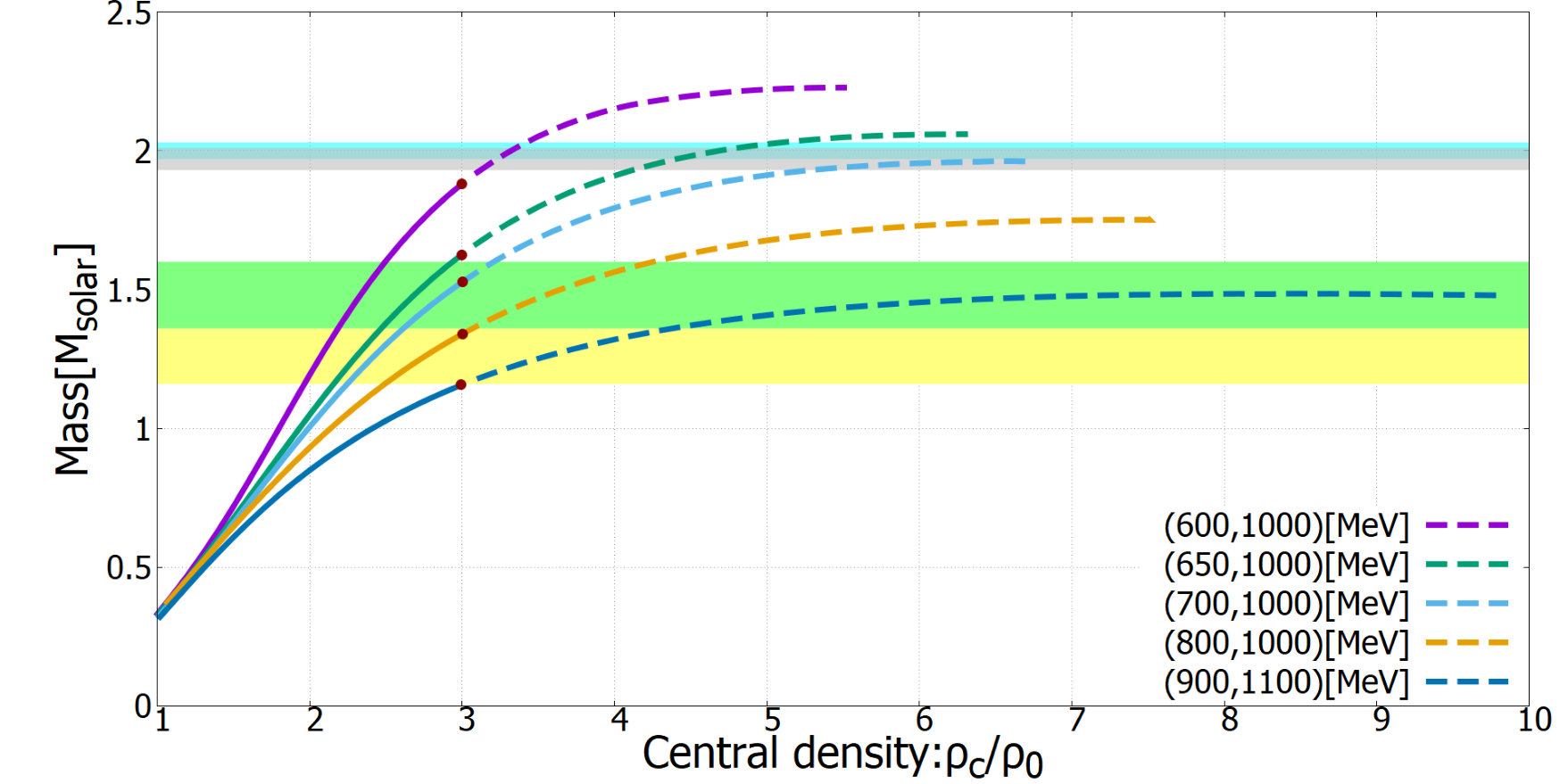 Figure 8
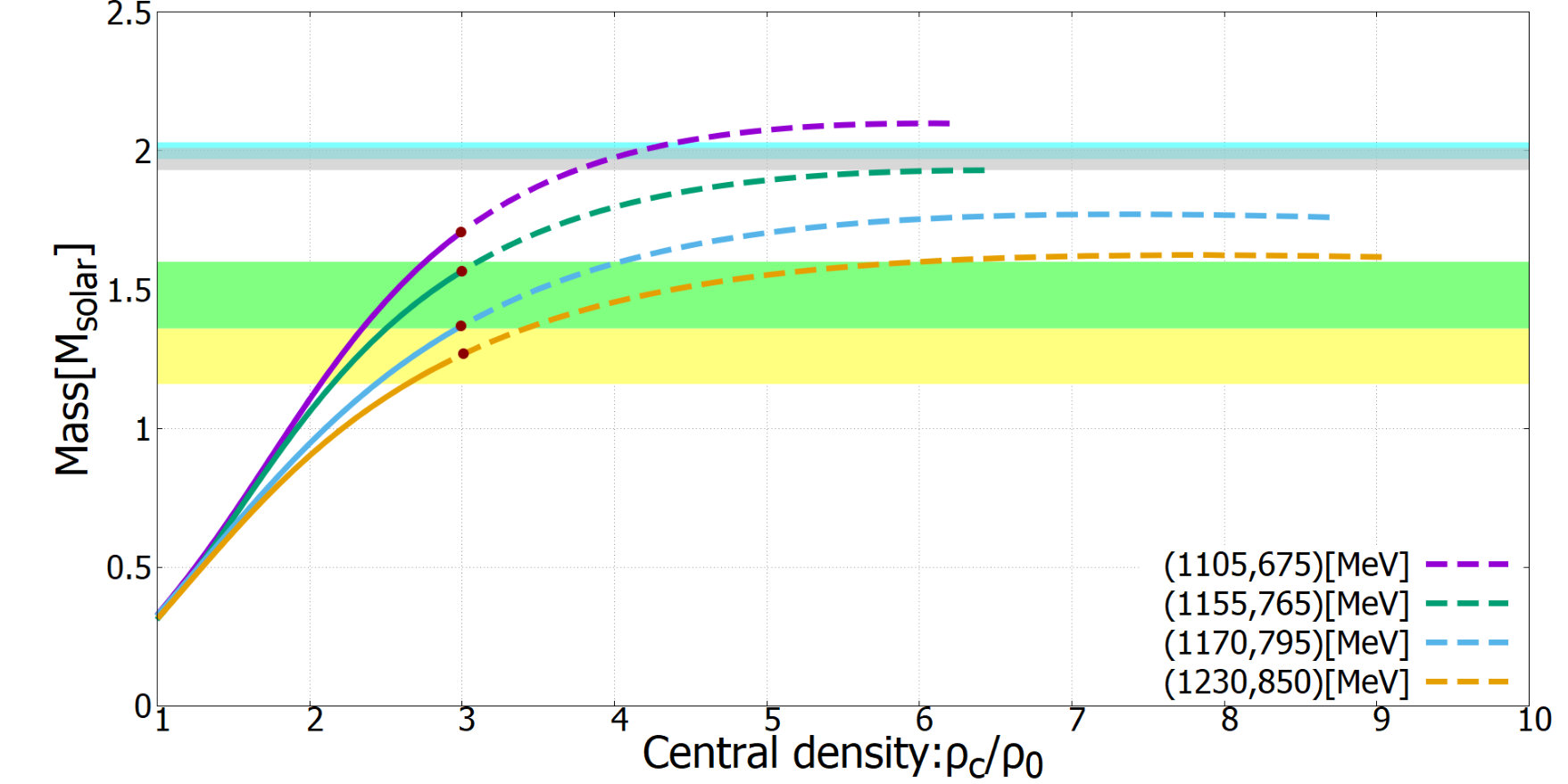 Figure 9
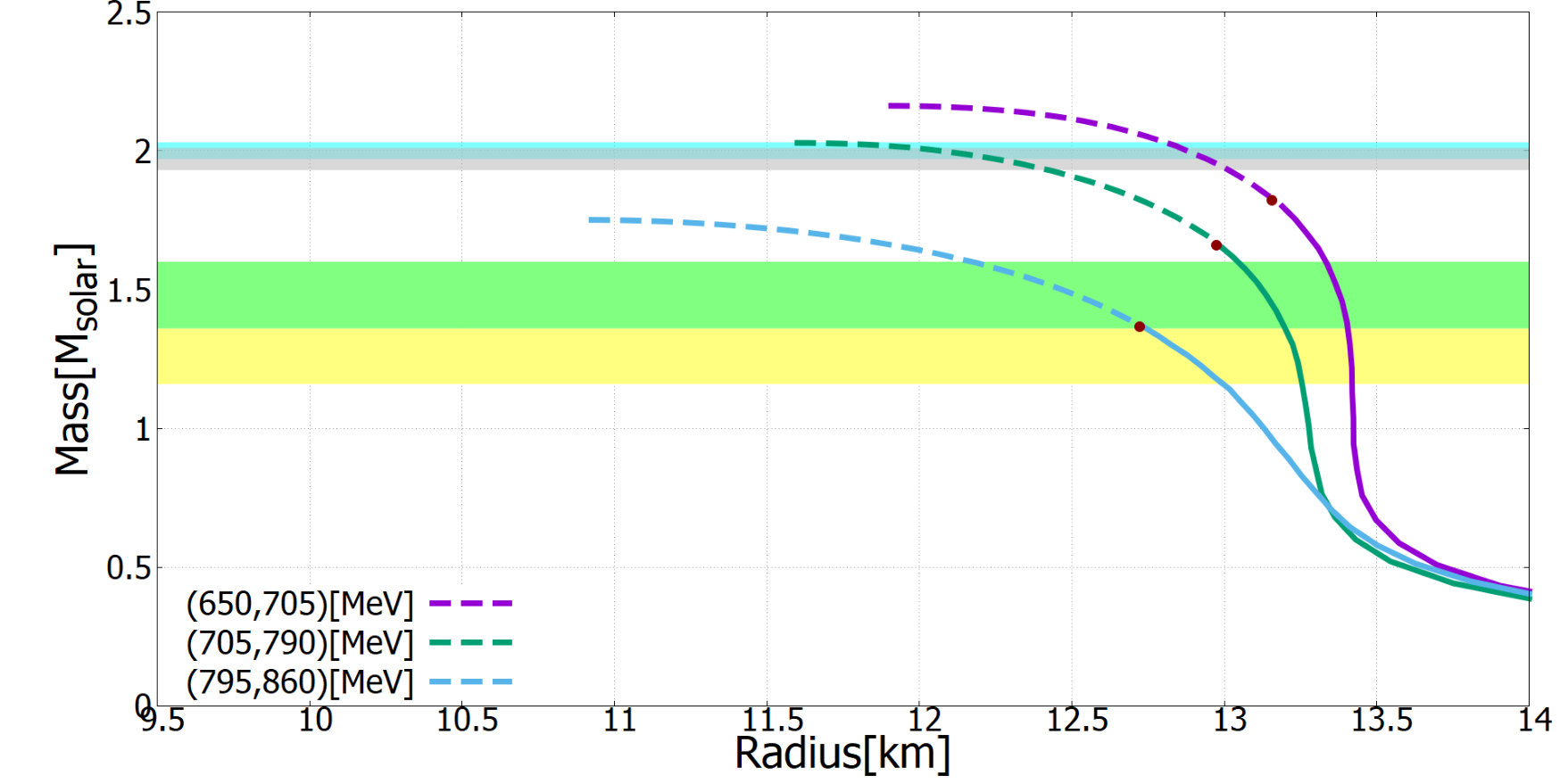 Figure 10
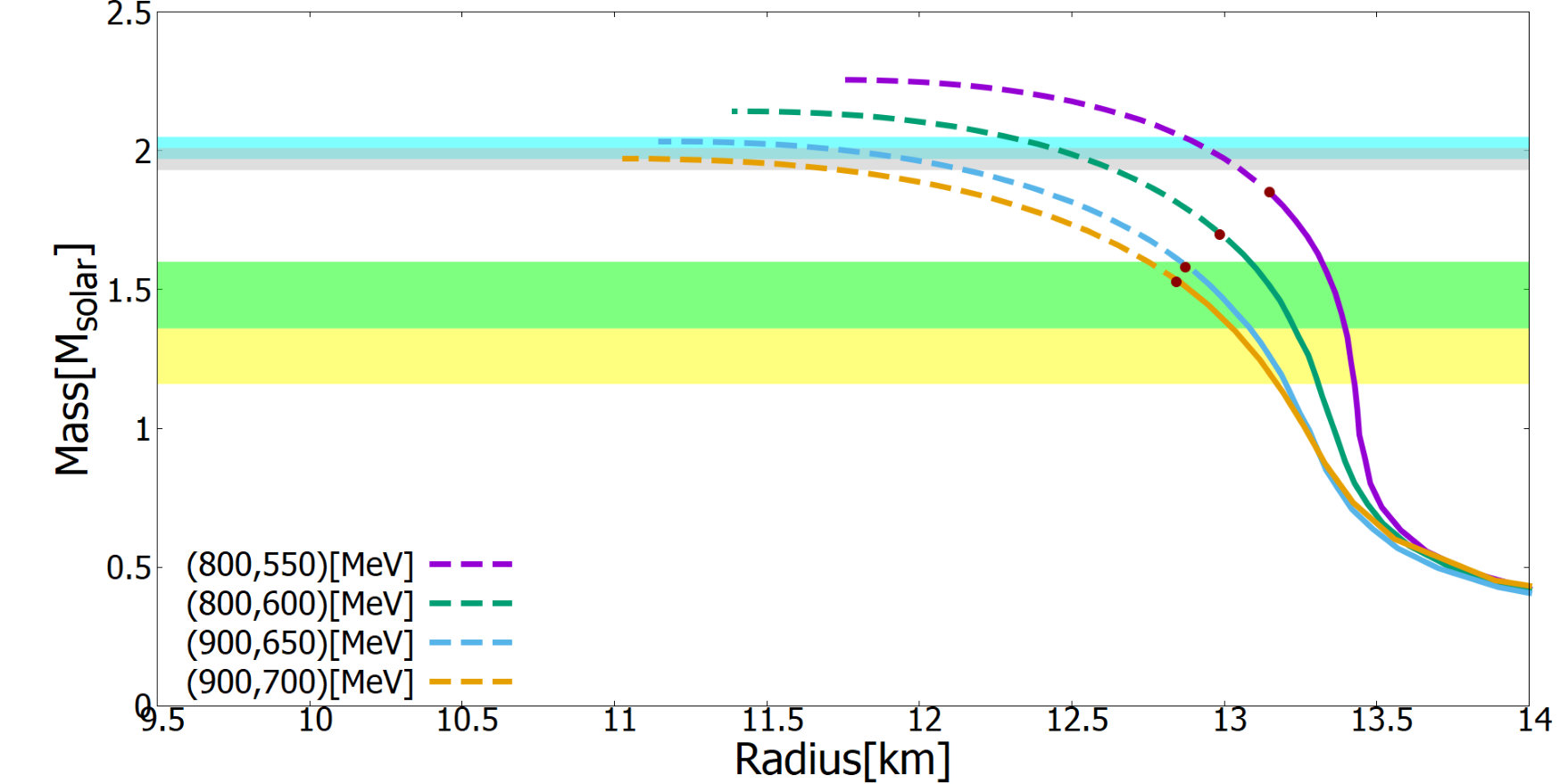 Figure 11
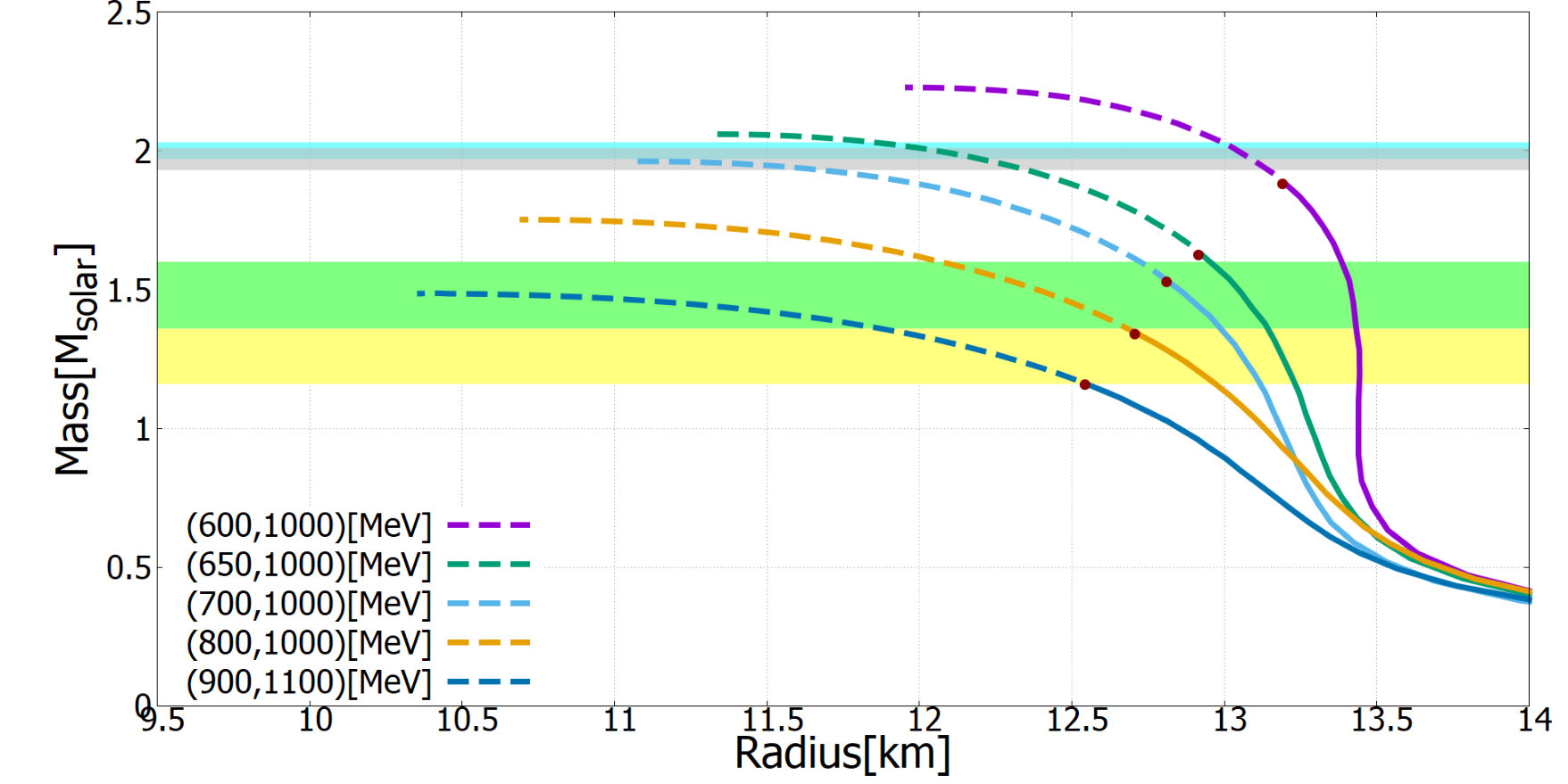 Figure 12
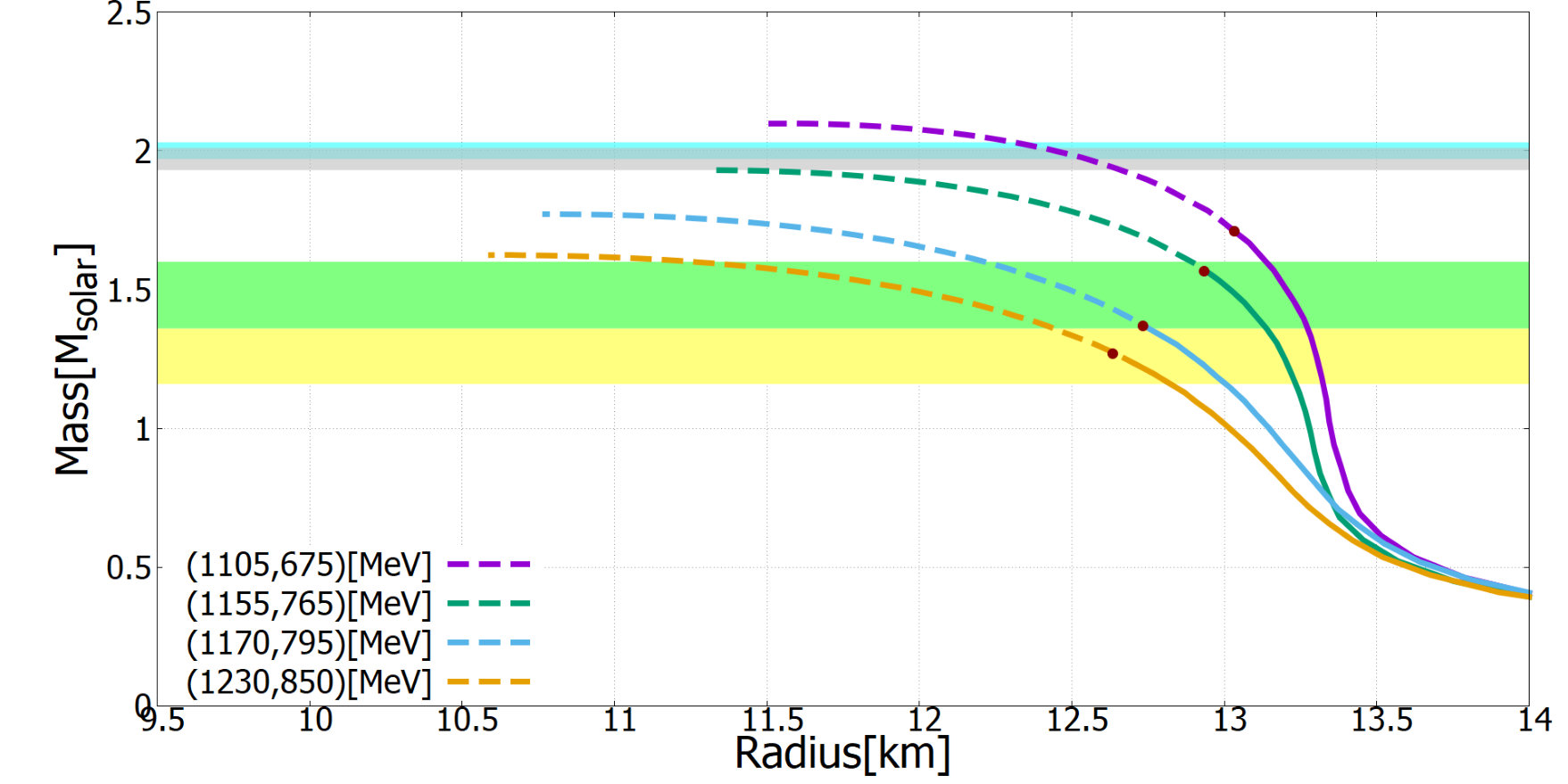 Figure 13
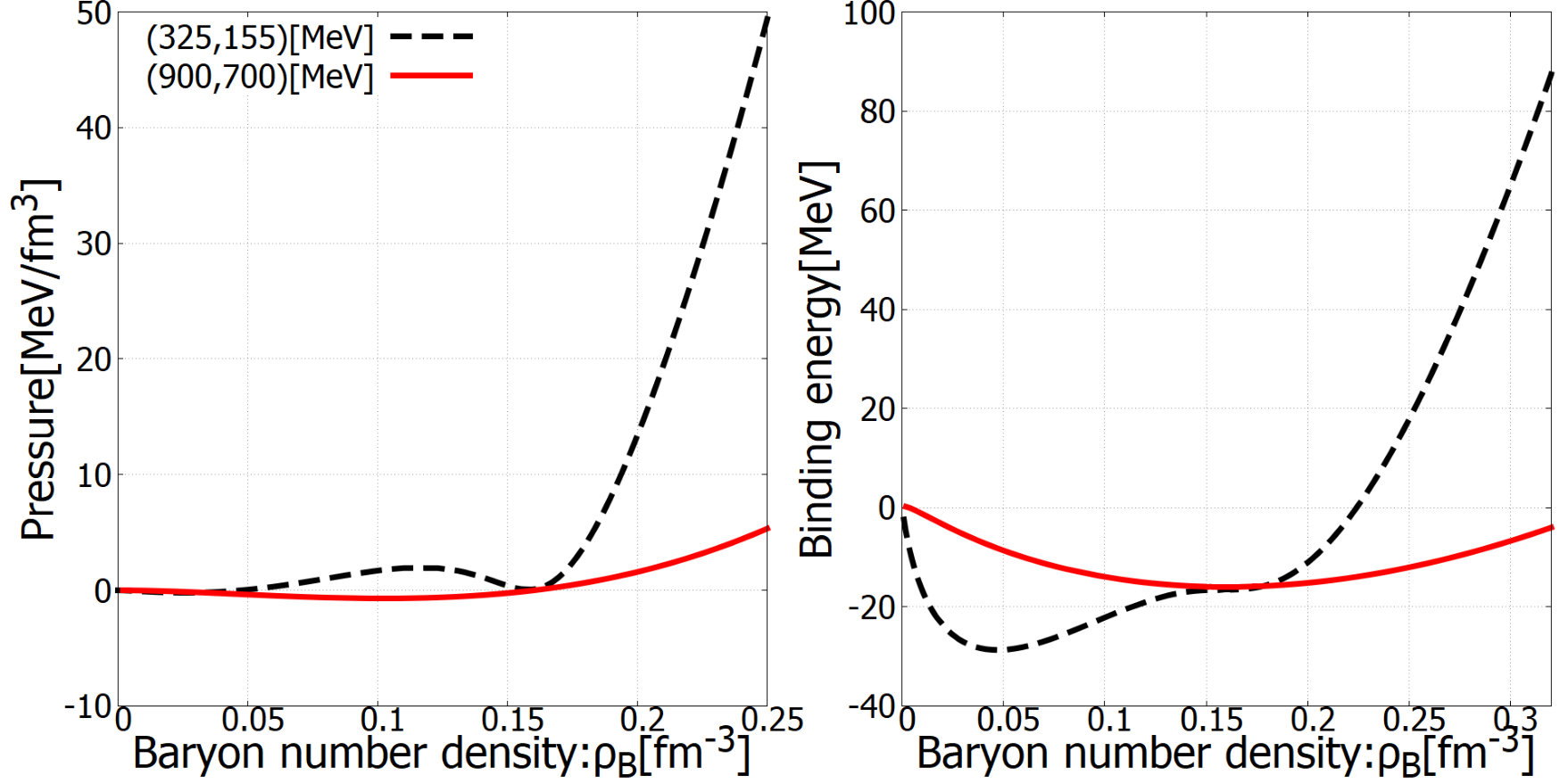 Figure 14
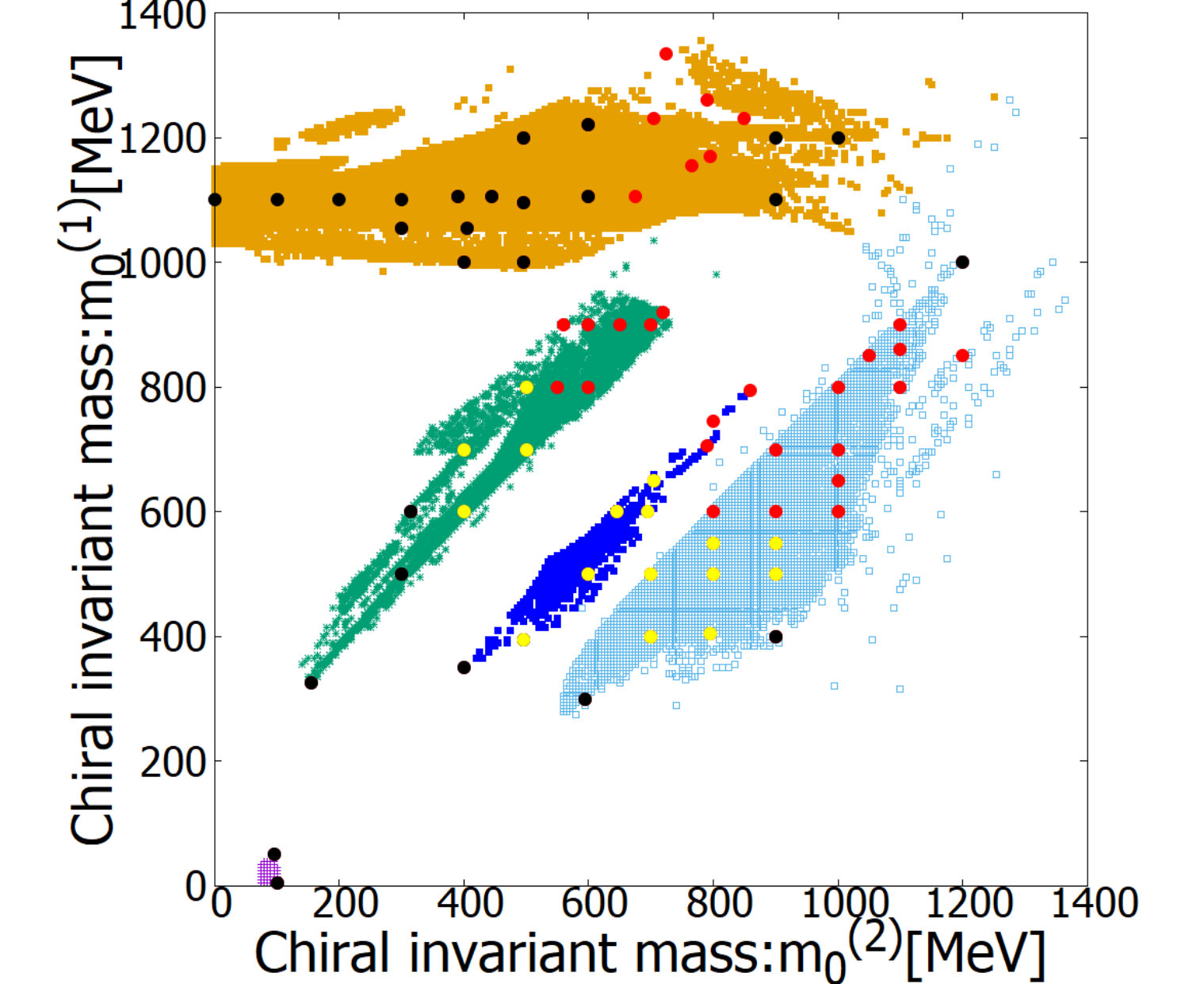 Figure 15
| Mass | Width[] | axial charge | |
|---|---|---|---|
| - | |||
| - | |||
| - [lat] | |||
| [to | [lat] | ||
| [to ] |
| 0.16 | -16 | 240 | 31 |
|---|
Peer Reviews
No public reviews on file for this paper yet. If you reviewed it on a platform where reviews are public (OpenReview, ICLR, NeurIPS, ICML), you can paste yours below so the community can read it here.
Videos
No videos yet. Explain this paper in a talk, walkthrough, or lecture? Add one.
Constraint to chiral invariant masses of nucleons from GW170817 in an extended parity doublet model
Takahiro Yamazaki
Masayasu Harada
Department of Physics, Nagoya University, Nagoya, 464-8602, Japan
Abstract
We construct nuclear matter based on an extended parity doublet model including four light nucleons , , , and . We exclude some values of the chiral invariant masses by requiring the saturation properties of normal nuclear matter; saturation density, binding energy, incompressibility, and symmetry energy. We find further constraint to the chiral invariant masses from the tidal deformability determined by the observation of the gravitational waves from neutron star merger GW170817. Our result shows that the chiral invariant masses are larger than about MeV. We also give some predictions on the symmetry energy and the slope parameters in the high density region, which will be measured in future experiments.
I Introduction
The chiral symmetry and its spontaneous breaking is one of the important features in low-energy hadron physics based on QCD. The breaking generates a part of hadron masses and causes a splitting between chiral partners. It is interesting to ask how much of the nucleon mass is generated by the spontaneous chiral symmetry breaking and what is the chiral partner to the nucleon.
In Ref. Detar:1988kn , a model based on the parity doublet structure was introduced, where the excited nucleon is regarded as the chiral partner to the nucleon . It is important to note that their masses include a chiral invariant mass in addition to the masses caused by the spontaneous chiral symmetry breaking. The determination of the chiral invariant mass using the phenomenology at vacuum is done in e.g. Refs. Jido:1998av ; Jido:2001nt ; Gallas:2009qp , which shows that the chiral invariant mass of the nucleon is smaller than about MeV.
The parity doublet structure is extended to include hyperons and/or more nucleons in e.g., Refs. Nemoto:1998um ; Chen:2008qv ; Dmitrasinovic:2009vp ; Dmitrasinovic:2009vy ; Chen:2009sf ; Chen:2010ba ; Steinheimer:2011ea ; Chen:2011rh ; Nishihara:2015fka ; Olbrich:2015gln ; Dmitrasinovic:2016hup ; Sasaki:2017glk ; Yamazaki:2018stk . In Ref. Yamazaki:2018stk , the authors of present paper constructed a model which includes two chiral representations, the representation under in addition to representation, to study four nucleons, , , and . It was shown that there are wide range of two chiral invariant masses satisfying vacuum properties of the nucleons; the masses, the axial charges and the pionic decay widths, and that the solutions are categorized into five groups.
The properties of hot and/or dense matter including neutron star matter based on the parity doublet structure are widely studied in Refs. Hatsuda:1988mv ; Zschiesche:2006zj ; Dexheimer:2007tn ; Dexheimer:2008cv ; Sasaki:2010bp ; Sasaki:2011ff ; Gallas:2011qp ; Paeng:2011hy ; Steinheimer:2011ea ; Dexheimer:2012eu ; Paeng:2013xya ; Benic:2015pia ; Motohiro:2015taa ; Mukherjee:2016nhb ; Suenaga:2017wbb ; Takeda:2017mrm ; Mukherjee:2017jzi ; Marczenko:2017huu ; Abuki:2018ijb ; Marczenko:2018jui . In Hatsuda:1988mv ; Zschiesche:2006zj ; Dexheimer:2007tn ; Dexheimer:2008cv ; Sasaki:2010bp ; Gallas:2011qp ; Steinheimer:2011ea ; Dexheimer:2012eu ; Benic:2015pia , the authors studied the relation between the chiral invariant mass and the incompressibility of nuclear matter and their results show that the empirical value MeV only when the chiral invariant mass is close to nucleon’s mass, MeV. In Ref. Motohiro:2015taa , six point interaction of scalar mesons was introduced and it was shown that the saturation properties are reproduced for wide region of the chiral invariant mass, i.e. MeV. In Ref. Marczenko:2018jui , the constraint to the chiral invariant mass from the properties of neutron stars including the tidal deformability observed from GW170817 TheLIGOScientific:2017qsa ; GBM:2017lvd ; Abbott:2018exr was obtained as - MeV. Recently, the parity doublet model is used to study the nuclei with finite size in Ref. Shin:2018axs which shows that MeV is preferred to reproduce the properties of nuclei. The relatively large value of the chiral invariant mass seems also consistent with lattice analyses in Refs. Aarts:2017rrl ; Aarts:2017iai ; Aarts:2018glk .
In this paper, we construct nuclear matter and neutron star matter using the model introduced in Ref. Yamazaki:2018stk based on the mean field approximation. For the meson parts, we use the model introduced in Ref. Motohiro:2015taa : the six point interaction of the scalar field is introduced and the and mesons are included based on the hidden local symmetry Bando:1987br ; Harada:2003jx . We will show that requiring the saturation properties of normal nuclear matter excludes some combinations of two chiral invariant masses. We solve the Tolman-Oppenheimer-Volkov (TOV) equation Tolman:1939jz ; Oppenheimer:1939ne to determine the energy density and tidal deformability of neutron stars. Then, we will show that the tidal deformability observed from GW170817 TheLIGOScientific:2017qsa ; GBM:2017lvd ; Abbott:2018exr provides further constraint to the chiral invariant masses.
This paper is organized as follows: In section II, we include the and mesons into the model introduced in Ref. Yamazaki:2018stk . We give formulations to study nuclear matter in the mean field approximation in section III. Here we show formulas to study saturation properties of the normal nuclear matter and the equation of state for neutron star matter. Section IV is devoted to the main part where we obtain constraints to the chiral invariant masses from the saturation properties and tidal deformability from GW170817. We also provide predictions for the relations between the mass and radius as well as those for the mass and the central density of neutron stars, and the symmetry energy and the slope parameter in dense matter. Finally, we will give a summary and discussions in section V.
II model
In this section, we introduce an extended parity doublet model to describe nuclear matter based on the model constructed in Ref. Yamazaki:2018stk . The model includes four baryon fields corresponding to the following representations under SU(2)SU(2)R chiral symmetry:
[TABLE]
The iso-singlet scalar meson and the iso-triplet pseudoscalar meson are included in a matrix field , which transforms as
[TABLE]
where . Following Ref. Motohiro:2015taa , we include and mesons as the gauge bosons of hidden local symmetry Bando:1987br ; Harada:2003jx by performing the polar decomposition of the field as 111 The normalization of the field in this paper is a half of the one in Ref. Motohiro:2015taa .
[TABLE]
We introduce the same potential for as used in Ref. Motohiro:2015taa :
[TABLE]
where is a parameter with dimension two and is the quark mass matrix defined as
[TABLE]
with and begin the masses of up and down quarks. In the present analysis, we neglect the difference between these masses, and take . In the vacuum, the combination is related the pion mass as
[TABLE]
We adopt the Yukawa interaction terms among and the nucleons as in Ref. Yamazaki:2018stk , so that we omit those in this paper.
We introduce the interaction terms among the vector mesons and nucleons similarly to Ref. Motohiro:2015taa . Here, instead of writing full Lagrangian, we shall show the relevant terms in the present analysis. The resultant interaction terms for meson is written as
[TABLE]
Here we assume that the coupling to is the same as that to for simplicity. Similarly, the interactions for mesons is given by
[TABLE]
We note that the mass terms for and mesons are written as
[TABLE]
III Formulation
In this section, we present formulations to study nuclear matter in the mean field approximation based on the model introduced in the previous section. Here we assume that all the parameters of the model do not depend on the chemical potentials.
III.1 Thermodynamic Potential
In the present analysis, we assume that there are no neutral and charged pion condensation, and that the following fields have their vacuum expectation values (VEVs) as
[TABLE]
In the mean field approximation, the thermodynamic potential is obtained by
[TABLE]
where
[TABLE]
The contribution from the nucleons, is expressed as
[TABLE]
where is the step function defined as
[TABLE]
is an energy of the nucleon
[TABLE]
is the effective chemical potential defined by
[TABLE]
with
[TABLE]
We should note that, in the above expression, the mean fields , and are solutions of the stationary conditions:
[TABLE]
where
[TABLE]
with
[TABLE]
III.2 Saturation Properties at Normal Nuclear Density
In this subsection, we provide formulas to calculate several physical quantities of nuclear matter at normal nuclear density.
From the thermodynamic potential obtained in the previous section, the baryon number density and the isospin density are calculated as
[TABLE]
where implies that the derivative in terms of is taken with fixed , and similarly for . One can easily confirm that and in Eq. (33) agree with those in Eq. (31). The saturation density is calculated as
[TABLE]
where is the value of the baryon number chemical potential at saturation point.
The pressure of the system is given by
[TABLE]
From the thermodynamic relation, the energy density is obtained as
[TABLE]
Then, the binding energy is given by
[TABLE]
From this, in Eq. (34) is given as
[TABLE]
where is the mass of lightest nucleon. We note that using above conditions, we can easily shows that the pressure at normal nuclear density vanishes:
[TABLE]
The incompressibility is calculated as
[TABLE]
The symmetry energy per nucleon is given as
[TABLE]
where is asymmetric parameter define as
[TABLE]
From Eq. (31), this is calculated as
[TABLE]
where the summation is taken over and , and and are the Fermi momentum and Fermi energy of the nucleon. The slope parameter is given by
[TABLE]
Here, we assume that only the lightest nucleon exist in the nuclear matter at normal nuclear density. Then, this is reduced to
[TABLE]
where is the Fermi energy of the lightest nucleon, and is the Fermi momentum, .
III.3 Neutron Star Matter and Tidal Deformability
In this subsection, we construct neutron star matter based on the model introduced in section II. Here we assume that there are no hyperons and quarks in the matter constructed below.
For constructing the neutron star matter, we introduce the electron and muon into matter, and require conditions for the charge neutrality and the beta equilibrium. The charge neutrality condition is written as
[TABLE]
where is given in Eq. (32). The electron density and the muon density are given by
[TABLE]
where is the corresponding chemical potential and
[TABLE]
with being the lepton mass. Here we assume that the lepton masses in the neutron star matter are the same as those in vacuum. The chemical potentials for leptons satisfy the chemical equilibrium conditions:
[TABLE]
The mass and radius of neutron star are determined by solving Tolman-Oppenheimer-Volkov (TOV) equations Tolman:1939jz ; Oppenheimer:1939ne given by
[TABLE]
The solution of the above TOV equations determines the radius and the mass of the neutron star as
[TABLE]
The dimenstionless tidal deformability is defined as Hinderer:2007mb ; Hinderer:2009ca ; Malik:2018zcf
[TABLE]
where is the compactness parameter and is the tidal Love number calculated by
[TABLE]
In this expression, the quantity is obtained by solving the following differential equation:
[TABLE]
where
[TABLE]
The gravitational wave GW170817 is measured from a binary neutron star merger, so that it gives an constraint to the binary dimensionless tidal deformability defined as
[TABLE]
where () is the tidal deformability of each neutron star.
IV Numerical analysis
In Ref. Yamazaki:2018stk , we determined ten couplings of nucleons to scalar and pseudoscalar mesons from ten physical inputs shown in Table 1 for fixed values of two chiral invariant masses and the pion decay constant MeV.
We showed that only certain combinations of two masses can reproduce physical inputs, and that the solutions are categorized into five groups as shown in Fig. 1.
In the following we shall show that some regions are excluded by requiring the saturation properties of normal nuclear matter and the tidal deformability constraint from the observation of GW170817 TheLIGOScientific:2017qsa ; GBM:2017lvd ; Abbott:2018exr . Here we assume that all the model parameters do not have any density dependence.
IV.1 Saturation Properties
In addition to the parameters determined in Ref. Yamazaki:2018stk at vacuum as explained at the beginning of this section, we use the masses of and mesons as
[TABLE]
Then, for fixed values of two chiral invariant masses, we determine four parameters, , , and to reproduce the saturation density, the binding energy, the incompressibility and the symmetry energy at the normal nuclear density shown in Table 2.
We use the combinations of two chiral invariant masses as shown by points in Fig. 1, and found that the saturation properties cannot be reproduced for the combinations indicated by the black dots. Let us exiplain the reason why we excluded the combinations where both the chiral invariant masses are small. For this purpose, we plot the density dependences of the pressure and energy density for MeV (black dashed curves) which we excluded, together with MeV (red curves) which satisfies the saturation properties.
Although both combinations satisfy and MeV at , the black dashed curves show that the binding energy is not minimized at and there is a global minimum around . This implies that the matter at is not stable. This is because, for small chiral invariant masses, the coupling of the nucleon to is large, and the attractive force is strong.
Similar situation occurs when one of two chiral invariant masses is small. When both the chiral invariant masses are very large, on the other hand, the attractive force is too weak to keep the matter.
IV.2 Tidal Deformability
In this subsection, we construct the neutron star matter and calculate the tidal deformability using the formulas shown in the previous section. Here we assume that there are no heperons and quarks in the matter.
When we solve the TOV equation (51), we use the Equation of State (EOS) obtained from the present model for , while we use the EOS given in Refs. Baym:1971pw ; Sharma:2015bna for . Then, we calculate the binary tidal deformability for the Chirp mass of
[TABLE]
where is the solar mass. We show the resultant values of the binary tidal deformability for several combinations of two chiral invariant masses for Group 2 in Fig. 3.
Here the dashed curves, from up to down, are for , , and MeV, respectively. We also plot the black sold line at which we regard as the upper bound of the constraint from the observation of GW170817 TheLIGOScientific:2017qsa ; Abbott:2018wiz . Figure 3 shows that the become smaller for larger chiral invariant mass. This is because the EOS becomes softer for larger chiral invariant mass.
As a result, the constraint excludes the region where chiral invariant masses are small. For example, the combination MeV is excluded as one can see easily in Fig. 3.
We next show the predicted for Groups 3, 4, 5 in Figs. 4, 5, 6, respectively. One can easily see that is larger for smaller chiral invariant masses, and the combinations , MeV are excluded. We summarize the results in Fig. 1, where red points show that is satisfied while yellow points show that the combination of the chiral invariant masses is excluded. From this, we conclude that the chiral invariant masses must be larger than about MeV to satisfy the tidal deformability constraint from the observation of GW170817.
IV.3 - Relation
In this subsection, we show our results for the - relation and the central density.
We plot the relation between neutron star mass and radius in Fig. 7 and the relation between the mass and the central density in Fig. 8 for several combinations of two chiral invariant masses in Group 2 which satisfy the constraint of the tidal deformability. Here, solid curves imply that the central density is smaller than the three times of normal nuclear matter density, , and the dashed curves are for . One may say that the combination MeV is excluded, since the present prediction does not reproduce the super-heavy neutron stars with mass Demorest:2010bx ; Antoniadis:2013pzd . However, we note that, in this study, we assume that the core of neutron star is constructed by protons, neutrons, and leptons only and that none of hyperons, meson condensation and quark degrees appear. We expect that the predictions shown by solid curves are not changed significantly, but those by dashed curves will be changed. Then, although the present prediction for MeV does not reproduce the super-heavy neutron stars with mass Demorest:2010bx ; Antoniadis:2013pzd , it will be changed by e.g., including effects of quark degrees (See e.g., Refs. Masuda:2012kf ; Masuda:2012ed ; Dexheimer:2012eu ; Masuda:2015wva ; Masuda:2015kha ; Kojo:2014rca ; Kojo:2015nzn ; Baym:2017whm ; Mukherjee:2017jzi ; Wu:2018kww .).
We also list the relations for Groups 3 - 5 in Figs. 9-14. From these figures, we can see that the larger chiral invariant mass provides the softer EOS leading to smaller radius and lighter mass. This is because the larger chiral invariant mass leads to the smaller repulsive interaction.
IV.4 Symmetry Energy and Slope Parameter
In this subsection, we calculate the symmetry energy and the slope parameter in high density matter. The plots for , , MeV are shown in Fig. 15.
We can see that three predictions are almost same, and we checked that other predictions are similar. This is because, in Eq. (43), the second term in the parenthesis is dominant and the symmetry energy is proportional to the baryon number density . The slope parameters predicted here seems a little larger than the one constrained in Ref. Kolomeitsev:2016sjl ; Ohnishi:private . In the present model, the large slope parameter causes the large radius of neutron stars.
V A Summary and Discussion
In this paper, we constructed nuclear matter including neutron star matter from an extended parity doublet model which we developed in the previous publication Yamazaki:2018stk , where two sets of chiral representations having two chiral invariant masses are introduced. We showed that some combinations of two chiral invariant masses are excluded by requiring the saturation properties of normal nuclear matter; the saturation density, the binding energy, the incompressibility, the symmetry energy. Then, we found that more constraint to the chiral invariant masses is obtained from the tidal deformability determined by the observation of GW170817. Out result shows that the chiral invariant masses are larger than about MeV, which is consistent with the constraint obtained in Ref. Marczenko:2018jui . We also showed predictions of the mass-radius relation of neutron stars, as well as the symmetry energy and the slope parameter at high density.
In the present analysis, some of our predictions do not reproduce the super-heavy neutron stars with Demorest:2010bx ; Antoniadis:2013pzd . However, we think that our model may not be applicable in the high-density region. It might be changed by e.g., including effects of quark degrees (See e.g., Refs. Masuda:2012kf ; Masuda:2012ed ; Dexheimer:2012eu ; Masuda:2015wva ; Masuda:2015kha ; Kojo:2014rca ; Kojo:2015nzn ; Baym:2017whm ; Mukherjee:2017jzi ; Wu:2018kww .).
The slope parameters predicted here seems a little larger than the one constrained in Ref. Kolomeitsev:2016sjl ; Ohnishi:private . In the present model, the large slope parameter causes the large radius of neutron stars, which are comparable with the results in e.g., Refs. Most:2018hfd ; Fattoyev:2017jql ; Kim:2018aoi , but larger than the ones in Refs. Kojo:2014rca ; Kojo:2015nzn ; Baym:2017whm ; Steiner:2010fz ; Lattimer:2014sga ; Togashi:2017mjp .
In our model, we include the six-point interaction of the meson. The existence of six point interaction might be driven by the violation of scale symmetry Ma:2016nki .
It is interesting to apply the present analysis to study the modification of spectrum of heavy-light mesons in dense matter as done in e.g. Refs. Harada:2016uca ; Suenaga:2018kta .
Acknowledgements.
We would like to thank Youngman Kim, Young-Min Kim, Toru Kojo, Chang-Hwan Lee, Akira Ohnishi, Chihiro Sasaki for valuable discussions and comments. The work of M.H. is supported in part by JPSP KAKENHI Grant Number 16K05345.
The reference list from the paper itself. Each links out to its DOI / PubMed record.
- 1(1) C. E. Detar and T. Kunihiro, “Linear σ 𝜎 \sigma Model With Parity Doubling,” Phys. Rev. D 39 , 2805 (1989). doi:10.1103/Phys Rev D.39.2805
- 2(2) D. Jido, Y. Nemoto, M. Oka and A. Hosaka, “Chiral symmetry for positive and negative parity nucleons,” Nucl. Phys. A 671 , 471 (2000) doi:10.1016/S 0375-9474(99)00844-1 [hep-ph/9805306].
- 3(3) D. Jido, M. Oka and A. Hosaka, “Chiral symmetry of baryons,” Prog. Theor. Phys. 106 , 873 (2001) doi:10.1143/PTP.106.873 [hep-ph/0110005].
- 4(4) S. Gallas, F. Giacosa and D. H. Rischke, “Vacuum phenomenology of the chiral partner of the nucleon in a linear sigma model with vector mesons,” Phys. Rev. D 82 , 014004 (2010) doi:10.1103/Phys Rev D.82.014004 [ar Xiv:0907.5084 [hep-ph]].
- 5(5) Y. Nemoto, D. Jido, M. Oka and A. Hosaka, “Decays of 1/2- baryons in chiral effective theory,” Phys. Rev. D 57 , 4124 (1998) doi:10.1103/Phys Rev D.57.4124 [hep-ph/9710445].
- 6(6) H. X. Chen, V. Dmitrasinovic, A. Hosaka, K. Nagata and S. L. Zhu, “Chiral Properties of Baryon Fields with Flavor SU(3) Symmetry,” Phys. Rev. D 78 , 054021 (2008) doi:10.1103/Phys Rev D.78.054021 [ar Xiv:0806.1997 [hep-ph]].
- 7(7) V. Dmitrasinovic, A. Hosaka and K. Nagata, “Nucleon axial couplings and [(1/2,0) + (0,1/2)] - [(1,1/2) + (1/2,1)] chiral multiplet mixing,” Mod. Phys. Lett. A 25 , 233 (2010) doi:10.1142/S 0217732310032494 [ar Xiv:0912.2372 [hep-ph]].
- 8(8) V. Dmitrasinovic, A. Hosaka and K. Nagata, “A Lagrangian for the Chiral (1/2,0) + (0,1/2) Quartet Nucleon Resonances,” Int. J. Mod. Phys. E 19 , 91 (2010) doi:10.1142/S 0218301310014650 [ar Xiv:0912.2396 [hep-ph]].