Topological many-body scar states in dimensions 1, 2, and 3
Seulgi Ok, Kenny Choo, Christopher Mudry, Claudio Castelnovo, Claudio, Chamon, and Titus Neupert

TL;DR
This paper introduces an exact method to construct topologically degenerate many-body scar states across 1D, 2D, and 3D systems, exhibiting area law entanglement and properties akin to topological phases.
Contribution
It provides a novel exact construction of topological many-body scar states in multiple dimensions, linking scar states with topological order.
Findings
Constructed exact topological scar states in 1D, 2D, and 3D.
Demonstrated these states have area law entanglement.
Showed these states possess topological degeneracies.
Abstract
We propose an exact construction for atypical excited states of a class of non-integrable quantum many-body Hamiltonians in one dimension (1D), two dimensions (2D), and three dimensins (3D) that display area law entanglement entropy. These examples of many-body `scar' states have, by design, other properties, such as topological degeneracies, usually associated with the gapped ground states of symmetry protected topological phases or topologically ordered phases of matter.
Click any figure to enlarge with its caption.
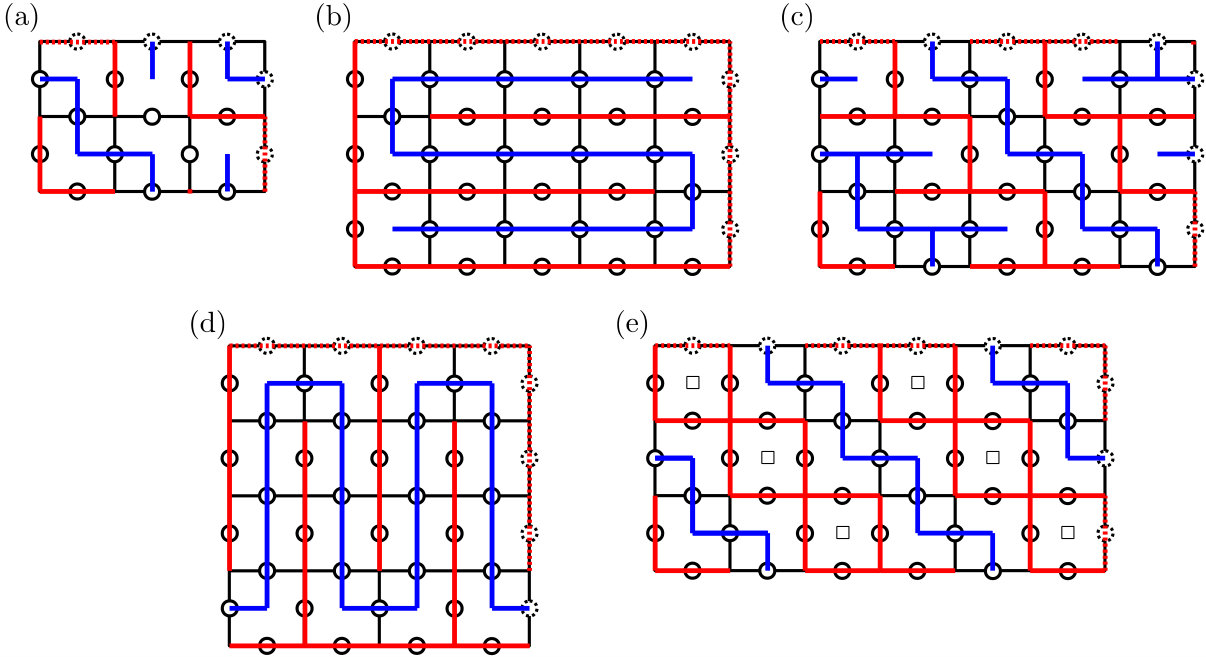 Figure 1
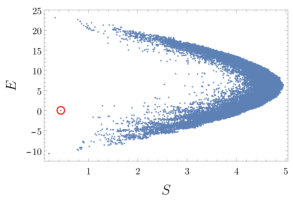 Figure 2
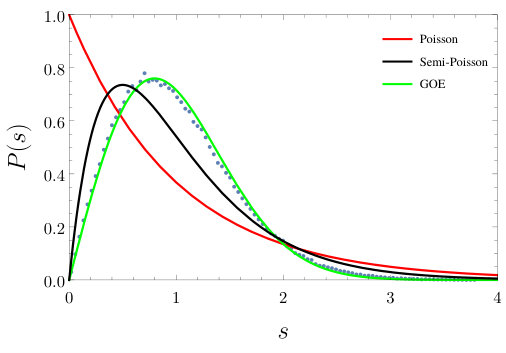 Figure 3
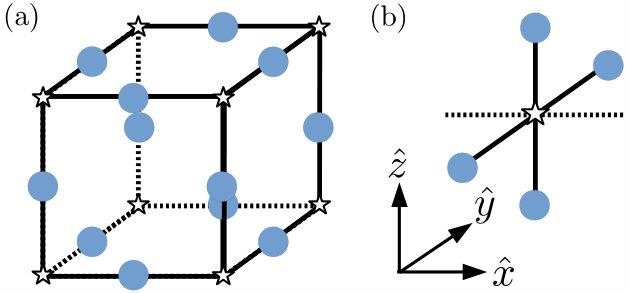 Figure 4
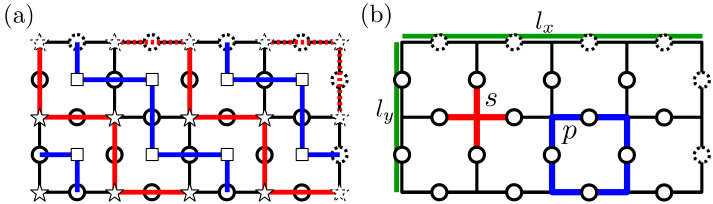 Figure 5
Peer Reviews
No public reviews on file for this paper yet. If you reviewed it on a platform where reviews are public (OpenReview, ICLR, NeurIPS, ICML), you can paste yours below so the community can read it here.
Videos
No videos yet. Explain this paper in a talk, walkthrough, or lecture? Add one.
Topological many-body scar states in dimensions 1, 2, and 3
Seulgi Ok
Department of Physics, University of Zurich, Winterthurerstrasse 190, 8057 Zurich, Switzerland
Kenny Choo
Department of Physics, University of Zurich, Winterthurerstrasse 190, 8057 Zurich, Switzerland
Christopher Mudry
Condensed Matter Theory Group, Paul Scherrer Institute, CH-5232 Villigen PSI, Switzerland
Institute of Physics, École Polytechnique Fédéerale de Lausanne (EPFL), CH-1015 Lausanne, Switzerland
Claudio Castelnovo
Theory of Condensed Matter Group, Cavendish Laboratory, University of Cambridge, Cambridge CB3 0HE, United Kingdom
Claudio Chamon
Physics Department, Boston University, Boston, Massachusetts 02215, USA
Titus Neupert
Department of Physics, University of Zurich, Winterthurerstrasse 190, 8057 Zurich, Switzerland
Abstract
We propose an exact construction for atypical excited states of a class of non-integrable quantum many-body Hamiltonians in one dimension (1D), two dimensions (2D), and three dimensins (3D) that display area law entanglement entropy. These examples of many-body “scar” states have, by design, other properties, such as topological degeneracies, usually associated with the gapped ground states of symmetry protected topological phases or topologically ordered phases of matter.
Introduction — Until recently, the study of many-body quantum systems has largely focused on ground-state properties and low-energy excitations, implicitly assuming the eigenstate thermalization hypothesis (ETH) dictating that highly excited states of generic non-integrable models are void of interesting structures Berry and Tabor (1977); Srednicki (1994). With the discovery of quantum systems that violate the ETH, a broader interest in the physics of many-body excited states emerged. This modern development is complemented by the growing potential of quantum simulators – predominantly using ultracold atomic gases – to prepare and study quantum many-body systems that are well isolated from the environment Kinoshita et al. (2006); Schreiber et al. (2015).
Theoretical indicators for the violation of the ETH by a conserved quantum many-body Hamiltonian include (i) a sub-volume law scaling for the entanglement entropy of eigenstates, (ii) emergent local integrals of motion in a non-integrable system Geraedts et al. (2017); Imbrie et al. (2017), and (iii) oscillations in the expectation value of suitably chosen local observables under the unitary time-evolution Turner et al. (2018a).
Two examples of ETH-violating conserved quantum Hamiltonians are those that either support (1) quantum many-body localized states Fleishman and Anderson (1980); Gornyi et al. (2005); Basko et al. (2006); Oganesyan and Huse (2007); Pal and Huse (2010); Serbyn et al. (2013); Huse et al. (2014); Imbrie (2016), where nearly all eigenstates at finite energy density share properties (i) and (ii), and (2) many-body quantum scars, where only a small set of states embedded in a continuum of thermalizing states show such exotic behavior Vafek et al. (2017); Shiraishi and Mori (2017); Ho et al. (2018); Turner et al. (2018a); Moudgalya et al. (2017, 2018); Turner et al. (2018b); Lin and Motrunich (2018). Here, we will be concerned with examples for the latter.
Theoretical studies of such ETH-violating systems are challenging for two reasons. Analytical progress Basko et al. (2006); Imbrie (2016); Vafek et al. (2017); Moudgalya et al. (2017, 2018); Lin and Motrunich (2018) is hard because the models in question are, by definition, non-integrable. Numerical techniques to obtain highly excited states rely on exact-diagonalization Luitz et al. (2015) and, in some cases, matrix-product state calculations Khemani et al. (2016). These techniques are limited in that the range of available system sizes is often too small to allow an extrapolation to the thermodynamic limit. For these reasons, the majority of studies on ETH-violation have been focused on one-dimensional (1D) models.
In this work we present a generic construction that places a scar state in the spectrum of non-integrable many-body quantum systems in 1D, 2D, and 3D. While the construction of such states applies to many systems, our primary focus is on topological scar states. In 1D, we construct symmetry-protected topological (SPT) states Chen et al. (2013). In 2D, we present a non-integrable deformation of the toric-code, with 4-fold degenerate scar states on the torus. Finally, in 3D we present a deformation of the X-cube model Castelnovo et al. (2010); Vijay et al. (2016) as an example of a system with scars that display fracton topological order Chamon (2005); Bravyi et al. (2011); Haah (2011); Castelnovo et al. (2010); Vijay et al. (2015, 2016).
Our construction is inspired by families of Hamiltonians that have been studied in the contexts of quantum dimer models and spin liquids Rokhsar and Kivelson (1988); Sachdev (1989); Ioffe and Larkin (1989); Henley (1997); Moessner and Sondhi (2001); Castelnovo et al. (2005); Castelnovo and Chamon (2008). In those studies, the emphasis was on the construction of parent Hamiltonians for a given ground state. Consider the Hamiltonian
[TABLE]
[For instance, at the Rokhsar-Kivelson point of the quantum dimer model on the square lattice, would be a plaquette and the operators are projectors that encode both the potential and kinetic (plaquette flip) terms Rokhsar and Kivelson (1988); Henley (1997); Castelnovo et al. (2005).] If all the couplings are positive, the state is the ground state of , as the are positive-semidefinite. If the take positive or negative values depending on , then one cannot guarantee that is a ground state. It is, nonetheless, an eigenstate with energy . Even when this state is a high energy eigenstate in the spectrum of , it is an atypical state in that it displays area law entanglement entropy, for it is also a ground state of a different local Hamiltonian . Hence is a scar state, if is nonintegrable. (Reference Shiraishi and Mori, 2017 also presents an analytical construction of scar states; we explain the connection in the Supplemental Information.)
By deforming exactly solvable models – the toric code, for instance – one can break integrability while retaining the scar state. [In the Supplementary Material we show how to construct non-commuting operators with the desired properties starting from solvable models with commuting projectors.] In what follows, we construct topological scar states in 1D, 2D, and 3D.
A warm-up example — We start with a simple example in 1D, which is topologically trivial, but illustrates the general ideas in a straighforward way. Consider a quantum spin-1/2 1D chain with periodic boundary conditions, i.e., a ring, with sites. On each site , we denote the three Pauli operators by , , and . For any , we define the local Hamiltonian
[TABLE]
with . The condition is required to place the scar state in the middle of the spectrum; the condition is needed so as not to break the system into two independent (and integrable) transverse-field Ising chains.
At , the system is equivalent to a paramagnetic spin chain in a Zeeman field, which is integrable. With , all the nearest-neighbor terms no longer commute, i.e., . In this case, should no longer be integrable, a fact confirmed by analysis of the energy level statistics obtained numerically as we now explain. We study the statistics of the spacings between consecutive energy levels, , as well as the -value defined as the average of the ratios . We analyze the spectrum in common eigenspaces of a maximal set of commuting symmetries of the system, namely translation, parity under inversion, and an additional -valued parity defined by . Figure 1 contains the result of this analysis for , and . The distribution matches the distribution of eigenvalue spacings for the Gaussian Orthogonal Ensemble (GOE) of random matrices, thus supporting the claim that Hamiltonian (2) is non-integrable. The corresponding mean -value for our distribution (averaged over the different momentum sectors) is , close to that of the GOE, , and clearly distinct from the value of the Poisson distribution, .
One can verify that the state
[TABLE]
is annihilated by the operators for all . Therefore is an eigenstate of with eigenvalue 0.
That this eigenstate obeys area law entanglement entropy can be seen as follows. The operators are positive-semidefinite definite, owing to the identity Q^{2}_{i}(\beta)=2\cosh\left(\vphantom{\Bigg{(}}\beta\,\left(Z^{\,}_{i-1}\,Z^{\,}_{i}+Z^{\,}_{i}\,Z^{\,}_{i+1}\right)\right)\,Q^{\,}_{i}(\beta). Therefore, is the ground state of another (local) Hamiltonian, . The spectrum of has a gap between its ground state and all excited states, a gap that remains for a finite range of values of . Therefore, obeys area law entanglement entropy for a range of Hastings (2007). Alternatively, the area-law property of can be argued from the form of Eq. (3) for any , by noting that it can be represented by a quantum circuit of constant depth (independent of both and system size), applied to a product state Eisert et al. (2010); Hermanns (2017).
In Fig. 2, we present the entanglement entropy for the different eigenstates of for , and . Notice that the scar state is embedded within highly entangled states.
1D: SPT cluster model — Consider a quantum spin-1/2 ring with sites. Odd and even sites are denoted by and , respectively. For any with , we define the Hamiltonians
[TABLE]
Note that for any and . For , is exactly solvable and its ground state is a gapped SPT state Gu and Wen (2009); Pollmann et al. (2012). Its topological attributes originate from symmetry protected zero modes that are localized at the two ends of an open chain when open boundary conditions are imposed instead of periodic ones. The symmetry protecting the boundary states is as shown in the Supplemental Material Chen et al. (2013). Being gapped at , the SPT phase extends to non-vanishing but sufficiently small and . (See Ref. Santos (2015) for another deformation of 1D SPT Hamiltonians.)
The null state for is an eigenstate of the operators, , with eigevalue . We denote this state by . For and , the null state of Eq. (4a) is
[TABLE]
It remains to be shown that the Hamiltonian is non-integrable. Since the Hamiltonian is made up of two commuting pieces and , one must show that each component alone is non-integrable. We shall reduce the calculation of the energy level statistics to the problem already solved for the topologically trivial warm up example of the Hamiltonian in Eq. (2), presented previously. The mapping is via a nonlocal unitary transformation
[TABLE]
which maps into where
[TABLE]
The spectrum of can be related to that of by noticing that the operators with that appear in the exponentials in Eq. (7) have no dynamics within , and vice versa, the with have no dynamics within . For the purpose of obtaining the eigenvalues of , one can freeze the ; there are only two gauge inequivalent choices depending on the sector selected, i.e., the choice of . (This symmetry is one of the two ’s in the .) The spectrum of in the sector (equivalent to fixing ) reduces to that of that we studied previously. We thus conclude that the 1D SPT scar from Eq. (5a) is an exceptional state in the spectrum of a non-integrable Hamiltonian +.
Example in 2D: Toric code — In 2D we study a lattice model derived from the toric code Kitaev (2003). The Hamiltonian is defined by the pair of commuting operators
[TABLE]
where labels a star and a plaquette (see Fig. 3), and . (Notice that yields the usual toric code up to an additive constant.) We define [] such that () is equal to 0 on one sublattice and 1 on the other sublattice of the lattice (). Here, is the lattice formed by the centers of all the stars, and is the lattice formed by the centers of all the plaquettes. Our deformation of the toric code for uses the paths and , on and , respectively. These paths are connected, non-intersecting, and chosen such that all the spins are on either of the two paths. (An example of such paths is presented in Fig. 3, and in the Supplemental Material we give further examples.) These conditions on guarantee that (a) , (b) there is no further integral of motion besides or as well as space group symmetries, and (c) the spectrum of alone is equal to that of for a path of length (up to exact degeneracies due to a different number of integrals of motion in 1D and 2D). To obtain (c), one notes that for spins not in are integrals of motion of . Replacing them by their eigenvalue reduces to the form of for an appropriate choice of its integrals of motion for in Eq. (4b), upon labeling the spins along in the order of the 1D chain. We conclude that the level statistics of and are identical up to exact degeneracies. Hence the numerical evidence for the non-integrability of directly carries over to . In our model, the extensive symmetries at arising from are lifted when (in which case are no longer sums of commuting projectors).
The scar states are built as follows. Because and square to unity and satisfy , we can build a vector out of the distinct eigenvalues of independent ’s and independent ’s to label an orthogonal basis of a -dimensional subspace of the -dimensional Hilbert space on which acts. To complete the basis of the Hilbert space, we use the eigenstates with the eigenvalues of the pair of Wilson-loop operators with defined in Fig. 3. The following four scar states (one in each of the 4 topological sectors) are eigenstates of with the eigenvalues :
[TABLE]
3D Example: -cube model — Our 2D construction can be extended in a straightforward way to 3D toric code-type Hamiltonians Hamma et al. (2005). Here, we derive scar states for the slightly more exotic fracton topological order, which only arises in three or more dimensions Chamon (2005); Castelnovo et al. (2010); Vijay et al. (2015); Haah (2011); Vijay et al. (2016). Fracton phases carry excitations which are (at least partially) immobile in that they cannot be moved infinitesimally by applying local operators. In addition, they can support topological ground state degeneracies that scale exponentially in the system size. Here, we introduce a Hamiltonian based on the X-cube model Vijay et al. (2016), which supports fracton topological order in its ground state, to construct a set of 3D scar states with the same exponential degeneracy. The Hamiltonian is, once again, defined by the pair of commuting operators
[TABLE]
where labels a star and a cube (see Fig. 4), and . (Notice that yields the usual X-cube model up to a constant.) We define () analogously to that in the 2D model, such that () is equal to 0 on one sublattice and 1 on the other sublattice of the lattice (). The paths and are defined on and , respectively, and they obey the same conditions as in the 2D construction. These conditions guarantee that for any , while lifting the extensive symmetries at arising from because are no longer sums of commuting projectors.
The Hilbert space for a cubic lattice of linear size is -dimensional (there are sites in and in ). The counting of independent stars and cubes delivers the vector of eigenvalues. These quantum numbers are complemented by the sub-extensive vector of topological quantum numbers. The number of scar states that are eigenstates of with the eigenenergy thus grows sub-extensively with the linear size of , and are written as
[TABLE]
Conclusions — We proposed a scheme to analytically construct highly excited states of non-integrable local Hamiltonians with sub-volume-law entanglement entropy scaling that are embedded in a dense spectrum of volume-law scaling states. We gave further examples of constructions of scar states using stochastic matrix form Hamiltonians Henley (1997); Castelnovo et al. (2005); Castelnovo and Chamon (2008) with a notion of SPT or topological orders. This allowed us to construct sets of degenerate scar states. Whether these degeneracies are topological in that they carry a sense of protection against small generic local perturbations is left as a problem for future work.
Acknowledgments
The authors thank Nicolas Regnault for discussions and insightful comments on the manuscript. TN and CCa thank Zlatko Papić for fruitful discussions. SO and TN were supported by the the Swiss National Science Foundation (grant number: 200021_169061). KC and TN were supported by the European Unions Horizon 2020 research and innovation program (ERC-StG-Neupert-757867-PARATOP). CCh was supported by the U.S. Department of Energy (DOE), Division of Condensed Matter Physics and Materials Science, under Contract No. DE-FG02-06ER46316. CCa was supported in part by Engineering and Physical Sciences Research Council (EPSRC) Grants No. EP/P034616/1 and No. EP/M007065/1. CCh thanks the hospitality of the Pauli Center for Theoretical Studies at ETH Zürich and the University of Zürich, where this work was started.
I Supplemental Material
I.1 Construction of Hamiltonians containing null states
Here we demonstrate the construction of Hamiltonians hosting null eigenstates starting from a solvable model.
Consider first operators satisfying
[TABLE]
(Notice that if contains exclusively operators at site , that follows trivially from the fact that no common site belongs to and its complement.) Third, we define
[TABLE]
Notice that is Hermitian, while is not. They are related by
[TABLE]
In addition to being Hermitian, is local, because is local and the exponential of the local operator is also local; and it is positive-semidefinite, as can be inferred by squaring it,
[TABLE]
and observing that is positive-definite.
We shall now construct a common null state to all the operators.
First, notice that the state
[TABLE]
is annihilated by , for all , for
[TABLE]
where we used the fact that . The state is arbitrary, as long as it is not annihilated by the projectors .
Second, let
[TABLE]
It follows that, for any ,
[TABLE]
and consequently
[TABLE]
Therefore, the state is a common null state of all the local operators , and also of any local Hamiltonian written as a weighted sum of the , say
[TABLE]
for any weights . In Eq. (2), we chose, in place of and , and , respectively.
I.2 Symmetries in 1D
One finds the commutation relations
[TABLE]
Therefore, , , and can be diagonalized simultaneously.
Translation symmetry: , , and are each invariant under the translations
[TABLE]
Hence, , , and can be simultaneously diagonalized with the Hermitian generator of the unitary operators representing the transformations (23), i.e., the momentum operator associated to the sublattice , say.
Inversion symmetry: For any site , is invariant under the inversion
[TABLE]
For any site , is invariant under the inversion
[TABLE]
Hence, has the symmetry that is generated by the two independent involutive unitary transformations (24) and (25). This is to say that , , and are invariant under any inversion of the ring that leaves one site of the ring unchanged.
Two independent involutive symmetries: Hamiltonian is invariant under the involutive unitary transformation
[TABLE]
that acts trivially on the sites of the ring. Hence, has the symmetry that is generated by the two independent involutive unitary transformations (26a) and (26b).
I.3 A local unitary transformation in 1D
We verify the transformation law
[TABLE]
with and defined in Eq. (7) and Eq. (6), respectively. To this end, it suffices to prove the identity
[TABLE]
The terms in the exponent of that do not contain do not contribute to the transformation, i.e.,
[TABLE]
where , for , and vice versa for . Using additional relations
[TABLE]
one acquires the identity in Eq. (28).
I.4 Open boundary conditions in 1D
Using the notation introduced in Eq. (4), we define the Hamiltonian
[TABLE]
By inspection of the explicit representations
[TABLE]
we observe that and obey the vanishing commutation relations
[TABLE]
The two vanishing anticommutators
[TABLE]
along with the fact that , and the Hermitian operator defined in Eq. (26) commute with , imply that every eigenspace of , including the one of the scar state, is at least four-fold degenerate, and the quadruplet of states can be labelled by the eigenvalues of and . The degeneracy is protected by the symmetries U1 and U2. Since and are local operators at the end of the chain, the Hamiltonian is in an SPT phase.
I.5 Examples of paths and
in 2D
For convenience, we recall that we introduced the pair of Hamiltonians
[TABLE]
in Eq. (8). The definition of the paths and was given below Eq. (8). An example for the choice of paths and was given in Fig. 3. Four more examples and one counter example are given in Fig. 5.
I.6 Relation to the construction for scar states from
Ref. Shiraishi and Mori (2017)
In this section, we show that there exists a unitary transformation that brings Hamiltonian (1a) with the property (1b) into the form of the family of Hamiltonians defined in Eqs. (1) and (2) from Ref. Shiraishi and Mori (2017). However, we emphasize that Hamiltonian (1a) stems from the stochastic matrix form Hamiltonians introduced in Refs. Castelnovo et al. (2005), wherein the property (1b) was proven.
We present the local Hermitian operator in Eq. (1a) (the dependence is implicit) as
[TABLE]
that assigns to all eigenspaces of with nonzero eigenvalue the eigenvalue 1. The eigenvalue of the null state with respect to both and is [math] for all . We define the local Hermitian operator
[TABLE]
The projector defined by Eq. (36b) and fulfill all the conditions of their counterparts in Eqs. (1) and (2) from Ref. Shiraishi and Mori (2017), respectively. Since is allowed to take the value [math], in which case , , and , our Hamiltonian in Eq. (1a) belongs to the family of Hamiltonians defined by Ref. Shiraishi and Mori (2017).
The reference list from the paper itself. Each links out to its DOI / PubMed record.
- 1Berry and Tabor (1977) M. V. Berry and M. Tabor, Proc. R. Soc. Lond. A 356 , 375 (1977).
- 2Srednicki (1994) M. Srednicki, Phys. Rev. E 50 , 888 (1994) . · doi ↗
- 3Kinoshita et al. (2006) T. Kinoshita, T. Wenger, and D. S. Weiss, Nature 440 , 900 (2006).
- 4Schreiber et al. (2015) M. Schreiber, S. S. Hodgman, P. Bordia, H. P. Lüschen, M. H. Fischer, R. Vosk, E. Altman, U. Schneider, and I. Bloch, Science 349 , 842 (2015).
- 5Geraedts et al. (2017) S. D. Geraedts, R. Bhatt, and R. Nandkishore, Phys. Rev. B 95 , 064204 (2017).
- 6Imbrie et al. (2017) J. Z. Imbrie, V. Ros, and A. Scardicchio, Annalen der Physik 529 , 1600278 (2017).
- 7Turner et al. (2018 a) C. Turner, A. Michailidis, D. Abanin, M. Serbyn, and Z. Papić, Nat. Phys. 14 , 745 (2018 a).
- 8Fleishman and Anderson (1980) L. Fleishman and P. Anderson, Phys. Rev. B 21 , 2366 (1980).