The Alexander polynomial for closed braids in lens spaces
Bo\v{s}tjan Gabrov\v{s}ek, Eva Horvat

TL;DR
This paper introduces a new method to compute the Alexander polynomial of links in lens spaces using a Burau-like representation of the mixed braid group, simplifying calculations in this setting.
Contribution
It develops a reduced Burau-like representation for the mixed braid group in lens spaces and enables direct calculation of the Alexander polynomial from mixed braids.
Findings
Provides a new algebraic tool for link invariants in lens spaces
Enables direct computation of Alexander polynomial from mixed braids
Simplifies previous methods for analyzing links in lens spaces
Abstract
We present a reduced Burau-like representation for the mixed braid group on one strand representing links in lens spaces and show how to calculate the Alexander polynomial of a link directly from the mixed braid.
Click any figure to enlarge with its caption.
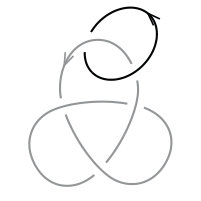 Figure 1
Peer Reviews
No public reviews on file for this paper yet. If you reviewed it on a platform where reviews are public (OpenReview, ICLR, NeurIPS, ICML), you can paste yours below so the community can read it here.
Videos
No videos yet. Explain this paper in a talk, walkthrough, or lecture? Add one.
The Alexander polynomial for closed braids in lens spaces
Boštjan Gabrovšek and Eva Horvat
Faculty of Mechanical Engineering and Faculty of Mathematics and Physics, University of Ljubljana, Slovenia; Institute of Mathematics, Physics and Mechanics (IMFM), Slovenia
Faculty of Education, University of Ljubljana, Slovenia
Abstract.
We present a reduced Burau-like representation for the mixed braid group on one strand representing links in lens spaces and show how to calculate the Alexander polynomial of a link directly from the mixed braid.
Key words and phrases:
Burau representation, Alexander polynomial, links in lens spaces, mixed braids, mixed braid group
2010 Mathematics Subject Classification:
Primary: 57M27. Secondary: 20F36, 57M07
1. Introduction
It is widely known that if a knot is the closure of a braid , an element of the Artin braid group , the Alexander polynomial of is given by the formula
[TABLE]
where is the reduced Burau representation of . In [18] Morton extended this formula and introduced a colored Burau representation of the braid group that enables us to compute the multivariable Alexander polynomial of a link by similar algebraic means.
On the other hand, we know by the Lickorish-Wallace theorem [17] that every closed, orientable, connected 3-manifold can be obtained by performing Dehn surgery on a link in . When studying links in , we take a disjoint union of a surgery link, used to construct , and the link in itself, to obtain a so-called mixed link, see Figure LABEL:fig:mixed-link (see also [4, 7, 9, 8] and for alternative approaches [2, 19, 20, 21]). The corresponding mixed braid group [13, 16] enables us to represent a link in as a closure of a mixed braid.
Just as the braid group plays an important role in classical knot theory in , the mixed braid group plays an important role in the theory of knots and links in other 3-manifolds. An increasing number of topological and algebraical tools are being developed in the ongoing investigation of constructing and generalizing classical knot invariant to those of knots in 3-manifolds (e.g. via Markov trace functions on the associated algebras, computations of skein modules, Chern-Simons theories, …). In these studies lens spaces are of special interest, since, by the Lickorish-Wallace theorem, they can be viewed as constructing blocks of c.c.o. 3-manifolds.
It was recently shown in [10] how the Alexander polynomial of a link in changes when we think of as a mixed link and perform rational surgery on some of its components. In particular, an explicit formula was given that computes the Alexander polynomial of a link inside a lens space directly from the mixed link diagram.
In this paper we introduce a Burau-like representation of the mixed braid group on one strand [12, 14], which enables us to generalize Formula (1) to lens spaces, i.e. it allows us to compute the Alexander polynomial of a link in the lens space directly from the mixed braid group representative.
The paper is structured as follows. In Section 2, we recall the definition of the mixed braid group on one strand. In Section 3, we recall the definitions of the Alexander polynomial in and the Alexander polynomial(s) in . In Section 4, we recall Morton’s results, introduce the Burau-like representation for the mixed braid group on one strand, and state our main result (Theorem 4.2), the algebraic formula for computing the Alexander polynomial.
2. The mixed braid group on one strand
The lens space is the manifold obtained by performing Dehn surgery on the unknot with surgery coefficients , where we assume are two coprime integers. Following [13, 4], we fix pointwise and represent a link in by the link , which we call a mixed link, composed of the fixed component and the moving component . When appropriate, we emphasize that surgery has been performed on the fixed component and denote the link as . Taking a regular projection of to the plane of , we obtain a mixed link diagram, as in Figure LABEL:fig:mixed-link.
By the Alexander theorem, we can represent as the closure of a braid in the braid group , where the strand , called the fixed strand, belongs to , while the strands of are called moving strands and belong to . By the parting process described in [16] and [4], we can assume that the fixed strand begins and ends on the left, while all crossings belonging to the moving components are pushed to the right and may occasionally make a simple wind around the fixed strand as in Figure LABEL:fig:mixed-braid.
Fixing the vertical left strand , we can form the mixed braid group on one strand , a subgroup of , with the following presentation [12]:
[TABLE]
where the generators and are illustrated in Figure 2.
We advise the reader to see [16] for more details on this and more general constructions related to braiding mixed links.
3. The Alexander polynomial for links in lens spaces
In this Section we describe a Torres-type formula [23], constructed in [10], which relates the two-variable Alexander polynomial of a mixed link in to the corresponding Alexander polynomial of a link in .
We briefly recall the algebraic definition of the Alexander polynomial of a link in , based on the Fox construction (see [24, 11], cf. [25]).
Given a group with a finite presentation
[TABLE]
denote by its abelianization and by the corresponding free group. Apply the chain of maps
[TABLE]
where denotes the Fox differential, is the quotient map by the relations and is the abelianization map.
The Alexander-Fox matrix of the presentation of is the matrix A=\big{[}\alpha(\gamma(\frac{\partial r_{i}}{\partial x_{j}}))\big{]}_{1\leq i\leq m,1\leq j\leq n}. The first elementary ideal is the ideal of , generated by the determinants of all the minors of .
For a link in , the abelianization of is a free abelian group, whose generators correspond to the components of . For a -component link, we have .
Let be the first elementary ideal, obtained from a presentation of . The Alexander polynomial of a link is the generator of the smallest principal ideal containing .
We are only interested in distinguishing the variable, corresponding to the fixed component, from the variables, corresponding to the moving link components. In the above construction, we thus replace the map by the map , where is the canonical projection, defined by
[TABLE]
We obtain a two-variable Alexander polynomial , which can be viewed as the Alexander polynomial of a link in the solid torus.
We are now ready to define the Alexander polynomial of a link in Given a mixed link , the following proposition allows us to describe the link group of (the fundamental group of ).
Proposition 3.1** ([22]).**
Let be the presentation of the link group of . The presentation of the link group of is given by
[TABLE]
where (resp. ) denote the meridian (resp. longitude) of the regular neighbourhood of .
The abelianization of the fundamental group of a link in may also contain torsion, see [10, Corollary 2.10]. In this case we need the notion of a twisted Alexander polynomial. We recall the following from [1] (see also [3]).
Let be a finitely presented group and denote by its abelianization. Every homomorphism determines a twisted Alexander polynomial as follows. Choose a splitting , where is the free part of . The map induces a ring homomorphism sending to . We apply the chain of maps
[TABLE]
and obtain the -twisted Alexander matrix A^{\sigma}=\big{[}\sigma(\alpha(\gamma(\frac{\partial r_{i}}{\partial x_{j}})))\big{]}_{i,j}. The twisted Alexander polynomial is defined by .
If we replace the twisted map by the canonical projection , which sends the torsion part of to , we obtain the Alexander polynomial . In order to obtain the one-variable polynomial of a -component link , we compose the projection by the canonical projection , that sends each to .
We continue by describing how to obtain the Alexander polynomial for from the Alexander polynomial of .
Let be the disk, bounded by . We may assume that intersects transversely in intersection points with intersection signs . Denote by the homology class of in .
By Proposition 3.1, the presentation of is obtained from the presentation of the link group by adding one relation. The Alexander-Fox matrices are thus closely related and consequently so are the Alexander polynomials, as the following theorem states.
Theorem 3.2** ([10]).**
Let and . The Alexander polynomial of and the two-variable Alexander polynomial of the classical link are related by
[TABLE]
It is also shown in [10] that a normalized version of the Alexander polynomial in lens spaces, denoted by , respects a skein relation
[TABLE]
where and is a skein triple in .
4. The Burau representation
In [18], Morton showed how to express the multivariable Alexander polynomial of a closed braid directly from the braid itself by the following construction.
Take the reduced Burau representation
[TABLE]
given by
[TABLE]
where the above matrix differs from the identity matrix solely at three places in the row . In the case or , the matrix is truncated appropriately. We label each strand of the braid by by putting the label on the strand that starts from the -th position at the bottom as in Figure 3.
We assign to the braid
[TABLE]
the coloured reduced Burau matrix
[TABLE]
where the variable denotes the label of the undercrossing strand at crossing , counted from top of the braid. Recall that a braid determines a permutation , such that any strand in connects position at the bottom to the position at the top.
Denoting by the axis of the braid , we consider the multivariable Alexander polynomial , where denotes the variable, corresponding to the braid axis. Morton proved the following result.
Theorem 4.1** ([18]).**
The multivariable Alexander polynomial , where is the axis of the closed -braid , is given by the polynomial with the identifications .
On the other hand, the Torres-Fox formula obtained in [23] tells us how the Alexander polynomial of a link changes when we remove one of its components. For a two component link , we have
[TABLE]
where is the linking number of and , and for a -component link , where , the formula states
[TABLE]
where denotes the linking number of and .
Once we suppress the axis in Theorem 4.1 by taking , we can directly apply the Torres-Fox formula and obtain the following equality:
[TABLE]
where is the number of components of the link .
Following Morton’s construction, we define a representation of the mixed braid group on one strand
[TABLE]
by
[TABLE]
where the matrices above differ from the identity matrix solely at the first two places in the first row for and the three places in the -th row for .
For example, a representation of the mixed braid group is given by
[TABLE]
We are now ready to state our main theorem.
Theorem 4.2**.**
Let be a mixed braid on one strand, such that represents a link in . Let be the sum of the exponents of the generator appearing in . Denote and . The Alexander polynomial of the link is given by
[TABLE]
Proof.
Define a map by and . It is easy to check that is a group monomorphism. We now label the first strand by and the rest of the strands of by . Observe in Equations (7) that and , thus the (bi)coloured reduced Burau matrix satisfies . By Theorem 4.1, the 2-variable Alexander polynomial of is given by
[TABLE]
By Theorem 3.2, we can use Equation (4) to obtain the Alexander polynomial of the link in . If , we have
[TABLE]
and if we have
[TABLE]
∎
Remark 4.3**.**
It follows from the proof of Theorem 4.2 that the 2-variable Alexander polynomial of a link in the solid torus, seen as a mixed link on one fixed strand , is given by Formula (9).
Example 4.4**.**
It has been calculated in [10] that the Alexander polynomial for the knot in Figure LABEL:fig:mixed-link is equal to . The braid representative of this knot is represented in Figure LABEL:fig:mixed-braid. We have
[TABLE]
[TABLE]
Since , Equation (8) yields
[TABLE]
Acknowledgments
The first author was supported by the Slovenian Research Agency grants J1-8131, J1-7025, N1-0064, and P1-0292. The second author was supported by the Slovenian Research Agency grant N1-0083.
The reference list from the paper itself. Each links out to its DOI / PubMed record.
- 1[1] A. Cattabriga, E. Manfredi, and M. Mulazzani, On knots and links in lens spaces , Topology Appl. 160 :2 (2013), 430–442.
- 2[2] A. Cattabriga, E. Manfredi, E., L. Rigolli, Equivalence of two diagram representations of links in lens spaces and essential invariants , L. Acta Math. Hungar. 146 (1) (2015), 168–201.
- 3[3] A. Cattabriga, E. Manfredi, Diffeomorphic vs Isotopic Links in Lens Spaces , Mediterr. J. Math. 15 :172 (2018)
- 4[4] I. Diamantis and S. Lambropoulou, Braid equivalence in 3-manifolds with rational surgery description , Topol. Appl. 194 (2015), 269–295.
- 5[5] I. Diamantis, S. Lambropoulou, J. Przytycki: Topological steps toward the Homypt skein module of the lens spaces L ( p , 1 ) 𝐿 𝑝 1 L(p,1) via braids , Journal of Knot theory and its Ramications, 25 :14 (2016).
- 6[6] I. Diamantis, S. Lambropoulou, A new basis for the Homflypt skein module of the solid torus , Pure Appl. Algebra. 220 :2 (2016), 577–605.
- 7[7] B. Gabrovšek, Tabulation of Prime Knots in Lens Spaces , Mediterr. J. Math. 44 :88 (2017).
- 8[8] B. Gabrovšek, M. Mroczkowski, The HOMFLYPT skein module of the lens spaces L p , 1 subscript 𝐿 𝑝 1 L_{p,1} , Topology Appl. 175 (2014) 72–80.