Interaction effects on $\mathcal{PT}$-symmetry breaking transition in atomic gases
Ziheng Zhou, Zhenhua Yu

TL;DR
This paper investigates how interatomic interactions influence the parity-time ($ ext{PT}$) symmetry breaking transition in ultracold atomic gases, revealing that the transition point depends on interaction parameters and system size.
Contribution
It introduces a model for interacting bosons under $ ext{PT}$-symmetric Hamiltonian and analyzes how interactions modify the symmetry breaking transition point.
Findings
Transition point $ ext{Γ}_{ m tr}$ decreases with interaction strength and particle number.
In the large interaction limit, $ ext{Γ}_{ m tr}$ scales as $| ext{δg}|^{-(N-1)}$.
Signatures of $ ext{PT}$ phases are proposed for experimental detection.
Abstract
Non-Hermitian systems having parity-time () symmetry can undergo a transition, spontaneously breaking the symmetry. Ultracold atomic gases provide an ideal platform to study interaction effects on the transition. We consider a model system of bosons of two components confined in a tight trap. Radio frequency and laser fields are coupled to the bosons such that the single particle Non-Hermitian Hamiltonian , which has -symmetry, can be simulated in a \emph{passive} way. We show that when interatomic interactions are tuned to maintain the symmetry, the -symmetry breaking transition is affected only by the SU(2) variant part of the interactions parameterized by . We find that the transition point decreases as or increases; in the large …
Click any figure to enlarge with its caption.
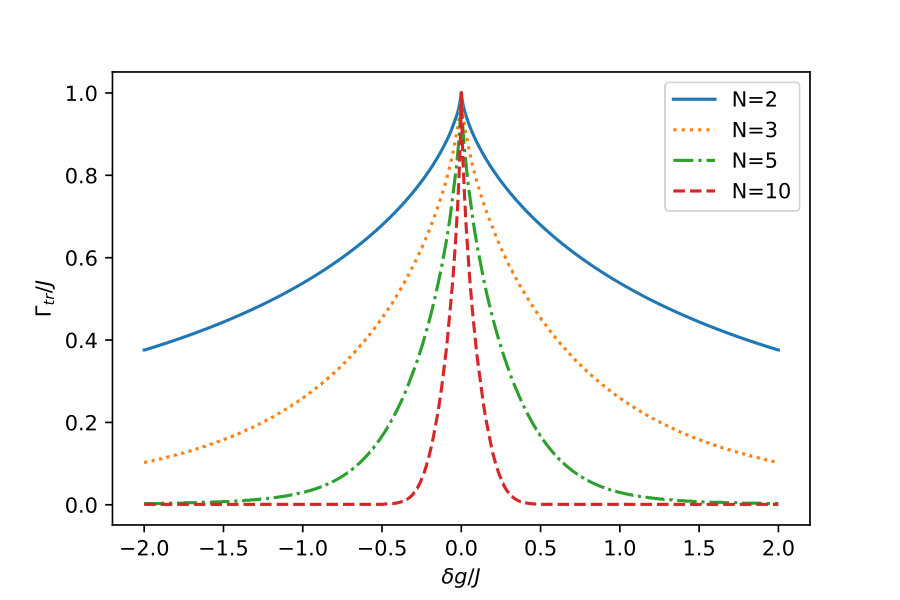 Figure 1
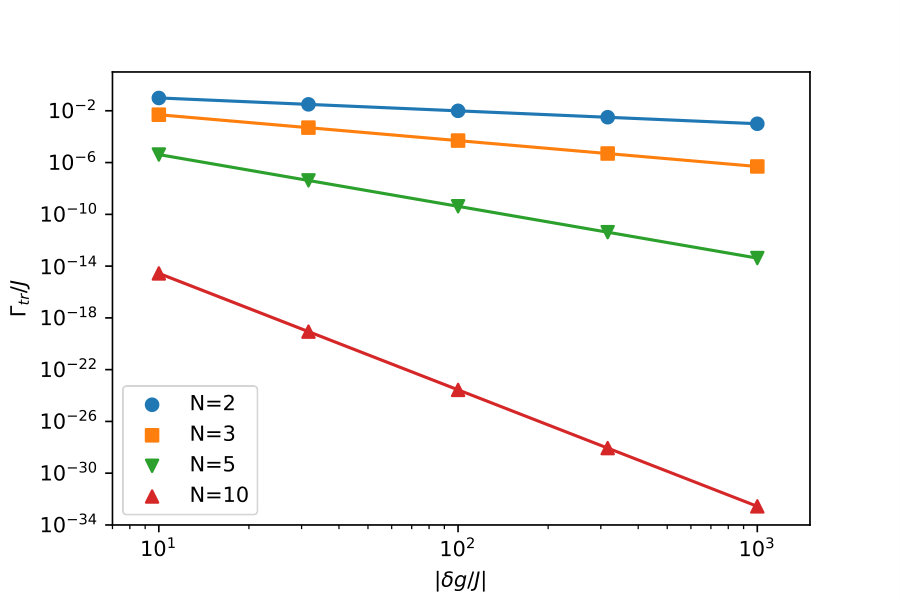 Figure 2
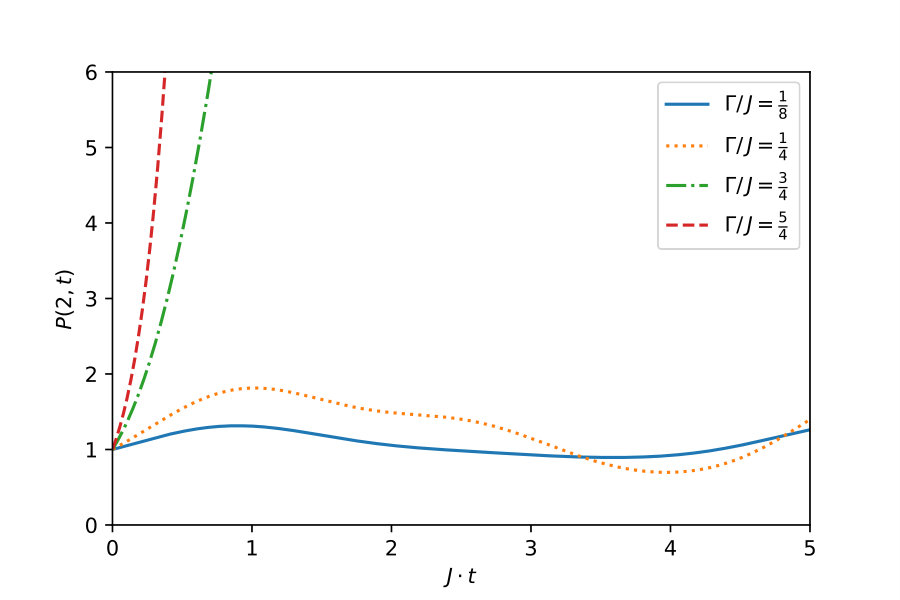 Figure 3
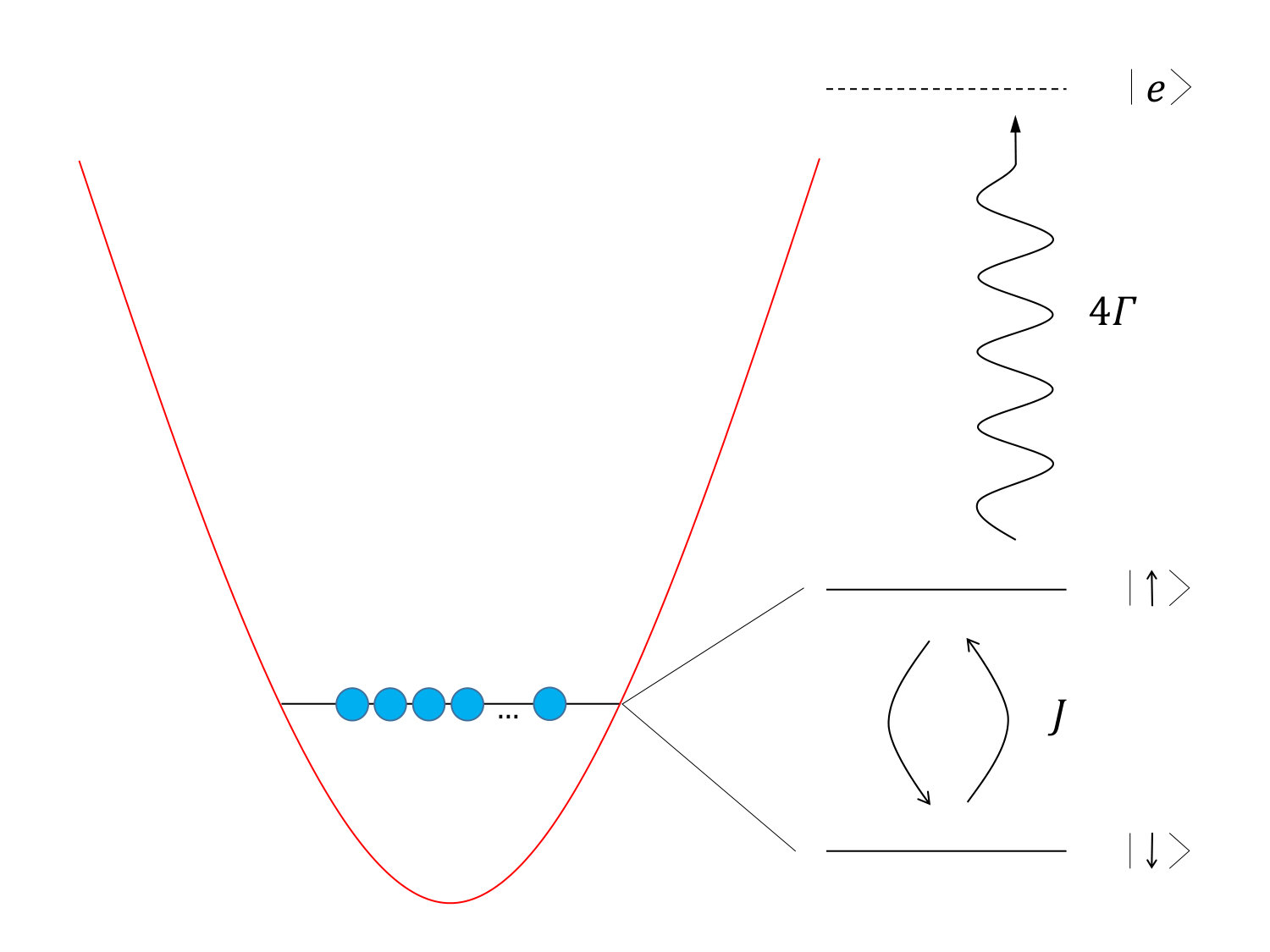 Figure 4
Peer Reviews
No public reviews on file for this paper yet. If you reviewed it on a platform where reviews are public (OpenReview, ICLR, NeurIPS, ICML), you can paste yours below so the community can read it here.
Videos
No videos yet. Explain this paper in a talk, walkthrough, or lecture? Add one.
Interaction effects on -symmetry breaking transition in atomic gases
Ziheng Zhou
Laboratory of Quantum Engineering and Quantum Metrology, School of Physics and Astronomy, Sun Yat-Sen University (Zhuhai Campus), Zhuhai 519082, China
Zhenhua Yu
Laboratory of Quantum Engineering and Quantum Metrology, School of Physics and Astronomy, Sun Yat-Sen University (Zhuhai Campus), Zhuhai 519082, China
State Key Laboratory of Optoelectronic Materials and Technologies, Sun Yat-Sen University (Guangzhou Campus), Guangzhou 510275, China
Abstract
Non-Hermitian systems having parity-time () symmetry can undergo a transition, spontaneously breaking the symmetry. Ultracold atomic gases provide an ideal platform to study interaction effects on the transition. We consider a model system of bosons of two components confined in a tight trap. Radio frequency and laser fields are coupled to the bosons such that the single particle Non-Hermitian Hamiltonian , which has -symmetry, can be simulated in a passive way. We show that when interatomic interactions are tuned to maintain the symmetry, the -symmetry breaking transition is affected only by the SU(2) variant part of the interactions parameterized by . We find that the transition point decreases as or increases; in the large limit, scales as . We also give signatures of the -symmetric and the symmetry breaking phases for the interacting bosons in experiment.
Study of non-Hermitian systems is constantly enriching our knowledge derived from Hermitian ones Bender ; Muss ; Moi ; Guo ; Kip ; Ueda ; Segev ; Khaj ; Fu . Of particular interest are a class of non-Hermitian systems having the parity-time () symmetry Bender1999 ; Moibook ; Benderbook . A representative model of the class is a two-level system whose Hamiltonian is of the form ; under the combined transformation of complex conjugate and the swap , is invariant Swanson . Parameter tuning across the critical point gives rise to the transition of the two-level system from the -symmetric phase to the symmetry breaking phase where exponentially growing or decaying modes set in. -symmetry breaking transition has been widely investigated in electromagnetic Guo ; Kip ; Kottos ; Peschel ; Schafer ; Yang , and mechanical systems Bender2013 . The transition is the cornerstone of exceptional properties regarding light propagation Lin2011 ; Scherer2011 ; Scherer2013 , lasing Yang2014 ; Khaj2014 ; Zhang2014 and topological energy transfer Rotter2016 ; Harris2016 .
Recently -symmetry breaking transition was successfully demonstrated in a gas of two component noninteracting 6Li atoms in a passive way Luo ; in the experiment, the application of a radio-frequency field and a laser inducing loss in one component of the atoms leads to, apart from kinetic energy, the single particle Hamiltonian , as the term gives rise to an overall decay. This approach circumvents the difficulty of realizing an atom gain in quantum simulation of -symmetric non-Hermitian Hamiltonians in atomic gases Moi . On the other hand, Feshbach resonance enables unprecedented control of interactions in ultracold atomic gases Chin , and deterministic preparation is achievable for a sample of variable atoms Bloch2010 ; Greiner2010 ; Bloch2011 ; Jochim . These capabilities make ultracold atoms an ideal platform to probe interaction effects on -symmetry breaking transition Konotop2016 .
In this work, we consider interacting two component bosons confined in a tight harmonic trap such that their spatial wave-function is frozen to be the ground harmonic state. The bosons are subject to the radio frequency field and the laser as in Ref. Luo . Feshbach resonance is used to tune the interaction Hamiltonian of the bosons to maintain the -symmetry. We find that in this interacting system, -symmetry breaking transition depends on only the SU(2) variant part of the interactions parameterized by . The transition point decreases as or increases. In the large limit, is suppressed as . Finally we show how the modification on the transition by the interactions can be detected experimentally.
Figure (1) gives a schematic of the system that we consider. Bosonic atoms with two internal states denoted by and are confined in a harmonic trap potential , where is the atomic mass. For simplicity, we assume the confinement being so tight, i.e., is much larger than any other energy scales to be considered, that the spatial wave-function of the bosons is frozen to be the single particle ground state of the harmonic trap. A radio-frequency field of frequency equal to the internal energy difference is used to flip the atoms between the two internal states and with Rabi frequency . An additional laser is coupled to the atoms in state and results in a loss rate of the atom number in the state. We take throughout.
In the absence of interatomic interactions, the Hamiltonian for each bosons spanned by and is non-Hermitian and is given by , apart from the ground harmonic state energy Luo . The interatomic interaction Hamiltonian of the bosons is given by
[TABLE]
where and is the s-wave scattering length Pethick ; Bloch , and are the Pauli matrices for the th boson. The interaction Hamiltonian is -symmetric only if ; in atomic gases, this condition can be experimentally fulfilled by the technique of Feshbach resonance Chin . We focus on this situation in the following discussion.
Therefore, the total Hamiltonian of interacting bosons is given by
[TABLE]
where , and . Compared with the noninteracting case, the -symmetry breaking transition of the interacting boson system is now determined by . Since there are two internal states and to accommodate bosons, the dimension of the Hilbert space shall be . It is easy to assure oneself that such a space is spanned by the streched states with where and . In this space, the matrix element of becomes
[TABLE]
The transition occurs when some eigenvalues of coalesce and turn complex afterwards. Note that when , the interactions drop out of ; this is the situation that the scattering lengths become all the same and the interatomic interactions are SU(2) invariant. This dependence of the transition on the interactions is because if the interatomic interactions are SU(2) invariant, i.e., , the noninteracting -symmetric non-Hermitian Hamiltonian and are commutable and can be diagonalised simultaneously.
The above non-Hermitian Hamiltonian formalism is related to the Lindbald equation describing the bosons subject to pure loss in the following way. In terms of the field operator () which annihilates (creates) a boson of internal state in the ground state of the harmonic trap, the Lindbald equation for the density matrix of the bosons is given by Cohen
[TABLE]
where is the Hermitian Hamiltonian of the bosons in the absence of the external lossy laser coupling. Given that in experiment the initial density matrix shall be always block diagonalized in the number of bosons, i.e., is zero unless , where and is the boson subspace projection operator, so is . If the last term in Eq. (6) were not there, the time dependent density matrix would be given by with and ; since the projection of in the boson subspace is just the non-Hermitian Hamiltonian in Eq. (2), i.e., , the properties of would determine the time evolution of .
To access the importance of the term in Eq. (6) to a typical experiment starting with particles, we note that initially only is nonzero. Since the pure loss can only cause the particle number to decrease, for all the following time, if or . Thus, from Eq. (6) one can first obtain ; the term has no effects on since the projection of the term involves only which is identically zero. Note that commutes with the total particle number. From hereon, one can show . Likewise, one can solve all the rest for in a cascade; the non-diagonal parts are always zero, i.e., for . The above argument justifies one to study the time evolution of the purely lossy system by analyzing the non-Hermitian Hamiltonian from Eq. (2). Of course, calculations of observables should resort to the density matrix . This justification shall also apply to other similar purely lossy systems.
We start with analyzing the non-Hermitian Hamiltonian of two interacting bosons. For , the Hamiltonian in the basis has the explicit form
[TABLE]
The corresponding characteristic polynomial is
[TABLE]
whose zeros are the eigenvalues of . Since all the coefficients of the cubic polynomial are real, one of the three zeros of is real definite. When is increased from zero, the rest two zeros of , which are also real in the first place, coalesce at the the -symmetry transition point and become complex afterwards. This coalescence occurs when the discriminant of
[TABLE]
is zero. When , retrieves the known transition point . For nonzero , Fig. (2) shows that is suppressed more and more as increases. By Eq. (9), it is manifest from that is even in , and one finds for , and for .
The suppression of in the limit is readily understood by inspecting the -symmetric Hamiltonian, Eq. (7). In such a limit, we recast with
[TABLE]
To the the leading order, yields right away that the two states and are degenerate and share the same eigenvalue , and the eigenvalue of the third state is zero, well separated apart from . Since the -symmetry transition is expected to happen at the point where eigenvalues of coalesce, to find the effects of and on the two degenerate eigenvalues originally equal to , we use to carry out a perturbation calculation to derive the effective Hamiltonian in the subspace spanned by the states and ; we find that to second order of the effective Hamiltonian is given by Cohen
[TABLE]
This effective Hamiltonian yields , the same as from requiring .
For , we numerically diagonalise and find that the transition is always due to the coalescence of a pair of eigenvalues of . Figure (2) shows that the critical value is also symmetric in , which is because, under the transformation and , we have . We find that for fixed , decreases as increases, while for fixed , as increases, is more and more suppressed.
Figure (3) shows that in the large limit, . This asymptotic behavior can be understood by an analysis similar to the one given above for . For arbitrary , in the large limit, we separate from Eq. (3) as with and . In such a limit, the leading order Hamiltonian gives rise to a pair of degenerate eigvenvalues in each subspaces spanned by and ; the eigenvalues are all well separated from each other. To determine the transition, we use to derive the effective Hamiltonian in the each two dimensional subspace. It is easy to convince oneself that to the lowest order of , the diagonal elements are , and the off-diagonal elements are generated at order of , resulting in . Thus, by diagonalizing the matrix of , we find the transition point for each two dimensional subspaces. Given that the maximum value of equals , overall, the -body system enters into the symmetry breaking phase first at .
The relation between the non-Hermitian Hamiltonian formalism and the Lindbald equation for our system given above indicates that the signatures of the -symmetric and symmetry breaking phases governed by in Eq. (3) can be detected experimentally in the following way. Let one prepare the experiment initally with bosons Bloch2010 ; Greiner2010 ; Bloch2011 such that ; the quantity shall have qualitatively different time dependent behaviors in the symmetric and symmetry breaking phases. For example, by the high accuracy atom number detection achieved experimentally Jochim , one can measure the rescaled probability of finding bosons with . In contrast, the total number of atoms was measured to distinguish the two phases for the noninteracting 6Li atoms Luo . In our interacting case, the total number of atoms ceases to be a good observable for the purpose since the observable depends on not only but also for whose dynamics is not determined by a single Hamiltonian for bosons. Figure (4) plots the rescaled in an experiment starting with bosons and for various values of . Note that for and , . Figure (4) shows that is bounded in the -symmetric phase, and grows exponentially in the symmetry breaking one. Due to the interactions, the point is already in the symmetry breaking phase while its value is still smaller than the critical value for the noninteracting case.
Acknowledgements. We thank Jiaming Li for discussions. This work is supported by NSFC Grants No. 11474179, No. 11722438, and No. 91736103.
The reference list from the paper itself. Each links out to its DOI / PubMed record.
- 1(1) C. M. Bender and S. Boettcher, Phys. Rev. Lett. 80 , 5243 (1998).
- 2(2) K. G. Makris, R. El-Ganainy, D. N. Christodoulides, and Z. H. Musslimani, Phys. Rev. Lett. 100 , 103904 (2008).
- 3(3) S. Klaiman, U. G nther, and N. Moiseyev, Phys. Rev. Lett. 101 , 080402 (2008).
- 4(4) A. Guo, G. J. Salamo, D. Duchesne, R. Morandotti, M. Volatier-Ravat, V. Aimez, G. A. Siviloglou, and D. N. Christodoulides, Phys. Rev. Lett. 103 , 093902 (2009).
- 5(5) C. E. Rüter, K. G. Makris, R. El-Ganainy, D. N. Christodoulides, M. Segev, and D. Kip, Nat. Phys. 6 , 192 (2010).
- 6(6) Z. Gong, Y. Ashida, K. Kawabata, K. Takasan, S. Higashikawa, and M. Ueda, Phys. Rev. X 8 , 031079 (2018).
- 7(7) G. Harari, M. A. Bandres, Y. Lumer, M. C. Rechtsman, Y. D. Chong, M. Khajavikhan, D. N. Christodoulides, and M. Segev, Science 359 , eaar 4003 (2018);
- 8(8) M. A. Bandres, S. Wittek, G. Harari, M. Parto, J. Ren, M. Segev, D. N. Christodoulides, and M. Khajavikhan, Science 359 , eaar 4005 (2018).