On grids in point-line arrangements in the plane
Mozhgan Mirzaei, Andrew Suk

TL;DR
This paper extends the Szemerédi-Trotter theorem by showing that arrangements avoiding a specific grid structure have fewer incidences, and constructs examples with many incidences that avoid such grids.
Contribution
It introduces a Turán-type bound for point-line arrangements avoiding a natural grid, and provides explicit constructions with high incidences without such grids.
Findings
Arrangements without a natural t×t grid have O(n^{4/3 - ε}) incidences.
Constructed arrangements without a 2×2 grid have at least Ω(n^{1+1/14}) incidences.
The results generalize incidence bounds by excluding specific grid configurations.
Abstract
The famous Szemer\'{e}di-Trotter theorem states that any arrangement of points and lines in the plane determines incidences, and this bound is tight. In this paper, we prove the following Tur\'an-type result for point-line incidence. Let and be two sets of lines in the plane and let be the set of intersection points between and . We say that forms a \emph{natural grid} if , and does not contain the intersection point of some two lines in for For fixed , we show that any arrangement of points and lines in the plane that does not contain a natural grid determines …
Click any figure to enlarge with its caption.
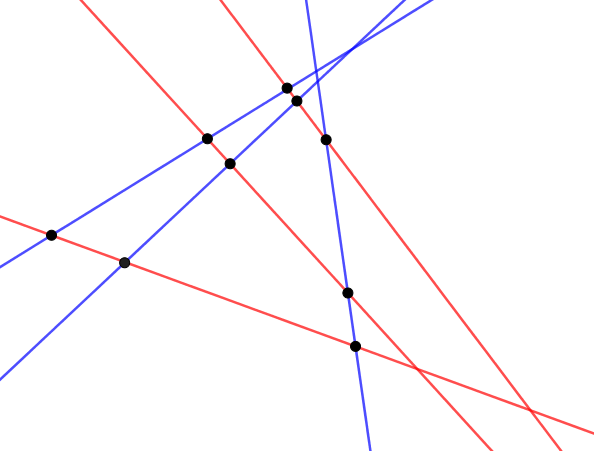 Figure 1
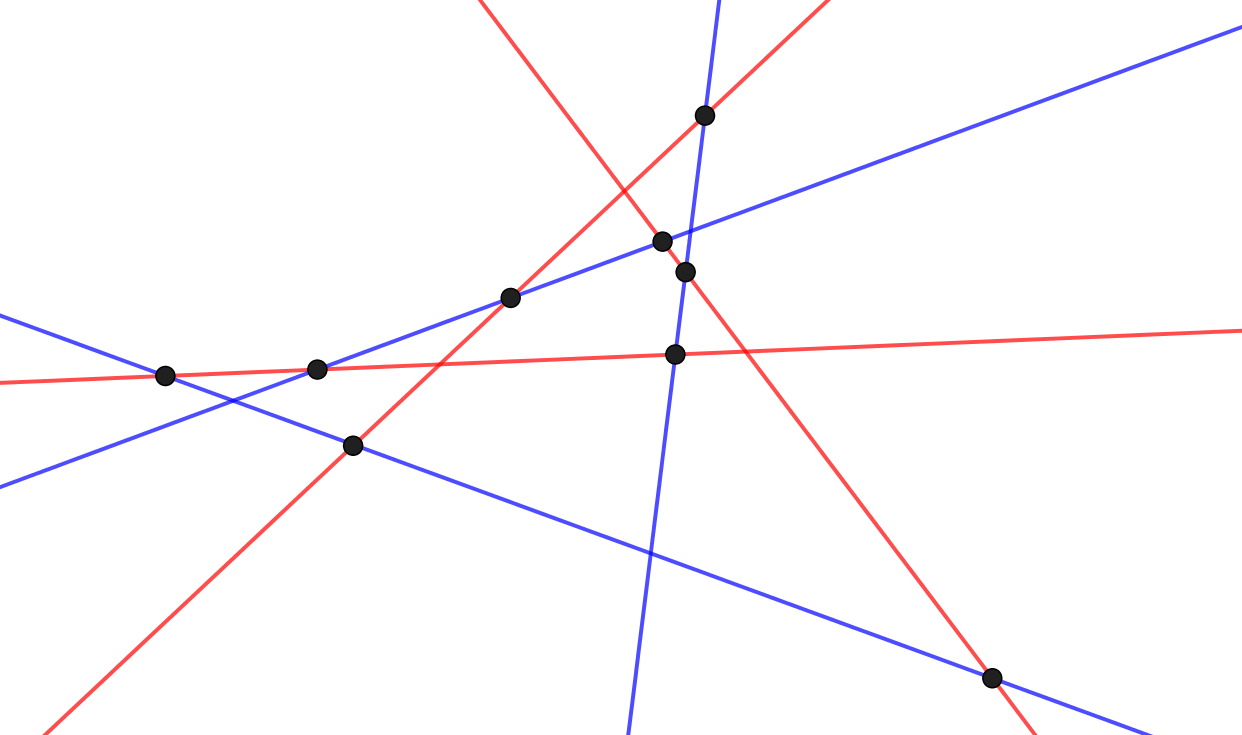 Figure 2
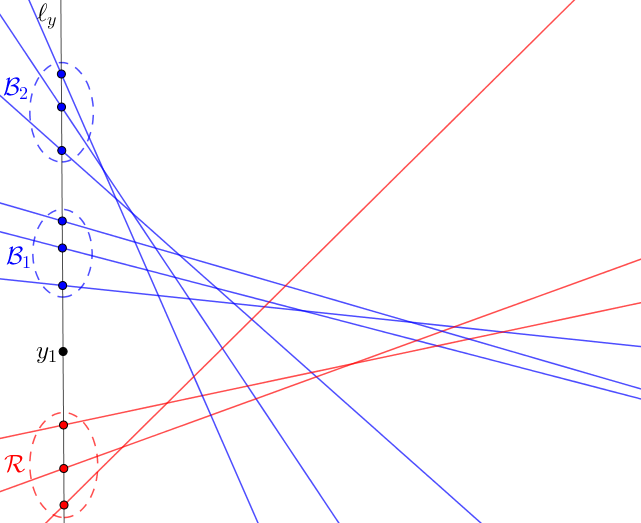 Figure 3
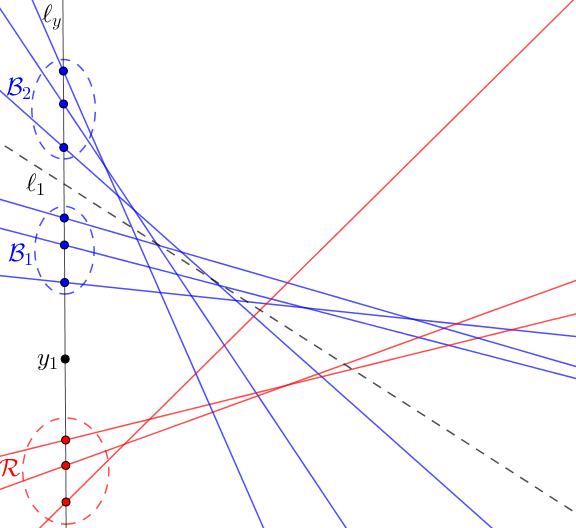 Figure 4
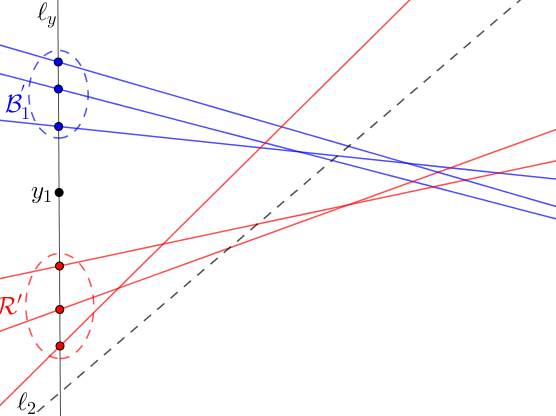 Figure 5
Peer Reviews
No public reviews on file for this paper yet. If you reviewed it on a platform where reviews are public (OpenReview, ICLR, NeurIPS, ICML), you can paste yours below so the community can read it here.
Videos
No videos yet. Explain this paper in a talk, walkthrough, or lecture? Add one.
On grids in point-line arrangements in the plane
Mozhgan Mirzaei Department of Mathematics, University of California at San Diego, La Jolla, CA, 92093 USA. Supported by NSF grant DMS-1800746. Email: [email protected].
Andrew Suk Department of Mathematics, University of California at San Diego, La Jolla, CA, 92093 USA. Supported by an NSF CAREER award and an Alfred Sloan Fellowship. Email: [email protected].
Abstract
The famous Szemerédi-Trotter theorem states that any arrangement of points and lines in the plane determines incidences, and this bound is tight. In this paper, we prove the following Turán-type result for point-line incidence. Let and be two sets of lines in the plane and let be the set of intersection points between and . We say that forms a natural grid if , and does not contain the intersection point of some two lines in and does not contain the intersection point of some two lines in For fixed , we show that any arrangement of points and lines in the plane that does not contain a natural grid determines incidences, where . We also provide a construction of points and lines in the plane that does not contain a natural grid and determines at least incidences.
1 Introduction
Given a finite set of points in the plane and a finite set of lines in the plane, let be the set of incidences between and . The incidence graph of is the bipartite graph , with vertex parts and and . If and , then the celebrated theorem of Szemerédi and Trotter [16] states that
[TABLE]
Moreover, this bound is tight which can be seen by taking the integer lattice and bundles of parallel ”rich” lines (see [13]). It is widely believed that the extremal configurations maximizing the number of incidences between points and lines in the plane exhibit some kind of lattice structure. The main goal of this paper is to show that such extremal configurations must contain large natural grids.
Let and (respectively, and ) be two sets of points (respectively, lines) in the plane. We say that the pairs and are isomorphic if their incidence graphs are isomorphic. Solymosi made the following conjecture (see page in [2]).
Conjecture 1.1**.**
For any set of points and for any set of lines in the plane, the maximum number of incidences between points and lines in the plane containing no subconfiguration isomorphic to is
In [15], Solymosi proved this conjecture in the special case that is a fixed set of points in the plane, no three of which are on a line, and consists of all of their connecting lines. However, it is not known if such configurations satisfy the following stronger conjecture.
Conjecture 1.2**.**
For any set of points and for any set of lines in the plane, there is a constant , such that the maximum number of incidences between points and lines in the plane containing no subconfiguration isomorphic to is
Our first theorem is the following.
Theorem 1.3**.**
For fixed , let and be two sets of lines in the plane, and let such that . Then there is a constant such that any arrangement of points and lines in the plane that does not contain a subconfiguration isomorphic to determines at most incidences.
See the Figure 1. As an immediate corollary, we prove Conjecture 1.2 in the following special case.
Corollary 1.4**.**
For fixed , let and be two sets of lines in the plane, and let If , then any arrangement of points and lines in the plane that does not contain a subconfiguration isomorphic to determines at most incidences.
In the other direction, we prove the following.
Theorem 1.5**.**
Let and be two sets of lines in the plane, and let such that For there exists an arrangement of points and lines in the plane that does not contain a subconfiguration isomorphic to and determines at least incidences.
Given two sets and of lines in the plane, and the point set we say that forms a natural grid if and the convex hull of does not contain the intersection point of any two lines in and does not contain the intersection point of any two lines in See Figure 2.
Theorem 1.6**.**
For fixed there is a constant such that any arrangement of points and lines in the plane that does not contain a natural grid determines at most incidences.
Let us remark that in Theorem 1.6, and can be easily generalized to the off-balanced setting of points and lines.
We systemically omit floor and ceiling signs whenever they are not crucial for the sake of clarity of our presentation. All logarithms are assumed to be base For we let
2 Proof of Theorem 1.3
In this section we will prove Theorem 1.3. We first list several results that we will use. The first lemma is a classic result in graph theory.
Lemma 2.1** (Kövari-Sós-Turán [10]).**
Let be a graph that does not contain a complete bipartite graph as a subgraph. Then where is constant which only depends on
The next lemma we will use is a partitioning tool in discrete geometry known as simplicial partitions. We will use the dual version which requires the following definition. Let be a set of lines in the plane. We say that a point crosses if it is incident to at least one member of but not incident to all members in
Lemma 2.2** (Matousek [12]).**
Let be a set of lines in the plane and let be a parameter such that Then there is a partition on into parts, where such that any point crosses at most parts
Proof of Theorem 1.3..
Set Let be a set of points in the plane and let be a set of lines in the plane such that does not contain a subconfiguration isomorphic to
If then (1.1) implies that and we are done. Likewise, if then (1.1) implies that and we are done. Therefore, let us assume In what follows, we will show that For sake of contradiction, suppose that where is a large constant depending on that will be determined later.
Set Let us remark that since we are assuming We apply Lemma 2.2 with parameter to and obtain the partition with the properties described above. Note that Let be the incidence graph of For consider the set of lines in If is incident to exactly one line in then delete the corresponding edge in the incidence graph After performing this operation between each point and each part by Lemma 2.2, we have deleted at most edges in where is an absolute constant. By setting sufficiently large, we have
[TABLE]
Therefore, there are at least edges remaining in By the pigeonhole principle, there is a part such that the number of edges between and in is at least
[TABLE]
Hence, every point has either [math] or at least neighbors in in We claim that contains a subconfiguration isomorphic to To see this, let us construct a graph as follows. Set Let be the set of points in that have at least two neighbors in in the graph For consider the set of lines from incident to such that appears in clockwise order. Then we define to be a matching on where
[TABLE]
Set Note that and are disjoint, since no two points are contained in two lines. Since we have
[TABLE]
Since
[TABLE]
this implies
[TABLE]
By setting to be sufficiently large, Lemma 2.1 implies that contains a copy of Let correspond to the vertices of this in and let We claim that is isomorphic to It suffices to show that For the sake of contradiction, suppose where and This would imply for some which contradicts the fact that is a matching. Same argument follows if and This completes the proof of Theorem 1.3. ∎
3 Natural Grids
Given a set of points and a set of lines in the plane, if , where is a sufficiently large constant depending on then Corollary 1.4 implies that there are two sets of lines such that each pair of them from different sets intersects at a unique point in Therefore, Theorem 1.6 follows by combining Theorem 1.3 with the following lemma.
Lemma 3.1**.**
There is a natural number such that the following holds. Let be a set of blue lines in the plane, and let be a set of red lines in the plane such that for we have Then contains a natural grid.
To prove Lemma 3.1, we will need the following lemma which is an immediate consequence of Dilworth’s Theorem.
Lemma 3.2**.**
For let be a set of lines in the plane, such that no two members intersect the same point on the -axis. Then there is a subset of size such that the intersection point of any two members in lies to the left of the -axis, or the intersection point of any two members in lies to the right of the -axis.
Proof.
Let us order the elements in from bottom to top according to their -intercept. By Dilworth’s Theorem [5], contains a subsequence of lines whose slopes are either increasing or decreasing. In the first case, all intersection points are to the left of the -axis, and in the latter case, all intersection points are to the right of the -axis. ∎
Proof of Lemma 3.1..
Let be as described above, and let be the -axis. Without loss of generality, we can assume that all lines in are not vertical, and the intersection point of any two lines in lies to the right of Moreover, we can assume that no two lines intersect at the same point on
We start by finding a point such that at least blue lines in intersect on one side of the point (along ) and at least red lines in intersect on the other side. This can be done by sweeping the point along from bottom to top until lines of the first color, say red, intersect below We then have at least blue lines intersecting above Discard all red lines in that intersect above and discard all blue lines in that intersect below Hence,
Set For the remaining lines in let where the elements of are ordered in the order they cross from bottom to top. We partition into two parts, where and By applying an affine transformation, we can assume all lines in have positive slope and all lines in have negative slope. See Figure 3.
Let us define a -partite -uniform hypergraph whose vertex parts are and is an edge in if and only if the intersection point lies above the line Note, if and are parallel, then Then a result of Fox et al. on semi-algebraic hypergraphs implies the following (see also [3] and [9]).
Lemma 3.3** (Fox et al. [8], Theorem 8.1).**
There exists a positive constant such that the following holds. In the hypergraph above, there are subsets where such that either or
We apply Lemma 3.3 to and obtain subsets with the properties described above. Without loss of generality, we can assume that since a symmetric argument would follow otherwise. Let be a line in the plane such that the following holds.
The slope of is negative. 2. 2.
All intersection points between and lie above 3. 3.
All intersection points between and lie below
See Figure 4.
Observation 3.4**.**
Line defined above exists.
Proof.
Let be the upper envelope of the arrangement that is, is the closure of all points that lie on exactly one line of and strictly above exactly the lines in
Let be the set of intersection points between the lines in with Likewise, we define to be the set of intersection points between the lines in with Since is -monotone and convex the set lies to the left of the set Then the line that intersects between and and intersects between and satisfies the conditions above.∎
Now we apply Lemma 3.2 to with respect to the line to obtain members in such that every pair of them intersects on one side of Discard all other members in Without loss of generality, we can assume that all intersection points between any two members in lie below since a symmetric argument would follow otherwise. We now discard the set
Notice that the order in which the lines in cross will be the same for any line Therefore, we order the elements in with respect to this ordering, from left to right, where We define to be the line obtained by slightly perturbing the line such that:
The slope of is positive. 2. 2.
All intersection points between and lie above 3. 3.
All intersection points between and lie below
See the Figure 5.
Finally, we apply Lemma 3.2 to with respect to the line to obtain at least members in with the property that any two of them intersect on one side of Without loss of generality, we can assume that any two such lines intersect below since a symmetric argument would follow. Set to be these set of lines. Then and their intersection points form a natural grid. By setting to be sufficiently large, we obtain a natural grid. ∎
4 Lower Bound Construction
In this section, we will prove Theorem 1.5. First, let us recall the definitions of Sidon and -fold Sidon sets.
Let be a finite set of positive integers. Then is a Sidon set if the sum of all pairs are distinct, that is, the equation has no solutions with , except for trivial solutions given by and We define to be the size of the largest Sidon set Erdős and Turán proved the following.
Lemma 4.1** (See [7] and [14]).**
For we have
Let us now consider a more general equation. Let be integers such that and consider the equation
[TABLE]
We are interested in solutions to (4.1) with Suppose is an integer solution to (4.1). Let be the number of distinct integers in the set Then we have a partition on the indices
[TABLE]
where and lie in the same part if and only if We call a trivial solution to (4.1) if
[TABLE]
Otherwise, we will call a nontrivial solution to (4.1).
In [11], Lazebnik and Verstraëte introduced -fold Sidon sets which are defined as follows. Let be a positive integer. A set is a -fold Sidon set if each equation of the form
[TABLE]
where and has no nontrivial solutions with Let be the size of the largest -fold Sidon set
Lemma 4.2**.**
There is an infinite sequence of integers such that
[TABLE]
and the system of equations (4.2) has no nontrivial solutions in the set In particular, for integers we have where is a positive constant.
The proof of Lemma 4.2 is a slight modification of the proof of Theorem in [14]. For the sake of completeness, we include the proof here.
Proof.
We put and define recursively. Given let be the smallest positive integer satisfying
[TABLE]
for every choice such that for every set of subscripts such that \Big{(}\sum_{i\in S}u_{i}\Big{)}\neq 0, and for every choice of , where For a fixed with this excludes numbers. Since the total number of excluded integers is at most
[TABLE]
Consequently, we can extend our set by an integer This will automatically be different from from since putting for all in (4.3) we get It will also satisfy by minimal choice of
We show that the system of equations (4.2) has no nontrivial solutions in the set We use induction on The statement is obviously true for We establish it for assuming for Suppose that there is a nontrivial solution to (4.2) for some with the properties described above. Let denote the set of those subscripts for which If then this contradicts (4.3). If then by replacing each occurrence of by we get another nontrivial solution, which contradicts the induction hypothesis. ∎
For more problems and results on Sidon sets and -fold Sidon sets, we refer the interested reader to [11, 14, 4].
We are now ready to prove Theorem 1.5.
Proof of Theorem 1.5..
We start by applying Lemma 4.1 to obtain a Sidon set such that We then apply Lemma 4.2 with and to obtain a -fold Sidon set such that
[TABLE]
where is defined in Lemma 4.2. Without loss of generality, let us assume
Let and let be the family of lines in the plane of the form where and is an integer such that
Hence, we have
[TABLE]
Notice that each line in has exactly points from since Therefore,
[TABLE]
Claim 4.3**.**
There are no four distinct lines and four distinct points such that
Proof.
For the sake of contradiction, suppose there are four lines and four points with the properties described above. Let and let Therefore,
[TABLE]
[TABLE]
[TABLE]
[TABLE]
Hence,
[TABLE]
[TABLE]
[TABLE]
[TABLE]
By summing up the four equations above, we get
[TABLE]
By setting we get
[TABLE]
where and Since must be a trivial solution to (4.4). The proof now falls into the following cases, and let us note that no line in is vertical.
Case 1. Suppose Then is vertical and we have a contradiction.
Case 2. Suppose and and Then and have the same slope which is a contradiction. The same argument follows if or
Case 3. Suppose and Since and this implies that is vertical which is a contradiction. A similar argument follows if and
Case 4. Suppose and Then implies that Since is a Sidon set, we have either and or and The first case implies that and are parallel which is a contradiction, and the second case implies that and are parallel, which is again a contradiction. ∎
This completes the proof of Theorem 1.5.∎
5 Concluding Remarks
- •
An old result of Erdős states that every -vertex graph that does not contain a cycle of length has edges. It is known that this bound is tight when and , but it is a long standing open problem in extremal graph theory to decide whether or not this upper bound can be improved for other values of Hence, Erdős’s upper bound of when implies Theorem 1.3 when and It would be interesting to see if one can improve the upper bound in Theorem 1.3 when For more problems on cycles in graphs, see [18].
- •
The proof of Lemma 3.1 is similar to the proof of the main result in [1]. The main difference is that we use the result of Fox et al. [8] instead of the Ham-Sandwich Theorem. We also note that a similar result was established by Dujmović and Langerman (see Theorem in [6]).
- •
Recently, Tomon and the second author [17] improved the lower bound in Theorem 1.5 to , and more generally, gave a construction of points and lines in the plane with no grid and with at least incidences.
The reference list from the paper itself. Each links out to its DOI / PubMed record.
- 1[1] Aronov, B., Erdős, P., Goddard, W., Kleitman, D., Klugerman, M., Pach, J., and Schulman, L. J. Crossing families. Combinatorica 14 , 2 (1994), 127–134.
- 2[2] Brass, P., Moser, W. O., and Pach, J. Research problems in discrete geometry . Springer Science & Business Media, 2006.
- 3[3] Bukh, B., and Hubard, A. Space crossing numbers. Combin. Probab. Comput. 21 , 3 (2012), 358–373.
- 4[4] Cilleruelo, J., and Timmons, C. k 𝑘 k -fold sidon sets. Electron. J. Combin. 21 , 4 (2014), P 4–12.
- 5[5] Dilworth, R. P. A decomposition theorem for partially ordered sets. Ann. of Math. (1950), 161–166.
- 6[6] Dujmović, V., and Langerman, S. A center transversal theorem for hyperplanes and applications to graph drawing. Discrete Comput. Geom. 49 , 1 (Jan 2013), 74–88.
- 7[7] Erdös, P., and Turán, P. On a problem of sidon in additive number theory, and on some related problems. J. Lond. Math. Soc. (2) 1 , 4 (1941), 212–215.
- 8[8] Fox, J., Gromov, M., Lafforgue, V., Naor, A., and Pach, J. Overlap properties of geometric expanders. J. Reine Angew. Math. 2012 , 671 (2012), 49–83.