Comparing Geometric Discord and Negativity for Bipartite States
Priyabrata Bag, Santanu Dey, Hiroyuki Osaka

TL;DR
This paper investigates the relationship between geometric discord and negativity in bipartite quantum states, providing counterexamples to a previously conjectured inequality and establishing bounds for their difference across various dimensions.
Contribution
The paper presents analytic families of states violating the geometric discord-negativity relation and derives bounds for their difference in arbitrary bipartite systems.
Findings
Counterexamples for $ ext{C}^2 imes ext{C}^3$ states violating the conjecture.
Bounds for $ ext{N}^2 - ext{D}$ in $ ext{C}^m imes ext{C}^n$ systems.
The conjecture does not hold universally beyond two-qubit states.
Abstract
The geometric discord of a state is a measure of the quantumness of the state and the negativity is a measure of the entanglement of a state. It was proved by D. Girolami and G. Adesso that for states on , the geometric discord is always greater than or equal to the square of the negativity and conjectured that this holds in general. S. Rana and P. Parashar showed that this relation does not hold for all states on for . We provide several analytic families of states on violating this relation. Certain upper and lower bounds for are obtained for states on for any .
Click any figure to enlarge with its caption.
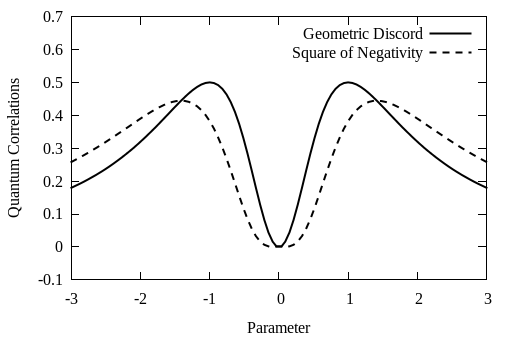 Figure 1
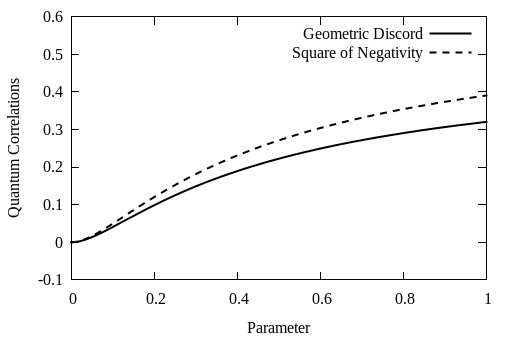 Figure 2
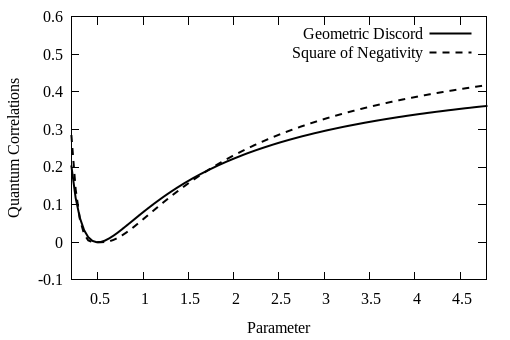 Figure 3
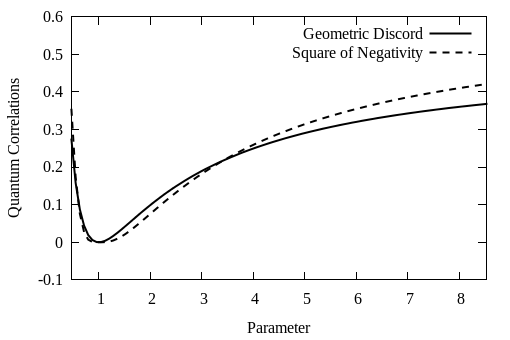 Figure 4
Peer Reviews
No public reviews on file for this paper yet. If you reviewed it on a platform where reviews are public (OpenReview, ICLR, NeurIPS, ICML), you can paste yours below so the community can read it here.
Videos
No videos yet. Explain this paper in a talk, walkthrough, or lecture? Add one.
**Comparing Geometric Discord and Negativity for
Bipartite States**
Priyabrata Bag, Santanu Dey, and Hiroyuki Osaka
Abstract
The geometric discord of a state is a measure of the quantumness of the state and the negativity is a measure of the entanglement of a state. It was proved by D. Girolami and G. Adesso that for states on , the geometric discord is always greater than or equal to the square of the negativity and conjectured that this holds in general. S. Rana and P. Parashar showed that this relation does not hold for all states on for . We provide several analytic families of states on violating this relation. Certain upper and lower bounds for are obtained for states on for any .
Keywords: Bloch form, entanglement, Gell-Mann matrices, geometric discord, negativity, Pauli matrices, .
1 Introduction
The entanglement of a state is related to quantum correlations. From recent findings, it has turned out that the notion of quantum discord is a good measure of quantum correlations. Let be the set of classical-quantum states, given by . We denote by , where .
For an () state , the geometric discord (GD) is a variant of quantum discord which is defined as
[TABLE]
where is the Hilbert-Schmidt norm for any matrix , and in the last equality (cf. [3]), the minimization is over all possible von Neumann measurements (that is, a set consisting of one-dimensional orthogonal projectors summing to the identity) on and . Here, and have been used to indicate the first part and the second part , respectively, of the system , and is the marginal of on . Let and be the generators of for dimension or . Suppose have the Bloch form
[TABLE]
The following inequality, derived in [7],
[TABLE]
gives a tight lower bound on GD, where denotes the eigenvalues of sorted in nonincreasing order. The equality holds in (1.3) for all states (cf. [7], [9]).
To calculate GD of a given state, we use the formula given by the equality in (1.3). For this we first find the Bloch form (1.2) for the given state by fixing the generators of as the Pauli matrices, namely,
[TABLE]
and the generators of as the Gell-Mann matrices, namely,
[TABLE]
[TABLE]
[TABLE]
Denote the linear partial transpose on by , that is, it maps to . A popular measure for the entanglement of a state is the negativity (cf. [8]) of , which is defined as
[TABLE]
where denotes the trace norm given by .
For states, it is shown in [1], that . S. Rana and P. Parashar discussed case in [6], and justified that this does not hold for . But they also deduced that the occurrence of the violation of this inequality is very rare for . The example of the state provided by them for for which involves long decimals and complex entries. The quantity is very small in their example. We find several parametrized families of states when in Section 2. We have examples where the entries of the matrices are simple fractions or integers and is not so small.
S. Rana in [5] proved that for any state , the number is an upper bound for the number of negative eigenvalues of . Later N. Johnston in [2] showed that for all and , there exists an state such that has negative eigenvalues. All parametrized families of states in Section 2 for which are such that have the maximum possible negative eigenvalues.
In Section 3, we show that for an state
[TABLE]
This makes use of convexity and some other property of negativity of states that was established by G. Vidal and R. F. Werner in [8].
2 Examples of States with
For with , consider the following element in :
[TABLE]
The eigenvalues of are [math] with multiplicity and with multiplicity . Since is Hermitian, this guarantees that is a state. The eigenvalues of are , and , all with multiplicity . Clearly, it has two negative eigenvalues for , namely, , with multiplicity . This is the maximum number of negative eigenvalues possible for the partial transpose of any state. The negativity of can be calculated from the second equality of (1.4) as
[TABLE]
for . Observe that when , and this coincides with the expression for in . Therefore .
For the state in (2.1), the Bloch form is determined by , and
[TABLE]
Thus,
[TABLE]
and hence
[TABLE]
If , then the eigenvalues of in nonincreasing order are and . Also, . Thus, the GD of is , when . Similarly, it can be shown that , when . Therefore, for , . Thus, for with , the state violates the inequality . In particular, for and , we obtain the following state:
[TABLE]
which violates the inequality . Here, . Let denote . Then, takes the form for all , and
[TABLE]
Using this representation, we obtain the following figure:
Similarly, for the following three families of states, it can be shown that the inequality is violated: The first family is given by
[TABLE]
for which the graphs of and are illustrated in the following figure:
The second family is given by
[TABLE]
for which the graphs of and are illustrated in the following figure:
Finally, the third family is given by
[TABLE]
for which the graphs of and are illustrated in the following figure:
3 Bounds for
In this section, we first obtain bounds for and individually of an state which together give bounds for . We assume throughout the section that . From the definition, it follows that both of and are nonnegative, and which give obvious lower bounds [math] for both of them. An upper bound for is obtained in the next proposition.
Proposition 3.1**.**
For any state ,
[TABLE]
Proof.
Here, we use the second expression for in (1) to find the upper bound. Let be a von Neumann measurement on , that is, there is an orthonormal basis of such that . For any von Neumann measurement , we have the following:
[TABLE]
Thus,
[TABLE]
Therefore . ∎
For any pure state it is proved in [4, Proposition 1] that .
Lemma 3.2**.**
* and for any pure state .*
Proof.
Since is a pure state, for some vector with Schmidt decomposition form
[TABLE]
for some orthonormal sets and , where and for . From [8, Proposition 8] we obtain
[TABLE]
where . Since , we obtain
[TABLE]
Therefore . It is proved in [4, Proposition 1] that
[TABLE]
where . It follows that . ∎
For with , let in , where and are matrix units for and , respectively. When , the state is a maximal entanglement. Since for in the decomposition (3.1) and for , it follows from (3.2) and (3.3) that and . Thus,
[TABLE]
Corollary 3.3**.**
If is an state, then .
Proof.
Since any state can be written as a convex sum of pure states and the convexity of by [8, Proposition 1], we have the conclusion. ∎
We conclude that the negativity achieves its maximum value on the states .
Theorem 3.4**.**
For any state
[TABLE]
Proof.
The proof is immediate from Proposition 3.1 and Corollary 3.3. ∎
Note that for any pure state .
Acknowledgement
The third author is partially supported by the JSPS KAKENHI Grant Number JP17K05285.
The reference list from the paper itself. Each links out to its DOI / PubMed record.
- 1[1] D. Girolami and G. Adesso. Interplay between computable measures of entanglement and other quantum correlations. Phys. Rev. A , 84:052110, Nov 2011.
- 2[2] N. Johnston. Non-positive-partial-transpose subspaces can be as large as any entangled subspace. Phys. Rev. A , 87:064302, Jun 2013.
- 3[3] S. Luo and S. Fu. Geometric measure of quantum discord. Phys. Rev. A , 82:034302, Sep 2010.
- 4[4] S. Luo and S. Fu. Evaluating the geometric measure of quantum discord. Theoret. and Math. Phys. , 171:870–878, Jun 2012.
- 5[5] S. Rana. Negative eigenvalues of partial transposition of arbitrary bipartite states. Phys. Rev. A , 87:054301, May 2013.
- 6[6] S. Rana and P. Parashar. Entanglement is not a lower bound for geometric discord. Phys. Rev. A , 86:030302, Sep 2012.
- 7[7] S. Rana and P. Parashar. Tight lower bound on geometric discord of bipartite states. Phys. Rev. A , 85:024102, Feb 2012.
- 8[8] G. Vidal and R. F. Werner. Computable measure of entanglement. Phys. Rev. A , 65:032314, Feb 2002.