Freely flowing currents and electric field expulsion in viscous electronics
Michal Shavit, Andrey Shytov, Gregory Falkovich

TL;DR
This paper explores how viscous electronic fluids exhibit electric field expulsion and freely flowing currents due to nonlocal current-field relations, revealing unique boundary behaviors and geometric dependencies.
Contribution
It introduces the concept of electric field expulsion in viscous electronics, deriving boundary conditions and analyzing flow and potential distribution in this new hydrodynamic regime.
Findings
Electric field can be expelled from viscous electronic flows.
Boundary jumps in electric potential occur at current-injecting electrodes.
Field expulsion depends on electrode geometry and breaks conformal invariance.
Abstract
Electronic fluids bring into hydrodynamics a new setting: equipotential flow sources embedded inside the fluid. Here we show that nonlocal relation between current and electric field due to momentum-conserving inter-particle collisions leads to a total or partial field expulsion from such flows. That results in freely flowing currents in the bulk and boundary jump in electric potential at current-injecting electrodes. We derive the appropriate boundary conditions, analyze current distribution in free flows, discuss how the field expulsion depends upon geometry of the electrode, and link the phenomenon to breakdown of conformal invariance.
Click any figure to enlarge with its caption.
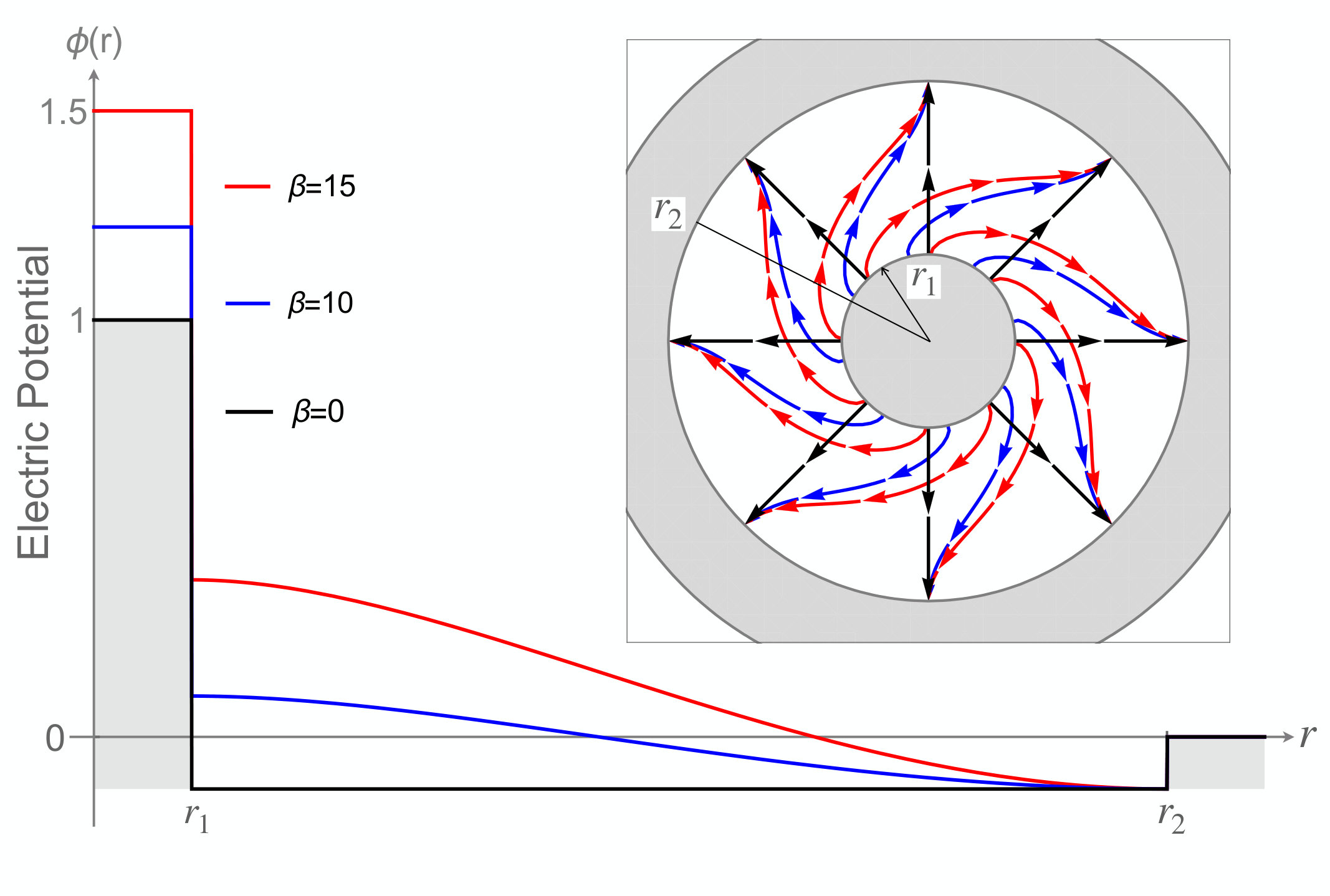 Figure 1
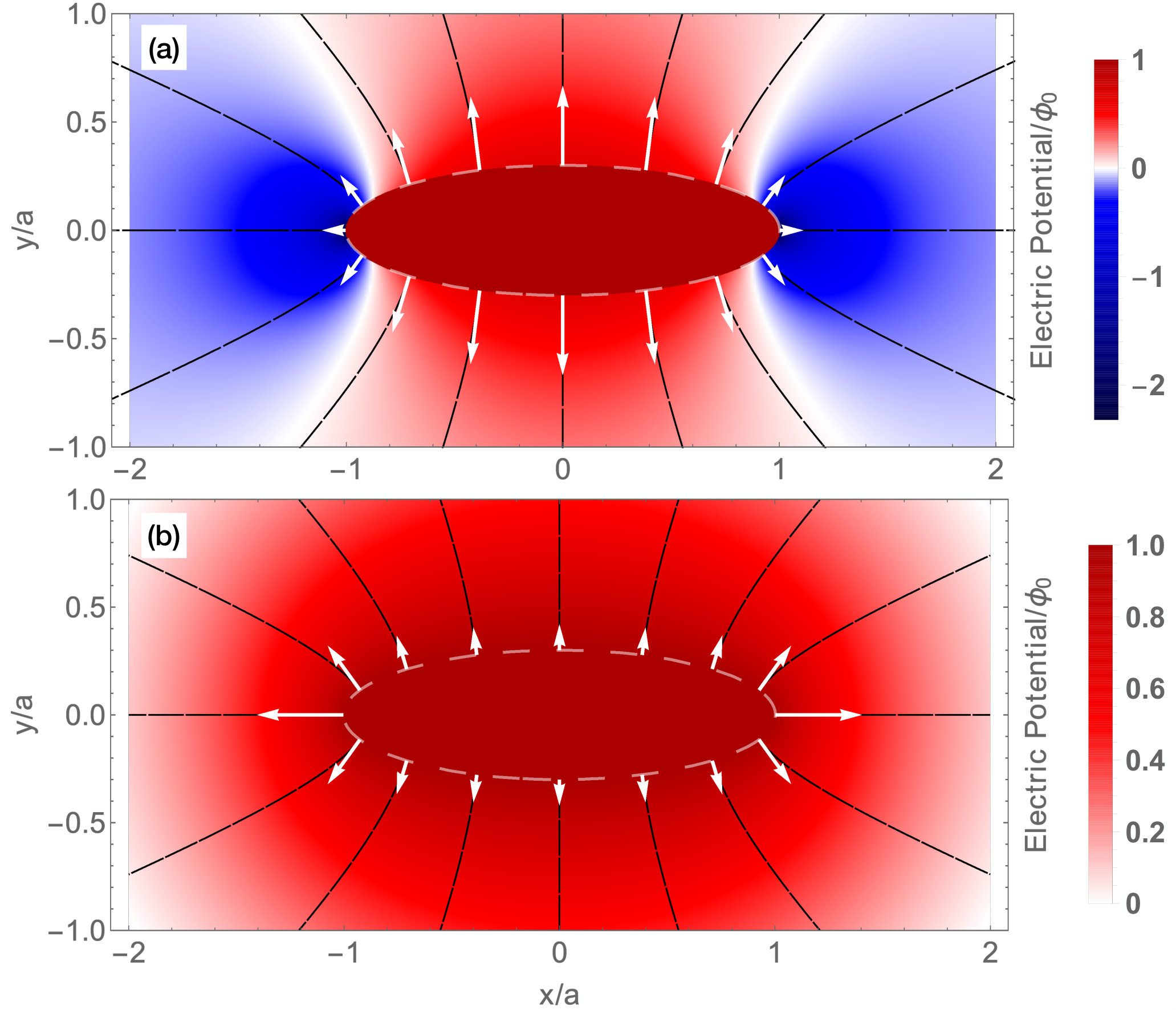 Figure 2
Peer Reviews
No public reviews on file for this paper yet. If you reviewed it on a platform where reviews are public (OpenReview, ICLR, NeurIPS, ICML), you can paste yours below so the community can read it here.
Videos
No videos yet. Explain this paper in a talk, walkthrough, or lecture? Add one.
Freely flowing currents and electric field expulsion in viscous
electronics
Michal Shavit, Andrey Shytov and Gregory Falkovich
Weizmann Institute of Science, Rehovot 76100 Israel
University of Exeter, Stocker Road, Exeter EX4 4QL, UK
Abstract
Electronic fluids bring into hydrodynamics a new setting: equipotential flow sources embedded inside the fluid. Here we show that nonlocal relation between current and electric field due to momentum-conserving inter-particle collisions leads to a total or partial field expulsion from such flows. That results in freely flowing currents in the bulk and boundary jump in electric potential at current-injecting electrodes. We derive the appropriate boundary conditions, analyze current distribution in free flows, discuss how the field expulsion depends upon geometry of the electrode, and link the phenomenon to breakdown of conformal invariance.
We experience now a rare moment of intense interaction between fields of solids and fluids. This is due to appearance of new high-mobility materials where current carriers exchange momentum faster than loose it to the lattice, so that their collective motion is a viscous fluid flow damle97 ; muller2009 ; sheehy2007 ; fritz2008 ; andreev2011 ; forcella2014 ; tomadin2014 ; narozhny2015 ; cortijo2015 ; lucas2016 ; bandurin2015 ; crossno2016 ; moll2016 ; Onset . Ideas from fluid mechanics can solve problems of nanoscale electronics: in particular, decrease resistance below ballistic limit and make current flow against the electric field bandurin2015 ; key-1 ; H2 ; KrishnaKumar2017 . No less remarkable is what electronics can do for fluid mechanics: 150 years after Stokes it can reveal new fundamental phenomena in laminar viscous flows, which is the subject of this Letter. The reason is that electronics brings a new setting which had not been regularly considered in low-Reynolds hydrodynamics — equipotential (metallic) electrodes serving as flow sources embedded inside the fluid. We show below that the conditions on the electric potential (pressure) imposed by sources could be in conflict with those of a viscous flow, which leads to anomalies at the boundaries and novel flow properties, see Figure 1.
Electronic fluids (e-fluids) are characterized by an unusual response of electric current to electric field . Instead of the usual Ohm’s law, , charge flows at the scales exceeding the electron-electron (e-e) mean free path are described by the combined Ohm-Stokes equation, stating that the electric field must now overcome both ohmic and viscous friction:
[TABLE]
Here are the number carrier density, charge and mean velocity, and is the medium conductivity. The nonlocal first term in (1) represents momentum diffusion due to momentum-conserving scattering between charge carriers and is proportional to the viscosity .
Equation (1) presents an interesting puzzle. Consider an incompressible flow, , and a potential electric field: . In that case, solving Eq.(1) appears deceptively simple: any solution with (purely Ohmic flow) also provides a solution for , since the viscous force vanishes identically: . This suggests a paradoxical conclusion: the flow pattern is not affected by viscous friction, and the electric potential driving the flow vanishes in the purely viscous limit .
Vanishing of the viscous force, however counterintuitive, can be verified explicitly in the simplest case of a spherical metallic electrode ejecting radial current into an infinite medium. The velocity field is readily obtained from current conservation:
[TABLE]
Here is the distance to the source center, is the total current, is the area of a unit sphere in dimensions. Since is a gradient of a harmonic function, the viscous force vanishes everywhere (this remains true if one adds uniform circulation, for instance, in 2d). The electric field outside is indeed independent of viscosity: . We therefore conclude that electric field is not required to drive a purely viscous flow within the system bulk. Yet the paradox remains: the viscous stress tensor, , is nonzero as well as the energy dissipation rate due to viscous friction,
[TABLE]
In other words, even though the net viscous force (divergence of the stress tensor) acting on any fluid element is zero, there are nonzero forces acting on the opposite sides of the element and deforming it, which must lead to dissipation. The energy loss in the bulk must be compensated by the work performed by the current source. This requires a finite electrode potential relative to sink at infinity: ( is the electrode radius). The contribution of the infinite viscous medium to the total resistance of the system is thus determined by the electrode size: . To reconcile finite with vanishing in the bulk, we conclude that the potential distribution must exhibit a sharp viscosity-dependent drop across a thin Knudsen layer of width , where the Stokes equation is not applicable. Note that the jump of the potential (pressure) at the boundary gives the momentum flux , which is exactly equal to the normal component of the viscous stress tensor, . In other words, the potential discontinuity can be paraphrased as the continuity of the normal flux of normal momentum. Indeed, viscous stresses are absent inside the electrode but present outside, so that the potential jump compensates the jump in the stress. That potential jump is similar to the Kapitza temperature jump upon heat transfer through a solid-liquid interface ref:Kapitza-jump .
The electric field is thus expelled from the bulk and is concentrated in the boundary layer in a viscous flow. Potential jump is proportional to the viscosity, that is to the mean free path. That means that the electric field inside the ballistic layer is independent of the mean free path. When one goes deep into the hydrodynamic regime (say, by increasing temperature in graphene), the mean free path shrinks but the electric field stays finite.
Stokes encountered similar phenomenon of bulk dissipation equal to the surface work in his analysis of the decay of water waves: the flow in the bulk is potential, while the viscous forces only perform work on the surface key-9 , see also key-3 .
Expulsion of the field from the bulk and its concentration at microscopic scales can be verified by analyzing kinetics of momentum-conserving e-e collisions key-5 ; key-4 for a point-like electrode, . Neglecting Ohmic momentum losses, such approach yields a potential that in the ballistic domain decays slowly: in . The potential falls rapidly at large distances, . In other words, a point source produces a radial flow having a constant potential at . By superposition this is also true for an arbitrary combination of point sources and sinks. However, field expulsion is only approximate for finite-size sources and sinks because they impose boundary conditions.
How is the above picture of field expulsion modified for an electrode of an arbitrary shape? A purely Ohmic flow in two dimensions can be found via conformal mapping that deforms one electrode into another and also transforms stream lines and potential contours. Naive reasoning outlined above suggests that the transformation of the potential might also be possible when viscosity is present due to conformal invariance of the Laplacian. Below we demonstrate that this conformal equivalence does not hold for viscous flows, since the field distribution depends nontrivially upon the shape of the electrode; in particular, for non-symmetric electrodes the flow, in general, is not potential and electric field partially penetrates the fluid.
Indeed, to determine the flow, one needs to solve Eq. (1) supplemented with boundary conditions, which must follow from the same variational principle that gives Eq. (1), i.e. minimization of the dissipated energy (3). Let us consider the dissipation rate as a functional of the velocity field , and minimize it for a given total current emitted by the electrode. Variation with respect to the bulk velocity gives (1), while variation with respect to the normal velocity on the source confirms the boundary condition (b.c.) in the form of the normal flux continuity (see Supplement):
[TABLE]
where is the unit vector normal to the boundary and is the boundary value of the potential satisfying Eq.(1). The second boundary condition depends on the nature of the interface between the source and the fluid. In particular, one can consider either a momentum-relaxing no-slip interface with , or a smooth no-stress interface with . In what follows, we restrict ourselves to the no-slip case for simplicity. In this case, using incompressibility , one can rewrite (4) via the signed extrinsic curvature of the boundary:
[TABLE]
This can be interpreted as a universal, viscosity-dependent contribution to contact resistance which cannot be ignored for a non-flat electrode. Let us stress the remarkable fact that this contribution can be both positive and negative depending on the curvature sign. Indeed, to balance the viscous stress, electric field in the ballistic layer is directed along/against the current respectively for positive/negative curvature. For example, consider the viscous flow in an annulus between two concentric circular electrodes of radii and , known as the Corbino disc geometry (see Fig. 2). The resistance of such system is determined by the two potential jumps each given by Eq. (5):
[TABLE]
Since the Stokes equation is symmetric under , , reversal of the current reverses the jumps.
If the curvature varies along the interface, the potential , in general, is not a constant, which results in a nonvanishing field in the bulk. Therefore, Eq.(4) provides an example of conformal anomaly in classical physics: phenomena at microscopic length scale affect the flow at however larger distances in a universal way, invalidating conformal invariant solutions to Eq.(1).
To see the breakdown of conformal invariance and partial penetration of the field into the flow, we consider an ellipse as the simplest non-trivial example of a source with a variable curvature. We introduce elliptic coordinates :
[TABLE]
where are the semiaxes, is the polar angle, and is the radial variable, at the electrode. This yields orthogonal coordinates in which the scaling factors are equal:
[TABLE]
so that the variables are related to by a conformal map, which facilitates the calculation of Laplacians. We seek solution of the Stokes equation, that is (1) with , supplied with the b.c. (5) with the curvature . We also assume zero tangential velocity at , electrode potential and zero potential at infinity. Interestingly, the velocity field is radial everywhere (the details are in the Supplement):
[TABLE]
The potential outside the source is non-uniform,
[TABLE]
which gives non-vanishing electrical field inside the viscous domain. At large distances, the potential is a quadrupole proportional to the eccentricity of the ellipse: . It changes sign on the lines , as for a point source in a half-plane key-2 .
It is instructive to compare the viscous flow (7) to the purely ohmic flow, , , which can be obtained by conformal deformation of the flow emitted by a circular electrode. The comparison can be seen in Fig. 1. The ohmic flow is also radial, with current concentrated near the tips , where the curvature is maximal. In a sharp contrast, viscous current mainly flows from flatter parts, while at the tips it is suppressed by the factor in (7). The slow viscous current along the directions around the minimum is dragged by the viscous force from adjacent faster currents. That viscous force is balanced by the electric field directed against the current key-1 . The potential jump at the electrode tip, according to (8), is , which for sufficiently eccentric ellipse can significantly exceed, by absolute magnitude, the driving voltage .
The conformal invariance is indeed broken: the solution (7-8) cannot be obtained from the flow outside a circular electrode by a conformal mapping. Since (7) satisfies both the no-slip and no-stress boundary conditions on the source, our conclusions here are quite general.
The resistance of the medium depends on the source shape and size. In the elliptic case, one finds from Eq.(7):
[TABLE]
The limit reproduces the resistance for a circular source . Comparing that with the kinetic regime, where , we see that the voltage and resistance grow with decreasing the electrode size as for and as for , according to the general relation between viscous and ballistic regimes key-1 ; key-2 . The resistance of a flat electrode, , is determined by its width : .
Stokes equation together with the charge continuity relates to vorticity of the flow: . Hence penetration of the electric field into the fluid makes the flow non-potential. One can quantify the degree of field expulsion by the dimensionless parameter
[TABLE]
so that work is performed per each particle crossing the Knudsen layer. For an elliptic source, takes a particularly transparent form: . In particular, for a circular source, , when the field is fully expelled from the fluid, and for a flat source, , when the potential jump vanishes according to (5).
So far, we considered vorticity generated by a non-uniform current through the electrode boundary with a non-uniform curvature. Vorticity can be also generated by non-potential forces, such as Lorentz or Coriolis force. Applying magnetic field results in -dependent velocity and induces electric field in the bulk already in the circularly symmetric geometry. Consider the above Corbino geometry with two concentric electrodes. Adding the magnetic field, we account only for the Lorentz force and disregard Hall viscosity assuming large enough scales Hall1 ; Hall2 . The Lorentz force gives rise to an angular velocity and vorticity and generates the electric field in the bulk. The force acting on the angular current affects the potential drop and the resistance:
[TABLE]
where is given by (6), and is the aspect ratio. The second term in the rhs of (11) is the magnetoresistance, which is positive. The magnetoresistance quickly grows with and is inversely proportional to , so that it may easily exceed the boundary contribution as the system goes deeper into the fluidity-dominated regime. Redistribution of the field between boundary and bulk is characterized by a dimensionless number , which is the ratio of Lorentz and viscous forces at the outer rim and determines the number of turns the flow makes between the source and the sink. Fig. 2 illustrates the dependence of the field inside the bulk for a varying and its expulsion at .
Note briefly that nonzero Ohmic resistivity always dominates at sufficiently large distances for zero magnetic field; to see expulsion we need , where is the ohmic-to-viscous crossover scale key-2 . For the Ohmic-Stokes flow between the concentric electrodes, extra resistance is added to (6). The viscous term saturates at , while Ohmic resistance slowly grows with increasing and dominates when .
While both Ohmic and viscous flows are inherently dissipative, there is a dramatic difference in the spatial distribution of the work done to compensate this dissipation. In Ohmic flows the momentum and the energy losses are locally compensated by an electric field proportional to the current at every point. On the contrary, momentum is diffusively conserved by viscous flows while the energy is lost everywhere there is a velocity gradient. As we have shown here, the electrical work compensating the viscous energy loss can be partially or even fully done on the flow boundaries. Although we used the electronic terminology, all the statements are valid for a general incompressible viscous fluid via the replacement , with being the pressure.
Distributions of potential and current described here could be probed e.g. in graphene via nanoscale imaging methods, such as scanning-gate microscopy ref:Ilani-imaging ; ref:Ensslin-SGM . Instead of embedding isolated contacts, it may be more practical to use needle-shaped electrodes protruding into e-fluid from its edge. Most of our findings remain valid for such a setup: due to (4), the current is redistributed similarly near the tip, and viscous drag results in a strong negative potential. Note that the flow could be affected by a non-universal contact resistance . Still, the viscous flow remains qualitatively distinct from an ohmic flow even when exceeds the resistance of the medium ( see the Supplement for an example). Indeed, large affects current uniformly along the contact, so that “windshear” near the tip may still induce negative potential. Finally, enhancement of viscous effects at the onset of fluidity observed recently Onset suggests that the negative potential near the tip may be maximal in this crossover regime, i.e. when . Detailed analysis of this regime is beyond the scope of this article.
To conclude, we demonstrated how electric field or pressure gradient can be partially or even completely expelled from viscous flows, so that some or all work compensating viscous dissipation is done on the source. In the electronic setting, when the electrodes are equipotential, the field and the work are concentrated in the ballistic layer on the surface. In hydrodynamic setting (say for a vertical tube injecting fluid between horizontal plates) the pressure gradient and the work are distributed inside the source. We have shown that whether the viscous flow is totally or partially force-free depends on the geometry, particularly on the curvature of the source.
Acknowledgements.
We are grateful to Leonid Levitov for numerous helpful discussions; his input was indispensable for this work. GF thanks Howard Stone for a helpful advice. The work was supported by the grants from the Minerva Foundation with funding from the Federal German Ministry for Education and Research, the Israeli Science Foundation, the Center for Scientific Excellence and the Russian Science Foundation (Project No. 14-22-00259).
The reference list from the paper itself. Each links out to its DOI / PubMed record.
- 1(1) Damle, K. & Sachdev, S. Nonzero-temperature transport near quantum critical points. Phys. Rev. B 56: 8714-8733 (1997).
- 2(2) Müller, M., Schmalian, J. & Fritz, L. Graphene: A Nearly Perfect Fluid. Phys. Rev. Lett. 103:025301 (2009).
- 3(3) Andreev, A. V., Kivelson, S. A. & Spivak, B. Hydrodynamic Description of Transport in Strongly Correlated Electron Systems. Phys. Rev. Lett. 106:256804 (2011).
- 4(4) Forcella, D., Zaanen, J., Valentinis, D. & van der Marel, D. Electromagnetic properties of viscous charged fluids. Phys. Rev. B 90:035143 (2014).
- 5(5) Tomadin, A., Vignale, G. & Polini, M. Corbino Disk Viscometer for 2D Quantum Electron Liquids. Phys. Rev. Lett. 113:235901 (2014).
- 6(6) Sheehy, D. E. & Schmalian, J. Quantum Critical Scaling in Graphene. Phys. Rev. Lett. 99:226803 (2007).
- 7(7) Fritz, L., Schmalian, J., Müller, M. & Sachdev, S. Quantum critical transport in clean graphene. Phys. Rev. B 78:085416 (2008) .
- 8(8) Narozhny, B. N., Gornyi, I. V., Titov, M., Schütt, M. & Mirlin, A. D. Hydrodynamics in graphene: Linear-response transport. Phys. Rev. B 91:035414 (2015).