One-loop electroweak radiative corrections to polarized $e^+e^- \to ZH$
S. Bondarenko, Ya. Dydyshka, L. Kalinovskaya, L. Rumyantsev, R., Sadykov, V. Yermolchyk

TL;DR
This paper provides high-precision theoretical predictions for the cross sections of the process e+e- to ZH at future colliders, including one-loop electroweak corrections and beam polarization effects.
Contribution
It presents the first comprehensive calculation of one-loop electroweak radiative corrections for polarized e+e- to ZH process using the SANC platform.
Findings
Numerical results for cross sections across 250-1000 GeV energy range.
Impact of beam polarization on cross section predictions.
Enhanced accuracy for future collider experiments.
Abstract
The paper describes high-precision theoretical predictions obtained for the cross sections of the process for future electron-positron colliders. The calculations performed using the SANC platform taking into account the full contribution of one-loop electroweak radiative corrections, as well as longitudinal polarization of the initial beams. Numerical results are given for the energy range GeV - GeV with various polarization degrees.
Click any figure to enlarge with its caption.
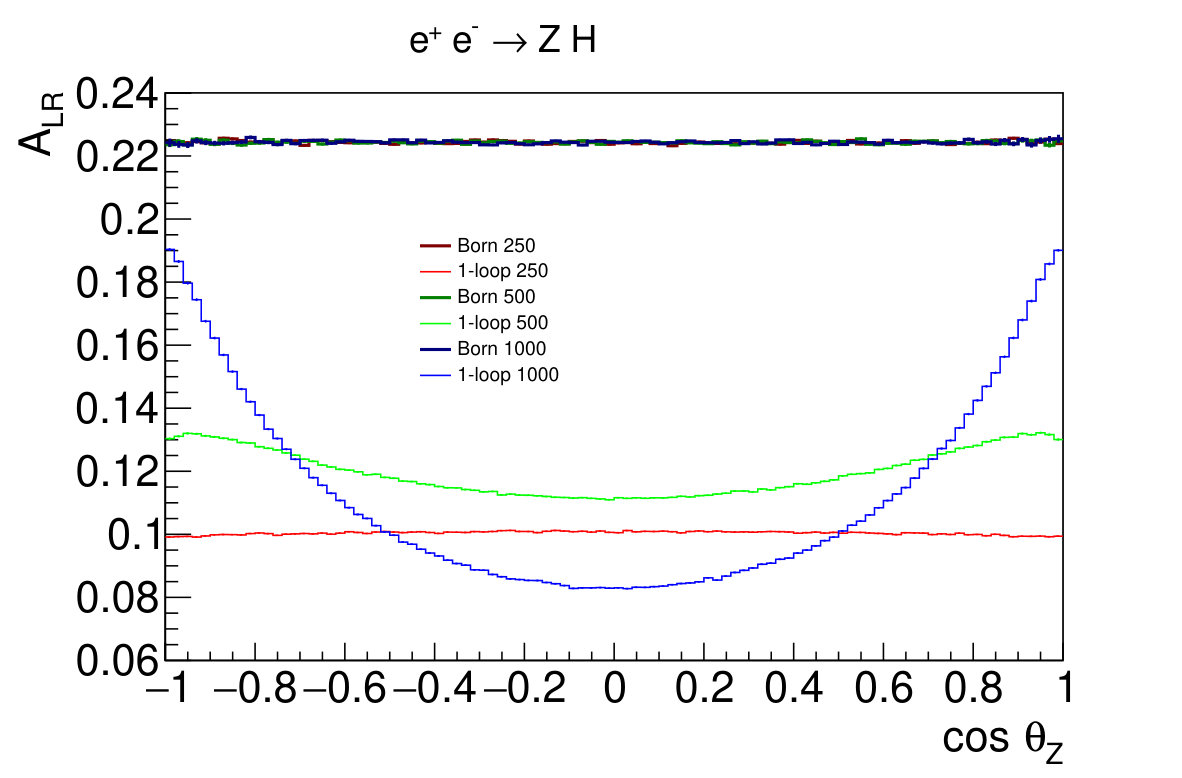 Figure 1
| , fb | , fb | , fb | , % | ||
|---|---|---|---|---|---|
| 0 | 0 | 82.0(1) | 225.59(1) | 206.91(1) | -8.28(1) |
| -0.8 | 0 | 47.6(1) | 266.05(1) | 223.52(2) | -15.99(1) |
| -0.8 | -0.6 | 46.3(1) | 127.42(1) | 111.76(2) | -12.29(1) |
| -0.8 | 0.6 | 147.1(1) | 404.69(1) | 335.28(1) | -17.15(1) |
| , fb | , fb | , fb | , % | ||
|---|---|---|---|---|---|
| 0 | 0 | 38.95(1) | 53.74(1) | 62.43(1) | 16.17(1) |
| -0.8 | 0 | 45.92(1) | 63.38(1) | 68.32(1) | 7.80(1) |
| -0.8 | -0.6 | 22.10(1) | 30.35(1) | 34.04(1) | 12.16(1) |
| -0.8 | 0.6 | 69.74(1) | 96.40(1) | 102.60(1) | 6.43(1) |
| , fb | , fb | , fb | , % | ||
|---|---|---|---|---|---|
| 0 | 0 | 11.67(1) | 12.05(1) | 14.58(1) | 20.97(1) |
| -0.8 | 0 | 13.75(1) | 14.217(1) | 15.824(1) | 11.31(1) |
| -0.8 | -0.6 | 6.65(1) | 6.809(1) | 7.955(1) | 16.84(1) |
| -0.8 | 0.6 | 20.85(1) | 21.62(1) | 23.69(1) | 9.57(1) |
Peer Reviews
No public reviews on file for this paper yet. If you reviewed it on a platform where reviews are public (OpenReview, ICLR, NeurIPS, ICML), you can paste yours below so the community can read it here.
Videos
No videos yet. Explain this paper in a talk, walkthrough, or lecture? Add one.
One-loop electroweak radiative corrections to polarized
S. Bondarenkoa, Ya. Dydyshkab, L. Kalinovskayab,
L. Rumyantsevb,c, R. Sadykovb, V. Yermolchykb
Abstract
The paper describes high-precision theoretical predictions obtained for the cross sections of the process for future electron-positron colliders. The calculations performed using the SANC platform taking into account the full contribution of one-loop electroweak radiative corrections, as well as longitudinal polarization of the initial beams. Numerical results are given for the energy range GeV — GeV with various polarization degrees.
a *Bogoliubov Laboratory of Theoretical Physics, JINR, Dubna, 141980 Russia
b Dzhelepov Laboratory of Nuclear Problems, JINR, Dubna, 141980 Russia
c Institute of Physics, Southern Federal University, Rostov-on-Don, 344090 Russia*
1 Introduction
The clean signatures of the reactions at colliders (eeC) combined with the effect of polarization of initial particles can greatly improve the precision of theoretical predictions for various observables of the Standard Model processes [1].
The future linear eeC projects such as FCCee, ILC [2] CLIC [3] are designed to provide polarized beams (up to 80% for electrons and up to 60% for positrons). For the future circular eeC – CEPC [4] and FCC-ee [5] the prospects for beam polarizations are also considered. Energy range for future eeC will be GeV, while GeV is the optimal energy for the Higgs production through the Higgs-strahlung , which is most important to get the precision measurements of Higgs mass, spin, CP nature, coupling of Higgs to ZZ and various branching ratios. Thus, it is important to take beam polarization into account in theoretical calculations.
At eeC the three main Higgs production processes are the Higgs-strahlung , the W-fusion and the Z-fusion [6, 7, 8, 9, 10, 11].
In this paper we present results of the full one-loop electroweak (EW) corrections to the process
[TABLE]
for arbitrary longitudinal polarizations and of the positron and electron beams, respectively. Numerical results are evaluated for the following longitudinal polarizations: (0,0;-0.8,0;-0.8,-0.6;-0.8,0.6) and for the energies: GeV.
The radiative corrections (RC) to with unpolarized initial particles were extensively considered in the literature [12, 13, 14]. The effect of polarization on the virtual and soft photonic contributions to electroweak (EW) RC to Higgs-strahlung process was previously calculated in [15, 16]. The present paper also takes into account the hard Bremsstrahlung contribution.
Numerical estimates are presented for the correction of the total cross section, of the differential distribution in the Z boson scattering angle and for the left-right asymmetry as a function of . The relevant contributions to the cross section are calculated analytically and then evaluated numerically.
For the numerical evaluation of the process we use the extended version of our Monte Carlo (MC) generator of unweighted events, that is based on the SANC [17] platform, and was previously used for Bhabha process [18]. The polarized virtual and soft Bremsstrahlung contributions are compared with the results of [16]. The cross sections for polarized Born and hard Bremsstrahlung are cross-checked with the corresponding results of the WHIZARD [19] and CalcHEP [20] programs.
The structure of the paper is the following. In Sect. 2 we describe the cross section calculation technique at the EW one-loop level. Expressions for covariant (CA) and helicity amplitudes (HA) are presented. The approach to taking into account the polarization effects is discussed. In Sect.3 we give our numerical results for the total and differential cross sections and relative corrections. Sect. 4 contains conclusion and discussion of obtained results.
2 Differential cross section
Let us consider scattering of longitudinally polarized and with polarization degrees and , respectively. Then the cross section of the generic process can be expressed as
[TABLE]
where corresponds to lepton with left (right) helicity state. Thus the cross section with arbitrary longitudinal polarization is a linear combination of four contributions:
[TABLE]
At one-loop the cross section of the process can be divided into four parts:
[TABLE]
where — Born level cross-section, — contribution of virtual(loop) corrections, — contribution due to soft photon emission, — contribution due to hard photon emission (with energy ). Auxiliary parameters (”photon mass”) and are cancelled out after summation.
We count all contributions through helicity amplitudes approach.
The virt(Born) cross section of the process can be written as:
[TABLE]
where
[TABLE]
The soft term is factorized to Born-level cross section:
[TABLE]
The cross section for hard Bremsstrahlung is
[TABLE]
where , and
[TABLE]
Here is an angle between 3-momenta of the photon and the positron, — an angle between 3-momenta of the -boson and the photon in the rest frame of -compound, — an azimuthal angle of -boson in the rest frame of -compound.
2.1 Covariant amplitude for virtual parts and Born level
The covariant amplitude neglecting the masses of initial particles can be written as [21]:
[TABLE]
where
[TABLE]
We also use various coupling constants
[TABLE]
2.2 Helicity amplitudes for virtual parts and Born level
HA for virtual part
There are 6 non-zero HAs for virtual contribution:
[TABLE]
where
[TABLE]
Expression for the amplitude is obtained from the expression by the replacement , the same procedure is applied to obtain from . To obtain amplitude from the replacement works.
HA for Born level
In order to get helicity amplitudes for the Born level one should set and .
2.3 Helicity amplitudes for hard Bremsstrahlung
For massless particle with light-like momentum we are using following notations for spinors:
[TABLE]
Using them we able to construct polarization wave-functions for other particles, including massive.
We project all massive momenta with to the light-cone of photon and introduce associated “momenta”:
[TABLE]
Vector appears to be light-like, so we are left with “momentum conservation” of associated vectors.
Construction of photon polarization vector needs introduction auxilary massless vector for gauge fixing. Physical amplitudes are independent of it. We use following parametrization:
[TABLE]
There are 20 non-zero HAs for hard contribution:
[TABLE]
[TABLE]
[TABLE]
where
[TABLE]
Other ones can be obtained using CP-symmetry:
Freedom in the light-cone projection choice corresponds to arbitrariness of spin quantization direction. We exploit it to make expressions compact.
To obtain amplitudes with definite helicity state spin-rotation matrices should be applied for each index of incoming particles independently:
[TABLE]
where
[TABLE]
3 Numerical results and comparison
In this section, we present the numerical results for the EW RC to obtained with help of SANC. We work in -sheme and use the following set of input parameters:
[TABLE]
For the real photon emission we apply the cut on the photon energy GeV.
In [21] we compared the results for one-loop EW corrections (excluding hard Bremsstrahlung) with the results of [16] and the program Grace-Loop [22].
In this paper in order to cross-check the results of hard and Born cross sections we produce the results for these contributions with the help of the WHIZARD and CalcHEP programs. We receive complete agreement in all digits.
Energy dependence
Tables 1 – 3 show our results for polarized Born, hard Bremsstrahlung and 1-loop cross sections and relative correction in percents, which is defined as
[TABLE]
for various energies and polarization degrees of initial particles.
As it can be seen in Table 1, taking into account the polarization significantly affects the value of the observed cross section: at zero beam polarization the correction value is negative and equal to , and with different set of the polarization beams the correction remains negative and is two time bigger, up to .
From Tables 2 and 3, we see that at zero beam polarization the correction value is positive and equal for GeV and for GeV, and with different set of the polarization beams the correction remains positive and varies greatly, up to for GeV and for GeV.
Angular dependence
Figure 1 shows the distributions of left-right asymmetry for three different energies GeV, where is defined as
[TABLE]
At Born level the is constant:
[TABLE]
4 Conclusion
In the paper we investigate the process at one-loop level with longitudinal polarizations of the positron and electron beams.
HA approach to the calculation of all components of the cross section: Born, virtual, soft part and hard Bremsstrahlung makes it easy to take into account any polarization of the beams.
Table 1-3 summarizes the estimation of the the correction value in percent for the set (0,0;-0.8,0;-0.8,-0.6;-0.8,0.6) of longitudinal polarizations and of the positron and electron beams, respectively, and for the energies: GeV. Estimation of correction amounts significant value: 6-20 for our set of the polarization value.
The asymmetry analysis shows a significant increase in at high angles with the increasing energy (from GeV to GeV).
5 Acknowledgement
Results were obtained within the framework of state’s task N 3.9696.2017/8.9 from Ministery of Education and Science of Russia.
The reference list from the paper itself. Each links out to its DOI / PubMed record.
- 1[1] G. Moortgat-Pick et al. , Phys. Rept. 460 (2008) 131–243, hep-ph/0507011 .
- 2[2] ILC — https://www.linearcollider.org/ILC .
- 3[3] CLIC — http://clic-study.web.cern.ch .
- 4[4] CEPC — http://cepc.ihep.ac.cn .
- 5[5] FCC-ee — http://tlep.web.cern.ch .
- 6[6] A. Blondel et al. , “Standard Model Theory for the FCC-ee: The Tera-Z”, in Mini Workshop on Precision EW and QCD Calculations for the FCC Studies : Methods and Techniques CERN, Geneva, Switzerland, January 12-13, 2018 , 2018, 1809.01830 .
- 7[7] A. Blondel and P. Janot, 1809.10041 .
- 8[8] G. J. Gounaris and F. M. Renard, Phys. Rev. D 90 (2014), no. 7 073007, 1409.2596 .