Quantum computation with universal error mitigation on superconducting quantum processor
Chao Song, Jing Cui, H. Wang, J. Hao, H. Feng, Ying Li

TL;DR
This paper demonstrates a universal quantum error mitigation protocol using gate set tomography and quasiprobability decomposition on superconducting quantum processors, effectively suppressing errors without fault tolerance.
Contribution
It introduces a novel, universal error mitigation method applicable to digital quantum computers, enhancing computation accuracy on near-term devices.
Findings
Successful error suppression in one- and two-qubit circuits
Protocol is universal for various quantum algorithms
Potential to enable more reliable near-term quantum computing
Abstract
Medium-scale quantum devices that integrate about hundreds of physical qubits are likely to be developed in the near future. However, such devices will lack the resources for realizing quantum fault tolerance. Therefore, the main challenge of exploring the advantage of quantum computation is to minimize the impact of device and control imperfections without encoding. Quantum error mitigation is a solution satisfying the requirement. Here, we demonstrate an error mitigation protocol based on gate set tomography and quasiprobability decomposition. One- and two-qubit circuits are tested on a superconducting device, and computation errors are successfully suppressed. Because this protocol is universal for digital quantum computers and algorithms computing expected values, our results suggest that error mitigation can be an essential component of near-future quantum computation.
Click any figure to enlarge with its caption.
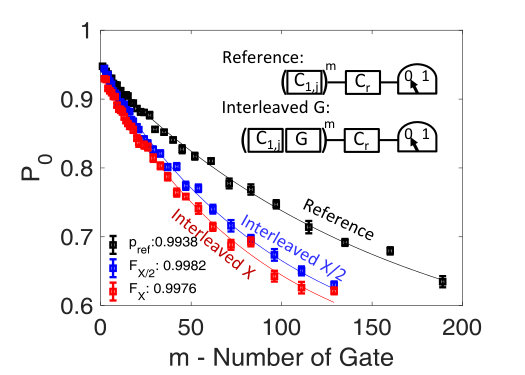 Figure 1
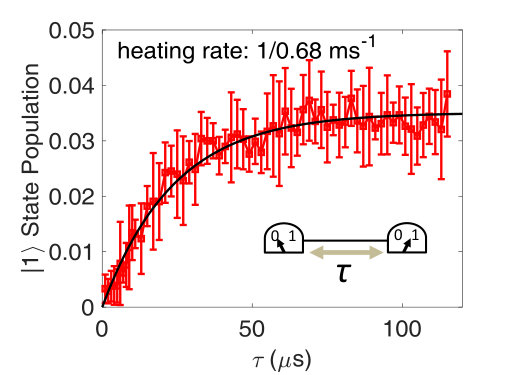 Figure 2
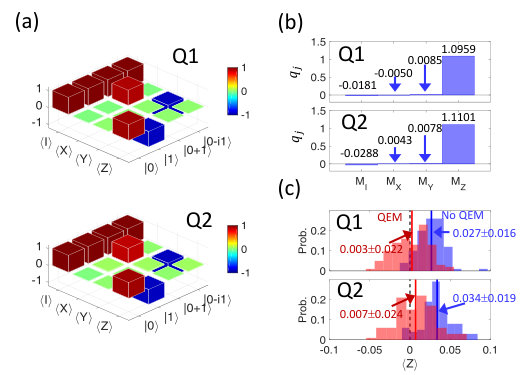 Figure 3
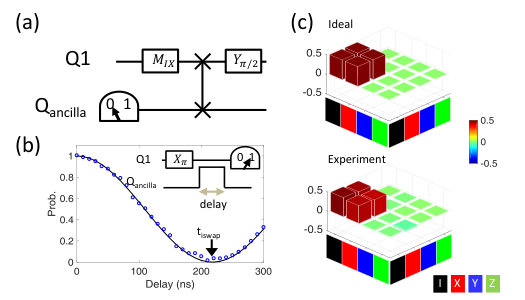 Figure 4
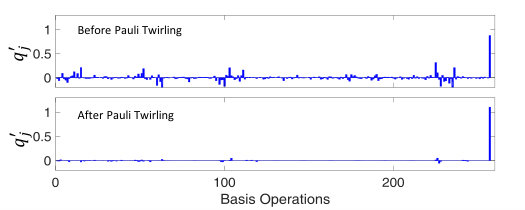 Figure 5
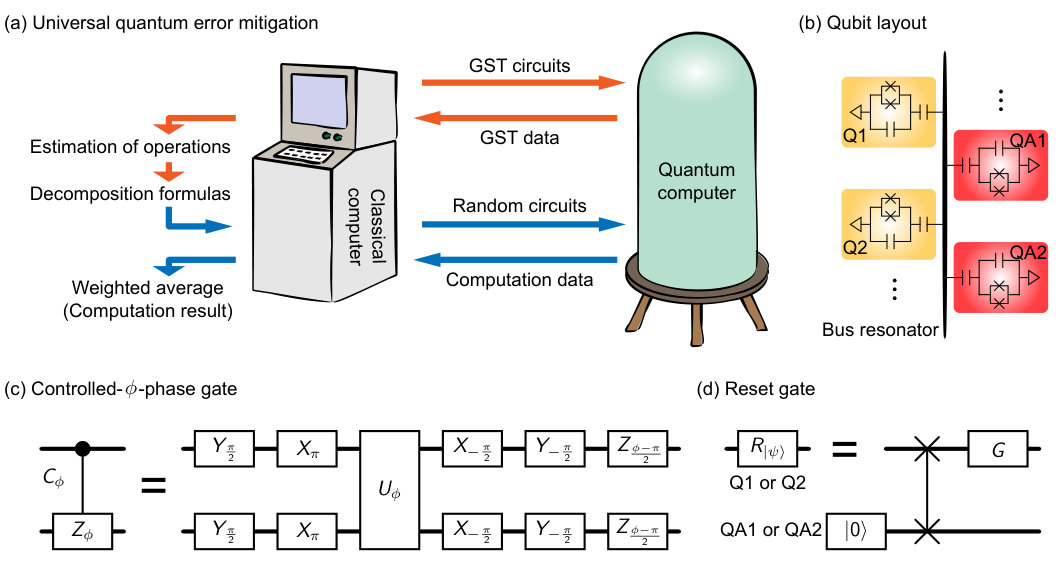 Figure 1
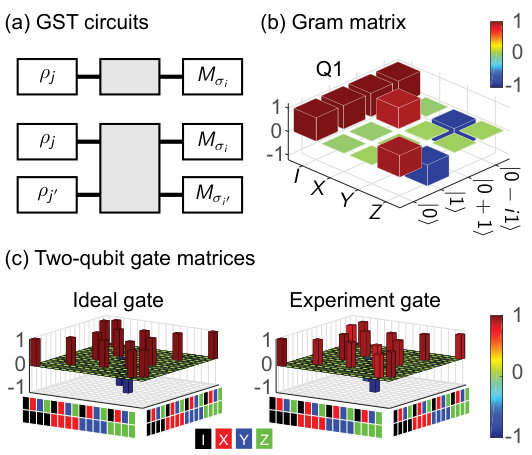 Figure 2
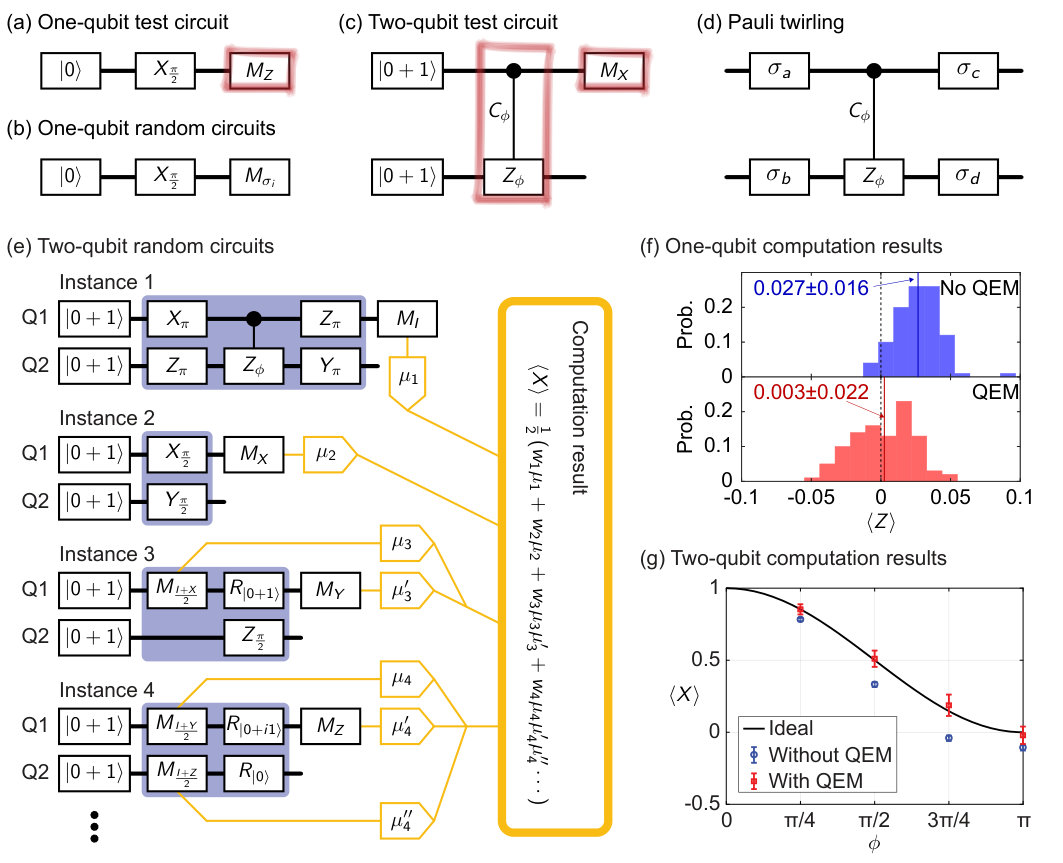 Figure 3
| No. | Operation | No. | Operation |
|---|---|---|---|
| 1 | 9 | ||
| 2 | 10 | ||
| 3 | 11 | ||
| 4 | 12 | ||
| 5 | 13 | ||
| 6 | 14 | ||
| 7 | 15 | ||
| 8 | 16 |
| Q1 | Q2 | |
|---|---|---|
| error rate of ground state readout | 0.0343 | 0.0360 |
| error rate of excited state readout | 0.0526 | 0.0607 |
| gate | Q1 | Q2 |
|---|---|---|
Peer Reviews
No public reviews on file for this paper yet. If you reviewed it on a platform where reviews are public (OpenReview, ICLR, NeurIPS, ICML), you can paste yours below so the community can read it here.
Videos
No videos yet. Explain this paper in a talk, walkthrough, or lecture? Add one.
Quantum computation with universal error mitigation on superconducting quantum processor
Chao Song1
Jing Cui1
H. Wang1
J. Hao2
H. Feng2
Ying Li3
1 Interdisciplinary Center for Quantum Information and Zhejiang Province Key Laboratory of Quantum Technology and Device, Department of Physics, Zhejiang University, Hangzhou 310027, China,
2 Institute of Automation, Chinese Academy of Sciences, Beijing 100190, China,
3 Graduate School of China Academy of Engineering Physics, Beijing 100193, China
Abstract
Medium-scale quantum devices that integrate about hundreds of physical qubits are likely to be developed in the near future. However, such devices will lack the resources for realizing quantum fault tolerance. Therefore, the main challenge of exploring the advantage of quantum computation is to minimize the impact of device and control imperfections without encoding. Quantum error mitigation is a solution satisfying the requirement. Here, we demonstrate an error mitigation protocol based on gate set tomography and quasiprobability decomposition. One- and two-qubit circuits are tested on a superconducting device, and computation errors are successfully suppressed. Because this protocol is universal for digital quantum computers and algorithms computing expected values, our results suggest that error mitigation can be an essential component of near-future quantum computation.
quantum error mitigation
I Introduction
Quantum computers are quantum-mechanical devices capable of solving problems that are believed to be intractable for classical computers. The most essential issue in practicing quantum computation is to deal with imperfections of the device and control that cause computation errors. Quantum error correction can suppress the chance of errors to an arbitrarily low level, which however is beyond the scope of near-future technologies [1, 2]. For shallow algorithms executed on near-future quantum devices [3, 4, 5, 6, 7, 8, 9], quantum error mitigation (QEM) methods [10, 11] are recently proposed to attain a computation result with error minimized, which are practical because encoding is not required. The QEM protocol based on a combination of gate set tomography and quasiprobability decomposition is one of those methods [12], which can be applied to any platform without prior knowledge of imperfections and works for any algorithm that outcomes are expected values of certain observables. In this method, certain quantum circuits are first executed to identify a model of imperfections, then random circuits are sampled from a distribution according to the model [see Fig. 1(a)]. The theory suggests that the average of such random circuits can provide an accurate computation result. Here, we demonstrate the experimental realization of this method for the first time. The device is a superconducting circuit consisting of ten frequency-tunable transmon qubits, among which four qubits are actively used in the demonstration. Details of the device can be seen in references [13]. We use single- and two-qubit circuits to test this method and find that with error mitigation the computation accuracy is significantly improved.
We utilize gate set tomography (GST) [14, 15, 16] to acquire information about the measurement and gate errors in the experiment, which is then used in QEM to decompose any ideal measurement or gate by those experimentally accessible ones with errors. GST can be seen as a self-consistent extension of the quantum process tomography, which takes into account all the errors occurred in the experimental operations including state preparations, quantum gates and measurements.
We use Pauli transfer matrix (PTM) representation to notate quantum states, quantum gates and measurements as commonly adopted in quantum tomography. We define as the operator from the -qubit Pauli basis , where denote the identity and three Pauli matrices, respectively. In PTM representation, a state is expressed as a column vector with elements ; An observable is expressed as a row vector with elements ; The superoperator of a gate is expressed as a matrix . Thus the expected value of the observable in the state going through a sequence of gates reads as follows:
[TABLE]
In GST, quantum gates are reconstructed in a set of experiments. In each experiment, one of the gates is applied on an initial state, and then a measurement is performed to read the value of an observable [see Fig. 2(a)]. We select as initial states and Pauli operators in as observables. Using the PTM representation, we can express the set of initial states as the state preparation matrix and similarly express the set of observables as the readout matrix . Here and below the operations with no superscripts are ideal and those with the superscript “exp” are physical and with errors as experimentally realized or measured. The Gram matrix and the matrix characterizing the superoperator , i.e., , can be obtained by applying the relevant operations in sequence in the experiment.
Experimental operations of , and can be reconstructed by analysing the data of and . However, we cannot exactly reconstruct experimental operations due to the insufficient information encoded in and in the presence of both state preparation and measurement errors. In our device, fidelities of the state preparation and single-qubit gates are much higher than other operations. Therefore, we assume that initial states are error-free and take as a decent guess of , where the caret symbol is introduced to differentiate an estimate from the physical operation itself. Then according to the linear inversion method [14, 15, 16], we have the estimates for and as and , respectively. The difference between the physical gate and its estimate depends on state preparation errors (i.e. the diffrence between and ). We note that this difference is not important because of not only the high fidelity of state preparation in our device but also the self-consistency of GST. Even if state preparation errors are significant, assuming the error-free state preparation does not affect the accuracy of quantum computation using QEM [12]. With these results obtained from the GST experiment, we can decompose any ideal measurement and gates into experimentally achieved operations.
Given the decomposition formulas [12], we randomly generate circuits modified from the original circuit of the computation task and implement these random circuits to obtain the computation result with error mitigated, because errors in random circuits cancel with each other when taking the average. In this paper, we only decompose and replace the measurement and two-qubit gate in the original circuit while the state preparation and single-qubit gates are unchanged. We do this because the error of the previous two is larger than the latter by an order of magnitude. To be explicit, by heralding the ground state for qubit preparation and measuring the heating rate [17], we estimate the ground state preparation error to be below ; error rates of single-qubit gates are calibrated to be below in randomized benchmarking [18, 19, 20]. In comparison, the readout error is about for the ground state and for the excited state; the two-qubit gates applied in this paper have errors around . We remark that gate fidelities can be further boosted on our device, however, which is unnecessary for the purpose of QEM demonstration.
II Mitigating readout error in one-qubit computation
We first test the effect of QEM with a one-qubit computation, whose circuit is shown in Fig. 3(a). In this circuit, we initialize the qubit by heralding the state , with a state fidelity above . Then the gate , whose gate fidelity is calibrated to be by randomized benchmarking, is applied to rotate the qubit state around the x-axis by , after which the operator is measured. The measurement is denoted by in the circuit, which yields an outcome of or . We repetitively implement the circuit for times and take the average as the expected value of . We then repeat the same procedure to obtain expected values. The histogram analysis of the resulting data is shown in the upper panel of Fig. 3(f). The average over expected values gives .
Since the state preparation and single-qubit gate are both quite precise, the relatively large deviation of from zero, i.e. the ideal result, is mainly due to the readout error, for which we intend to mitigate by decomposing the readout operation. To work out the decomposition formula, we obtain the Gram matrix in the experiment, and the result is shown in Fig. 2(b). Assuming the error-free state preparation, we can take a reasonable estimate of as
[TABLE]
where the Pauli operator basis is sorted in the order . With , we can decompose the observable in the form , where are rows of , and the quasi-probabilities are elements of the vector . Quasi-probabilities are real but can be greater than unity and be negative. In the quantum computation with QEM, we implement random circuits for times. In each of them, the measurement of in the original circuit is replaced by the measurement of [see Fig. 3(b)] with the probability . Here, is the physical measurement whose estimate is . The measurement outcome is or (the outcome is always in the measurement of , i.e., the identity operator ). When taking the average of measurement outcomes, each outcome is multiplied by a weight factor of . We take this weighted average as the expected value of . Then we repeat the above procedure to obtain expected values, and the average over all these expected values yields as shown in the lower panel of Fig. 3(f). The accuracy of the computation is successfully improved compared with the computation without QEM.
III Mitigating readout and entangling gate errors in two-qubit computation
Now we turn to a two-qubit computation, taking the deterministic quantum computation with pure states (DQCp) [21] as an example. The circuit is shown in Fig. 3(c). A main error source in this circuit is the controlled--phase gate , where . This gate is realized with a two-qubit dressed state gate [22] plus ten single-qubit gates as shown in Fig. 1(c). The two-qubit dressed state gate essentially achieves a controlled--phase gate in the basis, and single-qubit gates are used to transform the basis into the basis. Fidelities of different gates are , , , and for , , , and , respectively, characterized using GST. We remark that gate fidelities can be further boosted on our device, however, which is unnecessary for the purpose of QEM demonstration.
To mitigate the error in , we need first to work out the decomposition formula. Given the ideal superoperator representing , the decomposition formula reads , where is a set of quasi-probabilities as introduced previously and is the estimate of a set of experimentally achieved operations as defined below and in Table. 1.
In our experiment, operations are used for decomposing an ideal gate. The first operations are generated from the tensor product of single-qubit operations, which include measurement and reset gates, as listed in Table. 1. The operation is the gate modified by the Pauli twirling as we will explain soon. We reconstruct the experimental operations of and single-qubit measurement-reset gates in GST, while we simply assume single-qubit gates are error-free, because single-qubit gates can be experimentally implemented with high fidelity. Unlike the state preparation, assuming error-free single-qubit gates can potentially cause inaccuracy in the quantum computation with QEM. PTM of the controlled--phase gate obtained using GST is illustrated in Fig. 2(c) as an example. These operations are linearly independent, which ensures that the decomposition solutions can always be found by solving a system of linear equations. In all solutions we choose the one with the minimum in to minimize the variance of the computation result.
The measurement-reset operation is occasionally in random circuits [see Table. 1]. In order to minimize the time of reset, we realize the reset gate using ancilla qubits QA1 and QA2 on the same chip [see Fig. 1(b)]. Each reset operation uses an ancilla qubit initially prepared in the ground state , then a swap gate is applied to reinitialize the target qubit when the reset is requested [13], following which a single-qubit gate with the fidelity above rotates the qubit to the state as shown in Fig. 1(d). The whole measurement-reset operation typically has a fidelity of around .
Pauli twirling converts the error in a gate into stochastic Pauli errors [23, 24, 25], which can reduce the variance of the computation result [12]. The circuit of the gate with Pauli twirling is shown in Fig. 3(d). We sandwich in between four Pauli gates (two for each qubit) which are randomly chosen but conserves the gate up to a global phase difference. If all gates are error-free, the two-qubit gate realized in this way is still , i.e. . Here we use the bracket notation to denote a superoperator , are single-qubit Pauli gates chosen to satisfy , can be any phase factor, and is the probability. If gates have errors, the two-qubit gate will be effectively changed by the Pauli twirling. Using the twirled gate as the operation in the decomposition, we need the estimate of the twirled gate, which is , where is the estimate of the experimental operation of obtained in GST. For , the distribution of Pauli gates is unifrom, i.e. . For other gates where , Pauli gates are chosen from a subset: We take if , and otherwise.
In the two-qubit computation with QEM, to mitigate both readout and two-qubit gate errors, the gate is randomly replaced by the gate with the probability , and the measurement of is replaced by the measurement of with the probability , where . Similar to the one-qubit case, the measurement outcome of each random circuit is multiplied by a weight factor of , and we take the weighted average as the computation result as shown in Fig. 3(e).
In the experiment, we adjust the phase of and measure the expected value of . When implementing the computation with QEM, we randomly sample a circuit according to the decompositions of both and the observable . Representative decomposed sampling circuits are shown in Fig. 3(e). The experiment result is shown in Fig. 3(g), which demonstrates a significant improvement on the computation accuracy.
The most significant improvement is obtained at , in which case the difference between the computation result and the ideal value is reduced from to by using QEM. To estimate the fidelity required to achieve the same computation accuracy, we consider a quantum system with depolarizing error channels [26] and assume that the state preparation and single-qubit gates are ideal. The depolarizing error channel either preserves or completely destroys the information with certain probabilities [27], which does not characterize our device. We choose the depolarizing model because it takes all possible errors into account with equal probability. In the depolarizing model, the two-qubit gate and measurement with the fidelity are required to achieve the computation accuracy , which is comparable to the highest fidelity reported in the superconducting qubit system [20, 28].
IV Discussions
For multi-qubit devices, GST of the entire device is not practical, because the experiment time increases exponentially with the qubit number. Similarly, the number of operations for decomposing a multi-qubit gate also increases exponentially with the qubit number. Single-qubit and two-qubit gates are sufficient for the universal quantum computation. Therefore, if errors are uncorrelated, we only need to implement GST up to two qubits and decompose two-qubit gates, as demonstrated in our experiment. Errors are uncorrelated if the evolution of two qubits under a two-qubit gate is independent from the evolution of other qubits. As a result of the evolution, the quantum operation on the entire device can be factorized into the product of an operation on the two qubits and operations on other qubits. It is similar for single-qubit gates. In our device, the primary dephasing noise is dominated by fluctuators in the form of magnetic moments, whose influence is local in each individual physical qubit, and, therefore, the dephasing-induced errors are uncorrelated between qubits. In our experiment, we have neglected error correlations in GST, so that single-qubit operations are characterized in single-qubit tomography even in the two-qubit experiment. Neglecting error correlations sacrifices accuracy of QEM. A significant effect of correlations on the computation result is not observed in our experiment.
We have experimentally demonstrated that the universal QEM protocol can significantly reduce the error in quantum computation on a noisy quantum device. The protocol in our experiment does not require sub-threshold error rate or tremendous additional physical qubit resource. Compared with the algorithm-specified protocol [7] and the extrapolation of gate time [9], the combination of gate set tomography and quasi-probability decomposition is not restricted to the algorithm or error model. A few techniques in QEM are explored: estimate of the state preparation matrix according to ideal states, Pauli twirling for randomizing the error, approximate GST and decomposition neglecting error correlations. An important factor limiting the circuit depth in our demonstration is the variance of computation result, which depends on the error rate of quantum gates. Improvement in gate fidelity can extend the circuit depth, and relatively deep circuits can be implemented on intermediate-scale devices with a feasible fidelity [12]. By demonstrating the power of error mitigation techniques on the superconducting quantum device, our results highlight the potential of using such techniques in computation tasks on near-future quantum devices.
**Acknowledgments
** We thank Xiaobo Zhu and Dongning Zheng for fabricating the device. This work was supported by the National Basic Research Program of China (Grant No. 2017YFA0304300) and the National Natural Science Foundations of China (Grants No. 11434008 and No. 11725419). YL is supported by NSAF (Grant No. U1730449).
V Randomized benchmarking for single-qubit gates
In Fig. S1 we show the randomized benchmarking data for gates and of Q1. We find that fidelities of these two gates are and , respectively.
VI Heating rate measurement
In the experiment we herald the state to initialize the qubit. We need to wait after the measurement pulse for the readout resonator to settle down before any further operation can be applied, during which the qubit may be heated again, causing the ground state preparation error. In Fig. S2, we show the measurement of the heating rate of Q1, which indicates a ground state preparation error below .
VII Readout error for Q1 and Q2.
In order to measure the readout error, we repeatedly prepare the qubit to the state or and measure the probability of incorrect output. The results are shown in Table. S1
VIII One-qubit QEM experiment
Gram matrices for Q1 and Q2 are shown in Fig. S3(a). The decomposition coefficients (i.e. quasiprobabilities) of the measurement is shown in Fig. S3(b). In the QEM experiment, we take a sample number of to obtain an average value and repeat the experiment for times to obtain the distribution of . The result is shown in Fig. S3(c).
IX Measurement and reset gates
In the two-qubit QEM experiment, we used two ancillary qubits QA1 and QA2 to reset Q1 and Q2. The Circuit for the measurement-reset gate of and on Q1 is shown in Fig. S4(a). An i-swap gate is used in the reset gate, which is shown in Fig. S4(b). The GST result for this measurement-reset gate is shown in Fig. S4(c). Gate fidelities for all measurement-reset gates used in this paper are listed in Table. S2.
X Decomposing gate
When decomposing two-qubit gates, we suppose that the first gates listed in Table. I in the main text are ideal. The last gates, i.e. the measurement-reset gates are characterized by using GST, and the GST results are used in the decomposition. Coefficients (i.e. quasiprobabilities) of the decomposition for the gate are shown in Fig. S5. We find that by applying the Pauli twirling, the cost reduced from to . In the two-qubit QEM experiment, we generate random circuits according to the coefficients with the Pauli twirling applied.
XI Depolarizing error channels
For a two-qubit gate, if the fidelity is and the error channel is depolarizing, the gate succeeds (i.e. the gate does not cause any error) with the probability and fails (i.e. the two-qubit state becomes the maximally mixed state) with the probability . For a measurement, if the fidelity is and the error channel is depolarizing, the measurement succeeds (i.e. the outcome is true) with the probability , and the measurement fails (i.e. the outcome is completely random) with the probability . Suppose that is the computation result when all operations are error-free, the computation result becomes when error channels are switched on, and the difference from the ideal value is . When , , therefore if .
The reference list from the paper itself. Each links out to its DOI / PubMed record.
- 1[1] A. G. Fowler, M. Mariantoni, J. M. Martinis, and A. N. Cleland, Surface codes: Towards practical large-scale quantum computation , Phys. Rev. A 86 , 032324 (2012).
- 2[2] J. O’Gorman and E. T. Campbell, Quantum computation with realistic magic state factories , Phys. Rev. A 95 , 032338 (2017).
- 3[3] A. Peruzzo, J. Mc Clean, P. Shadbolt, M.-H. Yung, X.-Q. Zhou, P. J. Love, A. Aspuru-Guzik, and J. L. O’Brien, A variational eigenvalue solver on a photonic quantum processor , Nat. Commun. 5 , 4213 (2014).
- 4[4] P. J. J. O’Malley, R. Babbush, I. D. Kivlichan, J. Romero, J. R. Mc Clean, R. Barends, J. Kelly, P. Roushan, A. Tranter, N. Ding, B. Campbell, Y. Chen, Z. Chen, B. Chiaro, A. Dunsworth, A. G. Fowler, E. Jeffrey, E. Lucero, A. Megrant, J. Y. Mutus, M. Neeley, C. Neill, C. Quintana, D. Sank, A. Vainsencher, J. Wenner, T. C. White, P. V. Coveney, P. J. Love, H. Neven, A. Aspuru-Guzik, and J. M. Martinis, Scalable quantum simulation of molecular energies , Phys. Rev. X 6 , 031007 (2016).
- 5[5] Y. Shen, X. Zhang, S. Zhang, J.-N. Zhang, M.-H. Yung, and K. Kim, Quantum implementation of unitary coupled cluster for simulating molecular electronic structure , Phys. Rev. A 95 , 020501 (2017).
- 6[6] A. Kandala, A. Mezzacapo, K. Temme, M. Takita, M. Brink, J. M. Chow, and J. M. Gambetta, Hardware-efficient variational quantum eigensolver for small molecules and quantum magnets , Nature 549 , 242 (2017).
- 7[7] J. I. Colless, V. V. Ramasesh, D. Dahlen, M. S. Blok, M. E. Kimchi-Schwartz, J. R. Mc Clean, J. Carter, W. A. de Jong, and I. Siddiqi, Computation of molecular spectra on a quantum processor with an error-resilient algorithm , Phys. Rev. X 8 , 011021 (2018).
- 8[8] C. Hempel, C. Maier, J. Romero, J. Mc Clean, T. Monz, H. Shen, P. Jurcevic, B. P. Lanyon, P. Love, R. Babbush, A. Aspuru-Guzik, R. Blatt, and C. F. Roos, Quantum chemistry calculations on a trapped-ion quantum simulator , Phys. Rev. X 8 , 031022 (2018).