Magic polarization for light shift cancellation in two-photon optical clocks
Shira Jackson, Amar C. Vutha

TL;DR
This paper introduces a simple method using a magic polarization to cancel probe laser light shifts in two-photon optical atomic clocks, enhancing their accuracy by controlling light-induced frequency shifts.
Contribution
It identifies a magic polarization angle where light shifts are canceled and demonstrates how polarization controls both light shift suppression and excitation rate.
Findings
Magic polarization cancels differential light shifts.
Polarization controls excitation rate independently.
Estimated magic polarization angles for calcium and strontium clocks.
Abstract
We find a simple solution to the problem of probe laser light shifts in two-photon optical atomic clocks. We show that there exists a magic polarization at which the light shifts of the two atomic states involved in the clock transition are identical. We calculate the differential polarizability as a function of laser polarization for two-photon optical clocks based on neutral calcium and strontium, estimate the magic polarization angle for these clocks, and determine the extent to which probe laser light shifts can be suppressed. We show that the light shift and the two-photon excitation rate can be independently controlled using the probe laser polarization.
Click any figure to enlarge with its caption.
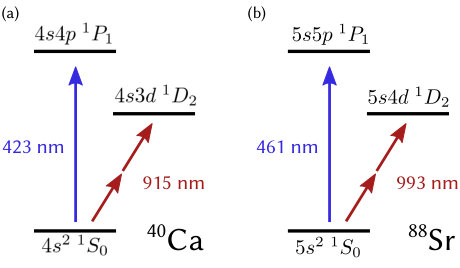 Figure 1
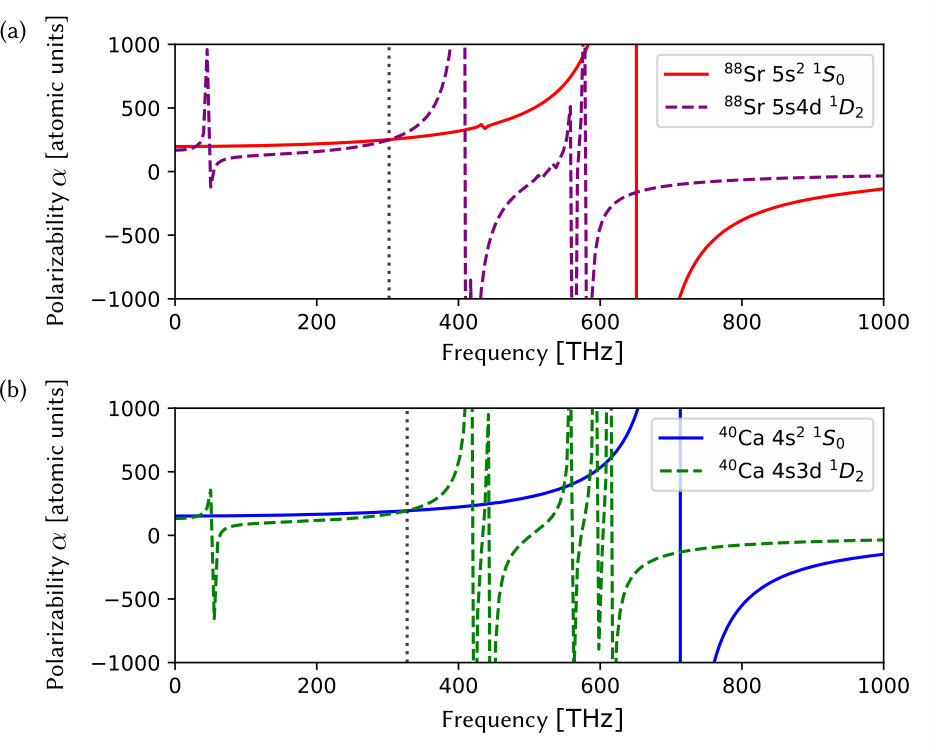 Figure 2
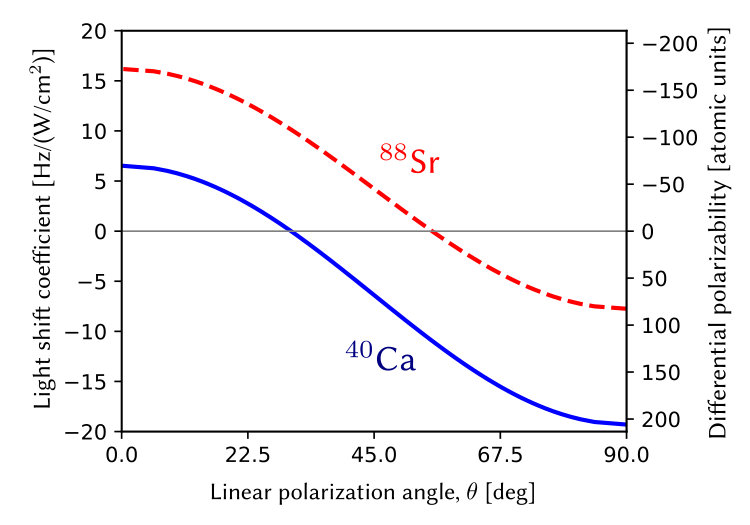 Figure 3
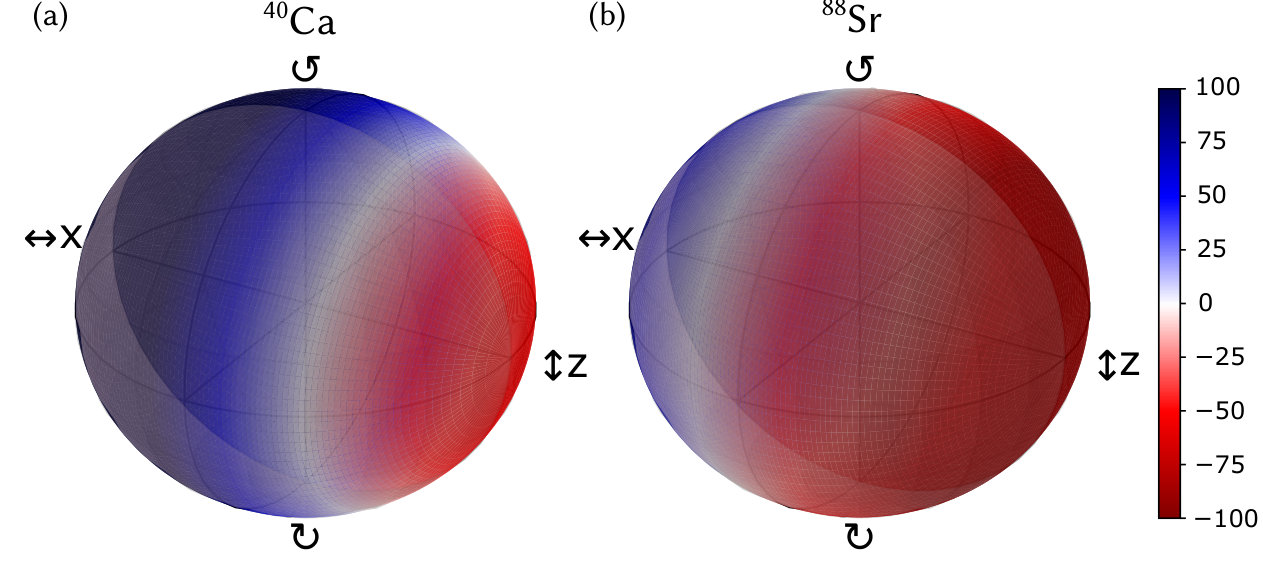 Figure 4
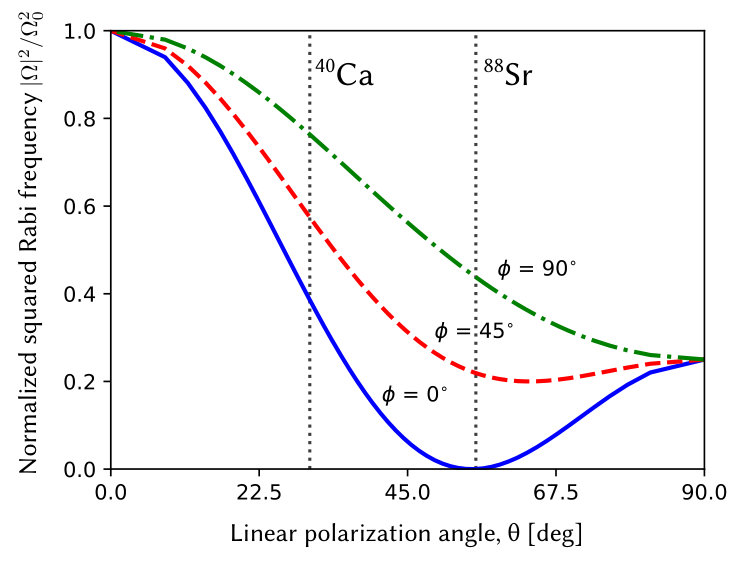 Figure 5
| [nm] | Level | Polarizability [a.u.] | |
| This work | Other results | ||
| Ca | 154.7 | 163.0a 168.7(16.9) b | |
| Sr | 201.6 | 192.5c, 197.2d | |
| 813.4 | Sr | 295.6 | 278.1c, 286.0d |
Peer Reviews
No public reviews on file for this paper yet. If you reviewed it on a platform where reviews are public (OpenReview, ICLR, NeurIPS, ICML), you can paste yours below so the community can read it here.
Videos
No videos yet. Explain this paper in a talk, walkthrough, or lecture? Add one.
Magic polarization for light shift cancellation in two-photon optical clocks
Shira Jackson
Amar C. Vutha
Department of Physics, University of Toronto, Toronto, Canada M5S 1A7
Abstract
We find a simple solution to the problem of probe laser light shifts in two-photon optical atomic clocks. We show that there exists a magic polarization at which the light shifts of the two atomic states involved in the clock transition are identical. We calculate the differential polarizability as a function of laser polarization for two-photon optical clocks based on neutral calcium and strontium, estimate the magic polarization angle for these clocks, and determine the extent to which probe laser light shifts can be suppressed. We show that the light shift and the two-photon excitation rate can be independently controlled using the probe laser polarization.
Optical clocks have reached an unprecedented level of accuracy, approaching fractional uncertainties of Chou et al. (2010); Beloy et al. (2014); Nicholson et al. (2015); Grebing et al. (2016); Huntemann et al. (2016); Dubé et al. (2017); Chen et al. (2017); Mcgrew et al. (2018). These clocks offer powerful tools for precision measurements and tests of fundamental physics Ludlow et al. (2015); Mann (2018), such as searches for dark matter and dark energy Derevianko (2016), or low-frequency gravitational wave detection Vutha (2015); Kolkowitz et al. (2016); Norcia et al. (2017). Optical clocks can be used for geodetic surveys of the earth’s gravitational potential Mehlstäubler et al. (2018); Grotti et al. (2018); Mcgrew et al. (2018). Atomic clocks are also an essential component of the new SI system of units, where the measurement of almost every physical quantity is ultimately related to the accurate measurement of frequency Milton et al. (2014); Keller and Aumentado (2016). It is widely expected that the SI second will soon be redefined in terms of optical atomic clocks McGrew et al. (2019).
Careful control of systematic errors is necessary to achieve such high levels of accuracy. An important and generic systematic in optical clocks is the light shift – a shift in the resonance frequency of the atoms due to off-resonant light. For example, one source of light shifts in optical lattice atomic clocks is the lattice laser which must remain on during the measurement. These shifts are usually controlled by choosing a “magic wavelength” for which the light shifts of the clock ground and excited states are equal Katori et al. (2003). This ensures that the relative energy difference between the two levels is unaffected by the optical lattice, therefore making the clock less sensitive to fluctuations in laser intensity.
In addition to light shifts from trapping lasers, many optical clocks suffer from light shifts due to the probe laser itself to some extent, because they rely on forbidden atomic transitions. This necessitates careful stabilization of the probe laser intensity, or sophisticated measurement protocols such as hyper-Ramsey schemes Yudin et al. (2010); Hobson et al. (2016); Huntemann et al. (2016); Zanon-Willette et al. (2017), autobalanced Ramsey spectroscopy Sanner et al. (2018), or displaced frequency-jump Ramsey spectroscopy Shuker et al. (2018) in order to suppress the probe laser light shift. Here we consider two-photon optical clocks Hall et al. (1989). Two-photon clocks using rubidium Zhu and Standridge (1997); Poulin et al. (2002); Ducos, F. et al. (2002); Edwards et al. (2005); Perrella et al. (2013); Newman et al. (2018); Martin et al. (2018a), xenon Rolston and Phillips (1991); Sterr et al. (1995) and silver Badr et al. (2004, 2006) have been successfully operated, and clocks using calcium Hall et al. (1989); Vutha (2015), and strontium Hall et al. (1989); Hummon have been proposed. Two-photon optical transitions can be driven using two counter-propagating laser beams at the same frequency, which makes the interrogation of the clock transition insensitive to first-order Doppler shifts and photon recoil shifts Hall et al. (1989). This offers an attractive path to a compact, field-portable optical clock that does not require strong cooling and confinement in a lattice, and therefore has a simplified architecture. However, the systematic frequency shifts in such clocks are dominated by the light shift due to the probe laser, because of the relatively large laser intensities that are needed to drive the transition (cf. Martin et al. (2018b); Gerginov and Beloy (2018); Newman et al. (2018); Martin et al. (2018a)). Here we show that light shifts due to the probe laser in two-photon optical clocks can be nulled using a specific choice of the laser polarization, removing one of the main obstacles to achieving high accuracy with these clocks.
The term “magic polarization” has been used in the context of reducing line broadening and increasing coherence times of hyperfine transitions in alkali atoms Kim et al. (2013), and improving the efficiency of Doppler cooling of a trapped gas Chalopin et al. (2018). It has also been shown that the degree of circular polarization can be used to mitigate the effects of differential hyperpolarizability in optical lattice clocks Katori et al. (2015). Here we use “magic polarization” to refer to a particular polarization angle of the probe laser light for which the differential dynamic polarizability of the two clock states is zero. We find this magic polarization for calcium and strontium two-photon optical clocks by calculating the dynamic polarizabilities of the clock states. We show that the probe laser light shifts can be strongly suppressed, and the fractional frequency uncertainty due to the light shift reduced below , using a robust method that is simple to implement.
The light shift of an atomic energy level due to the electric dipole () interaction is , where is the dynamic polarizability of the atomic state , is the electric field amplitude and is the frequency of the electric field. The polarizability depends on both the frequency and the polarization of the electric field. The polarizability of a state can be calculated to leading order in perturbation theory as
[TABLE]
where is the interaction operator and represent the unperturbed energies of states respectively. The electric dipole operator is a linear combination of three rank-1 spherical tensor operators (), with relative coefficients depending on the laser polarization.
In all the calculations, the quantization axis was assumed to be defined by a small magnetic field in the direction, and the probe laser was considered to propagate along the direction. We write the electric field as , which defines the polarization angles . The operator is therefore . The light shift for the clock transition is , where is the differential polarizability between the ground and excited clock states, and is the frequency of the probe laser.
The matrix elements in Eq. (1) can be calculated from the reduced matrix elements , which can in turn be related to experimentally determined oscillator strengths using the relation Drake (2006)
[TABLE]
where is the symmetric oscillator strength, is the non-symmetric oscillator strength, and .
Energy levels and oscillator strengths for transitions relevant to the calculation of dynamic polarizabilities are available both from experimental data and ab initio theoretical calculations. In calculating the clock state polarizabilities for rubidium, calcium, and strontium two-photon optical clocks, energies and oscillator strengths from the NIST Atomic Spectra Database Kramida et al. (2018) and other published sources Sansonetti and Nave (2010); Guo et al. (2010); Vaeck et al. (1988); Hansen et al. (1999); Ruczkowski et al. (2016) were used.
The energy level differences in these atoms are known to better than 10*-5*, and therefore do not contribute significantly to the uncertainty in the polarizability. The uncertainty is instead dominated by the oscillator strengths. The sum in Eq. (1) is usually well approximated by only a handful of terms that represent atomic levels which couple strongly to the state and are close in energy. We found that including more than 10 leading terms to the sum in Eq. (1) only changed the polarizability by 0.1%. To estimate the accuracy of the oscillator strengths used as inputs for our magic polarization calculations, we compared the polarizabilities of some reference states against previously published results, as summarized in Table 1. For all of these cases, our calculations reproduced the published values reasonably well, indicating that the oscillator strengths of the important transitions are accurate to better than 10%.
The atomic level structures relevant to two-photon optical clocks in neutral calcium and strontium are shown in Fig. 1. The strong dipole-allowed cycling transitions are convenient for laser cooling the atoms, in order to increase the interrogation time and reduce the second-order Doppler shift Hall et al. (1989); Vutha (2015). The two-photon clock states are the ground state and the excited state. The transition between these states is insensitive to the first-order Zeeman shift. The two-photon clock transition is probed using two laser beams with identical frequencies, but oppositely directed wavevectors. The ground and excited clock states are hereafter denoted as and .
The dynamic polarizabilities calculated for calcium and strontium, in atomic units, as a function of are shown in Fig. 2. (In atomic units, a polarizability of 1 is equal to , where is the permittivity of free space and is the Bohr radius.) At the clock transition frequency, the differential polarizability between and (which is proportional to the light shift of the clock transition) is shown as a function of probe laser linear polarization angle in Fig. 4. Both calcium and strontium two-photon clocks possess a magic polarization at which the differential polarizability is zero. This feature is generic, and we verified that the existence of a magic polarization angle is not affected by changes in a number of oscillator strength values.
The existence of a magic polarization in calcium and strontium is related to the light shift of . (The polarizability of is independent of the polarization angle, and has positive sign at the two-photon clock transition frequency, which decreases the energy of the ground state for increasing laser intensity.) The two odd-parity states closest in energy to are the and states in calcium (strontium). For -polarization, the probe laser is red-detuned on the transition, resulting in a large positive polarizability for which exceeds the polarizability of . For -polarization,the transition does not contribute to the polarizability due to angular momentum conservation. The light shift for -polarization is therefore determined by the state on which the probe laser is blue-detuned which results in a negative polarizability for . Between pure - and pure -polarization therefore, there is generically a magic polarization angle at which the ground and excited clock states have identical light shifts. Therefore the exact value of the magic angle may be affected by uncertainties in our calculations as described above, or higher-order corrections to the polarizabilities, but the existence of a magic angle is a robust result.
(In passing, we note that we also performed calculations for rubidium two-photon clocks operating on the 778 nm clock transitions, but did not find a magic polarization angle for degenerate two-photon excitation. This is related to the fact that the two-photon clock frequency happens to be very close to the strongly allowed transition at 780 nm. Therefore the polarizability of the ground state is so large that it entirely dominates the differential polarizability for all polarizations of the probe laser.)
For the case considered here, where the clock laser propagates perpendicular to the quantization axis, the differential polarizability does not depend on the ellipticity of the probe laser polarization. As a result the magic polarization angle is robust against any phase differences between the and components of the laser polarization, such as might be accrued in propagation through birefringent optical components (e.g., stressed vacuum viewports). This fact is evident in Fig. 3, where the differential polarizability plotted on the Poincaré sphere is seen to be independent of .
For both calcium and strontium the light shift in the vicinity of the magic polarization angle, , is , with the shift coefficient -30 Hz/(W/cm2)/rad. From Fig. 5, typical probe laser intensities for the calcium and strontium two-photon transitions are expected to be 1 W/cm2. With its polarization set to within 1 mrad of over the atomic ensemble (easily accomplished with standard optical components), it is sufficient to stabilize the probe laser intensity to just 1% to ensure that the systematic error due to the light shift is below 10*-18*. Probing the transition with a magic polarized laser effectively suppresses the light shift by over 2 orders of magnitude, and eliminates one of the main sources of inaccuracy in two-photon optical clocks based on alkaline-earth atoms.
The choice of laser polarization also affects the two-photon Rabi frequency and the excitation rate . The two-photon Rabi frequency is . The value of was numerically calculated for the calcium and strontium two-photon transitions using the same set of oscillator strengths used for the polarizability calculations. The calculated dependence of the Rabi frequency on the probe laser polarization is shown in Fig. 5. An analytical expression that accurately predicts the and dependence of the Rabi frequency is derived in the appendix. Intuitively, the dependence of on laser polarization can be understood as follows: the amplitude for the two-photon transition from is a sum of three interfering amplitudes, for excitation via intermediate states. The relative amplitudes and phases of these three terms are set by and . At there is complete destructive interference between these three excitation pathways and the Rabi frequency goes to zero (see Section A1 in the Appendix). However, adding a phase difference between the and components of the electric field, destroys this perfect cancellation between amplitudes and prevents the Rabi frequency from becoming zero for any value of . As this phase shift does not affect the differential polarizability between the clock states (see Fig. 3), the Rabi frequency for the transition can be tuned independently from the magic polarization and optimized as required. For example, controlling allows the strontium two-photon transition to have a large Rabi frequency despite the closeness of its magic polarization angle to the interference minimum at 55∘, as shown in Fig. 5.
In summary, we have described a magic polarization scheme for radically suppressing probe laser light shifts in two-photon optical clocks. Setting the probe laser to a magic polarization angle is sufficient to eliminate systematic errors due to light shifts in calcium and strontium two-photon clocks, opening up a path to compact and portable optical clocks based on simple two-photon transitions. Controlling polarizations to cancel light shifts may also be a useful method for other precision measurements on highly forbidden atomic and molecular transitions.
Acknowledgments. This work is supported by the Branco Weiss Fellowship, NSERC, and Canada Research Chairs. S.J. acknowledges support from an Ontario Graduate Scholarship. We are grateful to Eric Hessels and Matthew Hummon for stimulating discussions.
I Appendix A: Polarization dependence of the two-photon Rabi frequency
The two-photon Rabi frequency is
[TABLE]
with the summation extending over intermediate states that are connected to the and states. The Hamiltonian is
[TABLE]
where is the laser electric field amplitude, are the spherical components of the dipole moment operator, and the polarization angles are defined in the main text.
Using the Wigner-Eckart theorem, matrix elements of the spherical components of the dipole moment can be written as
[TABLE]
The state has and the state has .
Only three sets of matrix elements between these states and intermediate states result in non-zero contributions to the sum:
[TABLE]
All three of these pairs enter the Rabi frequency with the same energy denominator. Therefore
[TABLE]
and the two-photon Rabi frequency is
[TABLE]
For (pure linear polarization), the Rabi frequency goes to zero when , as shown in Fig. 5. For other values of , the magnitude of does not become zero for any value of .
The reference list from the paper itself. Each links out to its DOI / PubMed record.
- 1Chou et al. (2010) C. W. Chou, D. B. Hume, J. C. J. Koelemeij, D. J. Wineland, and T. Rosenband, Phys. Rev. Lett. 104 , 070802 (2010) . · doi ↗
- 2Beloy et al. (2014) K. Beloy, N. Hinkley, N. B. Phillips, J. A. Sherman, M. Schioppo, J. Lehman, A. Feldman, L. M. Hanssen, C. W. Oates, and A. D. Ludlow, Phys. Rev. Lett. 113 , 260801 (2014) . · doi ↗
- 3Nicholson et al. (2015) T. Nicholson, S. Campbell, R. Hutson, G. Marti, B. Bloom, R. Mcnally, W. Zhang, M. Barrett, M. Safronova, G. Strouse, and et al., Nature Communications 6 (2015).
- 4Grebing et al. (2016) C. Grebing, A. Al-Masoudi, S. Dörscher, S. Häfner, V. Gerginov, S. Weyers, B. Lipphardt, F. Riehle, U. Sterr, and C. Lisdat, Optica 3 , 563 (2016) . · doi ↗
- 5Huntemann et al. (2016) N. Huntemann, C. Sanner, B. Lipphardt, C. Tamm, and E. Peik, Physical Review Letters 116 , 063001 (2016) . · doi ↗
- 6Dubé et al. (2017) P. Dubé, J. E. Bernard, and M. Gertsvolf, Metrologia 54 , 290 (2017) . · doi ↗
- 7Chen et al. (2017) J.-S. Chen, S. M. Brewer, C. W. Chou, D. J. Wineland, D. R. Leibrandt, and D. B. Hume, Phys. Rev. Lett. 118 , 053002 (2017) . · doi ↗
- 8Mcgrew et al. (2018) W. F. Mcgrew, X. Zhang, R. J. Fasano, S. A. Schäffer, K. Beloy, D. Nicolodi, R. C. Brown, N. Hinkley, G. Milani, M. Schioppo, and et al., Nature 564 , 87–90 (2018) . · doi ↗