The simplicial volume of mapping tori of 3-manifolds
Michelle Bucher, Christoforos Neofytidis

TL;DR
This paper proves that all mapping tori of closed 3-manifolds have zero simplicial volume, extending the result to higher dimensions and providing new techniques for analyzing self-homeomorphisms of reducible 3-manifolds.
Contribution
It introduces a novel method for understanding self-homeomorphisms of connected sums and computes the simplicial volume of mapping tori, completing the classification in dimension four.
Findings
All mapping tori of closed 3-manifolds have zero simplicial volume.
The techniques extend to certain higher-dimensional connected sums.
Dimension four is unique in having all mapping tori with vanishing simplicial volume.
Abstract
We prove that any mapping torus of a closed 3-manifold has zero simplicial volume. When the fiber is a prime 3-manifold, classification results can be applied to show vanishing of the simplicial volume, however the case of reducible fibers is by far more subtle. We thus analyse the possible self-homeomorphisms of reducible 3-manifolds, and use this analysis to produce an explicit representative of the fundamental class of the corresponding mapping tori. To this end, we introduce a new technique for understanding self-homeomorphisms of connected sums in arbitrary dimensions on the level of classifying spaces and for computing the simplicial volume. In particular, we extend our computations to mapping tori of certain connected sums in higher dimensions. Our main result completes the picture for the vanishing of the simplicial volume of fiber bundles in dimension four. Moreover, we deduce…
Click any figure to enlarge with its caption.
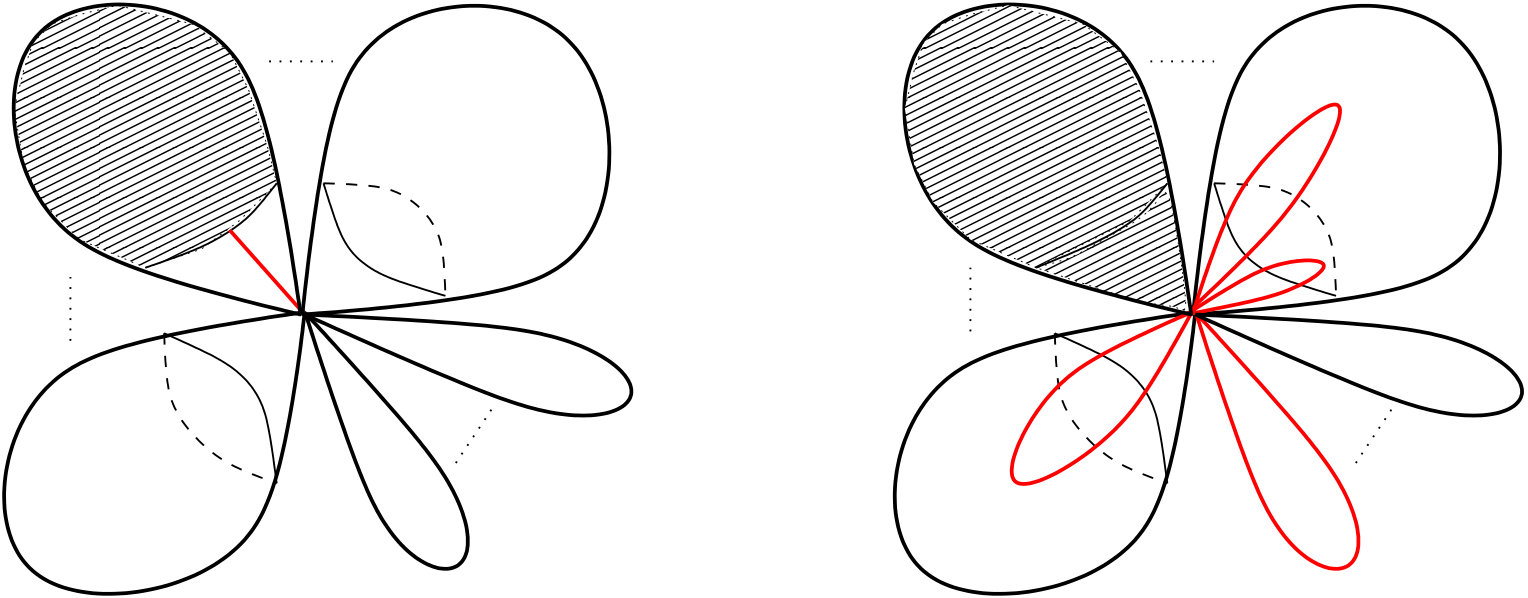 Figure 1
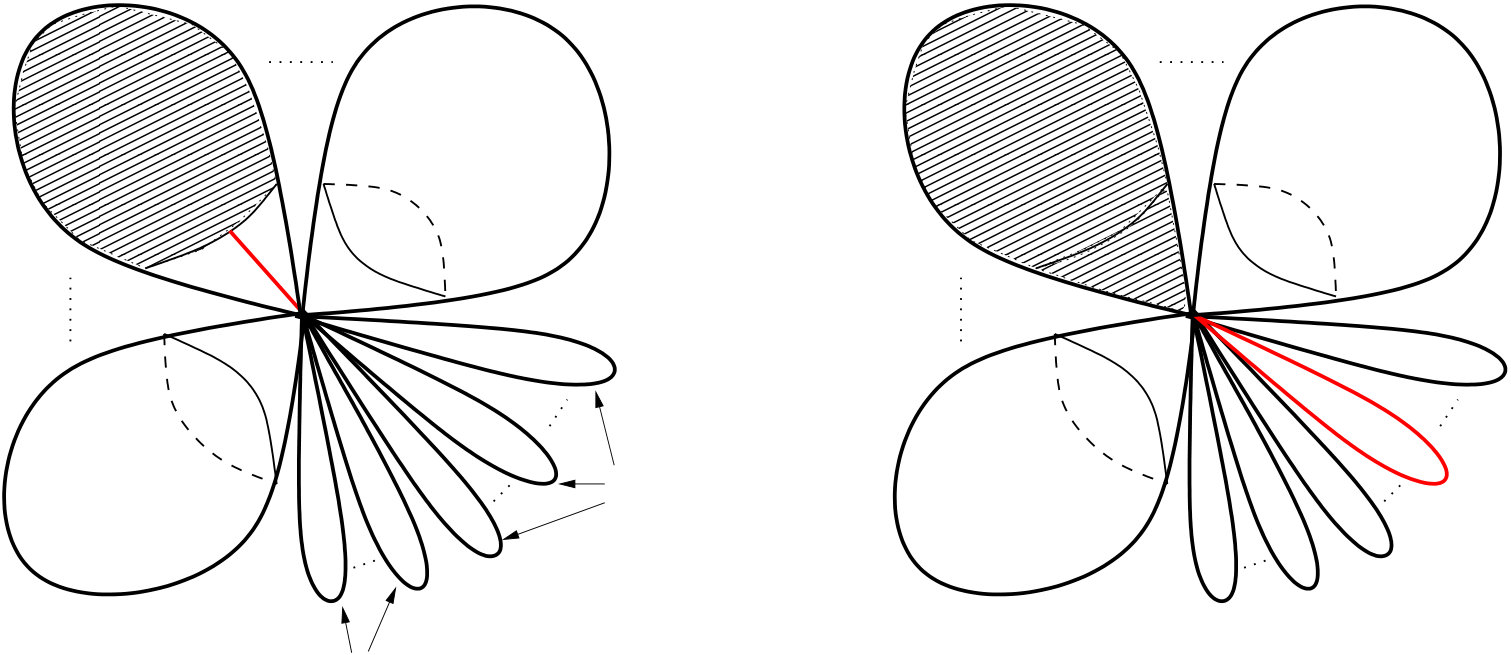 Figure 2
Peer Reviews
No public reviews on file for this paper yet. If you reviewed it on a platform where reviews are public (OpenReview, ICLR, NeurIPS, ICML), you can paste yours below so the community can read it here.
Videos
No videos yet. Explain this paper in a talk, walkthrough, or lecture? Add one.
The simplicial volume of mapping tori of 3-manifolds
Michelle Bucher and Christoforos Neofytidis
Section de Mathématiques, Université de Genève, 2-4 rue du Lièvre, Case postale 64, 1211 Genève 4, Switzerland
Section de Mathématiques, Université de Genève, 2-4 rue du Lièvre, Case postale 64, 1211 Genève 4, Switzerland
Abstract.
We prove that any mapping torus of a closed 3-manifold has zero simplicial volume. When the fiber is a prime 3-manifold, classification results can be applied to show vanishing of the simplicial volume, however the case of reducible fibers is by far more subtle. We thus analyse the possible self-homeomorphisms of reducible 3-manifolds, and use this analysis to produce an explicit representative of the fundamental class of the corresponding mapping tori. To this end, we introduce a new technique for understanding self-homeomorphisms of connected sums in arbitrary dimensions on the level of classifying spaces and for computing the simplicial volume. In particular, we extend our computations to mapping tori of certain connected sums in higher dimensions. Our main result completes the picture for the vanishing of the simplicial volume of fiber bundles in dimension four. Moreover, we deduce that dimension four together with the trivial case of dimension two are the only dimensions where all mapping tori have vanishing simplicial volume. As a group theoretic consequence, we derive an alternative proof of the fact that the fundamental group of a mapping torus of a 3-manifold is Gromov hyperbolic if and only if is virtually a connected sum and does not contain .
Key words and phrases:
Simplicial volume, mapping torus, fiber bundle, mapping class group of 3-manifold
2010 Mathematics Subject Classification:
57M05, 55R10, 57R22, 53C23
1. Introduction
For a topological space and a homology class , Gromov [9] introduced the -semi-norm of to be
[TABLE]
If is a closed oriented -dimensional manifold, then the simplicial volume of is given by , where denotes the fundamental class of .
In general, it is a hard problem to compute or estimate the simplicial volume (or more generally the -semi-norm), and results have been obtained only for certain classes of spaces. Most notably, there are precise computations for hyperbolic manifolds [9, 26] and -manifolds [6], non-vanishing results for negatively curved manifolds [9, 12] and higher rank locally symmetric spaces of non-compact type [5, 16, 24], and estimates for direct products [9] and surface bundles [7, 11]. The case of general fiber bundles seems to be more subtle. For instance, if the fiber of a bundle has amenable fundamental group, then the simplicial volume vanishes [9], however, if the bundle fibers over a base with amenable fundamental group, then the simplicial volume need not be zero. Indeed, any surface bundle over the circle that admits a hyperbolic structure has positive simplicial volume. In contrast, surface bundles over manifolds of dimension greater than one and amenable fundamental group have zero simplicial volume [3]. It is therefore natural to ask what happens to the simplicial volume of higher dimensional bundles over spaces with amenable fundamental groups:
Question 1.1**.**
Let be a closed oriented manifold of dimension greater than two. When does the simplicial volume of an -bundle over a closed oriented manifold with amenable fundamental group vanish?
Our main result gives a complete answer in dimension four:
Theorem 1.2**.**
The simplicial volume of every mapping torus of a closed 3-manifold is zero.
This result has various topological and group theoretic consequences. First of all, Theorem 1.2, together with known calculations and estimates completes the picture for the vanishing of the simplicial volume of fiber bundles in dimension four:
Corollary 1.3**.**
Let be a closed 4-manifold which is a fiber bundle with fiber and base . If and the surfaces and support a hyperbolic structure, then ; otherwise .
In higher dimensions, it is easy to construct examples of manifolds that fiber over the circle and have positive simplicial volume, by taking products of hyperbolic 3-manifolds that fiber over the circle with hyperbolic manifolds of any dimension. Since in addition the only mapping torus in dimension two is the 2-torus, which has zero simplicial volume, we obtain the following:
Corollary 1.4**.**
The simplicial volume of every mapping torus vanishes only in dimensions two and four.
An interesting group theoretic problem is to determine whether a given group is Gromov hyperbolic. A well-known obstruction for a group to be hyperbolic is to contain a subgroup isomorphic to . This property characterizes hyperbolicity for free-by-cyclic groups: If is a free group, then a semi-direct product is hyperbolic if and only if does not contain [1, 4]. This in particular determines when the fundamental group of a mapping torus of a connected sum is hyperbolic. Combining Theorem 1.2 with Mineyev’s work on bounded cohomology of hyperbolic groups [20, 21], we obtain a topological proof of the following known characterization of 3-manifold-by-cyclic groups:
Corollary 1.5**.**
The fundamental group of a mapping torus of a 3-manifold is hyperbolic if and only if is virtually and does not contain .
Remark 1.6*.*
As mentioned above, the characterization of the hyperbolicity of free-by-cyclic groups is part of [1, 4]. Thus, in view of geometrization of 3-manifolds, the only challenging case is when is (virtually) a connected sum of hyperbolic 3-manifolds and copies of (with at least one hyperbolic 3-manifold). In this case, is hyperbolic. M. Kapovich and Z. Sela made us aware of the fact that if is a finitely presented hyperbolic group and is hyperbolic, then is virtually a free product of free and surface groups. In particular the virtual cohomological dimension of is which excludes . Thus cannot be hyperbolic for any self-homeomorphism . Furthermore, M. Kapovich informed us that the assumption on the hyperbolicity for can be removed. Nevertheless, Corollary 1.5 gives another uniform argument for all 3-manifolds (possibly prime) with an aspherical summand in their prime decomposition.
In order to prove Theorem 1.2, we need to examine self-homeomorphisms of the 3-manifold fiber . When is reducible, then the monodromy of the mapping torus of is in general more complicated than when is prime [19, 27, 23]. However, as we shall see, the induced automorphism on the fundamental group of a reducible 3-manifold has a specific form. More precisely, by the description of any self-homeomorphism of
[TABLE]
given in [19, 27] (the can be taken to be aspherical up to finite covers), the induced automorphism on , where denotes the free group of rank , is a finite composition of self-automorphisms of factors and , of interchanges of isomorphic factors, and of automorphisms of type
[TABLE]
and
[TABLE]
or
[TABLE]
where . Automorphisms of type (4a) and (4b) correspond to slide homeomorphisms of and of each end of respectively; see Section 4.1.
Using the above description of , we can describe any homeomorphism explicitly on the classifying space and apply techniques from bounded cohomology to reduce our computation to the simplicial volume of a mapping torus of each individual prime summand. Then the vanishing of the simplicial volume of follows from the vanishing of the simplicial volume of mapping tori of prime 3-manifolds. In fact, assuming the above description for and the vanishing of the simplicial volume of any mapping torus of each prime summand, we can prove the following more general statement in arbitrary dimensions:
Theorem 1.7**.**
Let be a closed oriented -dimensional manifold, , where are aspherical, and be a homeomorphism. Suppose that the induced automorphism is given by where each , , is a finite composition of automorphisms of type () below:
- (1)
self-automorphisms of factors ;
- (2)
interchanges of two isomorphic factors;
- (3)
spins: self-automorphisms of ;
- (4)
slides of and each end of : automorphisms as given by (4a) and (4b) respectively.
If any mapping torus of each has zero simplicial volume, then .
Remark 1.8*.*
The terminology “spins” and “slides” comes from -dimensional topology; see [19] or Section 4.1. Although from our point of view, we would not need to distinguish between type (1) and type (3), we prefer to stay close to the description from [19].
The above statement applies in particular to hyperbolic manifolds of dimension greater than two:
Corollary 1.9**.**
Let , where each is a closed oriented hyperbolic manifold of dimension greater than two. Then for any homeomorphism .
Invoking again Mineyev’s work [20, 21], we can derive that for as in Corollary 1.9, the semi-direct product is not hyperbolic. This conclusion holds more generally, for as in Theorem 1.7, provided that an aspherical summand exists in the prime decomposition of . As pointed out in Remark 1.6, a purely group theoretic argument can be given to show that is not hyperbolic.
Outline
In Section 2 we collect some simple observations on mapping tori. In Section 3 we prove Theorem 1.7. Section 4 is devoted to the proof of Theorem 1.2. In Section 5 we discuss briefly Corollaries 1.3, 1.4, 1.5 and 1.9.
Acknowledgements
We would like to thank Brian Bowditch, Misha Kapovich, Jean-François Lafont, Clara Löh and Zlil Sela for useful comments. Both authors gratefully acknowledge support by the Swiss National Science Foundation, under grants FNS200021169685 and FNS200020178828.
2. Preliminary observations
Let be a CW-complex and be a continuous (not necessarily bijective) map. Recall that the mapping torus of , defined as
[TABLE]
naturally projects onto the circle, but it is not necessarily a fiber bundle when is not a homeomorphism. Its fundamental group is the semi-direct product
[TABLE]
where the positive generator of acts on by . There is a long exact sequence in integral homology
[TABLE]
where is induced by the inclusion . Furthermore, this long exact sequence is natural. More precisely, let be the mapping torus of , and suppose that there exists a continuous map such that the diagram
[TABLE]
commutes up to homotopy. Then induces a continuous map, still denoted , and the following diagram commutes:
[TABLE]
In our case, the CW-complex will always be -dimensional, for , so that the above long exact sequence in homology becomes
[TABLE]
When is an orientation preserving self-homeomorphism of a closed oriented -dimensional manifold , we obtain an isomorphism which maps the fundamental class of the -dimensional manifold to the fundamental class of . We want to slightly generalize the notion of fundamental class to our setting:
- •
For , where are closed oriented -dimensional manifolds and is a -dimensional CW-complex, we still call the fundamental class of and denote it by .
- •
If for as above, the continuous map satisfies
[TABLE]
then there is a unique class in mapped to in the long exact sequence (2). We denote it by and call it the fundamental class of . We further define the simplicial volume of , denoted , as the -semi-norm of the fundamental class of .
To finish this preliminary section, let us quote the following general fact (see also [17]), which will reduce our discussion to mapping tori of finite covers of the fiber.
Lemma 2.1**.**
Let be a manifold which has a finite cover such that for every homeomorphism . Then for every homeomorphism .
Proof.
By the multiplicativity of the simplicial volume under finite coverings, it suffices to show that any mapping torus is finitely covered by a mapping torus .
Suppose is a homeomorphism. Since has finite index in and has finitely many subgroups of a fixed index (being finitely generated), there is some natural number such that
[TABLE]
The desired finite cover of is then given by the mapping torus . Indeed, is a covering of degree of the mapping torus , which is a degree covering of . ∎
3. Proof of Theorem 1.7
As we mentioned in the introduction, the case of (reducible) 3-manifolds is contained in the more general statement of Theorem 1.7. We thus prove Theorem 1.7 first.
Let
[TABLE]
be a closed oriented -dimensional manifold, where are aspherical, and be a self-homeomorphism of such that the induced automorphism fulfils the assumptions of Theorem 1.7.
Set
[TABLE]
and observe that
[TABLE]
Furthermore, is aspherical and hence a model for the classifying space . Therefore, every self-homeomorphism of admits a counterpart on , i.e. a self-map inducing the same map on the fundamental group.
We will now give an explicit description of four types of maps inducing the four types of automorphisms that appear in Theorem 1.7. For this it is useful to think of as a punctured -sphere with open -balls removed and where the summands and are obtained as follows: Let
[TABLE]
be the boundary components of . For each summand , , choose a -ball and attach to along . For , let be a copy of attached to by identifying with and with to form an summand. We can then explicitly describe (a model of) the classifying map
[TABLE]
Define to be the join of the wedge product and assume that for each . The classifying map can be defined as follows:
- •
collapse to the join in ,
- •
send homeomorphically (and canonically) to ,
- •
project the -th onto and further to the -th circle of the bouquet of circles in .
From this point of view, it is obvious how to define, for each automorphism of type 1, 2 or 3 the corresponding map (even a homeomorphism) on that not only induces the same map on but even commutes with the classifying map as given above. Type 4 automorphisms – the slides – require more care. Recall their description in (4a) and (4b) for and each end of respectively. Choose a representative of .
For slide automorphisms as in (4a), define as follows:
- •
it is the identity on , for , and on ,
- •
it maps homeomorphically (and canonically as we have chosen ) to .
- •
it is the composition
[TABLE]
of the projection on the second factor with on .
See Figure 1 for an illustration of . It is obvious by construction that on .
In the second case (i.e. for slide automorphisms as in (4b)), define as follows:
- •
it maps the -th circle to the concatenation of with the -th circle, or of the -th circle with ,
- •
it is the identity everywhere else.
Again it is obvious that on .
Set now
[TABLE]
to be the map obtained by composing the self-maps on as described above, so that
[TABLE]
Since and induce identical maps on the fundamental group the diagram
[TABLE]
commutes up to homotopy, and the classifying map induces a map still denoted between the corresponding mapping tori,
[TABLE]
By construction, we have (where the fundamental class for not necessarily manifolds is as defined in Section 2). Thus the commuting long exact sequences in (1) imply that , so that the fundamental class exists and
[TABLE]
Since induces an isomorphism between the fundamental groups of the two mapping tori, we obtain
[TABLE]
as a consequence of Gromov’s Mapping Theorem [9, Section 3.1]. Our goal is now to prove .
To this end, set
[TABLE]
where is the number of slide automorphisms in the chosen decomposition of the original self-automorphism induced by . Define a map
[TABLE]
as the identity on and sending the -th circle of the bouquet of circles to the loop used to define the component of . Let us now define a self-map for which the diagram
[TABLE]
commutes. Recall that . For , define to be on and the identity on . Define as the identity on and almost precisely on : If the slide automorphism has the form (4a), then is except for , which is not mapped onto but onto the -th circle in the bouquet of circles in . While if the slide automorphism has the form (4b), then is except for the -th circle of the first bouquet of circle of which is not mapped to the concatenation of and itself, but to the concatenation of the -th circle in the (second) bouquet of circles in and itself or vice versa. Each of these maps commutes with , and hence so does the composition so that induces a map (still denoted by ) between the corresponding mapping tori
[TABLE]
Clearly, and by the commutativity of the diagram (4) also
[TABLE]
In view of the commuting long exact sequences from (1) and the fact that is an isomorphism, we obtain that , so that the fundamental class is defined and satisfies . Therefore,
[TABLE]
It is thus sufficient to show that .
The advantage with this new mapping torus is that the slides have no more mixing effect on . What we mean is that originally on (and also on ), the slide sends one irreducible summand, say to (respectively union a neighborhood of ), where can lie all over . Now, maps to the union of and the -th circle of the (artificially) added wedge . Furthermore, and leave each invariant, while permutes them. Let be the order of the permutation of induced by . Then maps each to and is the identity on . Set and let denote the canonical inclusion. Then
[TABLE]
Since is a finite cover of , we have
[TABLE]
It thus remains to show that for every .
By construction, the map is
- •
a homeomorphism from (for a possibly bigger ball than the one considered above) to ,
- •
the composition of the projection with a closed path in ,
- •
the identity on .
Define a map as
- •
a (canonical) homeomorphism from to ,
- •
on .
Observe that is homotopic to the canonical inclusion . Define
[TABLE]
as on and the identity on and observe that the diagram
[TABLE]
commutes. Since and are homotopic they induce a map
[TABLE]
As the map (or ) between the -dimensional CW complexes induce an isomorphism on preserving the respective fundamental classes, the same holds for the induced map of the mapping tori (again using the commuting long exact sequences (1)). Thus in particular,
[TABLE]
where the last equality comes from the fact that is a homeomorphism of and by assumption, the simplicial volume of any mapping torus of self-homeomorphisms of each prime summand vanishes.
This finishes the proof of Theorem 1.7.
4. Proof of Theorem 1.2
We now prove Theorem 1.2. First, we use Theorem 1.7 to reduce Theorem 1.2 to mapping tori of prime 3-manifolds.
4.1. Mapping tori of reducible 3-manifolds
First, we recall the isotopy types of the orientation-preserving self-homeomorphisms of reducible 3-manifolds. For the discussion in this subsection, we follow McCullough’s survey paper [19], as well as Zhao’s paper [27].
Suppose is a closed oriented reducible 3-manifold. By the Kneser-Milnor theorem, admits a non-trivial prime decomposition
[TABLE]
where the summands are irreducible and . As in the general case described in the beginning of Section 3, it is useful to view as a punctured -cell with boundary components
[TABLE]
and and attached. With this description, we can now list four types of homeomorphisms of .
Type 1. Homeomorphisms preserving summands. These are the homeomorphisms that restrict to the identity on .
Type 2. Interchanges of homeomorphic summands. If and are orientation-preserving homeomorphic summands, then a homeomorphism of is given by fixing all other summands, leaving invariant, and interchanging and .
Similarly, we can interchange two summands, leaving invariant.
Type 3. Spins of summands. For each , a homeomorphism of can be constructed by interchanging and , restricting to an orientation-preserving homeomorphism that interchanges the boundary components of , and by fixing all other summands, leaving invariant.
Type 4. Slide homeomorphisms. Let be one of the boundary spheres from (3), bounding either an , or an end of a copy of . Let be an arc in with start and endpoints in intersecting , respectively , only in its endpoints. Let be two regular neighborhoods of such that . Then has two connected components diffeomorphic to and . Let denote the latter connected component. Its torus factor should be thought as the product , where is close to the path closed up to a curve in , and the second factor is radial. A slide homeomorphism is defined as the identity on , while on it is the product of a Dehn twist along on and the trivial map on the radial factor.
To understand the effect of on the fundamental group, observe that up to homotopy, any curve not intersecting is left unchanged by since it is possible to homotope it away from and its regular neighborhood . In contrast, a curve entering through will be Dehn twisted along by . For the explicit description of we distinguish the case when bounds or an end of a copy of . Recall that
[TABLE]
where denotes the free group of rank , is taken with respect to a base point in . Let represent , or more precisely . If bounds , then the slide induces an automorphism on as given by (4a). If bounds either of the two boundary components of the -th copy of , then the slide induces an automorphism as given by (4b).
For more details on slide homeomorphisms, and especially for explicit description of the corresponding Dehn twists, we refer to [27, Section 2.2].
McCullough shows111As McCullough remarks, his proof was based on an argument by Scharlemann; cf. [2, Appendix A]. in [19, page 69] that every orientation-preserving self-homeomorphism of a closed oriented connected -manifold is isotopic to a composite of homeomorphisms of these four types. In fact, McCullough’s proof contains even the following more precise form:
Theorem 4.1**.**
Let be a closed oriented connected 3-manifold and be an orientation-preserving homeomorphism of . Then up to isotopy
[TABLE]
where each is a composition of finitely many homeomorphisms of type on .
Observe that if is a reducible 3-manifold with no aspherical summands in its prime decomposition, i.e. , where are finite groups, then is rationally inessential (i.e. its classifying map is trivial in degree three rational homology) and finitely covered by a connected sum (this covering corresponds to the kernel of the projection [15]). Thus the mapping torus of every homeomorphism is also rationally inessential and so it has zero simplicial volume. We may therefore assume that the reducible 3-manifold always contains an aspherical summand in its prime decomposition. Moreover, we may also assume, after passing to finite covering coverings if necessary, that each irreducible summand is aspherical.
By Theorem 4.1, the automorphism on induced by a self-homeomorphism of is a finite composition of the four types of automorphisms of Theorem 1.7. Thus, in order to show that , it suffices by Theorem 1.7 to show that the simplicial volume of any mapping torus of each prime summand of vanishes.
4.2. Mapping tori of prime 3-manifolds
Now we show that indeed the mapping torus of any prime 3-manifold has zero simplicial volume, and thus finish the proof of Theorem 1.2.
4.2.1. Non-aspherical prime fibers
We begin with the easiest cases, namely, when the 3-manifold fiber is covered either by or by . This is actually discussed above, but we include it here as well for completeness. As for connected sums of such spaces, is rationally inessential, so is the mapping torus for any homeomorphism , and hence . Alternatively, we can simply invoke the fact that a fiber bundle for which the fiber has amenable fundamental group has vanishing simplicial volume [9] (which will be used several times below), to conclude that for every homeomorphism .
4.2.2. Irreducible aspherical fibers
Now, we deal with the remaining cases of mapping tori of prime 3-manifolds, namely with the cases where the fiber is an irreducible aspherical 3-manifold. Recall that a closed irreducible aspherical 3-manifold either possesses one of the geometries , , , , or , or it has non-trivial JSJ-decomposition.
Hyperbolic fibers
If the fiber is hyperbolic, i.e. it possesses the geometry , then by Mostow rigidity every self-homeomorphism of is isotopic to a periodic map. This means that any mapping torus is covered by a product with a circle factor, which has vanishing simplicial volume. By the multiplicativity of the simplicial volume under taking finite coverings, we deduce .
Amenable fibers
Next, suppose that the fiber possesses one of the geometries , , or . Then is virtually a mapping torus of [25]. In particular, the fundamental group of fits (up to finite index subgroups) into an extension
[TABLE]
Since Abelian groups are amenable and extensions of amenable-by-amenable groups are again amenable, we deduce that is amenable. Thus, each mapping torus of has zero simplicial volume [9].
Non-amenable circle bundles
Now, we deal with the last two geometries, namely with and . If the fiber possesses one of the latter geometries, then is virtually a circle bundle over a closed hyperbolic surface [25]. In that case, any mapping torus of is virtually a circle bundle:
Lemma 4.2**.**
Let be a closed oriented hyperbolic surface and be a circle bundle over . Then any mapping torus is a circle bundle over a mapping torus of .
Proof.
Let be a homeomorphism and be the bundle projection. We observe that is a bundle map covering a self-homeomorphism of [15, 22]: Indeed, since the center (recall that ) and is surjective, we deduce that maps the infinite cyclic center of to the trivial element in . Thus, by the asphericity of our spaces, there is a map such that up to homotopy. Since has non-zero degree, must have non-zero degree as well, and by the classification of (maps between) surfaces it must be homotopic to a homeomorphism. We have
[TABLE]
and
[TABLE]
Thus, can be given an -bundle structure with projection map
[TABLE]
Indeed, since , the map is well-defined, namely
[TABLE]
∎
Since every circle bundle has zero simplicial volume [9], Lemma 4.2 and Lemma 2.1 imply that for any homeomorphism .
Non-trivial JSJ-decomposition
Finally, suppose that our irreducible aspherical 3-manifold does not possess a Thurston geometry. Then by [13, 14], there is a non-empty finite collection of disjoint incompressible tori such that each component of is either atoroidal and acylindrical or Seifert fibered; see [13, 14] for explanation of the terminology. If such a collection of tori is minimal, then it is unique up to isotopy, and it is called the JSJ-decomposition of (after Jacob-Shalen-Johannson [13, 14]). We also refer to the pieces of as JSJ-pieces. Furthermore, by [18], we may assume, after possibly passing to a finite cover of , that each JSJ-piece of is either hyperbolic or fibers over an oriented orbifold of negative Euler characteristic. (As before, we will show that the mapping torus of an iterate of a self-homeomorphism of a finite cover of has zero simplicial volume; cf. Lemma 2.1.)
Suppose now is an orientation preserving homeomorphism. If is a JSJ-decomposition of , then is also a JSJ-decomposition and so, after isotoping , we can assume that . Thus, after iterating , we may assume that sends each JSJ-torus and each JSJ-piece to itself. We thus obtain
[TABLE]
where , . Since again by Mostow rigidity any homeomorphism of a complete finite volume hyperbolic 3-manifold is isotopic to a periodic map, we can, upon further iteration and isotopy, also suppose that restricts to the identity on each hyperbolic piece. Thus, if and denote the hyperbolic and Seifert fibered pieces respectively of the JSJ-decomposition, then by [8]
[TABLE]
where the simplicial volumes on the right-hand side of the inequality denote the relative simplicial volumes. Because of the factor, we clearly have for all . Finally, since each , , fibers over an orbifold with negative Euler characteristic, we deduce, as in Lemma 4.2, that each is a circle bundle over a mapping torus of that orbifold, showing therefore that for all . This means that as required.
We have finished the proof that every mapping torus of an irreducible aspherical 3-manifold has zero simplicial volume.
The proof of Theorem 1.2 is now complete.
5. Proofs of Corollaries
5.1. Fiber bundles in dimension four
The proof of Corollary 1.3 is a combination of Theorem 1.2 and other known results:
Proof of Corollary 1.3.
Let be a closed oriented 4-manifold, which is a fiber bundle over a closed manifold , with fiber a closed manifold .
If , i.e. , then , because circle bundles have zero simplicial volume by [9]. If , then by Theorem 1.2. Finally, assume that . If or , then is rationally inessential and so by [9]. If , then by the amenability of the fundamental group of the fiber [9]. If , then by [3]. Finally, if both and are hyperbolic surfaces, then by [7] (positivity also follows by the weaker estimate of [11]). ∎
5.2. Mapping tori of higher dimensional manifolds
Theorem 1.2 provides the only dimension (together with dimension two) where all mapping tori have zero simplicial volume:
Proof of Corollary 1.4.
In dimension two, the only closed oriented mapping torus is the the 2-torus which has zero simplicial volume. In dimension four, Theorem 1.2 tells us that every mapping torus has zero simplicial volume. In dimension three, an example of a mapping torus with non-zero simplicial volume is given by a hyperbolic 3-manifold that fibers over the circle with fiber a hyperbolic surface . Finally, assume that is a hyperbolic manifold (or any manifold with ) of dimension . Then has dimension , is a mapping torus of , and by [9]. ∎
5.3. Hyperbolicity of fundamental groups of mapping tori of 3-manifolds
Theorem 1.2 together with Mineyev’s work [20, 21] implies that the fundamental group of any mapping torus of a rationally essential 3-manifold is never hyperbolic:
Proof of Corollary 1.5.
Let be a closed 3-manifold and the mapping torus of a homeomorphism .
If is irreducible, then by the description and the properties of the 3-manifold groups given in Section 4.2 it is easy to see that is never hyperbolic, unless is finite.
Assume now that is reducible and contains an aspherical summand in its prime decomposition. (Although not necessary, we can also assume that all aspherical summands are hyperbolic, otherwise , and hence , is not hyperbolic because it has a -subgroup.) Suppose that is hyperbolic. By the existence of an aspherical summand in (a finite cover of) , we deduce that and hence also are rationally essential. Now Mineyev’s work [20, 21] (see also [10]) implies that the comparison map from bounded cohomology to ordinary cohomology
[TABLE]
is surjective. Thus, by the duality of the -semi-norm and the bounded cohomology -semi-norm [9], we deduce that . But this contradicts Theorem 1.2.
Finally, assume that is reducible and has no aspherical summands in its prime decomposition, i.e. , where are finite groups. If , then is virtually and so is not hyperbolic. If , then is virtually a connected sum , for some (as mentioned before, this covering corresponds to the kernel of the projection ). Now, by [1, 4], is hyperbolic if and only if does not contain . ∎
5.4. Higher dimensions
The situation of Theorem 1.7 applies in particular to connected sums of hyperbolic manifolds of dimension greater than two.
Proof of Corollary 1.9.
Let be a connected sum of closed oriented hyperbolic manifolds of dimension greater than two, and be a homeomorphism. Since each is one-ended, Bass-Serre theory implies that, after possibly passing to a finite iterate of , each is mapped under to a conjugate of itself. Thus the composition of with a finite number of automorphisms of form (4a) (without ) has type (1). Since moreover any mapping torus of a hyperbolic closed manifold of dimension greater than two has zero simplicial volume, we deduce by Theorem 1.7 that . ∎
The reference list from the paper itself. Each links out to its DOI / PubMed record.
- 1[1] M. Bestvina and M. Feighn, A combination theorem for negatively curved groups , J. Differential Geom., 35 (1992), 85–101.
- 2[2] F. Bonahon, Cobordism of automorphisms of surfaces , Ann. Sci. École Norm. Sup. 16 (1983), 237–270.
- 3[3] J. Bowden, Asymptotic properties of MMM-classes , Geometry, dynamics, and foliations (2013), 283–300, Adv. Stud. Pure Math. 72 , Math. Soc. Japan, Tokyo, 2017.
- 4[4] P. Brinkmann, Hyperbolic automorphisms of free groups , Geom. Funct. Anal., 10 (2000), 1071–1089.
- 5[5] M. Bucher, Simplicial volume of locally symmetric spaces covered by SL 3 ℝ / SO ( 3 ) subscript SL 3 ℝ SO 3 \mathrm{SL}_{3}\mathbb{R}/\mathrm{SO}(3) , Geom. Dedicata 125 (2007), 203–224.
- 6[6] M. Bucher, The simplicial volume of closed manifolds covered by ℍ 2 × ℍ 2 superscript ℍ 2 superscript ℍ 2 \mathbb{H}^{2}\times\mathbb{H}^{2} , J. Topol., 1 (3) (2008), 584–602.
- 7[7] M. Bucher, Simplicial volume of products and fiber bundles , Discrete groups and geometric structures, 79–86, Contemp. Math. 501 , Amer. Math. Soc., Providence, RI, 2009.
- 8[8] M. Bucher, M. Burger, R. Frigerio, A. Iozzi, C. Pagliantini and M.B. Pozzetti, Isometric embeddings in bounded cohomology , J. Topology and Analysis, 6 (1), 2014, 1–25.