Inversion of normal moveout for monoclinic media
Grechka Vladimir, Contreras Pedro, Tsvankin Ilya

TL;DR
This paper presents a novel inversion method for monoclinic media using multi-azimuth reflection data, enabling estimation of anisotropic parameters with stable results in layered models.
Contribution
It introduces a Thomsen-style parametrization and an inversion algorithm that estimates monoclinic anisotropic parameters from reflection data, including P and split S waves.
Findings
Stable parameter estimates for layered monoclinic media
Effective inversion using NMO ellipses and vertical velocities
Inversion applicable to single-layer and stratified models
Abstract
Multiple vertical fracture sets, possibly combined with horizontal fine layering, produce an equivalent medium of monoclinic symmetry with a horizontal symmetry plane. Here, we show that multi component wide azimuth reflection data (combined with known vertical velocity or reflector depth) or multi-azimuth walkaway surveys provide enough information to invert for all but one anisotropic parameters of monoclinic media. To facilitate the inversion procedure, we introduce a Thomsen style parametrization that includes the vertical velocities of the -wave and one of the split waves and a set of dimensionless anisotropic coefficients. This notation captures the combinations of the stiffnesses responsible for the normal moveout ellipses of all three pure modes. Our parameter-estimation algorithm, based on NMO equations valid for any strength of the anisotropy, is designed…
Click any figure to enlarge with its caption.
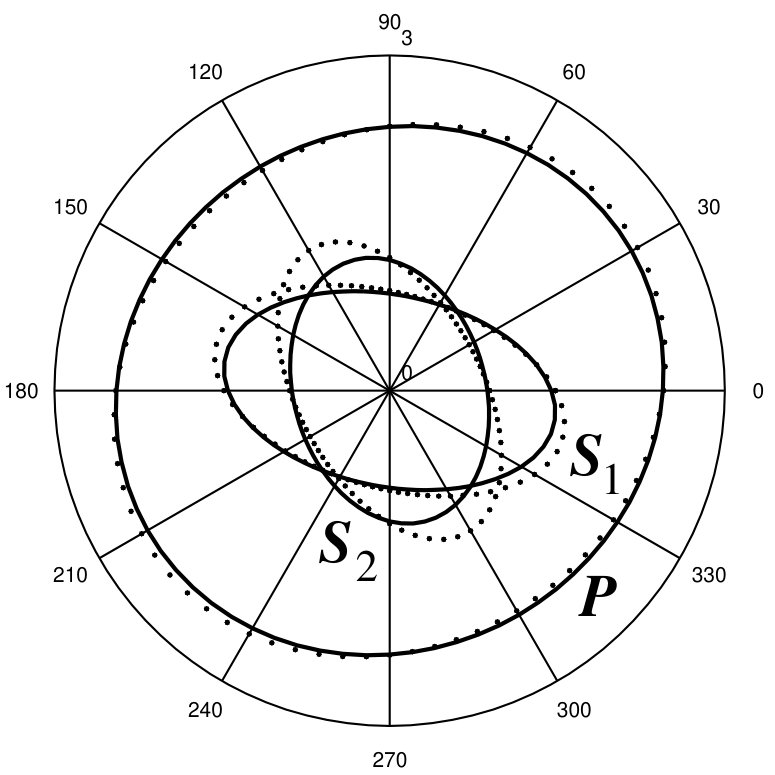 Figure 1
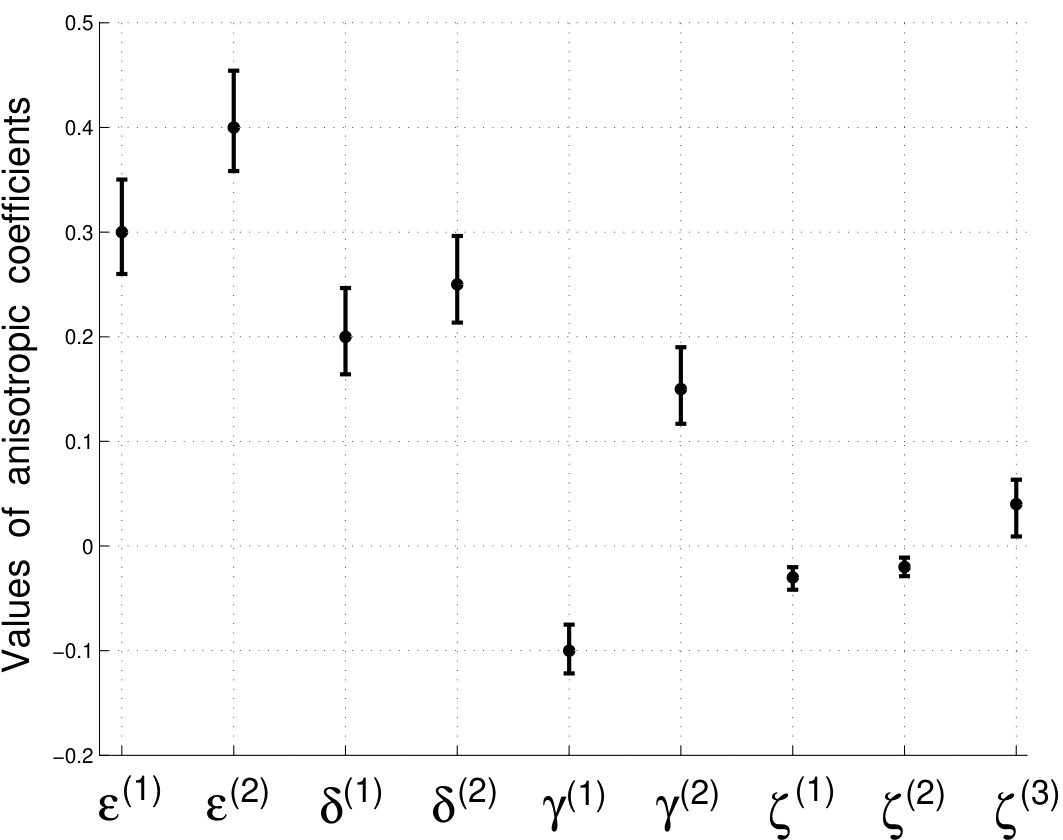 Figure 2
Peer Reviews
No public reviews on file for this paper yet. If you reviewed it on a platform where reviews are public (OpenReview, ICLR, NeurIPS, ICML), you can paste yours below so the community can read it here.
Videos
No videos yet. Explain this paper in a talk, walkthrough, or lecture? Add one.
Inversion of normal moveout for monoclinic media
Vladimir Grechka1, Pedro Contreras2, and Tsvankin Ilya1
1 Center for Wave Phenomena, Department of Geophysics,Colorado School of Mines, Golden, CO 80401
2 PDVSA-INTEVEP, Apartado 76343, Caracas 1070A, Venezuela
Abstract
Multiple vertical fracture sets, possibly combined with horizontal fine layering, produce an equivalent medium of monoclinic symmetry with a horizontal symmetry plane. Here, we show that multicomponent wide-azimuth reflection data (combined with known vertical velocity or reflector depth) or multi-azimuth walkaway VSP surveys provide enough information to invert for all but one anisotropic parameters of monoclinic media.
To facilitate the inversion procedure, we introduce a Thomsen-style parametrization that includes the vertical velocities of the -wave and one of the split -waves and a set of dimensionless anisotropic coefficients. This notation captures the combinations of the stiffnesses responsible for the normal-moveout (NMO) ellipses of all three pure modes. Our parameter-estimation algorithm, based on NMO equations valid for any strength of the anisotropy, is designed to obtain anisotropic parameters of monoclinic media by inverting the vertical velocities and NMO ellipses of the waves , and . A Dix-type representation of the NMO velocity of mode-converted waves makes it possible to replace the pure shear modes in reflection surveys with the waves and . Numerical tests show that our method yields stable estimates of all relevant parameters for both a single layer and a horizontally stratified monoclinic medium.
Keywords: Seismic anisotropy, anisotropic parameter estimation, monoclinic media, inversion procedure.
pacs:
91.30.Cd 91.60.Ba 91.30.pc 91.30.Ab
I Introduction
Natural fractures usually occur in vertical or subvertical sets (networks), which makes fractured reservoirs azimuthally anisotropic with respect to elastic wave propagation. In general, two or more sets of vertical non-corrugated fractures produce an effective monoclinic medium with a horizontal symmetry plane. Abundant geological evidence of multiple fracture sets corroborates potential importance of monoclinic models in seismic reservoir characterization.
Velocity analysis and parameter estimation for monoclinic media, however, is a highly challenging task due to the large number of independent stiffness coefficients. To avoid ambiguity in the inversion procedure, we follow the idea originally proposed for VTI media by Thomsen and attempt to identify the combinations of the stiffness coefficients responsible for seismic signatures commonly measured from reflection data. Since moveout velocity analysis is one of the most reliable tools for mapping the elastic properties of the subsurface, we use the NMO ellipses of -, , and -waves Grechka1 from a horizontal reflector to define the anisotropic parameters of monoclinic media. Despite the absence of vertical symmetry planes in our model, the polarization directions of the vertically propagating shear waves establish a natural coordinate frame with the vanishing stiffness coefficient . We specify the anisotropic parameters in this coordinate system (where the stiffness tensor has 12 independent elements) by analogy with the Thomsen-style notation of Tsvankin for orthorhombic media. A subset of these parameters (, , and ) is largely responsible for the values of the *semi-axes * of the NMO ellipses. Three newly introduced anisotropic coefficients mainly describe the *rotation * of the - and -wave NMO ellipses with respect to the chosen coordinate frame.
We show that the vertical velocities and NMO ellipses of the - and two split -waves can be used to estimate eleven parameters of monoclinic media. The only parameter not constrained by conventional-spread moveout data from horizontal reflectors is the anisotropic coefficient . We present numerical tests for a single layer and stratified monoclinic media which confirm the accuracy of our inversion procedure and its stability with respect to errors in input data.
II Selection of coordinate frame
Description of seismic wave propagation in monoclinic media with a horizontal symmetry plane takes the simplest form in the coordinate frame where the stiffness coefficient . The - and -axes of this coordinate system coincide with the polarization directions of the vertically propagating waves. Denoting the fast shear wave by and the slow one by , we find the following expressions for the vertical component of the slowness vector for waves traveling in the (vertical) direction:
[TABLE]
Here it is assumed that the -axis points in the direction of the polarization of the fast shear wave , which implies that .
III NMO ellipses for horizontal reflectors
Grechka and Tsvankin (1998) showed that azimuthally varying NMO velocity of pure (non-converted) modes is represented by the following quadratic form that usually specifies an *ellipse * in the horizontal plane:
[TABLE]
For a single horizontal layer of arbitrary symmetry, the matrix is given by Grechka2
[TABLE]
where denotes the vertical slowness component, , and .
Equivalently, the NMO ellipse (2) can be written through the eigenvalues of the matrix as Grechka1
[TABLE]
Here is the rotation angle of the ellipse with respect to the horizontal coordinate axes:
[TABLE]
The matrix W for horizontal events in monoclinic media is obtained from equation (3) by substituting the corresponding values of equations (1) and the derivatives and which can be determined from the Christoffel equation. The exact expressions for the matrices , , and in a monoclinic layer in terms of the stiffness coefficients are rather lengthy. They do show, however, that the “purely monoclinic” coefficients , , and , which vanish in orthorhombic media, contribute to the diagonal elements and (, , or ) only through the products ().
In contrast, the off-diagonal matrix elements are approximately *linear * in . Since the rotation angle of the NMO ellipse is almost proportional to [equation (5)], the coefficients are primarily responsible for the rotation (but not for the semi-axes) of the NMO ellipses.
IV Anisotropic parameters of monoclinic media and linearized NMO ellipses
Below is a list of our Thomsen-type parameters for monoclinic media with a horizontal symmetry plane defined through the density-normalized stiffness coefficients . Note that the vertical velocities and anisotropic coefficients , and are introduced exactly in the same way as the corresponding Tsvankin parameters for orthorhombic media with the vertical symmetry planes and .
– the -wave vertical velocity:
[TABLE]
– the vertical velocity of the fast shear wave polarized in the -direction:
[TABLE]
[TABLE]
[TABLE]
[TABLE]
[TABLE]
[TABLE]
[TABLE]
[TABLE]
– the parameter responsible for the rotation of the -wave NMO ellipse:
[TABLE]
– the parameter responsible for the rotation of the -wave NMO ellipse:
[TABLE]
– the parameter responsible for the rotation of the -wave NMO ellipse:
[TABLE]
The anisotropic parameters depend on the stiffness elements that vanish in orthorhombic media. The coefficient is analogous to the anisotropic parameter introduced by Mensch . The parameters and are different from their counterparts in Mensch notation because the latter is based on the approximate phase-velocity function.
V Approximations for the NMO ellipses
To demonstrate that the anisotropic coefficients defined above are useful in describing the NMO ellipses in monoclinic media, we linearize the exact equation (3) in terms of , , and . Also, additional linearizations in the parameters and were performed for the elements of all matrices . This yields the following approximate expressions for the matrices in a monoclinic layer:
[TABLE]
[TABLE]
[TABLE]
Here , , , and ; and are the vertical velocities of the fast and slow shear waves, respectively.
The approximate diagonal elements and in equations (V)–(V) are identical to the corresponding *exact * expressions for orthorhombic media given in Grechka3 . The “monoclinic” coefficients contribute to and only through their products that were dropped during the linearization procedure. In contrast, the off-diagonal matrix elements in equations (V)–(V) are linear in the coefficients and quadratic in the other anisotropic parameters. In monoclinic media, all three and, in general, the NMO ellipses of the -, - and -waves have different orientations.
Numerical tests show that the accuracy of the approximations (V)–(V) depends mostly on the parameters and is less sensitive to the other anisotropic coefficients. The example in Figure 1 demonstrates that for typical values of up to 0.05–0.06 equations (V)–(V) (dotted lines) yield a qualitatively adequate approximation for the exact NMO ellipses (solid).
As predicted by equations (V)–(V), the axes of the NMO ellipses of -, -, and -waves in Figure 1 are parallel neither to each other nor to the coordinate directions (i.e., to the -wave polarizations). This is a distinctive feature of monoclinic media that can be used in the inversion for the anisotropic parameters.
VI Parameter estimation
VI.1 Analysis of the weak-anisotropy approximation
Although equations (V)–(V) lose accuracy with increasing , they provide a useful insight into the influence of the medium parameters on normal moveout and help to design the inversion procedure. Note that only one of the anisotropic coefficients, , is not contained in any of these equations and, therefore, cannot be estimated from NMO velocities of horizontal events. In the weak-anisotropy approximation, the inversion of and is completely analogous to the parameter-estimation problem in orthorhombic media. As discussed by Grechka3 , the vertical velocities, and can be inverted for the anisotropic coefficients , , and . The remaining anisotropic parameters of monoclinic media can be estimated from the off-diagonal matrix elements , which yield three more equations for the three unknown parameters. We confirm these conclusions by performing numerical inversion based on the exact NMO equations.
VI.2 Numerical inversion
Input data for the parameter-estimation procedure include the vertical velocities and NMO ellipses of the three pure modes (, , ) determined from either wide-azimuth reflection data or walkaway VSP’s. The coordinate frame needed for moveout inversion can be established by performing Alford (1986) rotation of small-offset shear-wave data to identify the -wave polarization directions at vertical incidence. The anisotropic coefficients , , and are obtained by inverting the exact equation (3) for the matrix W. Figure 2 displays the inversion results for a monoclinic layer with the parameters specified in Figure 1. The NMO velocities of the three modes were computed for azimuths , , , and from equations (2) and (3). To simulate errors in measured data, we added Gaussian errors with a variance of 2% to the vertical and NMO velocities. Then we reconstructed the NMO ellipses for each realization of the data (distorted by noise) and carried out the inversion.
Overall, the stability of the inversion algorithm is quite satisfactory, but there is a substantial variation in the results from one anisotropic parameter to another. In particular, the error bars for and are much smaller than those for and the other anisotropic parameters. This can be explained by the structure of equations (V)–(V) for , and . The expressions for () have scaling factors that reach 4.0 and 6.5 for the model used in our numerical test. Therefore, the elements are much more sensitive to and than is to , which helps to recover with a higher accuracy.
The inversion technique introduced above was also extended to horizontally layered monoclinic media using the generalized Dix equation of Grechka2 that allows one to obtain the exact interval NMO ellipses. Although both the Dix differentiation and polarization layer stripping of shear waves have known limitations with respect to the vertical resolution, they give stable results for coarse intervals with sufficient thickness.
VII Conclusions
Effective monoclinic media with a horizontal symmetry plane represent a general anisotropic model of hydrocarbon reservoirs with two or more vertical fracture systems. An analytic study of normal moveout in monoclinic media, presented here, leads to a Thomsen-style notation that captures the combinations of the stiffness coefficients responsible for the NMO ellipses of - and -waves. Natural horizontal coordinate directions for monoclinic models are associated with the orthogonal polarization vectors of the vertically traveling shear waves.
The anisotropic coefficients of monoclinic media can be separated into two distinctly different groups. The first group contains seven parameters (, , and ) defined identically to the corresponding Tsvankin coefficients for orthorhombic media. While has no influence on the NMO ellipses of - and -waves, the remaining six coefficients control the normal-moveout velocities in the coordinate directions and .
Three additional anisotropic coefficients (the second parameter group) depend on the elements of the monoclinic stiffness tensor which vanish in orthorhombic media. The coefficients determine the *rotation * of the NMO ellipses with respect to the -wave polarization directions.
Our algorithm, based on the exact NMO equations, is designed to invert the vertical velocities and NMO ellipses of the three pure modes (the shear waves can be replaced by mode conversions) for the anisotropic parameters , , and . Numerical tests for a single layer and stratified monoclinic media indicate that the inversion procedure is sufficiently stable, and all eleven parameters are well constrained by the vertical and NMO velocities.
VIII Acknowledgments
We are grateful to members of the A(nisotropy)-Team of the Center for Wave Phenomena (CWP) at CSM for helpful discussions. Pedro Contreras thanks PDVSA-INTEVEP for giving him the opportunity to work at CWP. V. Grechka and I. Tsvankin acknowledge the support provided by the members of the Consortium Project on Seismic Inverse Methods for Complex Structures at CWP and by the United States Department of Energy (award #DE-FG03-98ER14908). I. Tsvankin was also supported by the Shell Faculty Career Initiation Grant.
The reference list from the paper itself. Each links out to its DOI / PubMed record.
- 1(1) R. Alford, 56th Ann. Internat. Mtg., Soc. Expl. Geophys, Expanded Abstracts. (1986) 476.
- 2(2) L. Thomsen, Geophysics. 51 (1986) 1954.
- 3(3) V. Grechka and I. Tsvankin, Geophysics. 63 (1998) 1079.
- 4(4) V. Grechka, I. Tsvankin, and J. Cohen, Geophysical Prospecting. 47 (1999) 11.
- 5(5) V. Grechka, S. Theophanis and I. Tsvankin, Geophysics. 64 (1999) 146.
- 6(6) T. Mensch and P. Rasolofosaon, Geophys. J. Int. 128 (1997) 43.
- 7(7) I. Tsvankin, Geophysics. 62 (1997) 1292.