Transverse thermopower in Dirac and Weyl semimetals
Gargee Sharma, Sumanta Tewari

TL;DR
This paper predicts and calculates the planar Nernst effect as a new consequence of chiral anomaly in Dirac and Weyl semimetals, providing a theoretical framework and 3D maps for experimental verification.
Contribution
It introduces the planar Nernst effect in Dirac and Weyl semimetals and provides analytical calculations of the effect's coefficient using a quasi-classical Boltzmann approach.
Findings
Planar Nernst effect arises in Dirac and Weyl semimetals due to chiral anomaly.
Analytical expressions for the planar Nernst coefficient in various semimetals.
Proposes experimental verification through 3D rotation measurements.
Abstract
Dirac semimetals (DSM) and Weyl semimetal (WSM) fall under the generic class of three-dimensional solids, which follow relativistic energy-momentum relation at low energies. Such a linear dispersion when regularized on a lattice can lead to remarkable properties such as the anomalous Hall effect, presence of Fermi surface arcs, positive longitudinal magnetoconductance, and dynamic chiral magnetic effect. The last two properties arise due to the manifestation of chiral anomaly in these semimetals, which refers to the non-conservation of chiral charge in the presence of electromagnetic gauge fields. Here, we propose the planar Nernst effect, or transverse thermopower, as another consequence of chiral anomaly, which should occur in both Dirac and Weyl semimetals. We analytically calculate the planar Nernst coefficient for DSMs (type-I and…
Click any figure to enlarge with its caption.
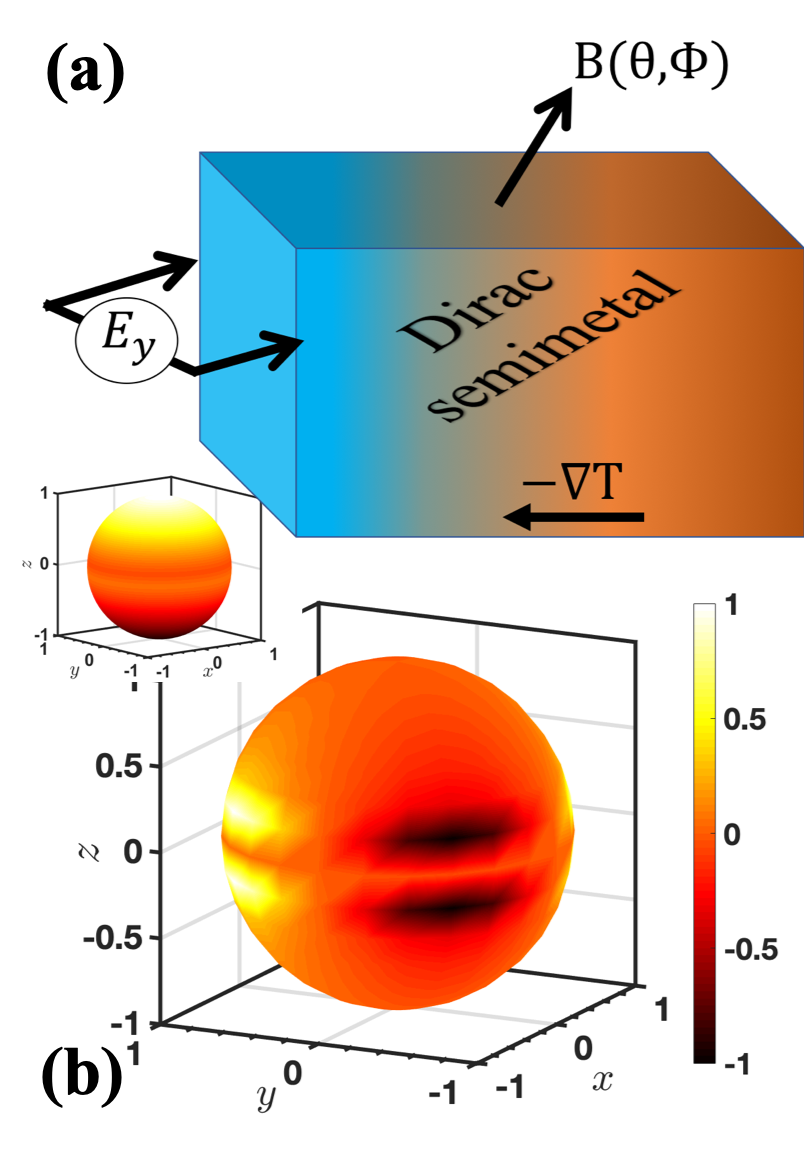 Figure 1
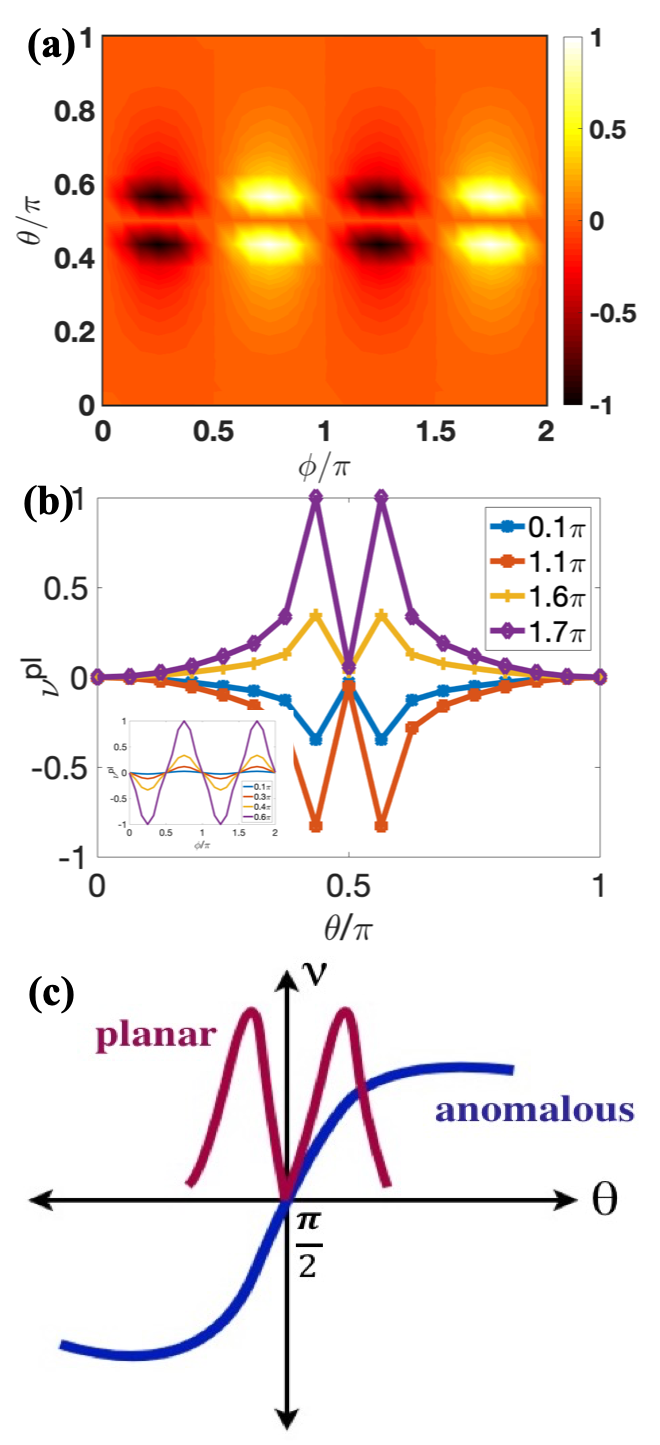 Figure 2
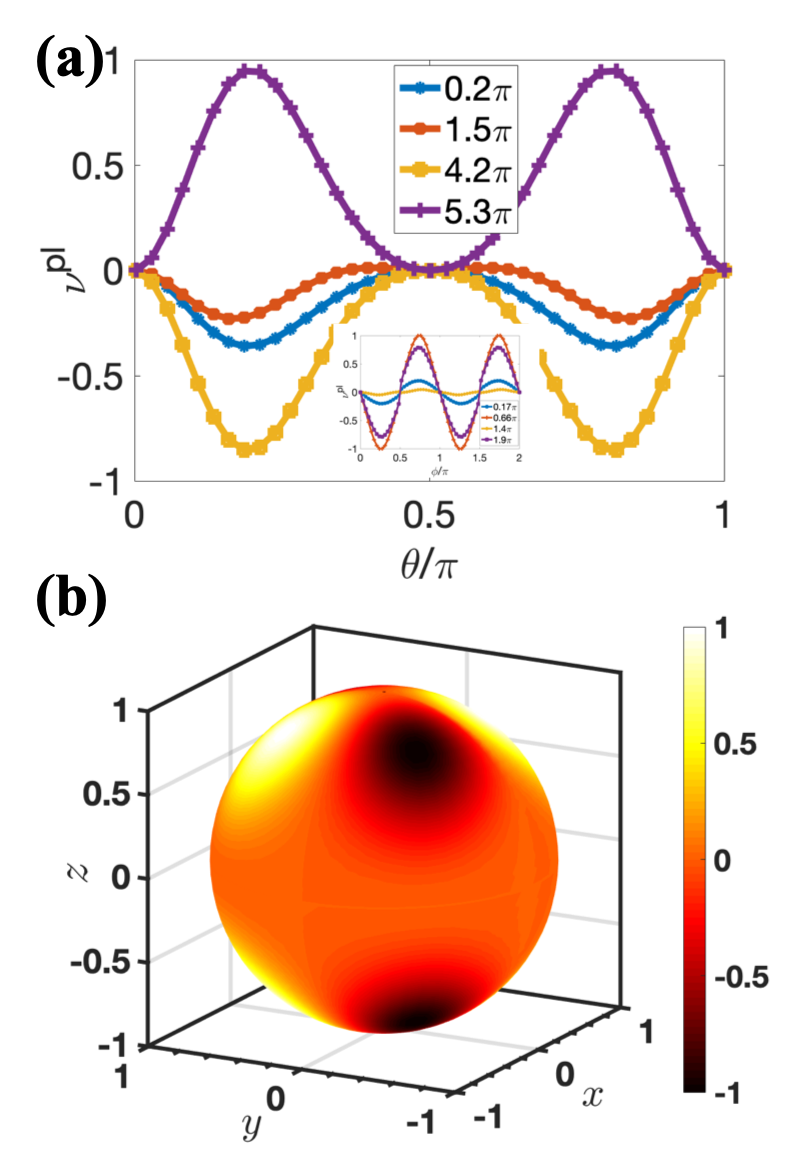 Figure 3
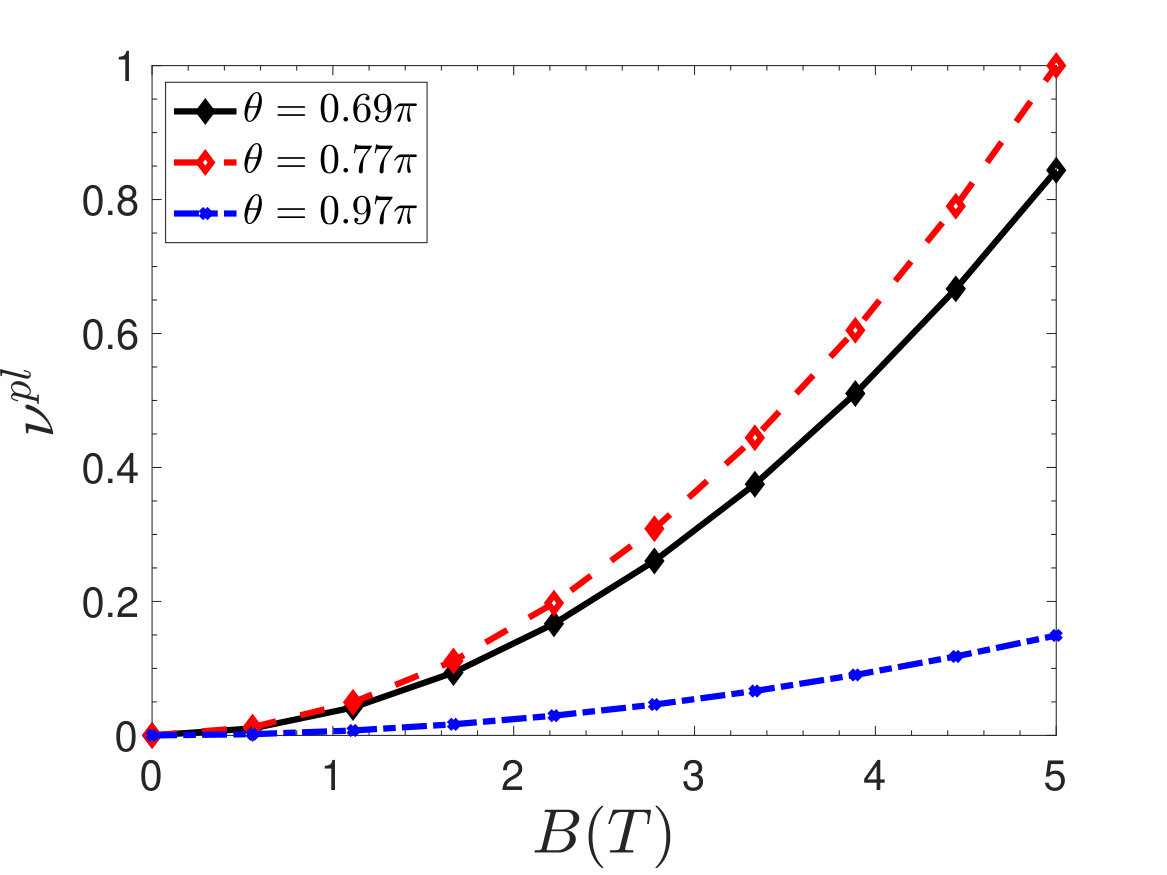 Figure 4
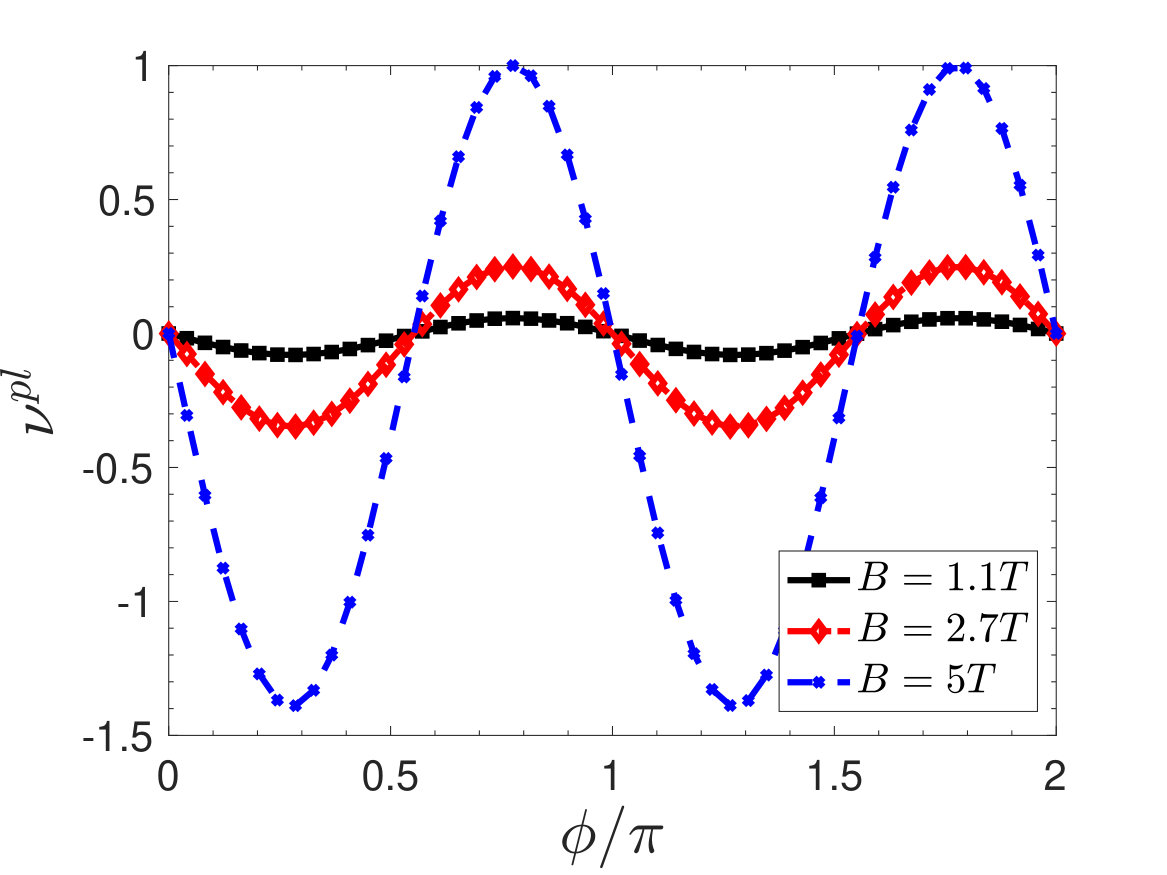 Figure 5
Peer Reviews
No public reviews on file for this paper yet. If you reviewed it on a platform where reviews are public (OpenReview, ICLR, NeurIPS, ICML), you can paste yours below so the community can read it here.
Videos
No videos yet. Explain this paper in a talk, walkthrough, or lecture? Add one.
Transverse thermopower in Dirac and Weyl semimetals
Girish Sharma
Department of Physics, National University of Singapore, Singapore 117551, Singapore
Centre for Advanced 2D Materials and Graphene Research Centre, National University of Singapore, Singapore 117546, Singapore
School of Basic Sciences, Indian Institute of Technology Mandi, Mandi-175005 (H.P.) India
Sumanta Tewari
Department of Physics and Astronomy, Clemson University, Clemson, South Carolina 29634, USA
Abstract
Dirac semimetals (DSM) and Weyl semimetal (WSM) fall under the generic class of three-dimensional solids, which follow relativistic energy-momentum relation at low energies. Such a linear dispersion when regularized on a lattice can lead to remarkable properties such as the anomalous Hall effect, presence of Fermi surface arcs, positive longitudinal magnetoconductance, and dynamic chiral magnetic effect. The last two properties arise due to the manifestation of chiral anomaly in these semimetals, which refers to the non-conservation of chiral charge in the presence of electromagnetic gauge fields. Here, we propose the planar Nernst effect, or transverse thermopower, as another consequence of chiral anomaly, which should occur in both Dirac and Weyl semimetals. We analytically calculate the planar Nernst coefficient for DSMs (type-I and type-II) and also WSMs (type-I and type-II), using a quasi-classical Boltzmann formalism. The planar Nernst effect manifests in a configuration when the applied temperature gradient, magnetic field, and the measured voltage are all co-planar, and is of distinct origin when compared to the anomalous and conventional Nernst effects. Our findings, specifically a 3D map of the planar Nernst coefficient in type-I Dirac semimetals (Na3Bi, Cd3As2 etc) and type-II DSM (PdTe2, VAI3 etc), can be verified experimentally by an in-situ 3D double-axis rotation extracting the full solid angular dependence of the Nernst coefficient.
I Introduction
The well known non-crossing theorem Neumann:1929 states that Bloch bands with the same symmetry cannot be degenerate at a generic point in the Brillouin zone, which gives rise to an avoided level crossing. However, the non-crossing theorem does not apply to bands exhibiting non-trivial topology, which can form topologically protected band degeneracies Chiu:2016 ; Volovik ; YangHang:2017 ; ArmitageMeleVishwanath:2017 . Dirac semimetals (DSMs) and Weyl semimetals (WSMs) are celebrated examples of three-dimensional systems with topologically protected level crossing near the Fermi level, exhibiting low energy excitations with relativistic energy-momentum relations resembling massless Dirac fermions Murakami1:2007 ; Murakami2:2007 ; Wan:2011 ; Burkov1:2011 ; Burkov:2011 ; Xu:2011 ; Yang:2011 . In a WSM the level crossings of non-degenerate pairs of bands can act as source and sink of Abelian Berry curvature Xiao:2010 , and are topologically protected by a non-zero flux of Berry curvature across the Fermi surface. Nielsen and Ninomiya Nielsen:1981 ; Nielsen:1983 showed that on a lattice, only an even number of Weyl points can occur, which carry opposite monopole charges such that the net monopole charge summed over all the Weyl points in the Brillouin zone vanishes. In a DSM, time reversal (TR) and space inversion (SI) symmetries are simultaneously preserved, and the bulk energy bands are Kramers degenerate. This ensures that an accidental crossing between valence and conduction bands engenders a four-fold degenerate Dirac node, which can be stable in the presence of additional symmetries, such as uniaxial discrete crystal rotation symmetries YangNagaosa:2014 ; YoungZaheer:2012 ; SteinbergYoung:2014 . Also the simultaneous presence of TR and SI symmetry ensures that the monopole charge vanishes at each crossing point. This can be contrasted with a WSM, which breaks either SI or TR symmetry. A WSM phase can be generated from a DSM by breaking either of these two symmetries, for example by applying a magnetic field, which breaks TR symmetry.
Recently there has been a surge of interest in DSMs and WSMs Su:2015 ; Huang:2015 ; Lv:2015 ; Liu:2014 ; SyXu:2013 ; Neupane:2014 ; ZKLiu:2014 ; Borisenko:2014 ; Jeon:2014 ; TLiang:2014 ; Xiong1:2015 ; Xiong:2015 ; Wang:2012 ; Wang:2013 ; Fu:2007 ; Teo:2008 ; Guo:2011 ; Kim:2013 ; Llu:2015 , as they evince many topological transport and optical properties not shared by other 3D materials. TR broken WSMs exhibit anomalous Hall and Nernst effects BurkovPRL2014 ; Sharma:2016 ; Sharma:2017 ; TLiang:2017 ; Watzman:2018 ; Lundgren:2014 ; Ferrerios2017 ; Chernodub2018 ; Rana2018 ; Caglieris:2018 ; GorbarMiransky2017 ; DasAgarwal , while dynamic chiral magnetic effect can be related to optical gyrotropy and natural optical activity in inversion broken WSMs Goswami:2015 ; Zhong:2015 . More interestingly, the surface of WSMs hosts distinct Fermi arcs, and the bulk transport is characterized by negative longitudinal magnetoresistance in the presence of parallel electric and magnetic fields due to chiral anomaly Goswami:2013 ; Bell:1969 ; Aji:2012 ; Adler:1969 ; Zyuzin:2012 ; LiangPRX:2018 ; Sharma2:2017 ; Y-YLv:2017 ; XHuang:2015 ; Shekhar:2015 ; BurkovPRB:2015 ; Zyuzin:2017 ; He:2014 ; CLZhang:2016 ; QLi:2016 ; Xiong ; Hirsch ; Son:2013 ; Kim:2014 ; Barnes:2016 . Very recently, the current authors along with others, proposed the planar Hall effect (PHE) Nandi ; Burkov2017 as another striking consequence of chiral anomaly in WSMs, where the effect manifests itself when the applied current, magnetic field, and the induced transverse Hall voltage all lie in the same plane, precisely in a configuration in which the conventional Hall effect vanishes. This resulted in a series of experiments, where this effect was confirmed by several groups pheexpt1 ; pheexpt2 ; pheexpt3 ; pheexpt4 ; pheexpt5 ; pheexpt6 ; pheexpt7 ; pheexpt8 ; pheexpt9 ; pheexpt10 ; pheexpt11 ; pheexpt12 in Weyl and Dirac semimetals.
Even though the anomalous Nernst effect should vanish in a continuum model of Weyl fermions Lundgren:2014 , it was shown to be both non-vanishing and measurable in both Dirac and Weyl semimetals Sharma:2016 ; Sharma:2017 . In fact, a large Nernst signal has been experimentally measured in both Dirac TLiang:2017 and Weyl semimetals Watzman:2018 ; Rana2018 ; Caglieris:2018 , which primarily arises due to the giant Berry curvature of the Bloch bands and the Dirac dispersion, respectively. The predicted Nernst effect strictly falls into the category of anomalous or conventional Nernst response. An anomalous (conventional) Nernst effect requires the presence of Berry curvature (magnetic field) in a direction perpendicular to the plane of temperature gradient and the induced voltage. Here, we propose another type of Nernst effect, namely the planar Nernst effect (PNE), which strictly arises as a consequence of chiral anomaly, and displays properties distinct from both the conventional and anomalous Nernst effects. The planar Nernst effect can be also viewed as transverse thermopower, analogous to the conventional thermopower (Seebeck coefficient) where a thermal gradient induces a thermoelectric voltage. In the current scenario, the voltage is induced transverse to the thermal gradient. The effect is shown to manifest in a configuration when the applied temperature gradient, magnetic field, and the induced voltage are co-planar. The planar Nernst effect is known to occur in ferromagnetic systems Schmid2013 ; Avery2012 ; YPu:2006 , however to the best of our knowledge has not been explored in WSMs/DSMs. We develop a quasiclassical theory of the planar Nernst effect in Weyl and Dirac semimetals, where the Fermi surfaces enclose nonzero fluxes of the Berry curvature in momentum space. Our findings, specifically a 3D map of the planar Nernst coefficient in type-I (Na3Bi, Cd3As2 etc) and type-II Dirac semimetals (VAI3, PdTe2 etc), can be verified experimentally by an in-situ 3D double-axis rotation extracting the full solid angular dependence TLiang2018 .
II Planar Nernst Effect
The conventional Nernst effect measures the transverse electrical response to a longitudinal thermal gradient in the presence of an out of plane magnetic field and absence of a charge current i.e. , where is defined to be the Nernst coefficient and is the temperature gradient applied along the axis, and . In terms of the conductivity tensors and , the Nernst coefficient can be derived to be
[TABLE]
A conventional Nernst effect requires a non-zero component of the magnetic field parallel to the plane, which provides the Lorentz force to the quasiparticles. On the other hand, an anomalous Nernst effect (due to the Berry phase) does not explicitly require a magnetic field, but rather requires a non-zero component of the Berry curvature, again parallel to the plane. Both of these effects have been well studied and experimentally observed in WSMs and DSMs Sharma:2016 ; Sharma:2017 ; TLiang:2017 ; Caglieris:2018 ; Watzman:2018 ; Rana2018 . Here, we predict a third type of Nernst response, namely the planar Nernst effect, which should also occur both in Dirac and Weyl semimetals. Unlike the conventional and the anomalous Nernst effects, the planar Nernst effect is characterized by co-planar , , and fields, and is a direct consequence of chiral anomaly in 3D Dirac materials. Fig. 1 schematically illustrates the measurement of the planar Nernst coefficient in Dirac semimetals. A longitudinal temperature gradient produces a transverse electric field due to chiral anomaly as a result of the co-planar component of the field. As the magnetic field is rotated along and directions, where is the polar angle and is the azimuthal angle, one can map the planar Nernst coefficient for a Dirac semimetal (note that the component in a DSM produces Weyl points, while the and components produce the planar Nernst effect due to chiral anomaly). Here we will calculate the planar Nernst coefficient using the quasi-classical Boltzmann formalism. in the relaxation time approximation, accounting for contributions from an external magnetic field and Berry curvature.
In the presence of Berry curvature , the semi-classical equations of motion for an electron are modified Sundurum:1999 ; Niu:2006 ; Son:2012 ; Duval:2006 . We need to account for the Berry curvature contributions while solving the quasi-classical Boltzmann equations. The steady state Boltzmann equation in the relaxation time approximation is given by
[TABLE]
where is the scattering time, is the equilibrium Fermi-Dirac distribution function, and is the distribution function of the system in the presence of perturbations. We point out that the scattering time actually depends on the nature of underlying impurities, and can lead to a non-trivial energy dependence. Nevertheless, for simplicity, for a finite chemical potential, we treat to be approximately energy independent Sharma:2016 . We also take an approximate momentum dependence of scattering time () such that internode scattering dominates over intranode scattering because for longitudinal magnetoconductance the internode scattering is supposed to be the dominant scattering mechanism.
III Solution for the Boltzmann equation and planar Nernst coefficient
In the presence of Berry curvature , the semi-classical equation of motion for an electron takes the following form Niu:2006 ; Sundurum:1999
[TABLE]
where is the crystal momentum, is the energy dispersion. The first term in Eq. 3 is the familiar relation between semi-classical velocity and the band energy dispersion . The second term is the anomalous transverse velocity term originating from . In the presence of electric and magnetic fields we have the standard relation: . These two coupled equations for and can be solved together to obtain Duval:2006 ; Son:2012
[TABLE]
where . We will denote without explicitly pointing out the implied and dependence. In Eq. 4 and Eq. 5, we have also defined to be the band-velocity.
Here, we are interested in the configuration , , but the magnetic field is along the in-plane direction. The Boltzmann equation takes the following form
[TABLE]
We solve the above Boltzmann equation, using the following ansatz Sharma:2016 ; Lundgren:2014
[TABLE]
We solve explicitly for the correction factor , but we examine that this correction factor is orders of magnitude smaller than the other terms (in the limit when the Boltzmann equation is valid i.e. ), and we thus retain only leading order terms in the distribution function . We can then write the following relation for the charge current
[TABLE]
The quantity is the entropy density for the Weyl/Dirac electron gas ZhangTewari:2008 . The second term in the above equation describes a purely anomalous Nernst response in the absence of any magnetic field. The first term in the above equation describes the Nernst response in the presence of the magnetic field. This is the quantity which is of interest to us here. We can then read the planar Peltier coefficient as
[TABLE]
where . The Nernst coefficient can be evaluated from Eq. 2 of the main text, where , and can be evaluated in a similar fashion for the same experimental configuration. When the Weyl cones are not tilted, the expression simplifies to
[TABLE]
IV Planar Nernst effect in Dirac semimetals
We will now discuss the planar Nernst effect in Dirac semimetals. We begin with the effective low energy Hamiltonian for a type-I Dirac semimetal Cd3As2, in the basis , , , , which can be written as YangNagaosa:2014 ; Hashimoto:2016 ; Cano:2016
[TABLE]
In Eq. 11, and are Pauli matrices representing the orbital degree of freedom and spin degree of freedom respectively. The matrix is the two-dimensional identity matrix in spin space. The functions are defined as
[TABLE]
Here we have only included terms up to the order . The parameters , , , depend on the material. Specifically for Cd3As2 ab-inito calculations upto order yield , , , Cano:2016 . This Hamiltonian produces two Dirac points at where the energy dispersion exactly vanishes. The effect of an external magnetic field , coupling to the spin degree of freedom can be now introduced by adding the Zeeman term Hashimoto:2016 in the Hamiltonian, where , and is the magnetic moment. With the applied magnetic field the Hamiltonian now produces a TR broken Weyl semimetal. The Bloch electrons also carry an orbital magnetic moment, given by
[TABLE]
This also gives rise to a Zeeman like contribution and the energy spectrum is shifted as .
It is also important to understand how do the Weyl points evolve in this model as a function of the magnetic field. When , the Weyl points are separated along the direction and are loacted at and occur at the same energy. When , the position of the Weyl nodes remains unchanged and they only move along the energy axis in a manner such that inversion symmetry is preserved. It is important that in order to generate Weyl points from the Dirac nodes. In Eq. 9 we calculated the planar Nernst coefficient for an in-plane magnetic field , however it is essential that in order to observe a planar Nernst effect in a Dirac semimetal, we need a finite magnetic field along the direction. This is because, we need a finite flux of Berry curvature, which is generated by a magnetic field along the axis due to the generation of Weyl points. We therefore have the configuration , . Following the standard procedure as mentioned earlier, we can straightforwardly extend the solution to the Boltzmann equation.
Fig. 1 shows the 3D mapping of the planar Nernst coefficient for a type-I Dirac semimetal, as a function of polar and azimuthal angle, for a constant , which is rotated in space. Such a 3D map of the planar Nernst coefficient can be verified experimentally by an in-situ 3D double-axis rotation extracting the full solid angular dependence TLiang2018 . Fig. 2 shows the density plot of the planar Nernst coefficient, and its specific dependence on the polar and azimuthal angles. The planar Nernst coefficient at a constant exhibits the behaviour (when ). Strikingly, we find that shows a peculiar dependence at a constant (when ). We see that slightly away from , the planar Nernst coefficient exhibits a peak, which does not change sign as one moves across (i.e. negative to positive ). This can be understood as follows: a non-zero field (i.e. around ) produces Weyl points and thereby a sharp peak in the Berry flux. Holding the magnitude of the applied magnetic field constant, a small implies that and are large enough, and the combination of the Berry curvature and the in-plane magnetic field gives rise to a large planar Nernst signal. Because depends on , which is the same for a finite , the signal does not change sign as one goes from positive to negative . Although the anomalous Nernst coefficient is also known to show a step like behaviour near , it is accompanied with a sign change Sharma:2017 ; TLiang:2017 . The conventional Nernst coefficient (even though it is small due to Sondheimer’s cancellation Sharma:2017 ), also shows a similar sign change as one moves across . This is a very important distinguishing feature of the planar Nernst coefficient (see Fig. 2).
Further, the planar Nernst coefficient does not satisfy the antisymmetric property . This is because the origin of the planar Nernst effect is linked to chiral anomaly, unlike usual Lorentz force term. Thus, the planar contribution and its peculiar angle dependence can be easily extracted by rotating the field along and , and subtracting the other two contributions.
Having discussed the planar Nernst effect in the type-I DSM, we will also briefly discuss this effect in the type-II DSM. Type-II DSMs are characterized by the occurrence of Dirac nodes at TR invariant momenta points in the Brillouin zone. The linearized low-energy Hamiltonian is given by
[TABLE]
where and are the orbital and spin degrees of freedom respectively. The effect of the Zeeman field is given by , where ’s are the components of external magnetic field i.e. . The energy dispersion of the lowest bands, which touch at the Weyl points, is given by
[TABLE]
where . Since the above equation is quite complicated, we will carefully examine the position and evolution of Weyl points below. We will therefore examine a few cases in order to track the evolution of Weyl points. The band touching condition is generically given by .
(i) When , i.e. the magnetic field is applied along the plane, we have Weyl nodes at for , and when , we have a nodal line in the plane BurkovPRL2018 . The band touching condition when is
[TABLE]
(ii) When the band touching condition is
[TABLE]
For or , we obtain the following equation in the plane
[TABLE]
which clearly defines a nodal line in the plane. We can generalize this result as follows: Consider a rotation of the axis by an angle . We have , , and . Eq. 17 can be expressed as
[TABLE]
The above equation defines a nodal line in the plane. For example when , there is a nodal line in the plane. Therefore, when , we always have a nodal line irrespective of the value of . The plane at which the nodal line occurs however depends on the value of .
(iii) Treating the generic case: The band touching condition can be simplified as follows after a few straightforward algebraic manipulations to be
[TABLE]
By a rotation of axis, as in the previous case, we can rewrite this as
[TABLE]
The above equation is identical to Eq. 18 (i.e. case (i) when ). The difference is that the plane has been rotated by an angle . Since the Weyl nodes in case (i) generically occur at and , the location of Weyl nodes in the current case remains invariant even for finite because the rotated coordinate system shares the same origin.
We can thus conclude that: for magnetic field along any direction we have either Weyl nodes (when ), or a nodal line (when ). The Weyl nodes always occur at irrespective of the value of . The chirality of the Weyl points switch as changes across the the angle . The nodal line occurs along the plane- .
Fig. 3 shows the map of the full angular dependence of the planar Nernst coefficient for a type-II DSM. The planar Nernst coefficient as a function of also shows a double peaked behaviour around .
V Planar Nernst effect in inversion asymmetric Weyl semimetals
Here we will examine the planar Nernst effect in Weyl semimetals (inversion symmetry broken), both type-I and type-II. The low energy Hamiltonian for inversion symmetry breaking Weyl semimetal is given by MccormickPRB2017
[TABLE]
being Pauli matrices int he orbital space. When , the above equation describes a inversion asymmetric WSM with four nodes located at . When the tilt parameter , we enter into a type-II WSM phase. The anomalous Nernst contribution from an inversion asymmetric, but TR preserving WSM is negligible, because the Berry phase effects from all the valleys cancel out. In the present case of planar Nernst effect, we just require a strictly in-plane magnetic field, as we already begin with Weyl points (unlike the DSM where a non-zero is essential to split a Dirac point into Weyl points). Such a configuration results in vanishing conventional Nernst effect, and thus the problem of disentangling the planar Nernst contribution from the total Nernst effect does not arise. In Fig. 4 we plot the planar Nernst coefficient in inversion asymmetric type-II Weyl semimetal displaying the feature. We also plot the planar Nernst coefficient as a function of the applied magnetic field. We do not get a linear in dependence even for tilted cones (unlike earlier studies on the Hall/longitudinal conductivity Sharma2:2017 ; Nandi ), as in the effects of tilts cancel out in the inversion asymmetric WSM model.
VI Conclusions:
In this work we have presented a quasi-classical theory of chiral anomaly induced planar Nernst effect (transverse thermopower) in Dirac and Weyl semimetals. We derived an analytical expression for the planar Nernst coefficient and also illustrated its generic behaviour for generic DSMs (type-I and type-II), and type-I and type-II WSMs. The planar Nernst effect manifests in a configuration when the applied temperature gradient, magnetic field, and the measured voltage are co-planar, and is of distinct origin when compared to the anomalous and conventional Nernst effects. We point out distinctive features of the planar Nernst coefficient in a Dirac semimetal, which exhibits a peak around as the magnetic field is rotated, with no change of sign. Such a feature can be sharply contrasted to the anomalous and conventional Nernst effect, which shows a sign change at . Our findings, specifically a 3D map of the planar Nernst coefficient, can be verified experimentally by an in-situ 3D double-axis rotation extracting the full solid angular dependence TLiang2018 . Experimentally it is known that jetting effect can complicate the measurement of magnetoresistance due to extrinsic reasons even in the absence of intrinsic mechanism such as chiral anomaly. In principle this may complicate measurement of planar Hall or Nernst effects as well. However in recent work Ong2018 , it has been shown that by careful measurement of voltage drops along the mid-ridge and edges of the sample, and also by numerical simulation, one can eliminate extrinsic jetting distortions.
Note added: During the final stages of the preparation of this manuscript, we came across the preprint Nag2018 , which discusses the planar Nernst coefficient, but only for multi-Weyl semimetals.
ST acknowledges support from ARO Grant No: (W911NF16-1-0182). GS acknowledges CA2DM-NUS computing resources.
The reference list from the paper itself. Each links out to its DOI / PubMed record.
- 1(1) J. von Neumann and E. Wigner, Z. Physik 30 , 467 (1929).
- 2(2) C.-K. Chiu, J. C. Y. Teo, A. P. Schnyder, and S. Ryu, Rev. Mod. Phys. 88 , 035005 (2016).
- 3(3) G. E. Volovik, Universe in a helium droplet, (Oxford University Press, 2003).
- 4(4) N. P. Armitage, E. J. Mele, and A. Vishwanath, Rev. Mod. Phys. 90 015001 (2018).
- 5(5) S.-Y. Yang, H. Yang, E. Derunova, S. S. P. Parkin, B. Yan, and M. N. Ali, Advances in Physics: X 3 1414631 (2018).
- 6(6) S. Murakami, New Journal of Physics 9 , 356 (2007).
- 7(7) S. Murakami, S. Iso, Y. Avishai, M. Onoda, and N. Nagaosa, Phys. Rev. B 76 , 205304 (2007).
- 8(8) K. Y. Yang, Y. M. Lu, and Y. Ran, Phys. Rev. B 84 , 075129 (2011).