An efficient cloud scheduler design supporting preemptible instances
\'Alvaro L\'opez Garc\'ia, Enol Fern\'andez-del-Castillo, Isabel, Campos Plasencia

TL;DR
This paper introduces a new cloud scheduling algorithm that efficiently supports preemptible instances, enabling better resource utilization and new revenue models for IaaS providers with minimal modifications.
Contribution
A novel scheduling algorithm supporting preemptible instances in IaaS clouds, allowing efficient resource use and new payment models with low overhead.
Findings
Supports preemptible instances with minimal scheduler modifications
Enables new cloud usage and payment models
Analyzes correctness and performance overhead
Abstract
Maximizing resource utilization by performing an efficient resource provisioning is a key factor for any cloud provider: commercial actors can maximize their revenues, whereas scientific and non-commercial providers can maximize their infrastructure utilization. Traditionally, batch systems have allowed data centers to fill their resources as much as possible by using backfilling and similar techniques. However, in an IaaS cloud, where virtual machines are supposed to live indefinitely, or at least as long as the user is able to pay for them, these policies are not easily implementable. In this work we present a new scheduling algorithm for IaaS providers that is able to support preemptible instances, that can be stopped by higher priority requests without introducing large modifications in the current cloud schedulers. This scheduler enables the implementation of new cloud usage and…
Click any figure to enlarge with its caption.
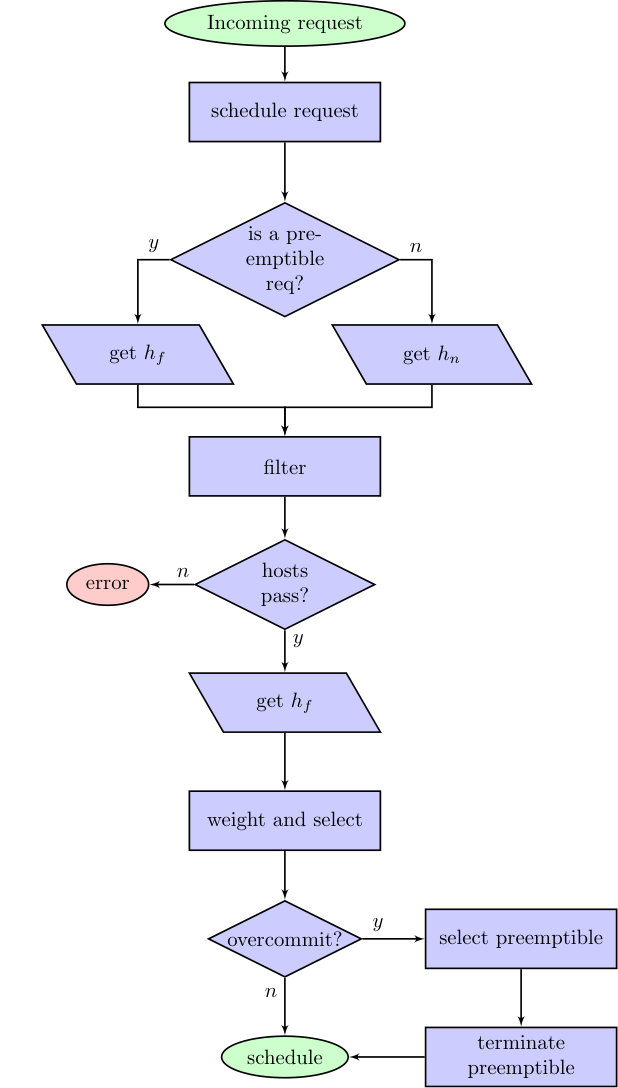 Figure 1
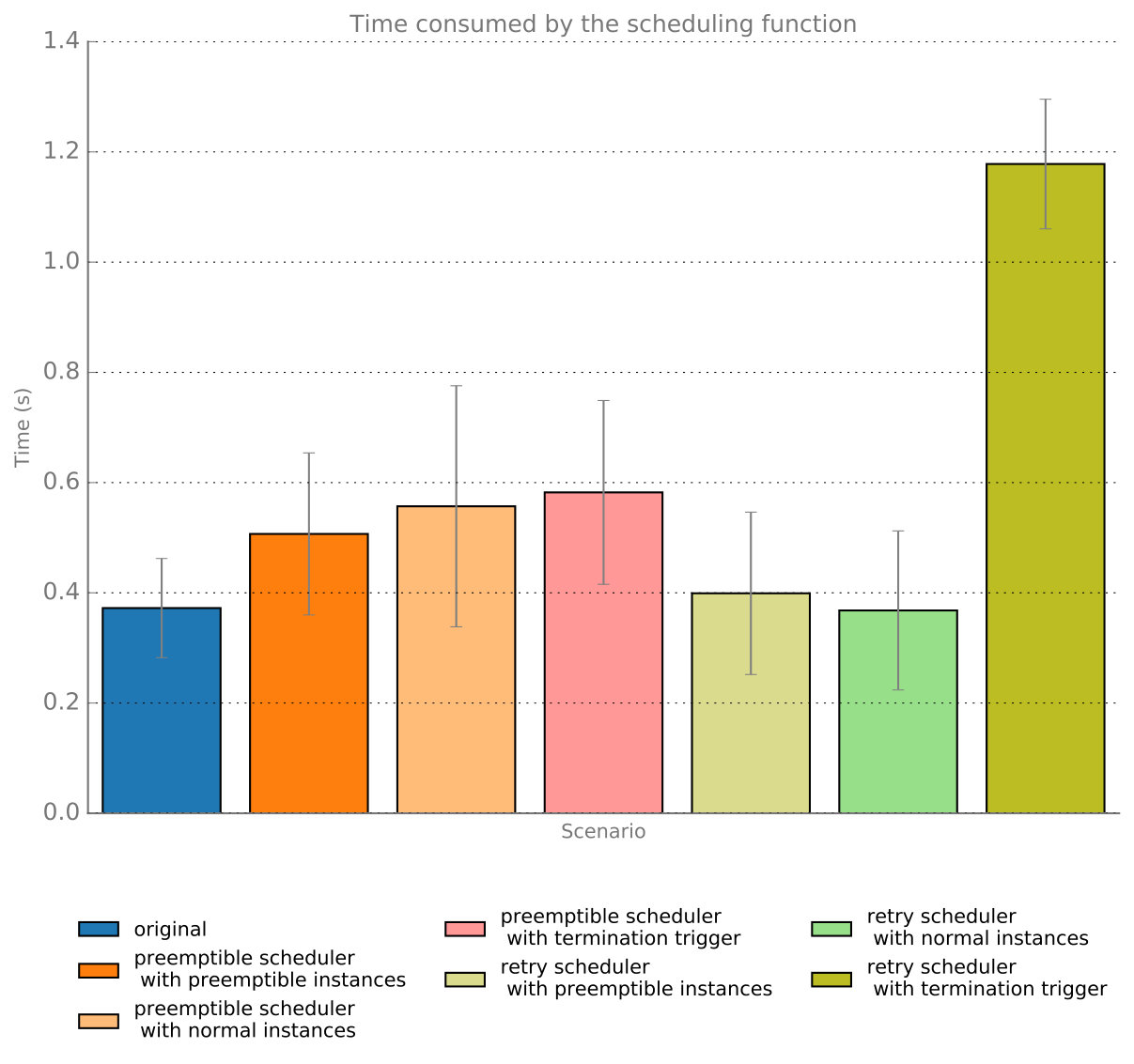 Figure 2
| CPU | x Intel®Xeon®Quad Core E5345 |
|---|---|
| RAM | |
| Disk | , rpm hard disk |
| Network | Ethernet |
| Name | vCPUs | RAM () | Disk () |
|---|---|---|---|
| small | 1 | 2000 | 20 |
| medium | 2 | 4000 | 40 |
| large | 4 | 8000 | 80 |
| Host | Instances | Preeptible Instances | ||
| ID | Time | ID | Time | |
| host-A | A1 | 272 | AP1 | 96 |
| A2 | 172 | AP2 | 207 | |
| host-B | B1 | 136 | BP1 (111Selected instance) | 71 |
| B2 | 200 | BP2 | 91 | |
| host-C | C1 | 97 | CP1 | 210 |
| C2 | 275 | CP2 | 215 | |
| host-D | D1 | 16 | DP1 | 85 |
| DP2 | 199 | |||
| DP3 | 152 | |||
| Host | Instances | Preeptible Instances | ||
| ID | Time | ID | Time | |
| host-A | AP1 | 247 | ||
| AP2 | 463 | |||
| AP3 | 403 | |||
| AP4 | 410 | |||
| host-B | B1 | 388 | BP1 | 344 |
| B2 | 103 | BP2 | 476 | |
| host-C | C1 | 481 | CP1 (111Selected instance.) | 181 |
| C2 | 177 | CP2 | 160 | |
| host-D | D1 | 173 | DP1 | 384 |
| DP2 | 168 | |||
| DP3 | 232 | |||
| Host | Instances | Preeptible Instances | ||||
| ID | Time | Size | ID | Time | Size | |
| host-A | AP1 | 298 | L | |||
| AP2 (111Selected instances.) | 278 | M | ||||
| AP3 (111Selected instances.) | 190 | S | ||||
| AP4 (111Selected instances.) | 187 | S | ||||
| host-B | B1 | 494 | L | BP1 | 178 | L |
| host-C | CP1 | 297 | L | |||
| CP2 | 296 | M | ||||
| CP3 | 296 | S | ||||
| host-D | D1 | 176 | M | |||
| D2 | 200 | M | ||||
| D3 | 116 | L | ||||
| Host | Instances | Preeptible Instances | ||||
| ID | Time | Size | ID | Time | Size | |
| host-A | A1 | 234 | L | AP1 | 172 | M |
| A2 | 122 | M | ||||
| host-B | BP1 | 272 | L | |||
| BP2 | 212 | M | ||||
| BP3 (111Selected instances.) | 380 | S | ||||
| host-C | C1 | 182 | S | |||
| C2 | 120 | M | ||||
| C3 | 116 | L | ||||
| host-D | DP1 | 232 | L | |||
| DP2 | 213 | S | ||||
| DP3 | 324 | M | ||||
| DP4 | 314 | S | ||||
Peer Reviews
No public reviews on file for this paper yet. If you reviewed it on a platform where reviews are public (OpenReview, ICLR, NeurIPS, ICML), you can paste yours below so the community can read it here.
Videos
No videos yet. Explain this paper in a talk, walkthrough, or lecture? Add one.
An efficient cloud scheduler design supporting preemptible
instances111This is the author’s accepted version of the following article: Álvaro López García, Enol Fernández del Castillo, Isabel Campos Plasencia, “An efficient cloud scheduler design supporting preemptible instances”, accepted in Future Generation Computer Systems, 2019, which is published in its final form at https://doi.org/10.1016/j.future.2018.12.057. This preprint article may be used for non-commercial purposes under a CC BY-NC-SA 4.0 license.
Álvaro López García
Enol Fernández del Castillo
Isabel Campos Plasencia
Institute of Physics of Cantabria, Spanish National Research Council — IFCA (CSIC—UC).
Avda. los Castros s/n. 39005 Santander, Spain
Abstract
Maximizing resource utilization by performing an efficient resource provisioning is a key factor for any cloud provider: commercial actors can maximize their revenues, whereas scientific and non-commercial providers can maximize their infrastructure utilization. Traditionally, batch systems have allowed data centers to fill their resources as much as possible by using backfilling and similar techniques. However, in an IaaS cloud, where virtual machines are supposed to live indefinitely, or at least as long as the user is able to pay for them, these policies are not easily implementable. In this work we present a new scheduling algorithm for IaaS providers that is able to support preemptible instances, that can be stopped by higher priority requests without introducing large modifications in the current cloud schedulers. This scheduler enables the implementation of new cloud usage and payment models that allow more efficient usage of the resources and potential new revenue sources for commercial providers. We also study the correctness and the performace overhead of the proposed scheduler agains existing solutions.
keywords:
Cloud computing , scheduling , preemptible instances , Spot Instances , resource allocation
††journal: Future Generation Computer Systems
1 Introduction
Infrastructure as a Service (IaaS) Clouds make possible to provide computing capacity as a utility to the users following a pay-per-use model. This fact allows the deployment of complex execution environments without an upfront infrastructure commitment, fostering the adoption of the cloud by users that could not afford to operate an on-premises infrastructure. In this regard, Clouds are not only present in the industrial ICT ecosystem, and they are being more and more adopted by other stakeholders such as public administrations or research institutions.
Indeed, clouds are nowadays common in the scientific computing field [1, 2, 3, 4], due to the fact that they are able to deliver resources that can be configured with the complete software needed for an application [5]. Moreover, they also allow the execution of non-transient tasks, making possible to execute virtual laboratories, databases, etc. that could be tightly coupled with the execution environments. This flexibility poses a great advantage against traditional computational models —such as batch systems or even Grid computing— where a fixed operating system is normally imposed and any complimentary tools (such as databases) need to be self-managed outside the infrastructure. This fact is pushing scientific datacenters outside their traditional boundaries, evolving into a mixture of services that deliver more added value to their users, with the Cloud as a prominent actor.
Maximizing resource utilization by performing an efficient resource provisioning is a fundamental aspect for any resource provider, specially for scientific providers. Users accessing these computing resources do not usually pay —or at least they are not charged directly— for their consumption, and normally resources are paid via other indirect methods (like access grants), with users tending to assume that resources are for free. Scientific computing facilities tend to work on a fully saturated manner, aiming at the maximum possible resource utilization level.
In this context it is common that compute servers spawned in a cloud infrastructure are not terminated at the end of their lifetime, resulting in idle resources, a state that is are not desirable as long as there is processing that needs to be done [4]. In a commercial this is not a problem, since users are being charged for their allocated resources, regardless if they are being used or not. Therefore users tend to take care of their virtual machines, terminating them whenever they are not needed anymore. Moreover, in the cases where users leave their resources running forever, the provider is still obtaining revenues for those resources.
Cloud operators try to solve this problem by setting resource quotas that limits the amount of resources that a user or group is able to consume by doing a static partitioning of the resources [8]. However, this kind of resource allocation automatically leads to an underutilization of the infrastructure since the partitioning needs to be conservative enough so that other users could utilize the infrastructure. Quotas impose hard limits that leading to dedicated resources for a group, even if the group is not using the resources.
Besides, cloud providers also need to provide their users with on-demand access to the resources, one of the most compelling cloud characteristics [9]. In order to provide such access, an overprovisioning of resources is expected [10] in order to fulfil user request, leading to an infrastructure where utilization is not maximized, as there should be always enough resources available for a potential request.
Taking into account that some processing workloads executed on the cloud do not really require on-demand access (but rather they are executed for long periods of time), a compromise between these two aspects (i.e. maximizing utilization and providing enough on-demand access to the users) can be provided by using idle resources to execute these tasks that do not require truly on-demand access [10]. This approach indeed is common in scientific computing, where batch systems maximize the resource utilization through backfilling techniques, where opportunistic access is provided to these kind of tasks.
Unlike in batch processing environments, virtual machines (VMs) spawned in a Cloud do not have fixed duration in time and are supposed to live forever —or until the user decides to stop them. Commercial cloud providers provide specific VM types (like the Amazon EC2 Spot Instances222http://aws.amazon.com/ec2/purchasing-options/spot-instances/ or the Google Compute Engine Preemptible Virtual Machines333https://cloud.google.com/preemptible-vms/) that can be provisioned at a fraction of a normal VM price, with the caveat that they can terminated whenever the provider decides to do so. This kind of VMs can be used to backfill idle resources, thus allowing to maximize the utilization and providing on-demand access, since normal VMs will obtain resources by evacuating Spot or Preemptible instances.
In this paper we propose an efficient scheduling algorithm that combines the scheduling of preemptible and non preemptible instances in a modular way. The proposed solution is flexible enough in order to allow different allocation, selection and termination policies, thus allowing resource providers to easily implement and enforce the strategy that is more suitable for their needs. In our work we extend the OpenStack Cloud middleware with a prototype implementation of the proposed scheduler, as a way to demonstrate and evaluate the feasibility of our solution. We moreover perform an evaluation of the performance of this solution, in comparison with the existing OpenStack scheduler.
The remainder of the paper is structured as follows. In Section 2 we present the related work in this field. In Section 3 we propose a design for an efficient scheduling mechanism for preemptible instances. In Section 4 we present an implementation of our proposed algorithm, as well as an evaluation of its feasibility and performance with regards with a normal scheduler. Finally, in Section 6 we present this work’s conclusions.
2 Related work
The resource provisioning from cloud computing infrastructures using Spot Instances or similar mechanisms has been addressed profusely in the scientific literature in the last years [12]. However, the vast majority of this work has been done from the users’ perspective when using and consuming Spot Instances [13] and few works tackle the problem from the resource provider standpoint.
Due to the unpredictable nature of the Spot Instances, there are several research papers that try to improve the task completion time —making the task resilient against termination— and reduce the costs for the user. Andrzejak et al. [14] propose a probabilistic model to obtain the bid prices so that the costs and performance and reliability can be improved. In [15, 16, 17, 18] the task checkpointing is addressed so as to minimize costs and improve the whole completion time.
Related with the previous works, Voorsluys et al. have studied the usage of Spot Instances to deploy reliable virtual clusters [19, 20], managing the allocated instances on behalf of the users. They focus on the execution of compute intensive tasks on top of a pool of Spot Instances, in order to find the most effective way to minimize both the execution time of a given workload and the price of the allocated resources. Similarly, in [21] the autors develop a workflow scheduling scheme that reduces the completion time using Spot Instances.
Jain et al. have performed studies in the same line, but focused on using a batch system that leverages the Spot Instances [22], learning from its previous experience —in terms of spot prices and workload characteristics— in order to dynamically adapt the resource allocation policies of the batch system.
Regarding Big Data analysis, several authors have studied how the usage of Spot Instances could be used to execute MapReduce workloads reducing the monetary costs, such as in [23, 24]. The usage of Spot Instances for opportunistic computing is another usage that has awaken a lot of interest, especially regarding the design of an optimal bidding algorithm that would reduce the costs for the users [25, 26]. There are already existing applications such as the vCluster framework [27] that can consume resources from heterogeneous cloud infrastructures in a fashion that could take advantage of the lower price that the Spot Instances should provide.
In spite of the above works, to the best of our knowledge, there is a lack of research in the feasibility, problematic, challenges and implementation from the perspective of the IaaS provider. In spite of the user’s interest in exploiting preemptible instances and the large commercial actors providing this alternative payment and access model, it is hard to find open source products or implementations of preemptible instances.
Amazon provides the EC2 Spot Instances444http://aws.amazon.com/ec2/purchasing-options/spot-instances/, where users are able to select how much they are willing to pay for their resources by bidding on their price in market where the price fluctuates accordingly to the demand. Those requests will be executed taking into account the following points:
The EC2 Spot Instances will run as long as the published Spot price is lower than their bid.
- 2.
The EC2 Spot Instance will be terminated when the Spot price is higher than the bid (out-of-bid).
- 3.
If the user terminates the Spot Instance, the complete usage will be accounted, but if it gets terminated by the system, the last partial hour won’t be accounted.
When an out-of-bid situation happens, the running instances will be terminated without further advise. This rough explanation of the Amazon’s Spot Instances can be considered similar to the traditional job preemption based on priorities, with the difference that the priorities are being driven by an economic model instead by the usual fair-sharing or credit mechanism used in batch systems.
Google Cloud Engine (GCE)555https://cloud.google.com/products/compute-engine has released a new product branded as Preemptible Virtual Machines 666https://cloud.google.com/preemptible-vms/. These new Virtual Machine (VM) types are short-lived compute instances suited for batch processing and fault-tolerant jobs, that can last for up to and that can be terminated if there is a need for more space for higher priority tasks within the GCE.
Marshall et al. [10] delivered an implementation of preemptible instances for the Nimbus toolkit in order to utilize those instances for backfilling of idle resources, focusing on HTC fault-tolerant tasks. However, they did not focus on offering this functionality to the end-users, but rather to the operators of the infrastructure, as a way to maximize their resource utilization. In this work, it was the responsibility of the provider to configure the backfill tasks that were to be executed on the idle resources.
Nadjaran Toosi et al. have developed a Spot Instances as a Service (SIPaaS) framework, a set of web services that makes possible to run a Spot market on top of an OpenStack cloud [28]. However, even if this framework aims to deliver preemptible instances on OpenStack cloud, it is designed to utilize normal resources to provide this functionality. SIPaaS utilizes normal resources to create the Spot market that is provided to the users by means of a thin layer on top of a given OpenStack, providing a different API to interact with the resources. From the CMF point of view, all resources are of the same type, being SIPaaS the responsible of handling them, in different ways. In contrast, our work leverages two different kind of instances at the CMF level, performing different scheduling strategies depending on which kind of resource it is being requested. SIPaaS also delivers a price market similar to the Amazon EC2 Spot Instances market, therefore they also provide the Ex-CORE auction algorithm [29] in order to govern the price fluctuations.
Carvalho et al. have proposed [30] a capacity planning method combined with an admission service for IaaS cloud providers offering different service classes. This method allows providers to tackle the challenge of estimating the minimum capacity required to deliver an agreed Service Level Objective (SLO) across all the defined service classes. In the aforementioned paper Carvalho et al. lean on their previous work [31, 32], where they proposed a way to reclaim unused cloud resources to offer a new economy class. This class, in contrast with the preemptible instances described here, still offer a SLO to the users, being the work on Carvalho et al. focused on the reduction of the changes that the SLO is violated due to an instance reclamation because of a capacity shortage.
2.1 Scheduling in the existing Cloud Management Frameworks
Generally speaking, existing Cloud Management Frameworks (CMFs) do not implement full-fledged queuing mechanism as other computing models do (like the Grid or traditional batch systems). Clouds are normally more focused on the rapid scaling of the resources rather than in batch processing, where systems are governed by queuing systems [34]. The default scheduling strategies in the current CMFs are mostly based on the immediate allocation or resources following a fist-come, first-served basis. The cloud schedulers provision them when requested, or they are not provisioned at all (except in some CMFs that implement a FIFO queuing mechanism) [35].
However, some users require for a queuing system —or some more advanced features like advance reservations— for running virtual machines. In those cases, there are some external services such as Haizea [36] for OpenNebula or Blazar 777https://launchpad.net/blazar for OpenStack. Those systems lay between the CMF and the users, intercepting their requests and interacting with the cloud system on their behalf, implementing the required functionality.
Besides simplistic scheduling policies like first-fit or random chance node selection [35], current CMF implement a scheduling algorithm that is based on a rank selection of hosts, as we will explain in what follows:
OpenNebula
uses by default a match making scheduler, implementing the Rank Scheduling Policy [36]. This policy first performs a filtering of the existing hosts, excluding those that do not meet the request requirements. Afterwards, the scheduler evaluates some operator defined rank expressions against the recorded information from each of the hosts so as to obtain an ordered list of nodes. Finally, the resources with a higher rank are selected to fulfil the request. OpenNebula implements a queue to hold the requests that cannot be satisfied immediately, but this queuing mechanism follows a FIFO logic, without further priority adjustment.
OpenStack
implements a Filter Scheduler [37], based on two separated phases. The first phase consists on the filtering of hosts that will exclude the hosts that cannot satisfy the request. This filtering follows a modular design, so that it is possible to filter out nodes based on the user request (RAM, number of vCPU), direct user input (such as instance affinity or anti-affinity) or operator configured filtering. The second phase consists on the weighing of hosts, following the same modular approach. Once the nodes are filtered and weighed, the best candidate is selected from that ordered set.
CloudStack
101010https://cloudstack.apache.org
utilizes the term allocator to determine which host will be selected to place the new VM requested. The nodes that are used by the allocators are the ones that are able to satisfy the request.
Eucalyptus
111111https://www.eucalyptus.com/
implements a greedy or round robin algorithm. The former strategy uses the first node that is identified as suitable for running the VM. This algorithm exhausts a node before moving on to the next node available. On the other hand, the later schedules each request in a cyclic manner, distributing evenly the load in the long term.
All the presented scheduling algorithms share the view that the nodes are firstly filtered out —so that only those that can run the request are considered— and then ordered or ranked according to some defined rules. Generally speaking, the scheduling algorithm can be expressed as the pseudo-code in the Algorithm 1.
3 Preemptible Instances Design
The initial assumption for a preemptible aware scheduler is that the scheduler should be able to take into account two different instance types —preemptible and normal— according to the following basic rules:
If it is a normal instance and there are no free resources for it, it must check if the termination of any running preemptible instance will leave enough space for the new instance.
- (a)
If this is true, those instances should be terminated —according to some well defined rules— and the new VM should be scheduled into that freed node.
- (b)
If this is not possible, then the request should continue with the failure process defined in the scheduling algorithm —it can be an error, or it can be retried after some elapsed time.
- 2.
If it is a preemptible instance, it should try to schedule it without other considerations.
It should be noted that the preemptible instance selection and termination does not only depend on pure theoretical aspects, as this selection will have an influence on the resource provider revenues and the service level agreements signed with their users. Taking this into account, it is obvious that modularity and flexibility for the preemptible instance selection and is a key aspect here. For instance, an instance selection and termination algorithm that is only based on the minimization of instances terminated in order to free enough resources may not work for a provider that wish to terminate the instances that generate less revenues, event if it is needed to terminate a larger amount of instances.
Therefore, the aim of our work is not only to design an scheduling algorithm, but also to design it as a modular system so that it would be possible to create any more complex model on top of it once the initial preemptible mechanism is in place.
The most evident design approach is a retry mechanism based on two selection cycles within a scheduling loop. The scheduler will take into account a scheduling failure and then perform a second scheduling cycle after preemptible instances have been evacuated —either by the scheduler itself or by an external service. However, this two-cycle scheduling mechanism would introduce a larger scheduling latency and load in the system. This latency is something perceived negatively by the users [38] so the challenge here is how to perform this selection in a efficient way, ensuring that the selected preemptible instances are the less costly for the provider.
3.1 Preemptible-aware scheduler
Our proposed algorithm (depicted in Figure 1) addresses the preemptible instances scheduling within one scheduling loop, without introducing a retry cycle, bur rather performing the scheduling taking into account different host states depending on the instance that is to be scheduled. This design takes into account the fact that all the algorithms described in Section 2.1 are based on two complimentary phases: filtering and raking., but adds a final phase, where the preemptible instances that need to be terminated are selected. The algorithm pseudocode is shown in 2 and will be further described in what follows.
As we already explained, the filtering phase eliminates the nodes that are not able to host the new request due to its current state —for instance, because of a lack of resources or a VM anti-affinity—, whereas the raking phase is the one in charge of assigning a rank or weight to the filtered hosts so that the best candidate is selected.
I our preemptible-aware scheduler, the filtering phase only takes into account preemptible instances when doing the filtering phase. In order to do so we propose to utilize two different states for the physical hosts:
This state will take into account all the running VM inside that host, that is, the preemptible and non preemptible instances.
This state will not take into account all the preemptible instances inside that host. That is, the preemptible instances running into a particular physical host are not accounted in term of consumed resources.
Whenever a new request arrives, the scheduler will use the or host states for the filtering phase, depending on the type of the request:
When a normal request arrives, the scheduler will use .
- 2.
When a preemptible request arrives, the scheduler will use .
This way the scheduler ensures that a normal instance can run regardless of any preemptible instance occupying its place, as the state does not account for the resources consumed by any preemptible instance running on the host. After this stage, the resulting list of hosts will contain all the hosts susceptible to host the new request, either by evacuating one or several preemptible instances or because there are enough free resources.
Once the hosts are filtered out, the ranking phase is started. However, in order to perform the correct ranking, it is needed to use the full state of the hosts, that is, . This is needed as the different rank functions will require the information about the preemptible instances so as to select the best node. This list of filtered hosts may contain hosts that are able to accept the request because they have free resources and nodes that would imply the termination of one or several instances.
In order to choose the best host for scheduling a new instance new ranking functions need to be implemented, in order to prioritise the costless host. The simplest ranking function based on the number of preemptible instances per host is described in Algorithm 3.
This function assigns a negative value if the free resources are not enough to accommodate the request, detecting an overcommit produced by the fact that it is needed to terminate one or several preemptible instances. However, this basic function only establishes a naive ranking based on the termination or not of instances. In the case that it is needed to terminate various instances, this function does not establish any rank between them, so more appropriate rank functions need to be created, depending on the business model implemented by the provider. Our design takes this fact into account, allowing for modularity of these cost functions that can be applied to the raking function.
For instance, commercial providers tend to charge by complete periods of , so partial hours are not accounted. A ranking function based in this business model can be expressed as Algorithm 4, ranking hosts according to the preemptible instances running inside them and the time needed until the next complete period.
Once the ranking phase is finished, the scheduler will have built an ordered list of hosts, containing the best candidates for the new request. Once the best host selected it is still needed to select which individual preemptible instances need to be evacuated from that host, if any. Our design adds a third phase, so as to terminate the preemptible instances if needed.
This last phase will perform an additional raking and selection of the candidate preemptible instances inside the selected host, so as to select the less costly for the provider. This selection leverages a similar ranking process, performed on the preemptible instances, considering all the preemptible instances combination and the costs for the provider, as shown in Algorithm 5.
4 Evaluation
In the first part of this section (4.2) we will describe an implementation —done for the OpenStack Compute CMF—, in order to evaluate our proposed algorithm. We have decided to implement it on top of the OpenStack Compute software due to its modular design, that allowed us to easily plug our modified modules without requiring significant modifications to the code core.
Afterwards we will perform two different evaluations. On the one hand we will assess the algorithm correctness, ensuring that the most desirable instances are selected according to the configured weighers (Section 4.4). On the other hand we will examine the performance of the proposed algorithm when compared with the default scheduling mechanism (Section 4.5).
4.1 OpenStack Compute Filter Scheduler
The OpenStack Compute scheduler is called Filter Scheduler and, as already described in Section 2, it is a rank scheduler, implementing two different phases: filtering and weighting.
Filtering
The first step is the filtering phase. The scheduler applies a concatenation of filter functions to the initial set of available hosts, based on the host properties and state —e.g. free RAM or free CPU number— user input —e.g. affinity or anti-affinity with other instances— and resource provider defined configuration. When the filtering process has concluded, all the hosts in the final set are able to satisfy the user request.
Weighing
Once the filtering phase returns a list of suitable hosts, the weighting stage starts so that the best host —according to the defined configuration— is selected. The scheduler will apply all hosts the same set of weigher functions , taking into account each host state . Those weigher functions will return a value considering the characteristics of the host received as input parameter, therefore, total weight for a node is calculated as follows:
[TABLE]
Where is the multiplier for a weigher function, is the normalized weight between calculated via a rescaling like:
[TABLE]
where is the weight function, and , are the minimum and maximum values that the weigher has assigned for the set of weighted hosts. This way, the final weight before applying the multiplication factor will be always in the range .
After these two phases have ended, the scheduler has a set of hosts, ordered according to the weights assigned to them, thus it will assign the request to the host with the maximum weight. If several nodes have the same weight, the final host will be randomly selected from that set.
4.2 Implementation Evaluation
We have extended the Filter Scheduler algorithm with the functionality described in Algorithm 6. We have also implemented the ranking functions described in Algorithm 3 and Algorithm 4 as weighers, using the OpenStack terminology.
Moreover, the Filter Scheduler has been also modified so as to introduce the additional select and termination phase (Algorithm 5). This phase has been implemented following the same same modular approach as the OpenStack weighting modules, allowing to define and implement additional cost modules to determine which instances are to be selected for termination.
As for the cost functions, we have implemented a module following Algorithm 4. This cost function assumes that customers are charged by periods of , therefore it prioritizes the termination of Spot Instances with the lower partial-hour consumption (i.e. if we consider instances with , and of duration, the instance with will be terminated).
This development has been done on the OpenStack Newton version121212https://github.com/indigo-dc/opie, and was deployed on the infrastructure that we describe in Section 4.3.
4.3 Configurations
In order to evaluate our algorithm proposal we have set up a dedicated test infrastructure comprising a set of identical IBM HS21 blade servers, with the characteristics described in Table 1. All the nodes had an identical base installation, based on an Ubuntu Server 16.04 LTS, running the Linux 3.8.0 Kernel, where we have deployed OpenStack Compute as the Cloud Management Framework. The system architecture is as follows:
A Head node hosting all the required services to manage the cloud test infrastructure, that is:
- (a)
The OpenStack Compute API.
- (b)
The OpenStack Compute Scheduler service.
- (c)
The OpenStack Compute Conductor service.
- (d)
The OpenStack Identity Service (Keystone)
- (e)
A MariaDB 10.1.0 server.
- (f)
A RabbitMQ 3.5.7 server.
- 2.
An Image Catalog running the OpenStack Image Service (Glance) serving images from its local disk.
- 3.
Compute Nodes running OpenStack Compute, hosting the spawned instances.
The network setup of the testbed consists on two Ethernet switches, interconnected with a Ethernet link. All the hosts are evenly connected to these switches using a Ethernet connection.
We have considered the VM sizes described in Table 2, based on the default set of sizes existing in a default OpenStack installation.
4.4 Algorithm Evaluation
The purpose of this evaluation is to ensure that the proposed algorithm is working as expected, so that:
The scheduler is able to deliver the resources for a normal request, by terminating one or several preemptible instances when there are not enough free idle resources.
- 2.
The scheduler selects the best preemptible instance for termination, according to the configured policies by means of the scheduler weighers.
4.4.1 Scheduling using same Virtual Machine sizes
For the first batch of tests, we have considered same size instances, to evaluate if the proposed algorithm chooses the best physical host and selects the best preemptible instance for termination. We generated requests for both preemptible and normal instances —chosen randomly—, of random duration between and , using an exponential distribution [39] until the first scheduling failure for a normal instance was detected.
The compute nodes used have of RAM and eight CPUs, as already described. The VM size requested was the medium one, according to Table 2, therefore each compute node could host up to four VMs.
We executed these requests and monitored the infrastructure until the first scheduling failure for a normal instance took place, thus the preemptible instance termination mechanism was triggered. At that moment we took a snapshot of the nodes statuses, as shown in Table 1 and Table 1. These tables depict the status for each of the physical hosts, as well as the running time for each of the instances that were running at that point. The shaded cells represents the preemptible instance that was terminated to free the resources for the incoming non preemptible request.
Considering that the preemptible instance selection was done according to Algorithm 5 using the cost function in Algorithm 4, the chosen instance has to be the one with the lowest partial-hour period. In Table 1 this is the instance marked with (111Selected instance.): BP1. By chance, it corresponds with the preemptible instance with the lowest run time.
Table 1 shows a different test execution under the same conditions and constraints. Again, the selected instance has to be the one with the lowest partial-hour period. In Table 1 this corresponds to the instance marked again with (111Selected instances.): CP1, as its remainder is . In this case this is not the preemptible instance with the lowest run time (being it CP2).
4.4.2 Scheduling using different Virtual Machine sizes
For the second batch of tests we requested instances using different sizes, always following the sizes in Table 2. Table 1 depicts the testbed status when a request for a large VM caused the termination of the instances marked with (111Selected instances.): AP2, AP3 and AP4. In this case, the scheduler decided that the termination of these three instances caused a smaller impact on the provider, as the sum of their remainders () was lower than any of the other possibilities ( for BP1, for CP1, for CP2 and CP3).
Table 1 shows a different test execution under the same conditions and constraints. In this case, the preemptible instance termination was triggered by a new VM request of size medium and the selected instance was the one marked with (111Selected instances.): BP3, as host-B will have enough free space just by terminating one instance.
4.5 Performance evaluation
As we have already said in Section 3, we have focused on designing an algorithm that does not introduce a significant latency in the system. This latency will introduce a larger delay when delivering the requested resources to the end users, something that is not desirable by any resource provider [4].
In order to evaluate the performance of our proposed algorithm we have done a comparison with the default, unmodified OpenStack Filter Scheduler. Moreover, for the sake of comparison, we have implemented a scheduler based on a retry loop as well. This scheduler performs a normal scheduling loop, and if there is a scheduling failure for a normal instance, it will perform a second pass taking into account the existing preemptible instances. The preemptible instance selection and termination mechanisms remain the same.
We have scheduled 130 Virtual Machines of the same size on our test infrastructure and we have recorded the timings for the scheduling function, thus calculating the means and standard deviation for each of the following scenarios:
Using the original, unmodified OpenStack Filter scheduler with an empty infrastructure.
- 2.
Using the preemptible instances Filter Scheduler and the retry scheduler:
- (a)
Requesting normal instances with an empty infrastructure.
- (b)
Requesting preemptible instances with an empty infrastructure.
- (c)
Requesting normal instances with a saturated infrastructure, thus implying the termination of a preemptible instance each time a request is performed.
We have then collected the scheduling calls timings and we have calculated the means and deviations for each scenario, as shown in Figure 2. Numbers in these scenarios are quite low, since the infrastructure is a small testbed, but these numbers are expected to become larger as the infrastructure grows in size.
As it can be seen in the aforementioned Figure 2, our solution introduces a delay in the scheduling calls, as we need to calculate additional host states (we hold two different states for each node) and we need to select a preemptible instance for termination (in case it is needed). In the case of the retry scheduler, this delay does not exists and numbers are similar to the original scheduler. However, when it is needed to trigger the termination of a preemptible instance, having a retry mechanism (thus executing the same scheduling call two times) introduces a significantly larger penalty when compared to our proposed solution. We consider that the latency that we are introducing is within an acceptable range, therefore not impacting significantly the scheduler performance.
5 Exploitation and integration in existing infrastructures
The functionality introduced by the preemptible instances model that we have described in this work can be exploited not only within a cloud resource provider, but it can also be leveraged on more complex hybrid infrastructures.
5.1 High Performance Computing Integration
One can find in the literature several exercises of integration of hybrid infrastructures, integrating cloud resources, commercial or private, with High Performance Computing (HPC) resources. Those efforts focus on outbursting resources from the cloud, when the HPC system does not provide enough resources to solve a particular problem [41].
On-demand provisioning using cloud resources when the batch system of the HPC is full is certainly a viable option to expand the capabilities of a HPC center for serial batch processing.
We focus however in the complementary approach, this is, using HPC resources to provide cloud resources capability, so as to complement existing distributed infrastructures. Obviously HPC systems are oriented to batch processing of highly coupled (parallel) jobs. The question here is optimizing resource utilization when the HPC batch system has empty slots.
If we backfill the empty slots of a HPC system with cloud jobs, and a new regular batch job arrives from the HPC users, the cloud jobs occupying the slots needed by the newly arrived batch job should be terminated immediately, so as to not disturb regular work. Therefore such cloud jobs should be submitted as Spot Instances
Enabling HPC systems to process other jobs during periods in which the load of the HPC mainframe is low, appears as an attractive possibility from the point of view of resource optimization. However the practical implementation of such idea would need to be compatible with both, the HPC usage model, and the cloud usage model.
In HPC systems users login via ssh to a frontend. At the frontend the user has the tools to submit jobs. The scheduling of HPC jobs is done using a regular batch systems software (such as SLURM, SGE, etc…).
HPC systems are typically running MPI parallel jobs as well using specialized hardware interconnects such as Infiniband.
Let us imagine a situation in which the load of the HPC system is low. One can instruct the scheduler of the batch system to allow cloud jobs to HPC system occupying those slots not allocated by the regular batch allocation.
In order to be as less disrupting as possible the best option is that the cloud jobs arrive as preemptible instances as described through this paper. When a batch job arrives to the HPC system, this job should be immediately scheduled and executed. Therefore the scheduler should be able to perform the following steps:
Allocate resources for the job that just arrived to the batch queue system
- 2.
Identify the cloud jobs that are occupying those resources, and stop them.
- 3.
Dispatch the batch job.
In the case of parallel jobs the scheduling decision may depend on many factors like the topology of the network requested, or the affinity of the processes at the core/CPU level. In any case parallel jobs using heavily the low latency interconnect should not share nodes with any other job.
5.2 High Throughput Computing Integration
Existing High Throughput Computing Infrastructures, like the service offered by EGI131313https://www.egi.eu/services/high-throughput-compute/, could benefit from a cloud providers offering preemptible instances. It has been shown that cloud resources and IaaS offerings can be used to run HTC tasks [42] in a pull mode, where cloud instances are started in a way that they are able to pull computing tasks from a central location (for example using a distributed batch system like HTCondor).
However, sites are reluctant to offer large amounts of resources to be used in this mode due to the lack of a fixed duration for cloud instances. In this context, federated cloud e-Infrastrucutres like the EGI Federated Cloud [43], could benefit from resource providers offering preemptible instances. Users could populate idle resources with preemptible instances pulling their HTC tasks, whereas interactive and normal IaaS users will not be impacted negatively, as they will get the requests satisfied. In this way, large amounts of cloud computing power could be offered to the European research community.
6 Conclusions
In this work we have proposed a preemptible instance scheduling design that does not modify substantially the existing scheduling algorithms, but rather enhances them. The modular rank and cost mechanisms allows the definition and implementation of any resource provider defined policy by means of additional pluggable rankers. Our proposal and implementation enables all kind of service providers —whose infrastructure is managed by open source middleware such as OpenStack— to offer a new access model based on preemptible instances, with a functionality similar to the one offered by the major commercial providers.
We have checked for the algorithm correctness when selecting the preemptible instances for termination. The results yield that the algorithm behaves as expected. Moreover we have compared the scheduling performance with regards equivalent default scheduler, obtaining similar results, thus ensuring that the scheduler performance is not significantly impacted.
This implementation allows to apply more complex policies on top of the preemptible instances, like instance termination based on price fluctuations (that is, implementing a preemptible instance stock market), preemptible instance migration so as to consolidate them or proactive instance termination to maximize the provider’s revenues by not delivering computing power at no cost to the users.
Acknowledgements
The authors acknowledge the financial support from the European Commission Horizon 2020 via INDIGO-DataCloud project (grant number 653549) and EGI-ENGAGE (grant number 654142) and the Ministry of Economy and Competitiveness for the support through the National Plan under contract number FPA2013-40715-P.
The authors want also to thank the IFCA Advanced Computing and e-Science Group.
The reference list from the paper itself. Each links out to its DOI / PubMed record.
- 1[1] C. Hoffa, G. Mehta, T. Freeman, E. Deelman, K. Keahey, B. Berriman, J. Good, On the Use of Cloud Computing for Scientific Workflows, in: 2008 IEEE Fourth International Conference on e Science, Ieee, 2008, pp. 640–645. doi:10.1109/e Science.2008.167 . · doi ↗
- 2[2] A. Iosup, S. Ostermann, M. Yigitbasi, Performance analysis of cloud computing services for many-tasks scientific computing, IEEE Transactions on Parallel and Distributed Systems 22 (June) (2011) 931–945.
- 3[3] J.-S. Vöckler, G. Juve, E. Deelman, M. Rynge, B. Berriman, Experiences Using Cloud Computing for a Scientific Workflow Application, Condor The 300 (1-2) (2011) 15–24. doi:10.1145/1996109.1996114 . · doi ↗
- 4[4] Á. López García, E. Fernández-del Castillo, P. Orviz Fernández, I. Campos Plasencia, J. Marco de Lucas, Resource provisioning in Science Clouds: Requirements and challenges, Software: Practice and Experience (July) (2017) n/a—-n/a. doi:10.1002/spe.2544 . · doi ↗
- 5[5] G. Juve, E. Deelman, Resource Provisioning Options for Large-Scale Scientific Workflows, 2008 IEEE Fourth International Conference on e Science (2008) 608–613 doi:10.1109/e Science.2008.160 . · doi ↗
- 6[6] S. Singh, I. Chana, A survey on resource scheduling in cloud computing: Issues and challenges, Journal of grid computing 14 (2) (2016) 217–264.
- 7[7] D. Salomoni, I. Campos, L. Gaido, J. M. de Lucas, P. Solagna, J. Gomes, L. Matyska, P. Fuhrman, M. Hardt, G. Donvito, L. Dutka, M. Plociennik, R. Barbera, I. Blanquer, A. Ceccanti, E. Cetinic, M. David, C. Duma, A. López-García, G. Moltó, P. Orviz, Z. Sustr, M. Viljoen, F. Aguilar, L. Alves, M. Antonacci, L. A. Antonelli, S. Bagnasco, A. M. J. J. Bonvin, R. Bruno, Y. Chen, A. Costa, D. Davidovic, B. Ertl, M. Fargetta, S. Fiore, S. Gallozzi, Z. Kurkcuoglu, L. Lloret, J. Martins, A. Nuzzo, · doi ↗
- 8[8] A. Lopez Garcia, L. Zangrando, M. Sgaravatto, V. Llorens, S. Vallero, V. Zaccolo, S. Bagnasco, S. Taneja, S. D. Pra, D. Salomoni, G. Donvito, A. L. Garcia, L. Zangrando, M. Sgaravatto, V. Llorens, S. Vallero, V. Zaccolo, S. Bagnasco, S. Taneja, S. D. Pra, D. Salomoni, G. Donvito, Improved Cloud resource allocation: how INDIGO-Data Cloud is overcoming the current limitations in Cloud schedulers, Journal of Physics: Conference Series 898 (9) (2017) 92010. ar Xiv:1707.06403 , doi:10.1088/ · doi ↗