Quantum Transport in Topological Semimetals under Magnetic Fields (II)
Hai-Peng Sun, Hai-Zhou Lu

TL;DR
This paper reviews recent advances in quantum transport phenomena in topological semimetals and insulators under varying magnetic field strengths, highlighting new mechanisms and theoretical insights into magnetoresistance, quantum oscillations, and Hall effects.
Contribution
It introduces novel theoretical mechanisms for quantum Hall effects and Hall resistance reversal, expanding understanding of topological materials under strong magnetic fields.
Findings
Negative magnetoresistance can occur without chiral anomaly.
Proposed a new 3D quantum Hall effect mechanism via Weyl orbit tunneling.
Observed Hall resistance reversal linked to Weyl fermion annihilation.
Abstract
We review our recent works on the quantum transport, mainly in topological semimetals and also in topological insulators, organized according to the strength of the magnetic field. At weak magnetic fields, we explain the negative magnetoresistance in topological semimetals and topological insulators by using the semiclassical equations of motion with the nontrivial Berry curvature. We show that the negative magnetoresistance can exist without the chiral anomaly. At strong magnetic fields, we establish theories for the quantum oscillations in topological Weyl, Dirac, and nodal-line semimetals. We propose a new mechanism of 3D quantum Hall effect, via the "wormhole" tunneling through the Weyl orbit formed by the Fermi arcs and Weyl nodes in topological semimetals. In the quantum limit at extremely strong magnetic fields, we find that an unexpected Hall resistance reversal can be…
Click any figure to enlarge with its caption.
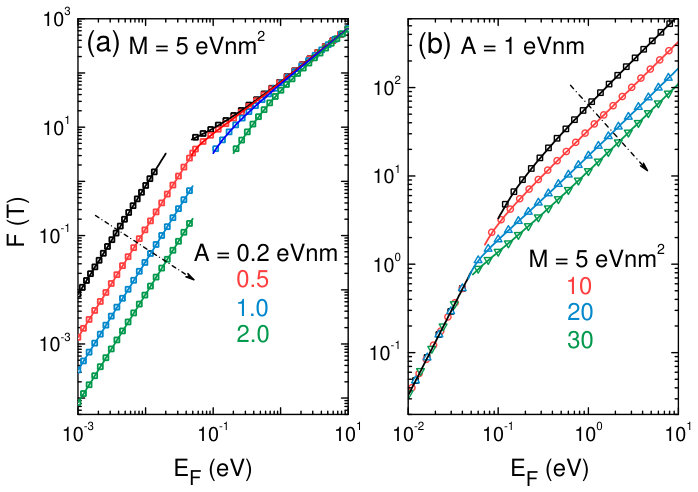 Figure 1
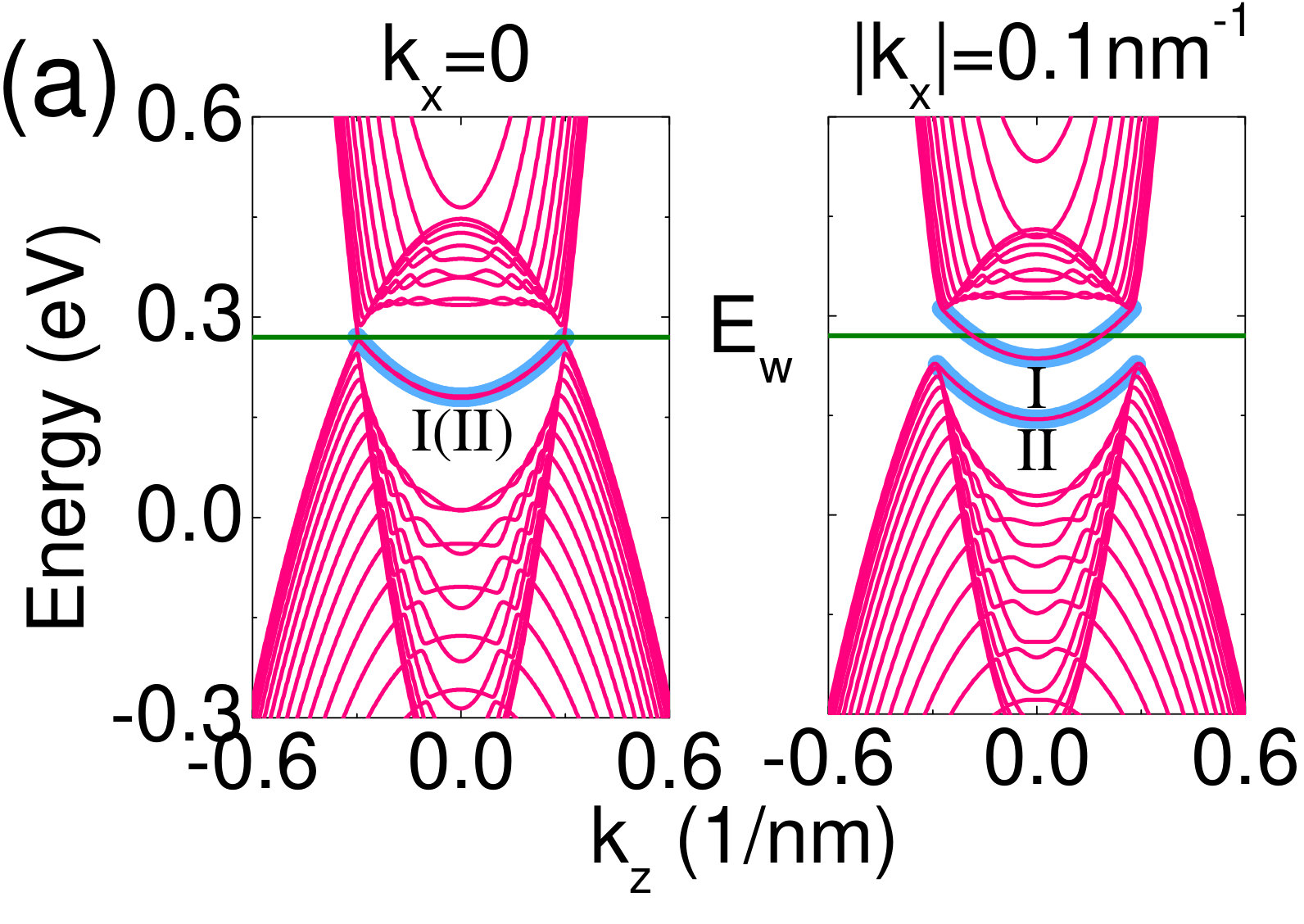 Figure 2
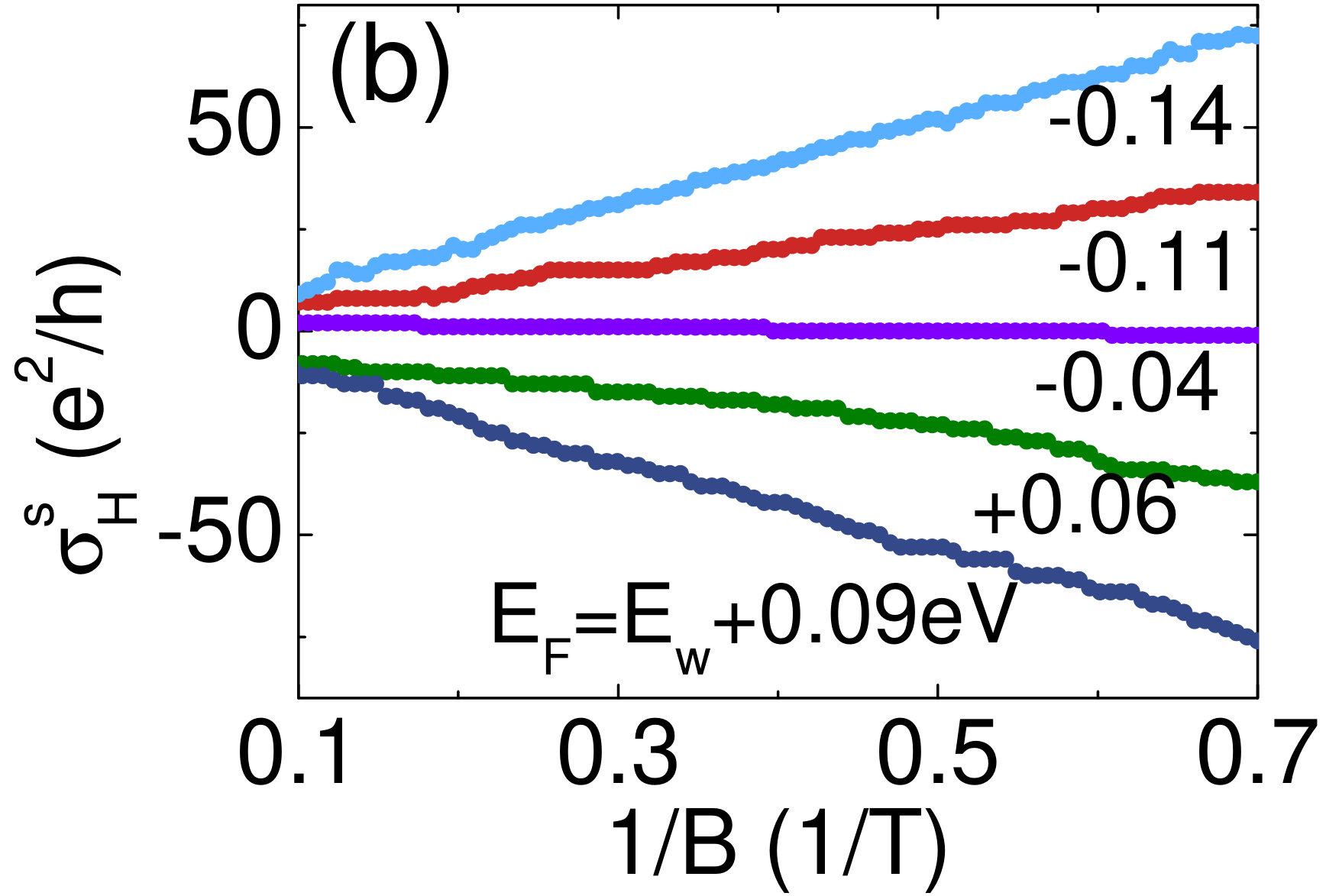 Figure 3
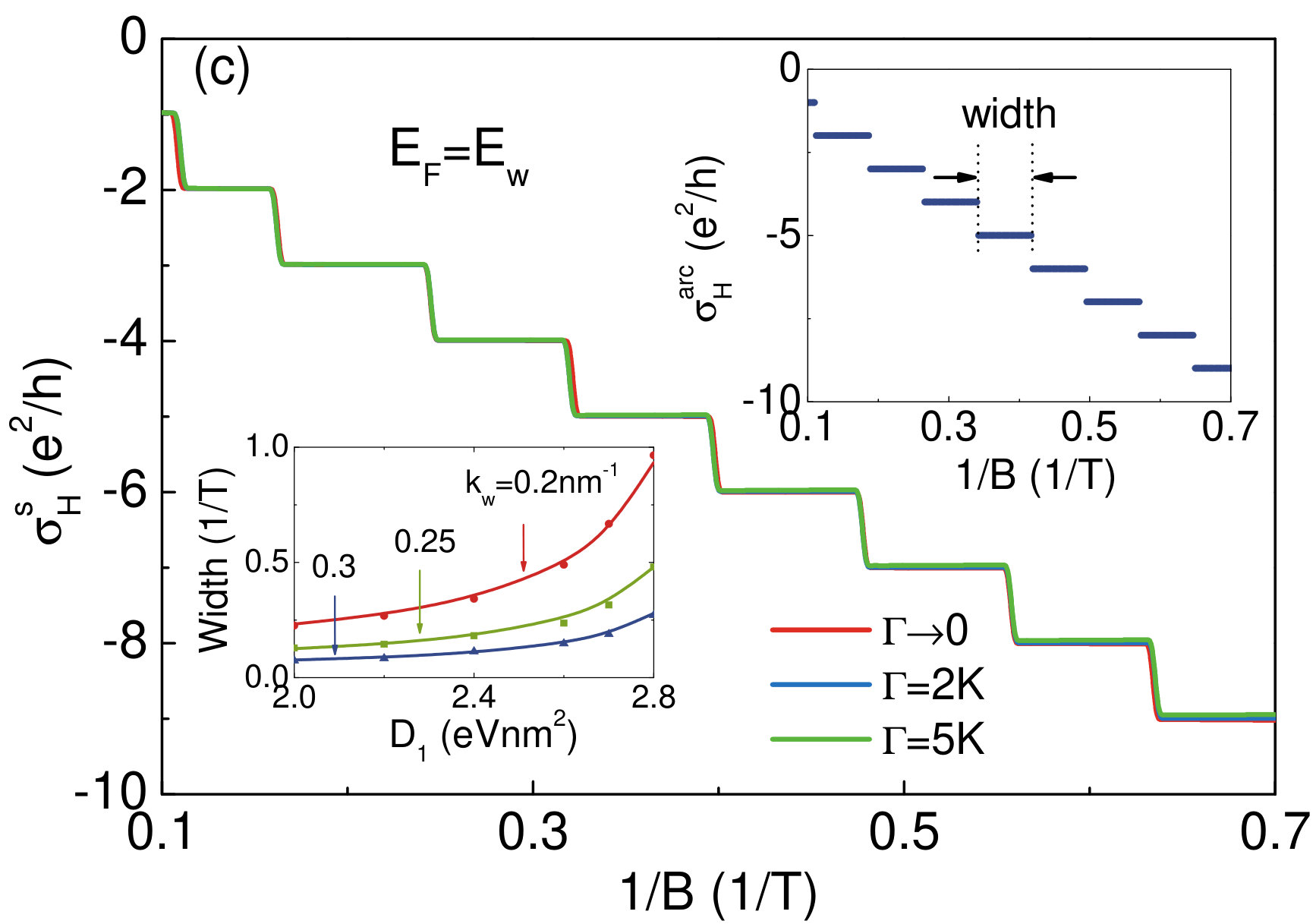 Figure 4
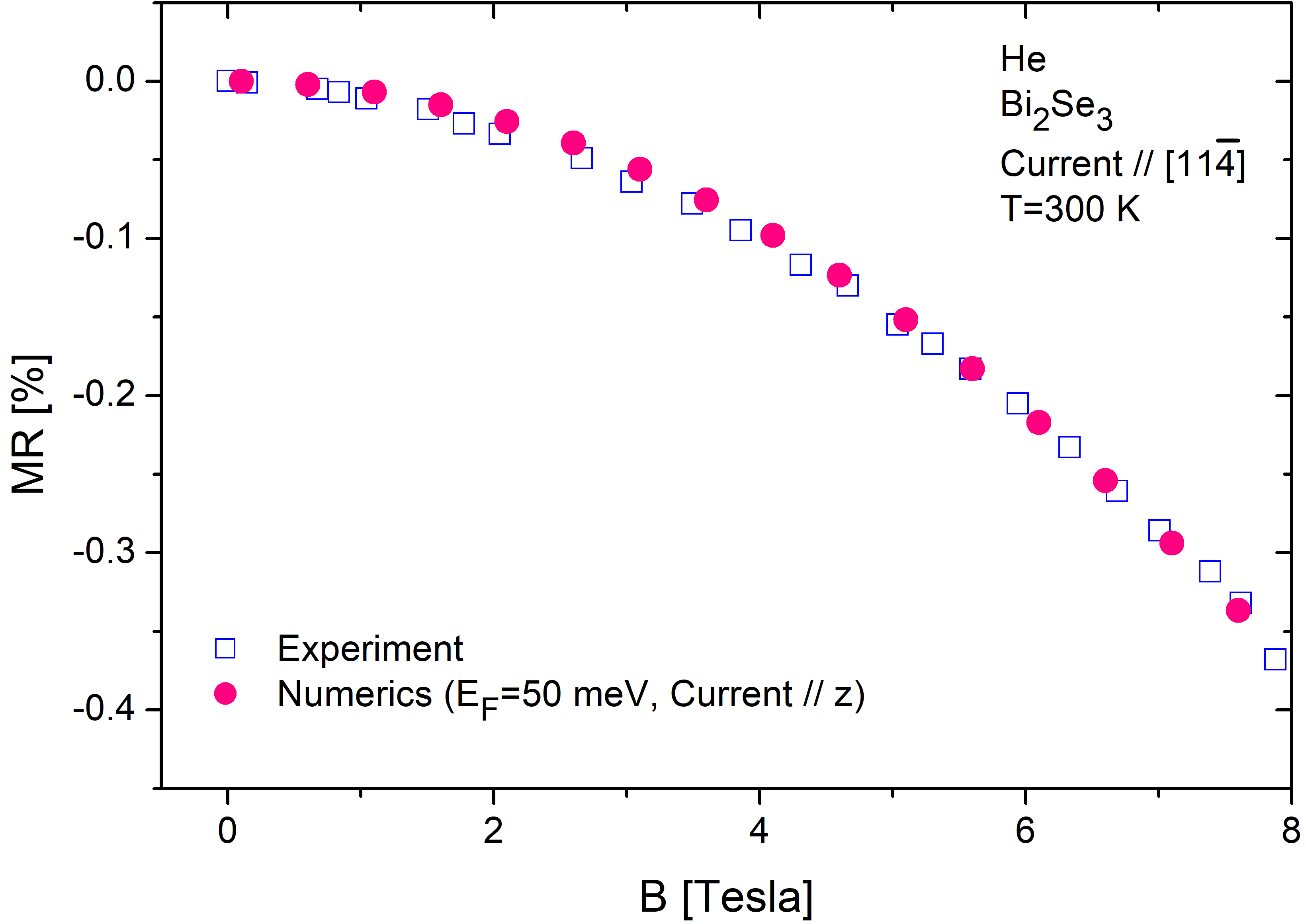 Figure 5
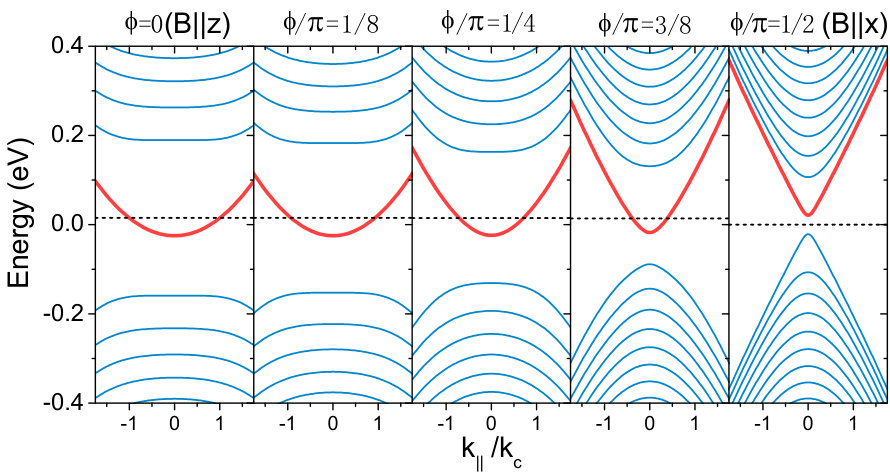 Figure 6
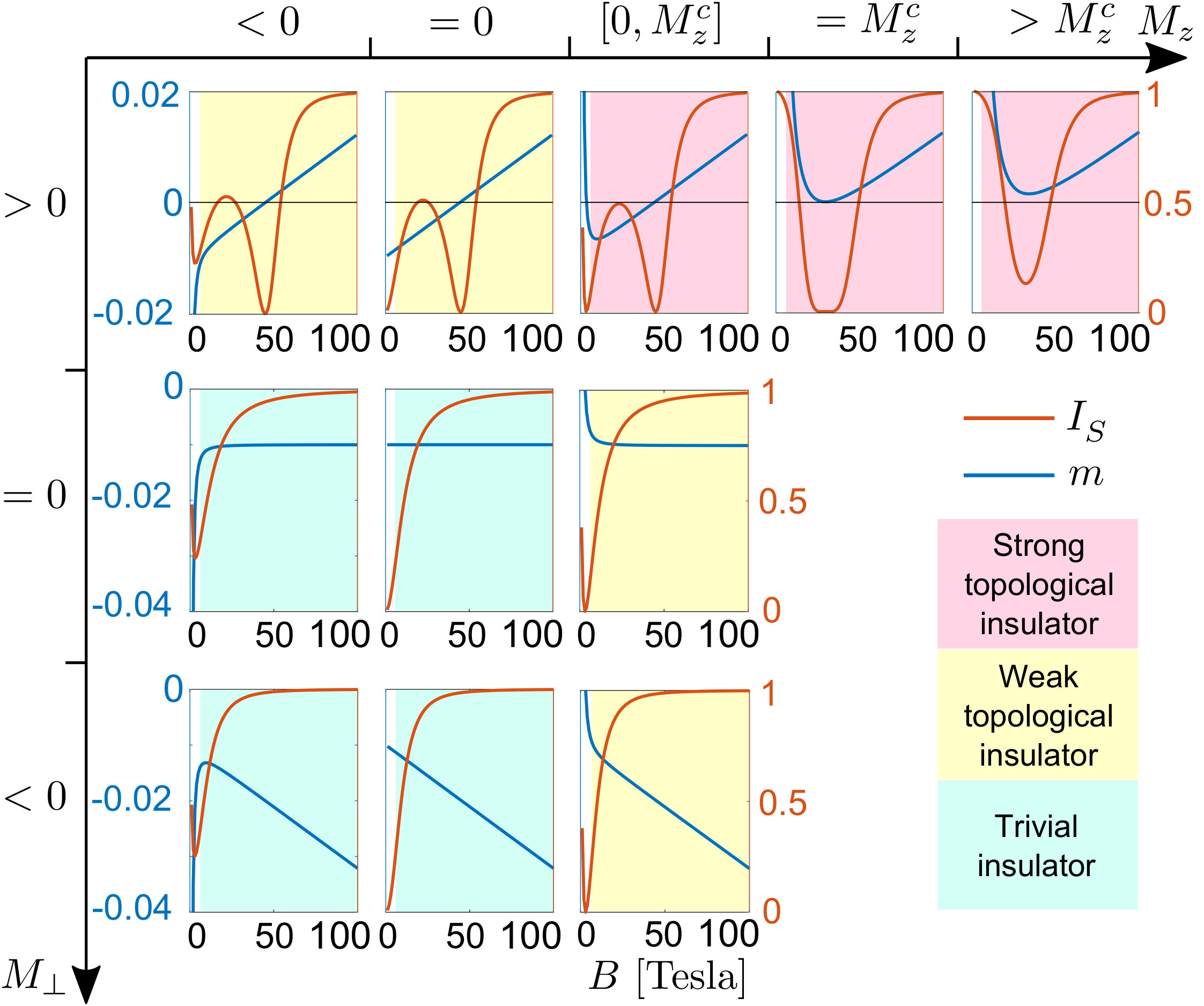 Figure 7
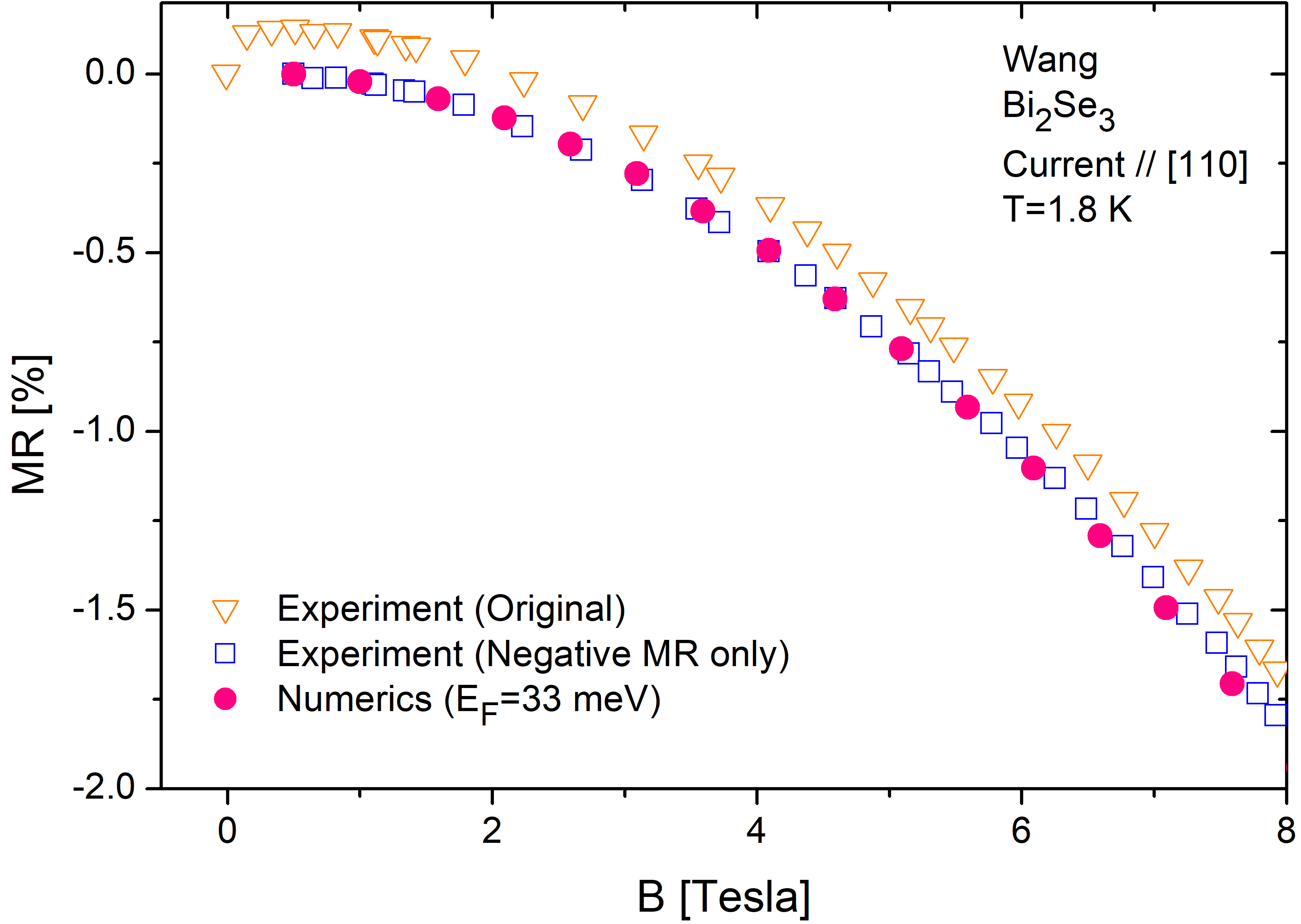 Figure 8
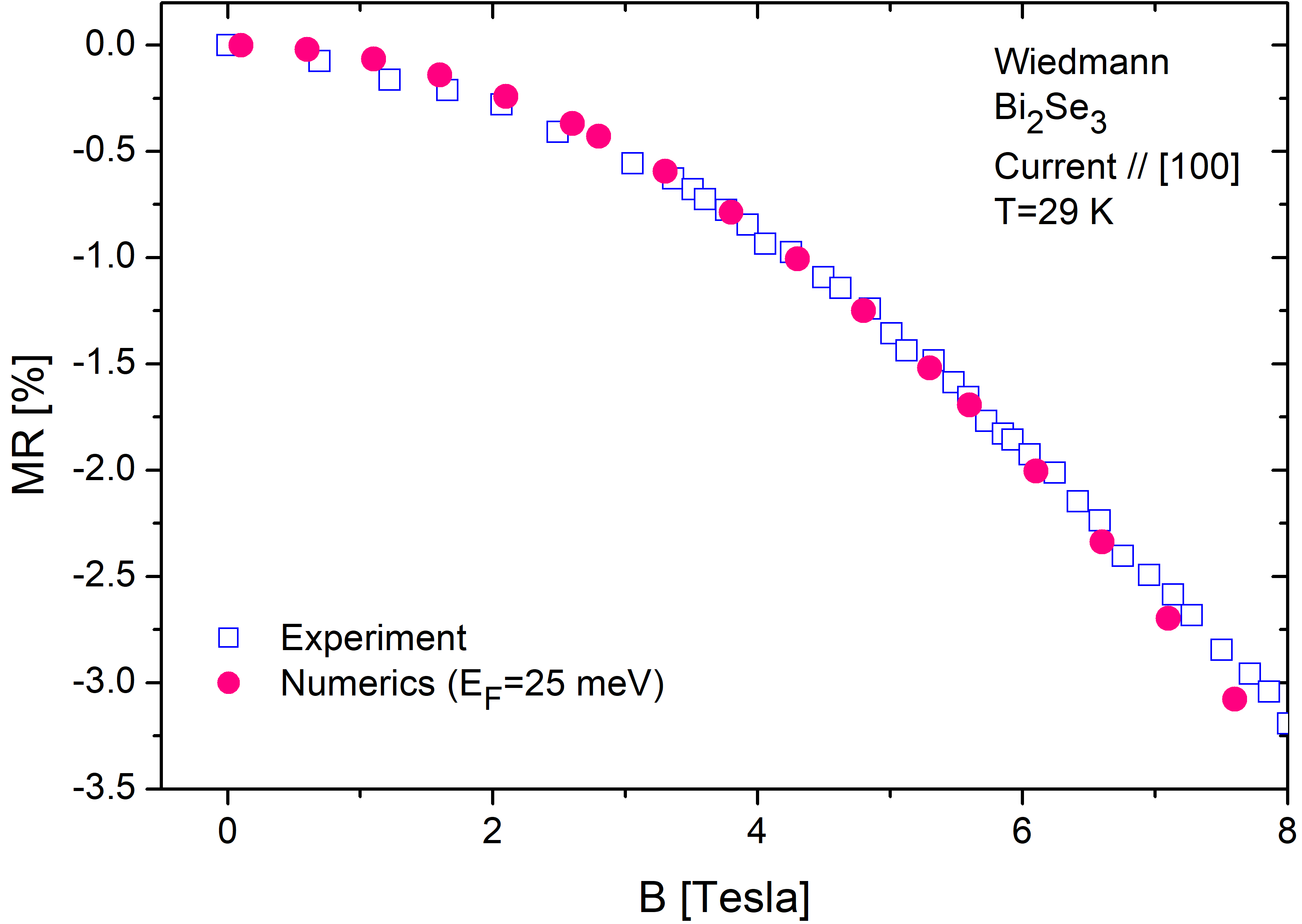 Figure 9
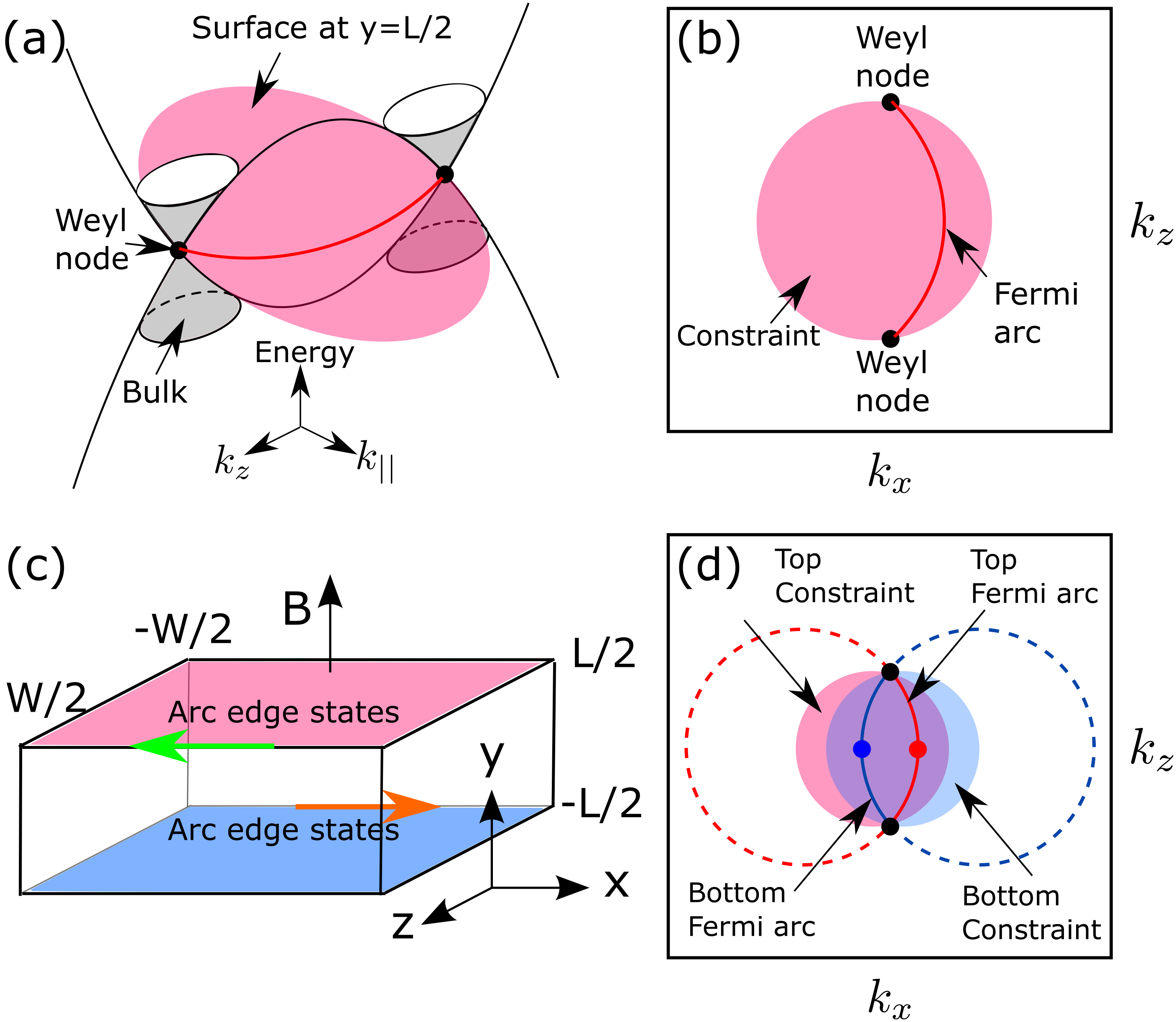 Figure 10
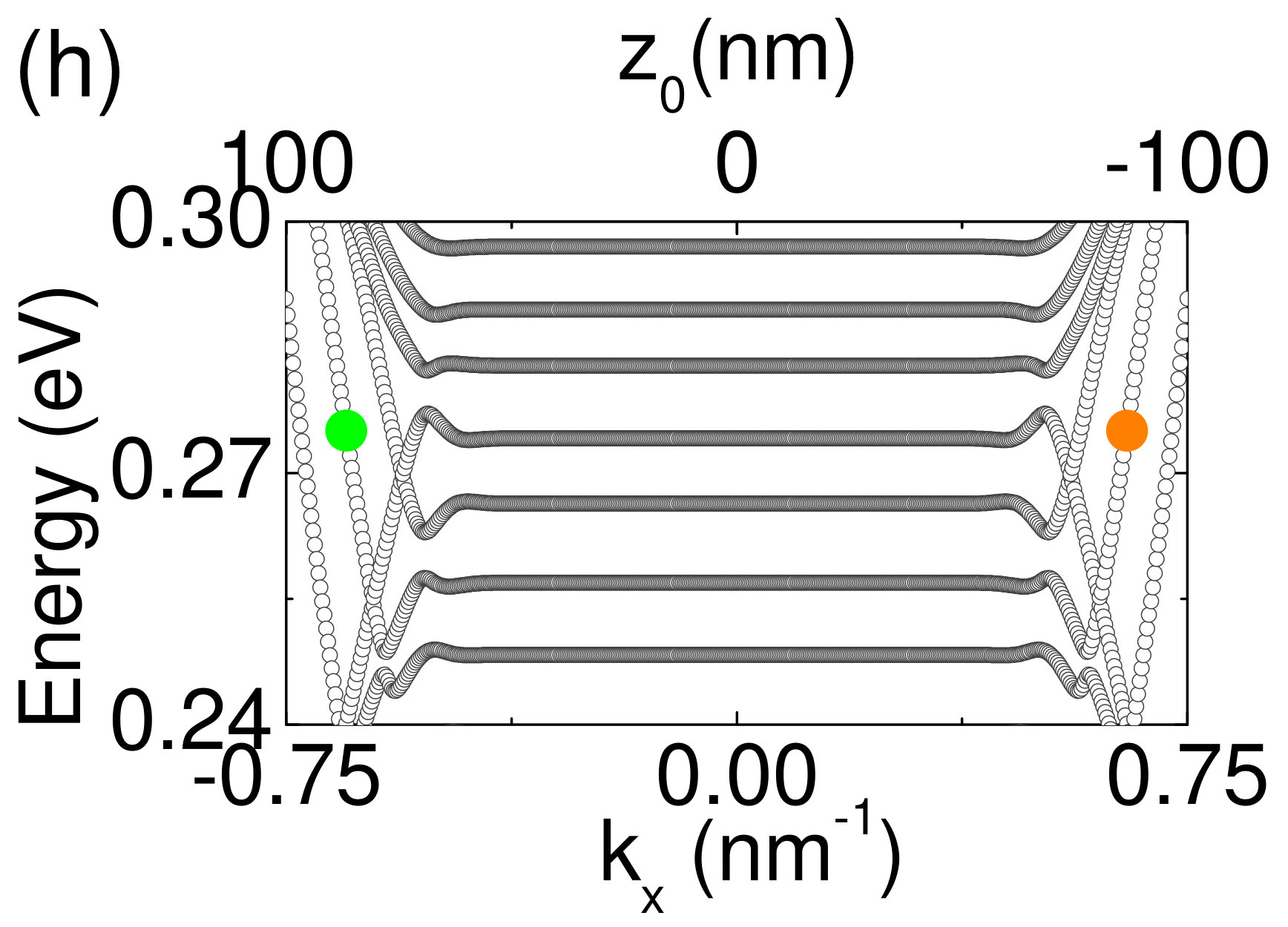 Figure 11
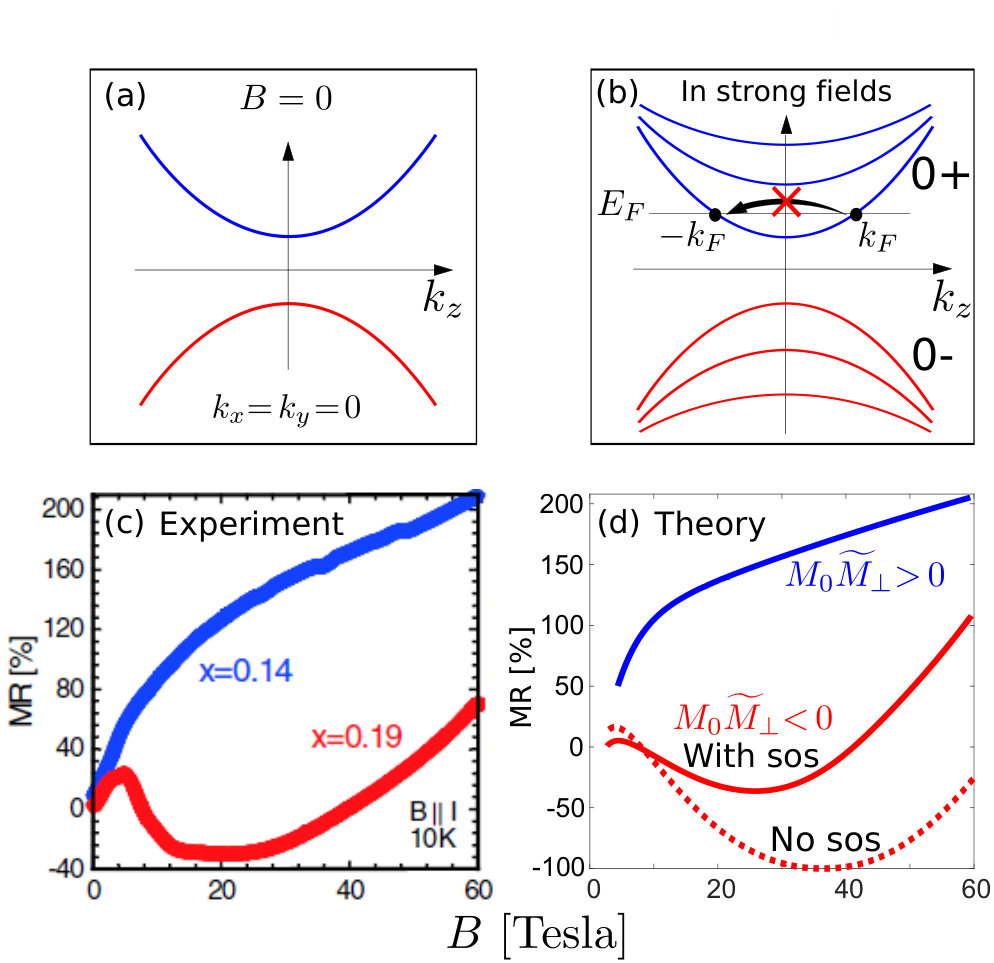 Figure 1
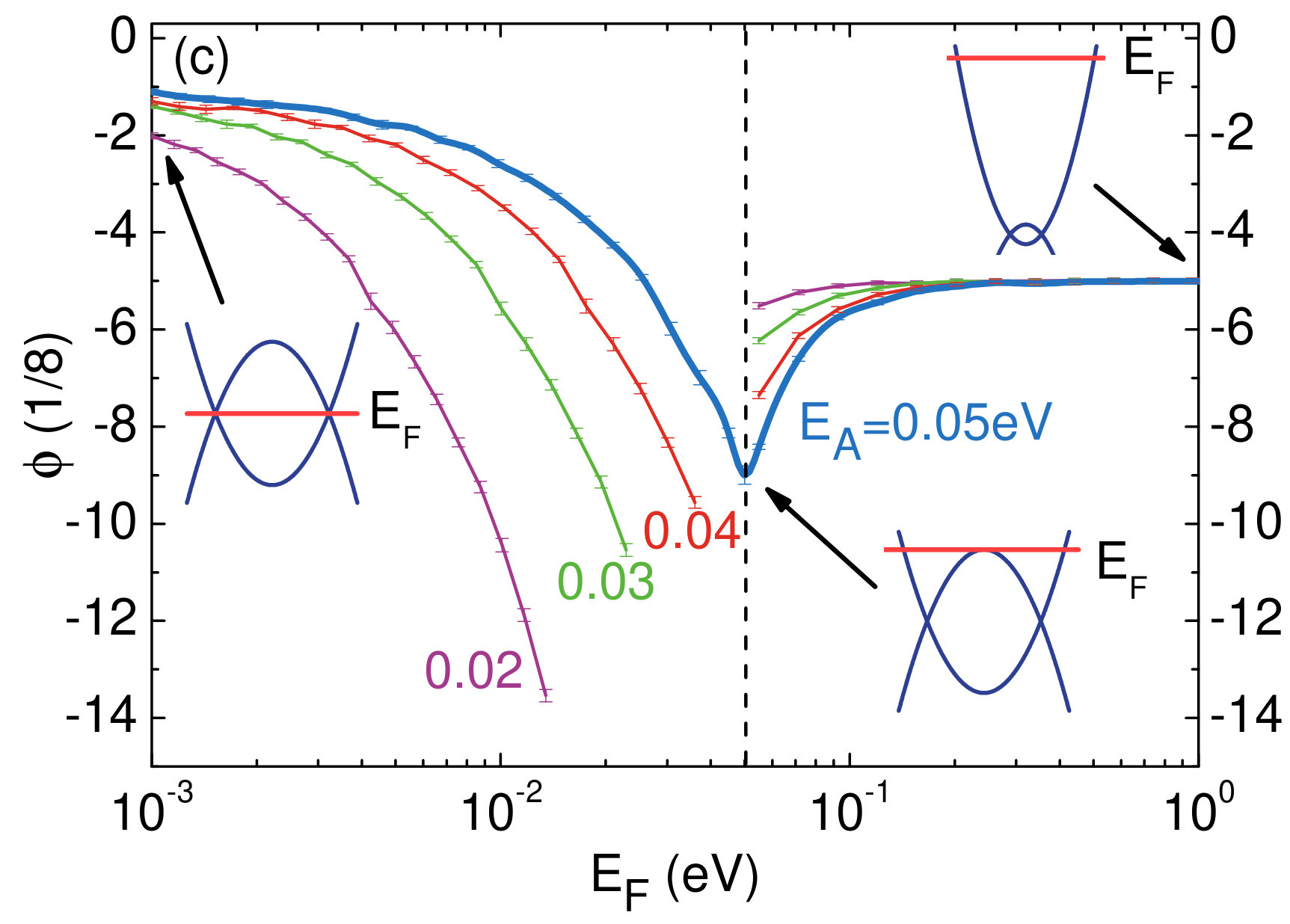 Figure 13
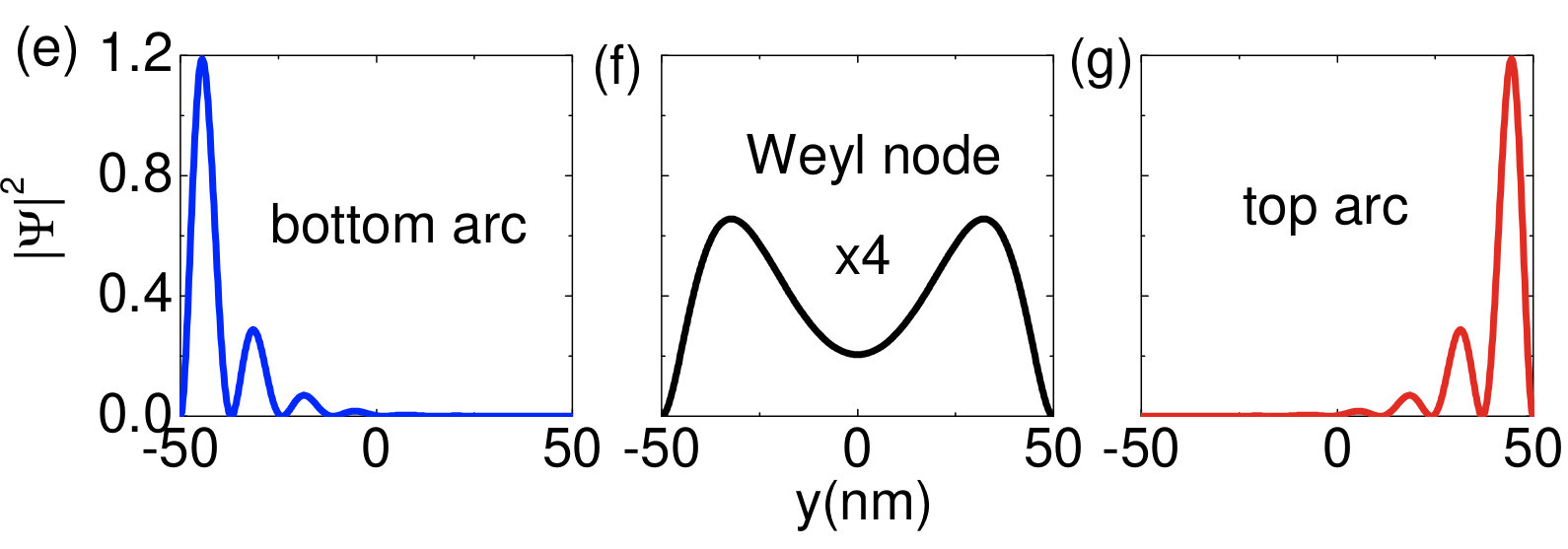 Figure 14
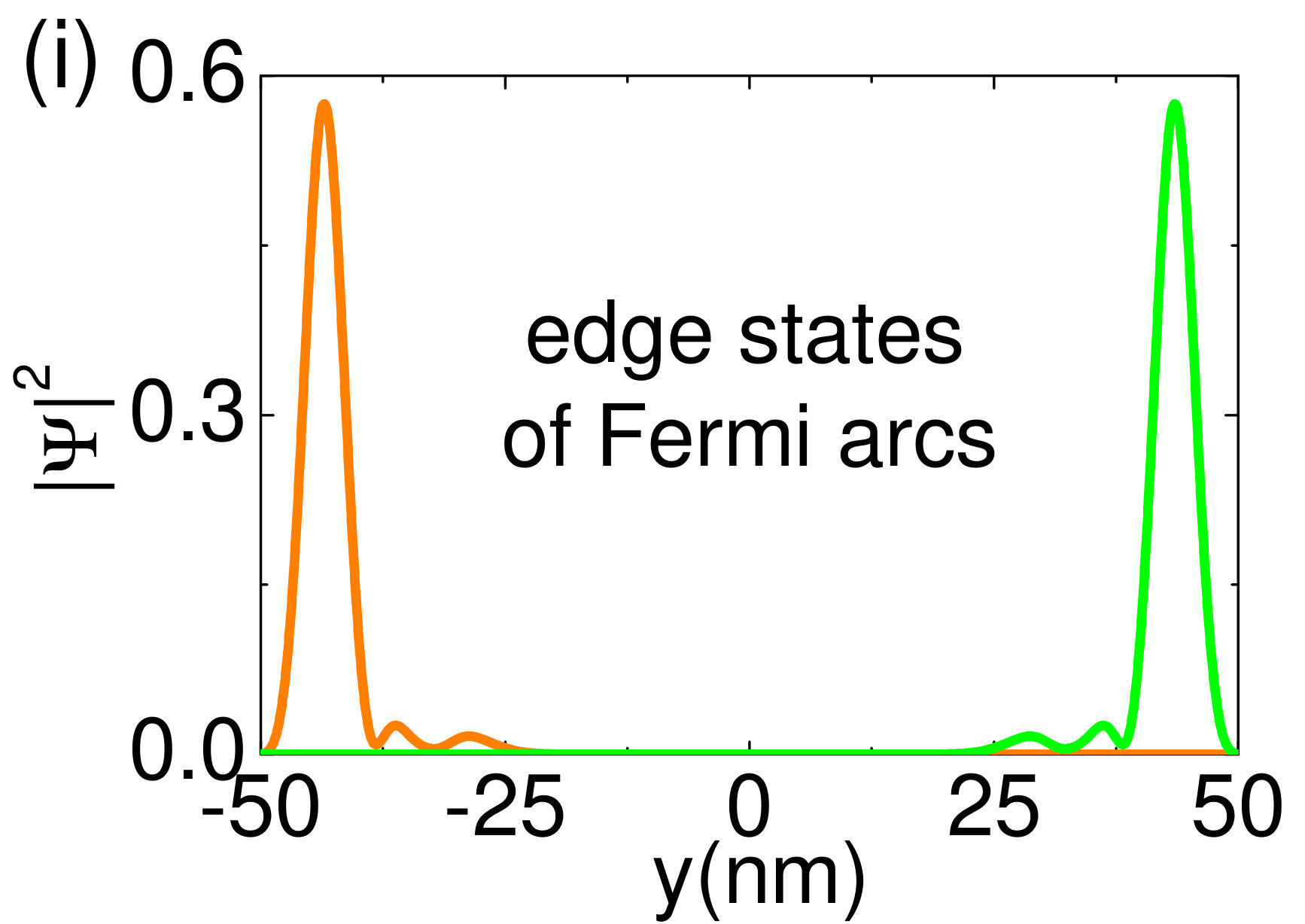 Figure 15
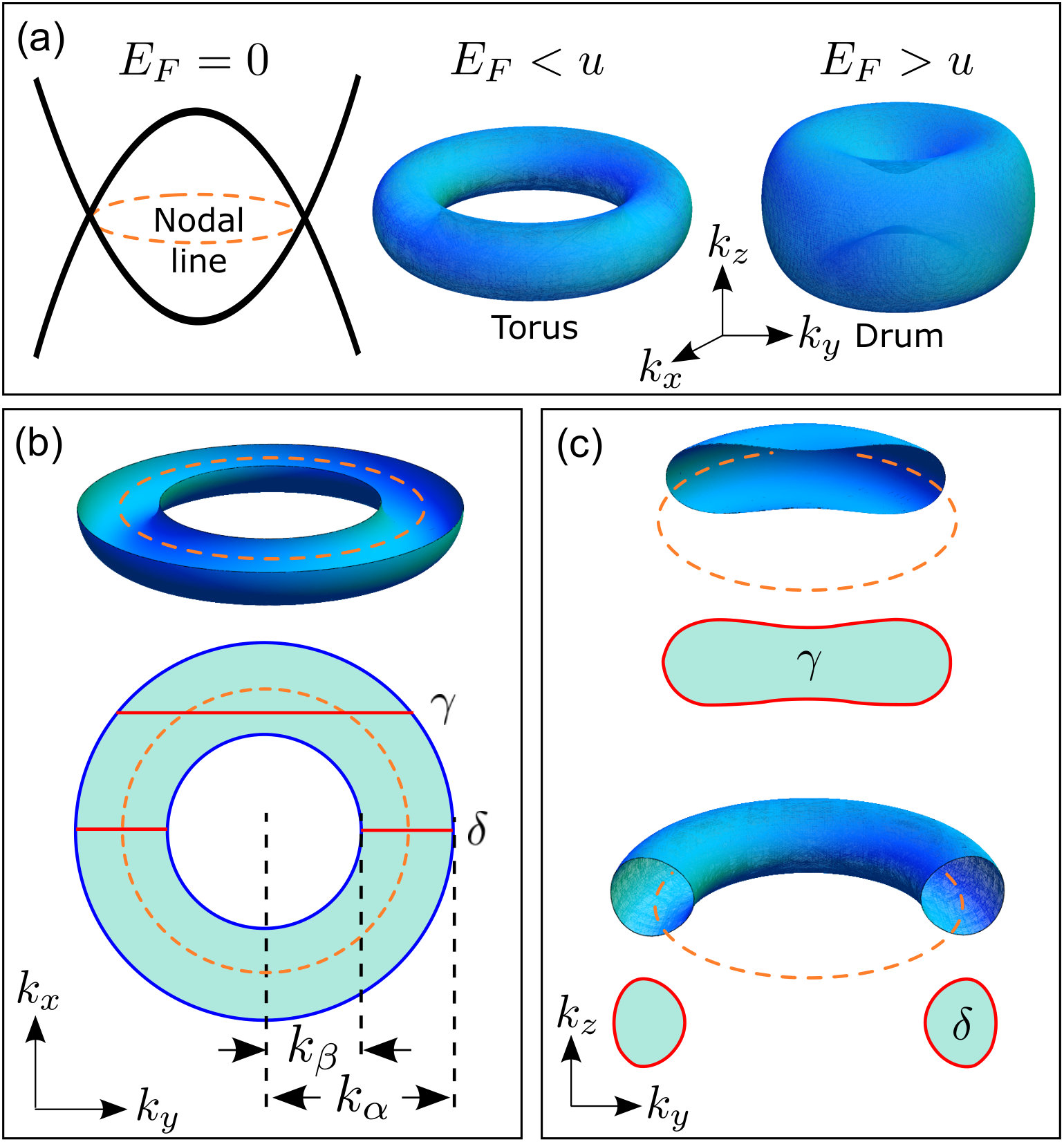 Figure 16
| System | Electron carrier | Hole carrier |
|---|---|---|
| 2D parabolic | 1/2 | |
| 3D parabolic | 5/8 | |
| 2D linear | 0 | 0 |
| 3D linear | 1/8 | |
| Nodal-line in | , | , |
| Nodal-line in | , | , |
| Longitudinal | Transverse | |||
|---|---|---|---|---|
| Parabolic | Linear | Parabolic | Linear | |
| -5/8 | -1/8 | -5/8 | -1/8 | |
| Berry | Min. | Electron | Hole | |
|---|---|---|---|---|
| phase | /max. | |||
| 0 | Max. | |||
| 0 | Min. | |||
| 0 | Max. | |||
| Min. |
| Longitudinal | Transverse | |||
|---|---|---|---|---|
Peer Reviews
No public reviews on file for this paper yet. If you reviewed it on a platform where reviews are public (OpenReview, ICLR, NeurIPS, ICML), you can paste yours below so the community can read it here.
Videos
No videos yet. Explain this paper in a talk, walkthrough, or lecture? Add one.
Quantum Transport in Topological Semimetals under Magnetic Fields (II)
Hai-Peng Sun
Department of Physics, Harbin Institute of Technology, Harbin 150001, China
Shenzhen Institute for Quantum Science and Engineering and Department of Physics, Southern University of Science and Technology, Shenzhen 518055, China
Shenzhen Key Laboratory of Quantum Science and Engineering, Shenzhen 518055, China
Hai-Zhou Lu
Corresponding author: [email protected]
Shenzhen Institute for Quantum Science and Engineering and Department of Physics, Southern University of Science and Technology, Shenzhen 518055, China
Shenzhen Key Laboratory of Quantum Science and Engineering, Shenzhen 518055, China
Abstract
We review our recent works on the quantum transport, mainly in topological semimetals and also in topological insulators, organized according to the strength of the magnetic field. At weak magnetic fields, we explain the negative magnetoresistance in topological semimetals and topological insulators by using the semiclassical equations of motion with the nontrivial Berry curvature. We show that the negative magnetoresistance can exist without the chiral anomaly. At strong magnetic fields, we establish theories for the quantum oscillations in topological Weyl, Dirac, and nodal-line semimetals. We propose a new mechanism of 3D quantum Hall effect, via the “wormhole” tunneling through the Weyl orbit formed by the Fermi arcs and Weyl nodes in topological semimetals. In the quantum limit at extremely strong magnetic fields, we find that an unexpected Hall resistance reversal can be understood in terms of the Weyl fermion annihilation. Additionally, in parallel magnetic fields, longitudinal resistance dips in the quantum limit can serve as signatures for topological insulators.
Keywords: topological semimetal, topological insulator, quantum oscillation, negative magnetoresistance, quantum Hall effect
Contents
-
III Weak field: Negative magnetoresistance in topological insulators
-
III.3 Comparison with negative magnetoresistance in experiments
-
IV Strong field: Quantum oscillation in Weyl and Dirac semimetals
-
IV.1 Quantum oscillation in linear and parabolic limits of a Weyl semimetal
-
IV.3 Anomalous phase shift near the Lifshitz point of Weyl and Dirac semimetals
-
V Strong field: Quantum oscillation in nodal-line semimetals
-
VII.1 Calculation of Landau bands with magnetic fields in the x-z plane
-
VIII Extremely strong field: Forbidden backscattering and resistance dip in the quantum limit
I Introduction
In the previous article, we have reviewed our recent works on quantum transport phenomena in topological Weyl and Dirac semimetals under magnetic fields Lu and Shen (2017), which covers weak (anti-)localization Lu and Shen (2015); Dai et al. (2016), negative magnetoresistance in Weyl/Dirac semimetals Li et al. (2016a), and magnetotransport in the quantum limit Lu et al. (2015a); Zhang et al. (2016a). In this review, we summarize our recent works that were not addressed In Ref. Lu and Shen (2017), specifically, on the 3D quantum Hall effect Wang et al. (2017), quantum oscillations in Weyl/Dirac Wang et al. (2016a) and nodal-line semimetals Li et al. (2018), and negative magnetoresistance in topological insulators Dai et al. (2017), Weyl-node annihilation, Zhang et al. (2017a) and vanishing backscattering Chen et al. (2018a) in the quantum limit. Following the structure in the previous review, these phenomena are organized depending on the strength of the magnetic field. There are several recent review papers on topological semimetals Weng et al. (2016a); Yan and Felser (2017); Armitage et al. (2018); Wang and Wang (2018).
The structure of this review is as the following. In Sec. II, we introduce the models we used for describing Weyl, Dirac, nodel-line semimetals, and topological insulators. In Sec. III, we survey the negative magnetoresistance without chiral anomaly in topological insulators Dai et al. (2017). In Sec. IV, we discuss quantum oscillations with the anomalous phase shift in topological semimetals Wang et al. (2016a). In Sec. V, we present the rules for phase shifts of quantum oscillations in topological nodal-line semimetals Li et al. (2018). In Sec. VI, we predict a 3D quantum Hall effect of Fermi arcs in topological semimetals Wang et al. (2017). In Sec. VII, we present the theory for the Weyl fermion annihilation in the quantum limit. The signature is recently observed as a sharp reversal in the Hall resistance of the topological Weyl semimetal TaP at extremely strong magnetic fields Zhang et al. (2017a). In Sec. VIII, we propose that resistance dips in the quantum limit can serve as a signature for topological insulators because of forbidden backscattering Chen et al. (2018a). Finally, we remark on future works in IX.
II Models for topological semimetals and insulators
In this section, we introduce the models we used for describing Weyl, Dirac, nodel-line semimetals, and topological insulators.
II.1 Topological Weyl semimetal
The topological Weyl and Dirac semimetal are 3D topological states of matter Wan et al. (2011); Yang et al. (2011); Burkov and Balents (2011); Xu et al. (2011); Delplace et al. (2012); Jiang (2012); Young et al. (2012); Wang et al. (2012a); Singh et al. (2012); Wang et al. (2013); Liu and Vanderbilt (2014); Bulmash et al. (2014). Their energy bands touch at the Weyl nodes which host monopoles. The Weyl nodes have been verified in the Dirac semimetals Na3Bi Wang et al. (2012a); Liu et al. (2014a); Xu et al. (2015a) and Cd3As2 Wang et al. (2013); Liu et al. (2014b); Neupane et al. (2014); Borisenko et al. (2014); Yi et al. (2014); Zhang et al. (2017b); Li et al. (2015, 2016a), and the Weyl semimetal TaAs family Huang et al. (2015a); Weng et al. (2015a); Lv et al. (2015a, b, c); Xu et al. (2015b); Yang et al. (2015a); Liu et al. (2015); Zhang et al. (2016b); Huang et al. (2015b); Yang et al. (2015a); Xu et al. (2015c, 2016a, 2016b); Belopolski et al. (2016a, b); Xu et al. (2015d), \colorblue TaIrTe4 Belopolski et al. (2017a) and YbMnBi2 Borisenko et al. (2015). Also, Weyl semimetals can be induced from half-Heusler compounds by applying magnetic fields Hirschberger et al. (2016); Felser and Yan (2016); Shekhar et al. (2018).
According to Sec. 2.1 of Lu and Shen (2017), a Weyl semimetal can be described by a two-node Hamiltonian Shen (2017); Okugawa and Murakami (2014); Lu et al. (2015b)
[TABLE]
where are the Pauli matrices, is the wave vector , , , and are model parameters. The eigen energies of the Hamiltonian are , with for the conduction band and for the valence band. The two Weyl nodes are at , and it has been demonstrated that the model is of all the topological semimetal properties Lu et al. (2015b), in particular, the Fermi arcs Zhang et al. (2016a), different from the model Ashby and Carbotte (2014); Gorbar et al. (2014); Lu and Shen (2015). This model has the topological properties because of the term Lu et al. (2010). For the 3D quantum Hall effect in Sec. VI, the above model is added with two trivial terms Shen (2017); Okugawa and Murakami (2014); Lu et al. (2015b)
[TABLE]
II.2 Topological Dirac semimetal
A Dirac semimetal can be regarded as a Weyl semimetal and its time-reversal partner. Dirac semimetals can be studied by using the Hamiltonian Wang et al. (2012a, 2013); Jeon et al. (2014)
[TABLE]
where is the factor for the band, is the factor for the band Jeon et al. (2014), , , and . The , , and axes in the Hamiltonian are defined along the [100], [010], and [001] crystallographic directions, respectively.
II.3 Topological nodal-line semimetal
Nodal-line semimetals Burkov et al. (2011); Chiu and Schnyder (2014); Fang et al. (2016); Yang et al. (2017a), in which the cross sections of conduction and valence bands are closed rings [Fig. 3(a)] in momentum space Chen et al. (2015a); Bzdušek et al. (2016); Feng et al. (2018); Yi et al. (2018), have the drumhead surface states, of which the direct evidence is still missing Chen et al. (2018b). Recently, a new type of surface state called the floating band was discovered in the nodal-line semimetal ZrSiSe Zhu et al. (2018). Besides, when the symmetries are broken, the nodal-line semimetals may develop into Dirac semimetals, topological insulators, and surface Chern insulators Chen and Lado (2018). The nodal lines are predicted in many materials, such as HgCr2Se4 Xu et al. (2011), graphene networks Weng et al. (2015b), Cu3(Pd/Zn)N Yu et al. (2015); Kim et al. (2015), SrIrO3 Fang et al. (2015); Chen et al. (2015b), TlTaSe2 Bian et al. (2016a), Ca3P2 Xie et al. (2015); Chan et al. (2016), CaTe Du et al. (2017), compressed black phosphorus Zhao et al. (2016), CaAg(P/As) Yamakage et al. (2015), CaP3 family Xu et al. (2017a), PdS monolayer Jin et al. (2017), Zintl compounds Zhu et al. (2016), BaMX3 (M=V, Nb and Ta, X=S, Se) Liang et al. (2016), rare earth monopnictides Zeng et al. (2015), alkaline-earth compounds Hirayama et al. (2017); Huang et al. (2016a); Li et al. (2016b), other carbon-based materials Chen et al. (2015a); Wang et al. (2016b), and metallic rutile oxides XO2 (X=Ir, Os, Rd) Sun et al. (2017). So far, the nodal lines have been verified in ZrSiS Schoop et al. (2016); Neupane et al. (2016); Chen et al. (2017a), PbTaSe2 Bian et al. (2016b); Chang et al. (2016a), InBi Ekahana et al. (2017) and PtSn4 Wu et al. (2016) by ARPES.
The Hamiltonian of nodal-line semimetals can be described as Bian et al. (2016a, b)
[TABLE]
where is the wave vector, , are the Pauli matrices, , , and are model parameters Bian et al. (2016b, a). The eigen energies of the Hamiltonian are . When is positive, two bands intersect at zero energy as , which describes the nodal-line ring. The radius of the nodal ring is [Fig. 3(a)]. When , the dispersions result in a torus Fermi surface [Fig. 3(a)]. When , the Fermi surface evolves into a drum-like structure [Fig. 3(a)]. Because of the low carrier density of the samples in experiments Schoop et al. (2016); Neupane et al. (2016), we focus on the case that . Moreover, the model in Eq. (4) is of the mirror reflection symmetry Bian et al. (2016a, b). Nodal lines can also be protected by other symmetries Fang et al. (2016); Kim et al. (2015); Bzdušek et al. (2016); Alexandradinata and Glazman (2018), for example, two-fold screw rotation Fang et al. (2015); Chen et al. (2015b), four-fold rotation, inversion Fang et al. (2016) and non-symmorphic symmetry through a glide plane Schoop et al. (2016); Neupane et al. (2016), etc.
II.4 Topological insulator
3D topological insulators can be described by the Hamiltonian Zhang et al. (2009); Shen (2017); Nechaev and Krasovskii (2016)
[TABLE]
where , , , and are model parameters. The model depicts a 3D strong topological insulator as and Shen (2017). There are four energy bands near the point, two conduction bands and two valence bands (see Fig. 2 In Ref. Dai et al. (2017)). The model has been shown effective to give proper descriptions for the topological surface states Lu et al. (2010); Shan et al. (2010); Zhang et al. (2010) and explain the negative magnetoresistance in topological insulators Dai et al. (2017); Wang et al. (2012b); He et al. (2013); Wiedmann et al. (2016); Wang et al. (2015).
In the presence of the magnetic field, the Zeeman Hamiltonian reads
[TABLE]
where are Landé g-factors for valence/conduction bands along the direction and in the plane and is the Bohr magneton.
III Weak field: Negative magnetoresistance in topological insulators
Recently discovered topological semimetals can host the chiral anomaly, namely, the violation of the conservation of chiral current Adler (1969); Bell and Jackiw (1969); Nielsen and Ninomiya (1981), which is widely believed to be the cause of the negative magnetoresistance Kim et al. (2013, 2014); Li et al. (2016c); Zhang et al. (2016b); Huang et al. (2015b); Xiong et al. (2015); Li et al. (2015); Zhang et al. (2017b); Li et al. (2016a); Arnold et al. (2016a); Yang et al. (2015b, c); Wang et al. (2016c). Nevertheless, in topological insulators, where the chiral anomaly is not well defined in the momentum space, a negative magnetoresistance can also be observed. This results in great confusion Wang et al. (2012b); He et al. (2013); Wiedmann et al. (2016); Wang et al. (2015); Breunig et al. (2017); Assaf et al. (2017); Zhang et al. (2018a) on the explanation of the negative magnetoresistance. Lately, it is found that the chiral anomaly in real space can be defined in a quantum spin Hall insulator Fleckenstein et al. (2016). In Ref. Dai et al. (2017), we use the semiclassical Boltzmann formalism with the Berry curvature and orbital moment, to explain the negative magnetoresistance in topological insulators, and show a quantitative agreement with the experiments (see Fig. 1).
III.1 Anomalous velocity
The Berry curvature and orbital moment will induce the anomalous velocity, which may lead to the negative magnetoresistance. In experiments, the negative magnetoresistance exists above K Wiedmann et al. (2016), thus quantum interference mechanisms can be excluded. In addition, due to the poor mobility in the topological insulators Bi2Te3 and Bi2Se3 Culcer (2012), when the magnetic field is up to 6 Tesla, the Landau levels cannot be well-formed. In the semiclassical regime, the electronic transport can be described by the equations of motion Sundaram and Niu (1999)
[TABLE]
where both the position and wave vector appear simultaneously, and are their time derivatives, is the electron charge, and are external electric and magnetic fields, respectively. , is the band dispersion, is the orbital moment induced by the semiclassical self-rotation of the Bloch wave packet, and is the Berry curvature Xiao et al. (2010). In the linear-response limit (), Eq. (11) yields an effective velocity
[TABLE]
where is the correction to the density of states, and
[TABLE]
Due to the Berry curvature, the velocity develops an anomalous term, which is proportional to . Note that the conductivity is the current-current (velocity-velocity) correlation Mahan (1990), thus the presence of the anomalous velocity is expected to generate an extra conductivity, which grows with the magnetic field, namely, a negative magnetoresistance. It has been implied that the negative magnetoresistance in topological semimetals is related to the Berry curvature Son and Spivak (2013); Yip (2015); Lu and Shen (2017). In our previous review Lu and Shen (2017), we have shown that the Berry curvature Sundaram and Niu (1999) can lead to a conductivity correction that grows with magnetic field ,
[TABLE]
where is the Fermi wave vector and the carrier density is directly proportional to . This is an alternative understanding to the negative magnetoresistance induced by the chiral anomaly. Ref. Dai et al. (2017) shows that this mechanism is large enough in topological insulators as those observed in the experiments, where the relative magnetoresistance can exceed -1% in a parallel magnetic field of several Tesla Wang et al. (2012b); He et al. (2013); Wang et al. (2015); Wiedmann et al. (2016); Breunig et al. (2017); Assaf et al. (2017); Zhang et al. (2018a).
III.2 Magnetoresistance formula
In our calculation, the relative magnetoresistance is defined as . In the semiclassical Boltzmann formalism, the longitudinal conductivity is contributed by all the bands crossing the Fermi energy, and for band Yip (2015)
[TABLE]
where is suppressed for simplicity, and are given by Eq. (13), is the Fermi distribution in equilibrium, the transport time is assumed to be a constant in the semiclassical limit Burkov (2014). For the -th band of the Hamiltonian , the component of the Berry curvature vector can be found as , where stand for , and is the Levi-Civita anti-symmetric tensor, and
[TABLE]
where . The orbital moment can be found as
[TABLE]
The Zeeman energy can induce a finite distribution of and Dai et al. (2017).
III.3 Comparison with negative magnetoresistance in experiments
Figures 1 shows that the numerically calculated relative magnetoresistance in parallel magnetic fields are negative and decrease monotonically with the magnetic field. They can be fitted by at small magnetic fields and conform to the Onsager reciprocity MR=MR. We also use a tight-binding model Mao et al. (2011) to justify the calculation. Figure 1 shows a good agreement on the negative magnetoresistance between the experiments and our numerical calculations. The current direction and temperature are from the experiments and the model parameters are from the calculations Nechaev and Krasovskii (2016) and experiments Wolos et al. (2016). In the experiment by Wang et al. Wang et al. (2012b), the temperature is 1.8 K, so the original data (orange triangles) has a positive magnetoresistance near zero field due to the weak anti-localization Checkelsky et al. (2009); Chen et al. (2010); Wang et al. (2011); He et al. (2011). The weak anti-localization induces a positive magnetoresistance Lu and Shen (2015), which is subtracted before the comparison. In the experiments by Wiedmann et al. Wiedmann et al. (2016) and He et al. He et al. (2013), the temperatures are 29 K and 300 K, there is no weak anti-localization effect. The negative magnetoresistance does not change much with temperature Dai et al. (2017), consistent with the experiments and showing the semi-classical nature of the negative magnetoresistance. The negative magnetoresistance becomes enhanced as the Fermi level approaches the band bottom Dai et al. (2017), indicating the role of the Berry curvature. Ref. Dai et al. (2017) also shows that the signs of -factors in the Zeeman coupling determine the signs of magnetoresistance qualitatively. In the experiment, the techniques used for topological insulators, for example, electron spin resonance and quantum oscillations, can not determine the signs of -factors but only their absolute values Wolos et al. (2016); Köhler and Wöchner (1975). Transport measurements can determine the sign of the -factor only in specific setups Srinivasan et al. (2016). The orbital moment has been neglected in most of the literature studying the magneto-transport using the semiclassical formalism Son and Spivak (2013); Yip (2015). As shown in Refs. Morimoto et al. (2016); Gao et al. (2017), the orbital moment is essential for the magnetoresistance anisotropy in a Weyl semimetal. Moreover, the correction to can enhance the band separation and the negative magnetoresistance. The orbital moment effectively enhances the MRx a few times larger. MRz can be even positive without .
III.4 Discussions
The conventional equations of motion in the low-field semiclassical regime () are only accurate to the linear order in the external fields ( and ), thus for studying magnetoconductivity which is an intrinsically nonlinear coefficient, the obtained results would not be complete. Based on a recently developed semiclassical theory with second-order accuracy Gao et al. (2014, 2015), a complete theory of magnetoconductivity for general 3D nonmagnetic metals was formulated within the Boltzmann framework with the relaxation time approximation Gao et al. (2017). The work shows several surprising results. First, there is an important previously unknown Fermi surface contribution to the magnetoconductivity, termed as the intrinsic magnetoconductivity, because the ratio is independent of the relaxation time. Here is the conductivity at . Second, a pronounced term can lead to the violation of Kohler’s rule. Previously, any deviation from Kohler’s rule is usually interpreted as from factors beyond the semiclassical description or from the presence of multiple types of carriers or multiple scattering times. The result here reveals a new mechanism for the breakdown of Kohler’s rule. Third, can lead to a positive longitudinal magnetoconductivity (or negative longitudinal magneto-resistivity). The effect is independent of chiral anomaly effect for the Weyl/Dirac fermions, and it can occur for a generic doped semiconductor without any band crossings. This indicates that positive longitudinal magnetoconductivity measured in the semiclassical regime alone cannot be regarded as smoking-gun evidence for the existence of topological band crossings. The intrinsic contribution generally exists in 3D metals with nontrivial Berry curvatures, and should be taken into account when interpreting experimental results. It may already play an important role behind the puzzling magnetotransport signals observed in recent experiments on TaAs2 and related materials.
In the quantum limit where only the lowest Landau band is occupied, magnetoresistance depends subtly on scattering mechanisms Lu et al. (2015a); Goswami et al. (2015); Zhang et al. (2016a), rather than the Berry curvature and orbital moment. The current-jetting effect is usually induced by inhomogeneous currents when attaching point contact electrodes to a large bulk crystal and may also hamper the interpretation of the negative magnetoresistance data dos Reis et al. (2016). A recent work also has pointed out that the negative magnetoresistance may exist without the chiral anomaly Andreev and Spivak (2018). In (Bi1-xInx)2Se3, it is proposed that the in-plane negative magnetoresistance is due to the topological phase transition enhanced intersurface coupling near the topological critical point Zhang et al. (2018a). In addition, it is also found that the magnetoresistance is robust against the deviation from the ideal Weyl Hamiltonian, such as the shifted Fermi energy, nonlinear dispersions, and the Weyl node annihilation Ishizuka and Nagaosa (2018).
IV Strong field: Quantum oscillation in Weyl and Dirac semimetals
When applying a magnetic field in the -direction, the energy spectrum evolves into a series of 1D Landau bands Lu et al. (2015b); Zhang et al. (2016a) (see Fig. 1(b)-(c) of Wang et al. (2016a)), which result in the Shubnikov-de Haas (SdH) oscillation of resistance. The oscillation of the resistivity can be demonstrated by the Lifshitz-Kosevich formula Shoenberg (1984)
[TABLE]
where is the phase shift, is the oscillation frequency and is the magnitude of magnetic field. and can reveal valuable details on the Fermi surface of the material.
The phase shift of each frequency component can be argued as the following
[TABLE]
where is a correction, which emerges only in 3D, and is the Berry phase Mikitik and Sharlai (1999); Xiao et al. (2010). The curvature of the Fermi surface along the direction of the magnetic field determines the sign of Lifshitz and Kosevich (1956); Shoenberg (1962); Coleridge and Templeton (1972); Luk’yanchuk and Kopelevich (2004). When the cross section is maximum, for electron carriers and for hole carriers ; when the cross section is minimum, for electron carriers and for hole carriers . For the sphere Fermi surface, there is only a maximum, thus for electron carriers and for hole carriers . For a parabolic energy band, it does not have Berry phase, thus the phase shift is and in 2D and 3D, respectively. However, a linear energy band (for example, Weyl and Dirac semimetalsVolovik (2003); Wan et al. (2011); Xu et al. (2011); Burkov and Balents (2011); Yang et al. (2011)) has an extra Berry phase Mikitik and Sharlai (1999), thus the phase shift is [math] Zhang et al. (2005) and Murakawa et al. (2013) in 2D and 3D, respectively. In a nodal-line semimetal Burkov et al. (2011); Chiu and Schnyder (2014); Fang et al. (2016); Yang et al. (2017a), an electron can collect a nontrivial Berry phase around the loop encircling the nodal line Fang et al. (2015). The phase shifts of 2D and 3D bands with linear and parabolic dispersions are summarized in Table 1.
Topological Weyl/Dirac semimetals and nodal-line semimetals provide a novel platform to explore the nontrivial Berry phase Murakawa et al. (2013); He et al. (2014); Novak et al. (2015); Zhao et al. (2015); Du et al. (2016); Yang et al. (2015c); Wang et al. (2016d); Xiong et al. (2015); Cao et al. (2015); Zhang et al. (2015a); Narayanan et al. (2015); Park et al. (2011); Xiang et al. (2015); Tafti et al. (2016); Luo et al. (2015); Dai et al. (2016); Arnold et al. (2016b); Klotz et al. (2016); dos Reis et al. (2016); Sergelius et al. (2016). In Ref. Wang et al. (2016a), we show that, near the Lifshitz point, the phase shift of the quantum oscillation can go beyond recognized values of or and nonmonotonically move toward a wide range between and . However, these values in experiments may be misunderstood as . For Dirac semimetals, the total phase shift adopts the discrete values of or . In recent experiments of electron carriers, the positive phase shifts are observed and may be explained by our findings. In addition, a new beating pattern, resulting from the topological band inversion, is found. Up to now, quantum oscillations have been inspected experimentally in HfSiS Kumar et al. (2017), ZrSiS Singha et al. (2017); Ali et al. (2016); Wang et al. (2016e); Lv et al. (2016); Hu et al. (2017a); Pan et al. (2018), ZrSi(Se/Te) Hu et al. (2016a) and ZrGe(S/Se/Te) Hu et al. (2017b), but the phase shifts have been concluded different. In Ref. Li et al. (2018), the phase shifts and frequencies (Table 5) of nodal-line semimetals are extracted from analytic results of the calculated resistivity. We also summarize the generic rules for phase shifts in random cases (Table 4). The generic rules assist us to handle several materials, for example, ZrSiS and Cu3PdN Singha et al. (2017); Ali et al. (2016); Wang et al. (2016e); Lv et al. (2016); Hu et al. (2017a); Pan et al. (2018).
IV.1 Quantum oscillation in linear and parabolic limits of a Weyl semimetal
The resistivity is calculated in two direction configurations according to linear response theory Charbonneau et al. (1982); Vasilopoulos and Van Vliet (1984); Wang and Lei (2012, 2015). For the longitudinal configuration, the resistivity is examined along direction. For the transverse configuration, the resistivity is examined along direction. The magnetoresistivity in the linear dispersion limit and parabolic dispersion limit takes the form of Eq. (18). In Table 2, we list the analytic expressions for the phase shift and frequency in these two limits.
IV.2 Resistivity peaks and integer Landau indices
In the experiment, the peak positions or valley positions, that are on the axis, are given the integer Landau indices , then the phase shift and frequency can be extracted from a plot of and [see inset of Fig. 1(d) of Wang et al. (2016a)]. Nevertheless, it is still in debate that whether the peaks Murakawa et al. (2013); Zhao et al. (2015); He et al. (2014); Zhao et al. (2015); Du et al. (2016); Yang et al. (2015c); Wang et al. (2016d); Cao et al. (2015) or valleys Narayanan et al. (2015); Qu et al. (2010); Park et al. (2011); Luo et al. (2015) should be given the Landau indices. Our results explicitly reveal that the resistivity peaks of and emerge near the Landau band edges and are in correspondence with the integer Landau indices. We evaluate the resistivity components theoretically from the conductivity components Datta (1997); Vasko and Raichev (2006). For the longitudinal configuration, the resistivity =, where the conductivity is along direction. Near band edges, the conductivity shows valleys due to vanishing velocities, thus shows peaks. For the transverse configuration, , and the longitudinal Hall conductivity and field-induced Hall conductivity are as follows
[TABLE]
where is the oscillation part and represents the zero-field conductivity. In , the term, which comes from the disorder scattering, was rarely considered before. A consequence of the term is that , up to the first order of . As and are both proportional to , their peaks are lined up for the random ratio of to (but when , the oscillation is so weak that it is hard to be observed ). This new finding comes from the disorder scattering term in the Hall conductance. At the same time, the valleys are lined up with the peaks, since , which comes from diffusion, is in proportion to the scattering times. However, , which arises from hopping is inversely in proportion to the scattering times Abrikosov (1998); Lu et al. (2015b); Vasilopoulos and Van Vliet (1984). To sum up, the peak positions follow the relation , thus and present peaks near Landau band edges and their phase shifts are the same.
IV.3 Anomalous phase shift near the Lifshitz point of Weyl and Dirac semimetals
Figure 2 shows the results of the frequency and the phase shift calculated numerically for the model in Eq. (1). In Fig. 2(c), the numerical results are in agreement with the analytical prediction for the linear limit () and for the parabolic limit (). We define and . For , the - curves break as the beating patterns emerge. In Fig. 2 (c), for , the phase shift drops below rather than shift monotonically from -1/8 to -5/8 around the Lifshitz transition point (namely, ). This is because there is no simple dependence Wang et al. (2016a). At the Lifshitz point, we can analytically show that the phase shift is , which is in agreement with that in Fig. 2 (c). It is equivalent to , which is usually considered to originate from the Berry phase as the Fermi sphere encircles the single Weyl node. Nevertheless, the Fermi sphere encircles two Weyl nodes when the Fermi energy is at the Lifshitz point. For , there is no nonmonotonicity in .
A Weyl semimetal combine with its time-reversal counterpart can compose a Dirac semimetal. The model of a Dirac semimetal can be made by in Eq. (1), integrated with its time-reversal counterpart , where the asterisk indicates complex conjugate. This model can be treated as a building block for Weyl semimetals, which respect time-reversal symmetry and meanwhile break inversion symmetry Huang et al. (2015a); Weng et al. (2015a); Lv et al. (2015a); Xu et al. (2015b); Yang et al. (2015a); Liu et al. (2015); Zhang et al. (2016b); Huang et al. (2015b); Xu et al. (2015c, 2016a). Here, for the Dirac semimetal, the total phase shift may take two values, for and or for . Around the Lifshitz point, the total phase shift may change between the two values.
The electron carriers is supposed to yield negative phase shifts and the hole carriers is supposed to yield positive phase shifts Murakawa et al. (2013). Nevertheless, in experiments of the Dirac semimetal Cd3As2, the phase shift for electron carriers takes positive values He et al. (2014); Narayanan et al. (2015); Zhao et al. (2015). One explanation may be that, for the phase shift to in the experiments, their actual values are around to due to the periodicity. Our numerical results show that the total phase shift adopts these values from around the Lifshitz point to higher Fermi energies, which is also consistent with the carrier density in the experiments. In Table 3, we propose the counterparts for the experimental values of the phase shift. In Ref. Wang et al. (2016a), we also demonstrate that beating patterns will emerge because of the band inversion, that is different from orbital quantum interference Xiong et al. (2016), the Zeeman splitting Zhang et al. (2015a); Hu et al. (2016b); Cao et al. (2015) and nested Fermi surfaces Zhao et al. (2015).
V Strong field: Quantum oscillation in nodal-line semimetals
V.1 Phase shifts of nodal-line semimetals
The frequencies and phase shifts can be analyzed from the Fermi surface described by Eq. (4). From the Onsager relation, we have , where is the area of the extremal cross section on the Fermi surface perpendicular to the magnetic field Onsager (1952). When the nodal-line plane is perpendicular to a magnetic field, specifically here, there are two extremal cross sections at the plane [Fig. 3(b)] . Combining this dispersion with the Onsager relation, we find that the high frequency is for the outside circle and the low frequency is for the inside circle. These two frequencies may lead to a beating pattern Phillips and Aji (2014).
Phase shifts are more complicated in the nodal-line semimetals. First of all, whether the magnetic fields are in-plane or out-of-plane, the torus Fermi surface has both maximum cross section and minimum cross section. Secondly, the Berry phase is 0 along the circle parallel to the nodal line and is along the circle enclosing the nodal line. Therefore, depending on direction of the magnetic field, the quantum oscillation allows different phase shifts, which is summarized in Table 1. When the nodal-line plane is perpendicular to a magnetic field, there are two cross sections and , shown in Fig. 3. Along loops of the cross sections and , the Berry phase is 0, thus phase shifts take values or . For the electron carriers, (see Table 4), the phase shifts of the maximum cross section are and . The phase shifts of the minimum cross section are and , that is equivalent to since the oscillation has periodicity.
V.2 Magnetoresistivity of nodal-line semimetals
To testify the above conclusion, we calculate the resistivities along the (, out of the nodel-line plane) and (, in the nodel-line plane) directions, respectively, according to and . The calculations show that for both and , there are two terms in the magnetoresistivities,
[TABLE]
where is the phase shifts and are the oscillation frequencies. Their analytic expressions are listed in Table 5. We show that the resistivity calculations and the Fermi surface analysis are equivalent for the phase shifts of the quantum oscillation in the nodal-line semimetal. The phase shifts, in a magnetic field parallel to the nodal-line plane [Fig. 3(c)], can also be found in a similar way, as listed in Table 4.
V.3 Discussions
For nodal-line semimetals, most of the quantum oscillation experiments have been done for the ZrSiS family materials Singha et al. (2017); Ali et al. (2016); Wang et al. (2016e); Lv et al. (2016); Hu et al. (2017a); Pan et al. (2018); Hu et al. (2016a, 2017b); Kumar et al. (2017), in which there are both electron and hole pockets at the Fermi energy Schoop et al. (2016); Neupane et al. (2016); Singha et al. (2017); Pan et al. (2018). ZrSiS (see Figure 3 In Ref. Li et al. (2018)) has the diamond-shaped electron pockets encircling the nodal line and the quasi-2D tubular-shaped hole pockets at the X points Pan et al. (2018). When the magnetic field is normal to the diamond-shaped Fermi surface, there are three extremal cross sections, the outer () and inner () cross sections of the diamond-shaped electron pocket, and the tubular-shaped hole pockets (). The and cross sections of the diamond-shaped Fermi surface take phase shifts of and , respectively. However, the frequencies of the and pockets are so large (about T) that it is hard to be extracted from the experiments. In contrast, the nodal-line hole pockets have been identified as the origin of the high frequency (about 210 T) component Pan et al. (2018). This pocket encircles a nodal line, thus it has a Berry phase. In addition, it has due to its quasi-2D nature. From Eq. (19), we find that the pocket has a phase shift of , which is in agreement with the results obtained by Ali et al. Ali et al. (2016). In Ref. Li et al. (2018), we also analyzes the phase shifts for Cu3PdN Yu et al. (2015); Kim et al. (2015).
When the symmetry protecting the nodal line is broken, there is a finite gap that separates the conduction and valence bands. The Berry phase becomes
[TABLE]
The nodal-line semimetals may also be distinguished from their weak localization behaviors that cross between 2D weak anti-localization and 3D weak localization Chen et al. (2019).
VI Strong field: 3D quantum Hall effect
The discovery of the quantum Hall effect in 2D opens the door to the field of topological phases of matter Klitzing et al. (1980); Thouless et al. (1982). In 3D electron gases, the extra dimension along the magnetic field direction prevents the quantization of the Hall conductance. Thus, the quantum Hall effect is normally observed in 2D systems Klitzing et al. (1980); Novoselov et al. (2005); Zhang et al. (2005); Xu et al. (2014); Yoshimi et al. (2015). In Ref. Wang et al. (2017), we show a 3D quantum Hall effect in a topological semimetal. The topological semimetal can be considered as a 2D topological insulator for momenta ( here) between the Weyl nodes, resulting in the topologically protected surface states [in Fig. 4 (c)] at the surfaces parallel to the Weyl node separation direction. The topologically protected states form the Fermi arcs Brahlek et al. (2012); Wu et al. (2013); Wang et al. (2012a); Liu et al. (2014a); Wang et al. (2013); Xu et al. (2015a); Wang et al. (2013); Liu et al. (2014b); Neupane et al. (2014); Yi et al. (2014); Borisenko et al. (2014); Weng et al. (2015a); Huang et al. (2015a); Lv et al. (2015a); Xu et al. (2015b); Liu et al. (2015) on the Fermi surface [red curves in Figs. 4 (a) and 4(b)]. The transport signature of the Fermi arcs is an intriguing topic Hosur (2012); Baum et al. (2015); Gorbar et al. (2016); Ominato and Koshino (2016); McCormick et al. (2018).
VI.1 Wormhole tunneling via Fermi arcs and Weyl nodes
The topological nature requires that only a region between the Weyl nodes can be occupied by the states of Fermi arcs Zhang et al. (2016a) [Fig. 4(b)]. At one surface, a closed Fermi loop, which is essential to the quantum Hall effect, cannot be formed by the Fermi arcs. However, in a topological semimetal slab, the Fermi arcs from opposite surfaces [Fig. 4(c)] can form the required closed Fermi loop [Fig. 4(d)]. Thus electrons can tunnel between the Fermi arcs at opposite surfaces via the Weyl nodes [Figs. 4(e)-4(g)]. The Fermi loop formed by the Fermi arcs at opposite surfaces via the Weyl nodes can support a 3D quantum Hall effect. To be specific, the Weyl nodes act like “wormholes” that connect the top and bottom surfaces, and an electron can complete the cyclotron motion. Since the Weyl nodes are singularities in momentum, the wormhole tunneling can be infinite in real space, according to the uncertainty principle. The time scale of the “wormhole” tunneling is 0 as the Weyl node on the top surface and the Weyl node on the bottom surface are the same one and are described by the one coherence wavefunction. In experimental materials, the tunneling distance is limited by the mean free path, which can be comparable to or longer than 100 nm in high-mobility topological semimetals Huang et al. (2015b); Yang et al. (2015a); Shekhar et al. (2015); Zhang et al. (2016b); He et al. (2014); Liang et al. (2015); Zhao et al. (2015); Narayanan et al. (2015); Xiong et al. (2015), even up to 1 m Moll et al. (2016), thus the thickness in the calculation is chosen to be 100 nm. The wormhole effect has been addressed in different situations in topological insulators Rosenberg et al. (2010). The quantum Hall effect solely from the Fermi arcs requires the bulk carriers to be depleted by tuning the Fermi energy to the Weyl nodes Ruan et al. (2016). Compared to the novel quantum oscillations Potter et al. (2014); Moll et al. (2016), the quantum Hall effect of the Fermi arcs contributes a quantized complement to the Fermi arc dominant electronic transports. The Weyl semimetals TaAs family Weng et al. (2015a); Huang et al. (2015a); Lv et al. (2015a); Xu et al. (2015b, 2016b); Huang et al. (2015b); Yang et al. (2015a); Liu et al. (2015); Shekhar et al. (2015); Zhang et al. (2016b); Belopolski et al. (2016a, b); Xu et al. (2015d) and the Dirac semimetals Cd3As2 and Na3Bi have extremely high mobilities He et al. (2014); Liang et al. (2015); Zhao et al. (2015); Narayanan et al. (2015); Xiong et al. (2015) required by the quantum Hall effect. Low carrier densities Li et al. (2015, 2016a); Zhang et al. (2017b) and gating Li et al. (2015) have also been achieved. The 3D quantum Hall effect of the Fermi arcs is expected in slabs of the TaAs family Weng et al. (2015a); Huang et al. (2015a); Lv et al. (2015a); Xu et al. (2015b); Huang et al. (2015b); Liu et al. (2015); Yang et al. (2015a); Shekhar et al. (2015); Zhang et al. (2016b); Ruan et al. (2016), [110] or [10] Cd3As2 Uchida et al. (2017a); Zhang et al. (2017b); Uchida et al. (2017b); Schumann et al. (2018); Zhang et al. (2018b), and [100] or [010] Na3Bi.
VI.2 Quantized Hall conductance
We can calculate the Hall conductivity from the Kubo formula Thouless et al. (1982); Gusynin and Sharapov (2005); Zyuzin and Burkov (2011); Zhang et al. (2014, 2015b); Pertsova et al. (2016); Wang et al. (2017). Figure 5 (b) presents the sheet Hall conductivity for the topological semimetal slab. When the Fermi energy is far away from the Weyl nodes, the sheet Hall conductivity obeys the usual dependence. The closer the Fermi energy moves towards the Weyl nodes, the smaller the slope becomes, which indicates that the carrier density is decreasing. Moreover, when the Fermi energy moves towards the Weyl nodes, the quantized plateaus of begin to arise. Note that a 100-nm slab is still a 3D object.
VI.3 3D distribution of the edge states
Figures 4(h) and 4(i) show that the edge states of the Fermi arcs have a unique 3D spatial distribution. Specifically, the top edge states propagate to the left (green arrow) and the bottom edge states to the right (orange arrow). This unique 3D distribution of the edge states of the Fermi arcs can be probed by scanning tunneling microscopy Zheng et al. (2016a) or microwave impedance microscopy Ma et al. (2015). Different from topological insulators Xu et al. (2014); Yoshimi et al. (2015), the Fermi-arc quantum Hall effect requires the collaboration of the two surfaces.
VI.4 Topological Dirac semimetals
A single surface of the Dirac semimetal can form a complete Fermi loop needed by the quantum Hall effect due to the time-reversal symmetry. However, the single surface Fermi arc loop is not that robust and may be distorted Kargarian et al. (2016). Therefore, it may present different characteristics compared to the two-surface Fermi arc loop. For the [112] and [110] Cd3As2 and [010] Na3Bi Xu et al. (2015a) slabs, the parameters from Ref. Cano et al. (2017) yield the 3D quantum Hall effect, which may exhibit a fourfold degeneracy.
VII Extremely strong field: Weyl fermion annihilation
The topological properties of the Weyl nodes can be revealed by studying the high-field transport properties of a Weyl semimetal. The lowest Landau bands of the Weyl cones remain at zero energy unless a strong magnetic field couples the Weyl fermions of opposite chirality. The coupled Weyl fermions lost their chiralities and acquire masses, two of the most characteristic features of the Weyl fermion. In this sense, the Weyl fermions are annihilated. In the Weyl semimetal TaP, we achieve such a magnetic coupling Zhang et al. (2017a). Their lowest Landau bands move above chemical potential, leading to a sharp sign reversal in the Hall resistivity at a specific magnetic field corresponding to the W1 Weyl node separation. In the following, we use a model calculation to show the physics.
VII.1 Calculation of Landau bands with magnetic fields in the x-z plane
In Sec. 2.1 of Lu and Shen (2017) and Eq. (1), we have given a minimal model for a Weyl semimetal
[TABLE]
where are the Pauli matrices, , is the wave vector, and , are model parameters. When , the intersections of the two bands are at where (see Fig. 1 of Lu and Shen (2017)), leading to the topological semimetal phase.
In Sec. 2.6 of Lu and Shen (2017), we have given the Landau bands in a magnetic field along the direction. Now we generalize the case to an arbitrary field applied normal to the direction , where is the angle between the and field directions. The Landau gauge can be chosen as . Under the Pierls replacement
[TABLE]
the Hamiltonian becomes
[TABLE]
where and . Define the guiding center
[TABLE]
and the ladder operators Shen et al. (2004)
[TABLE]
the Hamiltonian becomes
[TABLE]
where
[TABLE]
We have defined , which is the summation of the projections of and along the direction of the magnetic field and can serve as a good quantum number.
VII.2 Landau bands in the -direction magnetic field
At , i.e., the magnetic field is applied along the direction, the Hamiltonian reduces to
[TABLE]
where , , . With the trial wave functions for (later denoted as ) and for , where indexes the Hermite polynomials, the eigen energies can be found from the secular equation
[TABLE]
for , and for , where . The eigen energies are found as
[TABLE]
They represent a set of Landau energy bands ( as band index) dispersing with . The eigen states for are
[TABLE]
and for is
[TABLE]
where , and the wave functions are found as
[TABLE]
where , is the area of the sample, the guiding center , are the Hermite polynomials. As the dispersions are not explicit functions of , the number of different represents the Landau degeneracy in a unit area in the plane.
VII.3 Landau bands in the -direction magnetic field
If , the Hamiltonian can be solved numerically. We can write Eq. (33) as
[TABLE]
where , and . can be readily diagonalized to give the band spectrum
[TABLE]
where . The wave functions for the conduction and valence bands are
[TABLE]
with , . Denote
[TABLE]
we can calculate the off-diagonal matrix elements in the basis of as
[TABLE]
Then the energy spectrum along arbitrary directions in the plane can be solved numerically.
Figure 6 shows the Landau bands of the Weyl semimetal. When the magnetic field is along the direction (), the lowest Landau band (red) crosses the Fermi energy (dashed line). As the magnetic field is rotated from the direction to the direction (), the lowest Landau band is shifted and evolving. When the magnetic field is along the direction, the spectrum of the Landau bands is particle-hole symmetric and there is a gap due to the coupling between the Weyl fermions at the opposite Weyl nodes. This gap is why there is a sharp sign reversal in the Hall resistivity in the strong-field quantum limit of the Weyl semimetal TaP Zhang et al. (2017a). Because of the gap, the Weyl fermions acquire masses and lose their chiralities. Since having chirality and no mass are two features of the Weyl fermion, the Hall signal therefore indicates that the Weyl fermions are annihilated.
VIII Extremely strong field: Forbidden backscattering and resistance dip in the quantum limit
The discovery of 3D topological insulators Hasan and Kane (2010); Qi and Zhang (2011); Shen (2017), whose characteristics is of topologically protected 2D surface states, shines light on the exploring of exotic topological phases Yu et al. (2010); Chang et al. (2013); Fu and Kane (2008); Akhmerov et al. (2009); Belopolski et al. (2017b); Chiu et al. (2018). Therefore, distinguishing the bulk-state transport to identify topological insulators is an intriguring topic.
In strong magnetic fields, 1D Landau bands are formed from the quantization of the bulk states of a 3D topological insulator. In 2D, lowest Landau levels cross each other, which servers as a signature for the quantum spin Hall phase König et al. (2007); Büttner et al. (2011). In 2D, other approaches can be deployed to probe the quantum spin Hall phase, for example, interference effects Mani and Benjamin (2017). However, in 3D, it is seldom addressed that whether the lowest Landau band could be used to identify a topological insulator. In Ref. Chen et al. (2018a), we study the resistance of a 3D topological insulator in the strong-field quantum limit, namely, only the lowest Landau band is occupied [Fig. 7(b)]. We find that the backscattering can be totally suppressed in the quantum limit at a critical magnetic field, which can be used to identify the topological insulator phases. Besides, this forbidden backscattering is absent in topological semimetals Lu et al. (2015a); Goswami et al. (2015); Zhang et al. (2016a). This theory is consistent with the recent experiment [Figs. 7(c) and 7 (d)]. Moreover, this mechanism will be practical for those materials with small gap, for example, the ZrTe5 Weng et al. (2014); Liu et al. (2016) families and the Ag2Te Zhang et al. (2011).
VIII.1 Forbidden backscattering in the quantum limit
In a strong magnetic field along the direction, the energy spectrum quantizes into a series of 1D Landau bands [Figs. 7(a) and 7 (b)]. The energies of the lowest two Landau bands, denoted as and , are , where the magnetic length , the electron charge , and the mass term
[TABLE]
We can determine the gap between the two lowest Landau bands by with .
Next, we will concentrate on an electron-doped quantum limit, namely, the Fermi energy intersects only with the Landau band, of which the eigenstate is
[TABLE]
where we have defined
[TABLE]
and is the state of an usual zeroth Landau level multiplying a plane wave function along the direction Lu et al. (2015a).
In solids, the electronic transport is relatively influenced by the backscattering, which plays a dictating role in the presence of the 1D Landau band, since there are only two states at the Fermi energy, as denoted by and in Fig. 7. The backscattering between these two states is characterized by the scattering matrix element between them. From the spinor eigenstate in Eq. (64), we find that the modular square of the scattering matrix element between the and states is in proportion to the form factor
[TABLE]
vanishes when , that is, the backscattering between state and state is forbidden. According to Eq. (63), vanishes at a critical magnetic field evaluated by , where is equal to the Fermi wave vector at the Fermi energy. For a topological insulator, and , thus holds finite solutions, at which the backscattering is totally suppressed. A rich phase diagram can be found in Fig. 8. This forbidden backscattering will result in a dip in the resistance as a function of the magnetic field, which can be probed in experiments and can serve as a signature for topological insulator phases. This forbidden backscattering is an eigenstate property and thus is new and different from the mechanism of Landau level crossing König et al. (2007); Büttner et al. (2011), which is a spectrum property.
VIII.2 Conductivity in the quantum limit
Along the direction of the magnetic field, there is no Hall effect, thus the resistivity is the inverse of the conductivity, namely, . In the quantum limit, only band contributes to the conductivity. Following the methods in Refs. Lu et al. (2015a); Zhang et al. (2016a); Lu et al. (2011), the resitivitity can be expressed as
[TABLE]
where is the conductivity independent of the spinor inner product part and is the form factor. For different types of scattering potential, takes different forms. However, the form factor in Eq. (67) indicates that, for a topological insulator, the resistance always has a dip, regardless of . Figure 4 in Ref. Chen et al. (2018a) reveals the resistivity when the Gaussian and screened Coulomb potentials are present. They both show clear dips in the resistivity for some weak topological phases ( and in row 1, columns 1 and 2) and strong topological insulator phases ( and in row 1, column 3). Furthermore, the positions of the minima on the axis do not change for various potentials. The spin-orbit scattering can improve the above picture and result in a better fitting to the experiment. Specifically, in Fig. 7 (d), the spin-orbit coupling is included in the screened Coulomb scattering potential. By choosing proper fitting parameters, we obtain a % change at the dip of the resistance, which is in agreement with the experiment, as shown in Figs. 7 (c) and 7 (d).
IX Remarks and Perspective
The theories of the quantum oscillations need to be improved to match the semiclassical argument and full quantum mechanics calculations. Recently, a quantum theory of intrinsic magnetoresistance for three-dimensional Dirac fermions in a uniform magnetic field is proposed, which shows that the relative magneto-resistance is inversely quartic of the Fermi wave vector and only determined by carrier density, and a formula for the phase shift in SdH oscillation is present as a function of the mobility and the magnetic field Wang et al. (2018a). Furthermore, new discoveries on quantization rules in oscillations have been found for graphene, 2D materials, topological metals, topological crystalline insulator, and Dirac and Weyl semimetals Alexandradinata and Glazman (2017); Alexandradinata et al. (2018). Topological contributions have also been found in Bloch oscillations Höller and Alexandradinata (2018). Generalizations of these classical notions to nodal-line systems will be topics of fundamental interests in the future. Whether the rules for phase shift can be generalized to extremal orbits shared by electron and hole pockets in type-II Weyl semimetals Alexandradinata and Glazman (2017); O’Brien et al. (2016) will be an outstanding problem. Quantum oscillations in type-II Dirac semimetals PdTe2 Fei et al. (2017) and nodal-line systemsYang et al. (2018); Oroszlány et al. (2018) have also been addressed.
Lately, the quantized Hall resistance plateaus have been experimentally observed in the topological semimetal Cd3As2 Uchida et al. (2017b); Zhang et al. (2017c); Schumann et al. (2018), with thickness ranging from 10 to 80 nm. They cannot be regarded as 2D. Nevertheless, several questions still hold. First, Cd3As2 is a Dirac semimetal, composed of two time-reversed Weyl semimetals. At a single surface, there is a complete 2D electron gas, formed by two time-reversed half 2D electron gases of the Fermi-arc surface states. There may be also the trivial quantum Hall effect on a single surface. Second, the 3D bulk states quantize into 2D subbands for those thicknesses. If the 3D bulk states cannot be depleted entirely, they also have the trivial quantum Hall effect. The two issues may explain the 2-fold and 4-fold degenerate Hall resistance plateaus observed in the experiments. To deplete the 3D bulk states, the Fermi energy has to be placed exactly at the Weyl nodes. How to distinguish these trivial mechanisms from the 3D quantum Hall effect will be an interesting direction. Previously, when studying the geometric phase, the parameter space is usually either in real space or momentum space Xiao et al. (2010). The Weyl orbit formed by the Fermi arcs and Weyl nodes is a new physics, because part of the geometric phase is accumulated in real space and part in momentum space, quite different from the parameter spaces studied before. In particular, the geometric phase has a thickness dependence when accumulated along the path as electrons tunnel between the top and bottom surfaces Potter et al. (2014); Zhang et al. (2016c). Recently, a new experiment uses this thickness-dependent phase shift to demonstrate the contribution of the Weyl orbit in the observed quantized Hall resistance Zhang et al. (2018b). The 3D quantum Hall effect can also be supported by the CDW mechanism Halperin (1987), which has been observed recently in ZrTe5 Tang et al. (2018). More works will be inspired to verify the mechanism and realize the 3D quantum Hall effect in the future Lu (2018).
In the quantum limit, our theory have shown that up to two resistance dips may appear if the system is a 3D strong topological insulator Chen et al. (2018a). Surprisingly, recent experiments report up to five oscillations in the quantum limit Wang et al. (2018b, c). The oscillation as a function of the magnetic field follows a logithimic scale invariance law, much like those in the Efimov bound states of cold atoms. The Efimov bound state is a three-body bound state arising from the two-body interactions between atoms. Efimov-like bound states have been used to understand the unexpected oscillations Zhang and Zhai (2018); Liu et al. (2018a). A direct fitting of the resistance in the experiment have also been demonstrated Wang et al. (2018b); Liu et al. (2018a); Wang et al. (2018c). Nevertheless, other mechanisms that may lead to the scale invariance oscillations will be topics of broad interest.
In solids, the space group can protect energy nodes with other degeneracies, such as three-, six- and eight-fold one, which may lead to massless fermions that have no counterpart particles in high-energy physics Weng et al. (2016b, c); Bradlyn et al. (2016); Chang et al. (2017). Triply-degenerate nodal-point semimetals have been proposed with symmorphic space group symmetry of WC type crystal structure, including TaN, ZrTe and MoP, and observed by angle-resolved photoemission spectroscopy Lv et al. (2017); Ma et al. (2018). The unconventional three component fermions in them are formed by crossing of nondegenerate and double degenerate bands, protected by both rotational and mirror symmetries. As an intermediate fermion between Dirac and Weyl fermion, the host semimetal is expected to have different magnetoresistance He et al. (2017); Zhu et al. (2017); Shekhar et al. (2017). More topics will also be of broad interest, including the quantum transport in magnetic Weyl semimetals Felser and Yan (2016); Nayak et al. (2016); Wang et al. (2016f); Chang et al. (2016b); Nie et al. (2017); Yang et al. (2017b); Liu et al. (2018b); Wang et al. (2018d); Guin et al. (2018); Chang et al. (2018), the kagome ferromagnet Fe3Sn2 Yin et al. (2018), double-Weyl semimetals Xu et al. (2011); Huang et al. (2016b), type-II Weyl semimetals Soluyanov et al. (2015); Deng et al. (2016); Jiang et al. (2017); Wang et al. (2016g); Zhang et al. (2017d); Chen et al. (2016); Khim et al. (2016); Xu et al. (2017b); Belopolski et al. (2016c, b); Chang et al. (2016c), hopf-link nodal-line semimetals Zhong et al. (2017); Chen et al. (2017b); Yan et al. (2017); Ezawa (2017), Aharonov-Bohm effect Wang et al. (2016h), quasiparticle interference on the surfaces of Weyl semimetals Zheng et al. (2016b); Zheng and Hasan (2018); Zheng et al. (2017); Chang et al. (2016d) and Fano effect Wang et al. (2018e), exploring axial-gravitational anomaly through thermoelectrical transport Gooth et al. (2017).
Acknowledgements.
This work was supported by Guangdong Innovative and Entrepreneurial Research Team Program (Grant No. 2016ZT06D348), the National Key R & D Program (Grant No. 2016YFA0301700), the National Natural Science Foundation of China (Grant No. 11574127), and the Science, Technology, and Innovation Commission of Shenzhen Municipality (Grant No. ZDSYS20170303165926217 and JCYJ20170412152620376).
The reference list from the paper itself. Each links out to its DOI / PubMed record.
- 1Lu and Shen (2017) H.-Z. Lu and S.-Q. Shen, “Quantum transport in topological semimetals under magnetic fields”, Front. Phys. 12 , 127201 (2017) . · doi ↗
- 2Lu and Shen (2015) H. Z. Lu and S. Q. Shen, “Weak antilocalization and localization in disordered and interacting Weyl semimetals”, Phys. Rev. B 92 , 035203 (2015) . · doi ↗
- 3Dai et al. (2016) X. Dai, H.-Z. Lu, S.-Q. Shen, and H. Yao, “Detecting monopole charge in Weyl semimetals via quantum interference transport”, Phys. Rev. B 93 , 161110(R) (2016) . · doi ↗
- 4Li et al. (2016 a) H. Li, H. T. He, H. Z. Lu, H. C. Zhang, H. C. Liu, R. Ma, Z. Y. Fan, S. Q. Shen, and J. N. Wang, “Negative magnetoresistance in Dirac semimetal Cd 3 As 2 subscript Cd 3 subscript As 2 \text{Cd}_{3}\text{As}_{2} ”, Nature Commun. 7 , 10301 (2016 a) . · doi ↗
- 5Lu et al. (2015 a) H. Z. Lu, S. B. Zhang, and S. Q. Shen, “High-field magnetoconductivity of topological semimetals with short-range potential”, Phys. Rev. B 92 , 045203 (2015 a) . · doi ↗
- 6Zhang et al. (2016 a) S.-B. Zhang, H.-Z. Lu, and S.-Q. Shen, “Linear magnetoconductivity in an intrinsic topological Weyl semimetal”, New J. Phys. 18 , 053039 (2016 a) .
- 7Wang et al. (2017) C. M. Wang, H.-P. Sun, H.-Z. Lu, and X. C. Xie, “3D quantum Hall effect of Fermi arcs in topological semimetals”, Phys. Rev. Lett. 119 , 136806 (2017) . · doi ↗
- 8Wang et al. (2016 a) C. M. Wang, H.-Z. Lu, and S.-Q. Shen, “Anomalous phase shift of quantum oscillations in 3D topological semimetals”, Phys. Rev. Lett. 117 , 077201 (2016 a) . · doi ↗