TL;DR
This paper proposes using interpretable machine learning models, specifically OCTs and OCT-Hs, to understand the decision strategies behind optimal solutions in continuous and mixed-integer convex optimization problems, transforming optimization into a classification task.
Contribution
It introduces a novel approach that redefines optimization as a classification problem using OCTs and OCT-Hs, providing insights into the logic of optimal solutions.
Findings
High accuracy (90%-100%) in predicting optimal strategies.
Predictions lead to low suboptimality or infeasibility even when incorrect.
OCT-Hs perform comparably to neural networks.
Abstract
We introduce the idea that using optimal classification trees (OCTs) and optimal classification trees with-hyperplanes (OCT-Hs), interpretable machine learning algorithms developed by Bertsimas and Dunn [2017, 2018], we are able to obtain insight on the strategy behind the optimal solution in continuous and mixed-integer convex optimization problem as a function of key parameters that affect the problem. In this way, optimization is not a black box anymore. Instead, we redefine optimization as a multiclass classification problem where the predictor gives insights on the logic behind the optimal solution. In other words, OCTs and OCT-Hs give optimization a voice. We show on several realistic examples that the accuracy behind our method is in the 90%-100% range, while even when the predictions are not correct, the degree of suboptimality or infeasibility is very low. We compare optimal…
Click any figure to enlarge with its caption.
 Figure 1
 Figure 2
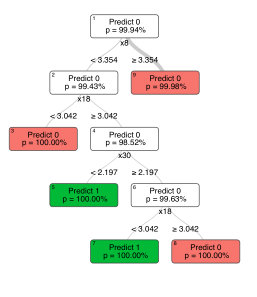 Figure 3
 Figure 4
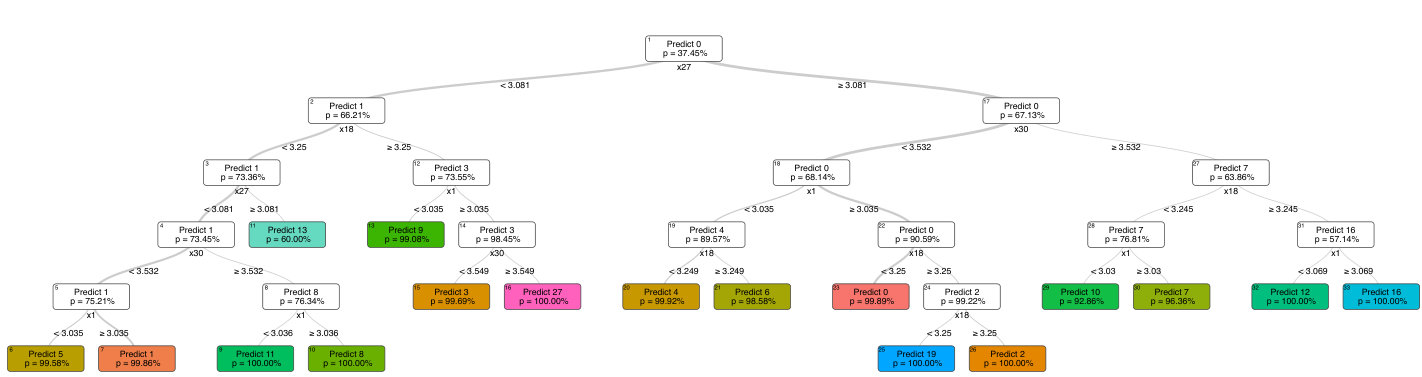 Figure 5
Peer Reviews
No public reviews on file for this paper yet. If you reviewed it on a platform where reviews are public (OpenReview, ICLR, NeurIPS, ICML), you can paste yours below so the community can read it here.
Code & Models
Videos
No videos yet. Explain this paper in a talk, walkthrough, or lecture? Add one.
