Interfacial Spin Seebeck effect in noncollinear magnetic systems
Benedetta Flebus, Yaroslav Tserkovnyak, and Gregory A. Fiete

TL;DR
This paper develops a comprehensive theoretical framework for understanding how heat-induced spin currents are generated at interfaces between noncollinear magnetic insulators and metals, extending previous models to more complex magnetic orders.
Contribution
It introduces a general theory for thermally-driven spin transport at noncollinear magnetic interfaces, unifying and extending existing models for simpler magnetic systems.
Findings
Derived a general expression for spin current in noncollinear magnets
Reproduced known results for ferromagnetic and antiferromagnetic systems
Provided a foundation for future experimental and theoretical studies
Abstract
The interplay between spin and heat currents at magnetic insulator|nonmagnetic metal interfaces has been a subject of much scrutiny because of both fundamental physics and the promise for technological applications. While ferrimagnetic and, more recently, antiferromagnetic systems have been extensively investigated, a theory generalizing the heat-to-spin interconversion in noncollinear magnets is still lacking. Here, we establish a general framework for thermally-driven spin transport at the interface between a noncollinear magnet and a normal metal. Modeling the interfacial coupling between localized and itinerant magnetic moments via an exchange Hamiltonian, we derive an expression for the spin current, driven by a temperature difference, for an arbitrary noncollinear magnetic order. Our theory reproduces previously obtained results for ferromagnetic and antiferromagnet systems.
Click any figure to enlarge with its caption.
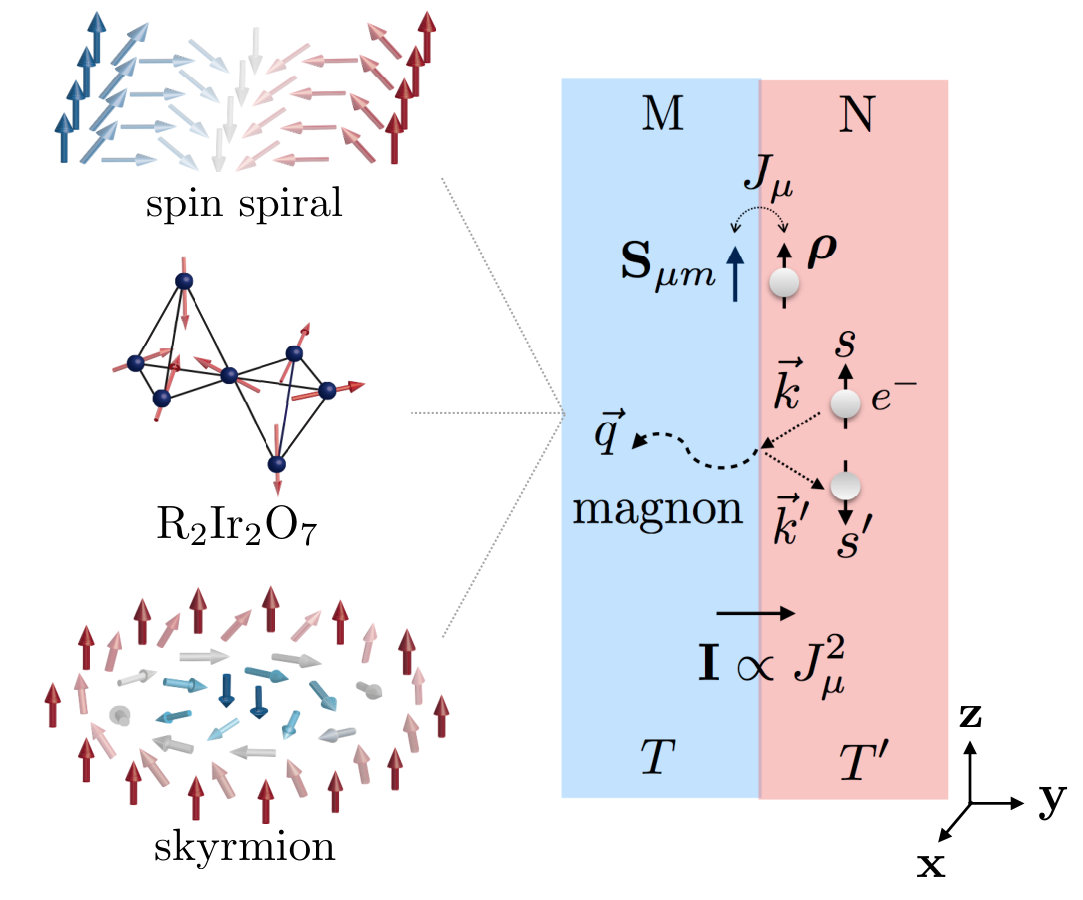 Figure 1
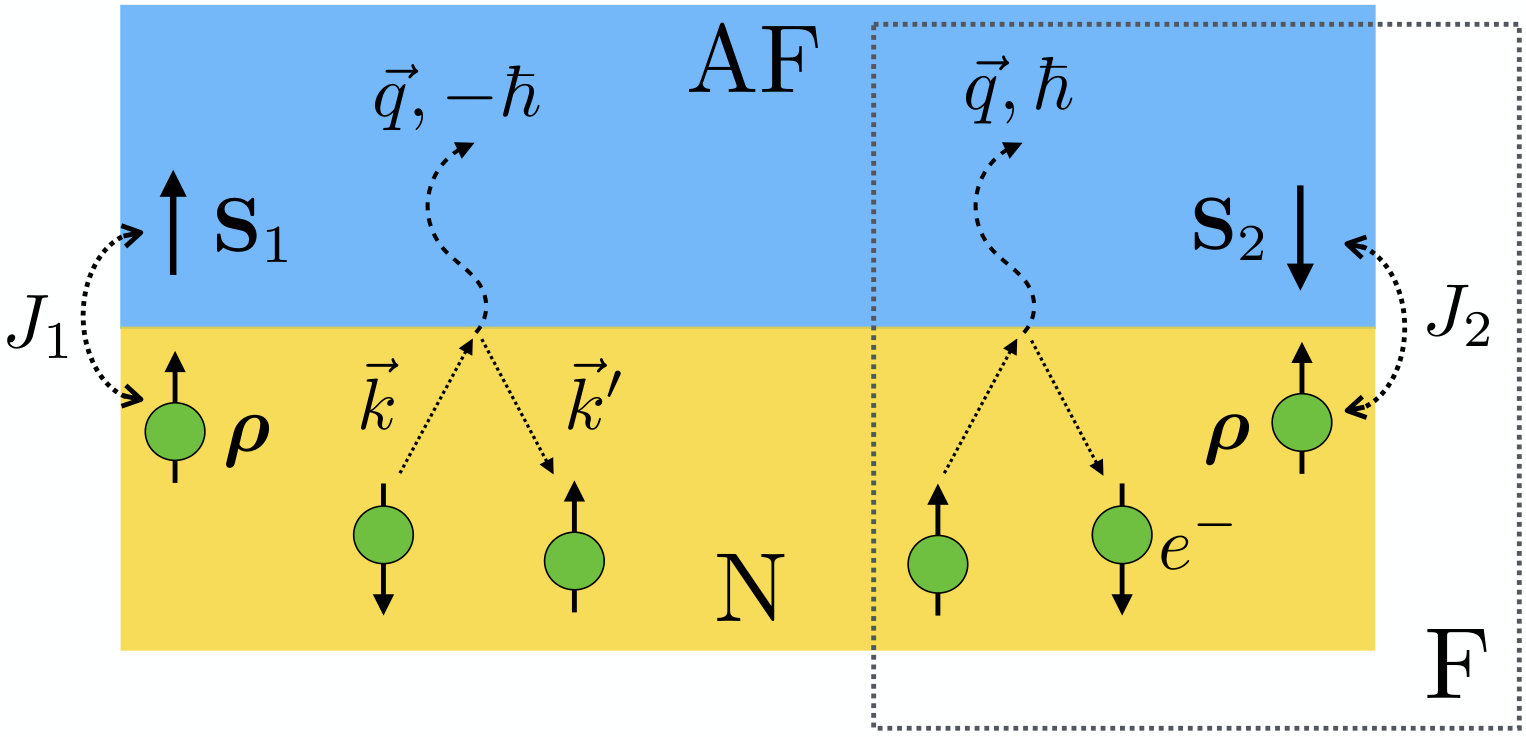 Figure 2
Peer Reviews
No public reviews on file for this paper yet. If you reviewed it on a platform where reviews are public (OpenReview, ICLR, NeurIPS, ICML), you can paste yours below so the community can read it here.
Videos
No videos yet. Explain this paper in a talk, walkthrough, or lecture? Add one.
Interfacial spin Seebeck effect in noncollinear magnetic systems
Benedetta Flebus
Yaroslav Tserkovnyak
Department of Physics and Astronomy, University of California, Los Angeles, California 90095, USA
Gregory A. Fiete
Department of Physics, The University of Texas at Austin, Austin, TX 78712, USA
Department of Physics, Massachusetts Institute of Technology, Cambridge, Massachusetts 02139, USA
Abstract
While the spin Seebeck effect (SSE) has proven to be an invaluable tool for probing spin correlations in collinear magnetic insulators, a theory generalizing the heat-to-spin interconversion in noncollinear magnets is still lacking. Nonetheless, a variety of quantum magnets that are attracting an increasing attention to, e.g., their topological properties, display a noncollinear spin order. Here, we establish a general framework for thermally-driven spin transport at the interface between a noncollinear magnet and a normal metal. Modeling the interfacial coupling between localized and itinerant magnetic moments via an exchange Hamiltonian, we derive an expression for the spin current, driven by a temperature difference, for an arbitrary noncollinear magnetic order. Our theory reproduces previously obtained results for ferromagnetic and antiferromagnet systems.
pacs:
I Introduction
Historically, thermoelectric phenomena have been an invaluable tool for probing correlations in electronic materials. The interplay between thermal and electric properties has been invoked, for instance, in elucidating the non-Fermi properties of metals through the violation of the Wiedemann-Franz law [wakeham, ], the non-Abelian nature of fractional quantum Hall states [mitali, ], and the chiral Majorana edge modes in gapped chiral spin liquids [spinliquid, ].
More recently, spin-caloritronic probes, which rely on the coupling between the electron’s spin and heat fluxes, have garnered much attention due to their potential for probing magnetic properties of insulating quantum materials [Bauer2010, , Zutic2004, ]. In particular, since its observation in a magnetic insulating system [uchida2008, ], the SSE, i.e., the generation of a pure spin current in response to a temperature gradient, has been subject to intense scrutiny [Uchida2014, ]. Since pure spin currents pumped out of a magnetic insulator can be converted, via the inverse Spin Hall effect [Saitoh2006, ; Kimura2007, ; Miao, ; Sinova2015, ], into a transverse charge current in an adjacent normal metal, the SSE has opened up new prospects for converting otherwise-wasted heat into charge currents. Thus, in addition to its promise for probing magnetic quantum materials, the discovery of the SSE has stimulated the pursuit of new material platforms and functionalities for designing efficient thermoelectric devices.
Heretofore, the SSE has been extensively investigated only for a limited number of insulating systems with collinear magnetic order [xiao2010, ; adachi2010, ; adachi2011, ; adachi20112, ; adachi2013, ; hoffman2013, ; Onhuma2013, ; Rezende2014, ; Rezende2016, ; Bender2016, ; kamra2017, ], with a particular focus on the ferrimagnetic yttrium iron garnet (YIG). For this ferrimagnet, the SSE has proved to serve as a sensitive probe of magnetization dynamics, allowing one to measure its magnon diffusion [cornelissen2015, ] and thermalization lengths [prakash2018, ], as well as the strength of magnetoelastic interactions [kikkawa2016, ].
Magnetic insulators, however, display a large variety of magnetic orders. Spin-orbit coupling, such as the Dzyaloshinskii-Moriya interaction, favors localized magnetic textures with nontrivial topology such as skyrmions [fert2017, ]. Strong competing exchange interactions between neighboring magnetic ions represent another source of noncollinearity [ramirez1994, ]. Moreover, a subtle interplay between these forces and the electronic interactions is responsible for the metal to noncollinear magnetic-insulator transition in pyrochlore iridates [gardner2010, ; krempa, ; Laurell, ; Sagayama, ; Donnerer, ]. Contrary to collinear systems, a non-collinear spin texture might engender a field-tunable SSE, as it typically displays a continuous response to a magnetic field through changes in the spin order canting. Moreover, as non-collinear orders often result from spin-orbit coupling (SOC), the dependence of the SSE on the orientation of the external field is expected to be more complex than for collinear systems. To properly account for these effects, a microscopic theory for the heat-to-spin interconversion in a noncollinear magnet—normal metal heterostructure is necessary.
In this work, we investigate the spin current resulting from the interfacial exchange interaction between the normal-metal spin density and the spins of a system with arbitrary magnetic ordering, as illustrated in Fig. 1. Specifically, we focus on the thermally-activated spin current, i.e., the spin current due to the interfacial SSE, which originates from inelastic magnon-electron scattering at the interface. Starting with equilibrium states of the magnetic and conducting systems in the absence of the interfacial coupling and using the Kubo formula up to the second order in the interfacial exchange parameter, we derive a general expression for the spin current, valid for any magnetic arrangement. Finally, we check our formula against two well-known collinear magnetic systems, a ferromagnetic and a bipartite antiferromagnetic insulating films and recover established results.
II Model
In this section we consider a noncollinear magnetic insulatornormal metal heterostructure. We present our model for the magnetic insulator and the normal metal, and we introduce the exchange Hamiltonian describing the interfacial coupling among them.
II.1 Magnetic system
The magnetic system is modeled using a supercell approach, i.e., it consists of a supercell, containing magnetic sites, that repeats periodically in the plane, as depicted in Fig. 1. The initial input of our model is the classical spin arrangement of the magnetic supercell, which can be found analytically or numerically depending on the complexity of the magnetic Hamiltonian. The position of each magnetic site can be written as , where is a 2 Bravais lattice vector labelling the th supercell and is the position of the th magnetic site within the supercell, respectively. For each site of the th supercell, we can orient a spin-space Cartesian coordinate system such that the axis locally lies along the classical orientation of the onsite spin operator . The latter can be related to the spin operator in the global frame of reference via the transformation
[TABLE]
where the matrix describes a right-handed rotation by an angle about the () axis, and () is the polar (azimuthal) angle of the classical orientation of the spin .
At temperature , with being the magnetic ordering temperature, we can access the magnon spectrum by linearizing the Holstein-Primakoff transformation in the local frame of reference [holstein1940, ]:
[TABLE]
Here, is the classical spin (in units of ) and () the magnon creation (annihilation) operator at the site , obeying the boson commutation relation . Next, we truncate the magnetic Hamiltonian beyond the quadratic terms in the Holstein-Primakoff bosons and perform a Fourier transform in the plane, i.e.,
[TABLE]
with being a 2 wavevector and the number of magnetic supercells. Generally, the resulting Hamiltonian is not block-diagonal and a Bogoliubov transformation is required to access the spin-wave spectrum . The latter can be defined as [keffer, ],
[TABLE]
where the magnetic excitations obey the Bose-Einstein statistics, i.e., , with , and and are both matrices. The matrices and are inputs to our theory and depend on the specific form of the magnetic Hamiltonian.
II.2 Electronic system
We treat the conducting side as a spin-degenerate normal metal of thickness . Its spin density (in units of ) can be written as
[TABLE]
where is a vector of Pauli matrices. For an electron state with spin along the -direction (with ), we expand the corresponding itinerant-electron field operator
[TABLE]
in terms of electron annihilation operators on the basis of Bloch wavefunctions . Here, the quantum number identifies the electron state in the spin-transport direction (e.g., a quantum-well state). The electronic Hamiltonian is given by
[TABLE]
with , where is the Fermi distribution function, the single-electron energy (measured with respect to the chemical potential) and the common temperature of the electron bath.
II.3 Interfacial Hamiltonian
The interfacial exchange interaction between the electronic spin density and the spins of the magnetic system is given by
[TABLE]
where is the exchange-interaction strength at the magnetic site , due to the overlap between itinerant and localized orbitals.
Our goal is to determine the spin current driven by a temperature difference between the magnetic and the metallic side. As we will show, the latter arises from thermally-activated electron-magnon scattering at the interface. Thus, while rewriting Eq. (8) in terms of second-quantized operators, we discard terms involving the -component of the spin-density operator (in the local frame), i.e., . The first term, i.e., , describes elastic scattering of electrons off the static spin density of the magnetic system and does not depend on the applied thermal bias [Bender2016, ]. Within mean field and far from the magnetic ordering temperature, i.e., , with being the number of magnons at the site , the second term reduces to a correction to the leading elastic-scattering processes, i.e., . Beyond mean field, the term leads to higher order corrections that we neglect here. Thus, Eq. (8) can be rewritten as
[TABLE]
where is a reciprocal lattice vector [footnoteBravais, ], , and
[TABLE]
with , and .
III Results.
In this section we discuss our analytical result for the interfacial spin current, and we check it against two well-known collinear magnetic systems.
III.1 Interfacial spin current
The conservation of spin density on the conducting side allows us to define the interfacial spin-current density operator (per unit of area) into the normal metal as
[TABLE]
Using the Kubo formula to second order in the exchange parameter [bruus, ], we find the -polarized spin-current density as
[TABLE]
with being the interfacial area and
[TABLE]
Here, and are, respectively, the magnon and electron spectral functions. For , we have , and . For , we have , , and .
The first term on the right-hand side of Eq. (13) describes an electron scattering inelastically off the interface and creating a magnon in the insulator, while the second term accounts for the reciprocal process. The difference between the insulator, , and metal, , temperatures breaks the balance between these two processes, driving a net spin-current density across the interface. Equation (12) shows that, as a consequence of the translational invariance in the plane, the inelastic electron-magnon scattering at the interface conserves the linear 2 momentum, modulo the reciprocal lattice basis (i.e., umklapp processes). On the other side, as the noncollinearity of the magnetic system breaks spin-rotational invariance, no spin component is conserved at the interface. Thus, inelastic scattering events without electronic spin-flip contribute as well to the total spin current.
Given any spin arrangement, Eq. (12) allows one to calculate the interfacial spin current, driven by an arbitrary temperature difference, as function of material-specific microscopic parameters. By neglecting vertex corrections, disorder in the normal metal can be accounted for via the electronic spectral function. For the magnetic side, instead, the effects of disorder can be included by increasing the size of the magnetic supercell such that it greatly exceeds the primitive one.
III.2 Collinear magnetic systems
In order to test our results, we consider two collinear magnetic systems, i.e., a ferromagnetic and a bipartite antiferromagnetic thin films. For simplicity, we treat both the electronic and magnetic systems as clean and non-interacting, i.e., and , and we neglect umklapp scattering. Moreover, we assume that the common electronic temperature and the single electron energy are both much smaller than the Fermi energy . Thus, we can treat the electron density of states as a constant, i.e., .
First, we consider a ferromagnetic system with collinear ground state defined by [footnoteisotropicity, ], i.e., its magnon modes carry spin along the direction. We assume that the corresponding Hamiltonian can be diagonalized in terms of a standard Bogoliubov transformation [White, ], i.e.,
[TABLE]
with . Generally, magnons flow in the direction opposite to a thermal bias, i.e., from the hot to the cold region [Bender2012, ]. Thus, if the magnetic-insulator temperature is higher than the normal-metal one, i.e., , we expect the -polarized spin-current density to flow into the conducting side, i.e., . This is correctly predicted by Eq. (12), which reduces to
[TABLE]
with
[TABLE]
Secondly, we consider a bipartite antiferromagnet with collinear ground state given by , with labelling the sublattice site. The corresponding Hamiltonian can be recasted in diagonal form by defining [Rezende2016, ]
[TABLE]
where is the creation operator of a magnon mode carrying spin angular momentum and energy . From Eq. (12), we find the -polarized spin-current density as [footnoteisotropicity, ]
[TABLE]
where is given by Eq. (13). Equation (18) shows that cross-sublattice terms contribute to the spin-current density. However, electron interference effects vanish when the two antiferromagnetic modes are equally populated. For degenerate dispersions, Eq. (18) indeed becomes
[TABLE]
Equation (19), which agrees with the results of Ref. [kamra2017, ], offers a simple physical interpretation: as magnons associated with the sublattice 2 (1) carry spin angular momentum , when the metallic side is hotter, they lead to a positive (negative) contribution to the -polarized spin current. In a collinear magnetic system, the inelastic magnon-electron processes driving the spin current must conserve the component of the spin parallel to the magnetic symmetry axis, i.e., the axis. Thus, an electron with spin-up (down) impinging on the interface is reflected with flipped spin, creating a magnon with angular momentum , as illustrated in Fig. 2. Equation (19) shows that, even when the antiferromagnetic modes are degenerate, the interfacial spin-current density (19) is finite if the symmetry between antiferromagnetic sublattices at the interface is broken, i.e., , which confirms the predictions of Ref. [bender2017, ].
IV Discussion and conclusions
In this work, we address thermally-driven spin transport at a noncollinear magnetic insulator normal metal interface, deriving an expression for the spin current applicable to any magnetic ordering. Our theory reproduces correctly the interfacial spin transport in collinear magnets normal metal heterostructures.
For thin films, along with bulk systems with strong spin-orbit coupling, the interface can represent the bottleneck for spin transport. In this scenario, our result captures the main contribution to the thermally-driven spin current. Otherwise, our expression for the spin current serves as a boundary condition, which should be complemented by an appropriate theory for bulk magnon transport [Bender2016, ]. The interfacial spin density induced by the spin current can be measured on the conducting side of the interface via the magneto-optical Kerr effect [Choi2014, ]. Instead, to relate our results for the spin current to a measurable ISHE voltage, the conductor has to be modelled as a bulk system and our theory complemented with transport equations describing spin diffusion on the metallic side [Cornelissen2016, ].
While here we focus on the spin current due to the SSE, our framework could be easily extended to include the spin pumping and spin-transfer torque contributions to the overall interfacial spin current, as well as additional interfacial interactions [Amin2016, ]. Future work should investigate the corrections arising from a non-perturbative treatment of the interfacial exchange interaction.
V ACKNOWLEDGEMENTS
The authors thank S.A. Bender and B. Ma for insightful discussions. B.F. was supported by the Dutch Science Foundation (NWO) through a Rubicon grant and Y.T. by NSF under Grant No. DMR-1742928. G. A. Fiete has been supported by the NSF under grants NSF DMR-1729588, NSF Materials Research Science and Engineering Center Grant No. DMR-1720595, and a Simons Fellowship.
The reference list from the paper itself. Each links out to its DOI / PubMed record.
- 1(1) N. Wakeham, A. F. Bangura, X. Xu, J.-F. Mercure, M. Greenblatt and N. E. Hussey, Nat. Commun. 2 , 396 (2011).
- 2(2) M. Banerjee, M. Heiblum, V. Umansky, D. E. Feldman, Y. Oreg, and A. Stern, Nature 559 , 205 (2018).
- 3(3) M. Ye, G. B. Halász, L. Savary, and L. Balents, Phys. Rev. Lett. 121 , 147201 (2018).
- 4(4) G. E. W. Bauer, A. H. Mac Donald, and S. Maekawa, Solid State Commun. 150 , 459–460 (2010); G. E. W. Bauer, E. Saitoh, and B. J. van Wees, Nat. Mat. 11 , 391 (2012).
- 5(5) I. Zutic, J. Fabian, and S. Das Sarma, Rev. Mod. Phys. 76 , 323 (2004).
- 6(6) K. Uchida, J. Xiao, H. Adachi, J. Ohe, S. Takahashi, J. Ieda, T. Ota, Y. Kajiwara, H. Umezawa, H. Kawai, G. E. W. Bauer, S. Maekawa, and E. Saitoh, Nat. Mat. 9 , 894–897 (2010).
- 7(7) K. Uchida, M. Ishida, T. Kikkawa, A. Kirihara, T. Murakami, and E. Saitoh, J. Phys.: Condens. Matter 26 , 343202 (2014).
- 8(8) E. Saitoh, M. Ueda, H. Miyajima, and G. Tatara, Appl. Phys. Lett. 88 , 182509 (2006).