Angular distribution coefficients of Z(W) boson produced in $e^+e^-$ collisions at $\sqrt{s}=240$ GeV
Yu-Dong Wang, Jian-Xiong Wang

TL;DR
This paper predicts the angular distribution coefficients of Z and W bosons produced in electron-positron collisions at 240 GeV, providing a basis for precise electroweak tests at the CEPC with reduced background.
Contribution
It presents detailed predictions of angular coefficients in various polarization frames for Z and W bosons at CEPC, enhancing the potential for precise electroweak measurements.
Findings
Angular coefficients depend on cosθ in different polarization frames.
Predictions show improved measurement accuracy at CEPC due to lower background.
Provides a method for testing electroweak production mechanisms and new physics effects.
Abstract
At designed CEPC, similar to hadron collider, the angular distribution coefficients of decay lepton pair from produced Z(W) boson in collisions are predicted. Their dependence on () are presented in four different polarization frame. Furthermore, the value of angular coefficients in different bins of are presented in the C-S frame. In comparison to the case at hadron collider, better accurate measurement for is expected since there exists less background and could be reconstructed from it's leptonic decay channel. This work supply a way to precise test the electroweak production mechanism or some effect induced from new physics in the future measurements at the CEPC.
Click any figure to enlarge with its caption.
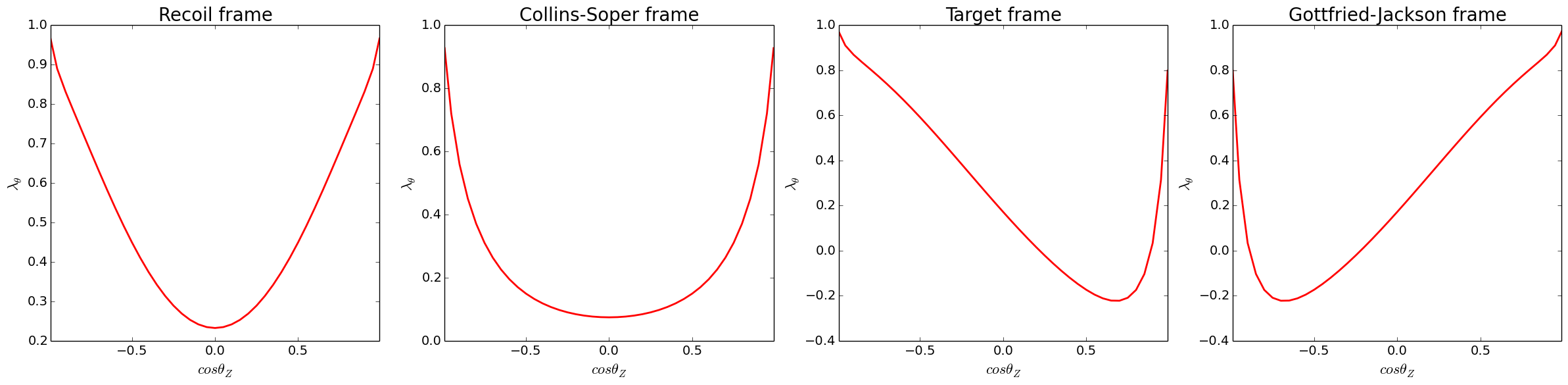 Figure 1
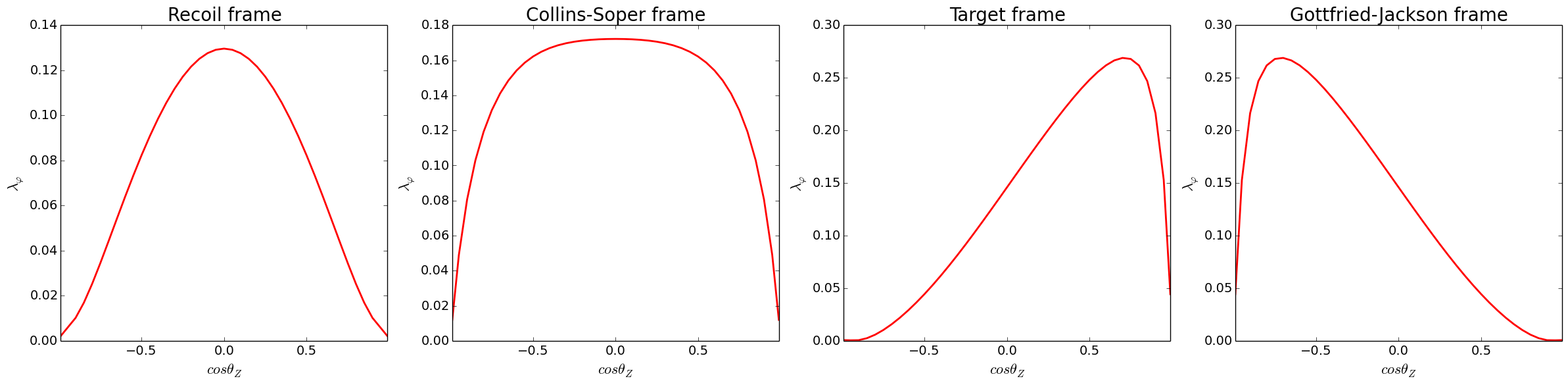 Figure 2
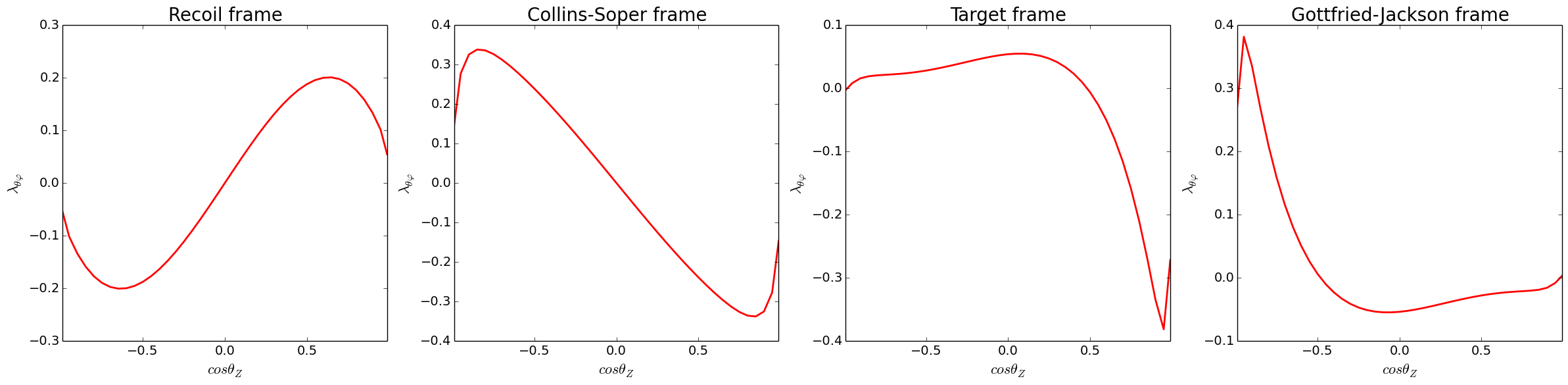 Figure 3
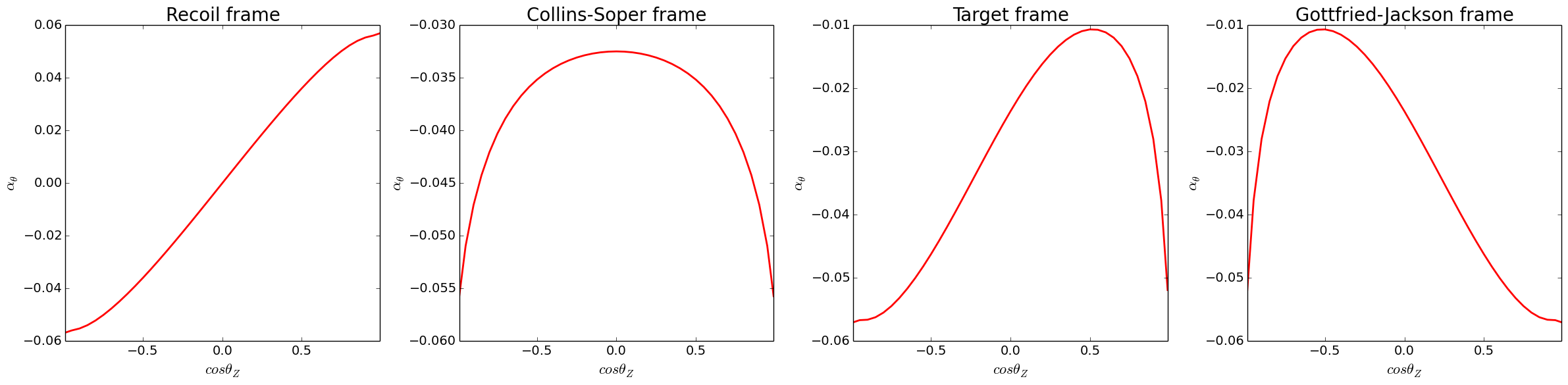 Figure 4
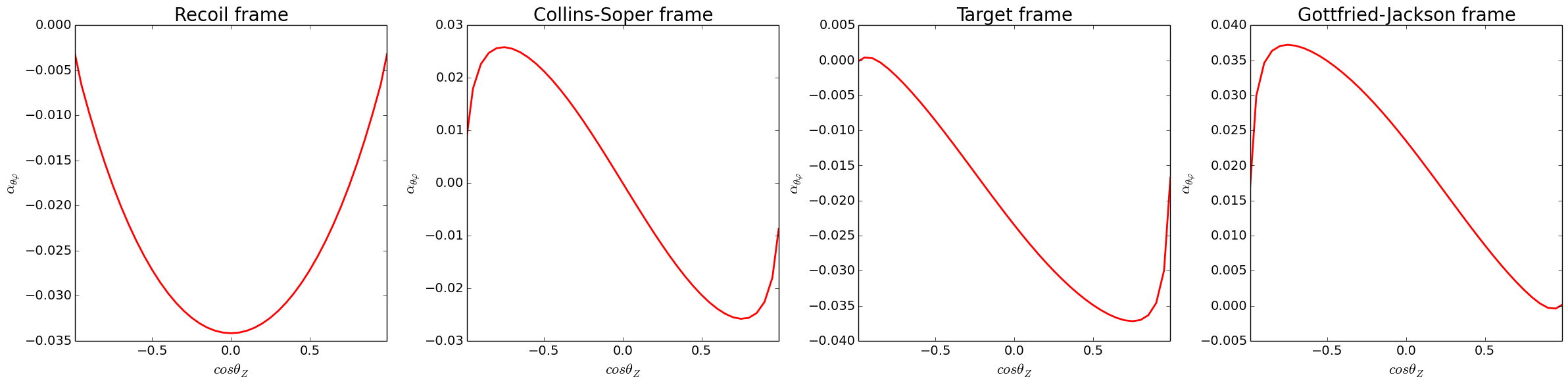 Figure 5
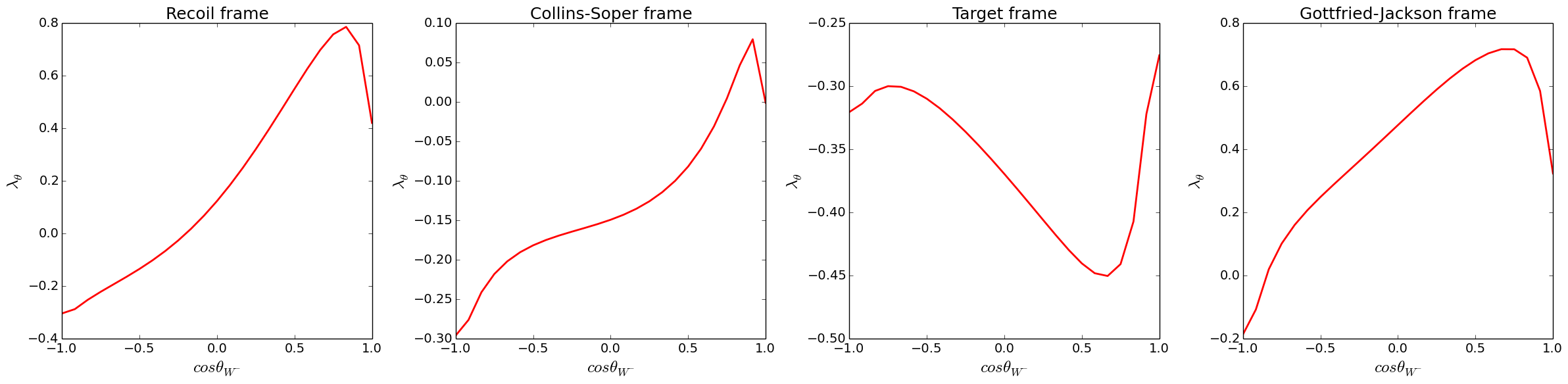 Figure 6
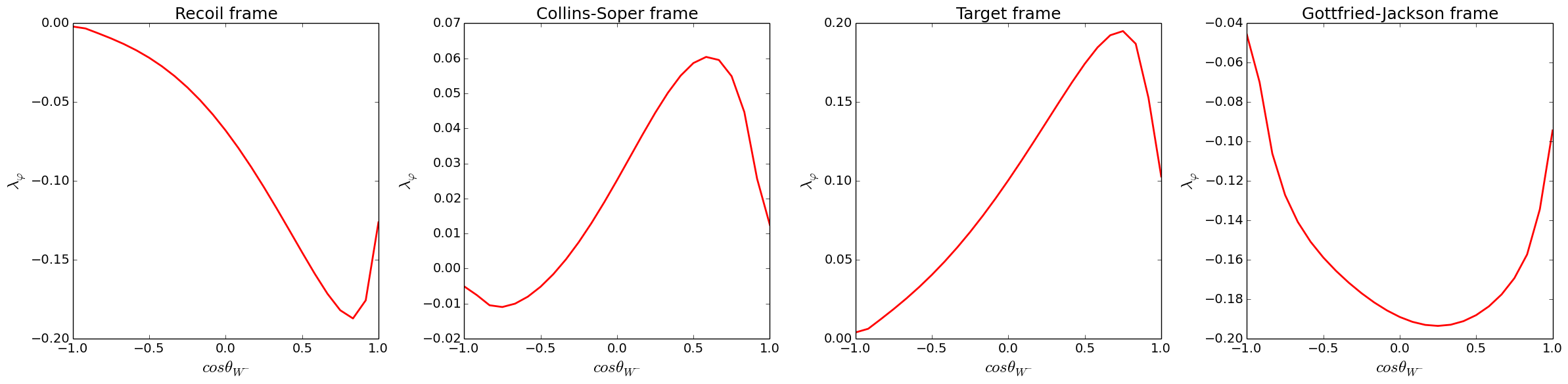 Figure 7
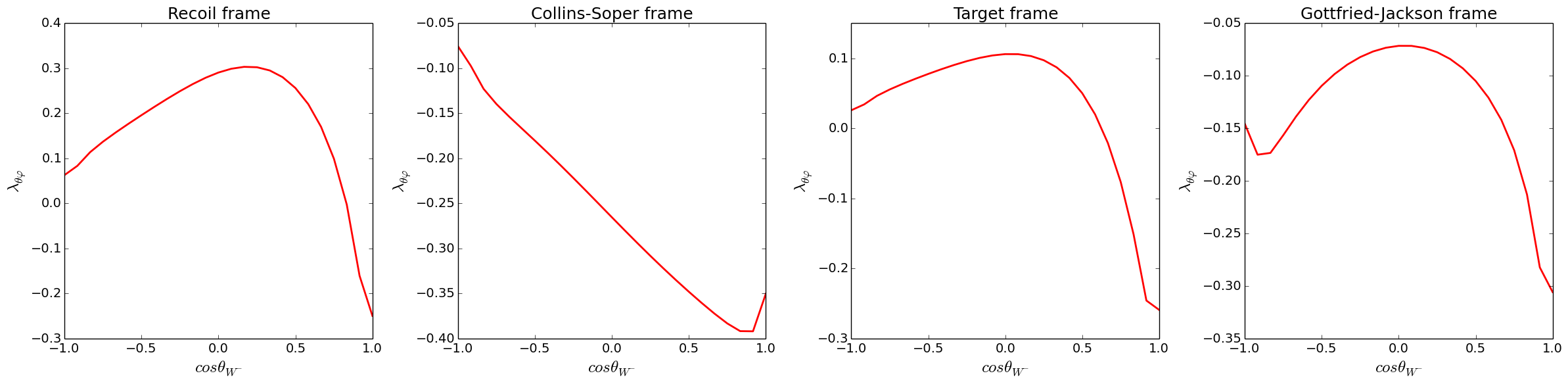 Figure 8
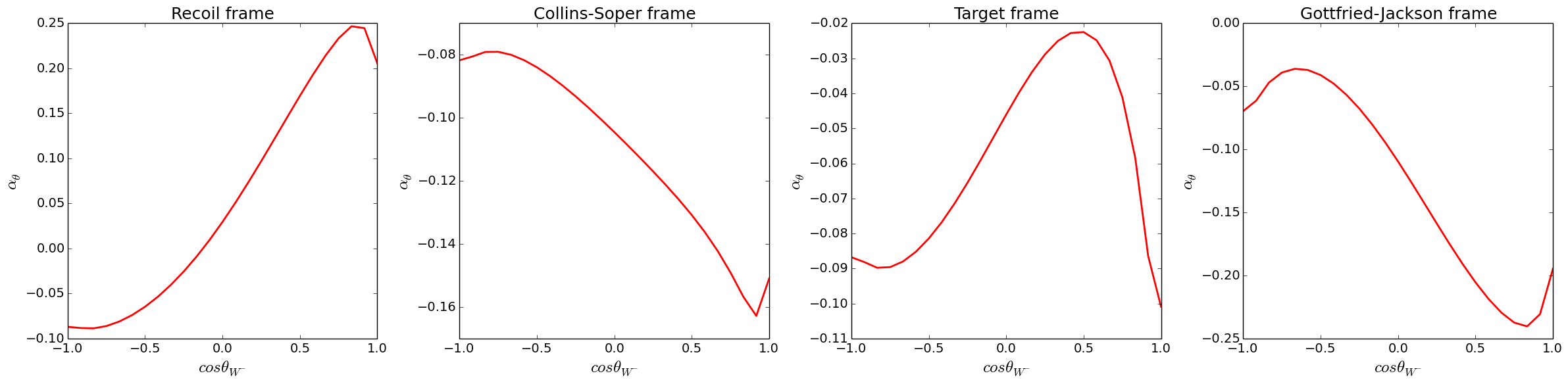 Figure 9
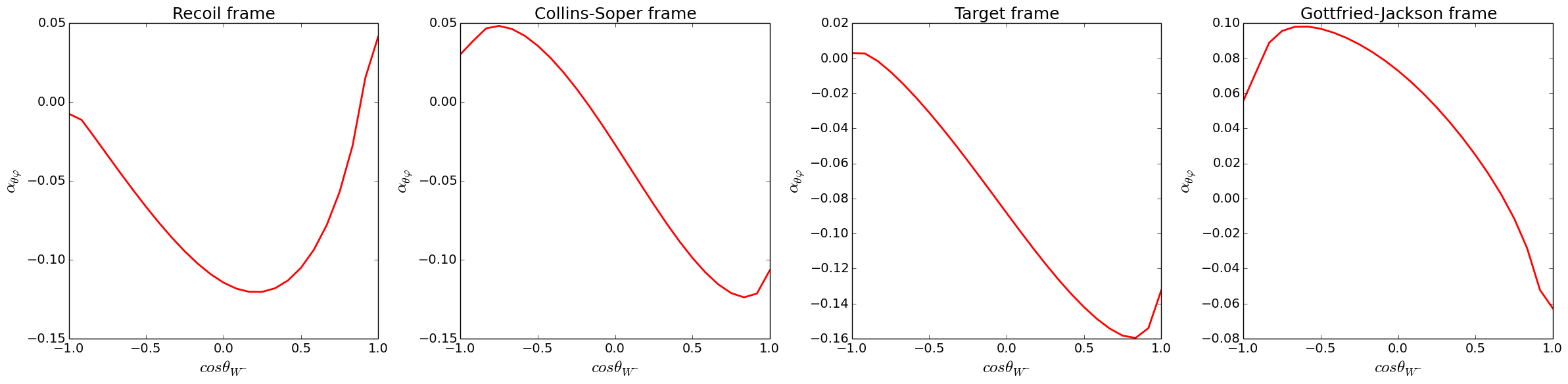 Figure 10
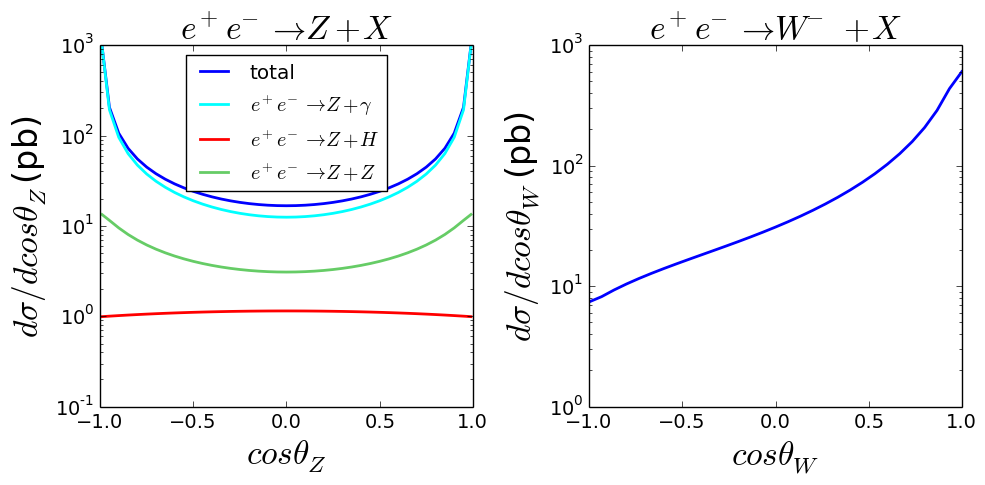 Figure 11
Peer Reviews
No public reviews on file for this paper yet. If you reviewed it on a platform where reviews are public (OpenReview, ICLR, NeurIPS, ICML), you can paste yours below so the community can read it here.
Videos
No videos yet. Explain this paper in a talk, walkthrough, or lecture? Add one.
Angular distribution coefficients of Z(W) boson produced in collisions at GeV
Yu-Dong Wang1) Jian-Xiong Wang2)
Institute of High Energy Physics, Chinese Academy of Sciences, Beijing 100049, China
School of Physics, University of Chinese Academy of Sciences, Beijing 100049, China
Abstract
At designed CEPC, similar to hadron collider, the angular distribution coefficients of decay lepton pair from produced Z(W) boson in collisions are predicted. Their dependence on () are presented in four different polarization frame. Furthermore, the value of angular coefficients in different bins of are presented in the C-S frame. In comparison to the case at hadron collider, better accurate measurement for is expected since there exists less background and could be reconstructed from it’s leptonic decay channel. This work supply a way to precise test the electroweak production mechanism or some effect induced from new physics in the future measurements at the CEPC.
keywords:
Drell-Yan process, Z boson, CEPC, angular distribution coefficients.
pacs:
1
2.15.Ji, 14.70.Hp ,14.70.Fm
1 Introduction
The Drell-Yan process, firstly proposed in ref.[2], which study the angular distribution of lepton pair from vector boson decay which produced in the hadron-hadron collisions. It is predicted in the simplest case that the differential cross section is proportional to at lowest order when the vector boson is virtual photon. With the emission and absorption of partons with large transverse momentum, there is a factor of 2 enhancement to the total cross section[3], and the angular distribution become more general[4, 5, 6]. Through measurements of the angular distribution coefficients of final-state lepton, many theoretical works such as the violation of Lam-Tung relation[5], the forward-backward asymmetry of lepton pair productions[8] were studied.
The Drell-Yan type processes provide a powerful method to understand the production mechanism of gauge boson and explore the new physics. In 1983, and Z boson are discovered [9, 10], and some following measurements was found to be consistent with the predictions of the V-A Standard Model[11, 12, 13]. The measurement of angular distribution coefficients of lepton pair in production was first reported for collisions at 1.96 TeV by CDF Collaboration[14], and the results were found in good agreement with the predictions of QCD fixed-order perturbation theory. The measurements were also done in the CMS and ATLAS collaborations at =8 TeV[15, 16, 17, 18, 19]. Meanwhile, many theoretical work on predictions of the inclusive Z boson production which involving emission of partons of large transverse momenta were done [20, 21].
The circular electron positron collider(CEPC) is proposed to build in future. It is designed that the center-of-mass (CM) energy would be has maximum energy 240 GeV and a higher luminosity than the linear collider [22], there will be less background compared with hadron collider. The CEPC project aims to precise test the properties of the higgs, Z and W boson and search for new physics. Compared to the process at hadron collider, the similar one is of interest and deserved to study.
In this paper we study the angular distribution coefficients of Z boson inclusive production. In comparison to Z boson hadroproduction, the energy of Z boson is fixed at Leading-order (LO) at collider. Thus for detailed study, we present these angular distribution coefficients dependence of (cos), () is polar angle of Z(W) boson in laboratory frame.
The angular differential cross section can be written as
[TABLE]
Where and are polar and azimuthal angles of the lepton in Z(W) rest frame, and . and are production density matrix of process and decay density matrix of respectively.
The content of this paper is divided into following parts. In Sec.2 we present the general expression of the lepton angular distribution of this process, and also represent the angular coefficients by the gauge boson production density matrix elements. In Sec.3 we calculate angular distribution coefficients numerically for total and the differential cross section in different polarization frame. In Sec.4 we draw the figures of angular coefficients of Z() production dependence of (). Also the calculation of coefficients of Z production processes at different bins of are done. Then the summary and conclusion is given at last Sec.
2 The angular distribution of the lepton pair
For simplicity, following discussion focus on the Z boson production and the situation is same for W boson. In the process that ( is or ), there are two planes need to define which named production plane and decay plane. In the lab frame, the first one is formed by beam direction and , between which the angle is . The other one is formed by and , the corresponding angle in Z boson rest frame is . Finally the angle between the production and decay plane is , which is invariant under lorentz transformation from the lab frame to the Z-rest frame.
The dilepton angular distribution is defined in the Z boson rest frame, and we use this frame for all following discussion. The invariant mass window of Z boson is chosen around 91.19 GeV, the contribution from is suppressed by a large factor and lead to a error less than 1%. The momentum of Z boson, and are expressed as
[TABLE]
Where the mass of fermion (mass of ) is set to zero approximately. There are four commonly used polarization frames[24] correspond different choice -axis, which are recoil(helicity) frame(), Gottfried-Jackson frame(), target frame() and the Collins-Soper(C-S)[23](). The three-vector and used here refer to the Z boson-rest frame. The last frame was frequently used in the measurements in hadron collision. For example, the polarization vector in helicity frame are expressed as
[TABLE]
The amplitude of each channel() in inclusive Z boson production can be written as
[TABLE]
Where is the decay width of Z boson, and . Both and are Lorentz invariant. Therefore they can be calculated in different frame. and are calculated in the lab frame and the Z boson rest frame respectively. The production and decay density matrix are defined as
[TABLE]
Where the decay density matrix is easy to obtained and the production matrix is discussed in appendix A.
By applying and , the differential cross section is expressed as [5]
[TABLE]
Where and are the polar and azimuthal angles of dilepton in the rest frame of Z boson. The coefficients of each term is given as follows,
[TABLE]
The asymmetry parameter of fermion is , given in PDG[25], its value are and for electron and muon respectively. In this paper, is used. According Eq.(2), there are additional three terms , and compared to the case in which production decay to lepton pair[26] due to the presence of parity-violation coupling . When , these terms disappear. From above expressions, terms of , and which proportional to sin or sin2 come from contributions of imaginary part of density matrix elements.
As presented in appendix A, there are relations Eq.(15) for the real part in which are from the coupling . According to Eq.(2), this part does not contribute to the value of , . Meanwhile , the contribution of imaginary part proportional to is small. It is expected that the value of and are much smaller than other coefficients. In particular, the following relations are obtained,
[TABLE]
\figcaption
The differential cross section of Z() boson production.
3 Cross section for Z(W) boson production
At leading-order(LO), the production of Z boson come from following three processes
[TABLE]
The production density matrices of Z boson in these processes are calculated by using package FDC[27], and obtain the value of angular distribution coefficients.
In these three processes, the production have a larger contribution on the cross section compared the others. The cross section are 46.64 pb, 0.96 pb and 0.20 pb for , ZZ and ZH production channels respective. Summed up all above production channels, the value of dilepton angular distribution coefficients at Z pole are shown in the table 3. The total cross section refer to the inclusive Z boson production .
The cross section is much smaller compared with the Drell-Yan type process in hadron collisions[28] at LO, to obtain accurate measurements, larger integrated luminosity is in need. From the CEPC design report [22], at the CM energy GeV, the luminosity of the CEPC is about . The integrated value is about year(it operate about 8 months each year), the total number of Z boson produced is about each year. It is expected to run 7 years at this energy, according to the fraction of Z decay modes[25], the total events of electron and muon pair should be . Also, the events of jets if we use the jets to reconstruct Z boson is about . In ATLAS[19], the total events of lepton pair is about , it is closed to the value at the CEPC. Moreover, there is less background at the CEPC, it is expected a good accuracy in the future CEPC experiment to measure angular distribution coefficients of inclusive Z boson production.
\tabcaption
The value of angular distribution coefficients and total cross section for Z boson productions at 240 GeV in the Recoil frame.
total cross section(pb)
0 0.937 0.008 0.030 0.031 -0.0003 0 0 0 23.90
0 0.937 0.008 -0.030 -0.031 -0.003 0 0 0 23.90
total 0.937 0.008 0 0 -0.003 0 0 0 47.80
\tabcaption
The value of angular distribution coefficients and total cross section for boson productions at 240 GeV in Recoil frame.
total cross section(pb)
0 0.532 -0.237 -0.072 1.333 -0.042 0 0 0 96.61
0 0.095 -0.1467 0.144 -0.354 -0.574 0 0 0 9.95
total 0.486 -0.227 -0.048 1.156 -0.099 0 0 0 106.64
The value of , and are all 0. All these term are proportional of imaginary part of the density matrix elements in Eq.(2). In the calculation, the imaginary part of density matrix is zero at LO, and these terms will not be discussed hereafter. However, for Z boson production at hadron collider[7], these coefficients are nonzero at Next-to-Leading order (NLO) corrections in QCD.
From table 3, the value of and are 0 when take full range of , since they are antisymmetric in value for and . Usually, there is a Lam-Tung[4] relation for the coefficients and . It is presented in the Drell-Yan process that with the vector boson being of gauge invariance condition (i.e. virtual photon) for full final state phase space (except the dilepton) integration. For the electroweak interaction at this situation we found that is about equal to 0.97, of course, it does not obey the relation as it should be. From the calculation, the value of off-diagonal density matrix elements which defined in Eq.(5) are about 100 times smaller compare to the diagonal matrix elements. The conclusion is obtained from the expression of coefficients Eq.(2) that the value of is far larger than the others, just as shown in the table 3.
The process that on W boson pole is also calculated(In the production process of LO, X can only be ). For production process, the results should be symmetric with . In table 3, the value of coefficient for and are not symmetric or antisymmetric as Z boson production. The contribution of the total cross section almost comes from region. It is estimated that the event number of boson produced at the CEPC per year at the CM energy 240 GeV is about , this offer a high accuracy for W boson detection. However, it is need to rebuild jets then to reconstruct W boson. Comparing to hadron collider where there are a lot of source of jets due to the complicated background, at the CEPC there is a advantage to rebuild the jets from W boson decay with less background. In the decay modes from PDG, the hadrons fraction is about 67.4% and the lepton fraction except is about 21.3%. By four momentum conversation, the momentum of anti-neutrino from decay could be obtained and then is reconstructed as:
[TABLE]
where is the sum of momentum of all the final state particles except the lepton. If then it is terrified that this is the momentum of anti-neutrino and can be used to reconstruct the boson too. Finally, the total proportion of which can be reconstructed through lepton and jets are about 67.4%+67.4%. It is deserved to measure the inclusive W boson production at the CEPC.
4 Angular distribution coefficients of Z(W) production processes
We present the differential cross section and angular distribution coefficients dependence of the , which is the polar angle of Z boson in the lab frame. In the experiment, usually the measurements are done in limited region. The following bins in which have enough events are selected in the table 4 to test the value of angular distribution coefficients. Since the differential cross section is symmetric in , the bins in range is just same as . For the the detector at the CEPC, the conical space with an opening angle is about 6.78 8.11 degrees, which corresponding to the value of is about 0.99, i.e. particles in the range can be measured well.
\figcaption
Angular distribution coefficients of the inclusive Z boson production dependence on .
\tabcaption
The cross section for inclusive Z boson production at different bins of and corresponding number of events estimated for the designed CEPC experiments.
0.83 0.71 1.20 0.54 1.80 20.00
N(1 year) 6.6 5.7 9.6 4.3 1.44 1.60
N(7 year) 4.7 4.0 6.7 3.0 1.01 1.12
In the figure 4, we show the angular coefficients dependence of in four different polarization frame, which are recoil frame, Collins-Soper frame, target frame and Gottfried-Jackson frame. In the first two frame, the angular coefficients have apparent symmetry. For recoil frame, , , are even and , are odd under . For Collins-Soper frame, , , are even and , are odd under . Since these symmetry, as seen in the table 3 that the total value of and are 0. The coefficients and which come from the parity-violation coupling part, are much smaller than value of , and just as the expectation discussed in Sec.2.
\figcaption
Angular distribution coefficients of the inclusive boson production dependence on .
Then in the figure 4, the same plots for productions is given. For more discussion about productions, it could be refer to the process in hadron collision [29].
\tabcaption
The angular distribution coefficients for Z boson production at each bin in at C-S frame.
-- 0.996 0 0.015 -0.028 0
-- 0.843 0.017 0.196 -0.054 0.012
-- 0.723 0.024 0.228 -0.050 0.015
-- 0.480 0.086 0.291 -0.045 0.022
-- 0.335 0.110 0.223 -0.040 0.019
- 0.216 0.135 0.100 -0.036 0.009
0.216 0.135 -0.100 -0.036 -0.009
0.335 0.110 -0.223 -0.040 -0.019
0.480 0.086 -0.291 -0.045 -0.022
0.723 0.024 -0.228 -0.050 -0.015
0.843 0.017 0.196 -0.054 0.012
0.99-$$1.0 0.996 0 0.015 -0.028 0
\tabcaption
The angular distribution coefficients for boson production at each bin in at C-S frame.
0.328 -0.105 0.295 0.652 -0.776
0.635 -0.160 0.209 1.288 -0.597
0.772 -0.185 0.019 1.598 -0.226
0.688 -0.171 -0.180 1.592 0.136
0.250 -0.098 -0.290 1.206 0.356
5 Summary and conclusion
We present the detailed definition for the theoretical calculation and experimental measurement on the lepton angular distribution coefficients of inclusive Z(W) boson production needed for the designed CEPC. The general expression of the dependence for lepton angular distribution coefficients in the Z boson rest frame are represented by the production density matrix elements of , and their range is given.
From the numerical results, it is clear that the event number of lepton pair estimated at the CEPC is at same order of magnitude compared to that in the ATLAS. The better accurate measurements is expected since there exists less background. In comparison to case at hadron collider, the measurement for is of a advantage that the momentum of the missing anti-neutrino from decay could be obtained and then is reconstructed. The two jets decay channels of can also be measured with less background. The angular distribution coefficients of Z() boson production dependence of () is calculated in the four different polarization frame. Furthermore, the value of angular coefficients in different bins of are presented in the C-S frame. The calculation and results in this paper supply a way to precise test the electroweak production mechanism or some effect induced from new physics in the future measurements at the CEPC.
There should be study on this subject to include Monte Carlo simulation with detector and background, to include NLO electroweak correction for the production and boson decay, NLO QCD correction to boson decay, the correction to narrow width approximation and initial-state-radiation effect. all these parts is out of the scope of this work and should be addressed at future study.
6 Acknowledgments
We thank Dr. Bin Gong for the discussions. This work was supported by the National Natural Science Foundation of China with Grant No. 11475183.
Appendix A The relations of the density matrix elements
The production density matrix of the vector boson is written as
[TABLE]
where is the polarization of the vector boson and , which is defined by
[TABLE]
By the definition of Eq.(12) and rewrite as that and is real(for the situation when there is no weak interaction in ,) .
[TABLE]
[TABLE]
From above calculation, we see that is not equal to , unless the situation that is real. Besides, we obtain following relations,
[TABLE]
If is real, from Eq.(14) we could obtain relations as
[TABLE]
The reference list from the paper itself. Each links out to its DOI / PubMed record.
- 1[1]
- 2[2] S.D. Drell and T.M. Yan, Phys.Rev.Lett. 25 (1970) 316
- 3[3] I. R. Kenyon, Rep. Prog. Phys. 45 , 1261(1982).
- 4[4] C.S. Lam, Wu-Ki Tung. Phys.Rev. D 18 (1978) 2447
- 5[5] E. Mirkes and J. Ohnemus, Phys.Rev.D 50 (1994) 5692, arxiv:9406381[hep-ph]
- 6[6] E. Mirkes and J. Ohnemus, Phys. Rev. D 51 (1995) 4891, ar Xiv:9412289 [hep-ph].
- 7[7] Wen-Chen Chang.et al. Phys.Rev. D 96 (2017) no.5.
- 8[8] ATLAS Collaboration, JHEP 09 (2015) 049.