Long-term X-ray variation of the colliding wind Wolf-Rayet binary WR 125
Takuya Midooka, Yasuharu Sugawara, Ken Ebisawa

TL;DR
This study presents a detailed analysis of the long-term X-ray variability of the Wolf-Rayet binary WR 125, revealing stable flux over half a year and insights into wind absorption and elemental abundances, with historical context from past satellite observations.
Contribution
First precise X-ray spectral study of WR 125 over six months, providing insights into wind absorption and elemental abundances in colliding wind binaries.
Findings
Stable X-ray flux over six months.
X-ray spectra absorbed by WR wind with unusual abundances.
Historical X-ray detection variability linked to orbital phase.
Abstract
WR 125 is considered as a Colliding Wind Wolf-rayet Binary (CWWB), from which the most recent infrared flux increase was reported between 1990 and 1993. We observed the object four times from November 2016 to May 2017 with Swift and XMM-Newton, and carried out a precise X-ray spectral study for the first time. There were hardly any changes of the fluxes and spectral shapes for half a year, and the absorption-corrected luminosity was 3.0e+33 erg/s in the 0.5 - 10.0 keV range at a distance of 4.1 kpc. The hydrogen column density was higher than that expected from the interstellar absorption, thus the X-ray spectra were probably absorbed by the WR wind. The energy spectrum was successfully modeled by a collisional equilibrium plasma emission, where both the plasma and the absorbing wind have unusual elemental abundances particular to the WR stars. In 1981, the Einstein satellite clearly…
Click any figure to enlarge with its caption.
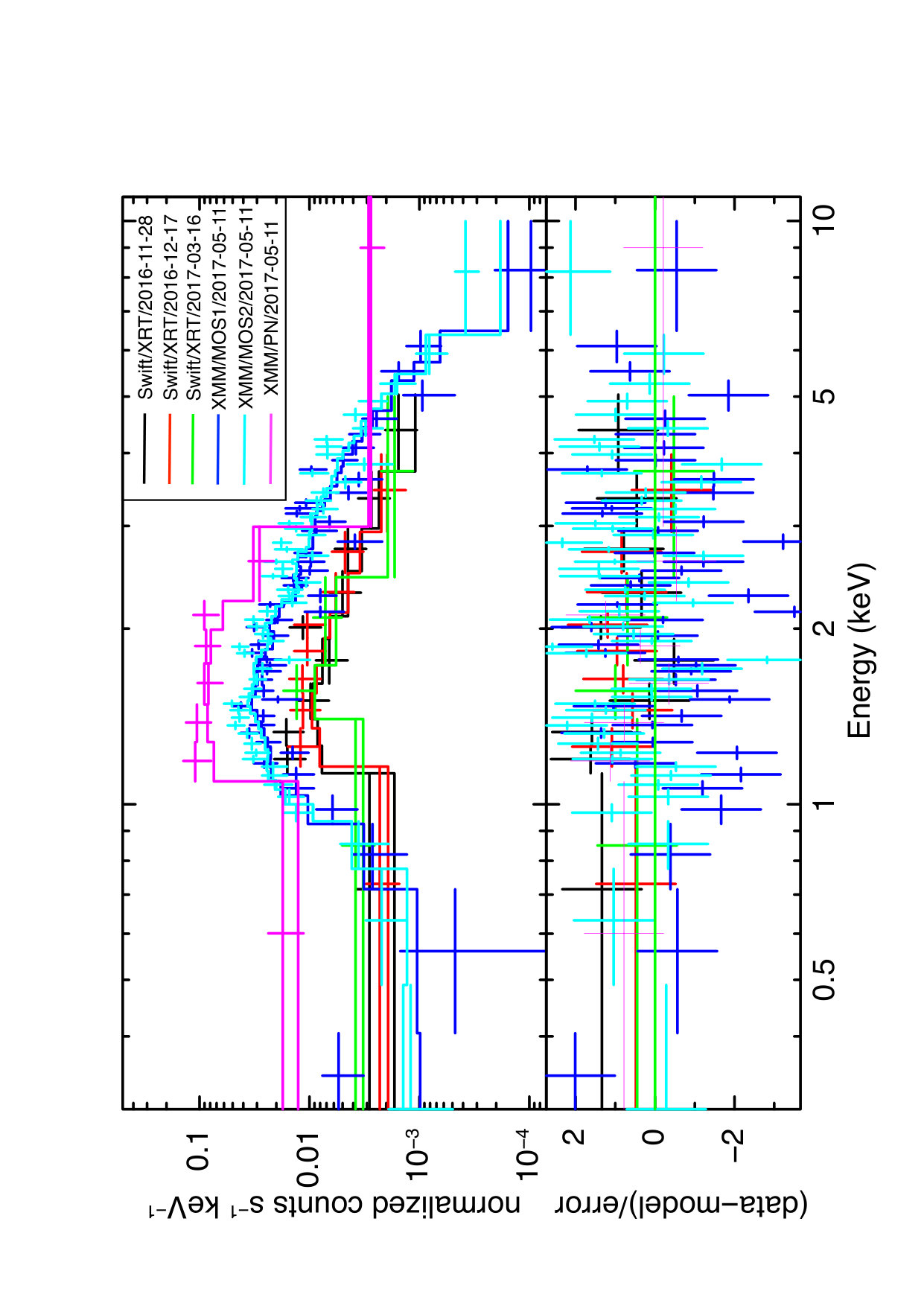 Figure 1
| Satellite/Detector | Obs. mode | Obs. ID | Start time [UT] | Exposure time (ks) |
|
|
||||
|---|---|---|---|---|---|---|---|---|---|---|
| Swift/XRT | Photon-Counting | 00034826001 | 2016-11-28T01:50 | 4.8 | 0.90.25 | 1.50.3 | ||||
| Swift/XRT | Photon-Counting | 00034826002 | 2016-12-17T13:27 | 4.7 | 0.60.20 | 1.70.3 | ||||
| Swift/XRT | Photon-Counting | 00034826003 | 2017-03-16T06:19 | 2.3 | 0.60.31 | 1.20.4 | ||||
| XMM/EPIC | Full frame | 0794581101 | 2017-05-11T09:06b | 21.5 | 5.20.5 | 15.50.8 |
| Parameter | TBabs*apec | TBabs*varabs*vvapec |
|---|---|---|
| Interstellar absorption | ||
| 1.59 | 0.94(fixed) | |
| Circumstellar absorption | ||
| ——- | 0.16 | |
| Thin thermal plasma | ||
| (keV) a | 2.33 | 2.1 |
| (Fe/He)/(Fe/He)⊙ | ——- | 0.290.33 |
| b, c | 2.7 | 1.3 |
| d | 7.9 | 7.3 |
| c, e | 3.3 | 3.0 |
| 197/135 | 187/134 |
| Obs. date | Satellite/Detector | Observed flux a |
| (yyyy.mm) | (10-13 erg s-1 cm-2) | |
| 1981.04 | Einstein/IPC | 7.3 |
| 1991.10 | ROSAT/PSPC | < 4.2 |
| 2016.11–2017.05 | Swift/XRT&XMM/EPIC | 7.9 |
Peer Reviews
No public reviews on file for this paper yet. If you reviewed it on a platform where reviews are public (OpenReview, ICLR, NeurIPS, ICML), you can paste yours below so the community can read it here.
Videos
No videos yet. Explain this paper in a talk, walkthrough, or lecture? Add one.
Long-term X-ray variation of the colliding wind Wolf-Rayet binary WR 125
Takuya Midooka1,2, Yasuharu Sugawara1, Ken Ebisawa1,2
1Institute of Space and Astronautical Science (ISAS), Japan Aerospace Exploration Agency (JAXA), 3-1-1 Yoshinodai, Chuo-ku,
Sagamihara, Kanagawa 252-5210, Japan
2Department of Astronomy, Graduate School of Science, The University of Tokyo, 7-3-1 Hongo, Bunkyo-ku, Tokyo 113-0033, Japan E-mail: [email protected]
(Accepted XXX. Received YYY; in original form ZZZ)
Abstract
WR 125 is considered as a Colliding Wind Wolf-rayet Binary (CWWB), from which the most recent infrared flux increase was reported between 1990 and 1993. We observed the object four times from November 2016 to May 2017 with Swift and XMM-Newton, and carried out a precise X-ray spectral study for the first time. There were hardly any changes of the fluxes and spectral shapes for half a year, and the absorption-corrected luminosity was 3.0 1033 erg s*-1* in the 0.5–10.0 keV range at a distance of 4.1 kpc. The hydrogen column density was higher than that expected from the interstellar absorption, thus the X-ray spectra were probably absorbed by the WR wind. The energy spectrum was successfully modeled by a collisional equilibrium plasma emission, where both the plasma and the absorbing wind have unusual elemental abundances particular to the WR stars. In 1981, the Einstein satellite clearly detected X-rays from WR 125, whereas the ROSAT satellite hardly detected X-rays in 1991, when the binary was probably around the periastron passage. We discuss possible causes for the unexpectedly low soft X-ray flux near the periastron.
keywords:
stars: Wolf-Rayet — X-rays: individual: WR 125 — binaries: spectroscopic
††pubyear: 2018††pagerange: Long-term X-ray variation of the colliding wind Wolf-Rayet binary WR 125–Long-term X-ray variation of the colliding wind Wolf-Rayet binary WR 125
1 Introduction
Most of the Wolf-Rayet (WR) stars, massive stars with significant mass-loss, are known to be binaries (Rosslowe & Crowther, 2015). In particular, those WR binaries which produce hot plasma from their stellar wind collision are called Colliding Wind Wolf-rayet Binaries (CWWBs). The shocked plasma has a temperature of 107–108 K and high absorption columns of 1022–1023 H cm*-2* (Schild et al., 2004). The X-ray luminosity is highly dependent on binary separations, mass-loss rates, and wind velocities (Stevens et al., 1992; Usov, 1992). The X-ray energy spectra significantly vary with the binary orbital phase, which enable us to study orbital dependence of the plasma parameters and amount of the circumstellar absorption through spectral analysis. In this manner, we are able to constrain the wind acceleration and the mass-loss rate from the WR star. We have already applied this methodology to the CWWBs WR 140 (Sugawara et al., 2015) and WR 19 (Sugawara et al., 2017), which are relatively bright with known orbital parameters. We measured variations of the circumstellar absorptions on the orbital phases, and successfully constrained the mass-loss rates from these WR stars (Sugawara et al., 2015, 2017).
WR 125 is considered as a CWWB, consisting of a WC7 type WR star and an O9 III companion star (Williams et al., 1994). The orbital period is unknown, while it is reported that the infrared flux started to increase in 1990 July and reached the maximum during 1992 and 1993 (Williams et al., 1994). In general, infrared brightening in the long-period CWWBs is thought to be caused by dust formation near the periastron passage in their eccentric binary orbits (Williams et al., 1987, 2012).
In 1981, the X-ray observatory Einstein detected X-rays from WR 125 for the first time (Pollock, 1987). The absorption-corrected luminosity was in the 0.2–4.0 keV band at an assumed distance of 1.9 kpc. As discussed in Pollock et al. (1981), the log-likelihood detection statistic gives a scale of the significant detection. In the case of Einstein IPC, being greater than 3 is considered to be a significant detection. Since Pollock (1987) showed that of WR 125 was 39.1, the detection was significant. Later, Pollock et al. (1995) claimed a marginal detection with ROSAT in 1991, where was 5.8; this detection was not significant because ROSAT usually takes >10 as the detection threshold.
In this paper, we present new Swift and XMM-Newton monitoring observations of WR 125, and investigate the long-term X-ray variation. In section 2 we introduce the observation and data reduction, and in section 3 we present data analysis and results. We discuss long-term X-ray variation of WR 125 using all the available X-ray observational results in section 4.
2 Observations and Data Reduction
Table 1 gives the observation log and the observed count rates. We proposed a Target of Opportunity (ToO) observation of WR 125 with Neil Gehrels Swift Observatory (Gehrels et al., 2004), and three pointings were made from 2016 November 28 to 2017 March 16 for a total exposure of about 12 ksec. The X-ray Telescope (XRT; Burrows et al., 2005) was operated in the Photon-Counting mode. We processed the XRT data through the Swift-XRT data product generator 111http://www.swift.ac.uk/user_objects/ (Evans et al., 2007, 2009). We produced the XRT light curves, images and spectra by using the Swift-XRT data product generator (Evans et al., 2007, 2009).
Having confirmed significant detection by Swift, we proposed a more detailed observation with XMM-Newton (Jansen et al., 2001), and the observation was carried out on 2017 May 11. The European Photon Imaging Camera (EPIC) is sensitive in the 0.2 to 12.0 keV energy range (Turner et al., 2001; Strüder et al., 2001). The data were reduced with SAS version 15.0.0 to obtain the filtered event files for EPIC-MOS1, 2 and pn in 0.3–10.0 keV.
Good time intervals were selected by removing the intervals dominated by flaring particle background when the single event (PATTERN 0) count rate in the 10 keV band was larger than 0.35 counts s*-1* and that in the 10–12 keV band larger than 0.4 counts s*-1* for EPIC-MOS and EPIC-pn data, respectively. We used a circular regions of 22″ radius from the same CCD for extracting source and background events222https://www.cosmos.esa.int/web/xmm-newton/sas-thread-pn-spectrum. Following the SAS Data Analysis Threads333*https://www.cosmos.esa.int/web/xmm-newton/sas-thread-timing
https://www.cosmos.esa.int/web/xmm-newton/sas-thread-epic-filterbackground
https://www.cosmos.esa.int/web/xmm-newton/sas-thread-mos-spectrum
https://www.cosmos.esa.int/web/xmm-newton/sas-thread-pn-spectrum *, we obtained light curves and spectra. In the following analysis, we used HEASOFT version 6.22.1 and XSPEC version 12.9.1p.
3 Data Analysis & Results
In the Swift of ToO observations, we detected a source at (19h 28m 15.6s, +19*∘* 33 20.9) with a 90% radial error of 2.7. The most precise coordinate of WR 125 is (19h 28m 15.61s, +19*∘* 33 21.53) by Gaia Collaboration et al. (2018), thus the detected object is certainly WR 125. Count rates of three Swift observations were almost the same (Table 1).
We used XSPEC to analyze X-ray spectra. We made three energy spectra corresponding to three Swift observations. For XMM-Newton, we made MOS1, MOS2 and pn energy spectra, separately. We grouped three Swift spectra every 10 counts per bin and three XMM-Newton spectra (MOS1, MOS2, pn) every 15 counts per bin.
We set the solar abundance by Wilms et al. (2000), and fitted the spectra using a simple model (TBabsapec), where an emission spectrum from collisionally-ionized diffuse gas is affected by the interstellar absorption (Smith et al., 2001). First, we fitted the six spectra separately, and found that there were hardly spectral variations. Consequently, we fitted the six spectra simultaneously. The left-hand side of Table 2 shows the best-fit parameters using the simple model (TBabsapec).
Now we estimate of the interstellar absorption from optical extinction. According to a catalogue of Galactic WR stars (van der Hucht, 2001), is 6.68 mag for WR 125. Consequently, was estimated as using the following equation (Vuong et al., 2003),
[TABLE]
Meanwhile, our best-fit column density was . Therefore, we suppose that X-rays were further absorbed by the WR wind.
Next, we introduced another absorption model (varabs), in which elemental abundance is variable, in order to take the additional circumstellar absorption into account, fixing of TBabs at the expected interstellar value (). We also changed apec to vvapec in order to specify abundances of the collisional equilibrium plasma and set H abundance to zero. We took the C, O and Ne abundances of WR 90, which is another WC7-type WR single star and fixed other chemical abundances to the unknown Fe abundance. Since hydrogen is depleted, we specified the C, O and Ne abundances relative to He, as (i.e. (C/He)∗/(C/He)⊙ = 101.7, (O/He)∗/(O/He)⊙ = 5.98 and (Ne/He)∗/(Ne/He)⊙ = 3.81; Dessart et al., 2000). Abundances of H and N were set to zero, which is expected for WR 125 being a WC-type WR star, and the abundances of the emission (vvapec) and absorption (varabs) components were made equal. We fitted the six spectra simultaneously, allowing only the He abundance of varabs and the Fe abundance and kT of vvapec to be free parameters.
The right-hand side of Table 2 shows the best-fit parameters using the more sophisticated model (TBabsvarabsvvapec). was 187/134(= 1.40), slightly better than that of the simple model. According to Gagné et al. (2012), absorption-corrected luminosities and temperatures of CWWBs range from 1031 to 10 and from 1 to 4 keV. The best-fit luminosity and plasma temperature of WR 125 were found within these ranges. The energy spectra and the best-fit models are shown in Figure 1.
4 Discussion
We detected persistent X-ray emission from the Colliding Wind Wolf-rayet Binary WR 125 with Swift and XMM-Newton in a series of four observations carried out in 2016-2017, following a clear detection with Einstein in 1981 and a marginal detection with ROSAT in 1991. No significant flux/spectral changes were found throughout the first observation in 2016 November to the last one in 2017 May. We suppose that the orbital period may be longer than 24 years, considering that the last reported periastron passage (expected from the near infrared flux increase) was in 1993 (Williams et al., 1994), and there was no flux increase reported since then.
We carried out X-ray spectral analysis in 0.3–10 keV from WR 125 for the first time. From the spectra analysis, we found that the column density was probably increased by WR 125’s stellar wind component, and the plasma parameters (luminosity and temperature) were not so extreme values among WC-type WR binaries (Gagné et al., 2012).
We carefully looked into the archival data of Einstein and ROSAT. Einstein data by Imaging Proportional Counter (IPC) instrument was sensitive in the 0.4 to 4.0 keV energy range. It was obtained in 1981 April 9 (sequence No. 8680), and the count rate was 0.0122, which is considered as a significant detection (Pollock, 1987; Harris et al., 1996). On 1991 October 28, ROSAT data was taken by Position Sensitive Proportional Counters (PSPC) instrument in 0.1-2.0 energy range for an exposure of 2105 seconds (sequence ID RP500042N00). As a result of scrutinizing the ROSAT data, we conclude that there was no meaningful X-ray detection from WR 125; the WR 125 count rate was less than that of the dimmest point source significantly detected in the field-of-view ().
With WebPIMMS (ver. 4.9)444*https://heasarc.gsfc.nasa.gov/cgi-
bin/Tools/w3pimms/w3pimms.pl*, we converted the Einstein count rate into the flux in the 0.5–10.0 keV energy range assuming = 1.59 , plasma temperature = 2.16 keV and 1.0 solar abundance in APEC model based on Swift and XMM-Newton (see above). The converted flux was 7.310*-13* erg s*-1* cm*-2*. We also converted the ROSAT upper-limit count rate () into the flux in the 0.5–10.0 keV range; it was 4.2 10*-13* erg s*-1* cm*-2*.
Table 3 shows the observed flux with Einstein, ROSAT and XMM-Newton (Swift) in the 0.5–10.0 keV energy range, where the flux observed with ROSAT in 1991 was obviously the lowest. Meanwhile, the infrared flux was increasing then, thus WR 125 was probably in the periastron passage (Williams et al., 1994). Namely, contrary to the expectation that X-ray luminosity of the internal shock layer is inversely proportional to the binary separation (Usov, 1992), the ROSAT observation suggested that the soft X-ray luminosity decreased at the periastron. Coincidentally, a similar soft X-ray decrease at the periastron was also observed from WR 22 (Gosset et al., 2009), Eta Carinae (Corcoran et al., 2010), WR 140 (Sugawara et al., 2015) and WR 21a (Gosset & Nazé, 2016).
In order to understand the observed low luminosity near the periastron, we examined three possibilities: First, there may be a chance that the WR star or the companion star coincidentally fully occulted the colliding wind region in 1991 exactly when ROSAT observed the source. Since the orbital inclination angle is not restricted at all from IR or optical observations, it is difficult to estimate the eclipse possibility. In any case, even though the orbit of WR 125 has a high inclination, eclipse may not be expected in X-ray band. Actually, a total X-ray eclipse was never reported up to now in any CWWBs; for example, WR 20a does not show any eclipses (Nazé et al., 2008) and V444 Cyg shows only a partial one (e.g. Lomax et al., 2015) despite of their high inclination angles. Therefore, the first possibility may be low.
Second, soft X-ray from the colliding wind region may have been heavily absorbed by the WR star wind, while intrinsic X-ray luminosity of WR 125 is not significantly variable. While ROSAT/PSPC was sensitive to X-rays only between 0.1 and 2.0 keV, Swift and XMM-Newton are respectively sensitive in the 0.3 to 10.0 keV and 0.3 to 12.0 keV energy ranges. Therefore, it might be possible that ROSAT was not able to detect the soft X-rays if significantly absorbed by the WR star wind. When we increased from the best-fit to assuming the same intrinsic luminosity and the spectra determined by Swift/XMM, we found it impossible to detect WR 125 using ROSAT/PSPC. However, in fact, there are few observations that CWWB has such a high column density (Rauw et al., 2000; Schild et al., 2004; Sugawara et al., 2015). Then, we examined requirements that WR 125 column density would reach . According to Pollock et al. (2005), column density of a spherically symmetric WR wind at a distance from the WR star surface along the line of sight can be written as
[TABLE]
where cos = cos sin, mass-loss rate yr*-1*, wind velocity km s*-1*, and are the orbital azimuthal and inclination angle, and is the WR stellar radius. In the case of WR 125, we used typical physical conditions in the WC type WR wind yr*-1*, = 2000 km s*-1* (Dessart et al., 2000), (Koesterke & Hamann, 1995), and mean atomic weight for nucleons = 6, which was estimated by the He, C, O and Ne abundances. Since we cannot constrain other orbital parameters, we assumed , which gives the maximum column density. We examined two cases for different location of the X-ray emitting plasma, (1) R = 0.5AU and (2) R = 1.0AU. As a result, we found that only when inclination is more than 78*∘* in situation (1) or is more than 84*∘* in situation (2), the column density reaches . Therefore, it is possible to attain only under the very limited circumstances with particular binary separation, orbital inclination angle and azimuthal angle.
Third, size of the X-ray emitting (colliding wind) might be reduced near the periastron under some circumstantial conditions. For example, one possibility is lack of the enough acceleration in the O-star wind. In general, wind momentum of the WR star overwhelms that of the O-star, so that the colliding region almost reaches the O-star surface. Consequently, near the periastron, O-star wind may not have sufficient space to reach its terminal velocity before entering the shock region, and collides with the WR star wind before reaching the terminal velocity; this will lead to reduction in the wind momentum fluxes (e.g. Luo et al., 1990; Stevens et al., 1992; Myasnikov & Zhekov, 1993). Other possibilities are radiative inhibition and radiative braking, which can be obstacles of wind-acceleration (e.g. Stevens & Pollock, 1994, Gayley et al., 1997). The radiative inhibition is a process where the acceleration of each wind is reduced by the radiation from its companion star. The radiative braking describes a scenario in which the WR wind is slowed after reaching a large velocity. These mechanisms require small binary separations; for example, the smallest separation in V444 Cyg is 35.97 R*⊙* (0.33AU) (Eriş & Ekmekçi, 2011). If binary separation of WR 125 is sufficiently small, these processes can slow down the wind velocity significantly, and reduce size of the colliding wind region, decreasing the X-ray flux. With a hydrodynamical simulation, it is suggested that X-ray flux could even disappear due to a full disruption of the colliding wind region (e.g. Parkin & Gosset, 2011). In conclusion, we suppose that the significant low soft X-ray flux in 1991 was likely to be a consequence of mixture of the second and third possibilities.
In summary, we have confirmed a long-term X-ray variation from WR 125 over 36 years for the first time using four X-ray satellites. Still, WR 125 has many unknown aspects, even its orbital period. If we can determine the orbital parameters precisely in future, we may understand reason of the significantly low luminosity in 1991. According to Williams et al. (1992), extinction of the non-thermal radio emission is expected to increase by the dense WR wind material just before the dust formation. Thus, we suppose that significant change of the radio flux may become a sign of the periastron passage. We propose multi-band monitoring observations of WR 125 including radio, in order to determine the orbital parameters and clarify the wind parameters.
Acknowledgements
We are grateful to the anonymous referee for the comprehensive review and many constructive comments. This research has made use of data and software provided by the High Energy Astrophysics Science Archive Research Center (HEASARC), which is a service of the Astrophysics Science Division at NASA/GSFC and the High Energy Astrophysics Division of the Smithsonian Astrophysical Observatory. We acknowledge the use of public data from the Swift data archive and the UK Swift Science Data Center at the University of Leicester. This study was based on observations obtained with XMM-Newton, an ESA science mission with instruments and contributions directly funded by ESA Member States and NASA. This research was partially supported by JSPS KAKENHI Grant Numbers JP16K17667 (Y.S.), JP16K05309 (K.E.).
The reference list from the paper itself. Each links out to its DOI / PubMed record.
- 1Burrows et al. (2005) Burrows D. N., et al., 2005, Space Sci. Rev. , 120, 165 · doi ↗
- 2Corcoran et al. (2010) Corcoran M. F., Hamaguchi K., Pittard J. M., Russell C. M. P., Owocki S. P., Parkin E. R., Okazaki A., 2010, Ap J , 725, 1528 · doi ↗
- 3Dessart et al. (2000) Dessart L., Crowther P. A., Hillier D. J., Willis A. J., Morris P. W., van der Hucht K. A., 2000, MNRAS , 315, 407 · doi ↗
- 4Eriş & Ekmekçi (2011) Eriş F. Z., Ekmekçi F., 2011, Astronomische Nachrichten , 332, 616 · doi ↗
- 5Evans et al. (2007) Evans P. A., et al., 2007, A&A , 469, 379 · doi ↗
- 6Evans et al. (2009) Evans P. A., et al., 2009, MNRAS , 397, 1177 · doi ↗
- 7Gagné et al. (2012) Gagné M., Fehon G., Savoy M. R., Cartagena C. A., Cohen D. H., Owocki S. P., 2012, in Drissen L., Robert C., St-Louis N., Moffat A. F. J., eds, Astronomical Society of the Pacific Conference Series Vol. 465, Proceedings of a Scientific Meeting in Honor of Anthony F. J. Moffat. p. 301 ( ar Xiv:1205.3510 )
- 8Gaia Collaboration et al. (2018) Gaia Collaboration et al., 2018, A&A , 616, A 1 · doi ↗