QED self energies from lattice QCD without power-law finite-volume errors
Xu Feng, Luchang Jin

TL;DR
This paper introduces a lattice QCD method to compute electromagnetic corrections to hadron masses with only exponentially suppressed finite-volume errors, improving accuracy over traditional power-law approaches.
Contribution
The authors develop a novel technique using the infinite-volume photon propagator to reduce finite-volume errors from power-law to exponential suppression in lattice QCD calculations.
Findings
Electromagnetic corrections to hadron masses can be computed with exponential finite-volume suppression.
The method enables more precise calculations of QED effects in lattice QCD.
Potential extensions include QED corrections to leptonic and rare decays.
Abstract
Using the infinite-volume photon propagator, we developed a method which allows us to calculate electromagnetic corrections to stable hadron masses with only exponentially suppressed finite-volume effects. The key idea is that the infinite volume hadronic current-current correlation function with large time separation between the two currents can be reconstructed by its value at modest time separation, which can be evaluated in finite volume with only exponentially suppressed errors. This approach can be extended to other possible applications such as QED corrections to (semi-)leptonic decays and some rare decays.
Click any figure to enlarge with its caption.
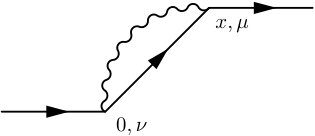 Figure 80
Peer Reviews
No public reviews on file for this paper yet. If you reviewed it on a platform where reviews are public (OpenReview, ICLR, NeurIPS, ICML), you can paste yours below so the community can read it here.
Videos
No videos yet. Explain this paper in a talk, walkthrough, or lecture? Add one.
QED self energies from lattice QCD
without power-law finite-volume errors
Xu Feng
School of Physics, Peking University, Beijing 100871, China
Collaborative Innovation Center of Quantum Matter, Beijing 100871, China
Center for High Energy Physics, Peking University, Beijing 100871, China
State Key Laboratory of Nuclear Physics and Technology, Peking University, Beijing 100871, China
Luchang Jin
Physics Department, University of Connecticut, Storrs, Connecticut 06269-3046, USA
RIKEN BNL Research Center, Brookhaven National Laboratory, Upton, New York 11973, USA
Abstract
Using the infinite-volume photon propagator, we developed a method which allows us to calculate electromagnetic corrections to stable hadron masses with only exponentially suppressed finite-volume effects. The key idea is that the infinite volume hadronic current-current correlation function with large time separation between the two currents can be reconstructed by its value at modest time separation, which can be evaluated in finite volume with only exponentially suppressed errors. This approach can be extended to other possible applications such as QED corrections to (semi-)leptonic decays and some rare decays.
I Introduction
Electromagnetic and strong interactions are two fundamental interactions known to exist in nature. They are described by the first-principle theories of quantum electrodynamics (QED) and quantum chromodynamics (QCD), respectively. In some physical processes, QED and QCD are both present and both play indispensable roles. A typical example is the neutron proton mass difference, which is attributed to both electromagnetic and strong isospin-breaking effects. Although this mass difference is only 2.53 times the electron mass, it determines the neutron-proton abundance ratio in the early Universe, which is an important initial condition for Big Bang nucleosynthesis. This quantity attracts a lot of interest and has motivated a series of lattice QCD studies on the isospin breaking effects in hadron spectra Duncan et al. (1996, 1997); Blum et al. (2007, 2010); Ishikawa et al. (2012); Borsanyi et al. (2015); Boyle et al. (2017).
Generally speaking, QED effects are small due to the suppression of a factor of the fine-structure constant . However, when the lattice QCD calculations reach the percent or sub-percent precision level, the QED correction becomes relevant. It plays a particularly important role in precision flavor physics, where lattice QCD calculations of the semi-leptonic decay form factors and the leptonic decay constant ratio have reached the precision of Aoki et al. (2017). At this precision the isospin symmetry breakings cannot be neglected. Pioneering works Carrasco et al. (2015); Lubicz et al. (2017); Giusti et al. (2018) have been carried out to include QED corrections to leptonic decay rates.
The conventional approach to include QED in lattice QCD calculations is to introduce an infrared regulator for QED. One popular choice is QEDL, first introduced in Ref. Hayakawa and Uno (2008), which removes all the spatial zero modes of the photon field. There are also some other methods: QEDTL Borsanyi et al. (2015), massive photon Endres et al. (2016), boundary condition Lucini et al. (2016). In general, by including the long-range electromagnetic interaction on a finite-volume lattice, all these treatments introduce power-law suppressed finite-volume errors. This is different from typical pure QCD lattice calculations where finite-volume errors are suppressed exponentially by the physical size of the lattice. Ref. Davoudi et al. (2018) provides an up-to-date systematic analysis of the finite-volume errors for the hadron masses in the presence of QED corrections.
Another approach to incorporate QED with QCD is to evaluate the QED part in infinite volume analytically and completely eliminate the power-law suppressed finite volume errors. Such an approach, called QED∞, has been used in the calculation of hadronic vacuum polarization (HVP) and the hadronic light-by-light (HLbL) contribution to muon Bernecker and Meyer (2011); Asmussen et al. (2016); Blum et al. (2017, 2018). This approach, when applied to QED corrections to stable hadron masses, does not completely remove the power-law suppressed finite volume effects. This is mostly because the hadron correlation functions, which one calculates on the lattice to extract hadron masses, are exponentially suppressed for large hadron source and sink separation. Therefore, the finite volume error of the QED correction to the hadron correlation function evaluated with QED∞, while its absolute size is still exponentially suppressed by the size of the system, is only power-law suppressed compared with the correction functions. In this paper, we propose a method to solve this problem. We show that the QED self-energy diagram can be calculated on a finite volume lattice with only exponentially suppressed finite-volume effects.
II Master formula
We first consider the self-energy calculation in an infinite space-time volume. For the case of a stable hadronic state , the self-energy diagram shown in Fig. 1 can be calculated in Euclidean space from the integral:
[TABLE]
where hadronic part is given by
[TABLE]
where is the hadronic current, indicates a hadronic state with the mass and spatial momentum , and is the photon propagator whose form is analytically known. The states obey the normalization convention . The current operator is a standard Euclidean Heisenberg-picture operator . A possible short distance divergence of the integral can be removed by renormalizing the quark mass.
If we examine an finite-volume system, the main feature of the conventional methods such as QEDL is to design a finite-volume form for photon propagator, , and calculate the hadronic correlation function in a finite volume in the presence of finite-volume QED using . Unfortunately, it results in power-law suppressed finite-volume effects in the mass extracted from the finite-volume hadronic correlation function. For the QED∞ approach, one may begin with the infinite volume formula in Eq. (1) to extract the QED self energy, but then limit the range of the integral and replace by a finite volume version. However, as we will explain later, the result still suffers from power-law finite-volume effects.
To completely solve the problem, we develop a method as follows. We choose a time (), that is sufficiently large that the intermediate hadronic states between the two currents are dominated by single hadron states since all the other states (resonance states, multi-hadron states, etc) are exponentially suppressed by .
[TABLE]
We propose to approximate and using the lattice-QCD calculable expressions and , which are defined as
[TABLE]
where is a QED weighting function, defined as:
[TABLE]
Here the energy is given by the dispersion relation . The integral in can be calculated in infinite volume (semi-)analytically. In section IV, detailed expressions for are given for both Feynman- and Coulomb-gauge photon propagators.
The finite-volume hadronic part is defined through finite-volume lattice correlators (assuming ):
[TABLE]
where / is an interpolating operator which creates/annihilates the zero momentum hadron state at time , is the separation between the source and current operators, which only needs to be large enough to suppress the excited states effects.
We will demonstrate below the quantities and defined in the master formula (II) only differ from and by exponentially suppressed finite-volume effects.
III Path to the master formula
III.1 Comparison between and
We adopt the conventional expectation (which can be demonstrated in perturbation theory using the Poisson summation formula Luscher (1986)) that for a theory such as QCD with a mass gap a matrix element such as , evaluated in a finite space-time volume with periodic boundary conditions, will differ from the corresponding matrix element in infinite volume by terms that are exponentially suppressed in the spatial and temporal extents of the volume. In addition, the value of the infinite-volume , when , is exponentially suppressed in .
These considerations suggest that the integral for is dominated by the region inside the finite-volume lattice and well approximated by the finite-volume integral . We therefore conclude that differs from its infinite-volume version by an exponentially suppressed finite-volume effect.
III.2 Comparison between and
We remind the reader that the value of is not always exponentially suppressed at large . In fact, for large , we shall have:
[TABLE]
Therefore if we limit the range of the integral for in Eq. (1), it will contain an power-law finite volume effect even if the infinite-volume photon propagator is used instead of . This is one of the reasons why the traditional QED∞ method, which works for the cases of HVP and HLbL, does not work for the QED self-energy diagram. As both ends of the photon propagator couple to the quark current, one can only perform the intergral over a finite time window. Even if we could create an infinite time-extent lattice and use the integral
[TABLE]
the result would still carry an finite-volume effect, due to the fact that is not exponentially suppressed at large .
Instead of using at large directly, we study the -dependence of the infinite-volume for . By inserting a complete set of intermediate states, we can rewrite as
[TABLE]
Without losing generality, positive is assumed in the above equation. In Euclidean space with large , the contribution from excited states si exponentially suppressed. The following approximation, where only the lowest energy states’ contributions are kept, is then valid for :
[TABLE]
where . On one hand, Eq. (III.2) suggests that we can calculate , for large , via the matrix element . On the other hand, it indicates that the Fourier transformation of at fixed gives the relevant matrix element:
[TABLE]
Putting Eq. (11) into Eq. (III.2), we are able to reconstruct the needed infinite volume hadronic matrix element at large from its value at modest :
[TABLE]
We will refer this relation, which is the crucial step in the derivation, as the “infinite volume reconstruction method”. Here the symbol reminds us that the excited-state contributions in and are exponentially suppressed and have been neglected.
In the previous section, we have confirmed that is equal to up to some exponentially suppressed corrections if , and is exponentially suppressed itself otherwise. We therefore conclude that can be well approximated by through
[TABLE]
where the weighting function has been given in Eq. (5) and will be discussed in the following section.
IV QED weighting function
Detailed expressions for the QED weighting function defined in Eq. (5) can be evaluated for Feynman- and Coulomb- gauge photon propagators:
- •
Feynman gauge
[TABLE]
[TABLE]
- •
Coulomb gauge
[TABLE]
[TABLE]
Only the spatial polarization components are needed for the large time expression in Coulomb gauge. All other components of are zero.
V Extended discussions
Eq. (12) tells us that the large time hadronic matrix elements can be determined using , while can be calculated using lattice. Before reaching Eq. (12), we explored other methods to determine . We recognized that by using the Coulomb-gauge photon propagator and assuming is a spin-0 charged particle, the corresponding matrix element can be determined easily. Here follows our discussion.
The infinite volume photon propagator in Coulomb gauge is given in Eq. (16). This implies, for , only is relevant. For a spin-0 charged particle, we have
[TABLE]
where the matrix element is expressed in terms of the form factor with . If the initial or the final state has zero momentum, as is the case in Eq. (III.2), we have
[TABLE]
Therefore, we can obtain that simply because of the Coulomb-gauge condition. Thus
[TABLE]
for a spin-0 charged particle and a Coulomb-gauge photon propagator, and all the finite volume errors are exponentially suppressed by the lattice size, , or the integration range in the time direction, . Note that is required for the above statement to be valid.
VI Conclusion
We have demonstrated that the QED self-energy for a stable hadron can be calculated on a finite volume lattice with only exponentially suppressed finite volume effects. The power-law finite volume effects, which are common in QCD+QED calculations, are completely eliminated. This is achieved with the following three ideas:
QED∞: We start with an integral , where the QED part in the integrand can be calculated in infinite volume analytically, and the hadronic part is purely a QCD matrix element, and enjoys an exponential suppressed long distance behavior because of the mass gap, as is familiar from pure QCD lattice calculations; 2. 2.
Window method: We introduce a cut in the time extent of the integral, , to separate the integral into the short-distance part, which can be calculated within finite volume directly, and the remaining long-distance part. 3. 3.
Infinite volume reconstruction method: We use the fact that the long-distance hadronic function is dominated by the lowest isolated pole (the hadron whose QED mass shift is under study) in the spectral representation to express the infinite-volume hadronic function at large in terms of its value at modest , which can be evaluated in finite volume.
The first idea, QED∞, has already been employed in some QED+QCD calculations, e.g. HVP Bernecker and Meyer (2011), HLbL Blum et al. (2017); Asmussen et al. (2016) and the QED correction to HVP Blum et al. (2018). For these calculations, this idea by itself is able to remove all the power-law suppressed finite-volume errors. The second idea used in this work, the window method, is relatively new. The name of the method comes from Ref. Blum et al. (2018), where the integrand is also divided into parts, and different treatments are applied to different parts. The third idea, the infinite volume reconstruction method, combined with the window method, is the essential part of our framework. It should be emphasized that, it is the infinite-volume hadronic function, , at large , being expressed in terms of at modest , which helps eliminate the power-law finite-volume errors.
In additional to QED self-energy, the framework developed here can also be applied to other QED+QCD problems. One example is the QED corrections to (semi-)leptonic decays, which can be used to determine some important CKM matrix elements like and Carrasco et al. (2015); Lubicz et al. (2017); Giusti et al. (2018). Another example is the rare kaon decays Christ et al. (2015, 2016a, 2016b); Bai et al. (2017, 2018), where the light electron propagator can be treated in a similar way as the photon discussed in this paper to reduce the finite-volume error.
Acknowledgements.
We would like to thank our RBC and UKQCD collaborators for helpful discussions and support.
The reference list from the paper itself. Each links out to its DOI / PubMed record.
- 1Duncan et al. (1996) A. Duncan, E. Eichten, and H. Thacker, Phys. Rev. Lett. 76 , 3894 (1996) , ar Xiv:hep-lat/9602005 [hep-lat] . · doi ↗
- 2Duncan et al. (1997) A. Duncan, E. Eichten, and H. Thacker, Phys. Lett. B 409 , 387 (1997) , ar Xiv:hep-lat/9607032 [hep-lat] . · doi ↗
- 3Blum et al. (2007) T. Blum, T. Doi, M. Hayakawa, T. Izubuchi, and N. Yamada, Phys. Rev. D 76 , 114508 (2007) , ar Xiv:0708.0484 [hep-lat] . · doi ↗
- 4Blum et al. (2010) T. Blum, R. Zhou, T. Doi, M. Hayakawa, T. Izubuchi, S. Uno, and N. Yamada, Phys. Rev. D 82 , 094508 (2010) , ar Xiv:1006.1311 [hep-lat] . · doi ↗
- 5Ishikawa et al. (2012) T. Ishikawa, T. Blum, M. Hayakawa, T. Izubuchi, C. Jung, and R. Zhou, Phys. Rev. Lett. 109 , 072002 (2012) , ar Xiv:1202.6018 [hep-lat] . · doi ↗
- 6Borsanyi et al. (2015) S. Borsanyi et al. , Science 347 , 1452 (2015) , ar Xiv:1406.4088 [hep-lat] . · doi ↗
- 7Boyle et al. (2017) P. Boyle, V. Gülpers, J. Harrison, A. Jüttner, C. Lehner, A. Portelli, and C. T. Sachrajda, JHEP 09 , 153 (2017) , ar Xiv:1706.05293 [hep-lat] . · doi ↗
- 8Aoki et al. (2017) S. Aoki et al. , Eur. Phys. J. C 77 , 112 (2017) , ar Xiv:1607.00299 [hep-lat] . · doi ↗