Colossal enhancement of spin-chirality-related Hall effect by thermal fluctuation
Yasuyuki Kato, Hiroaki Ishizuka

TL;DR
Thermal fluctuations can dramatically enhance the spin-chirality-induced anomalous Hall effect in itinerant magnets, with conductivity increasing up to three orders of magnitude due to skew scattering effects.
Contribution
This study demonstrates that thermal fluctuations significantly amplify the spin-chirality-related Hall effect, revealing a mechanism for large temperature-dependent Hall conductivity increases.
Findings
Hall conductivity increases up to 10^3 times the ground state value
Thermal fluctuations induce multiple-spin scattering enhancing Hall effect
Results suggest relevance to experimentally observed thermal Hall effect enhancements
Abstract
The effect of thermal fluctuation on the spin-chirality-induced anomalous Hall effect in itinerant magnets is theoretically studied. Considering a triangular-lattice model as an example, we find that a multiple-spin scattering induced by the fluctuating spins increases the Hall conductivity at a finite temperature. The temperature dependence of anomalous Hall conductivity is evaluated by a combination of an unbiased Monte Carlo simulation and a perturbation theory. Our results show that the Hall conductivity can increase up to times the ground state value; we discuss that this is a consequence of a skew scattering contribution. This enhancement shows the thermal fluctuation significantly affects the spin-chirality-related Hall effect. Our results are potentially relevant to the thermal enhancement of anomalous Hall effect often seen in experiments.
Click any figure to enlarge with its caption.
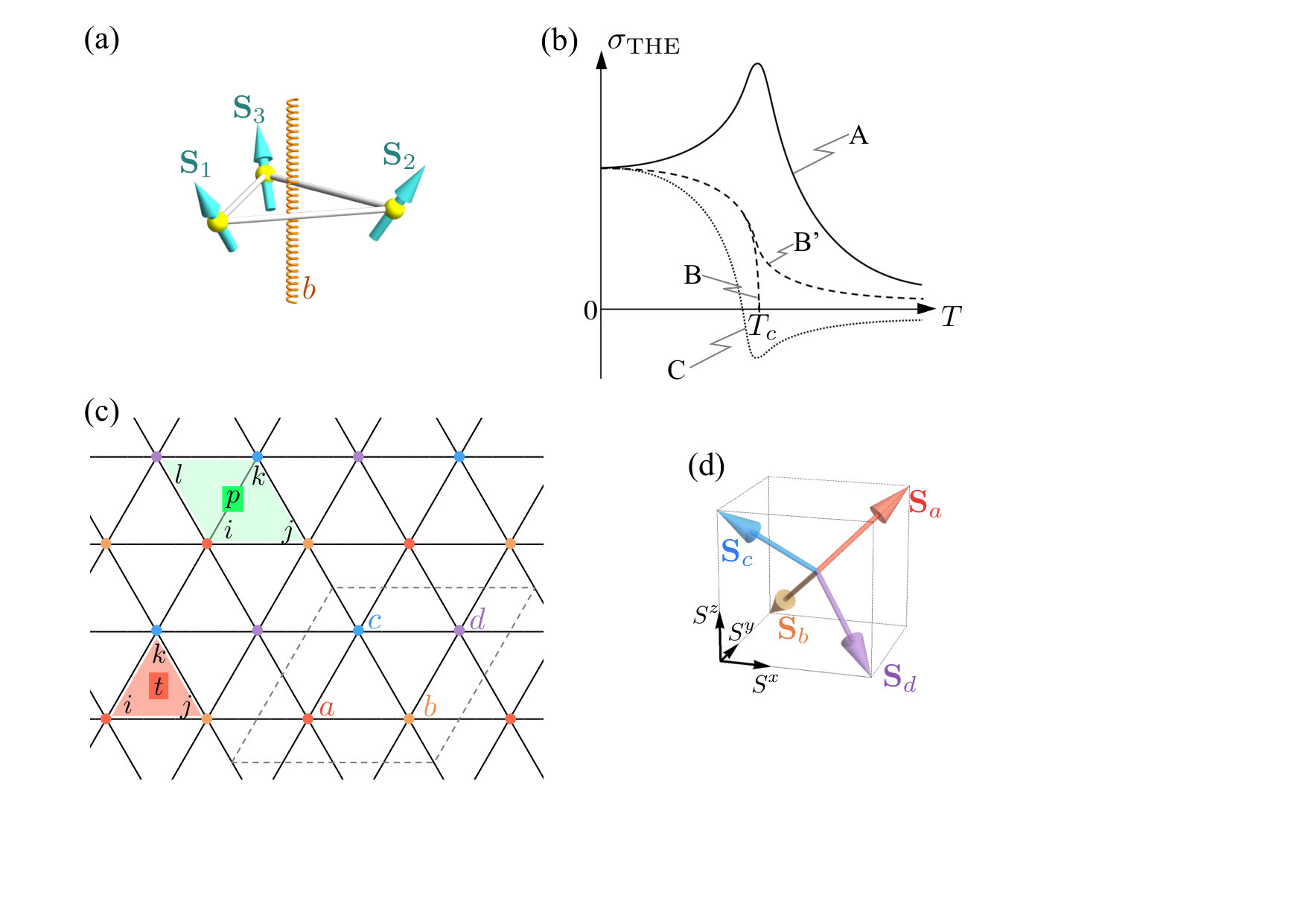 Figure 1
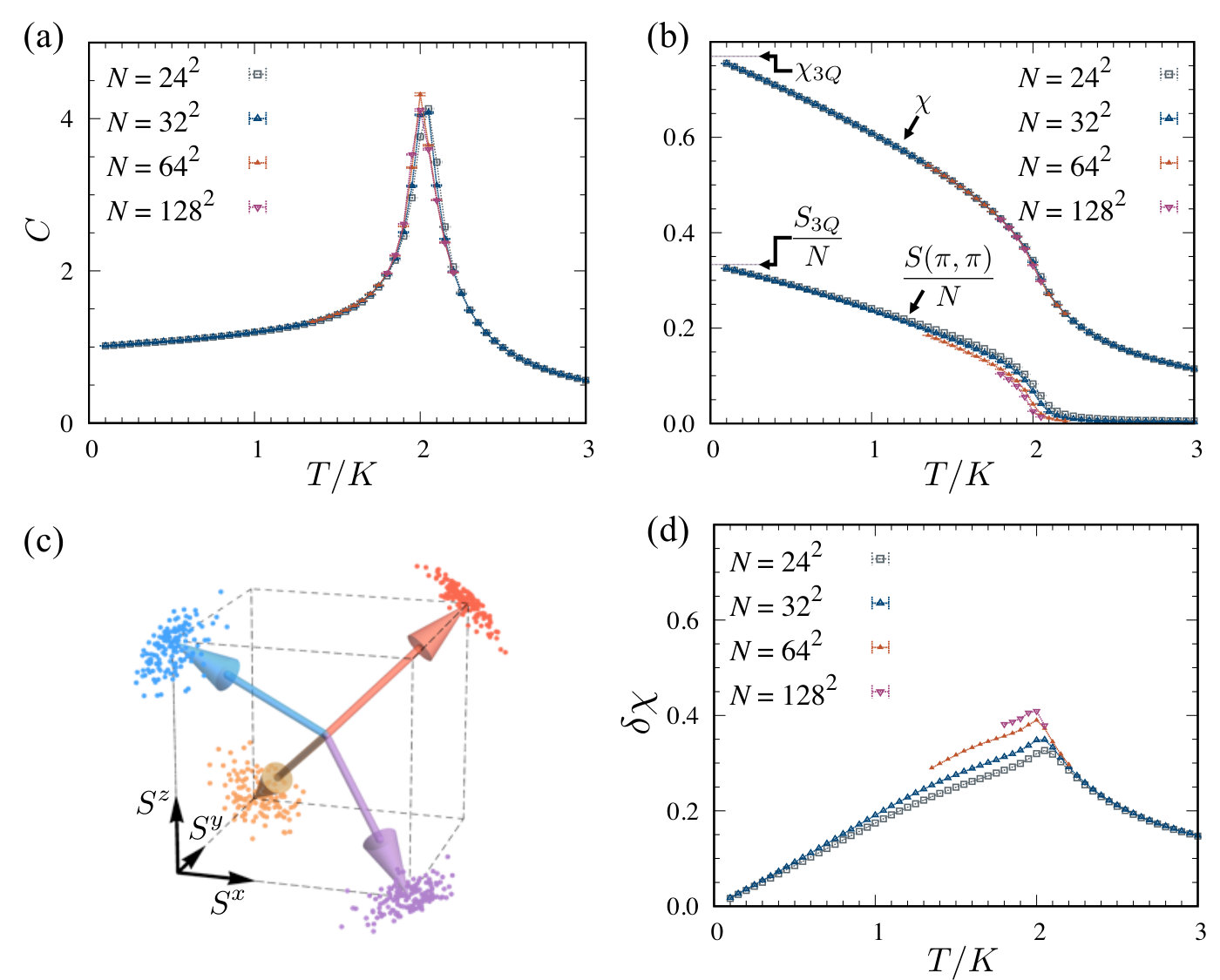 Figure 2
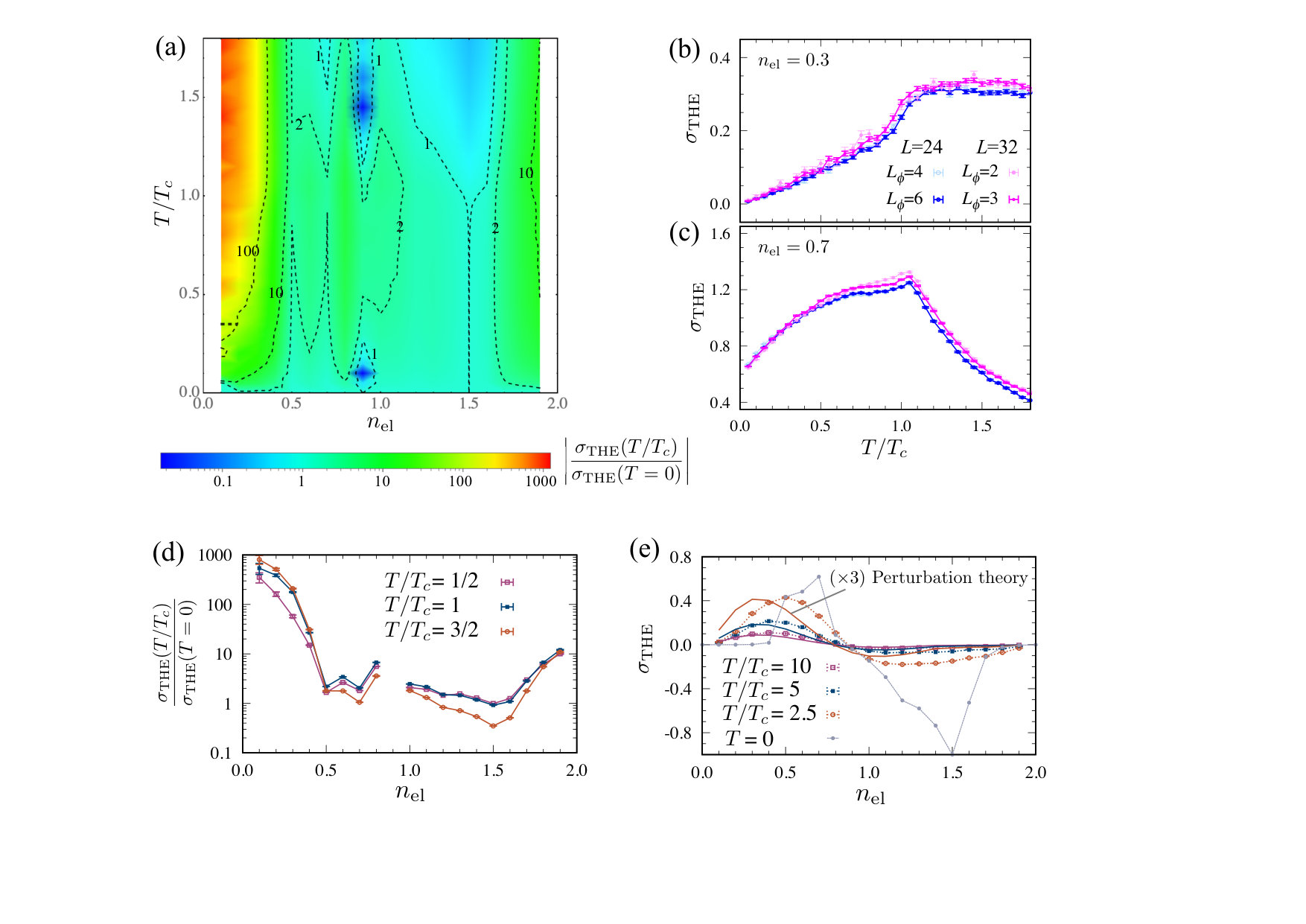 Figure 3
Peer Reviews
No public reviews on file for this paper yet. If you reviewed it on a platform where reviews are public (OpenReview, ICLR, NeurIPS, ICML), you can paste yours below so the community can read it here.
Videos
No videos yet. Explain this paper in a talk, walkthrough, or lecture? Add one.
Colossal enhancement of spin-chirality-related Hall effect by thermal fluctuation
Yasuyuki Kato
Department of Applied Physics, The University of Tokyo, Bunkyo, Tokyo, 113-8656, JAPAN
Hiroaki Ishizuka
Department of Applied Physics, The University of Tokyo, Bunkyo, Tokyo, 113-8656, JAPAN
Abstract
The effect of thermal fluctuation on the spin-chirality-induced anomalous Hall effect in itinerant magnets is theoretically studied. Considering a triangular-lattice model as an example, we find that a multiple-spin scattering induced by the fluctuating spins increases the Hall conductivity at a finite temperature. The temperature dependence of anomalous Hall conductivity is evaluated by a combination of an unbiased Monte Carlo simulation and a perturbation theory. Our results show that the Hall conductivity can increase up to times the ground state value; we discuss that this is a consequence of a skew scattering contribution. This enhancement shows the thermal fluctuation significantly affects the spin-chirality-related Hall effect. Our results are potentially relevant to the thermal enhancement of anomalous Hall effect often seen in experiments.
††preprint: APS/123-QED
I Introduction
Anomalous Hall effect (AHE) has been one of the central topics in the study of quantum transport phenomena Hall (1881). Continuous study over more than a century have revealed that AHE shows rich properties which attracts the interest not only from basic science but also from applications (e.g., high-accuracy Hall-effect sensors) Nagaosa et al. (2010); Maekawa (2006). Microscopically, the mechanism of the AHE is often classified into two groups: Intrinsic mechanism related to the Berry curvature of the electronic bands Karplus and Luttinger (1954) and the extrinsic mechanism due to impurity scattering Smit (1955, 1958); Berger (1970). The difference in the microscopic origin is often reflected in the behaviors of the AHE. For instance, the intrinsic AHE reflects singular structures in the Berry curvature. This gives rise to non-monotonic temperature () Fang et al. (2003) and field Takahashi et al. (2018) dependence of the anomalous Hall conductivity . On the other hand, the extrinsic AHE by magnetic scatterings shows a peaklike enhancement of the Hall resistivity at a certain which characterizes the underlying physics such as the magnetic transition Kondo (1962) and coherence Fert and Levy (1987); Yamada et al. (1993); Kontani and Yamada (1994) s. These rich features of the AHE have been intensively studied in both theory and experiment, and are also useful in identifying the physics behind the phenomena.
Among various studies, a recent breakthrough was the discovery of AHE related to scalar spin chirality which is often called topological Hall effect (THE). Scalar spin chirality is a quantity defined by the scalar triple product of magnetic moments , where is a local magnetic moment [Fig. 1(a)]). This quantity is a measure of the non-coplanar nature of spin texture because the spin chirality is zero whenever the three spins lie in a same plane. It was pointed out that the spins produce a fictitious magnetic field when the three adjacent spins have a finite scalar spin chirality, resulting in an AHE Ye et al. (1999); Ohgushi et al. (2000); Taguchi et al. (2001) [Fig. 1(a)]. Alternatively, it is interpreted as an AHE due to the magnetic scattering by multiple scatterers Tatara and Kawamura (2002); Ishizuka and Nagaosa (2018). The spin-chirality-related mechanism is studied in various materials, such as perovskite Matl et al. (1998); Jakob et al. (1998); Chun et al. (2000); Lyanda-Geller et al. (2001) and pyrochlore Taguchi et al. (2001) oxides, chiral magnets Neubauer et al. (2009); Kanazawa et al. (2011); Yokouchi et al. (2014); Franz et al. (2014), triangular oxides Martin and Batista (2008); Akagi and Motome (2010); Kato et al. (2010); Takatsu et al. (2010); Ok et al. (2013), and kagome antiferromagnets Chen et al. (2014); Nakatsuji et al. (2015). The THE in these materials are often investigated by the magnetic field dependence, which are consistent with the theoretical predictions Taguchi et al. (2001); Neubauer et al. (2009); Kanazawa et al. (2011).
In contrast, the dependence of the THE in the non-coplanar magnetic states is less understood. The Hall conductivity is expected to decrease with increasing temperature in magnets with non-coplanar magnetic orders because the scalar spin chirality decreases [Curve B in Fig. 1(b)]. In experiment, however, many materials show an increase of the Hall conductivity with increasing Takatsu et al. (2010); Ok et al. (2013); Yokouchi et al. (2014) [Curve A of Fig. 1(b)]; some materials show the maximum slightly above the magnetic transition temperature Takatsu et al. (2010); Ok et al. (2013). This is in contrast to the known theories, where the maximum is expected to be below Kondo (1962) or much Fert and Levy (1987) higher than . To the best of our knowledge, no theoretical understanding on the dependence is reached so far.
In this work, we theoretically study the enhancement of Hall conductivity () by the thermal fluctuation focusing on the fluctuation-induced skew scattering. As an example, we consider a triangular lattice model with four-sublattice non-coplanar order called order [Figs. 1(c) and 1(d)]. The dependence of is calculated combining a Monte Carlo (MC) simulation and a large-size numerical calculation using Kubo formula. We find that increases with increasing , sometimes up to times compared with the ground state. The scan over the carrier density , which is the average number of electrons per site, shows the enhancement due to the skew scattering by multiple spins generally appears in this model. Our results show the thermal fluctuation causes enhancement of AHE at finite .
II Model
In this study, we consider a classical Heisenberg spin model on a triangular lattice as an example of short-range non-coplanar magnetic order Momoi et al. (1997). The Hamiltonian reads
[TABLE]
where () represents localized spin at site , the sums , , and run over all the four-site plaquettes, all the sites, and all the three-site plaquettes, respectively, and , , , and represent a short range multispin interaction, a single-ion anisotropy, a sublattice specific magnetic field, and a fictitious field coupled to the spin chirality, respectively. For each triangular plaquette and rhombic plaquette , multispin interactions are defined as
[TABLE]
where of a triangular plaquette is defined in order of counter-clockwise, and of a rhombic plaquette is defined so that the pairs of and are the diagonal pairs of the corners of a rhombic plaquette [see Fig. 1(c)]. A model with first term was originally introduced in the study on two-dimensional solid 3He Thouless (1965). More recently, the biquadratic terms in was discussed in the effective spin models for the Kondo lattice model Akagi et al. (2012); Ishizuka and Motome (2015). The model with only terms () exhibits a finite phase transition with the spontaneous symmetry breaking from paramagnets to a chiral phase where spins are disordered but s are ordered Momoi et al. (1997).
With , , and , the low phase becomes a magnetic order because these terms reduce the symmetry: the term represents the single spin cubic anisotropy because of which spins favor one of directions (); the term represents the Zeeman coupling between the -sublattice spins and an external magnetic field (), and the term represents a coupling between a fictitious field and because of which in entire range. With these three terms, the low- chiral phase is replaced by a four-sublattice long-range magnetic ordered phase [Figs. 1(c) and 1(d)]. In this state, the four spins on each sublattice in Fig. 1(c) points along different directions [Fig. 1(d)], forming a non-coplanar magnetic texture.
III Results
Monte Carlo simulation —
The finite properties of this model is calculated by MC simulations using a standard single-spin-flip Metropolis algorithm sup . Figure 2 shows the results of MC simulations with . The specific heat in Fig. 2(a) shows a peak at , and the normalized structure factor , [ is the number of spins and is the size of the system.] becomes nonzero below reflecting a phase transition to a magnetic order phase. In the lowest , approaches , and approaches as shown in Fig. 2(b). Figure 2(c) shows a spin configuration obtained in simulation at the sufficiently low . These results consistently show that the ground state is the order and the phase transition is continuous. We also find that the overall behavior of the above quantities are sufficiently converged with with some finite size effect close to . The behavior of , , and as well as the observed finite size effect indicates that the phase transition is continuous.
We note that the scalar spin chirality remains positive in the entire range, even above [Fig. 2(b)]. The nonzero comes from the local correlation of fluctuating spins under the field in Eq. (1), which acts as the “magnetic field” for . As a measure of the chirality due to the fluctuating spins, we use
[TABLE]
In contrast, shows a different dependence. Figure 2(d) shows increases with increasing and shows a cusp like peak at . The magnetic scattering by fluctuating spins produces anomalous Hall effect proportional to the scalar spin chirality Tatara and Kawamura (2002); Ishizuka and Nagaosa (2018). Therefore, the fluctuating spins may produce a non-monotonic dependence of .
Anomalous Hall conductivity — To study the dependence of , we consider itinerant electrons coupled to the spins in . The electrons are coupled to the localized spins via Hund’s coupling, i.e., we consider a Kondo lattice model on the triangular lattice. The Hamiltonian reads:
[TABLE]
where are the vector of Pauli matrices, and () is a creation (annihilation) operator of itinerant electron at site with spin . The first term represents the kinetic energy term of itinerant electrons, and the second term the Hund’s coupling. We assume that the coupling is relatively weak (), and the energy scale in the electron system is much larger than the spin system. Then, for simplicity, we fix the temperature of the electron system . The Hall conductivity is calculated by Kubo formula using spin configurations generated by the MC simulation Yi et al. (2009); Ueland et al. (2012); Ishizuka and Motome (2013a, b); Rosales et al. (2019); sup .
Figures 3(b,c) show at as examples. Different lines are for different choices of and ; we find only small finite size effect after taking the average over the twisted boundaries. When [Fig. 3(b)], we find at . However, monotonically increases with increasing , reaching at ; this is approximately 30 times larger than . In our calculation, we find the enhancement of in nearly all choices of . Figure 3(c) shows the results for . Similar to Fig. 3(b), increases with increasing and decreases above ; the curve shows a maximum around with a kink slightly below it. This trend also appears for except the difference in the sign of sup .
The increase of implies the enhancement is related to the fluctuation effect. Indeed, the dependence of is in contrast to that of , which decreases monotonically with increasing [Fig. 2(b)]. Therefore, the enhancement is different from what is expected in the intrinsic THE mechanism. On the other hand, the increase of below and the maximum around are coincident with the dependence of . Furthermore, at some filling e.g., [Fig. 3(c)], shows a cusp at resembling . These features imply the enhancement is related to the spin chirality of fluctuating spins , presumably related to the skew scattering mechanism Ishizuka and Nagaosa (2018)
Our results in Fig. 3(a) also find that the thermal effect is larger when the Fermi level is close to the band edge, i.e., or . Figure 3(d) shows the ratio at 1/2, 1, and 3/2. As shown in the figure, is typically 2–10 times larger than . On the other hand, the enhancement at the band edges are much larger, sometimes up to times of that at .
The and regions are close to the ideal setup in which the skew scattering is often studied. In the case (), the electron (hole) bands are well approximated by the quadratic dispersion. The skew scattering in these situations are often driven by the large-angle scattering, which is dominant when . Here, and are the Fermi wavenumber and the correlation length for , respectively. Therefore, the skew scattering theory in Ref. Ishizuka and Nagaosa (2018) applies to this case. The condition is not satisfied when the chemical potential moves away from the band edge. Hence, the results may generally change due to the large Fermi surface. Nevertheless, our result shows the enhancement is commonly seen regardless of the size of the Fermi surface.
High-temperature region — We next turn to the dependence of at a high- region well above . The results of MC simulation are shown in Fig. 3(e). The results show a qualitatively different dependence compared to the result; for tends to be larger than that for in the high regime while the trend is opposite in the low near . This contrasting trend at a high- is explained by the relaxation-time (electron lifetime) dependence of skew scattering mechanism. To see the density of state [] dependence, we evaluated using a perturbation method in Ref. Tatara and Kawamura (2002). In the region, the fluctuation contribution is expected to be the only contribution to the Hall effect. Also, the correlation length of the spins becomes very short in this region. Therefore, we only take into account the contribution from the nearest-neighbor spin correlation. With these approximations, the conductivity reads Tatara and Kawamura (2002):
[TABLE]
where and () is the velocity (energy) of electrons with momentum (). Here, the sum of is limited to the three spins forming the triangles [Fig. 1(c)]. The electron lifetime is evaluated using the first Born approximation, . Here, we neglected the spin-spin correlation for the evaluation of .
The result of Eq. (4) is shown in Fig. 3(e). The perturbation theory semi-quantitatively reproduces the overall trend of numerical results. The similarity between the numerical results and the perturbation suggests that the Hall effect is related to the skew scattering by the fluctuating spins in the high- regime; in the perturbation theory, larger skew scattering contribution to is expected when is larger Nagaosa et al. (2010); Tatara and Kawamura (2002); Ishizuka and Nagaosa (2018), and indeed for is smaller than that for .
IV Summary and concluding remarks
To summarize, in this work, we studied the effect of the thermal fluctuation to the spin-chirality-related anomalous Hall effect. By an unbiased numerical simulation, we find the Hall conductivity increases with increasing temperature, sometimes approximately times the ground state value. Detailed analysis on the temperature and electron-density dependence shows the enhancement is consistent with the skew scattering mechanism proposed recently Ishizuka and Nagaosa (2018); the thermal enhancement is larger when the Fermi level is close to the band edge, and is also related to the density of states. These results show a significant effect of the thermal fluctuation to the Hall effect induced by non-coplanar magnetic orders.
In contrast to our results, the skew scattering mechanism was also discussed in relation to the sign change of close to the critical temperature in chiral magnets with long-period magnetic orders (e.g., MnGe) Ishizuka and Nagaosa (2018). This is a decidedly different behavior from the current case where the skew scattering enhances the Hall effect. Presumably, a key difference is the size of the magnetic structure, i.e., the characteristic wave number is large (small) in the order (magnetic skyrmion crystals). In the skew scattering mechanism Ishizuka and Nagaosa (2018), the scattering amplitude is proportional to where is the angle between the in-comming and out-going electrons, namely, larger angle scattering is important. In addition to the skew scattering, the small angle scattering is also induced by the intrinsic topological Hall effect (THE) when is small. In other words, from the scattering theory viewpoint, the scattering channels for the skew scattering and intrinsic THE are different for small . In contrast, since the magnetic unit cell of order has only four sites ( is large), both the skew scattering and intrinsic THE induce a large angle scattering. Our results presented here shows that the magnetic fluctuation plays a non-trivial and crucial role in magnets with such a short period order.
Acknowledgements.
The authors thank J. M. Ok, Y. Motome, and N. Nagaosa for fruitful discussions. This work was supported by JSPS KAKENHI Grant Numbers JP16H02206, JP16H06717, JP18K03447, JP18H03676, JP18H04222, JP19K14649, and JP26103006, and CREST, JST (Grant Nos. JPMJCR16F1, JPMJCR18T2, and JPMJCR1874). Numerical calculations were conducted on the supercomputer system in ISSP, The University of Tokyo.
The reference list from the paper itself. Each links out to its DOI / PubMed record.
- 1Hall (1881) Edwin Herbert Hall, “XVIII. On the “Rotational Coefficient” in nickel and cobalt,” Philos. Mag. 12 , 157–172 (1881).
- 2Nagaosa et al. (2010) Naoto Nagaosa, Jairo Sinova, Shigeki Onoda, A. H. Mac Donald, and N. P. Ong, “Anomalous Hall effect,” Rev. Mod. Phys. 82 , 1539–1592 (2010) . · doi ↗
- 3Maekawa (2006) Sadamichi Maekawa, Concepts in spin electronics (Oxford Univ. Press, 2006).
- 4Karplus and Luttinger (1954) Robert Karplus and J. M. Luttinger, “Hall Effect in Ferromagnetics,” Phys. Rev. 95 , 1154–1160 (1954) . · doi ↗
- 5Smit (1955) J. Smit, “The spontaneous hall effect in ferromagnetics I,” Physica 21 , 877 – 887 (1955) . · doi ↗
- 6Smit (1958) J. Smit, “The spontaneous hall effect in ferromagnetics II,” Physica 24 , 39 – 51 (1958) . · doi ↗
- 7Berger (1970) L. Berger, “Side-Jump Mechanism for the Hall Effect of Ferromagnets,” Phys. Rev. B 2 , 4559–4566 (1970) . · doi ↗
- 8Fang et al. (2003) Zhong Fang, Naoto Nagaosa, Kei S. Takahashi, Atsushi Asamitsu, Roland Mathieu, Takeshi Ogasawara, Hiroyuki Yamada, Masashi Kawasaki, Yoshinori Tokura, and Kiyoyuki Terakura, “The Anomalous Hall Effect and Magnetic Monopoles in Momentum Space,” Science 302 , 92–95 (2003) . · doi ↗