Implementation of MUAV as reference source for GLAO systems
Ra\'ul Rodr\'iguez Garc\'ia, Salvador Cuevas

TL;DR
This paper presents a method to use MUAVs as artificial reference sources for GLAO systems, analyzing turbulence profiles and establishing flight stability and altitude requirements for effective star emulation.
Contribution
It introduces a novel approach to generate artificial guide stars using MUAVs, detailing the necessary flight parameters and demonstrating feasibility with commercial UAVs.
Findings
MUAVs must be at least 800 m above the observatory.
A stability of 1.54 cm is required in less than 18 ms.
Commercial MUAVs can nearly meet these requirements.
Abstract
We propose an alternative method to generate an artificial reference source for a Ground Layer Adaptive Optics system airborne on a Multirotor Unmanned Aerial Vehicle. Turbulence profiles from the Ground Layer at the National Astronomical Observatory in San Pedro Martir were analyzed to establish the requirements in luminosity, altitude, and flight stability of an artificial source. We found the source must be at least 800 m above the observatory's surface and follow a fixed trajectory to emulate the apparent movement of the stars with a stability of 1.54 cm in time intervals smaller than 18 ms. We establish some commercial and customized MUAVs can nearly accomplish this task.
Click any figure to enlarge with its caption.
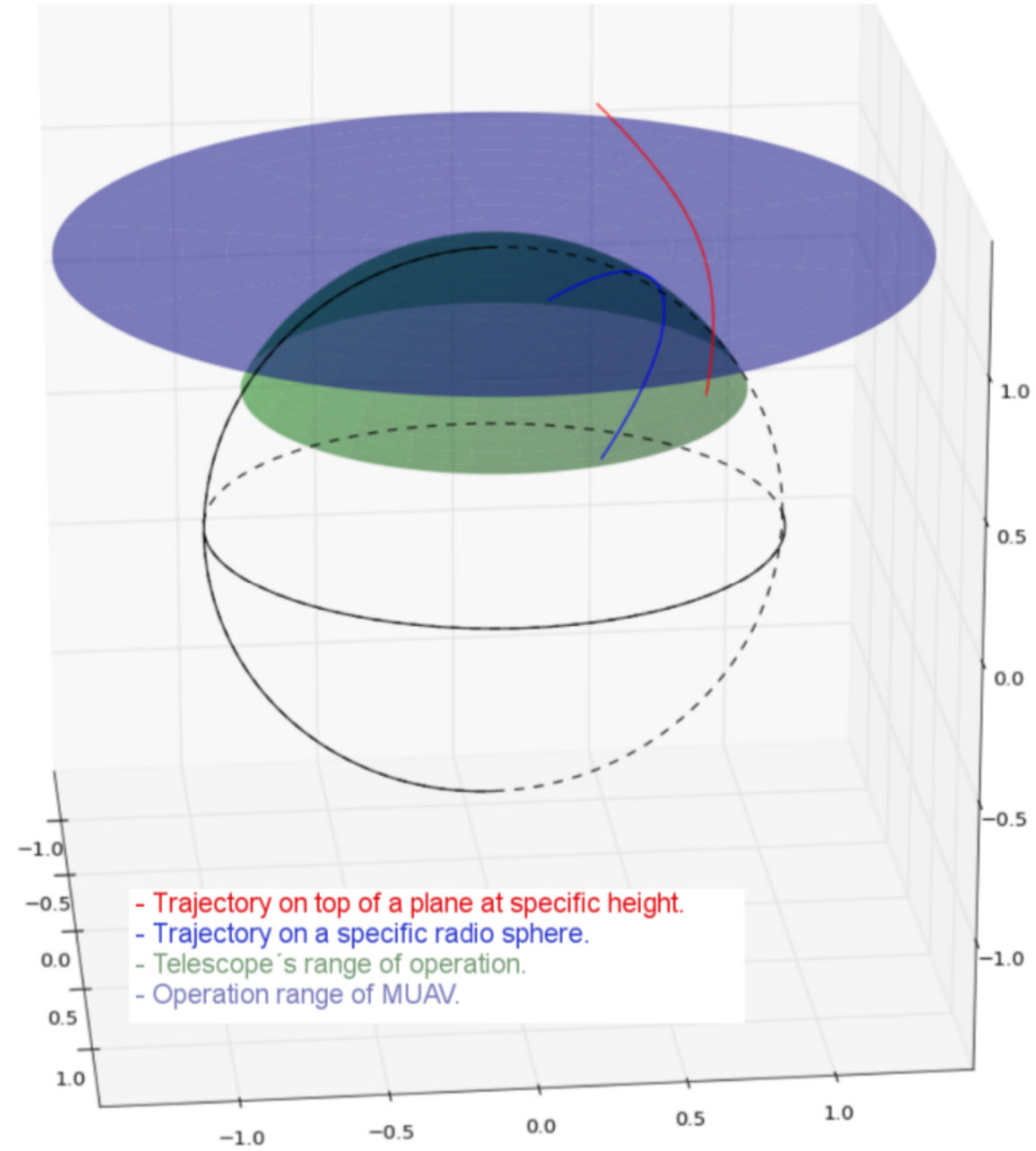 Figure 1
| Seeing | Fried | Isoplanatic | Coherence | |
|---|---|---|---|---|
| Parameter | parameter | angle | time | |
| (arcsec) | (cm) | (arcmin) | (ms) | |
| Mean | [] | [] | [] | [] |
| LOLAS-2 | [] | [] | [] | [] |
| Telescope Aperture | =500 nm | =1500 nm |
|---|---|---|
| 2.1 m | 967 | 259 |
| 6.5 m | 2992 | 800 |
| NOTE. - Height in meters above the observatory surface. | ||
| Minimum | Linear | Apparent | Maximum | Required |
|---|---|---|---|---|
| high | dimension | brightness | speed | stability |
| (m) | (mm) | () | (cm/s) | (cm) |
| 800 | 2.3 | -0.23* | 5.83 | 1.54 |
| Altitude | Speed | Wind | Payload | Autonomy |
|---|---|---|---|---|
| resistance | ||||
| (AMSL)1 | (m/s) | (m/s) | (kg) | (min) |
| 5000-6000 | H: 20 | 12 | 1 - 6 | 20 - 40 |
| V: 5 |
| Data type | Positioning | Hover | Horizontal | Tilted |
|---|---|---|---|---|
| plane | plane | |||
| Simulated | X=0.41 | S:14.7 | C:13 | |
| Y=0.10 | C:3.29 | |||
| Z= 0.82 | ||||
| Experimental | V: 1* | 4.5 | C:1.1* | S:10 |
| H: 2* |
Peer Reviews
No public reviews on file for this paper yet. If you reviewed it on a platform where reviews are public (OpenReview, ICLR, NeurIPS, ICML), you can paste yours below so the community can read it here.
Videos
No videos yet. Explain this paper in a talk, walkthrough, or lecture? Add one.
Implementation of MUAV as reference source for GLAO systems
Raúl Rodríguez García11affiliation: Instrumentation Department IA-UNAM 22affiliation: [email protected] and Salvador Cuevas 11affiliation: Instrumentation Department IA-UNAM
Instituto de Astronomía
Universidad Nacional Autonoma de México, Apdo. Postal 70-264, 04510
Ciudad de México, México
Abstract
We propose an alternative method to generate an artificial reference source for a Ground Layer Adaptive Optics system airborne on a Multirotor Unmanned Aerial Vehicle. Turbulence profiles from the Ground Layer at the National Astronomical Observatory in San Pedro Martir were analyzed to establish the requirements in luminosity, altitude, and flight stability of an artificial source. We found the source must be at least 800 m above the observatory’s surface and follow a fixed trajectory to emulate the apparent movement of the stars with a stability of 1.54 cm in time intervals smaller than 18 ms. We establish some commercial and customized MUAVs can nearly accomplish this task.
Adaptive Optics, GLAO, Artificial Reference Source, MUAV, UAV.
\AuthorCallLimit
=1 \collaborationNameOptics and Instrumentation Deparment
1 Introduction
Modern astronomical instrumentation has focused big efforts on the development and construction of instruments for the new generations of terrestrial mega telescopes. Most will have to use Adaptive Optics (AO) systems, to correct the negative effects produced by the terrestrial atmosphere on the incident light, and thus obtaining its maximum performance. This technique has more than 60 years of development since it was proposed by Babcock (1953). However, to apply it, we need luminous references to measure, in real time, the distortions of the wave-fronts coming from astronomical objects that reach the Earth (Hardy, 1998).
The AO systems work with two types of reference sources: one uses natural guide stars (NGS). Nevertheless, these are insufficient to cover the entire observable sky. The other type emerges as a solution to the problem presented by the NGS and consists of implementing laser techniques (Laser Guide Star, LGS) (Foy and Labeyrie, 1985).
Two methods are normally used: the LGS Sodium and the LGS Rayleigh. The first method takes advantage of the resonance of the atmospheric sodium layer produced by a laser (589.6 nm wavelength), which is emitted from the Earth’s surface to a height of 90 km (average height of the sodium layer) to form a luminous spot, whose backscattering light returns through all the atmospheric layers until it reaches the telescope’s optics. The second method uses the Rayleigh scattering produced by the air molecules in the atmosphere. However, since the air density decreases with height, this type of lasers only have a good performance to produce a bright spot in heights less than 20 km.
It should be noted that even though the LGS allows to have luminous references in the whole observable field by terrestrial telescopes, its implementation is not so simple, and it needs specific special facilities and expertise, no to mention the cost (Wizinowich, 2012).
According to the atmospheric turbulence characteristics, it is well known that the greatest distortion of the wave-front is mainly produced in two layers known as the Free Atmosphere, and the Ground Layer (Skidmore et al., 2009). The latter is where usually the greatest distortion of the wave-front occurs (Tokovinin et al., 2003; Egner and Masciadri, 2007; Osborn et al., 2010). Therefore, specialized AO systems have been developed to correct the effects of this layer; they are known as Ground Layer Adaptive Optics (GLAO) (Tokovinin et al., 2010b).
Nowadays, there are new greater vertical resolution instruments that have come to improve the characterization of the Ground Layer, and now, we know that the greatest influence over incident wave-fronts is inside the first 100 m above the surface of some observatories (Oya, 2015; Hickson et al., 2010; Tokovinin et al., 2010a). In Mexico, at National Astronomical Observatory (OAN) some measurements with one of these instruments were performed, which we can notice a similar Ground Layer behavior (Sánchez et al., 2015). However, it is necessary to conduct a long term characterization campaign for confirming this scenario.
Additionally, the development and application of Unmanned Aerial Vehicles (UAV) have been an international boom in different fields of science, including in astronomical instrumentation for optical telescopes such as is found in Biondi et al. (2016).
In Basden et al. (2018) a general and extensive analysis of using rotary unmanned aerial vehicles as an artificial guide star can be found. Here, it was proposed and analyzed the idea of a future UAV application, where the devices are used as an auxiliary reference source for OA systems. In this article, the device performance is simulated working together with laser references for the correction of several layers of atmospheric turbulence. Their results show the necessity to reach a height of 10 km, which is not at present possible.
A key point for use MUAV in astronomical instrumentation applications is to determine the optical effects generated by these devices when flying. Rodríguez García et al. (2019) measured these effects and determined that in isothermal conditions, the optical turbulence produced by these devices is negligible (Rodríguez García et al., 2019).
In this article, we analyze the possibility of the current implementation of an artificial reference source, when we restrict the turbulence correction to the Ground Layer. We compared the advances achieved by the technology with Multirotor Unmanned Aerial Vehicle (MUAV) and the atmospheric conditions found in the observatory of San Pedro Martir in Mexico as an example for its application.
We study the feasibility of using a MUAV (including programmable-ready to fly devices), as a carrier of a LED light source to generate an artificial reference source for AO. This reference source will use to determine the distortion on the wave-fronts produced by the Ground Layer turbulence, and thus implement it for terrestrial telescopes with GLAO systems. In Section 2, we specify the general conditions for reference sources of an adaptive optics system, and the characteristics required by a UAV. In section 3, we establish the restrictions for this source based on the characteristics of the local turbulence of the Ground Layer at San Pedro Martir observatory. Finally, in Section 4 we introduce the features for the selection of a MUAV, and we analyze their performance, both for commercial and for custom design devices. This analysis seeks to determine if these devices can fully comply with the before established restrictions.
2 General Conditions
2.1 Reference Source of an AO System
In general, any reference source used for adaptive optics systems must fulfill the following conditions:
- •
The light source will be punctual and bright enough to be detected by the wave-front sensor of the adaptive optics system.
- •
The reference source will remain within the isoplanatic angle of the observed field during the time required for observations (Fried, 1982)
- •
The source will remain spatially stable inside the AO wave-front sensor.
- •
This reference source will be located at a certain distance from the telescope along to the optical axis, in which the error caused by the cone effect is the minimum (Fried and Belsher, 1994).
It is important to point out that LGS need to be stabilized with some NGS in the field of view (FoV) of telescope (Tokovinin et al., 2016).
2.2 Unmanned Aerial Vehicles (UAV)
To have a functional system that can be optimally implemented in astronomical observatories, concerning UAVs in general, it is necessary to establish the following operating conditions:
The device will have the capability to transport and supply the energy for the reference source. 2. 2.
It will operate semi-automatically and remotely from a Ground Station. 3. 3.
It will perform the following functions: take off; reach a specific operation position and height correspondent to the pointing position of the telescope; return and land at the initial take-off position (Home). 4. 4.
It will be stabilized within the field of the isoplanatic angle of the telescope. 5. 5.
The device will have the possibility to receive and perform commands to change their position constantly, and follow a specific trajectory as well, corresponding to the telescope tracking. 6. 6.
It will have adequate security systems to avoid accidents that could put people at risk, either at the infrastructure of the observatory or for the device itself Basden et al. (2018).
3 RESTRICTIONS FOR THE REFERENCE SOURCE
In this section, we establish the restrictions for the reference source (minimum height, size of the light source, brightness, and speed of movement) from the Ground Layer atmospheric parameters (seeing , Fried parameter , isoplanatic angle , and coherence time ) for the OAN in Mexico.
To establish the restrictions of the reference source, need to know the characteristics of the Ground Layer of the site where we are trying to correct by AO. This latter is achieved by calculating the atmospheric parameters from the profile of turbulence ( profile data), obtained experimentally at each astronomical site.
We determined the atmospheric parameters by two procedures: in the first, we employed the average value of atmospheric seeing [arsec] reported by Skidmore et al. (2009) and Avila et al. (2011) for the Ground Layer of the OAN with the equations of the atmospheric parameters (Tyson, 1998). The results for two wavelengths, and (in brackets), are in table 1 as mean.
The second was done using the data of OAN acquired with the latest generation Low-Layer Scidar (LOLAS-2) instrument (Avila et al., 2016), the same equations of atmospheric parameters were used and are in table 1 as LOLAS-2. For both analysis were considered a maximum height of the turbulent layer of , and an average wind speed for the first kilometer of height above the surface of the observatory of , reported by Cruz-Gonzales et al. (2004).
In addition to the atmospheric parameters calculated above, there is another fundamental parameter for our analysis. This parameter is known as focal anisoplanatism or cone effect, in which are related the diameter of the telescope (), the height of the reference source () and features of the turbulence layer (Ground Layer) evaluated as isoplanatic angle () , as shown in the following relation Tyler (1994).
[TABLE]
We used the data from LOLAS-2 to determine the restrictions for the proposed reference source since we considered these data as the worst condition values for the characteristics of the analyzed turbulence.
Table 3 shows the required height for our reference source, for two wavelengths, considering the cone effect for a telescope of 2.1 m and 6.5 m, current and future infrastructures of the OAN respectively. It is important to note that as the turbulent layer is very close to the surface of the observatory, the values of the isoplanatic angle obtained are in order of arc minutes. This latter allows us when we evaluate only the cone effect of the Ground Layer, to have telescope’s apertures of considerable diameter with reference sources at low height, compared to the laser techniques LGS of conventional adaptive optics.
The reference list from the paper itself. Each links out to its DOI / PubMed record.
- 1Allen (1973) Allen, C. W. (1973). Astrophysical quantities .
- 2Avila et al. (2011) Avila, R., Sánchez, L., Cruz-González, I., Castaño, V. M., and Carrasco, E. (2011). Recalibrated turbulence profiles at San Pedro Mártir. Rev. Mexicana Astron. Astrofis., 47:75–82.
- 3Avila et al. (2016) Avila, R., Zúñiga, C. A., Tapia-Rodríguez, J. J., Sánchez, L. J., Cruz-González, I., Avilés, J. L., Valdés-Hernández, O., and Carrasco, E. (2016). LOLAS-2: Redesign of an Optical Turbulence Profiler with High Altitude-resolution. PASP, 128(968):105001.
- 4Babcock (1953) Babcock, H. W. (1953). The Possibility of Compensating Astronomical Seeing. PASP, 65(386):229.
- 5Basden et al. (2018) Basden, A. G., Brown, A. M., Chadwick, P. M., Clark, P., and Massey, R. (2018). Artificial guide stars for adaptive optics using unmanned aerial vehicles. MNRAS, 477(2):2209–2219.
- 6Bing et al. (2015) Bing, L., Qing-Hao, M., Jia-Ying, W., Biao, S., and Ying, W. (2015). Three-dimensional gas distribution mapping with a micro-drone. In 2015 34th Chinese Control Conference (CCC) , pages 6011–6015.
- 7Biondi et al. (2016) Biondi, F., Magrin, D., Ragazzoni, R., Farinato, J., Greggio, D., Dima, M., Gullieuszik, M., Bergomi, M., Carolo, E., and Marafatto, L. (2016). Unmanned aerial vehicles in astronomy. In Advances in Optical and Mechanical Technologies for Telescopes and Instrumentation II , volume 9912 of Society of Photo-Optical Instrumentation Engineers (SPIE) Conference Series , page 991210.
- 8Cruz-Gonzales et al. (2004) Cruz-Gonzales, I., Avila, R., Tapia, M., Angeles, F., Carrasco, E., Conan, R., Costero, R., Cruz, D. X., Cuevas, S., and Echevarria, J. (2004). San Pedro Mártir: astronomical site evaluation. In Ardeberg, A. L. and Andersen, T., editors, Second Backaskog Workshop on Extremely Large Telescopes , volume 5382 of Society of Photo-Optical Instrumentation Engineers (SPIE) Conference Series , pages 634–642.