Separability gap and large deviation entanglement criterion
Jakub Czartowski, Konrad Szyma\'nski, Bart{\l}omiej Gardas, Yan V., Fyodorov, Karol \.Zyczkowski

TL;DR
This paper investigates the separability gap in quantum Hamiltonians, providing bounds for its size in random models and proposing an entanglement criterion based on deviations in expectation values.
Contribution
It introduces explicit bounds for the separability gap in random Hamiltonians and develops an entanglement criterion based on large deviation analysis.
Findings
Bounds for the separability gap depend on the number of subsystems.
The entanglement criterion applies to generic multipartite systems.
Large deviations in expectation values indicate almost certain entanglement.
Abstract
For a given Hamiltonian on a multipartite quantum system, one is interested in finding the energy of its ground state. In the separability approximation, arising as a natural consequence of measurement in a separable basis, one looks for the minimal expectation value of among all product states. For several concrete model Hamiltonians, we investigate the difference , called separability gap, which vanishes if the ground state has a product structure. In the generic case of a random Hermitian matrix of the Gaussian orthogonal ensemble, we find explicit bounds for the size of the gap which depend on the number of subsystems and hold with probability one. This implies an effective entanglement criterion applicable for any multipartite quantum system: If an expectation value of a typical observable among a given…
Click any figure to enlarge with its caption.
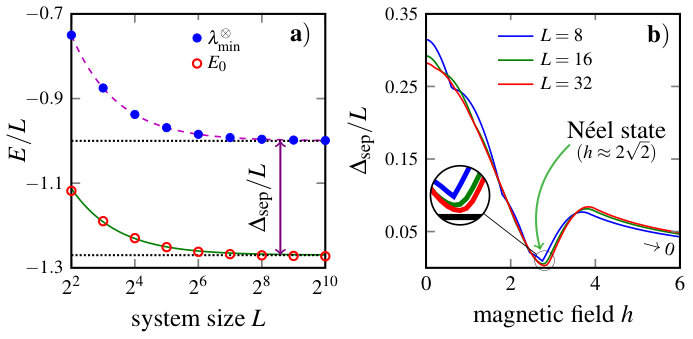 Figure 1
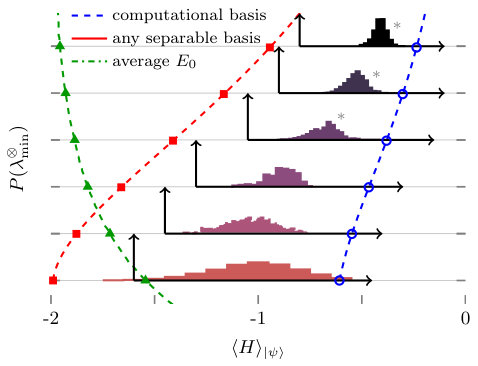 Figure 2
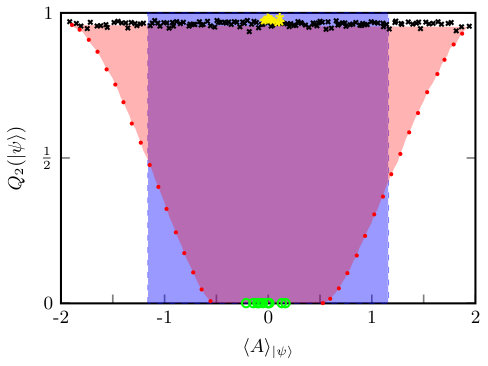 Figure 3
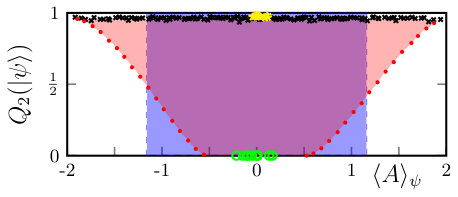 Figure 4
Peer Reviews
No public reviews on file for this paper yet. If you reviewed it on a platform where reviews are public (OpenReview, ICLR, NeurIPS, ICML), you can paste yours below so the community can read it here.
Videos
No videos yet. Explain this paper in a talk, walkthrough, or lecture? Add one.
Separability gap and large deviation entanglement criterion
Jakub Czartowski
Jagiellonian University, Marian Smoluchowski Institute of Physics, Łojasiewicza 11, 30-348 Kraków, Poland
Konrad Szymański
Jagiellonian University, Marian Smoluchowski Institute of Physics, Łojasiewicza 11, 30-348 Kraków, Poland
Bartłomiej Gardas
Jagiellonian University, Marian Smoluchowski Institute of Physics, Łojasiewicza 11, 30-348 Kraków, Poland
Institute of Physics, University of Silesia, ul. Bankowa 12, 40-007 Katowice, Poland
Yan V. Fyodorov
Department of Mathematics, King’s College London, London WC2R 2LS, UK
Karol Życzkowski
Jagiellonian University, Marian Smoluchowski Institute of Physics, Łojasiewicza 11, 30-348 Kraków, Poland
Center for Theoretical Physics, Polish Academy of Sciences, Al. Lotników 32/46, 02-668 Warszawa, Poland
Abstract
For a given Hamiltonian on a multipartite quantum system, one is interested in finding the energy of its ground state. In the separability approximation, arising as a natural consequence of measurement in a separable basis, one looks for the minimal expectation value of among all product states. For several concrete model Hamiltonians, we investigate the difference , called separability gap, which vanishes if the ground state has a product structure. In the generic case of a random Hermitian matrix of the Gaussian orthogonal ensemble, we find explicit bounds for the size of the gap which depend on the number of subsystems and hold with probability one. This implies an effective entanglement criterion applicable for any multipartite quantum system: If an expectation value of a typical observable among a given state is sufficiently distant from the average value, the state is almost surely entangled.
I Introduction.
Describing complex many-body physical systems one often postulates a suitable Hamiltonian and tries to find its ground state energy . From the mathematical perspective, one thus faces an optimization problem when searching for the minimal expectation value among all normalized pure states . That is to say, . In principle, if a hermitian Hamiltonian matrix is provided, one can diagonalize it, find its spectrum and thus easily identify the smallest eigenvalue . Nevertheless, if the system in question consists of interacting particles (e.g. spins), the dimension of the matrix grows exponentially, , rendering this simplistic approach ineffective for .
Although heuristic algorithms for large systems exist Baccari et al. (2018); Rams et al. (2018), they are most likely to fail in the high-entanglement limit Eisert et al. (2010). In such cases of practical importance one applies various methods based on quantum annealing Santoro & Tosatti (2006); Boixo et al. (2014) and can depend on an increasing number of dedicated physical annealing systems T. Lanting, at al. (2014); Aramon et al. (2018); Harris, R. at al. (2018); King, A. at al. (2018). Relying on this approach, however, one faces a variety of difficulties and challenges Gardas et al. (2018a). There is one particular drawback that is not readily evident. Namely, at the end of a quantum annealing, one measures the orientation of individual spins forming the system and obtains an approximation to the ground state energy related to a product state, , where the minimum is taken over all product states, 111Measuring a complex system in a highly entangled energy basis (which may a priori be unknown) is practically impossible.. Such separable states, admitting the simplest tensor network structure with bond dimension being one Orus (2014), are physically associated with the mean field like approximations.
Although for a system composed out of spins selecting the optimal configuration of signs out of possibilities is already a great achievement, in this way one cannot obtain any approximation for the ground state energy better than the minimal product value . The size of the separability gap , defined by the difference of both minima,
[TABLE]
depends clearly on the analyzed Hamiltonian .
The aim of the present work is to investigate to what extent this issue poses a fundamental limitation to the near-term quantum annealing technology. In particular, we identify Hamiltonians for which the separability gap (1) becomes significant. As for those Hamiltonians there exists a systematic upper bound for the precision of the separable state approximation commonly used by noisy intermediate scale device Preskill (2018), quantum annealers in particular.
Since the latter devices are far from being perfect in many aspects Gardas & Deffner (2018), the measurement process they perform has not been put under theoretical scrutiny. However, as the quantum technology improves, this problem becomes more and more relevant for practical applications Gardas et al. (2018b). In this paper, we show that for a generic Hamiltonian the separable state approximation leads to a significant and systematic error of the ground state energy. Our findings allow us to formulate the large deviation entanglement criterion based on a generic, macroscopic, observable that is applicable for any multipartite quantum system. The term “generic Hamiltonian” refers to a typical realization of a random Hermitian matrix pertaining to the Gaussian orthogonal ensemble of a fixed dimension.
We emphasize that it is the measurement process performed by current (and most likely also by near-term Ozfidan et al. (2019)) quantum annealers that serves as the main motivation behind our work. As far as we know, with these machines one can only measure individual spins in the computational basis. A primary example is the D-Wave Q machine where all spins are measured in the -basis to reconstruct the final (classical) energy. Here we simply pin point far reaching consequences of this fact, indicating the very limit for the underlying present-day technology.
II Extreme separable values and product numerical range
To tackle the aforementioned issue we begin with basic notions and definitions concerning spectrum of quantum systems. The set of possible expectation values of an operator among all normalized states, , is called numerical range Gustafson & Rao (2012). For any hermitian matrix, of order , this set forms an interval along the real axis between the extreme eigenvalues, , where the eigenvalues (possibly degenerated) are ordered, .
Assume now that (i) so that the Hilbert space has a tensor structure, , and (ii) the product states are defined. By analogy, the set of expectation values of among normalized product states, , is called product numerical range Puchała et al. (2011). By definition it is a subset of and for a Hermitian it forms an interval between extreme product values, . Product numerical range found several applications in the theory of quantum information Gawron et al. (2010). For instance, if the minimal product value of a hermitian matrix of size is non-negative, then represents an entanglement witness or a positive map useful for entanglement detection Horodecki et al. (2009).
II.1 Linear chain of interacting qubits.
The model we are going to discuss first is motivated by the idea of finding the ground state of a physical system (consisting of interaction qubits) with spin-glass quantum annealers T. Lanting, at al. (2014). After the annealing cycle has been completed, just before the final measurement, the system Hamiltonian reads Boixo et al. (2014)
[TABLE]
Here, is the -th component of the spin- operator (acting on a local Hilbert space ) associated with -th qubit. Input parameters , are defined on a graph , specified by its edges and vertices. They encode the initial problem to be solved T. Lanting, at al. (2014). Clearly, this Hamiltonian is classical in a sense that all its terms commute. Thus, the final measurement can be carried out on individual qubits, in any order, without disturbing the system Zurek (2003). After that, the ground state energy is easily reconstructed from the eigenvalues that were measured. This is of great practical importance. However, to become general purpose computing machines Preskill (2018) near-term annealers will need to include interactions between the remaining components of the spin operator, , Mizel et al. (2007).
General purpose computing machines are those that realize the gate model of quantum computation to which adiabatic quantum computing is equivalent (with possible polynomial overhead); cf. Ref. Mizel et al. (2007). Although one cannot establish this equivalence with only interactions, it is sufficient to add only or type of interactions to the annealer Hamiltonian to demonstrate universality Biamonte & Love (2008).
For the sake of argument, assume that the final measurement can be accomplished faithfully. Also, let the system be shielded from its environment for as long as it is necessary to perform computation. Even then, there exists a fundamental limitation on how much information can be extracted from the system by measuring it in the computational basis. We demonstrate this feature studying a chain of spins with a nearest neighbour coupling – the 1D Heisenberg model in the transverse magnetic field Arnesen et al. (2001),
[TABLE]
Although for a general Hamiltonian it is hardly possible to evaluate the minimal product value analytically, it is doable in the case of vanishing magnetic field, .
In order to simplify the matter we assume spherical coordinates on a Bloch sphere, rotated such that the main axis lies along the axis of the standard Cartesian coordinates. Under such assumption it can be shown that expectation value on a separable state yields
[TABLE]
thus the minimal product value reads .
A numerical simulation (cf. Fig. 1 a) shows that the separability gap plays a crucial role for any system size. For a large number of qubits the gap grows linearly with the system size, with . In the asymptotic limit, , the ground state energy of (3) was derived analytically, , for the same system with periodic boundary conditions Taylor & Müller (1985); Maciążek & Wojtkiewicz (2016). As in this limit does not depend on the boundary conditions, we arrive at the explicit result for the asymptotic separability gap,
[TABLE]
This implies a systematic error if the ground state energy is approximated by reconstructing the ground state by an optimal product state. To put it differently, in this case the true minimal energy of the system can never be reached by any annealing procedure.
The separability gap is maximal at and vanishes in the case of very strong fields, , for which the interaction part of can be neglected. Interestingly, this dependence is not monotonic, as the separability gap exhibits its minimum at . At this value of the field the gap tends to zero, since the ground state of the system becomes separable Néel product state Niederberger et al. (2010).
II.2 Toy model with interaction between all subsystems
Consider an arbitrary Hamiltonian describing a system of qudits and acting on the space of dimension . If the eigenstate corresponding to the eigenvalue is separable, the separability gap vanishes by definition. However, the reverse implication does not hold, as the gap can be arbitrary small even if two eigenstates with the smallest energies, and are strongly entangled.
To investigate this problem consider a model Hamiltonian matrix representing a two-qubit system
[TABLE]
where denotes a matrix with the vector at the antidiagonal and zero entries elsewhere. Then the Hamiltonian can be written as Taylor & Müller (1985)
[TABLE]
We shall assume that , so the ordered spectrum of reads and . In the non-degenerate case, , all the eigenvectors of are maximally entangled and they form the Bell basis Nielsen & Chuang (2010). Due to the special form of it is possible to perform optimization over product states analytically. By assuming angular parametrisation on the Bloch sphere for each qubit, we arrive at the expectation value of on a product state
[TABLE]
which is to be minimized. By setting and we arrive at the minimal value . Note that the separability gap is the largest for and it vanishes for .
Analyzing dimension of a subspace which contains at least a single separable state one can show Puchała et al. (2011) that for a hermitian matrix of order the minimal product value is not larger than the energy of the first excited state, , so in this case the separability gap is bounded, . Hence in the limit the spectrum of becomes degenerated and thus the separability gap vanishes.
Let us now generalize the above model for qubits by considering a symmetric, antidiagonal real matrix of size such that and all other entries equal to zero. This Hamiltonian captures an all-to-all type of interactions between qubits and can be written in a compact form, , where . The only non-zero eigenvalues are and thus . To calculate the minimum value over the product states we again resort to the polar coordinates on the Bloch ball and define state . Calculating the expectation value on such state yields
[TABLE]
which is easily minimized with and . The resulting minimal separable expectation value, , tends to zero as (recall that ). Similar conclusions can be drawn by analyzing a family of real symmetric and antidiagonal Hamiltonians with no more than non-zero entries,
[TABLE]
In particular, setting one obtains , thus the support of the spectrum is . On the other hand, one can show using analogous method as before that
[TABLE]
Hence, the above model extends the family of Hamiltonians for which tends to zero in the case of a large number of qubits, despite the support of being fixed.
As we will shortly see, this non–intuitive property is characteristic for generic Hamiltonians. This is an important result especially since can not be calculated analytically in general Skowronek & Życzkowski (2009) and furthermore all known numerical methods are restricted to small system sizes (cf. Appendix I).
III Generic Hamiltonians of -qubit systems
The situation in which separable states do not approximate well the ground state is in some sense generic (or typical). To substantiate this statement let us consider random hermitian matrices drawn from the Gaussian Orthogonal Ensemble (GOE) of size , which describe Hamiltonians acting on qubits. For each sample matrix we wish to determine minimal eigenvalue and estimate minimal separable expectation value . Due to the concentration of measure in the limit of a large system size these quantities become self-averaging, so that for a typical realization their values are close to the ensemble averages Livan et al. (2018).
Generically no product states are found in subspaces with dimension comparable to . In the case of qubits a subspace of dimension almost surely (a.s.) contains no product state Walgate & Scott (2008). It is therefore reasonable to expect that the range of expectation values of a GOE Hamiltonian over product states shrinks with increasing system size: product states are superpositions of almost all eigenstates of the Hamiltonian. This behavior holds true as it is a consequence of the following two results:
Proposition 1. Consider a generic Hamiltonian represented by a GOE matrix of size , with normalized as , so that the minimal energy asymptotically reads . Then the minimal value among all product states of the –partite system satisfies the following estimates with probability one (almost surely),
[TABLE]
Proposition 2.. The above estimates work also for the partition of total space into qubits. Let us assume that so that with , and any state separable with respect to partition is separable for splitting as well.
To derive the upper estimate note that the diagonal entries of correspond to expectation values among product states . For any random GOE matrix of size its diagonal, , is a sequence of numbers independently drawn from the normal distribution . Therefore, the typical minimal entry on diagonal behaves as Leadbetter et al. (2012) and leads to the right inequality in (11). The reasoning leading to the lower estimate relies partly upon the use of the so-called “replica trick” and saddle point approximation (cf. Fyodorov (2002) and Appendix II for a more detailed analysis).
Fig. 2 presents histograms of the smallest separable expectation value obtained for a sample of random Hamiltonians from the Gaussian Orthogonal Ensemble of size . Numerical data are obtained by the algorithm described in Appendix I or a standard optimization algorithm (). Results obtained confer to the bounds (11). The lower bound corresponds to a measurement of the energy in an optimized separable basis, while the upper one to a measurement carried out in the fixed separable basis.
Proposition 1 implies that for a typical random matrix acting on an –qubit system with probability one, although . This observation implies that for a large system described by a generic Hamiltonian the separability gap is constant, , so it is not possible to obtain any accurate estimation of the ground state energy, if the measurement is performed in any separable basis.
It is worth emphasizing that the above observation has key consequences for the theory of multipartite entanglement in large quantum systems: Measuring any generic observable of a composed system of total dimension in a separable state yields outcome close to the average of eigenvalues . This above statement can be connected with earlier results of Wieśniak et al. Wieśniak et al. (2005), who proposed to consider macroscopic quantities, like magnetic susceptibility, as entanglement witness. In fact our observation can be formulated in a similar spirit.
Any generic hermitian observable of order allows one to construct two dual entanglement witnesses, corresponding to both wings of the semicircular spectrum, , such that any negative expectation value, Tr, implies entanglement of the state . The actual value of the parameter, , as a function of the total system size , number of parties , mean value and the variance of , follows from the bound (11), since it implies that the matrix is positive among all states separable with respect to the partition . The above result can be reformulated into the following simple, yet a very general large deviation entanglement criterion.
Namely, if an expectation value of a typical observable of order in the state is sufficiently distant from the barycenter of the spectrum, , that is when
[TABLE]
then the state is almost surely entangled with respect to the partition into subsystems with levels each.
Hence this criterion belongs to the class of double–sided entanglement witnesses recently analyzed in Bae et al. (2018). Note that the reasoning holds in one direction only as there exist also entangled states for which the expectation value is close to the mean . However, numerical computations confirm a natural conjecture that the larger the absolute value of the deviation, , the larger average entanglement of the analyzed state (cf. numerical results presented in Fig. 3). To quantify entanglement of pure states of an -qubit system we used the family of measures introduced by Meyer and Wallach Meyer & Wallach (2002), which are based on the linear entropy of reduced states averaged over all possible reductions consisting of subsystems,
[TABLE]
where being the linear entropy of a state of dimension . This function captures the mean entanglement of -qubit subsystems with the rest of the system. Although Fig. 3 depicts data obtained for , similar results were also analyzed for other measures of entanglement, including quantities with . All these results support the statement that the deviation of the expectation value beyond the bounds (12) can be used to quantify the degree of entanglement of the analyzed state .
For comparison Fig. 3 contains also data for random separable states and generic random states, which are known to be highly entangled Życzkowski & Sommers (2001); Hayden et al. (2006). The set of separable pure states has a lower dimension and carries zero measure in the entire set of all pure states, so its projection onto an axis determined by the observable is typically much smaller than the entire range . Asymptotically, in the limit of large dimension of the Hilbert space, the ratio of the volumes of both sets tends to zero.
IV Discussion and outlook
In this work we have investigated to what extent the near-term quantum annealing technology may become fundamentally limited by its intrinsic measurement process allowing to ask only yes or no questions to individual qubits. This type of “polling” on a quantum system is probably the most natural one and definitely the easiest to realize experimentally. Unfortunately, as we have argued, it does not allow to extract all relevant information from the system in question.
In particular, we analyzed the separability gap and showed that it is non-zero for several model Hamiltonians acting on multipartite quantum systems. Moreover, we studied Hamiltonians constructed by random matrices from the Gaussian orthogonal ensemble and demonstrated that for such a generic Hamiltonian involving L qubits the minimal value of energy among all product states is significantly larger than the ground state energy . Thus making use of near-term quantum annealers, in which the final result is obtained by independent measurements of each of qubits and corresponds to a product state, can not provide a reliable approximation for the ground state energy of a typical problem. Furthermore, we formulated an entanglement criterion based on the expectation value of a generic observable among an arbitrary state of a composed quantum system and showed that provides direct information concerning the degree of entanglement of the investigated state .
Acknowledgements
It is a pleasure to thank Jacek Dziarmaga, Bálint Koczor, Tomasz Maciążek, Andy Mason, Zbigniew Puchała, Marek Rams, Ilya Spitkovsky and Jakub Zakrzewski for inspiring discussions. Financial support by Narodowe Centrum Nauki under the grant number 2015/18/A/ST2/00274 (KŻ) and 2016/20/S/ST2/00152 (BG) is gratefully acknowledged. The research at KCL was supported by EPSRC grant EP/N009436/1. This research was supported in part by PL-Grid Infrastructure.
V Appendix
V.1 Numerical technique to estimate
We briefly sketch here the approach employed in this work to calculate the separability gap for a random Hamiltonian pertaining to Gaussian Orthogonal Ensemble (GOE), in the case of a small system size (up to ). The ground state energy can be obtained easily in this case. The algorithm used for calculation of minimal separable expectation – , on the other hand, utilizes the divide and conquer strategy Knuth (1998). To begin with, let us consider a general case of minimizing expectation value of , where is a qubit state and belongs to a -dimensional space . The expectation value can be rewritten as
[TABLE]
where is a matrix of size 2. If is fixed, further optimization over is trivial: the result is minimal eigenvalue of hermitian matrix :
[TABLE]
The above expression can be written in a more succinct form. Let (with ). Then, the above expression becomes
[TABLE]
where all averages are taken over the -dimensional vector . The minimization of can be now interpreted as minimization of convex function over -dimensional convex set of simultaneous expectation values called numerical range:
[TABLE]
This problem is easily numerically solved with an arbitrary high accuracy.
Solution of the case can be leveraged to the more general , where : using the procedure described above, it is possible to determine arbitrarily close approximation of the set
[TABLE]
This (convex) set can then be used in place of in calculation of – the result is minimal energy over separable states in tripartite case. This result can be alike used further – the recursive structure provides natural extensions. Complexity of the algorithm is exponential, owing to the NP-completeness of the problem, but it is possible to determine certified lower and upper bounds of this way in deterministic time and linear space complexity.
V.2 Lower estimate in Eq. (11) of main text
In this section we provide a reasoning, which leads to the left hand side of Eq. (11) in the main text for any generic Hamiltonian of order , where denotes a high (), but otherwise arbitrary dimension of each subsystem, while stands for their number. The method used relies upon the use of the so-called “replica trick”, which is a powerful but not fully rigorous method of theoretical physics.
We wish to show that the minimal separable expectation value, , vanishes in the large system limit, . Here we analyze separability with respect to partition of the system into subsystems of size each. Due to effect of concentration of measure the above quantity is "self-averaging", which means that its distribution becomes strongly localized around the expectation value. Therefore it is sufficient to study the average value and demonstrate that
[TABLE]
where the brackets denote the ensemble average, and
[TABLE]
with Fyodorov & Le Doussal (2014). To this end, we assume a hermitian Hamiltonian drawn from GOE with scale parameter such that .
To begin with, we introduce the partition function Huang (1987)
[TABLE]
where plays a role of the inverse temperature. Here, denotes the integration measure over a single qubit space. Then, the typical separable expectation value, Eq. (B1), can be found as the zero-temperature limit of the associated free energy:
[TABLE]
To calculate the latter limit, consider the following function defined for positive integer ,
[TABLE]
which is the -th power of . Then we can formally write
[TABLE]
which is interpreted as a derivative of an analytic continuation of . This average can be further simplified using the equality which holds for any matrix
[TABLE]
with being the scaling parameter of the GOE. Here, denotes a hermitian part of a matrix . Therefore,
[TABLE]
By introduction of a collection of matrices , so that
[TABLE]
where the number does not depend on Fyodorov & Sommers (2007), the above integral can be written in a form suitable for the saddle point approximation Fyodorov (2002); Ronchetti (1997). The domain of integration over matrices goes over positive-definite matrices of size with diagonal entries fixed to be unity. Making use of this approximation one arrives at an expression,
[TABLE]
where we chose a nonstandard GOE scaling, .
In the limit of large , this integral is dominated by the maximum of the exponent argument. Furthermore, and
[TABLE]
Henceforward, we assume that , where is parametrized with a single parameter :
[TABLE]
Such an ansatz is compatible with properties of maximal at low temperature (high ).
By calculating maximum of one can easily determine that in the limit . Thus,
[TABLE]
where denotes the Hadamard (i.e. elementwise) product of matrices. Therefore the following estimate holds
[TABLE]
Finally, taking the limit in Eq. (B4) we obtain , with , where is the total system size, is the number of partitions and is their local dimension. Since we have worked with the scaling , the ensemble average, , needs to be compared to the average minimal eigenvalue, . Then we arrive at the desired expression
[TABLE]
We have assumed that such that the saddle point method can be used. Let us now consider the case of ; is kept constant and . In this limit the following holds
[TABLE]
This demonstrates that the estimate (B1) holds for , what completes the reasoning concerning Proposition 1.
Therefore, when dimension increases, the minimal separable expectation value of generic Hamiltonian of size with respect to partition approaches 0.
Let us now proceed to Proposition 2. Formally, to conduct the proof we require that . Let us now assume that the local dimension forms a power of two, , so the total dimension reads with . Any state entangled with respect to the partition of the entire system into subsystems of size is also entangled with respect to the finer partition into qubits. Therefore the estimate (B16) holds also for the physically motivated partition and implies that the ratio tends to zero in the limit .
The reference list from the paper itself. Each links out to its DOI / PubMed record.
- 1Baccari et al. (2018) Baccari, F., Gogolin, C., Wittek, P. & Acín, A. Verification of quantum optimizers. Preprint at ar Xiv:1808.01275 (2018).
- 2Rams et al. (2018) Rams, M. M., Mohseni, M. & Gardas, B. Heuristic optimization and sampling with tensor networks for quasi-2D spin glass problems. Preprint at ar Xiv:1811.06518 v 1 (2018).
- 3Eisert et al. (2010) Eisert, J., Cramer, M. & Plenio, M. B. Colloquium: Area laws for the entanglement entropy. Rev. Mod. Phys. 82 , 277 (2010) . · doi ↗
- 4Santoro & Tosatti (2006) Santoro, G. E. & Tosatti, E. Optimization using quantum mechanics: quantum annealing through adiabatic evolution. J. Phys. A: Math. Gen. 39 , R 393 (2006) .
- 5Boixo et al. (2014) Boixo, S., Rønnow, T. F., Isakov, S. V., Wang, Z., Wecker, D., Lidar, D. A., Martinis, J. M. & Troyer, M. Evidence for quantum annealing with more than one hundred qubits. Nat. Phys. 10 , 218 (2014) . · doi ↗
- 6T. Lanting, at al. (2014) T. Lanting, at al. , Entanglement in a quantum annealing processor. Phys. Rev. X 4 , 021041 (2014) . · doi ↗
- 7Aramon et al. (2018) Aramon, M., Rosenberg, G., Valiante, E., Toshiyuki Miyazawa, H. T. & Katzgraber, H. G. Physics-inspired optimization for quadratic unconstrained problems using a digital annealer. Preprint at ar Xiv:1806.08815 (2018).
- 8Harris, R. at al. (2018) Harris, R. at al., Phase transitions in a programmable quantum spin glass simulator. Science 361 , 162 (2018) . · doi ↗