Density Oscillations Induced by Individual Ultracold Two-Body Collisions
Q. Guan, V. Klinkhamer, R. Klemt, J. H. Becher, A. Bergschneider, P., M. Preiss, S. Jochim, and D. Blume

TL;DR
This paper combines experimental and theoretical approaches to observe and analyze density oscillations caused by ultracold two-body collisions, revealing insights into few-body quantum dynamics and non-thermalization.
Contribution
It presents the first combined experimental and theoretical study of density oscillations from ultracold two-body collisions with a novel setup and zero-range theory interpretation.
Findings
Observed spatial oscillations of relative density
Reproduced oscillations with zero-range theory
System does not approach thermodynamic limit
Abstract
Access to single-particle momenta provides new means of studying the dynamics of a few interacting particles. In a joint theoretical and experimental effort, we observe and analyze the effects of a finite number of ultracold two-body collisions on the relative and single-particle densities by quenching two ultracold atoms with an initial narrow wave packet into a wide trap with an inverted aspect ratio. The experimentally observed spatial oscillations of the relative density are reproduced by a parameter-free zero-range theory and interpreted in terms of cross-dimensional flux. We theoretically study the long-time dynamics and find that the system does not approach its thermodynamic limit. The setup can be viewed as an advanced particle collider that allows one to watch the collision process itself.
Click any figure to enlarge with its caption.
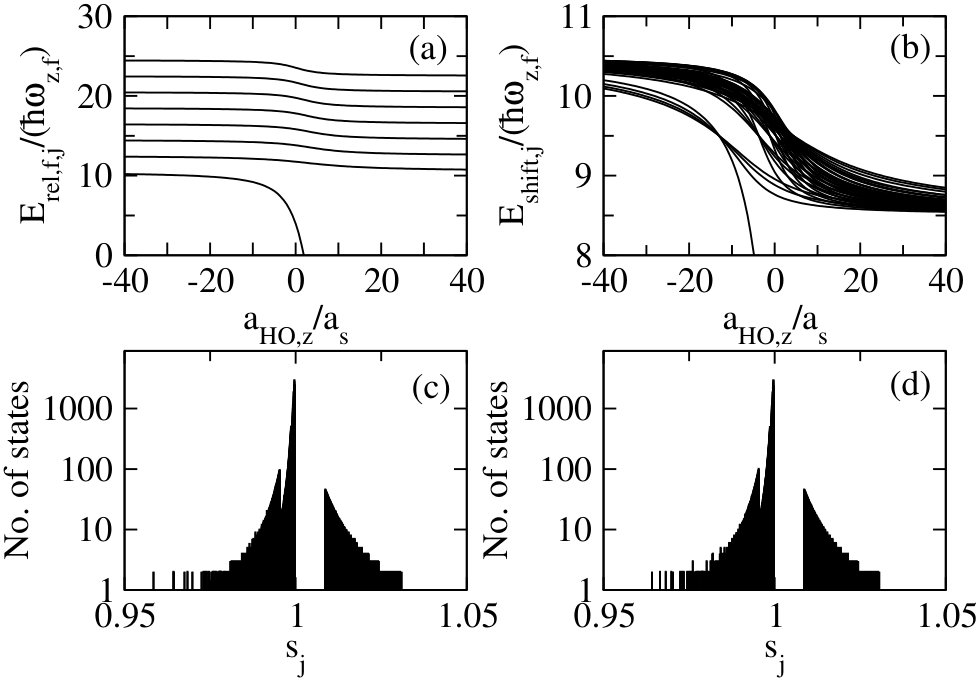 Figure 1
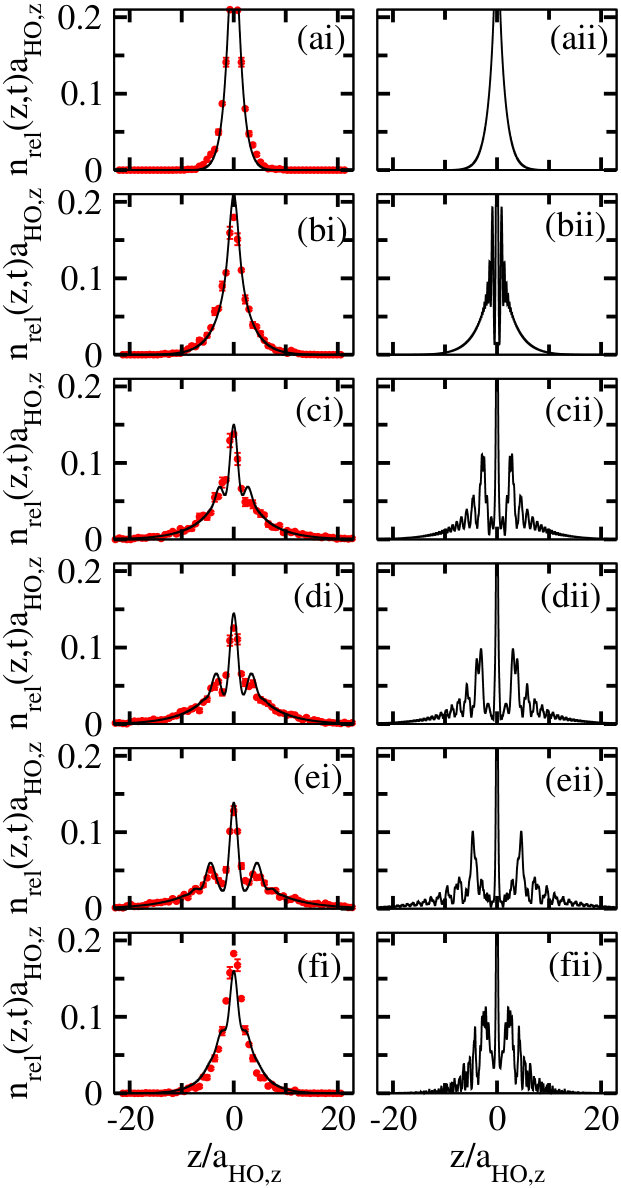 Figure 2
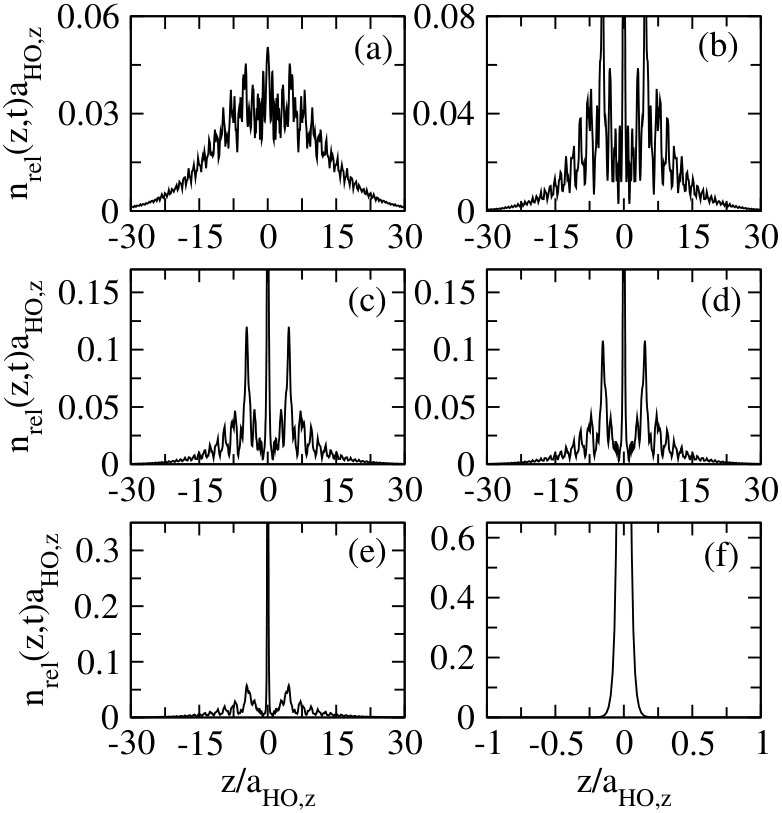 Figure 3
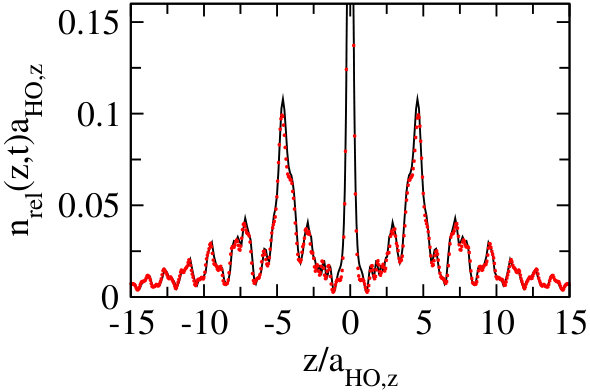 Figure 4
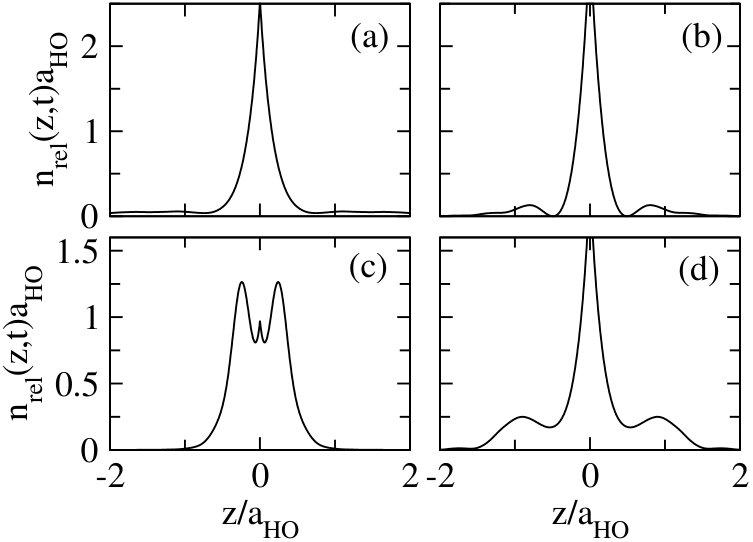 Figure 5
 Figure 1
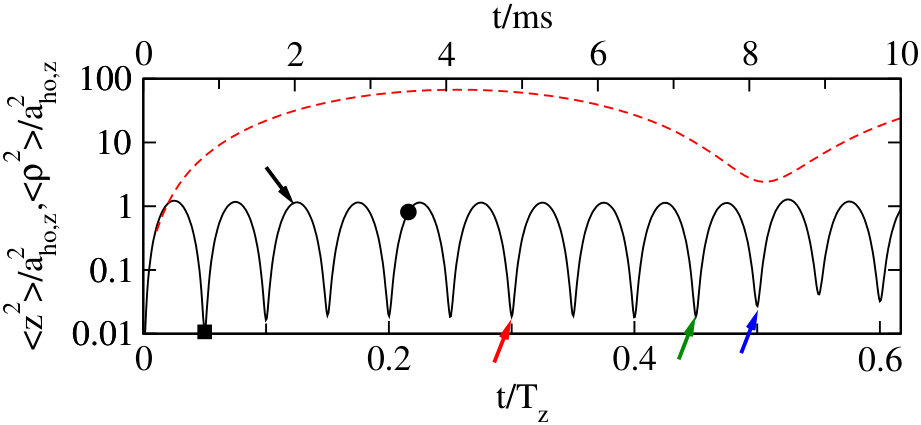 Figure 2
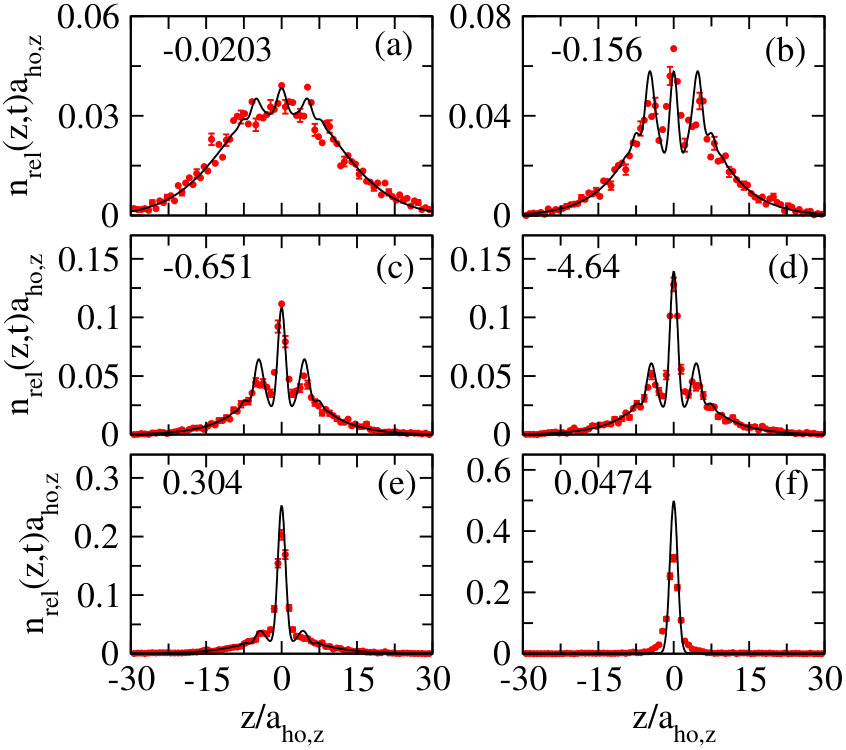 Figure 3
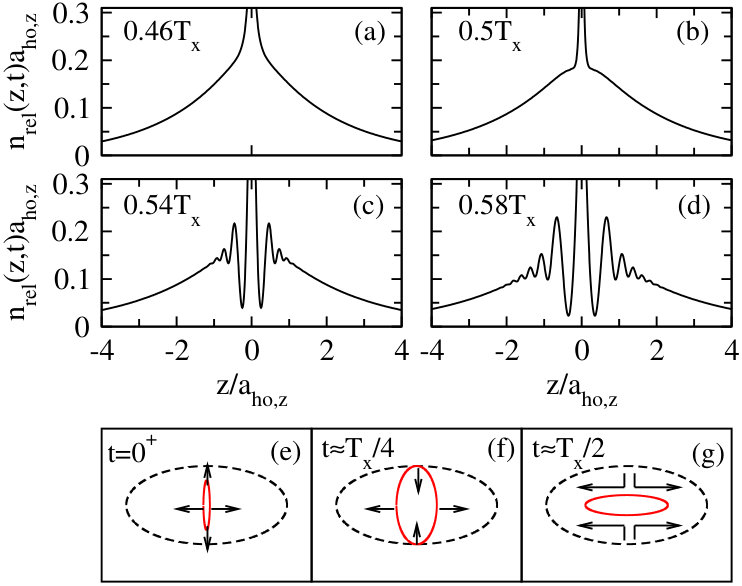 Figure 4
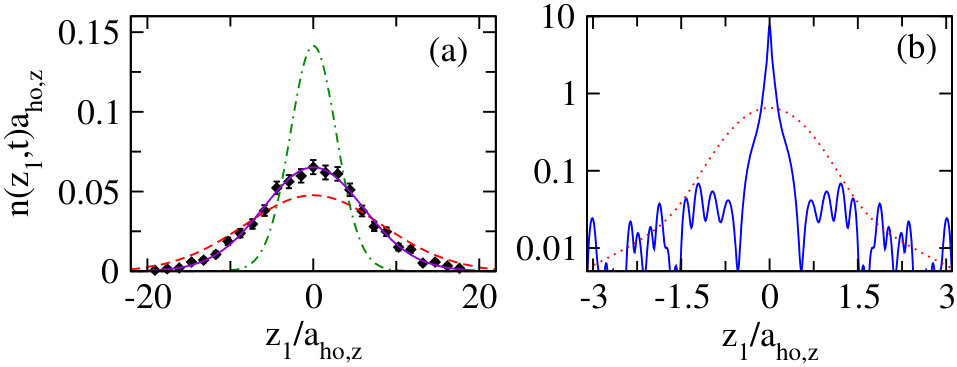 Figure 5
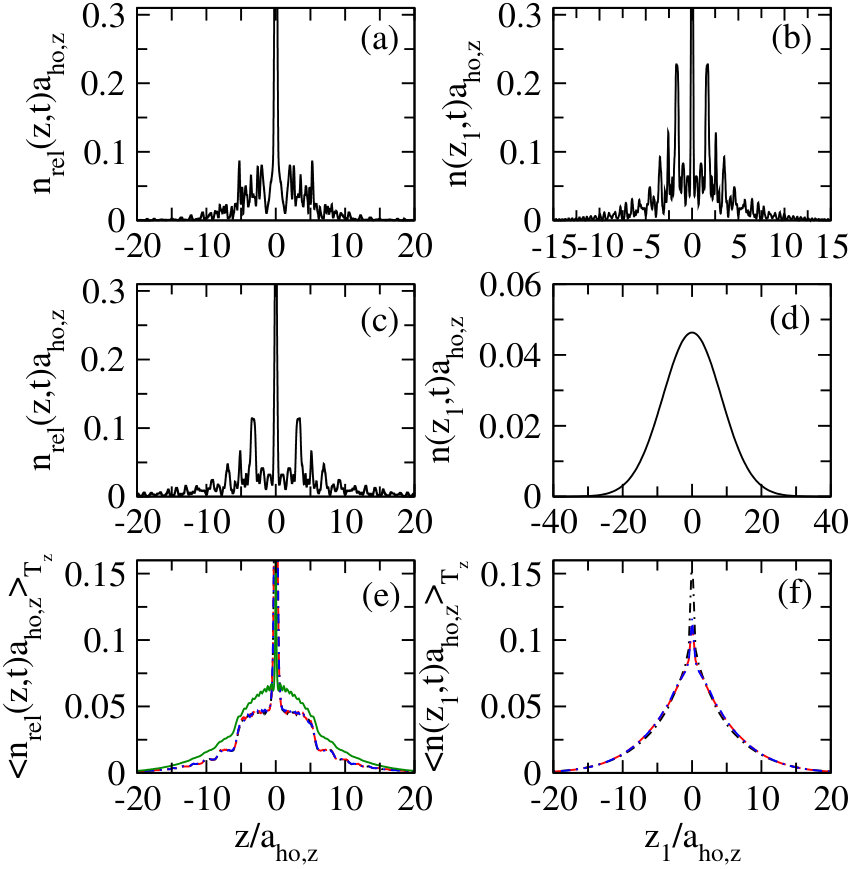 Figure 6
| 900 | |||
|---|---|---|---|
| 700 | |||
| 692 | |||
| 690 | |||
| 685 | |||
| 665 |
Peer Reviews
No public reviews on file for this paper yet. If you reviewed it on a platform where reviews are public (OpenReview, ICLR, NeurIPS, ICML), you can paste yours below so the community can read it here.
Videos
No videos yet. Explain this paper in a talk, walkthrough, or lecture? Add one.
Current address: ]Institute of Quantum Electronics, ETH Zurich, CH-8093 Zurich, Switzerland
Density Oscillations Induced by Individual Ultracold Two-Body Collisions
Q. Guan
Homer L. Dodge Department of Physics and Astronomy, The University of Oklahoma, 440 West Brooks Street, Norman, Oklahoma 73019, USA
V. Klinkhamer
R. Klemt
J. H. Becher
A. Bergschneider
[
P. M. Preiss
S. Jochim
Physics Institute, Heidelberg University, Im Neuenheimer Feld 226, 69120 Heidelberg, Germany
D. Blume
Homer L. Dodge Department of Physics and Astronomy, The University of Oklahoma, 440 West Brooks Street, Norman, Oklahoma 73019, USA
Homer L. Dodge Department of Physics and Astronomy, The University of Oklahoma, 440 West Brooks Street, Norman, Oklahoma 73019, USA
[
Physics Institute, Heidelberg University, Im Neuenheimer Feld 226, 69120 Heidelberg, Germany
Homer L. Dodge Department of Physics and Astronomy, The University of Oklahoma, 440 West Brooks Street, Norman, Oklahoma 73019, USA
Abstract
Access to single particle momenta provides new means of studying the dynamics of few interacting particles. In a joint theoretical and experimental effort, we observe and analyze the effects of a finite number of ultracold two-body collisions on the relative and single-particle densities by quenching two ultracold atoms with initial narrow wave packet into a wide trap with inverted aspect ratio. The experimentally observed spatial oscillations of the relative density are reproduced by a parameter-free zero-range theory and interpreted in terms of cross-dimensional flux. We theoretically study the long time dynamics and find that the system does not approach its thermodynamic limit. The set-up can be viewed as an advanced particle-collider that allows one to watch the collision process itself.
The one-dimensional harmonic oscillator is discussed in many text books, from introductory classical and quantum mechanics to quantum optics and field theory ho_book . The physics of the one-dimensional harmonic oscillator is simple: Its classical orbits are sinusoidal and periodic and the quantum propagator has a compact analytical expression. Moreover, the harmonic oscillator allows one to gain intuition for the dynamics of multi-dimensional systems.
This work studies, both experimentally and theoretically, the quench dynamics of an anisotropic three-dimensional harmonic oscillator in which the three degrees of freedom are coupled by a point scatterer of varying strength that is located at the origin. Since the point scatterer has a measure of zero, the classical trajectories are not influenced by the point scatterer Seba . However, the situation changes drastically when one enters the quantum regime since the point scatterer can simultaneously partially reflect and partially transmit the wave packet, or even reflect the wave packet in its entirety Seba ; Seba_2 ; Seba_3 ; Olshanii_1 ; Olshanii_2 ; Olshanii_3 ; Qu ; John_1 ; John_2 ; John_3 ; artem ; blume ; peter ; busch_dynamics .
The quench dynamics of one-dimensional quantum systems has been investigated extensively at the microscopic level 1d_exp_1 ; 1d_exp_2 ; 1d_exp_3 ; Newton_Cradle_1 ; Newton_Cradle_2 ; Newton_Cradle_3 ; Schmiedmayer_1d ; 1d_theory_1 ; 1d_theory_2 ; John_2 ; John_3 ; artem ; blume ; peter ; busch_dynamics . Examples include the realization of quantum Newton’s cradle Newton_Cradle_1 ; Newton_Cradle_2 ; Newton_Cradle_3 and the observation of quantum revivals in a system containing around atoms, addressing questions related to equilibration, thermalization, and their connections to integrability of one-dimensional systems Schmiedmayer_1d . The quench dynamics of three-dimensional systems is expected to differ from that of one-dimensional systems in important ways. This letter explores these differences by studying the quench dynamics of an anisotropic harmonic oscillator, including the weakly-attractive and repulsive regimes, where the system behavior is quite intuitive, and the strongly-interacting regime, where the -wave scattering length is the largest length scale in the problem and intuition tends to fail.
We realize the three-dimensional anisotropic harmonic oscillator with point scatterer experimentally by optically trapping two ultracold atoms [Fig. 1(a)], which interact via a short-range van der Waals potential with tunable scattering length. The dynamics are initiated by a quench of the trap geometry. The system provides a versatile platform for studying few-body dynamics in a regime where a small and predictable number of collisions occur. Since the optical trap is nearly perfectly harmonic, the center-of-mass motion, which is not affected by the interactions, decouples from the relative motion. Thus, we focus on (i) the dynamics in the relative degrees of freedom and (ii) the impact of this motion on the single-particle density. Excellent agreement with our parameter-free theory predictions is found. In the strongly-interacting regime, the resulting density profiles in the relative, low-energy -coordinate display time-dependent oscillatory or fringe pattern, which we interpret as signatures of cross-dimensional dynamics. The single-particle density profiles, in contrast, are smooth except for very short time periods during which the two particles are close to each other. This illustrates that the scattering events impact the single- and higher-order correlation functions differently. While the relative density varies appreciably with time, our calculations reveal an extremely slow approach to equilibrium, manifest in a failure to thermalize over thousands of cycles.
Experimentally, we prepare two 6Li atoms in two distinct hyperfine states denoted by and feshbach in the motional ground state of a tightly focussed optical tweezer trap elongated along the -direction [Fig. 1(ai)] exp1 . At time , the system is quenched by instantaneously changing the trap geometry and aspect ratio [Fig. 1(aii)]. We release the atoms into a much weaker dipole trap with inverted geometry, whose weakest frequency is along the -axis. Since the trap potentials are harmonic to a good approximation, the system before and after the quench is described in terms of the low-energy two-particle Hamiltonian , where denotes the geometry before () and after () the quench,
[TABLE]
and
[TABLE]
Here, and are the relative and center-of-mass position vectors, respectively, and the associated masses, and the three-dimensional -wave scattering length characterizing the interaction strength.
The experimentally measured trapping frequencies are kHz before and Hz (aspect ratio of ) after the quench. For all theoretical studies presented, to simplify the calculations, we assume that the initial and final traps are axially symmetric (but about different axis). Specifically, our calculations use , , , , and .
We record the spatial correlations along the -axis [Fig. 1(aiii)] that develop during the wave packet dynamics using a single-atom and state resolved imaging scheme exp2 . Furthermore, we control the interaction strength by adiabatically adjusting a magnetic offset field in the vicinity of a broad Feshbach resonance located at around G feshbach . This allows us to reach three distinct regimes via the quench, which are set by the role of a bound state in the system [Fig. 1(b)]: In the case of a small negative [in units of the harmonic oscillator length ], the system is in the weakly-attractive regime where the quench projects onto a large number of nearly free particle eigenstates. For , the occupation of the lowest eigenstate of immediately after the quench is about (Table S1 SupMat ). For small positive (e.g. ), in contrast, the particles are deeply bound into a single molecular state both before and after the quench. In this work, we are particularly interested in the paradigmatic “unitary” regime fermion_rmp ; bloch_rmp , where the three-dimensional scattering length is the largest length scale in the system or even diverges. In this regime (), is of order (Table S1 SupMat ).
Since the quench does not couple the relative and center-of-mass motions, the center-of-mass wave packet for simply performs breathing oscillations at the characteristic time scales . The relative motion, in contrast, is non-trivial. Since the energy of the wave packet in the relative degrees of freedom is much larger than the energy scales set by the trapping frequencies of (Table S1 SupMat ), the dynamics in the relative degrees of freedom involves many eigenstates of . To illustrate this, the circles in Fig. 1(b) schematically show the occupation probabilities , which are obtained by expanding the relative portion of the wave packet in terms of the eigenstates of Calarco ; Calarco_2 , for three different -wave scattering lengths.
Figure 2 summarizes the dynamics for by displaying and , where . Both observables oscillate smoothly with time but at different frequencies. The times marked by a circle, a square, and arrows are discussed in more detail in Figs. 3, 4, and 5, respectively.
Figure 3 shows the relative density along the -coordinate for , i.e., after four collisions (Fig. 2), for six different -wave scattering lengths. The agreement between the experimental results (circles) and the parameter-free theory results (solid lines) is, except for Fig. 3(f), very good. The theoretical results shown in Fig. 3 are convolved with a Gaussian to account for the experimental resolution of . Interestingly, the relative densities shown in Figs. 3(a)-3(e) contain oscillatory structure or fringes, which change notably with the -wave scattering length , on top of a broad background. The fringe pattern changes with time and we have found no unique way to assign - and -independent peak spacings for fixed scattering length. For the smallest positive -wave scattering length considered [Fig. 3(f)], the initial state is small compared to the harmonic oscillator lengths of the final and initial traps and the coefficient is large (Table S1 SupMat ). In this case, finite-range effects might need to be accounted for to obtain quantitative agreement between theory and experiment.
The relative densities, shown in Figs. 3(a)-3(f), reflect the evolution from a comparatively weakly-interacting regime, in which the molecular state does not play a special role (small ), to the strongly-interacting regime, where is appreciable but not dominant, to the small molecular bound-state regime, where dominates. For large negative we observe a clear fringe pattern. Since the wave packet in the relative coordinate would, in the absence of the scatterer, simply repeatedly expand and contract, the fringes have to be caused by scattering events. Figure 4 shows the theoretically determined unconvolved relative density along for during the first scattering event, i.e., for close to . At this time, is quite small but is comparatively large. This implies that the majority of the wave packet is located away from the point scatterer. The snapshots in Fig. 4 illustrate that the fringes emerge as a consequence of the scattering. A portion of the small- wave packet does not get reflected along the -direction but instead gets “redirected” to leave the small- region along the -direction [schematic in Fig. 4(g)]. One can think of the scattering event as a cross-dimensional redistribution of flux from the - to the -direction, creating a newly emitted wave packet portion along the -direction that subsequently interferes with the “background” wave packet portion. This process is repeated during subsequent scattering events (), leading to an increasingly complex fringe pattern in the relative density along (see also Fig. S3 SupMat ).
Does the single-particle density, an observable recorded frequently in cold atom experiments, develop a fringe pattern? The answer is yes but only for very short time periods over a length scale that is too small to be observed with the current experimental set-up. Figure 5(a) compares the experimental (diamonds) and convolved theoretical (solid line) single-particle densities along for and . At this time, which corresponds to two oscillations of (Fig. 2), the convolved single-particle density is smooth. It continues to be smooth for times [red dashed and green dot-dashed lines in Fig. 5(a)]. Since the size of the wave packet is much larger than the Gaussian convolution width , , the convolved and unconvolved single-particle density are indistinguishable on the scale shown in Fig. 5(a). The behavior of the single-particle density changes drastically when the wave packet is characterized by a small and a small . For , the unconvolved single-particle density [solid line in Fig. 5(b)] exhibits a fringe pattern. The fringe pattern exists only for a short time period. For (not shown), e.g., the oscillations are no longer visible. Additionally, the limited spatial resolution smoothes out the fringe pattern of the single-particle density such that it cannot be observed in the experiment [dotted line in Fig. 5(b)]. The fringe pattern in the single-particle density keeps “appearing” and “disappearing” at larger times. Figure 6(b) shows that the single-particle density displays intricate fine structure for (corresponding to ). Figure 6(d) shows that no fringe pattern exists in the single-particle density for (corresponding to ). Remarkably, the relative density along is characterized by notable fine structure for both times [Figs. 6(a) and 6(c)].
The discussion surrounding Figs. 3-6(d) illustrates that collisions impact the single-particle and relative densities differently. In particular, the relative density displays an increasingly large number of oscillations with increasing time while the single-particle density is smooth for all times, except for . Given the strong time dependence of the relative density, we ask whether the system, in the large time limit, approaches thermal equilibrium. The answer is, as is expected from Ref. Olshanii_1 , that it does not. To gain insight into the long-time dynamics, we analyze cycle-averaged observables, i.e., observables averaged over a period of length [from to ]. Lines in Figs. 6(e) and 6(f) show the unconvolved cycle-averaged relative and single-particle densities and , respectively, for and , , and . In both panels, the three curves are indistinguishable on the scale shown. Thus, despite the intricate dynamics within each cycle, the cycle-averaged observables display essentially no dynamics. The reason for this is that the normalized nearest neighbor energy spacings are rather sharply peaked around 1 (Fig. S1 SupMat ). We emphasize that this behavior is also observed for other scattering lengths. The close to frozen cycle-averaged relative density for large indicates a lack of thermalization. Indeed, the thermal relative density [green solid line in Fig. 6(e)] differs visibly from the calculated cycle-averaged relative densities.
In summary, we have presented a joint theoretical-experimental study that investigated the wave packet dynamics of two ultracold atoms following a “violent” trap quench, which leads to the occupation of many eigenstates of the post-quench Hamiltonian. Following the quench, two-body collisions, through their effect on the structural observables, were observed. The excellent agreement between the experimental and theoretical data together with the time-resolved single-atom detection with high spatial resolution makes the system a promising candidate for future dynamical studies, which are aimed at addressing questions related to thermalization, state engineering, chaos, and integrability. The set-up also promises to be a fertile playground for testing hydro-dynamical formulations hydro_1 ; hydro_2 ; hydro_3 , which can potentially be used to simulate the dynamics of few- and many-body systems. Quantitative tests of the hydrodynamics theory with ultracold atoms may yield insights into why the dynamics of quark gluon plasmas seems, somewhat surprisingly, to be governed by hydrodynamic equations gluon_1 ; gluon_2 .
I Acknowledgement
QG and DB gratefully acknowledge support by the National Science Foundation through grant number PHY-1806259. This work has partially been supported by the ERC consolidator grant 725636, the Heidelberg Center for Quantum Dynamics, and the DFG Collaborative Research Centre SFB 1225 (ISOQUANT). PMP acknowledges funding from European Union’s Horizon 2020 programme under the Marie Sklodowska-Curie grant agreement No. 706487 and the Daimler and Benz Foundation. AB acknowledges funding from the International Max-Planck Research School (IMPRS-QD). This work used the OU Supercomputing Center for Education and Research (OSCER) at the University of Oklahoma (OU).
II Experimental details
The experiments described in this paper are all performed with two 6Li atoms in two of the three lowest hyperfine states, denoted by and . The experimental procedure starts from a balanced, degenerate mixture of these two hyperfine states, which we obtain after evaporating the gas close to the Feshbach resonance at around . After evaporation we increase the magnetic field to above the Feshbach resonance to prepare a weakly-attractive Fermi gas [left side of Fig. S1(a)]. We then transfer the atoms into an optical tweezer and spill to the motional ground state exp1_S . This state is adiabatically connected to the molecular state for positive . We reach a ground state fidelity of approximately . To study the two-atom system at different interaction strengths, we adiabatically ramp the magnetic field in to values between and (see Table S1). Afterwards we slowly ramp on the weak crossed-beam optical dipole trap. As the dipole trap provides a much weaker confinement compared to the tight tweezer it does not significantly affect the initial state. At we instantaneously switch off the tweezer trap and allow the wave packet to expand in the crossed-beam dipole trap. We keep the magnetic field constant during expansion. After expansion in the weak trap we apply a free-space single-atom imaging scheme exp2_S to obtain a spin-resolved image of the two atoms after various times of flight, which is spatially resolved along the -axis, while integrating out the other two axes.
III Zero-range framework
The eigenenergies and eigenfunctions of and are obtained using the zero-range framework developed in Ref. Calarco_S . For integer aspect ratio , as considered in our calculations, the determination of the eigenenergies involves the evaluation of a finite number of hypergeometric functions. The calculations can be performed efficiently by employing an iterative scheme. As an example, Fig. S1(a) shows the resulting low-lying portion of the relative energy spectrum with as a function of for . The quantum number, which is associated with the relative orbital angular momentum operator along the -axis, is a good quantum number for the Hamiltonian . Thus, the different channels that the initial state is projected onto evolve independently. To visualize the energy level distribution of the entire spectrum, we shift the -th energy level down by . The resulting energies , , are shown in Fig. S1(b) as a function of . It can be seen that all the energies are folded into a single “energy band”. On the negative scattering length side, the energy band is split into two sub-bands that are separated by a “gap”. This indicates that the system supports two different types of excitations: excitations that lie predominantly along the -direction and excitations that lie predominantly along the -direction. For all cases considered in this work, the channel contributes more than to the total weight. The results presented account for the and finite components.
Figures S1(c)-S1(d) show the distribution of the nearest neighbor spacings , , where denotes the average of the nearest neighbor spacings, for and , respectively, for . The lowest 100,021 energy levels with are included in Figs. S1(c) and S1(d). The nearest neighbor distributions peak at and fall off rapidly for smaller and larger . Importantly, even the energy spectrum for and contains more than one distinct energy spacing despite the fact that the point scatterer does not set a length scale in this case. The reason is that the system is characterized by two length scales, namely the harmonic oscillator lengths in the axial and transverse directions. The situation here is thus different from the strictly one-dimensional system and the spherically symmetric three-dimensional system with infinite coupling constants, which are characterized by a single harmonic oscillator length and equidistant energy level spacings Busch_S . The distributions shown in Figs. S1(c)-S1(d) are notably different from a GUE (Gaussian unitary ensemble) distribution, indicating non-chaotic behavior GUE_1_S ; GUE_2_S . The GUE of random matrices has been used extensively in the literature to analyze quantum chaotic behavior. It is also worthwhile pointing out that the distributions are not Poissonian and different from those for a Seba billiard Seba_S .
To time evolve the initial state under the post-quench Hamiltonian , the relative portion of the initial state is expanded in terms of the relative eigenstates of Calarco_S . Provided the expansion coefficients are known, the time dynamics amounts to keeping track of the phase factors. Time-dependent structural observables are obtained by combining the relative and center-of-mass portions of the wave packet and integrating numerically over a subset of the spatial degrees of freedom. To obtain accurate results for small and large interparticle spacings, the relative wave packet is constructed using non-linear grids in and .
To obtain the expansion coefficients right after the quench, we numerically calculate the overlap integrals between the initial state and the -th eigenstate of . Since has the most significant overlap with at small distances, special care has to be taken to obtain an accurate representation of the at small and . As pointed out in Ref. Calarco_S , the convergence of the infinite sums in Eq. (56) of Ref. Calarco_S is quite slow for small and/or . To deal with this, we adjust the number of terms included in the expansion depending on the and values considered. Table S1 lists the occupation probabilities for the magnetic field strengths considered in this work.
IV Convolved and unconvolved distributions
As discussed in the main text, the experimental resolution when measuring the position coordinate of the -th atom along the axial direction is . The convolved theoretically determined single-particle and relative densities are based on
[TABLE]
and
[TABLE]
where the subscripts “con” and “uncon” refer to “convolved” and “unconvolved”, respectively. In the main text, the subscripts “con” and “uncon” are dropped for notational simplicity. The widths of the Gaussian in Eqs. (IV) and (IV) differ since the single-particle resolution implies a resolution of for the relative coordinate .
Figure S2 shows the unconvolved data corresponding to Fig. 3 of the main text.
V Time evolution of relative density
Figure S3 shows the relative densities for and six different times. The experimental data and convolved theoretical results are in excellent agreement (see the left column of Fig. S3). The right column of Fig. S3 shows the unconvolved theoretical results. For [Figs. S3(ai) and S3(aii)], no fringe pattern exists in either the convolved or unconvolved data because collisions have not yet happened. For [Figs. S3(bi) and S3(bii)], the system has undergone one collision. While the unconvolved data does show a fringe pattern at this time [see Fig. S3(bii)], the convolved data does not [see Fig. S3(bi)]. For [Figs. S3(ci) and S3(cii)], the system has undergone two collisions. For this time, two types of oscillations can be seen on top of each other in the unconvolved data; one has already propagated out and the other exists only at small [see Fig. S3(cii)]. After two collisions, the fringe pattern is visible in the convolved data [see Fig. S3(ci)]. For [Figs. S3(di) and S3(dii)] and [Figs. S3(ei) and S3(eii)], the system has undergone three and four collisions, respectively. For these times, the unconvolved relative densities show more and more fine structure [see Figs. S3(dii) and S3(eii)]. Correspondingly, the contrast of the fringe pattern in the convolved relative density increases and small wiggles can be seen in addition to the three main peaks (one central peak at and two side peaks at ). For [Figs. S3(fi) and S3(fii)], the system has undergone eight collisions. It can be seen that the unconvolved relative density is governed by multiple frequencies. Since the oscillations are occuring on a small length scale, the finite spatial resolution is not sufficient to resolve the fringe pattern in the convolved data, i.e., Fig. S3(fi) shows only a hint of a shoulder.
VI Finite-range interactions
To analyze the role of effective range corrections, we compare results for the zero-range potential and an attractive Gaussian potential with range , for which the depth is adjusted to dial in the desired -wave scattering length. We restrict ourselves to finite-range potentials that support zero or one free-space -wave bound state. For the Gaussian potential, the time evolution is performed by separately propagating each component of the relative portion of the wave packet. We find that the lowest few provide a good description of the initial state. Each component is, in turn, expanded in terms of the product of -dependent radial functions and spherical harmonics , where the relative orbital angular momentum quantum number runs over even values (). The resulting set of coupled radial equations is propagated in time using the techniques described in Refs. chebyshv_S . Since the dynamics leads to the occupation of many partial waves, the convergence with respect to needs to be checked carefully. The results shown in Fig. S4 include values up to 4 and values up to .
Figure S4 compares the relative density along for and . The aspect ratio is set to 10 for the zero-range interaction (black solid line) and to 10.01 for the Gaussian interaction (red circles). The agreement between the line and the symbols is excellent. This shows that the relative density along is insensitive to the short-range details of the interactions and that a small change in the aspect ratio has a negligible effect on the short-time dynamics. We expect the latter to be true quite generally. The former, in contrast, is only expected to hold if is much larger than .
VII Relative thermal density
To obtain the relative thermal density shown in Fig. 6(e) of the main text, we define an effective relative temperature through
[TABLE]
where runs over all eigenstates of and the are the Boltzmann factors,
[TABLE]
with chosen such that the normalization
[TABLE]
is fulfilled. Here, is the relative energy after the quench (see Table S1), and the Boltzmann constant. Physically, the effective temperature is defined assuming that the system in the relative degrees of freedom is described by a canonical ensemble. The relative thermal density is then given by
[TABLE]
VIII Comparison with dynamics of strictly one-dimensional system
An important question is the following: Does a strictly one-dimensional system exhibit analogous dynamics or does the three-dimensional character of our set-up play a crucial role? We find that the observed short-time dynamics depends notably on the three-dimensional character of the set-up despite the fact that the trap is highly-elongated. To arrive at this conclusion, we performed calculations for a strictly one-dimensional system Busch_S . Specifically, we consider a quench of a strictly one-dimensional two-particle system with contact interaction of strength . We prepare the system in its ground state at and consider the situation where the trap frequency is reduced by a factor of 100 at time (we have checked that a reduction of the trap frequency by a factor of 10 yields qualitatively similar results).
Figure S5 shows the unconvolved relative density for and , , , and , i.e., just before and after the system has undergone the first collision. Here, denotes the trap frequency and is the corresponding trap length scale, . is the oscillation period, . Comparison of Fig. S5 and Fig. 3 of the main text shows that fewer fringes are formed per scattering for the strictly one-dimensional case than for the three-dimensional anisotropic case considered in the main text. The fact that the build-up of “wiggles” is much slower in the one-dimensional case than in the case considered in the main text where there is a transfer of flux from the transverse to the axial degrees of freedom underscores that collisions in three spatial dimensions are much more “effective” than in one spatial dimension. This conclusion is consistent with earlier studies that worked with larger particle numbers and initial states that were closer to equilibrium Monroe ; Smith ; DeMarco ; jin ; foot . We find similar behavior for other finite . For infinitely large , “wiggles” are absent entirely. This can be attributed to the scale invariance of the one-dimensional harmonically trapped two-atom system with diverging . In contrast, “wiggles” develop for two atoms in an anisotropic trap with infinitely large due to the fact that the external confinement is characterized by two or more harmonic oscillator lengths.
References
- (1)
F. Serwane, G. Zürn, T. Lompe, T. B. Ottenstein, A. N. Wenz, S. Jochim, Deterministic Preparation of a Tunable Few-Fermion System, Science 332, 6027 (2011).
- (2)
A. Bergschneider, V. M. Klinkhamer, J. H. Becher, R. Klemt, G. Zürn, P. M. Preiss, and S. Jochim, Spin-resolved single-atom imaging of 6Li in free space, Phys. Rev. A 97, 063613 (2018).
- (3)
Z. Idziaszek and T. Calarco, Analytical solutions for the dynamics of two trapped interacting ultracold atoms, Phys. Rev. A 74, 022712 (2006).
- (4)
T. Busch, B.-G. Englert, K. Rza̧żewski, and M. Wilkens, Two Cold Atoms in a Harmonic Trap, Found. Phys. 28, 549 (1998).
- (5)
O. Bohigas, M. J. Giannoni, and C. Schmit, Characterization of Chaotic Quantum Spectra and Universality of Level Fluctuation Laws, Phys. Rev. Lett. 52, 1 (1984).
- (6)
O. Bohigas, M. J. Giannoni, and C. Schmit, Spectral properties of the Laplacian and random matrix theories, J. Physique Lett. 45, 1015 (1984).
- (7)
P. S̆eba, Wave Chaos in Singular Quantum Billiard, Phys. Rev. Lett. 64, 1855 (1990).
- (8)
T. H. Ezer and R. Kosloff, An accurate and efficient scheme for propagating the time dependent Schrödinger equation, J. Chem. Phys. 81, 3967 (1984).
- (9)
C. R. Monroe, E. A. Cornell, C. A. Sackett, C. J. Myatt, and C. E. Wieman, Measurement of Cs-Cs elastic scattering at , Phys. Rev. Lett. 70, 414 (1993).
- (10)
H. Wu and C. J. Foot, Direct simulation of evaporative cooling, J. Phys. B 29, 321 (1996).
- (11)
G. M. Kavoulakis, C. J. Pethick, and H. Smith, Relaxation Processes in Clouds of Trapped Bosons above the Bose-Einstein Condensation Temperature, Phys. Rev. Lett. 81, 4036 (1998).
- (12)
B. DeMarco, J. L. Bohn, J. P. Burke, Jr., M. Holland, and D. S. Jin, Measurement of -Wave Threshold Law Using Evaporatively Cooled Fermionic Atoms, Phys. Rev. Lett. 82, 4208 (1999).
- (13)
J. Goldwin, S. Inouye, M. L. Olsen, and D. S. Jin, Cross-dimensional relaxation in Bose-Fermi mixtures, Phys. Rev. A 71, 043408 (2005).
The reference list from the paper itself. Each links out to its DOI / PubMed record.
- 1(1) H. Kleinert, Path Integrals in Quantum Mechanics, Statistics, Polymer Physics, and Financial Markets , 5th ed, (World Scientific, 2009).
- 2(2) P. S̆eba, Wave Chaos in Singular Quantum Billiard, Phys. Rev. Lett. 64 , 1855 (1990).
- 3(3) P. S̆eba and K. Życzkowski, Wave Chaos in quantized classically nonchaotic systems, Phys. Rev. A 44 , 3457 (1991).
- 4(4) S. Albeverio and P. S̆eba, Wave Chaos in Quantum Systems with Point Interaction, J. Stat. Phys. 64 , 369 (1991).
- 5(5) V. A. Yurovsky and M. Olshanii, Restricted thermalization for two interacting atoms in a multimode harmonic waveguide, Phys. Rev. A 81 , 043641 (2010).
- 6(6) V. A. Yurovsky and M. Olshanii, Memory of the Initial Conditions in an Incompletely Chaotic Quantum System: Universal Predictions with Application to Cold Atoms, Phys. Rev. Lett. 106 , 025303 (2011).
- 7(7) V. A. Yurovsky, A. Ben-Reuven, and M. Olshanii, Dynamics of Relaxation and Fluctuations of the Equilibrium State in an Incompletely Chaotic System, J. Phys. Chem. B 115 , 5340 (2011).
- 8(8) A. G. Sykes, J. P. Corson, J. P. D’Incao, A. P. Koller, C. H. Greene, A. M. Rey, K. R. A. Hazzard, and J. L. Bohn, Quenching to unitarity: Quantum dynamics in a three-dimensional Bose gas, Phys. Rev. A 89 , 021601(R) (2014).